Blog
The HEMA Sabre: Patterns, Hilts and What to Buy

The HEMA sabre is the most fragmented family in the sport. Under one word you have British military patterns, Italian duelling sabres, Polish szabla, gymnasium sabres, hangers, and a set of training tools that includes the dussack and the spadroon depending on who you ask. Two people can both say they fence sabre and be doing almost nothing alike.
That is the first thing to understand before you buy one, because the word on its own tells you very little. The second thing is that the curve on a sabre is not there for decoration. It changes how the edge meets the target, how the blade moves through a cut, and how the hand has to be angled to keep the two lined up. Everything about sabre technique comes back to that.
If you are working out where to start in the sport generally, read what HEMA actually is and how to choose your first HEMA sword. If you already know you want a curved blade, the HEMA sabres category is where these sit.
What counts as a HEMA sabre
In practice, a single edged sword with some curve, a hilt built around protecting the hand, and a body of period technique attached to it. The hand protection is the part that separates a sabre from a messer or a plain single edged sword: sabres carry knuckle bows, stirrups, three bar guards or full baskets, because by the time these swords were in use nobody was wearing a gauntlet to fence in.
The other defining feature is that the material is recent enough to be unusually well documented. Sabre manuals from the 18th and 19th centuries were written for armies and for commercial fencing schools, which means they are systematic, printed in quantity and often illustrated properly. If you like sources that tell you exactly what to do rather than leaving you to interpret a 15th century woodcut, sabre is a comfortable place to be.
The patterns you will hear named
British military patterns
The 1796, the 1821 and the 1845 come up constantly, along with the gymnasium patterns used for training. These are the reference points for most English language sabre material, and clubs teaching British systems will usually want something in that shape.
Italian and the Radaelli school
The Italian sabre tradition, and Radaelli’s system in particular, is the ancestor of much of modern sport sabre. The blades tend to be lighter and straighter than the military patterns and the fencing is closer to what a sport fencer would recognise.
Polish szabla
A distinct tradition with its own curve, its own hilt conventions and its own body of technique. If your club teaches szabla they will tell you exactly what they want, and it will not be a British pattern with a different label on it.
Duelling sabre and gymnasium sabre
Lighter blades made for salle fencing rather than campaign use. This is where sabre starts turning into a sport rather than a military skill, and the handling reflects it.
The hanger
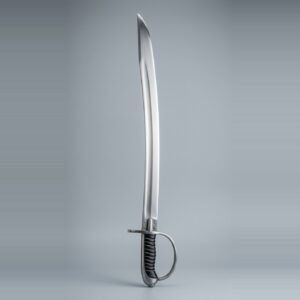
The short, broad, single edged sword carried by sailors, infantry and anyone else who needed a blade that worked in a confined space. Usually a simple D shaped knuckle bow and not much else. It is the least fashionable member of the family and one of the most practical.
Hilt types, and what each one is buying you
Stirrup hilt
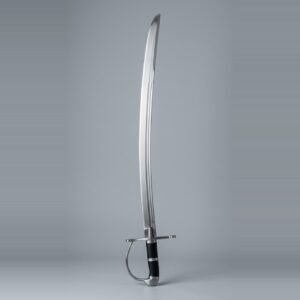
One quillon and a single D shaped bow, sometimes with a riveted plate at the blade. Light, simple and quick in the hand, with the least material sitting between you and the other fencer’s point. The trade is that it covers less than the alternatives.
Three bar guard
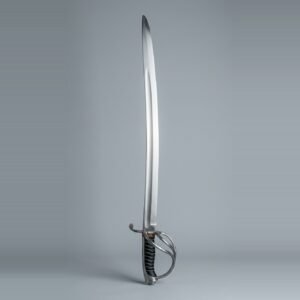
Three bars sweeping from the knuckle bow around the hand. This is the standard military compromise and it is a good one: substantially more cover than a stirrup, much lighter than a full basket, and it does not change the balance as dramatically.
Basket and full bar
Maximum hand protection, maximum weight at the hilt. A full bar basket shifts the balance back toward the hand, which makes the point feel faster and the cut feel less authoritative. Some people love that and some people find it makes the sword feel hollow.
One practical note that applies across all of them: check the fit with the gloves you actually train in. A guard sized for a bare hand and a guard sized for a padded sabre glove are different objects, and finding out after delivery is annoying.
The blade, and what the curve is doing
A curved blade presents the edge to the target at an angle as it passes, which means the cut slices along its length rather than landing flat. That is why sabres cut the way they do and why edge alignment on a sabre is both more forgiving in some directions and completely unforgiving in others.
Fullers on sabre blades usually run from the base and stop short of the point, which stiffens the last section where the cut lands while keeping weight down along the rest. A blade with a fuller that stops short is not cheaply made, it is doing exactly what it should.
Curve varies enormously across the family, from nearly straight blades on some gymnasium and duelling patterns to pronounced curves on cavalry types. There is no single correct amount and your club’s material decides it. If you want the straight single edged relatives instead, the messer guide covers the German side and the smallsword and spadroon guide covers the later light swords.
What sabre fencing is like
Quick, and heavily weighted toward the cut. The tempo sits between longsword and smallsword: faster than the two handed material, more committed than the pure thrusting swords. Distance changes constantly because the cut needs less precision than a thrust, so people close and open far more freely than a rapier fencer would consider sensible.
Hand protection matters more in sabre than almost anywhere else, because the hand is closest and the cut is the main tool. Expect your club to be firm about gloves, and expect the hilt of the sword itself to be part of that conversation rather than an afterthought.
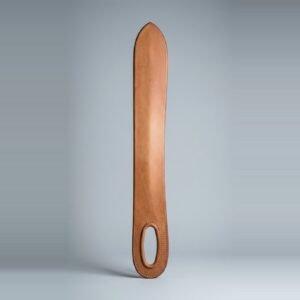
The dussack guide is worth reading alongside this one, because the dussack is the training relative that teaches a lot of the same movement at a fraction of the cost and with far less to go wrong.
Tips and the rules
This is the part people skip and then regret at registration. The Berlin HEMA Cup gear requirements state plainly that rounded tips are not allowed on rapier and sabre. The permitted shapes are spatulated or rolled, at a minimum diameter of 1.5 cm. A ball on the end of the blade is not a rolled tip and will not pass.
Different events run different rules, so check the ruleset of the event you are entering rather than assuming. We do not describe any piece as tournament legal without naming the ruleset it is legal under, and you should treat anyone who does as guessing. HEMA tournament gear rules goes through what is generally asked for.
Steel and flex
These trainers are 51CrV4 spring steel hardened to 49 to 52 HRC. Spring steel is the choice because it bends and returns instead of taking a set or snapping under a hard bind, which matters on a curved single edged blade taking repeated cuts onto another blade.
Stainless is the warning sign. It is on decorative swords because it needs no oiling, and it is too hard and brittle for anything that gets hit. Sabres get sold as wall pieces more than almost any other type, so the stainless test is especially useful here.
Flex matters less on a cutting sword than on a thrusting one, but it still matters and your club may have a view. HEMA sword flex explained covers the tiers. If you want something that will actually cut tatami rather than a trainer, read blunt versus sharp training swords first, because they are not interchangeable and a sharp is not a sparring tool.
What to check before you buy
Ask your club first. Sabre is the family where club requirements vary most, and a sword bought for the wrong tradition is harder to repurpose than in any other part of the sport.
Then check three things on the piece itself. The guard has to fit your gloved hand. The tip has to meet whatever standard you will be fencing under. And the hilt has to be handed correctly, which sounds obvious until you learn that left handed stock is systematically thin across sabres and messers everywhere in this market. If you are left handed, ask before ordering rather than after.
Nothing in this range ships with a scabbard, so do not plan storage around one. If you want to compare against the straight thrusting end of the catalogue before committing, rapier versus sidesword is the guide for that.
Where to see these
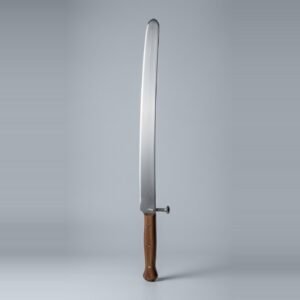
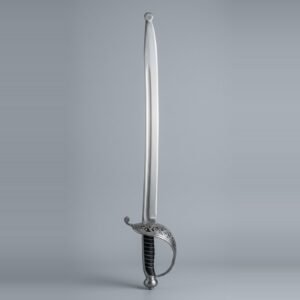
Several to compare. The Sturvang three bar sabre is the standard military arrangement: a curved single edged blade with a fuller that stops short of the point, a backstrap cap and a wire over leather grip. The Kaldrast hanger sabre is the short broad form with a simple D shaped knuckle bow and a black leather grip, which is the practical end of the family rather than the fashionable one. For drilling the same movement without the steel, the Reifholm leather dussack is the club standard. And if you want to see where the straight single edged side of the period went, the Orlunde spadroon has a pierced openwork shell and a ray skin and wire grip. The Kjeldhar stirrup hilt sabre is the light cavalry arrangement, one quillon and a D shaped bow over a riveted blade plate, and the Ostrevak steel dussack is the steel version of the drilling tool the leather one stands in for.
All of them are made by hand in the Czech Republic, inspected at our North Babylon, New York warehouse and shipped from there. Engraving is done in the United States after arrival, and the rune and custom design options are on the engraving page.
Questions people ask
What is a HEMA sabre?
A single edged sword with some degree of curve and a hilt built to protect the hand, used with one of the documented historical systems rather than modern sport rules. The family covers British military patterns, Italian duelling sabres, Polish szabla, gymnasium sabres and hangers, so the word alone does not narrow it down much.
Is a HEMA sabre the same as an Olympic sabre?
No. Sport sabre uses a very light blade, electric scoring and a rule set built for competition speed, and it descends from the Italian salle tradition rather than trying to reproduce it. A HEMA sabre is heavier, has real hand protection and is used with the period technique the manuals describe.
Which sabre pattern should I buy?
Whichever one your club teaches, and ask before ordering. This is the family where the answer varies most between clubs, and a sword bought for a British system is an awkward fit in a szabla class.
Why are rounded tips banned on sabre?
Because a rounded tip concentrates force in a small area on a thrust. The Berlin HEMA Cup requirements specify spatulated or rolled tips at a minimum of 1.5 cm in diameter instead, and they say explicitly that rounded tips are not permitted on rapier and sabre.
Does the amount of curve matter?
Yes, and it varies widely across the family. A pronounced curve favours the draw cut and changes how the hand has to be angled, while a nearly straight blade behaves more like a spadroon. The material you fence decides which one is correct, so let the system choose rather than the photograph.
Is a sabre a good first HEMA sword?
It is a reasonable one. It is single handed, the sources are clear and well organised, and the technique is quick to get moving with. The catch is the variety: you need a straight answer from your club about which pattern before you spend anything.
What about left handed sabres?
Ask first. Hilts with asymmetric hand protection are almost always built for the right hand, and left handed stock is thin across this part of the market everywhere, not just here. It is worth a message before you order rather than a return afterwards.
Do these come with a scabbard?
Not in this range. Store the blade lightly oiled and horizontal rather than sealed in a sheath, where trapped damp sits against the steel and does exactly what you would expect.
Keep reading
The rest of the HEMA writing is in the guides section, and the full line sits under HEMA swords.