Blog
HEMA Tournament Gear Rules

Tournament gear rules are the reason people turn up at an event with a sword they have trained with for two years and are told they cannot use it. It happens at every competition, usually to somebody who bought on the strength of a product description that used the phrase tournament legal without naming a single ruleset.
There is no international HEMA governing body. Every event writes its own gear document, and while they broadly agree, the details differ enough to matter. The Berlin HEMA Cup requirements are not the London HEMA Open requirements, and neither of them is your club’s requirements.
So this guide does two things. It sets out the rules that recur across events, using specific published examples rather than vague summaries, and it explains how to read a gear document before you buy rather than after. If you are newer than that, start with what HEMA is or the first sword guide. The range being discussed sits under HEMA swords.
The one rule that governs all the others
Never buy on a claim of tournament legality that does not name the event. A seller who writes tournament legal and stops there has told you nothing, because there is no single standard to be legal against. A seller who writes accepted under the Berlin HEMA Cup 2026 gear requirements has made a checkable statement, which is a different thing entirely.
Gear documents are published. They are usually a page or two. Reading one before ordering takes less time than arguing with a gear marshal at eight in the morning.
Tip rules, which fail more swords than anything else
The tip is where most refusals happen, and it is the easiest thing to check before you buy.
The Berlin HEMA Cup gear requirements permit spatulated or rolled tips with a minimum diameter of 1.5 cm, and that applies across all four tournament categories. Rounded tips are explicitly not allowed on rapier and sabre. The event supplies its own tip caps and does not accept personal ones.
What those words mean
A spatulated tip is flattened and widened into a paddle shape. A rolled or back folded tip is the last section of the blade curled over on itself to make a blunt loop. Both spread the force of a thrust across a wider area. A rounded tip, meaning the blade simply tapering to a domed end, is narrower and concentrates more force into one spot, which is why it is refused on the thrust heavy disciplines.
The tip cap rule catches people out for a different reason. If the event supplies caps, your sword has to accept the cap the event supplies, which means an unusual tip shape can fail even when it is technically compliant. Check the dimension, not just the description.
Blade rules for longsword
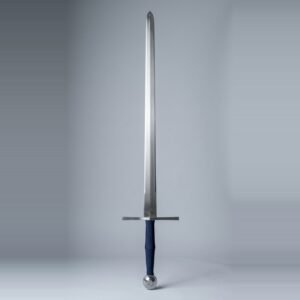
Berlin also requires that longsword blades have a clearly distinguishable edge, back and flats. That sounds like an odd thing to legislate until you have seen the alternative, which is a blade that is essentially a rectangular bar with a schilt welded on. A blade with real edge geometry behaves predictably in the bind and reads correctly to a judge watching from six feet away.
The rule that surprises newcomers most is this: many longsword tournaments will not accept a blunt longsword at all, and allow only purpose built feders or sword shaped feders. A blunt longsword remains an excellent piece for drilling, pair work, reenactment and cutting preparation. It simply is not what most longsword events want in the ring. If competing matters to you, that decides the purchase, and the difference between the two is explained in what a feder is and again in blunt against sharp training swords.
Flex rules
Most events set a flex expectation rather than an exact figure, and the market talks in tiers. Light sits around 15 to 21 lb, medium around 25 to 29 lb, strong or tournament runs 30 to 43 lb and upward, and stiff or minimal flex is reserved for harnischfechten and buhurt.
Competitions generally want the strong or tournament tier, because a blade that whips under load produces exchanges nobody can judge cleanly. Some events set a minimum stiffness for exactly that reason and some set a maximum for safety. Both exist, which is why the tier on the box is not an answer on its own.
The counterintuitive part, worth repeating because it catches everybody once: a higher flex number means a stiffer blade, not a bendier one. The number is the force needed to deflect the blade. Full explanation in the flex guide.
Rapier is measured differently again. Castille Armory grades rapier blades as F2, F3 and F4, measured as deflection under a 6 oz weight drop, which is a published repeatable test rather than a marketing adjective.
Discipline specific rules worth knowing
Dagger
Rondel daggers are banned in the dagger event at the London HEMA Open. This is the classic example of a piece that is entirely legitimate as a training tool and simply not permitted in one specific competition. A rondel trainer with a riveted blunting plate over the point is a fine thing to own and drill with. Marketing it as tournament legal without that caveat is the kind of claim this community notices immediately.
Rapier and sabre
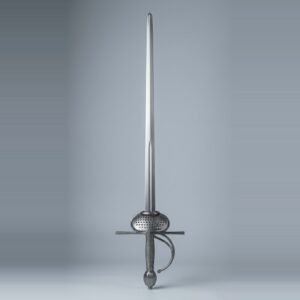
These are the two disciplines where rounded tips are refused at Berlin, so tip shape matters more here than anywhere. Both are also thrust heavy, which puts more of the safety load onto blade flex and tip geometry rather than onto edge treatment.
Harnischfechten and buhurt
Different rules entirely, because the target is armoured. Stiff or minimal flex blades are correct here and completely wrong for unarmoured fencing. Do not read across from one to the other.
The protective kit, in the order events check it
The sword is only part of the gear check, and it is rarely the part that stops somebody entering. Events specify the mask and its back of head protection, gorget, jacket to a rated standard, forearm and elbow protection, gloves, groin protection and chest protection where required. Some specify a rating standard for the jacket and the mask and will refuse anything below it.
Read the whole document, not just the blade section. A compliant sword and a mask without back of head protection still means you are watching from the balcony.
Why the kit list keeps growing
Every item on a modern gear list exists because somebody got hurt without it. Back of head protection became standard after enough people took a hard cut behind the mask. Rated jackets became standard after enough thrusts went through unrated ones. Forearm and elbow protection became standard because those are the parts a fencer leads with and the parts a blade finds first. None of it was invented by a committee that enjoys paperwork.
The practical consequence is that gear lists get stricter rather than looser, and a jacket that passed three years ago may not pass now. Check the current document for the current year, not the one you read when you first started competing.
How to read a gear document before you buy
Find the event page and locate the gear requirements. Note the tip shape and the minimum diameter. Note whether blunts are accepted in the longsword category or only feders. Note the flex expectation. Note whether tip caps are supplied or personal. Then compare each of those against the product listing, and where the listing does not say, ask the seller before ordering rather than after.
If a listing cannot answer those four questions, that is the answer. A HEMA seller who does not publish tip shape, tip diameter, flex tier and steel spec is not selling to informed buyers, which tells you what kind of product it is.
The lead time problem
One practical note that has nothing to do with rules and everything to do with competing. Several of the best known makers quote three to five months, some longer, and at least one well regarded workshop has stopped producing. If your event is in April and your sword is on a six month list, the ruleset is not your problem. Stock is.
Marking your gear
Events run gear check tables covered in near identical blades, and so do club racks. A short engraved line on the ricasso, a name, a date or Elder Futhark, makes yours findable in ten seconds instead of two minutes of squinting. It is cut in the United States after the piece arrives and explained on the engraving page.
Where to see these
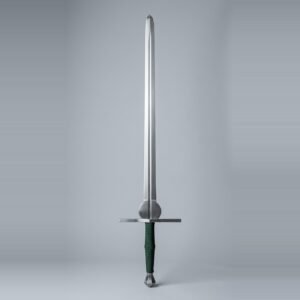
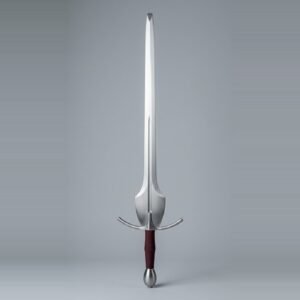
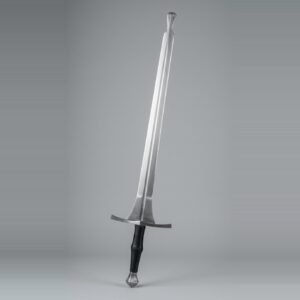
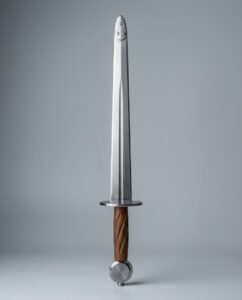
The Vindlaur feder is the plain standard longsword trainer with a rounded schilt, which is the form most longsword events are written around. The Brimhalt feder carries a shield shaped schilt for more coverage over the hand. The Norvakt rondel dagger trainer is the piece the London HEMA Open dagger rule applies to, and the Corvalde rapier sits in the discipline where tip shape rules bite hardest. Ranges under feders, HEMA rapiers and dagger knives.
Tournament gear questions
Is there one set of HEMA tournament rules?
No. There is no international governing body and every event publishes its own gear requirements. They broadly agree on tips, flex and protective standards, and they differ enough in the detail that you have to read the one for your event.
What tip shape do tournaments require?
Commonly spatulated or rolled with a minimum diameter around 1.5 cm. The Berlin HEMA Cup sets exactly that across all four categories and refuses rounded tips on rapier and sabre.
Can I compete with a blunt longsword?
Often not. Many longsword events accept only purpose built feders or sword shaped feders and exclude blunts entirely. Check the gear document for your event before buying, because this one rule decides the whole purchase.
What flex do tournaments want?
Usually the strong or tournament tier, roughly 30 to 43 lb and upward, because a stiffer blade produces exchanges that can be judged cleanly. Some events set a maximum as well as a minimum, so read the document rather than assuming stiffer is always better.
Are rondel daggers allowed in competition?
Not in the dagger event at the London HEMA Open, where they are banned outright. Other events differ. A rondel trainer is a perfectly good drilling piece and should never be sold as tournament legal without naming the event.
Can I bring my own tip cap?
Not at events that supply their own, and Berlin is one of them. Personal caps are refused there. Check whether your event supplies caps and whether your tip will accept the one they hand you.
Does the protective kit get checked as strictly as the sword?
More strictly, usually. Mask rating, back of head protection, gorget, jacket standard, gloves, forearm and elbow protection and groin protection are all specified, and a compliant sword with a noncompliant jacket still means no fencing.
What should I ask a seller before buying for competition?
Tip shape and tip diameter, flex tier, steel and hardness, and whether the piece is a feder, a sword shaped feder or a blunt. If they cannot answer all four, buy elsewhere.
The two companion reads are the feder guide and the flex guide, and everything else this shop has written is indexed in guides.