Blog
HEMA Sword Flex Explained

Flex is the property that decides whether a thrust bends a blade harmlessly or puts somebody in hospital. It is also the property most sellers describe with a single adjective and no number, which is why so many people buy the wrong one.
A HEMA training blade is built to bend. That is not a flaw in the steel and it is not the blade being cheap. It is the safety mechanism. When the point lands and the fencer keeps moving forward, the energy has to go somewhere, and a blade that flexes turns most of it into a bow instead of into a rib.
This guide explains how flex is measured, what the tiers mean, why stiffer is not better, and how to pick the right one without buying three. If you are earlier in the process, read what a feder is first, and if you are still choosing a type at all, the first sword guide comes before this one. The range is under feders.
What flex actually measures
Flex is a stiffness rating, not a bendiness rating, and that inversion catches out nearly everybody. The number describes the force required to deflect the blade a set distance. A higher number means a stiffer blade that resists bending. A lower number means a softer blade that bows more easily.
So when a listing says 18 lb light flex and 38 lb tournament flex, the 38 lb blade is the stiff one. People read the higher number as more flex because more usually means more. It does not here.
How it is tested
The common method is to fix the blade, load the point with a known weight or press until a set deflection is reached, and record the force. Different makers test at different deflections and different fixture points, which is exactly why one maker’s medium is another maker’s light. Compare within a brand, not across brands, unless both publish their method.
Castille Armory takes a different approach for rapier and grades blades as F2, F3 and F4, measured as deflection under a 6 oz weight drop. That is a published, repeatable test, and publishing the method is the thing that separates a serious HEMA seller from a costume shop. Most sellers do not bother.
The four tiers, as the market actually sells them
Purpleheart Armoury publishes the clearest version of the tiers and the rest of the market broadly follows it. These are the numbers to hold in your head.
Light or flexible: about 15 to 21 lb
The softest normal option. Built for controlled sparring, coaching drills and working with beginners. It bends early and dramatically, which is forgiving when somebody misjudges distance. It is generally not accepted for full contact tournament use, and in a hard bind it can feel vague because the blade is moving when you want it still.
Medium: about 25 to 29 lb
The default for daily training and moderate sparring, and the tier most club fencers should buy first. It behaves predictably in the bind, still bows properly on a thrust and does not punish a partner for a slightly late parry. If you have no strong reason to choose otherwise, choose this.
Strong or tournament: about 30 to 43 lb and upward
Built for full speed and full force competition. The blade stays where you put it, which is what a tournament fencer wants, because a blade that whips around under load makes an exchange impossible to read for both the fencers and the judges. The cost is that it transmits more into your training partner, which is why many clubs restrict these blades to people who have earned the control to use them.
Stiff or no flex
Minimal deflection, made for harnischfechten and buhurt where the target is armoured and the thrust is not going into an unarmoured body. This is a specialised tool. It is not a general purpose upgrade and it should never be used for unarmoured sparring.
Why stiffer is not better
There is a persistent instinct that a stiffer blade is a higher quality blade, presumably inherited from knives, where rigidity is a virtue. In HEMA it is a trade off with a real cost on the other side.
A stiff blade gives you better feedback in the bind, better point control and a fight that reads clearly. It also hits harder, hurts more, breaks fingers more often and puts more load into your partner’s mask on every thrust. A soft blade is kinder to everybody and mushier to fence with. Neither end of the scale is correct. The right answer is the one that matches what you actually do on a Tuesday night.
There is also a durability argument that runs the opposite way to intuition. A stiffer blade absorbs less of the impact by bending, so more of it goes into the edges and the shoulders of the schilt. Stiff blades chip and crack at least as readily as soft ones, and they take their training partners with them.
What changes the flex besides the rating
Blade length
A longer blade of identical section is more flexible at the point simply because the lever is longer. This is why a shorty feder at the same nominal tier feels stiffer than a full length one, and why comparing flex numbers between different blade lengths is close to meaningless.
Distal taper
How the thickness reduces from the base toward the point. Two blades with the same width profile and the same steel can behave completely differently depending on where the thickness goes. A blade with an aggressive distal taper bends mostly in the last third, which is where you want it to bend.
Heat treat
HEMA blades are spring steel, typically 51CrV4, 6150, 9260 or 1095, hardened to roughly 49 to 52 HRC. That band is deliberately softer than a cutting blade, which runs 54 to 58 HRC. Softer here means the blade returns to straight after bending instead of taking a permanent set or snapping. A blade hardened like a cutting sword and then asked to flex is a blade that breaks, usually at the worst moment. More on this in the steel glossary.
Age and abuse
Flex is not fixed for life. A blade that has taken hundreds of hard binds develops small set bends, work hardening and edge damage. If your sword no longer springs straight, it has changed tier without telling you and it needs inspecting rather than ignoring.
Flex and the tip, which are not the same thing
People conflate these constantly. Flex is about the blade. The tip is a separate safety system and the rules treat it separately.
The Berlin HEMA Cup gear requirements permit spatulated or rolled tips with a minimum diameter of 1.5 cm across all four tournament categories. Rounded tips are explicitly not allowed on rapier and sabre. Longsword blades must have a clearly distinguishable edge, back and flats. Tip caps are supplied by the tournament and personal caps are not accepted.
A perfectly flexible blade with a narrow tip is still dangerous, because the flex only starts absorbing energy once the point has already loaded. A wide tip spreads the force across the mask or jacket in the first instant. You want both, and buying one because you have the other is how people get hurt. The full rules picture is in HEMA tournament gear rules.
Picking a tier without buying three swords
Ask your club first, because many have a policy and several will refuse a blade above a set tier for general sparring. After that, the honest shortcut is this. If you mostly drill and spar at controlled speed, buy medium. If you compete at full contact and your club is happy with it, buy strong or tournament. If you coach beginners or you are one, light has a real place. If you fence in harness, you already knew you needed stiff and you did not read this far.
One more practical note. Clubs run racks of identical blades and the tier is invisible once the sword is out of the box. Marking your own with a short engraved line on the ricasso, a name or a date or a line of Elder Futhark, ends that problem permanently. It is cut in the United States after arrival and explained on the engraving page.
Where to see these
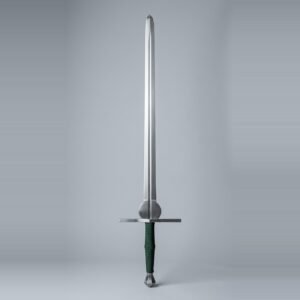
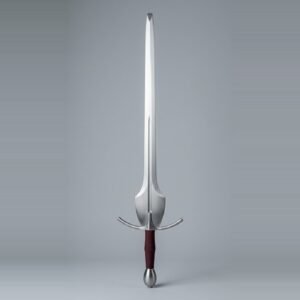
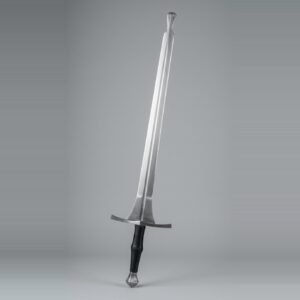
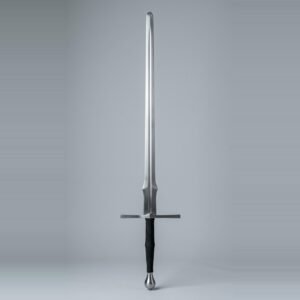
The Vindlaur feder is the plain standard longsword trainer and the natural starting point for anybody buying a first flexible blade. The Brimhalt feder carries a shield shaped schilt and a narrow low fuller for more coverage over the hand. For the other end of the scale, the Draugmoor blunt longsword and the Vardholt blunt longsword show what a sword shaped blunt profile does to the way a blade bends. Wider ranges under HEMA longswords and HEMA swords.
Flex questions
Does a higher flex number mean a bendier blade?
No, the opposite. The number is the force needed to deflect the blade, so a higher number means a stiffer blade. A 40 lb blade is much stiffer than a 20 lb one.
What flex should a beginner buy?
Medium, roughly 25 to 29 lb, unless the club says otherwise. It is predictable in the bind, safe on the thrust and forgiving of partners who are still learning distance.
Can I compare flex numbers between two different makers?
Only loosely. Makers test at different deflections and fixture points, so one workshop’s medium can sit near another’s light. Compare within a brand, and treat published test methods as a sign of a serious seller.
Does a flexible blade mean a weak blade?
No. Flex comes from geometry and heat treat, not from poor steel. A properly made spring steel blade at 49 to 52 HRC bends and returns to straight thousands of times, which is exactly what it was built to do.
Why do tournaments want stiffer blades?
Because a whippy blade makes an exchange hard to read for the fencers and impossible to judge cleanly from outside. Tournament flex keeps the point where the fencer put it. That is also why tournaments pair it with strict tip and protective gear rules.
My blade has a permanent bend, can I fix it?
A small set can sometimes be corrected, but a blade that has taken a set has been loaded past where it should have gone and needs inspecting for cracks, especially at the schilt shoulder and the ricasso. Retire anything with a visible crack rather than straightening it and hoping.
Is rapier flex measured the same way as longsword flex?
Not always. Castille Armory, for example, grades rapier blades as F2, F3 and F4, measured as deflection under a 6 oz weight drop, which is a different test from the pound rating used on longsword blades.
Does flex change how a sword feels to hold?
Standing still, barely at all. In the bind, completely. A softer blade wanders under pressure while a stiffer one transmits the other fencer’s intention straight into your hands, which is the real reason experienced fencers become fussy about it.
If this has left you wanting the basics rather than the detail, what HEMA is covers the ground, and everything else is indexed in guides.