
A drinking horn is a cow horn with the soft inner core taken out, the walls sanded back, and the inside sealed so it can hold liquid. The shape is not a design decision. It is whatever the animal grew, which is why every horn tapers, curves and holds a slightly different amount, and why none of them will stand up on a table. Which is the whole reason a horn arrives with a stand or a belt hanger. A full one has nowhere to go but your hand, which is what the tankards fixed.
The horns here run roughly 14 to 16 inches along the outer curve and hold between 12 and 20 fluid ounces depending on the individual horn. Rims are polished brass or polished steel, fitted and set to the mouth. Colour runs from cream and honey amber with translucent passages through smoke grey to near black with lighter banding. Three come with a leather belt hanger, two with a turned walnut or oak stand, and every interior is sealed with a food safe lining.
Tip it slowly. The bore narrows all the way down and the last third arrives faster than you expect. A horn on a belt loop is standard kit at an event, and the renaissance faire and reenactment kit guide covers the rest of what to pack.
Free US shipping
On most pieces. Heavier and oversized ones carry a flat charge.
Hand Forged
Heated, hammered and ground by hand.
Engraving available
Names, dates or Norse runes on most pieces.
Ships from Chicago
Inspected and dispatched from our Chicago warehouse. No import duty, no customs delay on US orders.
Drinking Horns
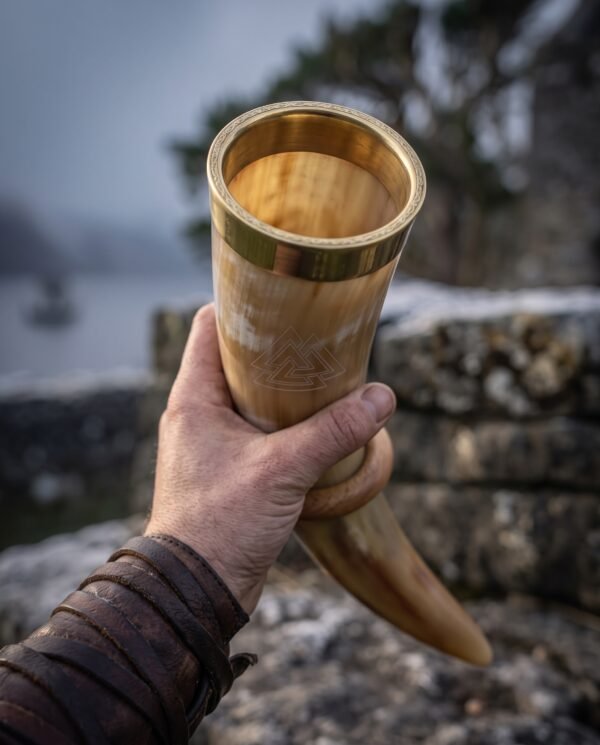
Amberdraught Hand Made Valknut Drinking Horn and Oak Stand | Pale Natural Ox Horn | Solid Brass Rim Band with Tan Leather Belt | Norse Wedding Gift | RK-1685
Original price was: $199.00.$159.20Current price is: $159.20.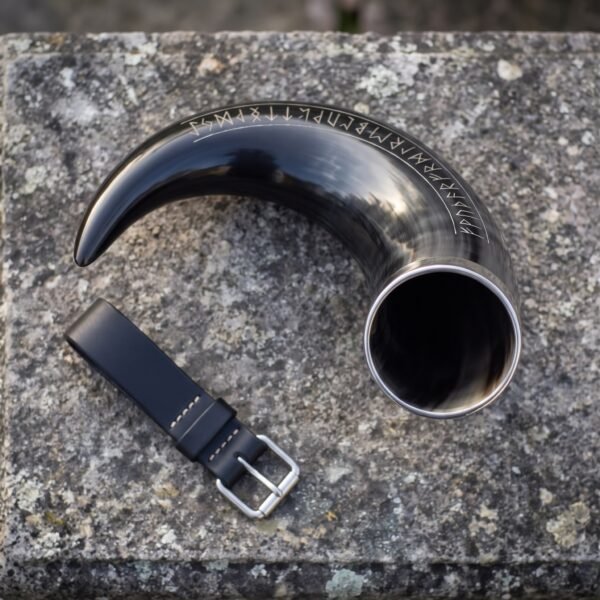
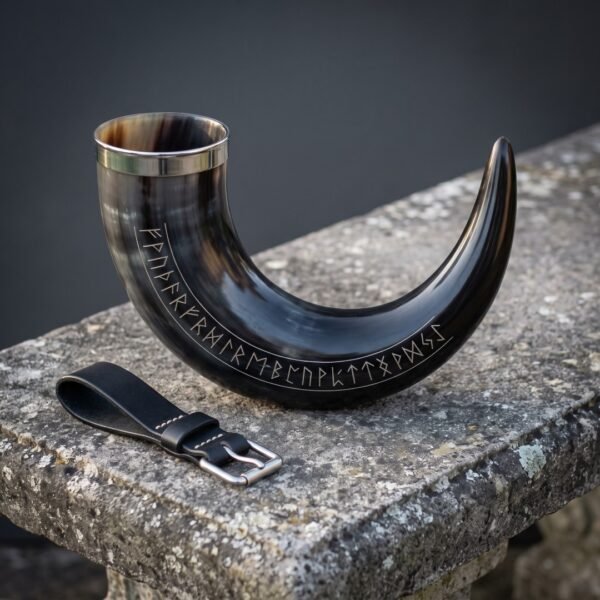
Runemead Hand Made Rune Drinking Horn | Full Elder Futhark Row | Dark Natural Ox Horn and Polished Steel Rim with Black Leather Belt Loop | Norse Mead Gift | RK-1675
Original price was: $169.00.$135.20Current price is: $135.20.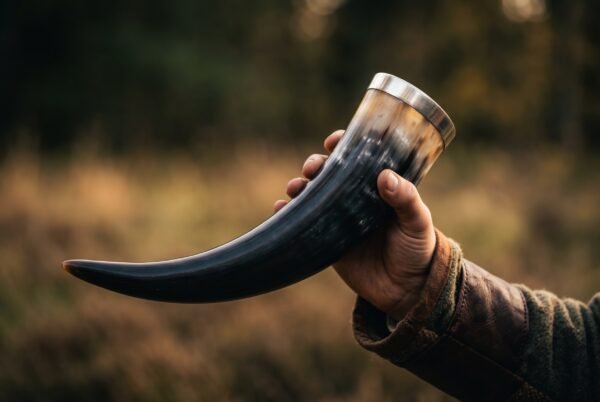
Oakcradle Hand Made Drinking Horn with Stand | Dark Natural Ox Horn | Turned Walnut Cradle and Carved Knotwork Coaster | Norse Table Gift | RK-1677
Original price was: $189.00.$151.20Current price is: $151.20.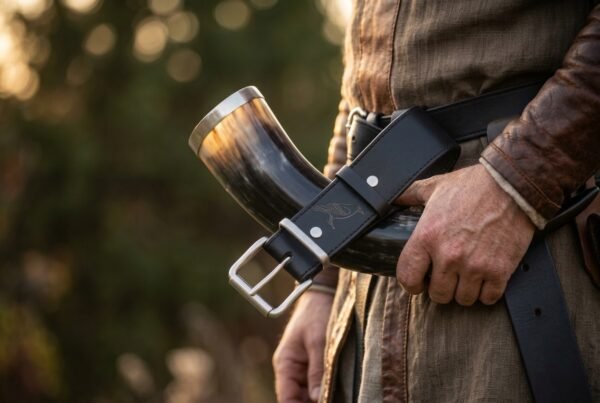
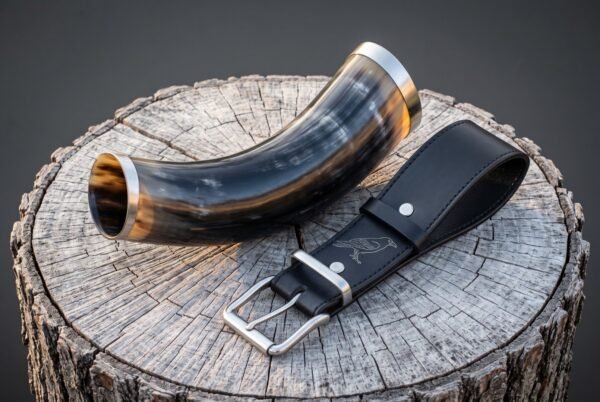
Draughtraven Hand Made Viking Drinking Horn and Leather Belt Hanger | Natural Ox Horn | Polished Steel Rim and Tip Band with Engraved Raven Strap | Norse Feast Gift | RK-1672
Original price was: $149.00.$119.20Current price is: $119.20.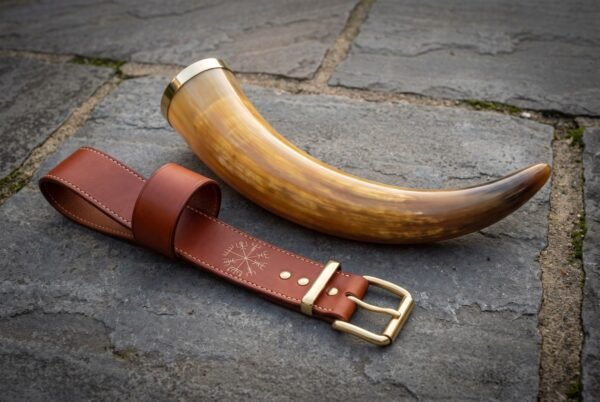
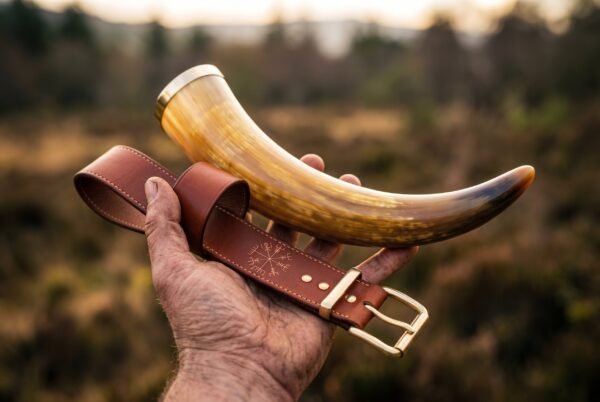
Hornmead Hand Made Viking Drinking Horn with Polished Brass Rim | Roughly 14 to 16 Inches Along the Curve | Vegvisir Stamped Leather Belt Hanger | Norse Mead Gift | RK-1711
Original price was: $159.00.$127.20Current price is: $127.20.Horn is not glass, wood or metal
A drinking horn starts as keratin, the same material as a fingernail, grown in layers around a bony core. That single fact explains almost everything about how these behave. Keratin is light for its bulk, so a full horn feels lighter in the hand than a pewter tankard holding the same amount. It is springy rather than brittle, so a horn that goes off a table usually survives what would end a glass. It is also porous on the inside and it does not like heat, which sets the two rules everyone eventually learns the hard way.
The shape is not designed either. It is whatever that animal grew, tapering from a wide mouth to a solid point, curving once along its length and often twisting slightly as well. Nobody drew it. That is why capacity is quoted as a range rather than a number, why two horns of the same listing are never quite the same length, and why the wall thickness varies from one to the next.
The Norse used horns for exactly the same reason anyone else did. Cattle were already being kept, the horn was a by product, and hollowing one out gave you a vessel that cost nothing and did not break. The prestige versions in the archaeology carry silver or gilt mounts around the rim, which is where the fitted band on a modern horn comes from. The band is not decoration alone. It protects the mouth, which is the thinnest and most exposed edge on the whole piece.
The horns in this collection
Five pieces. What separates them is the fitting at the mouth, what is cut into them, and whether they come with something to stand in or something to hang from.
Horns with a belt hanger
Three of these. Two use a black leather belt loop with a brushed steel buckle and take a belt up to about 1.5 inches or 40 mm wide. The third uses tan vegetable tanned bridle leather with a solid brass buckle and a wide retaining loop, which is the sturdier of the two arrangements and the one to pick if the horn will be worn at an event rather than carried across a room. All three have hand burnished leather edges, which is the finishing step that stops a strap edge fraying after a season.
Horns with a stand
Two of these, and the stands work differently. One is a turned walnut cradle on a pedestal with a steel collar and a weighted round base, and the cradle is a saddle rather than a ring, cut with a curve across the top so the belly of the horn beds into it instead of balancing on a rim. It ships with a turned walnut coaster carved with a Celtic knot. The other is a turned oak ring on a pedestal with a beaded round foot, and it comes with a tan leather belt as well, so it can sit on a table or go on a hip.
Engraved horns
One carries the full twenty four character Elder Futhark row cut so it follows the outer curve, which is harder than it sounds because horn is layered and springy and a chisel will skate on it if the layers are not read first. One has a Valknut cut into the outer face of pale amber horn, where the translucent passages let light through behind the cut. One has a Vegvisir stamped into the leather strap rather than into the horn, and one has a raven cut into the leather the same way.
Capacity, fittings and colour across the range
Every figure below comes from the specification panel of a piece on this page. Horn is a natural material and no two are identical, so capacity and length are quoted as ranges and that is deliberate rather than vague.
| Piece | Horn and colour | Capacity | Rim and fittings | Engraving | Supplied with |
|---|---|---|---|---|---|
| Hornmead | Natural ox horn, polished and sealed | About 16 to 20 fl oz | Polished brass rim band | Vegvisir stamped into the leather | Tan bridle leather hanger, solid brass buckle |
| Draughtraven | Amber through smoke grey to near black | About 12 to 16 fl oz, 350 to 470 ml | Polished steel rim band and a steel band at the tip | Raven cut into the leather strap | Black leather belt loop, steel roller buckle |
| Runemead | Charcoal to near black with grey banding | About 16 to 20 fl oz, 470 to 590 ml | Polished steel rim band | Full Elder Futhark row along the outer curve | Black leather belt loop, brushed steel buckle |
| Oakcradle | Charcoal through smoke grey | About 14 to 18 fl oz, 410 to 530 ml | Polished steel rim band | Celtic knot carved into the coaster | Turned walnut cradle stand and walnut coaster |
| Amberdraught | Cream through honey amber, translucent passages | About 16 to 20 fl oz, 470 to 590 ml | Solid brass rim band | Valknut cut into the outer face | Turned oak stand and tan leather belt |
One figure to read carefully. A horn listed at 16 to 20 fluid ounces is closer to a pint and a half than to a pint, and the taper means the last third comes at you quickly. That is a warning about the pour rate rather than about the volume.
How a horn is made safe to drink from
A raw horn is not ready for anything. It arrives off the animal with a soft inner core still in it, and the interior wall is porous. The core is removed, the inside is cleaned and cut back, the outside is sanded through progressively finer grits and buffed, and then the interior is sealed with a food safe brewers lining that is applied, sealed and cured. That lining is what stops liquid soaking into the keratin, and it is the reason a modern horn does not develop the smell that untreated ones are famous for.
The lining is also the limiting factor on temperature. Hot liquid softens it and heat makes keratin itself flex and eventually delaminate. So no tea, no mulled wine, no dishwasher, and no leaving a horn in a car in July. Cold drinks are what these are for, and cold is where horn is genuinely better than glass, because keratin conducts heat poorly and a horn keeps a cold drink cold noticeably longer than a metal cup does.
Drinking from one without wearing it
Everybody gets this wrong once. A horn is not a glass and it does not empty like one. The bore narrows steadily from the mouth to the tip, so the liquid accelerates as the angle increases, and the flow at forty degrees is nothing like the flow at sixty. Tilt slowly and stop tilting the moment liquid touches your lip, then let gravity do the rest in small increments.
The second trick is that a horn cannot be set down. There is no flat base anywhere on it, which means once it is filled it is committed to your hand, a stand or a hanger. Fill it after you have decided where it is going to live between mouthfuls, not before. This is a large part of why the drinking horn acquired its reputation, and the reputation is deserved.
What to put in one
Mead is the obvious answer and it is a good one, since a sweet mead sits well against horn and neither picks up flavour from the other. Beer works and ale works better than anything heavily carbonated, because a horn has no straight wall to run the head down and a fizzy pour foams straight up at you. Cider, wine and spirits are all fine. Water is fine too, and the number of people who fill a new horn with water on the first evening purely to practise the tilt is higher than anyone admits.
What horn does not want is anything hot, anything left standing in it overnight, and anything strongly coloured left long enough to stain the lining. Pour it, drink it, rinse it.
Colour, and why no two match
Colour in horn comes from pigment laid down while the animal was growing, so it runs in bands along the length rather than sitting evenly across the surface. Pale horns come up cream and honey amber with sections thin enough to pass light. Dark horns run charcoal to near black, usually with lighter grey banding where the growth changed. Most horns are somewhere between and carry a mixture.
The listing photograph is one horn from a batch. Yours will share the tone family and the fittings and it will not share the exact pattern. If you want a specific character, buy the pale one for translucency and the dark one for contrast against a steel rim, and treat everything beyond that as luck.
Wearing one on a belt
The hangers here take a belt up to about 1.5 inches or 40 mm wide, which covers most leather belts and all of the wider reenactment ones. Thread the belt through the loop before you buckle it rather than trying to feed a loaded hanger onto a fastened belt. Hang the horn on the side away from your dominant hand so you are not reaching across yourself, and hang it tip forward, which keeps the point out of the back of a chair when you sit down.
A loaded horn on a belt swings. That is fine walking and less fine on stairs, so put a hand on it. If the strap goes dry and stiff over years, a leather conditioner brings it back. Our belts and flags category has wider belts if the one you own is not up to it.
Care, washing and storage
Rinse with cool water after use and let it drain tip down. Warm water with a drop of mild dish soap is fine for a proper clean, but nothing hot, and never a dishwasher, since heat and a caustic detergent will take the lining off and lift the polish in one cycle. Do not soak a horn and do not leave liquid standing in one overnight.
Dry the inside as far as you can reach and then let it air. Store it on its stand or hanging from its hanger, mouth down or on its side, so any last moisture leaves rather than sitting at the tip. Polished horn can be given a wipe of mineral oil once or twice a year if it starts to look dry, and the brass or steel band takes a metal polish on a cloth. Brass darkens over time, which most owners leave alone.
Keep it off radiators and out of direct sun. Keratin dries, shrinks and eventually cracks along the grain if it is baked, and a cracked horn cannot be repaired to hold liquid again.
Engraving
Horn takes a cut well if the layers are read first, and leather takes a stamp cleanly, so both the horn body and the strap are available. Names, dates, a rune line or a stave all work. Elder Futhark is a phonetic alphabet rather than a cipher, so a name is transliterated by sound and there is no rune for the letter C. Where a piece already carries an engraved design, your engraving replaces it rather than sitting alongside it. Text engraving is 19 dollars, a symbol is 39 dollars and a family crest is 49 dollars. Engraving is permanent and an engraved piece cannot be returned, so check the spelling twice before the order goes in. Horns are a common wedding and groomsmen gift for exactly this reason, and the wedding and groomsmen gifts range covers the rest of the table.
Where these come from and how they ship
Ransack Viking is a US company based in Chicago, Illinois. The pieces are handmade in the Czech Republic, then imported, inspected and shipped from Chicago. Engraving is done in the US after arrival. Every horn is a natural object worked by hand, so length, capacity, colour and wall thickness vary between two pieces of the same listing. The fittings, the lining and the finish are the same every time.
How to choose
Buy a belt hanger horn if it is going to an event and a stand horn if it is going on a shelf. Pick brass fittings for warm rooms and dark timber, steel for cool rooms and pale timber. Take the pale amber horn if you want light coming through the wall and the charcoal one if you want the rim to stand out against it. If it is a gift, the stand versions present better out of the box, because a horn on its own looks like half of something until it is filled.
Browse related categories
- Horn mugs and tankards, the version that stands up
- Viking beer mugs for the rest of the table
- Viking home decor and pieces for the room
- Damascus steel jewellery and Norse pendants
- Hnefatafl boards and Viking games
- Runestones and rune sets
Guides worth reading first
- The Viking drinking horn and what the finds show
- Buying a drinking horn without regretting it
- Elder Futhark runes and how a name is transliterated
- The Valknut and what the three knots mean
- Renaissance faire and reenactment kit, what to actually bring
Frequently asked questions
Are these horns safe to drink from?
Yes. The soft inner core is removed, the interior is cleaned back and then sealed with a food safe brewers lining that is applied and cured before the horn leaves the shop. That seal is what keeps liquid out of the keratin and stops the smell that untreated horns are known for.
Can I put a hot drink in one?
No. Heat softens the lining and makes keratin flex and eventually delaminate, so no tea, no mulled wine and nothing warmed. Cold drinks only. Horn actually holds a cold drink cold longer than metal does, which is the trade you are getting.
How much does a horn hold?
Between about 12 and 20 fluid ounces on this page, depending on the individual horn. Capacity is quoted as a range because the horn is a natural object and no two are the same size. Each listing states its own range.
Why will my horn not stand up?
Because it has no flat surface anywhere on it. That is why every piece here arrives with either a turned stand or a leather belt hanger. Fill it once you know where it is going to sit between mouthfuls.
Can it go in the dishwasher?
Never. Heat and a caustic detergent will strip the lining and dull the polish in a single cycle. Rinse in cool water, use a drop of mild dish soap if it needs it, drain it tip down and let it air dry.
Will mine look like the photograph?
It will share the colour family, the fittings and the engraving. It will not share the exact banding, length or capacity, because colour in horn is laid down as the animal grows and every one is different.
What belt width do the hangers fit?
Up to about 1.5 inches or 40 mm, which covers most ordinary leather belts and the wider reenactment ones. Thread the belt through the loop before you buckle it rather than after.
Where are these made?
They are handmade in the Czech Republic, then imported, inspected and shipped by Ransack Viking from Chicago, Illinois. Engraving is added in the US after arrival.
Featured pieces
 Draughtraven Hand Made Viking Drinking Horn and Leather Belt Hanger
Original price was: $149.00.$119.20Current price is: $119.20.
 Runemead Hand Made Rune Drinking Horn
Original price was: $169.00.$135.20Current price is: $135.20.
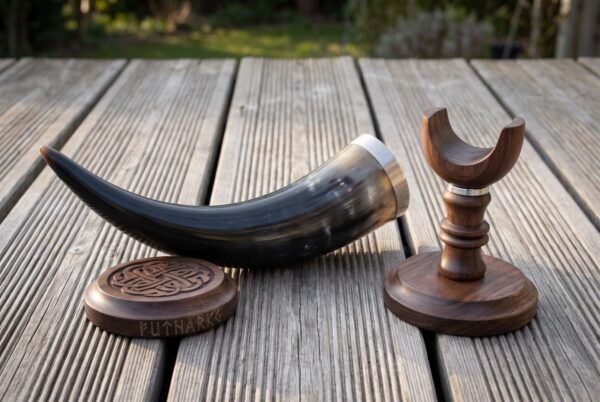 Oakcradle Hand Made Drinking Horn with Stand
Original price was: $189.00.$151.20Current price is: $151.20.
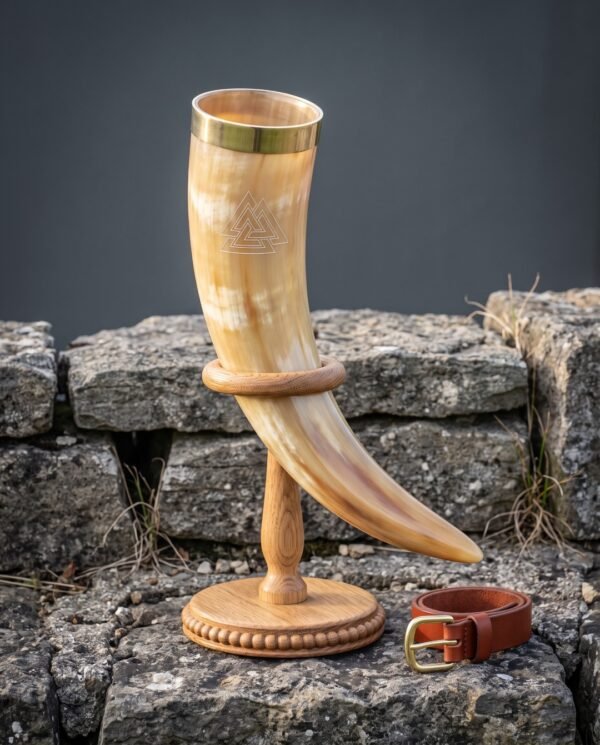 Amberdraught Hand Made Valknut Drinking Horn and Oak Stand
Original price was: $199.00.$159.20Current price is: $159.20.