
A belt is the one piece of Norse kit that gets used every day. It carries the knife, the pouch and the drinking horn, and on a period tunic with no pockets it is the only thing holding the whole arrangement together. The buckle fails first, which is why a solid frame with a proper centre bar matters more than the decoration on it.
This page holds belts, buckles and a wall banner. The belts are full grain vegetable tanned cowhide, 1.5 inches wide, cut to order for waists from 30 to 46 inches, with stamped Celtic knotwork or a line of Elder Futhark runes struck into damp leather. The buckles are sold on their own, one in solid steel with a brushed satin finish and a stamped Valknut, one in solid brass with a cut Vegvisir, both sized for straps in the usual one and a half to one and three quarter inch range. The banner is heavy natural cotton canvas at about 12 ounce weight, roughly 16 by 22 inches on a turned ash cross bar.
Measure your existing strap before buying a buckle. It is the mistake almost everyone makes.
Free US shipping
On most pieces. Heavier and oversized ones carry a flat charge.
Hand Forged
Heated, hammered and ground by hand.
Engraving available
Names, dates or Norse runes on most pieces.
Ships from Chicago
Inspected and dispatched from our Chicago warehouse. No import duty, no customs delay on US orders.
Viking Belts, Buckles & Flags
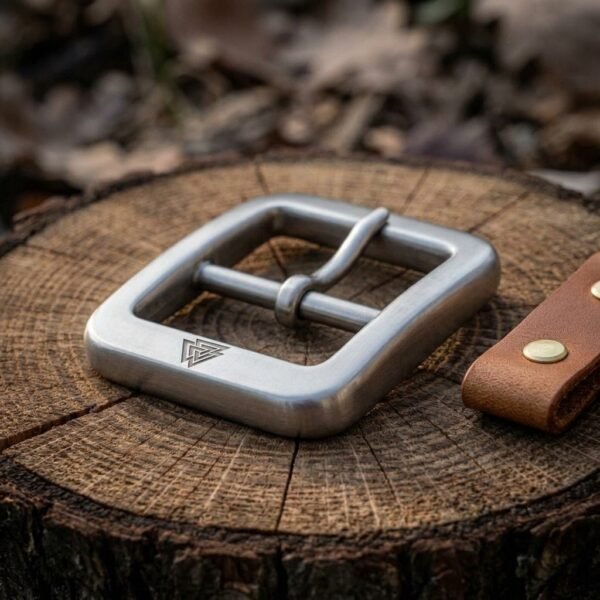
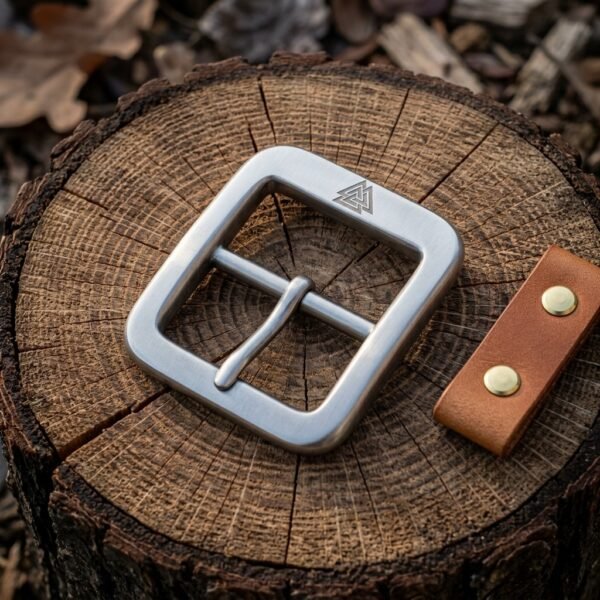
Girdlock Hand Made Brushed Steel Viking Belt Buckle with Stamped Valknut & Tan Leather Snap Tab | Norse Gift | RK-1638
Original price was: $49.00.$39.20Current price is: $39.20.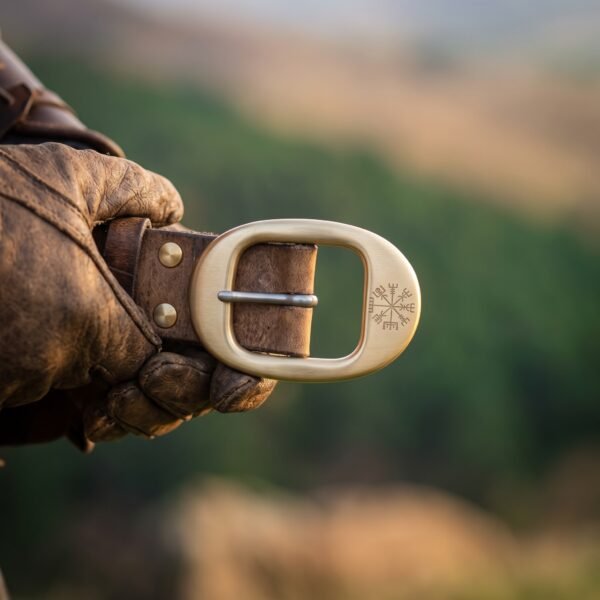
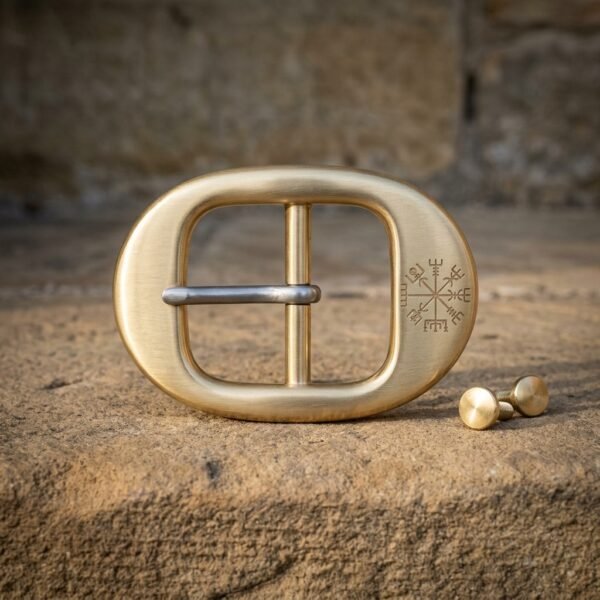
Waystead Hand Made Solid Brass Viking Belt Buckle with Engraved Vegvisir & Two Screw Studs | Norse Leatherwork Gift | RK-1618
Original price was: $49.00.$39.20Current price is: $39.20.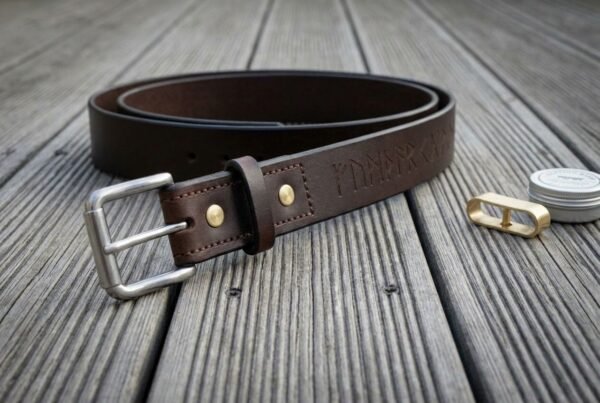
Runestrap Hand Made Dark Brown Leather Rune Belt | Full Grain Strap with Stamped Elder Futhark Line | Brushed Steel Tongue Buckle, Brass Rivets and Leather Balm | Norse Gift | RK-1642
Original price was: $72.00.$57.60Current price is: $57.60.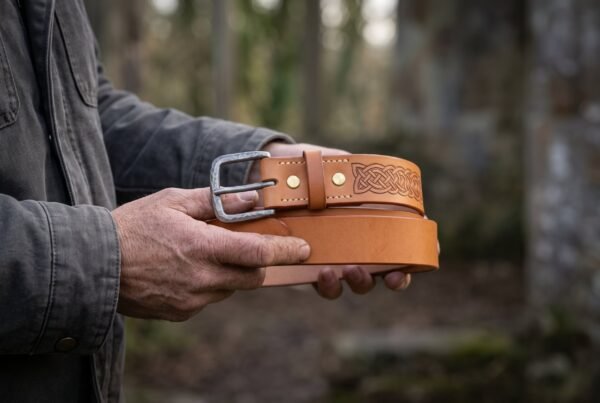
Knotcinch Hand Made Viking Leather Belt | 1.5 Inch Wide Full Grain Hide | Celtic Knotwork Stamped Panel with an Antiqued Hammered Buckle and Brass Rivets | Norse Everyday Gift | RK-1663
Original price was: $72.00.$57.60Current price is: $57.60.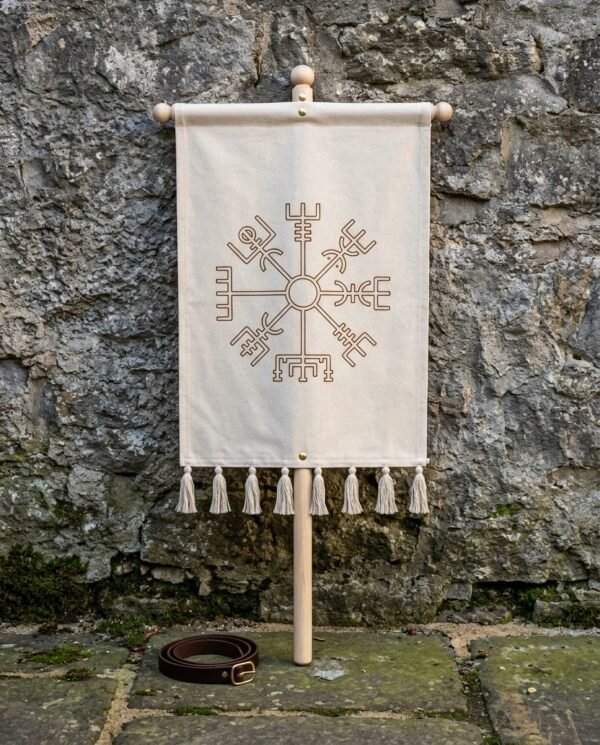
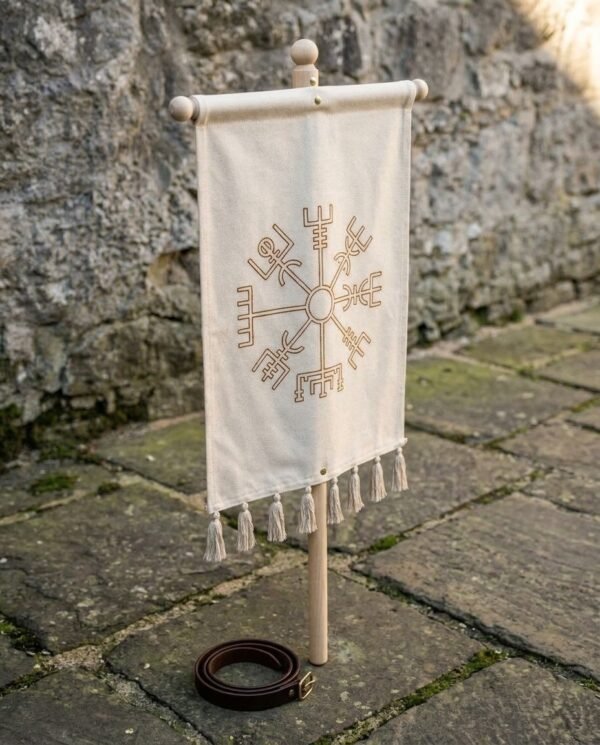
Waymark Hand Made Vegvisir Canvas Banner on an Ash Staff | 16 by 22 Inches | Heavy Cotton Canvas with a Turned Ash Cross Bar and Tassel Fringe | Norse Home Decor Gift | RK-1659
Original price was: $169.00.$135.20Current price is: $135.20.Why the belt carried everything
Norse clothing had no pockets. That single fact explains most of what a Viking age belt was for. The knife hung from it, the pouch hung from it, the drinking horn hung from it in a ring or a loop, and on a working day so did whatever else needed carrying. The belt was not a fashion item bolted onto an outfit. It was the load bearing part of the outfit.
That changes what you look for. A belt built to carry weight needs to be a single piece of hide rather than two thin layers bonded together, because a bonded strap delaminates at the fold behind the buckle and then it is finished. It needs a buckle whose frame does not open under load. And it needs holes that are punched and edge finished rather than stamped through and left raw, because a raw hole tears along the grain the first time you lean on it.
The straps here are cut from full grain vegetable tanned cowhide in one piece, in roughly 9 to 10 ounce weight, which is about 3.5 to 4 mm thick. That is heavy for a dress belt and correct for one that will carry a knife and a pouch all day. It is stiff on the first wearing and it stays stiff for a week or two. Then it starts to remember the shape of you.
The belts, buckles and banners in this collection
Five pieces sit on this page and they split into three jobs. Two are finished belts. Two are buckles sold on their own for a strap you already own or are building. One is a wall banner.
Finished belts
Both belts are 1.5 inches wide, which is the width that fits standard belt loops on jeans and trousers without fighting them. One is cut to order for waists from 30 to 46 inches in hand rubbed tan, struck with a four strand Celtic knotwork panel inside a stitched border, hung on a heavy roller frame buckle in an antiqued steel finish and held by two solid brass rivets that come out again if you want to change the buckle. It has five holes at one inch spacing, burnished edges and a light wax topcoat, and it ships with a spare keeper loop, a spare rivet set and a care card.
The other is a dark chocolate brown strap in full grain leather with no bonded or split filler layers, stamped along the face with a line of Elder Futhark runes. Its buckle is a brushed steel tongue buckle on a heel bar, the folded buckle end secured with solid brass rivets, and it carries a stitched leather keeper with a spare solid brass keeper on a screw post supplied alongside. Five punched holes, burnished edges, and a tin of leather balm in the box.
Buckles sold on their own
Both buckles fit standard straps in the one and a half to one and three quarter inch range, and neither includes a belt. The steel one is a squared centre bar frame with rounded corners, a shaped tongue and a Valknut stamped into the upper corner, brushed in one direction by hand with the edges softened, supplied with a tan leather snap tab and two studs for a snap style strap. The brass one is a rounded oval frame with a squared inner opening and a fixed centre bar, a steel tongue, and a Vegvisir cut into the wide face of the frame with the engraving left darker for contrast. It comes with two brass screw studs for mounting a leather strap, in a drawstring pouch.
The wall banner
One piece here is not worn at all. It is a hanging banner in heavy natural cotton canvas, undyed, at about 12 ounce weight, roughly 16 inches wide by 22 inches deep excluding the fringe and about 40 inches overall including the staff. A Vegvisir stave is applied by hand in warm ochre ink. The cross bar is turned ash of about 20 inches with a ball finial at each end, and the staff is turned ash of about 24 inches, slotted and pegged into the cross bar. Eight hand tied cotton tassels run along the lower edge, two solid brass studs hold the head and one holds the foot, and a wall cleat comes with it. The leather belt shown in the product photograph is a prop and does not come with the banner.
Sizes, materials and fittings across the range
Every figure below is taken from the specification panel of a piece on this page. These are cut, struck and finished by hand, so read the numbers as what to expect rather than as a guarantee to the millimetre.
| Piece | Material | Size | Cut or stamped work | Fittings | Included |
|---|---|---|---|---|---|
| Knotwork belt | Full grain vegetable tanned cowhide, about 9 to 10 oz | 1.5 in wide, waist 30 to 46 in, cut to order | Four strand Celtic knotwork panel with a stitched border | Heavy roller frame buckle, antiqued steel, two brass rivets | Spare keeper loop, spare rivet set, care card |
| Rune belt | Full grain leather, dark chocolate brown, single piece cut | Five punched holes, burnished edges | Elder Futhark rune line struck into the face | Brushed steel tongue buckle on a heel bar, brass rivets | Spare brass keeper, tin of leather balm |
| Steel buckle | Solid steel, brushed satin | For straps of about 1.5 in | Valknut stamped into the upper corner of the frame | Squared centre bar frame, shaped tongue | Tan leather snap tab with two studs, no strap |
| Brass buckle | Solid brass frame and centre bar, steel tongue | For straps of one and a half to one and three quarter in | Vegvisir cut into the wide face, left darker | Rounded oval frame, fixed centre bar | Two brass screw studs, drawstring pouch, no strap |
| Wall banner | Heavy natural cotton canvas, about 12 oz, ash cross bar and staff | About 16 by 22 in, about 40 in overall with the staff | Vegvisir applied by hand in ochre ink | Two brass studs at the head, one at the foot, ball finials | Cross bar, staff, wall cleat, eight cotton tassels |
One number needs care. Waist size is not the same as strap length. Order a belt by the waist measurement you actually wear, not by the number printed inside your trousers, because those two figures disagree more often than they agree.
Measuring for a belt, and measuring for a buckle
For a belt, run a tape around your waist over the clothing you will wear it with, at the height the belt will sit. That number is the waist size to order. Do not add anything to it. The strap is cut so that the number you give lands on the centre hole of five, which leaves you two holes either side for a heavy tunic, a cold winter or an honest Christmas.
For a buckle it is the strap width that matters, not the waist. Measure the strap itself across the widest point, not the belt loops on your trousers and not the buckle you are replacing. A 1.5 inch strap will not pass through a buckle cut for 1.25, and a 1.25 inch strap in a 1.75 buckle will rattle sideways and wear a mark into the leather.
Both buckles here are sold without a strap. That is deliberate, because most people buying a buckle are either rebuilding an existing belt or making one, and neither wants a second strap they did not ask for.
Leather, and how it behaves over the first year
Vegetable tanned hide is tanned with bark and plant tannins rather than mineral salts. It is stiffer than chrome tanned leather when new, it takes a stamp cleanly, and it darkens with light and use into a deeper colour that no dye can imitate. That darkening is the point. A veg tan belt at three years does not look like the same object it was in the box, and that is why this is the tannage used for belts, sheaths and saddlery.
Full grain means the outer surface of the hide is intact rather than sanded back and coated. It is the strongest part of the skin and the part that develops a patina. Anything sold as genuine leather, corrected grain or bonded is a different material with a different life expectancy.
Expect the strap to be stiff for a week or two, then to soften and take a curve. Expect the colour to deepen. Expect the burnished edges to need a rub with a cloth every few months to stay slick. None of that is wear. It is what the material does.
Care, storage and what actually kills a belt
Two things destroy leather. Soaking it and then drying it fast, and letting it dry out completely and stay that way. Everything else is cosmetic.
If a belt gets wet, let it dry slowly at room temperature away from any heat source. Never on a radiator, never in front of a fire, never with a hairdryer. Fast drying draws the oils out of the fibre and the strap goes brittle and cracks at the fold behind the buckle, which is the highest stress point on the whole thing.
Twice a year, or whenever the surface starts to look dry and chalky, work a thin coat of leather balm into the strap with a cloth and let it sit overnight. The rune belt ships with a tin of balm for exactly this. Less is more. A heavy coat sits on the surface, attracts dust and does nothing for the fibre underneath.
Hang belts by the buckle rather than coiling them tight in a drawer, because a tight coil sets a permanent memory into the strap. Steel buckles want a wipe of oil if they live somewhere damp. Brass darkens over months into a dull gold and comes back with metal polish on a cloth, or leave it and let it age.
Hanging the banner
The banner is heavier than it looks, because 12 ounce canvas on an ash cross bar with eight tassels is not a poster. Use the wall cleat supplied rather than a nail through the canvas. Fix the cleat into a stud or use a proper plug in plaster, mount the cross bar on it, and let the staff hang free below.
Keep it out of direct sunlight if you can. Ochre ink on undyed canvas is stable but every applied pigment fades eventually, and a banner on a south facing wall will lighten faster than one across the room from the window. If it creases in transit, hang it and leave it. Canvas of this weight drops its own creases out in a few days under its own mass.
Engraving and personalising
Engraving is added in the United States after the pieces arrive, and on these it goes onto metal rather than leather. A name, a date or a short line can be cut into the wide face of a brass buckle or onto the frame of a steel one. Text engraving is 19 dollars, a symbol is 39 dollars and a family crest is 49 dollars.
Elder Futhark is a phonetic alphabet, not a cipher, so a name is transliterated by the sounds in it rather than letter by letter, and there is no rune for the letter C. If you want a name in runes on a buckle, read the rune guide first and send the exact spelling you want cut.
Engraving is permanent and an engraved piece cannot be returned. Read your spelling twice.
Where these come from and how they ship
Ransack Viking is a US company based in Chicago, Illinois. The pieces are handmade in the Czech Republic, then imported, inspected and shipped from Chicago. Engraving is done in the US after arrival.
Because each strap is cut from a natural hide and each stamp is struck by hand into damp leather, two belts of the same name will differ slightly in colour and in the exact depth of the stamped panel. Hide varies across a single animal, let alone across two. Cut to order sizing means allow a little longer for a belt than for a buckle.
How to choose
If you want a belt you can wear to work as well as to an event, take the 1.5 inch knotwork strap in tan. It reads as a good belt first and a Norse belt second, which is the right way round for anything worn five days a week.
If it is for kit, take the dark brown rune belt. The stamped Futhark line is the thing people notice across a field, and the spare brass keeper is genuinely useful once you start hanging a pouch and a knife off it.
If you already own a strap you like, buy a buckle and leave the strap alone. Brass suits tan and warm leathers, steel suits black and dark brown. And if what you actually want is the Norse look on a wall rather than around your waist, buy the banner.
Browse related collections
- Viking home decor for the wall and the table
- Scabbards and sheaths to hang from a belt
- Leather armor, bracers and body pieces
- Arm rings and torcs in the same metals
- Engraved and personalised pieces across the range
- Wedding and groomsmen gifts
- Runestones and rune sets
Guides worth reading first
- Elder Futhark runes and how names are transliterated
- The Vegvisir, what the stave actually is
- The Valknut and what the three knot symbol means
- Viking symbols and their meanings
- Gifts for reenactors that get used
- Where our pieces are made and how they reach you
Frequently asked questions
What size belt should I order?
Measure around your waist over the clothing you will wear the belt with, at the height it will sit, and order that number. Do not add to it. The strap is cut so your measurement lands on the centre hole of five, leaving two holes either side.
Do the buckles come with a belt?
No. Both buckles on this page are sold on their own, for a strap you already have or one you are building. The steel one includes a tan leather snap tab with two studs. The brass one includes two brass screw studs and a drawstring pouch.
What strap width do these buckles fit?
Standard straps in the one and a half to one and three quarter inch range. Measure your strap across its widest point rather than guessing from your trouser loops. A strap that is too wide will not pass through, and one that is too narrow will slide sideways and wear a mark into the leather.
What does vegetable tanned mean?
It is leather tanned with bark and plant tannins instead of mineral salts. It starts stiffer, takes a stamped pattern cleanly, and darkens with light and use into a colour no dye can copy. It is the tannage used for belts, sheaths and saddlery for exactly those reasons.
How do I stop a leather belt cracking?
Do not dry it fast. If it gets wet, let it dry at room temperature away from any heat. Twice a year work a thin coat of leather balm in with a cloth and leave it overnight. Cracking almost always starts at the fold behind the buckle, which is the highest stress point.
Can I change the buckle on one of these belts?
On the knotwork belt, yes. Its buckle is held by two solid brass rivets that are removable for exactly that reason. The rune belt has a folded end riveted with brass, so changing that buckle is a leatherwork job rather than a two minute swap.
Does the banner come with the belt in the photograph?
No. The leather belt shown alongside the banner is a prop. The banner ships with its canvas, the turned ash cross bar, the staff and a wall cleat.
Where are these made?
They are handmade in the Czech Republic, then imported, inspected and shipped by Ransack Viking from Chicago, Illinois. Engraving is added in the US after arrival.
Featured pieces
 Girdlock Hand Made Brushed Steel Viking Belt Buckle with Stamped Valknut & Tan Leather Snap Tab
Original price was: $49.00.$39.20Current price is: $39.20.
 Waystead Hand Made Solid Brass Viking Belt Buckle with Engraved Vegvisir & Two Screw Studs
Original price was: $49.00.$39.20Current price is: $39.20.
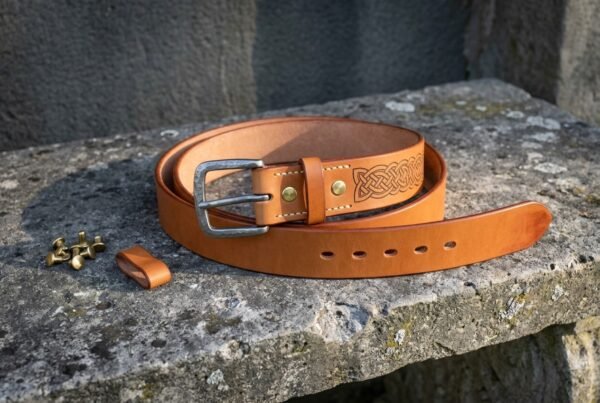 Knotcinch Hand Made Viking Leather Belt
Original price was: $72.00.$57.60Current price is: $57.60.
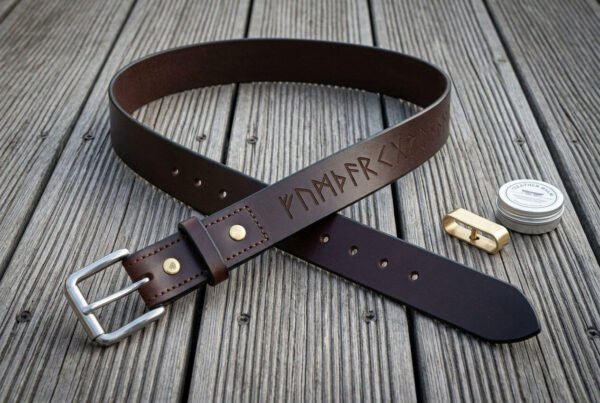 Runestrap Hand Made Dark Brown Leather Rune Belt
Original price was: $72.00.$57.60Current price is: $57.60.