
Blog
Gifts for Reenactors: What They Actually Want, by Period

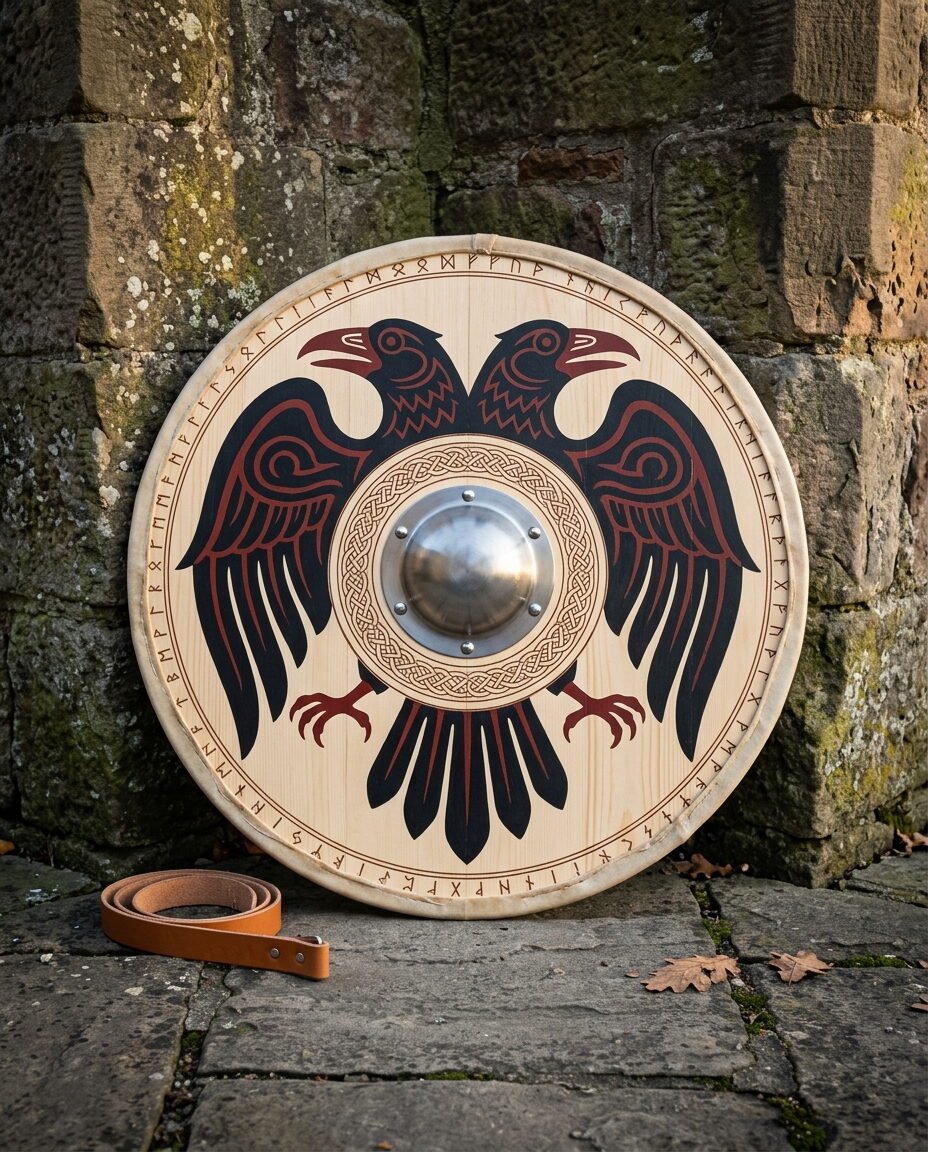
A reenactor wants kit that fits the period he already portrays, and nothing else will do. Buy for the Viking age man and you are looking at a round shield, a bearded axe or a horn. Buy for a fourteenth century knight and none of that works, however handsome it is. Ask which century and which group first, then use the sections below, which are sorted by the person rather than by the shelf.
Two questions to ask before you buy anything
The first is which period he portrays. Reenactors are specific about this in a way outsiders tend to find slightly alarming. A man who does ninth century Norse will not put a fourteenth century great helm anywhere near his kit, and a late medieval man has no use for a round shield. If you cannot ask him directly, ask whoever runs his group, or look at the photographs he has posted and count the buckles.
The second is what his group allows on the field. Most combat groups run written safety standards, and those standards normally require blunt or rebated edges for any contact work, along with checks before every event. A sharp blade is for display, for drill and for the table, not for hitting another human being. Assume anything you buy is a display and collector piece unless his marshal has passed it, and say so when you hand it over. That is not a small print detail, it is the difference between a good gift and one he quietly cannot use.
For the Viking age reenactor
This is the largest group in the hobby and the easiest to buy for, because the objects are simple and the range is wide. Nobody portraying the Norse world has yet run out of uses for an axe.
A shield, if he does not already have two
The round shield is the centre of Norse kit and the thing most people upgrade first, because the cheap starter shield they built from plywood in year one always looks like it. Our round shields are hand made hardwood with a rawhide edge, mostly around 24 inches across, and they sat between 339 and 395 dollars when this was written. Prices can change. If you want to understand construction, boss, grip and edging before you spend that, Viking shields explained is the background.
Suits: the man who fights on the line and whose shield is looking tired. Does not suit: a new member who has not yet been told what his group wants, and anyone who portrays a period after roughly the eleventh century.
An axe, which almost every Norse impression can use
An axe is the most defensible thing you can buy a Viking age reenactor, because the axe was the common tool of that world rather than a rich man’s item, and it belongs in almost any impression. The bearded axes range starts at 189 dollars and runs up past 350 for the heavier hammer poll heads. If you want to know why the shape looks the way it does, the history of the Viking axe explains what the beard was for.
Suits: nearly everyone doing early medieval northern Europe. Does not suit: a man who already owns four, which is more common than you think. Ask.
A horn for the camp, not the field
Evenings at an event are half the hobby, and a horn is the object that gets passed around a fire and remembered. Our drinking horns start near 149 dollars and include versions with stands, belt frogs and full Elder Futhark rows cut into the horn. Nobody has ever complained about being given one.
Suits: everyone in the camp, including the partner who comes along and does not fight. Does not suit: the very strict authenticity crowd if the fittings are wrong for his century, so favour plain over decorated if he is that sort.
For the Norman and high medieval portrayal
Once the impression moves past the eleventh century the shield goes kite shaped, the helmet gains a nasal, and half of what he already owns becomes the wrong century. A nasal helmet is the honest gift here, and ours sit around 299 dollars in the medieval helmets range. A spectacle helm covers the late Viking and Norman crossover. If he is after a blade rather than head protection, the arming swords in the Viking swords range carry into this period and start around 379 dollars.
Helmet sizing is where gifts go wrong. Head circumference varies far more than people assume, padding takes up real space inside a bowl, and a helmet that does not fit is an ornament. If you cannot find out his measurement without ruining the surprise, get it from someone in his group or buy something that does not need to fit. Viking armour explained covers what actually gets worn under and over a helmet, which is useful if you are new to this and about to be talked at over dinner.
Suits: the man building a second impression and short of head protection. Does not suit: a first year member, who usually borrows kit and does not yet know what he wants.
For the late medieval and crusader kit
Great helms and pig faced bascinets belong here, and both are strong pieces at the top of the budget, roughly 389 to 409 dollars in our helmets range when this was written. These are heavy, they are visually spectacular, and they are the sort of thing a reenactor stares at in an online basket for a year without buying. If someone in his life is going to break the deadlock, it may as well be you.
The same caution applies twice over. Fit matters more on an enclosed helm than on an open one, and group safety rules on head protection are usually the strictest rules they have. Buy it as display kit unless you know it passes.
For the living history person who does not fight
Not everyone in the hobby swings anything. Crafters, cooks, traders and the people who run the children’s tent are the backbone of most events and are constantly forgotten at Christmas. A slate rune set, a candle holder for the camp table, a keyring, a pendant or a belt fitting all land better than another blade. The accessories range covers most of this ground below 160 dollars.
Suits: the crafter, the partner, the teenager coming into the hobby. Does not suit: nobody, honestly. This is the safest section on the page.
Engraving on reenactment kit
Engraving is offered inside the add to cart form on the product page. Text or runes is 19 dollars and a family crest is 49, and the cutting is done in the US after the piece arrives. Full detail is on the engraving page. Ransack Viking is a US company in Memphis, Tennessee. Every piece is handmade in the Czech Republic the old way, then imported, inspected and shipped from Memphis.
Two warnings, because reenactors are the one audience who will notice. Modern lettering on a piece that is meant to read as tenth century will bother a serious portrayer, and a personal name in Latin script across a blade is the most common version of this mistake. Runes are safer, and a name or a group name on the underside of a fitting is safer still. If in doubt, engrave the part nobody photographs.
What not to give
A poor quality blade. Wall hanger swords with cast pot metal fittings and an unhardened blade are the standard bad gift in this hobby, and a reenactor spots one across a field. If you are buying steel, buy steel you can name. Ours is plain 1095 at 54 to 58 HRC, or Damascus, which is 1095 and 15N20 forge welded at 58 to 60 HRC.
Anything sized wrong. Helmets, mail, belts and boots all need measurements. Shields and horns do not. If you do not have the numbers, stay in the second column.
Anything that arrives after the event. Reenactment gifts are usually timed to a season opener or a specific show, and a helmet that lands the week after is a helmet he did not get to use for a year. Order early, and if the date is tight, buy something in stock instead of the exact thing.
Anything that contradicts his period. This is the failure mode unique to this hobby. A gift that is beautiful and two hundred years wrong will be thanked for warmly, put in a cupboard, and never mentioned again.
A note on the law
Owning historical arms is straightforward across the US for an adult, but carrying is a different matter, and a reenactor drives to events with kit in the car. Blade length limits, concealed carry of fixed blades and transport rules vary by state, and some cities set their own. Most groups tell members to transport everything cased, unloaded from the hand and out of reach. Our knife laws by state page has the state summaries and links to the statutes, which is ten minutes better spent before the drive than at the roadside.
A drinking horn is one of the safer choices, and picking one is covered in buying a drinking horn. For a wedding party specifically, see groomsmen gifts in axes and blades, and for a game rather than a blade there is hnefatafl.
Questions people ask
Can these pieces be used in combat reenactment?
Treat them as display and collector pieces. Nearly every combat group requires blunt or rebated edges, specific thickness and a pass from a safety officer before anything goes on the field, and standards differ between groups and countries. A sharp hand forged blade does not meet those rules as it stands, and enthusiasm will not persuade a safety officer otherwise. Ask his marshal what his group accepts before you buy anything intended for contact.
How do I find out what period he portrays without spoiling the surprise?
Ask someone in his group. This is never the hard part, because getting a reenactor to talk about his period is not a problem anybody has had. Failing that, look at his photographs. A round shield and a nasal helm point early medieval. A kite shield points eleventh or twelfth century. An enclosed helm points late medieval. If you are still unsure, buy a horn, a rune set or a camp item, none of which are period locked in a way that will annoy him.
What size helmet should I buy?
Do not guess. Head circumference varies widely and padding takes real space inside the bowl, so a helmet bought on an estimate usually fits nobody. Get his measurement from a partner or a group mate, or choose something that does not need fitting. A helmet that is slightly too large can sometimes be padded out, but one that is too small cannot be fixed.
Is a shield a good gift for a beginner?
Usually not. New members normally borrow kit for their first season while they learn what their group expects, and shield rules on construction, edging and boss vary. Buy a beginner something personal instead, like a horn, a belt knife or camp gear, and save the shield for the second or third year when he knows what he wants.
Do you sell anything for a Viking age woman’s impression?
Yes, and it is the most overlooked part of the hobby. Pendants, brooched fittings, rune sets, camp lighting and drinking gear all belong to a woman’s kit as much as a man’s, and none of it is sized. The accessories and home ranges are where to look. A knife on the belt was also entirely normal for women in the Norse world, so a small seax is not a strange choice.
What steel are your swords and axes made from?
Plain 1095 high carbon steel at 54 to 58 HRC, or Damascus, which is 1095 and 15N20 forge welded at 58 to 60 HRC. Both are carbon steels, so both will rust if they are left damp in a tent, and both want wiping dry and a light coat of oil after an event. That is normal for carbon steel and it is the price of an edge that behaves properly. Stainless would be easier to look after and worse to use.
Shop the range
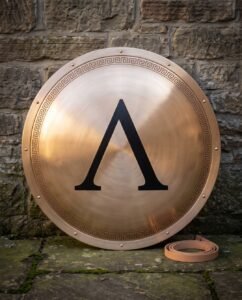 Gorgonward Hand Made Bronze Faced Greek Hoplon Shield | 32 Inch Aspis with Meander Border | Porpax Arm Band and Antilabe Grip | Spartan Display Gift | RK-1497
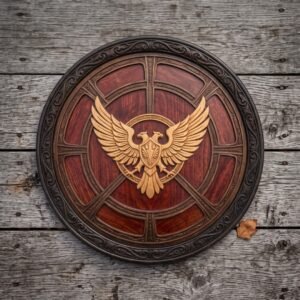 Twinhawk Hand Made Carved Hardwood Round Shield with Double Headed Eagle | 24 Inch Diameter | Blackened Steel Rim and Knotwork Band | Heraldry Display Gift | RK-1986
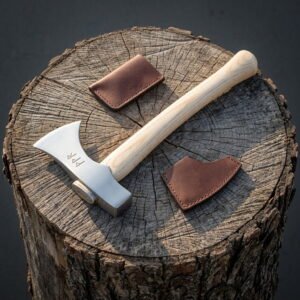 Ashbite Hand Forged Viking Hand Axe with Struck Rune Marks | 15 Inch Ash Handle | Polished Bearded Head, Leather Edge Sheath and Pouch | Camp and Bushcraft Gift | RK-1817
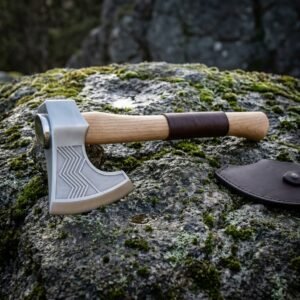 Notchcrown Hand Forged 1095 Steel Viking Hand Axe | 16 Inch Ash Haft | Chevron Etched Cheek and Hammer Poll with Snap Closed Leather Mask | Camp Gift | RK-1904
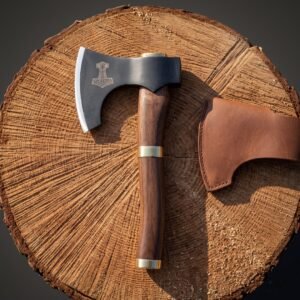 Hammerbeard Hand Forged 1095 Steel Bearded Axe | 16 Inch Rosewood Haft | Blackened Head with Etched Mjolnir, Brass Collar and Leather Blade Cover | Viking Camp Gift | RK-2105
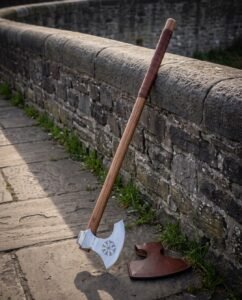 Wayfarrow Hand Forged Long Handled Viking Axe with Bearded Head & Etched Vegvisir | About 35 Inch Haft | Leather Grip Wrap and Fitted Leather Blade Cover | Norse Gift | RK-2204