
Blog
Axe vs Hatchet: The Difference That Actually Matters

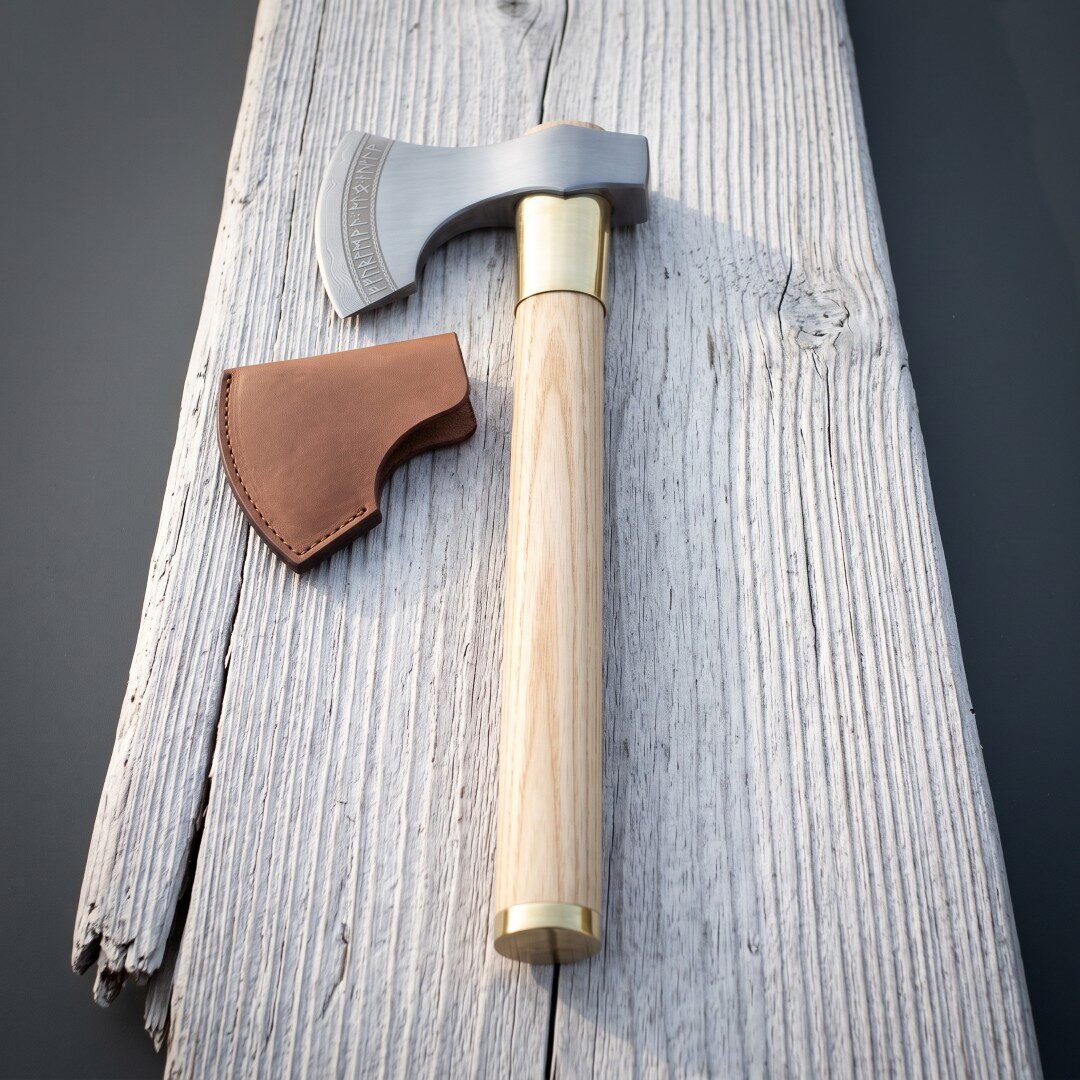
A hatchet is an axe. That is the whole taxonomy, and anyone selling you a sharp distinction is selling you something. What actually differs is haft length, head weight and the number of hands you use, and those three things change what the tool can do far more than the label on the box does.
The reason it matters is that people buy the wrong one constantly. They buy a hatchet expecting it to split rounds and it bounces. They buy a full sized axe for a rucksack and never take it anywhere. Getting this right is mostly a matter of being honest about what you are going to hit.
The Short Answer
A hatchet is a short axe meant for one hand, usually somewhere between ten and sixteen inches overall, with a head around a pound to a pound and a half. An axe, unqualified, usually means the two handed tool, twenty six inches and up, with a head of two and a half pounds or more. Everything in between exists and has its own names, none of which anybody agrees on.
What Actually Separates Them
 Stormbeard Hand Forged Damascus Viking Bearded Hatchet | 1095 and 15N20 Head | Rune Line Walnut Haft and Leather Mask | Camp and Bushcraft Gift | RK-1538
 Birchbite Hand Forged 1095 Carbon Steel Viking Hand Axe | 14 Inch Hickory Handle | Celtic Knotwork Etched Cheek and Leather Blade Mask | Camp Craft Gift | RK-1490
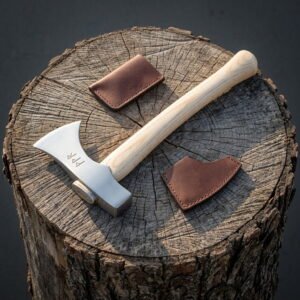 Ashbite Hand Forged Viking Hand Axe with Struck Rune Marks | 15 Inch Ash Handle | Polished Bearded Head, Leather Edge Sheath and Pouch | Camp and Bushcraft Gift | RK-1817
Haft length
Length is leverage and length is speed at the head. Double the haft and the head arrives faster for the same effort from your shoulder, which is why a long axe splits and fells and a short one does not. Length also costs accuracy and control, and it is the reason nobody carves a tent peg with a felling axe.
Head weight
Weight is the other half of the energy, and it is the part people underestimate. A one pound head moving fast delivers a fraction of what a three pound head delivers, and no technique closes that gap. Weight is also fatigue, and fatigue is where accidents come from.
One hand or two
This is the honest dividing line. If the tool is designed to be swung in one hand with the other hand holding the work, it is a hatchet, whatever the marketing calls it. Once you need both hands on the haft, the geometry, the safety rules and the technique all change.
What it is for
A hatchet is a processing tool. Splitting kindling, limbing small branches, driving pegs, shaping wood, opening a fire. An axe is a reduction tool. Turning a tree into logs and logs into firewood. The overlap in the middle is real, and it is where most of the confusion sits.
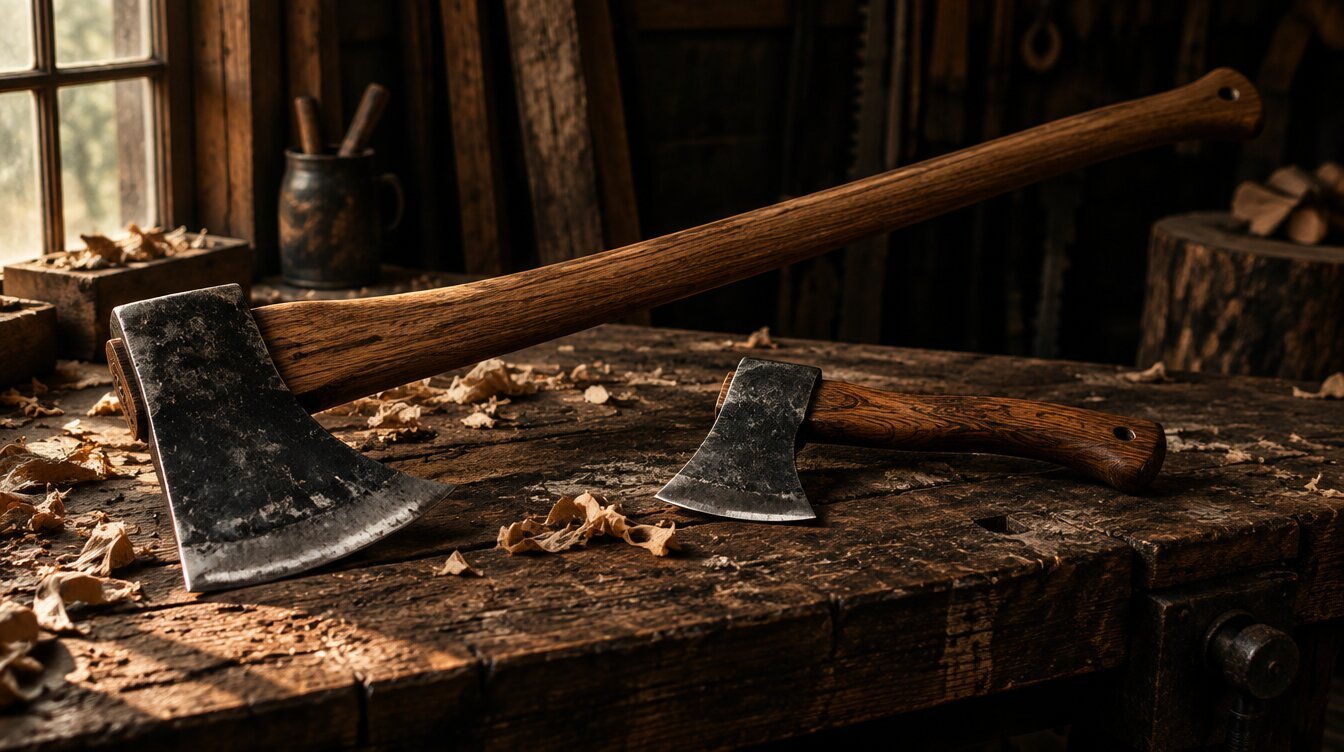
Axe Against Hatchet, Compared
| Factor | Hatchet | Full sized axe |
|---|---|---|
| Overall length | Roughly 10 to 16 inches | Roughly 26 to 36 inches |
| Head weight | About 1 to 1.5 lb | About 2.5 to 6 lb |
| Hands | One | Two |
| Best at | Kindling, limbing, carving, camp work | Felling, bucking, splitting rounds |
| Worst at | Anything thicker than your wrist | Fine work, and being carried |
| Carry | Belt, pack, glovebox | Vehicle, woodshed, both hands |
| Risk profile | Glancing blows toward the leg | Overstrike and fatigue |
The Middle Ground Nobody Names Consistently
Between the two sits a whole class of tools that different traditions call different things. A boy’s axe or three quarter axe runs somewhere around twenty four to twenty eight inches with a head near two and a quarter pounds, and it is arguably the most useful single axe most people could own. A camp axe or forest axe sits in the same territory with a thinner cheek for cutting rather than splitting. A hand axe means a short one handed axe in most of the world, and a Palaeolithic stone tool if you are talking to an archaeologist, which is one of the better traps in the English language.
None of these names are standardised. Read the numbers, not the noun.
Where the Bearded Shape Comes In
A bearded axe has the lower part of its blade drawn down and back into a hook, so the cutting edge is long while the head stays light. The Norse used the shape because it gave a wide edge without the mass a wide head would normally cost, and because the hollow behind the beard lets you grip the haft right up under the head for controlled cutting.
That second point is why bearded shapes turn up so often at hatchet size. Choking up behind the beard turns the tool into something closer to a heavy knife, which is exactly what you want for shaping wood, feathering a stick or taking bark off. A bearded hatchet is not a marketing hybrid; it is a genuinely old idea at a size that suits modern use. The shape itself is explained in full in what a bearded axe is, and how it compares with a plain battle shape is in battle axe against bearded axe.
The bearded axes range runs from short one handed heads to long hafted pieces, and the wider Viking axes range covers the rest.
Sizes and What They Are Honestly Good For
| Overall length | Head weight | What it does well |
|---|---|---|
| 10 to 14 inches | Around 1 lb | Kindling, carving, pack carry, one handed work close to the body |
| 14 to 19 inches | 1 to 1.75 lb | Camp work, small limbing, the practical bearded hatchet size |
| 20 to 26 inches | 1.75 to 2.5 lb | Two hands at a push, small felling, splitting seasoned rounds |
| 26 to 32 inches | 2.5 to 4 lb | Real felling and bucking, the general purpose axe |
| 32 inches and up | 4 lb and up | Splitting, mauls, sustained heavy work |
The Geometry Nobody Mentions
Head weight and haft length are only half the story. A splitting profile is thick behind the edge and flares quickly, so it wedges wood apart along the grain. A felling or cutting profile is thin behind the edge and stays thin, so it slices across the grain and buries itself. Put a splitting head on a short haft and you get a tool that bounces off everything. Put a thin cutting head into a knotty round and you will find the edge folded.
This is why a hatchet that splits kindling beautifully may be poor at carving, and why the axe that carves beautifully will disappoint you at the woodpile. Ask what the cheek looks like, rather than only what the head weighs. The full checklist for this is in how to choose a Viking axe.
How the Head Is Hung
On a short haft, the join matters more, not less. Every miss on a hatchet lands the haft on the wood just below the head, and a poorly seated head loosens fast under that. Look for a head seated deep in the eye with the wood proud at the top, a wedge driven properly rather than glued, and grain running in line with the blade rather than across it. Cross grain hafts snap, and they snap at the worst moment.
A leather or steel collar under the head is worth having on anything you will use one handed, because overstrike is not a possibility, it is a certainty. Replacement hafts are in axe handles and hafts.
Throwing Axes Are a Third Thing
A throwing axe is not a small chopping axe. The heads are lighter and the geometry is set up for rotation and for surviving repeated hard landings on a wooden target, which is a different requirement from cutting. Throwing a hatchet you intend to work with is a good way to loosen the head and chip the edge. There is a separate range for it, and the technique is in axe throwing for beginners. Where tomahawks fit is covered in Viking axe against tomahawk.
Steel and Edge
Our heads are forged from 1095 carbon steel at 54 to 58 HRC, or Damascus of 1095 and 15N20 at 58 to 60 HRC. For an axe, the lower hardness is a feature rather than a compromise: an edge that can roll and be filed back is far better on a tool that meets knots and grit than one that chips. What the numbers actually mean is in the steel glossary.
Carbon steel rusts. Wipe the head after use, keep a light oil on it, and take the edge back with a file and a stone rather than a grinder, which is the fastest way to ruin the temper. The method is in how to sharpen an axe, and if you have inherited something orange, removing rust from an axe covers the restoration.
So Which Should You Buy?
If you are outfitting a campsite and want one tool, take something around twenty four to twenty six inches with a head near two pounds. It splits kindling, limbs small wood, and can be used two handed on anything thicker.
If you already own a full sized axe and want the thing you actually carry, take a bearded hatchet in the fourteen to nineteen inch range. The beard gives you the choke grip for fine work and the long edge for the coarse work, and at that size it lives on a belt without becoming a decision.
If you want something for a wall, buy the piece you like the look of and accept what it is. A display axe with a long haft and an engraved cheek is a perfectly honest object as long as nobody pretends it is a felling tool. The line between the two is drawn in the best Viking axes guide, and the long two handed end of the family is in the Dane axe.
Carry and Common Sense
An axe or hatchet in a sheath, in a pack or in a vehicle is unremarkable almost everywhere in the United States. Carrying one openly on a belt through a town is a different conversation, and local rules vary more than people expect. Check before you travel with one, and treat any edge over a certain size as something to transport rather than to wear.
Where Ours Come From
Ransack Viking is a US company based in Chicago, Illinois. The axes are forged by hand in the Czech Republic, then imported, inspected and shipped from Chicago, which is where any engraving is cut after the head arrives. US orders ship free and tracked, with no import duty or customs delay, and every piece carries a lifetime warranty against defects with no expiry date. Engraving options are in custom engraving and the rest of the writing is in the guides.
Questions people ask
What is the difference between an axe and a hatchet?
Size and grip. A hatchet is a short axe designed for one hand, usually ten to sixteen inches with a head around a pound to a pound and a half. An axe usually means the two handed tool from about twenty six inches upward with a heavier head. A hatchet is a type of axe, not a separate tool.
Can a hatchet split firewood?
Kindling and small split rounds, yes. Full rounds off a log, no, and trying will loosen the head and blunt the edge. The energy simply is not there in a one pound head on a short haft, and no technique makes up the difference.
What is a bearded hatchet?
A short one handed axe whose blade is drawn down into a hook, giving a long cutting edge on a light head. The hollow behind the beard lets you grip the haft directly under the head for controlled carving, which is what makes the shape genuinely useful at that size rather than only decorative.
What size axe should I buy for camping?
Around twenty four to twenty six inches with a head near two pounds if you want one tool that does everything reasonably. If you already own a big axe and want something to carry, a bearded hatchet of fourteen to nineteen inches is the better second piece.
Is a hatchet the same as a hand axe?
In normal usage, yes, both mean a short axe used in one hand. The catch is that archaeologists use hand axe for a Palaeolithic stone tool, so the phrase means two entirely different objects depending on who you are talking to.
Can I throw my hatchet?
You can, and you will regret it. Throwing axes are built with lighter heads and geometry meant for rotation and repeated hard landings. A working hatchet thrown at a target loosens at the eye and chips at the edge, and neither of those is covered by good intentions.
What steel should an axe head be?
Something tough rather than something very hard. Plain 1095 at 54 to 58 HRC takes impact without chipping and can be filed back in the field, which matters more on a tool that meets knots and grit than a few extra points of edge retention would.
Why do Viking axes look so thin?
Because they were. Many excavated Viking Age heads are light, with thin blades and a wide edge, which made them cheap to make and quick in the hand. That geometry is a fighting and light working shape, not a splitting one, and modern reproductions that keep the look usually add thickness for the sake of the woodpile.
Where to see these
The catalogue carries the Birchbite Viking axe and the Stormbeard Viking bearded hatchet. So do the Twinbite double bit axe and the Wayfarrow handled Viking axe.
Shop the range
Stormbeard Hand Forged Damascus Viking Bearded Hatchet | 1095 and 15N20 Head | Rune Line Walnut Haft and Leather Mask | Camp and Bushcraft Gift | RK-1538Birchbite Hand Forged 1095 Carbon Steel Viking Hand Axe | 14 Inch Hickory Handle | Celtic Knotwork Etched Cheek and Leather Blade Mask | Camp Craft Gift | RK-1490Ashbite Hand Forged Viking Hand Axe with Struck Rune Marks | 15 Inch Ash Handle | Polished Bearded Head, Leather Edge Sheath and Pouch | Camp and Bushcraft Gift | RK-1817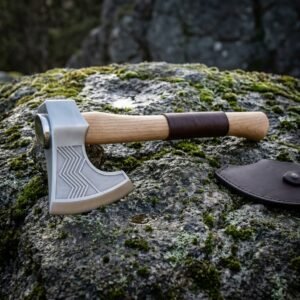 Notchcrown Hand Forged 1095 Steel Viking Hand Axe | 16 Inch Ash Haft | Chevron Etched Cheek and Hammer Poll with Snap Closed Leather Mask | Camp Gift | RK-1904
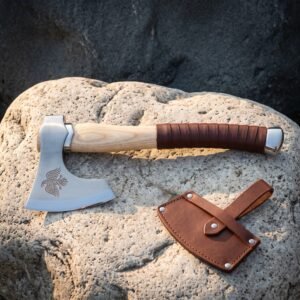 Ravenhaft Hand Forged 1095 Steel Raven Axe | 15 Inch Ash Haft | Etched Raven Head with Leather Wrapped Grip and Snap Closure Sheath | Norse Gift | RK-1918
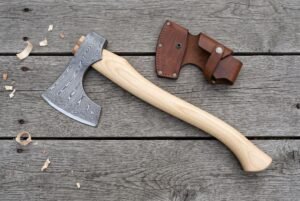 Palefrost Hand Forged Damascus Viking Bearded Axe | 19 Inch | Birch Wood Handle with Leather Blade Cover and Gift Box | Norse Collector and Wedding Gift | RK-351