Blog
How to Sharpen an Axe: Step-by-Step (File, Stone, Strop)

Sharpening an axe takes three stages: a mill file to remove chips and set the bevel, a sharpening stone to refine what the file left, then a leather strop until the bit cuts paper cleanly. That is 20 to 40 minutes on a neglected axe and under 10 minutes on one that just needs a touch-up. None of it needs a power tool, which is just as well, because a power tool is what ruined most of the edges that end up needing the full treatment. This guide walks through each stage in order, with a tool checklist, the mistakes that ruin edges, and a maintenance schedule that keeps you from repeating all three.
Everything below applies to felling axes, hatchets, camp axes, and hand-forged carbon steel axes like the ones in our Viking axe collection. Carbon steel takes a keener edge than most hardware-store axes, but the technique is identical.
What You Need Before You Start
You do not need a bench grinder, and for most axes you should not use one. Power tools remove metal fast and can overheat the edge, which ruins the heat treatment in seconds and cannot be undone afterwards. Hand tools are slower, and that is the entire point of them.
| Tool | Purpose | When You Need It |
|---|---|---|
| Bastard mill file (8 to 10") | Removes chips, rolls, and heavy dullness; sets the bevel | Damaged or very dull edges |
| Coarse stone (220 to 400 grit) | Erases file scratches, begins refining | After filing |
| Fine stone (600 to 1000 grit) | Produces a clean working edge | Every sharpening |
| Leather strop + compound | Removes the burr, polishes to shaving sharp | Final step and quick touch-ups |
| Vise or clamp | Holds the axe dead still | Always |
| Cut-resistant gloves | Protects your file hand | Always |
| Marker | Ink the bevel to check your angle | Helpful for beginners |
Safety first: clamp the axe securely before any stroke, keep both hands behind the cutting edge, wear gloves, and stroke away from your body whenever possible. A slip onto a freshly filed edge cuts deep.
How to Sharpen an Axe Step by Step
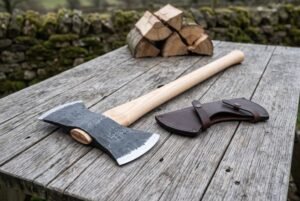

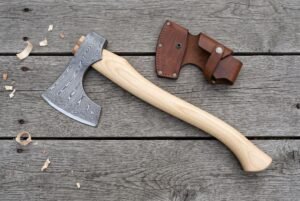 Palefrost Hand Forged Damascus Viking Bearded Axe | 19 Inch | Birch Wood Handle with Leather Blade Cover and Gift Box | Norse Collector and Wedding Gift | RK-351
Step 1: Clean the Head and Inspect the Edge
Wipe the head with a rag and a little degreaser or WD-40 to remove sap and grime, and knock off any light surface rust with fine steel wool. Then sight down the edge under a light. Shiny flat spots mean dullness; visible nicks mean you will start with the file; a rolled or wavy edge means the same. If the edge only feels slightly dull and has no damage, skip straight to Step 4.
Step 2: Clamp the Axe Securely
Fix the handle in a vise with the head horizontal and the bit facing away from you, or clamp the head to a bench with the edge overhanging. The axe must not move at all. A shifting workpiece is how fingers meet edges. Color the bevel with a marker so you can see exactly where your file is cutting. It looks fussy and it saves you ten minutes of guessing.
Step 3: File the Bevel to Shape
Hold the file at the existing bevel angle, most working axes carry roughly 25 to 30 degrees per side, with a slightly convex profile. Push the file across and along the edge in smooth, overlapping strokes, cutting on the push only; lift the file on the return, because dragging it backward dulls the file’s teeth. Work one side until you raise a burr (a thin wire of metal you can feel on the opposite side), then flip the axe and match the same number of strokes on the other face. Keep going until nicks are gone and the marker ink is removed evenly from heel to toe of the bit.
Step 4: Work the Coarse Stone
Move to a 220 to 400 grit stone, lubricated with water or honing oil depending on the stone type. Use small circular motions or sweeping strokes along the bevel, maintaining the same angle the file established. Your goal here is simply to erase the file scratches and even out the scratch pattern on both sides. On an axe it is often easier to move the stone over the clamped head rather than the head over the stone. Puck-style axe stones exist for exactly this reason.
Step 5: Refine with the Fine Stone
Switch to 600 to 1000 grit and repeat with lighter pressure. Alternate sides every few strokes now, which keeps the burr small and centered. When the bevel shows a uniform, near-mirror scratch pattern and the edge catches gently on a thumbnail along its full length, you are ready to strop. For a deeper look at why steel type changes how fine an edge you can hold, see our guide to Damascus steel vs stainless steel.
Step 6: Strop to a Shaving Edge
Load a leather strop with honing compound and draw the edge backward, spine leading, edge trailing, at the bevel angle, 10 to 15 light passes per side, alternating. Stropping stands the microscopic edge up straight and strips away the last of the burr. Test by slicing a sheet of paper: a properly finished axe should cut it cleanly with little pressure. Some people take it all the way to hair-shaving sharp. For splitting work that is effort spent on an edge the wood will blunt by lunchtime, and stopping at the fine stone is plenty.
Step 7: Protect the Fresh Edge
Wipe the head clean and apply a thin coat of oil (3-in-1, camellia, or even mineral oil) to prevent rust, especially on carbon steel. Oil the handle occasionally with boiled linseed oil if it is wood, and store the axe in a dry place with an edge cover. A sharp axe left bare in a damp shed will be a dull, speckled axe by spring.
Five Mistakes That Ruin Axe Edges
Grinding on a power wheel. Overheating turns the edge straw-blue and soft; the axe will never hold sharpness again without serious regrinding.
Chasing a razor-thin angle. An axe edge takes impact. Go thinner than about 20 degrees per side and the edge chips or rolls on the first knot. An axe is not a razor, and the knot does not care how thin you got it.
Sharpening only one side. Uneven bevels steer the axe in the cut and leave the apex off-center. Count strokes and mirror them.
Ignoring the burr. If you never feel a burr, you never reached the apex. The axe will look sharpened and will still crush fibers instead of cutting them.
Dragging the file both directions. Files cut one way. Pressure on the backstroke wears the teeth and glazes the file.
Simple Axe Edge Maintenance Schedule
After every heavy session, wipe the head and give it 10 strop passes per side. Touch up on the fine stone every few outings, or the moment the edge stops biting and starts glancing. Reach for the file only when you see damage. Kept on this schedule, a quality carbon steel axe, like a hand-forged piece from our axe collection, may go years between full filings. The same wipe-and-oil habit applies to field blades too; our hunting knives and Viking knives stay sharp far longer with a strop hanging near the back door.
Axe Sharpening FAQ
What angle should I sharpen an axe at?
Most general-purpose and felling axes perform best at roughly 25 to 30 degrees per side with a slightly convex bevel, while dedicated splitting tools can run blunter. Rather than measuring obsessively, match the factory bevel: ink it with a marker, take a few file strokes, and adjust your angle until the ink wears off evenly across the full bevel width.
Can I sharpen an axe with just a file?
Yes. A sharp mill file alone will take an axe from damaged to genuinely usable, and plenty of woodsmen carry only a file in the field. The stone and strop stages refine that edge so it slices rather than tears, lasts longer between touch-ups, and resists chipping. They are refinements. The file does the real shaping work, and it is the one stage you cannot skip.
How often should an axe be sharpened?
Touch up little and often rather than rescuing a wrecked edge occasionally. A quick strop after each use and a few minutes on a fine stone every several sessions keeps the edge working. If you find yourself swinging harder to get the same bite, or the axe glances instead of sticking, it is overdue.
Should an axe be shaving sharp?
A limbing or carving axe benefits from a shaving-sharp, stropped edge because it slices across grain. A splitting maul does not. It works by wedging, so a clean edge off a medium stone is plenty. Sharpen to the task rather than to impress anyone: sharper is better for cutting wood fibers, but durability matters more than polish for splitting rounds.
Why does my axe dull so quickly?
The usual culprits are contact with dirt and stone (chopping too close to the ground), an edge left too thin for hard or knotty wood, or soft steel from a previous overheating on a grinder. Sharpen with hand tools only, keep a chopping block under your work, and thicken the bevel slightly if the edge keeps rolling.
Do hand-forged axes need different sharpening?
The process is identical. Hand-forged high-carbon heads are usually harder than budget hardware-store axes, so they reward the extra stone and strop stages with a noticeably keener, longer-lasting edge. They also rust faster than coated axes, which means the finishing oil wipe stops being optional. Every axe we ship from Chicago, IL arrives with a usable edge that this routine will keep working for decades.
A sharp head still rusts, so pair this with taking rust off an axe head and with the wider routine in our knife care guide. For where these shapes came from, read our Viking axe history, and if you sharpen mainly to throw, see throwing an axe as a beginner.
On the shelf
Closest to this in the shop, the Barkbiter felling axe and the Ashfell felling axe. Alongside them, the Bindwood hickory axe handle and the Haftmask leather axe sheath.
Shop the range
Palefrost Hand Forged Damascus Viking Bearded Axe | 19 Inch | Birch Wood Handle with Leather Blade Cover and Gift Box | Norse Collector and Wedding Gift | RK-351