Blog
The Seax: The Knife Every Viking Carried

The seax was the one blade nearly every person in the Viking world carried. Part utility knife, part sidearm, this single-edged blade hung from the belt of farmers, traders, warriors, and often women too, ready for everything from cutting rope and preparing food to settling a fight when nothing else was at hand. Swords belonged to the wealthy and axes to the battlefield. The seax belonged to everyone, which is why viking seax history is really the history of everyday Norse life rather than a chapter of military history, and the knife was so tied to identity in the wider Germanic world that an entire people, the Saxons, are commonly thought to take their name from it.
What Exactly Is a Seax?
A seax (also spelled sax, scramasax, or in Old Norse simply sax) is a single-edged knife or short sword used across the Germanic world from roughly the fifth century through the end of the Viking Age. The defining features are:
A single cutting edge
Unlike the double-edged Viking sword, the seax sharpened only one side, with a thick spine that gave the blade strength for hard utility work and chopping cuts.
A worn-flat carry
Archaeological finds of scabbard fittings and grave layouts show the seax was typically worn horizontally at the front of the belt, edge upward, where it could be drawn instantly with either hand, a detail many modern replicas and TV costumes get wrong.
A full range of sizes
“Seax” covers everything from a palm-sized work knife to the langseax, a blade long enough to serve as a short sword. Size, decoration, and steel quality tracked the owner’s wealth.
Types of Seax: From Pocket Knife to Short Sword
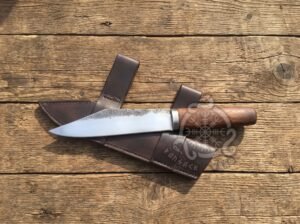
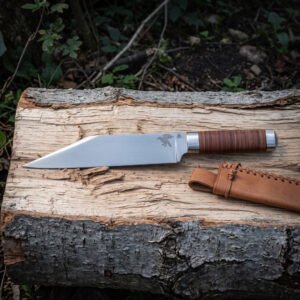
Archaeologists group seaxes by blade shape and length. The table below summarizes the broad types you will see referenced in museum catalogs and serious reproductions.
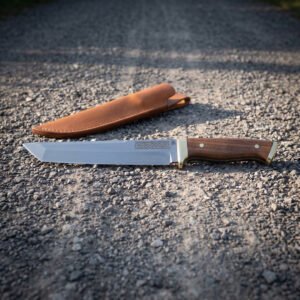
| Type | Typical Blade Length | Notes |
|---|---|---|
| Hadseax / small knife | Under 4 in (10 cm) | Everyday utility knife; the most common find in settlements |
| Narrow seax | 4 to 14 in (10 to 35 cm) | General-purpose belt knife of the early period |
| Broadseax | 8 to 14 in (20 to 35 cm) | Wider, heavier blade; common on the Continent |
| Broken-back seax | Varies, often 8 to 22 in | Distinct angled spine that drops sharply to the point; iconic in England and Scandinavia in the 8th, 10th centuries |
| Langseax | Over 20 in (50 cm+) | Effectively a single-edged short sword; a fighting blade |
The broken-back seax is the silhouette most people picture today: a straight edge, a spine that runs level and then angles down abruptly to a clipped point. The most famous example is the Seax of Beagnoth, dredged from the River Thames and inscribed with the only complete carved runic alphabet (futhorc) known on a blade, an Anglo-Saxon piece, but from the same shared knife culture the Vikings belonged to.
The Broken Back Seax in Detail
If one shape says seax, this is it. The edge runs straight from the handle. The spine runs level for most of the blade, then breaks downward at a sharp angle and runs straight to meet the edge at the point. There is no curve to it. The angle is a deliberate corner, which is why the form is called broken back, and why once you have seen one you can pick it out of a case across the room.
Why build a blade that way? Nobody left an explanation, so what follows is reasoning from the object. The break puts the point below the line of the spine, so in a normal grip the tip sits roughly in line with the forearm, which is what you want for a thrust or for driving the point into a joint while butchering. It leaves a long stretch of straight edge, which is what you want against a board or a piece of rope. It puts more steel behind the point than a leaf shape of the same length, so the tip is stiff and hard to snap. And it is quick to forge, with no curve to chase.
The type turns up widely in England and Scandinavia in the later part of the period. The best known survivor is the Seax of Beagnoth, dredged from the Thames and now in the British Museum, which carries an inlaid runic alphabet and a name along the blade. It is an Anglo-Saxon piece rather than a Norse one, but the knife culture on both sides of the North Sea was the same.
The Langseax: A Knife That Became a Short Sword
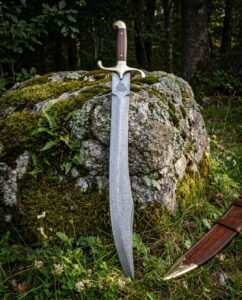
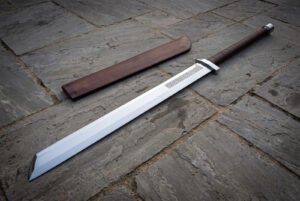
At the top of the size range the seax stops being a knife in any useful sense. The langseax, meaning simply long sax, runs past about 50 cm of blade and in some finds a good deal more: single edged, thick spined, heavy toward the point.
Two things make it a different tool from a belt knife. The first is reach. The second is where the mass sits. A double edged Viking sword is tapered and fullered so the balance stays close to the hand, which is what lets it change direction quickly. A langseax keeps a thick spine most of the way along, so the weight sits further forward and the blade wants to cut in the direction it is already going. It hits harder than its size suggests and recovers more slowly, so it behaves like a very long chopping knife and not much like a sword.
Cost matters too. A single edged blade with a thick spine needs less good steel than a sword and less skilled work, since only one bevel has to be ground true and there is no fuller to sink. For a man who could not afford a sword, a langseax was the closest he could get, and unlike a sword it stayed useful for ordinary work.
Who Carried the Seax, and Why It Mattered
In Viking Age Scandinavia the knife was the one edged implement that crossed every social line. Grave excavations across Norway, Sweden, and Denmark routinely include knives in male and female burials alike, rich and poor. A farmhand used his sax for cutting bread, whittling pegs, and butchering; a wealthy man might carry one with a silver-wired hilt and a decorated scabbard as jewelry that worked for a living.
The seax also carried legal and symbolic weight in the wider Germanic world. Carrying a blade openly marked a free person, and the everyday knife was the most accessible one there was. The traditional explanation of the name of the Saxons, that they were the “people of the sax”, goes back to medieval writers; like many early etymologies it cannot be proven beyond doubt, but it shows how completely this blade was identified with the culture that carried it.
How a Seax Was Made
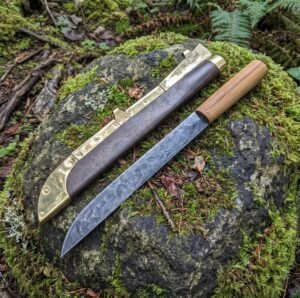
Most seaxes were forged from bloomery iron with a harder steel edge welded on, the same economical construction used for axes. High-status blades went much further: pattern-welded seaxes survive in which rods of iron and steel were twisted and forge-welded into rippling patterns along the blade, then finished with inlaid wire, runes, or maker’s marks. That layered look is the ancestor of what modern knife buyers call Damascus steel. If the watery pattern appeals to you, our guide to Damascus steel vs stainless steel explains how today’s version compares.
Handles were typically a simple full or partial tang fitted into wood, antler, or horn, usually without a guard. Scabbards were leather, often decorated and riveted along the edge rather than seamed at the back, made to hang horizontally from two belt loops.
How the Seax Was Worn
The carry is the part modern reproductions and screen costumes most often get wrong, and it is one of the better attested details we have, which makes the error harder to forgive. Seaxes hung horizontally across the front of the belt, edge upward, from two or three points on the scabbard rather than a single loop at the throat.
The evidence comes from two directions. Graves preserve the position: scabbard fittings, rivets and the corroded blade are found lying across the pelvis, running left to right rather than down the thigh. And the scabbards are built for it. A seax scabbard is a folded leather sheath riveted along the edge side, not up the back, and decorated on the face that would show. Slung vertically, the ornament would be pressed against the leg.
Edge up also solves a practical problem. A single edged blade riding edge down in a soft sheath saws at the seam every time the wearer sits or bends. Turn it over and the spine takes the wear, which is why the rivets sit on the edge side, giving the edge something solid to lie against. The draw follows from the position: the hand comes across the body and the knife comes out flat with the edge already turned the useful way. Either hand can reach it, which is not true of a knife on the hip, and it stays reachable while riding, rowing or sitting to eat.
The Seax in a Fight
The seax was a backup blade rather than a battlefield primary. Spear, axe and sword did the front-line work. But at grappling range, in a doorway, or when a shield wall collapsed into a scrum, a stout single-edged blade that could be drawn lying flat against the body was worth everything. The thick spine let a fighter drive the point through layered clothing, and the single bevel took hard abuse that would snap a slimmer knife.
Saga literature is full of knives used in close quarters and night attacks, and while the sagas are later literary works rather than eyewitness records, they consistently portray the knife as the blade that was simply always there. That is the seax’s real story: not glamour, but presence.
A Seax and a Modern Viking Knife Are Not the Same Thing
Most knives sold as Viking knives today, ours included, are reproductions in the historical spirit rather than copies of a specific find. Anyone telling you otherwise is selling a story alongside the knife. It is worth being clear about where the two part company.
Start with the steel. A Viking Age seax was bloomery iron with a hardened steel edge forge welded on, because good steel was scarce and the smith spent it only where it cut. Hardness was uneven and nobody measured it. A modern blade is one known steel, hardened through and tested. Our plain carbon seaxes are 1095 at 54 to 58 HRC. The Damascus pieces are 1095 and 15N20 forge welded in layers and finished at 58 to 60 HRC, harder than any Viking Age knife and holding an edge accordingly.
Then the geometry. Originals were often thinner behind the edge than buyers expect, and the ones in cases have lost metal to corrosion on top of that. Reproductions carry a slightly thicker edge, because a knife sold to be used has to survive an owner who will eventually pry with it, whatever the listing told him not to do. Handles are the other honest difference. Viking handles were wood, antler or horn on a full or partial tang, almost never with a guard, and shaped to one owner’s hand. Modern handles are fitted to a pattern, and some designs add a small guard that no original had, which is a safety choice rather than a historical one.
Every blade we sell is handmade in the Czech Republic by smiths working the old way, then imported, inspected and shipped from Chicago, Illinois, with engraving done in the US. That is a hand forged blade with a documented steel and heat treatment, which is a different proposition from a museum piece and, for anything you intend to use, a better one.
Hand-forged reproductions in the historical spirit are the core of our Viking seax collection, and the broader Viking knives range includes smaller belt knives closer to the everyday hadseax. If the layered pattern is what draws you, the Damascus knives are the closest thing on the market to the pattern-welded blades the wealthiest Norsemen carried, and a fixed-blade from our hunting knives line covers the same jobs a Norse farmer asked of his sax. When you get to choosing one, our Viking seax knife buyer’s guide walks through blade length, tang, handle and sheath in the order that matters.
How the seax compares with the American Bowie is set out in the seax against the Bowie, and if you are buying one rather than reading about it, see our guide to picking a Norse knife.
Questions people ask
What does the word seax mean?
Seax is simply the Old English word for knife, related to Old Norse sax and going back to a Germanic root meaning to cut. In modern usage it refers specifically to the single-edged knives and short swords carried across the Germanic and Norse world from about the fifth century to the eleventh.
Is a seax a knife or a sword?
Both, depending on size. The same basic single-edged design was made in lengths from a small utility knife of a few inches up to the langseax at over 20 inches of blade, which functioned as a short sword. Archaeologists classify them by blade length and shape rather than drawing one hard line between knife and sword, because the evidence does not offer one.
What is a broken-back seax?
A seax style with a straight edge and a spine that runs level before angling down sharply to the point, creating a distinctive clipped profile. The angle is a corner rather than a curve. It became widespread in England and Scandinavia during the eighth through tenth centuries, and the rune-inscribed Seax of Beagnoth from the Thames is its most famous surviving example.
How was a seax worn?
Horizontally at the front or side of the belt with the edge facing up, hanging from two or three points on the scabbard. Grave finds show the blade lying across the pelvis, and the scabbards are riveted along the edge side and decorated on the outward face. Edge up keeps the blade off the seam and lets either hand draw it flat and fast.
Did Viking women carry a seax?
Knives appear regularly in female Viking Age graves, which is strong evidence that women routinely carried and used them, primarily as daily tools for food preparation, textile work, and farm tasks. Larger fighting-sized seaxes are found mostly in male burials, but the everyday belt knife belonged to everyone. It was a tool long before it was anything else.
How is a modern seax different from a Viking Age one?
The shape can be close; the metal is not. An original was soft iron with a hardened steel edge welded on, uneven in hardness and now thinned by corrosion. A modern blade is one known steel through the whole piece, hardened and tested, usually with a slightly thicker edge so it survives real use. Handles follow a pattern rather than one owner’s hand.
Were seaxes pattern-welded like Damascus steel?
High-status examples were. Smiths twisted and forge-welded rods of iron and steel into decorative layered patterns, sometimes adding inlaid wire or runes. Modern Damascus achieves a similar layered look with cleaner materials, though today it is chosen mainly for appearance and edge performance rather than necessity. The Viking smith layered steel because he had to.
For one built to your own measurements, build a custom seax and choose the blade shape, the steel, the blade length and the handle material.
From the shop
In the shop right now, the Anglosaxon Viking Seax knife and the Knotsax broken back Seax. The Deepgrove Viking Seax knife and the Langfell Viking Seax sit next to them.
A knife that grew up
Build a seax long enough and you end up somewhere near a messer, a sword put together like a knife. What a messer is covers the type, and the Brunhak messer trainer is a blunt one for club use. The rest are in HEMA messers.

4 thoughts on “The Seax: The Knife Every Viking Carried”
Comments are closed.