
Blog
Odin’s Ravens: Huginn and Muninn in the Sources

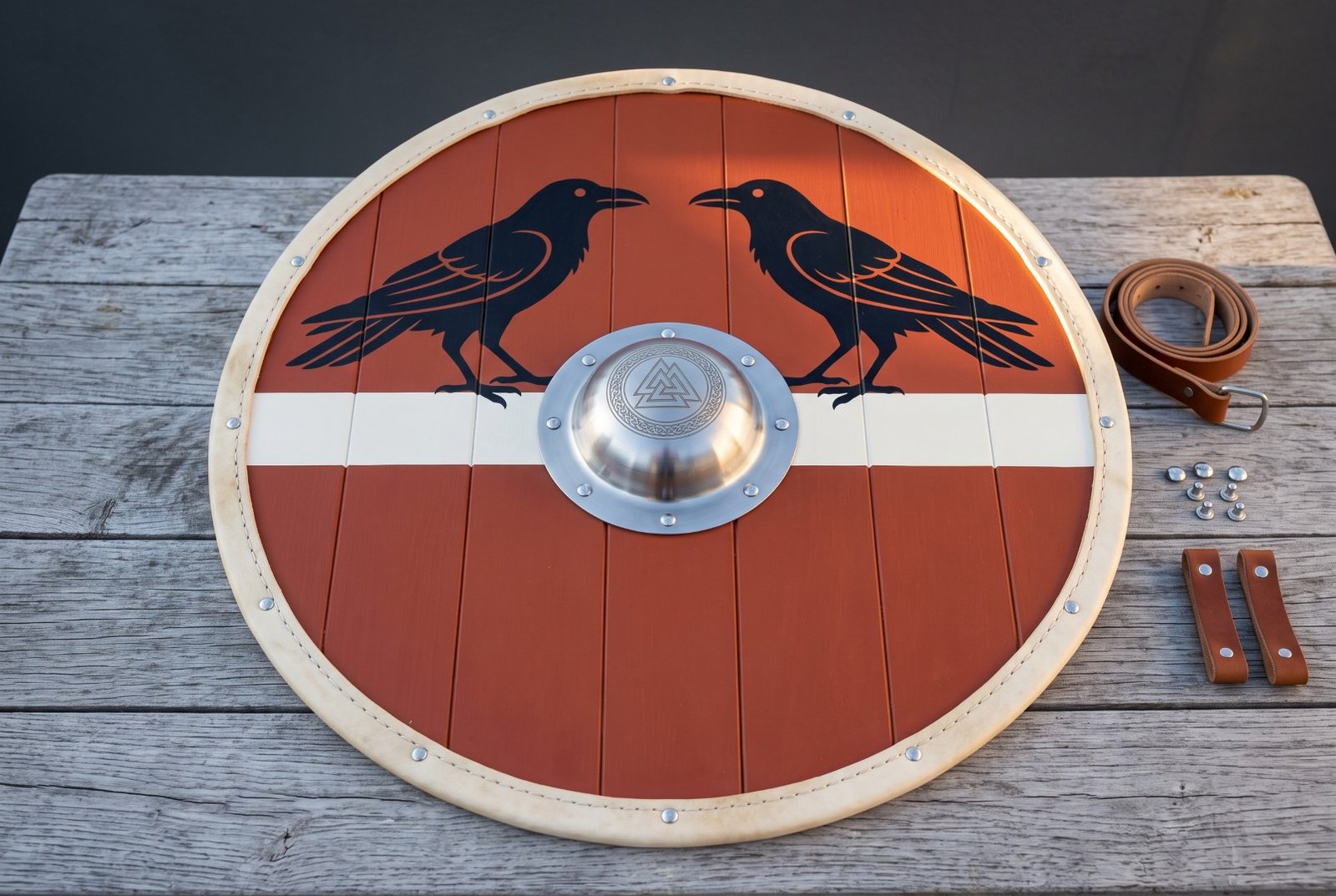
Huginn and Muninn are Odin’s two ravens. They are named in Grimnismal in the Poetic Edda, where Odin says they fly over the whole world every day and that he fears for their return, and Snorri Sturluson fills in the picture around 1220: they perch on his shoulders and tell him everything they have seen. The names mean roughly thought and memory. Everything else you have read about them was added later by somebody with a page to fill.
That is the whole documented core, and it is a good deal smaller than the merchandise implies. What follows sets out the stanza itself, what Snorri added, where the names come from, and the much larger role real ravens play in Norse poetry and on the battlefield.
The stanza that carries it
Grimnismal stanza 20 is the earliest surviving text that names the pair. In it Odin says that Huginn and Muninn fly each day over the wide earth, that he fears Huginn will not come back, and that he fears still more for Muninn. Odin is speaking in the first person, half starved between two fires, and the line is not a piece of scene setting. It is an admission of anxiety from the god who is supposed to know everything.
Read it closely and the order is strange. He fears for the bird of thought, and he fears more for the bird of memory. If the ravens stand for his own faculties, the god of wisdom is telling us that losing memory would be worse than losing thought. That is the reading most people take, and the poem does not confirm it. It just puts the two fears side by side and moves on.
The stanza before it names Odin’s wolves, Geri and Freki, and says he gives them all his food while he himself lives on wine alone. The birds and the wolves belong together in the poem as the animals of a god who is fed by others and who feeds others.
What Snorri adds
In Gylfaginning, part of the Prose Edda that Snorri assembled around 1220, the account gets specific in a way the poetry never bothers to. Two ravens sit on Odin’s shoulders and speak into his ear all the news they see and hear. He sends them out at daybreak, they fly over the whole world, and they come back at breakfast. This is how he comes by so much news, Snorri says, and it is why people call him the raven god.
The shoulder perch, the schedule and the raven god title are Snorri’s contribution to the picture, drawn from poetic tradition he knew and written down two centuries after anyone was worshipping the man. The daily flight and the two names come from the older verse. Keeping those apart is worth doing, because the shoulder image is the one that ends up on almost every modern pendant and it is the part with the shallowest roots.
The names
Huginn comes from hugr, which covers mind, thought and intention. Muninn comes from munr, and munr is the slippery one. It can mean memory, but it also carries desire, will and affection depending on context. Memory is the standard translation and it is not the only defensible one. Some scholars prefer to leave munr closer to mind or desire, which changes the tidy thought and memory pairing that gets printed on product tags.
What the pair might mean
The mental faculties reading
The common academic reading treats the ravens as externalised parts of Odin himself: his thought and his memory sent out into the world and returned. This sits well with the shamanic elements people find in Odin, the god who changes shape, who lies as if dead while his spirit travels, who wins knowledge through ordeal. Hilda Ellis Davidson wrote along these lines, and the reading has the merit of taking Odin’s stated fear seriously.
The sceptical reading
Rudolf Simek pushed back, arguing that Huginn and Muninn as named personifications of thought and memory look like a relatively late poetic development rather than an ancient belief, and that the older layer is simply the association between Odin and ravens as birds of the slain. On that view the names are a poet’s neat idea that stuck, and Snorri built a scene around it.
Both readings are still in play. What nobody can do is point to a Norse text that explains the ravens, because none exists. The sources describe them and stop.
Ravens outside the myth
The beasts of battle
Ravens are everywhere in skaldic verse, and mostly not as Odin’s messengers. Poets praise a lord by saying he fed the raven, reddened the raven’s beak or gladdened the carrion bird, which is a compact way of saying he won and left the dead behind. Old English poetry uses the same convention, with the raven, the eagle and the wolf appearing together before a battle. The birds are real scavengers before they are anything else, and ravens genuinely do follow wolves and track carcasses, so the poetry is built on observation.
The raven banner
Viking armies carried raven banners. The Anglo-Saxon Chronicle records a banner taken from a Norse force in Devon in 878, and later English tradition attached the name Raven to it. Orkneyinga saga gives the most memorable version, where Earl Sigurd’s mother makes him a raven banner that will bring victory to the man it is carried before and death to the man who carries it. Sigurd loses standard bearer after standard bearer and finally carries it himself, which tells you how that ends.
The archaeology
Helmet plates from Vendel and Valsgarde in Sweden show helmeted figures accompanied by birds, and small metal figures of a seated person flanked by two birds turn up in Scandinavian contexts. The best known is a small silver figure found at Lejre in Denmark in 2009, seated on a high chair between two birds. It is often labelled Odin with Huginn and Muninn. Some specialists have argued instead that it depicts Freyja on the high seat, and the debate has not closed. That uncertainty is typical: the images are suggestive and none of them is captioned.
Why the ravens took over the merchandise
Two birds make a good design. They fill a round shield face, they mirror each other across a blade or a pendant, and they read instantly at any size. Add the fact that Odin is the most written about of the Norse gods and the pair became the default Norse motif after Thor’s hammer. That is a decision about graphic design, not about theology. Our guide to Viking symbols and their meanings covers where the rest of the set sits on the scale from attested to invented, and the piece on the Valknut deals with the other symbol most often tied to Odin.
Raven pieces we make
The pair turns up right across the catalogue, and we cut them with the sources in mind rather than the film versions. There are raven etched blades in our Viking knives range, including seax patterns named for Huginn and Munin, raven motifs on the heads and hafts in Viking axes, and on the shields, spears and larger pieces in Norse arms. Smaller mirrored raven work suits the discs and bails in our Norse pendants. If you want a name, a date or a line of Elder Futhark added under the birds, that runs through our engraved and personalised range. So there is no confusion about how it is made: Ransack Viking is a US company in Memphis, Tennessee, every piece is handmade in the Czech Republic the old way, then imported, inspected and shipped from Memphis, and engraving is done in the US after the piece arrives. Blade steel is plain 1095 at 54 to 58 HRC, or Damascus of 1095 and 15N20 forge welded at 58 to 60 HRC.
Judging a raven design
Look at the head and the beak first. A raven has a heavy wedge shaped beak with a slight downward curve, a shaggy throat and a wedge tail. A crow has a slimmer straight beak and a fan tail. A great many pieces sold as ravens are drawn as crows, and once you can see it you cannot stop seeing it. On mirrored pairs, check the two birds are true mirrors rather than one bird copied and flipped badly, which shows up in the feet and the eye placement.
On etched steel the danger is filling in. Fine feather lines etched too deep bleed into each other and the bird becomes a black blob at arm’s length, so a good design keeps the feather detail in the wing and leaves the body clean. On a seax, where the blade is broad and the spine is straight, the birds usually sit better along the spine than across the belly of the blade. Our post on the history of the seax explains why that blade shape gives so much room for decoration, and Viking axe history covers the equivalent problem on an axe cheek.
Odin himself is set in context in the guide to the Norse gods, and what he is preparing for is explained in Ragnarok.
Questions people ask
Who are Huginn and Muninn?
Odin’s two ravens, named in Grimnismal in the Poetic Edda. Odin says they fly over the wide earth every day, that he fears Huginn will not return, and that he fears more for Muninn. Snorri Sturluson, writing around 1220, describes them perching on Odin’s shoulders and reporting the news of the world into his ear each morning.
What do the names Huginn and Muninn mean?
Huginn comes from hugr, meaning mind or thought. Muninn comes from munr, which is usually translated memory but also carries desire, will and affection. Thought and memory is the standard rendering and it is a simplification. Anyone telling you the names have a single fixed meaning is smoothing over a genuine ambiguity in the Old Norse.
Are Odin’s ravens attested in the Viking Age?
The pairing of Odin with ravens is well grounded in Norse poetry, and the two named birds appear in Grimnismal, an eddic poem whose material is generally taken as pre-Christian in origin even though the manuscripts are later. The shoulder perching scene and the daily timetable are Snorri’s thirteenth century elaboration, so the two layers are worth keeping apart, whatever the pendant description tells you.
Why does Odin fear losing them?
No source explains it. If the ravens are his own thought and memory sent abroad, the fear is a fear of losing his mind, and that reading fits the shamanic elements elsewhere in Odin’s story. Rudolf Simek argued instead that the named pair is a late poetic personification. Both positions are defended in the scholarship and neither can be proved from the text, which has never stopped anybody stating one of them flatly.
Did Viking armies really use raven banners?
Yes. The Anglo-Saxon Chronicle records a banner captured from a Norse force in Devon in 878, and Orkneyinga saga describes Earl Sigurd’s raven banner, woven by his mother, which brought victory to the host and death to whoever carried it. Ravens also appear constantly in skaldic verse as the birds fed by a successful commander after a battle.
How do I tell a raven design from a crow?
Beak and tail. A raven has a heavy wedge shaped beak with a slight downward hook, a shaggy throat and a wedge shaped tail. A crow has a slimmer straight beak and a fan tail. A large share of pieces sold as ravens are drawn as crows by people who have not looked closely at either bird. On mirrored pairs, check the feet and the eyes to be sure the two birds are true mirrors.
Shop the range
 Beltsax Hand Forged High Carbon Steel Viking Seax Knife with Premium Cowhide Sheath | Compact Norse Belt Knife and Collector Gift | RK-656
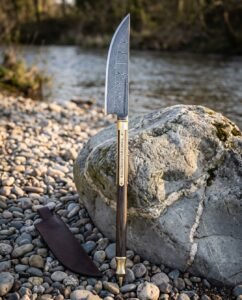 Riverclaw Hand Forged Damascus Viking Bowie Knife | 14 Inch Overall with a 9 Inch Blade | Rosewood Handle, Rune Cut Brass Bolster and Leather Sheath | Hunting Camp Gift | RK-1736
 Runechain Hand Forged 1095 Steel Rune Etched Chain Knife Pair | Two Blades Two Chains and Two Leather Sheaths | Ring Pommels and Leather Grips | Norse Collector Gift | RK-1793
 Pivotwing Hand Forged 1095 Steel Butterfly Knife | 9.5 Inch Open with 4.5 Inch Clip Point Blade | Skeletonised Channel Handles, Knotwork Etching and Leather Belt Pouch | EDC Gift | RK-1962
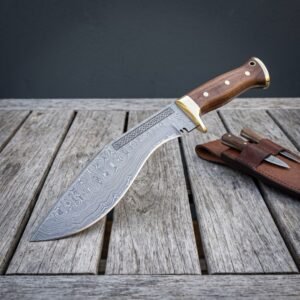 Fellcarve Hand Forged Damascus Kukri Knife with Walnut Scales & Brass Bolster | About 16 Inches Overall | Leather Sheath and Two Companion Knives | Norse Camp Gift | RK-2195
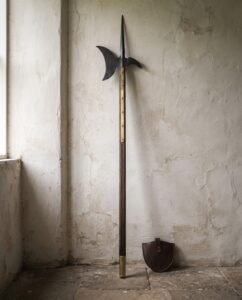 Nightward Hand Forged High Carbon Steel Halberd Polearm | 66 Inch Overall with an 18 Inch Head | Reenactment Display Gift | RK-1365