A tomahawk is a light head on a long handle. That is the whole idea and everything else follows from it. A hatchet does its work with mass, a heavy head on a short haft that you have to lift and drop. A tomahawk does it with speed, because energy climbs with the square of velocity and a light head can be moved very fast. The result is an axe you can carry all day, swing accurately when you are tired, and throw with some hope of it landing point first.
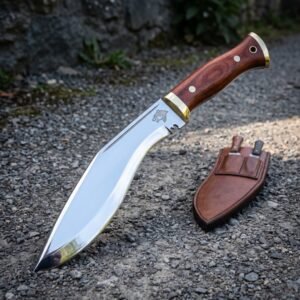
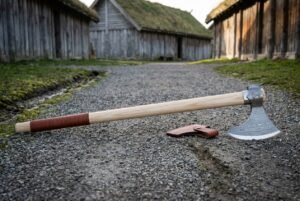
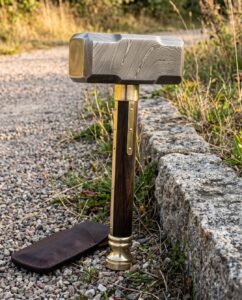
The three here run 14 to 20 inches overall with cutting edges of 3.5 to 5.5 inches. One is Damascus of 1095 and 15N20 at 58 to 60 HRC on a rosewood handle. One is a mirror polished trade pattern with a fan shaped bit on a hickory haft with a laced leather grip. One is a single piece of 1095 with a blackened finish, a skeletonised handle and a flat hammer poll. Each comes with a leather cover or sheath.
Decide whether it is going in a pack or on a wall, and read Viking axe against tomahawk if you are torn. A tomahawk sits at the light end of the range, so the axe against hatchet comparison is worth a read before you commit to a haft length.
Free US shipping
On most pieces. Heavier and oversized ones carry a flat charge.
Hand Forged
Heated, hammered and ground by hand.
Engraving available
Names, dates or Norse runes on most pieces.
Ships from Chicago
Inspected and dispatched from our Chicago warehouse. No import duty, no customs delay on US orders.
Tomahawks
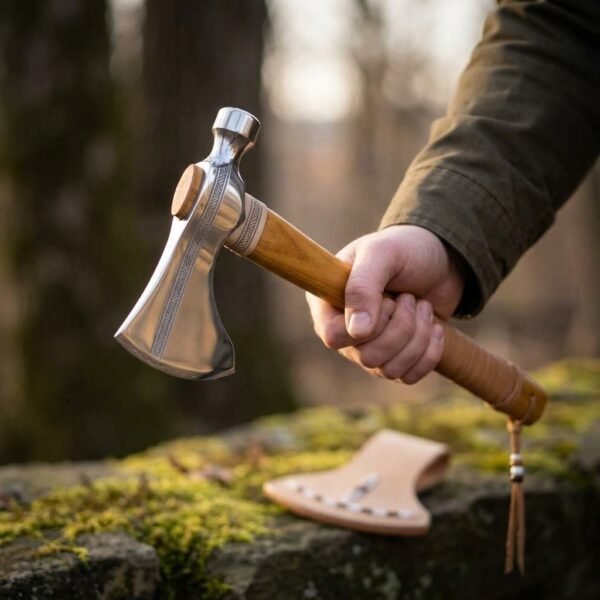
Hickoryhawk Hand Forged High Carbon Steel Native American Style Tomahawk | Collector Reenactment and Display Gift | RK-1201
Original price was: $225.00.$180.00Current price is: $180.00.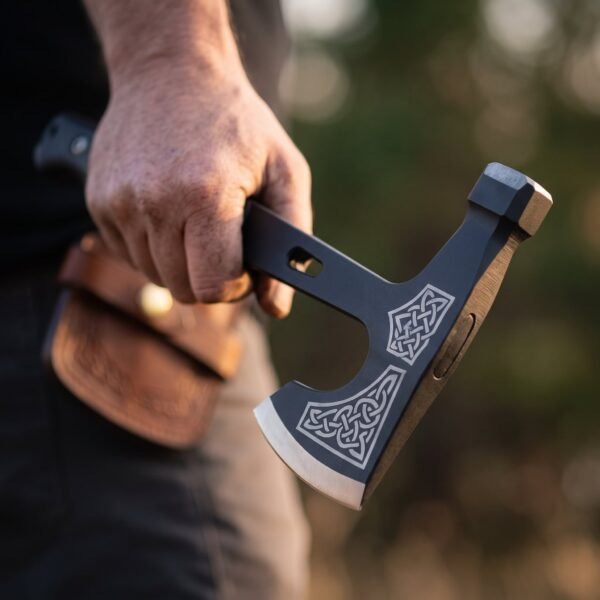
Grimhawk Hand Forged High Carbon Steel Tactical Tomahawk | 14 Inch Overall with 3.5 Inch Cutting Edge | Bushcraft Camping Gift | RK-1202
Original price was: $215.00.$172.00Current price is: $172.00.Light head, long handle, and why that changes everything
Three things separate a tomahawk from a hatchet or a bearded axe, and all three come from the same decision to keep the head light.
The first is the ratio of head to handle. A hatchet hangs a heavy head off a short haft and relies on mass. A tomahawk hangs a light head off a long one and relies on speed. Energy rises with the square of velocity and only in a straight line with mass, so doubling how fast the head is moving does far more than doubling how much it weighs. A light head on a long handle can be accelerated hard by a wrist, which is why a tomahawk cuts above its listed weight and why you can keep swinging it long after a hatchet has emptied your arm.
The second is what that lets you carry. A tomahawk that weighs little enough to hang off a belt all day is a tomahawk you actually have with you. A heavy hatchet is the one that stays in the truck.
The third is the throw. A light head on a long handle rotates predictably, and predictable rotation is the entire basis of throwing. You can learn the distance at which one turn puts the edge into the target and repeat it. Nothing about a heavy short axe rotates as consistently.
The pattern has an obvious history and it is worth stating plainly. The trade tomahawk was a European made trade item carried into North America, adopted widely, and then modified by the people who used it until the shape settled into what we recognise now. The flared fan shaped bit and the light eye are that shape.
The tomahawks in this collection
Three, and they solve three different problems. One is built to be looked at, one is built to be carried and abused, and one sits between the two.
The Damascus tomahawk
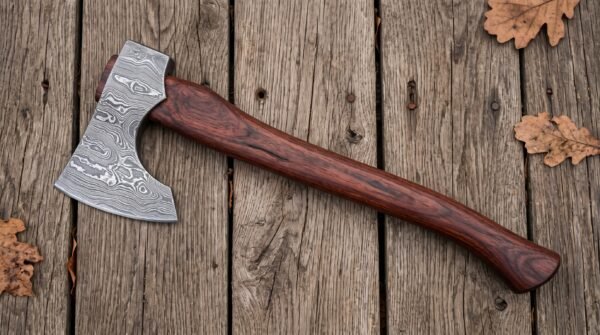
Twenty inches overall on a rosewood handle, with a 6 inch head carrying a 5.5 inch cutting edge, in forge welded Damascus of 1095 and 15N20 hardened to 58 to 60 HRC. That edge length is the longest here by a wide margin, and it is what gives the piece its presence. It comes with a leather blade cover and a gift box, and at 159 dollars it is the least expensive on the page, which surprises people who expect a pattern welded head to cost the most.
Rosewood is dense, oily and close grained, so it takes a polish and resists moisture without much help. It is also the handle timber most likely to make somebody pick the piece up off a table.
The trade pattern in hickory
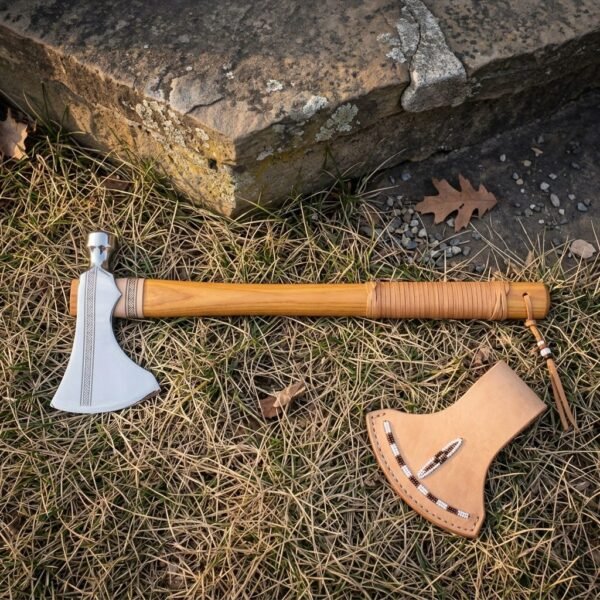
Nineteen inches overall, high carbon steel, hand forged and mirror polished, hardened to 54 to 56 HRC. The bit is 3.5 inches and fan shaped, which is the defining feature of the pattern. Widening the edge away from a narrow eye gives you a long cutting edge on a very light head, and the rounded poll balances it. The haft is hickory with a leather laced grip and a beaded leather tassel, and a geometric linear band is engraved on the cheek of the head and on the collar. A natural leather head cover is included. At 225 dollars it is the most decorated of the three.
Hickory is stiffer and heavier than ash and it is the traditional American haft timber. It takes shock without complaint and it is easy to replace if it ever does break.
The one piece tactical
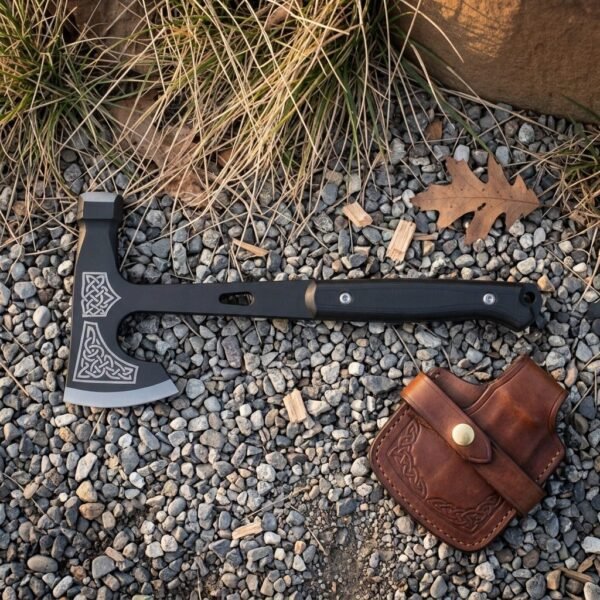
Fourteen inches overall in 1095 high carbon with a blackened oxide finish, hardened to 54 to 56 HRC, with a 3.5 inch cutting edge and a flat hammer poll. The important part is the construction. It is one piece full tang with a skeletonised handle, wrapped in vegetable tanned leather, and it ships with a hand stitched leather belt sheath.
Most tomahawks are a head wedged onto a wooden haft. That is fine until you baton it, pry with it or hit something harder than you intended, and then the head starts to work loose. A one piece tomahawk has nothing to come apart. There is no eye, no wedge and nothing to re seat. Skeletonising the handle takes weight out of the part that does not do any cutting, and the leather wrap puts a grip surface back over the holes. At 14 inches it is the one that goes in a pack.
Sizes, steel and fittings across the range
Every figure below is taken from the specification panel of a piece on this page. These are forged and fitted by hand, so treat them as what to expect rather than as a guarantee.
| Tomahawk | Steel and hardness | Overall length | Cutting edge | Poll | Handle | Included | Price |
|---|---|---|---|---|---|---|---|
| Damascus on rosewood | 1095 and 15N20 at 58 to 60 HRC | 20 in | 5.5 in, 6 in head | Not listed | Rosewood | Leather blade cover and gift box | 159 dollars |
| Trade pattern in hickory | High carbon, mirror polished, 54 to 56 HRC | 19 in | 3.5 in, fan shaped | Rounded | Hickory with a leather laced grip and beaded tassel | Natural leather head cover | 225 dollars |
| One piece tactical | 1095, blackened oxide, 54 to 56 HRC | 14 in | 3.5 in | Flat hammer poll | One piece full tang, skeletonised, leather wrapped | Hand stitched leather belt sheath | 215 dollars |
Note what the poll tells you. A rounded poll is balance and nothing else. A flat hammer poll is a working face you can drive a stake or a wedge with, which is why it is on the piece built for camp use.
Sizing and fit
Overall length is the first choice and it decides how the piece behaves more than the head does. Twenty inches gives you the reach and the leverage to chop properly two handed and it is the length that throws best. Fourteen inches is a belt and pack length, quick in tight spaces and much easier to control one handed, but you will feel the shorter lever when you are limbing anything thick.
Edge length is the second. Five and a half inches of edge takes a bigger bite and is the better wood cutter. Three and a half inches concentrates the same force into a shorter section, which bites deeper per strike into small material and is easier to keep sharp.
Handle diameter differs across the three. Rosewood and hickory are shaped to fill a hand. The skeletonised one piece is thinner through the grip because it is steel, and the leather wrap is what makes it comfortable. If you have large hands, the wooden hafts will suit you better over a long session.
Steel and hardness
Two steels run through everything here. Plain heads are 1095 high carbon hardened to 54 to 58 HRC. Damascus is 1095 and 15N20 forge welded and etched, taken to 58 to 60 HRC. There is no third grade.
Both plain pieces here are listed at 54 to 56 HRC, which sits at the softer end of that band and is deliberate on a chopping tool. An axe edge that is too hard chips when it meets a knot or a nail, and a chip is far more work to fix than a rolled edge. Slightly softer steel takes a dent, comes back with a file, and keeps going.
The Damascus head is run harder because the nickel bearing 15N20 in the billet toughens it. The two steels are paired because they weld to each other cleanly and take acid differently, the 1095 going dark and the 15N20 staying bright, which is what makes the layers visible. Neither steel is stainless and both will rust if you ignore them. The steel and hardness page covers what an HRC number means, and Damascus versus high carbon compares the two directly.
Handles, wraps and fittings
Wooden hafts and a steel handle behave nothing alike, so treat them differently.
Hickory and rosewood both want a wipe of oil once or twice a year. Dry wood shrinks, and a shrunken haft is how a head starts to move. Keep either one out of a hot car and away from a radiator. If a head ever does feel loose on a wooden haft, stop and have it re seated rather than swinging it and hoping. Replacement hafts and blanks are in axe handles and hafts.
The leather laced grip on the trade pattern and the leather wrap on the one piece both take hand oil and darken with use, which is what they are meant to do. If a wrap loosens, it can be re laced. Leather conditioner once a year is plenty and soaking it is a mistake.
The blackened oxide finish on the tactical piece is a surface treatment, not armour. It slows rust down and it does not stop it, and it will wear bright at the edge and at any point that rubs. That is normal and it is not a defect.
Sharpening, care and storage
Sharpening an axe is not knife work. Follow the curve of the bit with a file or a coarse stone, keep the bevel angle that is already there rather than inventing a thinner one, work both sides evenly and finish with a fine stone or a puck. A thinner edge cuts better and chips sooner, so on a tool that meets knots and dirt, resist the temptation. The full method is on how to sharpen an axe.
Wipe the head after use and keep a light film of oil on it. On the Damascus head, never use abrasive polish, wire wool or a rust eraser, because the etch is a surface only and scrubbing takes the pattern off permanently. On the mirror polished head, fingerprints are acidic and will etch themselves into the finish within weeks if you leave them there. Light orange spotting on any of them lifts with oil and a soft cloth, and grey patina is stable.
Store with the cover or sheath off if the piece is going to sit for months, because leather holds moisture against steel. Our axe care guide covers the routine and removing rust from an axe deals with the case where it has already started.
Throwing, and what it does to a tomahawk
These will throw, and the 20 inch piece throws best because a longer handle rotates more slowly and more predictably. Learn the distance for a single rotation, mark it, and repeat it. Consistency comes from your feet, not from your arm.
Be honest with yourself about the cost. Throwing means the head hits wood hard and sometimes hits the ground, the frame or another blade, and edges roll and chip. Throw the piece you are willing to touch up, not the one with the etched pattern on it. If throwing is the main plan, look at throwing axes, which are built for it, and read axe throwing for beginners before you set up a target.
Engraving
Any of these can be engraved after they arrive in the United States. The cheek of the head is the natural place, and the trade pattern already carries a geometric band there and on the collar. Where a piece already carries an engraved design, your chosen engraving replaces it rather than sitting beside it.
Text engraving is 19 dollars, a symbol is 39 dollars and a family crest is 49 dollars. Elder Futhark is a phonetic alphabet rather than a code, so a name is transliterated by sound and there is no rune for the letter C. Engraving is permanent and an engraved piece cannot be returned, so check the spelling before you order.
Where these come from and how they ship
Ransack Viking is a US company based in Chicago, Illinois. The pieces are handmade in the Czech Republic, then imported, inspected and shipped from Chicago. Engraving is done in the US after arrival.
Because heads are forged and hafts are shaped by hand, two pieces of the same model will differ slightly in grind, etch figure and the colour of the timber. Nothing here is a stamped part off a press, and the small differences are the evidence.
How to choose
If it is going in a pack and will be used, take the one piece tactical at 215 dollars. Fourteen inches carries easily, the flat hammer poll gives you a second tool for driving stakes, and nothing on it can work loose because there is nothing on it that comes apart.
If you want the most axe for the money and the best looking piece here, take the Damascus at 159 dollars. Twenty inches of reach, five and a half inches of edge and a pattern welded head for less than either of the plain ones is an odd bit of pricing and you may as well take advantage of it.
If you want the historically correct trade pattern with the fan shaped bit, the laced grip and the tassel, take the hickory piece at 225 dollars. It is the one that belongs in a reenactment kit or on a wall with a caption under it, and the engraved band on the cheek does more for it than any amount of polish.
Browse related categories
- Throwing axes built to be thrown repeatedly
- Bearded axes with the dropped beard on the edge
- Battle axes across the Norse and medieval period
- Splitting and felling axes for actual firewood
- Viking axes, the whole Norse axe collection
- War axes on longer hafts
- Axe handles and replacement hafts
- Leather sheaths and head covers
Guides worth reading first
- Viking axe or tomahawk: which one you actually want
- Axe throwing for beginners: distance, rotation and targets
- Choosing an axe by length, head weight and use
- How to sharpen an axe without ruining the bevel
- Axe care: head, edge, haft and storage
- Axe against hatchet, where the line actually falls
Frequently asked questions
What is the difference between a tomahawk and a hatchet?
Weight distribution. A hatchet is a heavy head on a short handle and works by mass. A tomahawk is a light head on a long handle and works by speed. The tomahawk is easier to carry, easier to swing accurately when you are tired, and far better to throw. The hatchet splits better.
Can I throw these?
Yes, and the 20 inch piece throws best because a longer handle rotates more predictably. Accept that throwing rolls and chips edges and sometimes damages handles. Throw the one you are happy to touch up rather than the one with the pattern on it.
Why is the one piece version better for hard use?
Because there is no joint to fail. Most tomahawks are a head wedged onto a wooden haft, and a wedged head works loose when you baton it, pry with it or strike something harder than you meant to. A single piece of steel with a skeletonised handle has no eye and no wedge to come apart.
Are these sharp when they arrive?
Yes. Every edge is ground and finished by hand and arrives with a working edge. They are not razors, because a very thin edge on an axe chips on a knot. A file and a puck will take any of them further if you want.
Why are two of them listed at 54 to 56 HRC?
Because that is the right hardness for a chopping tool. An axe edge that is too hard chips instead of denting, and a chip is much more work to fix than a roll. Slightly softer steel takes the hit, comes back with a file and keeps working.
What is the flat poll on the tactical one for?
Hammering. It is a working face you can drive a tent stake or a wedge with, which saves carrying a second tool. The rounded poll on the trade pattern is there for balance and is not meant to be struck with.
Do they come with a sheath?
Yes. Two come with leather head covers and one with a hand stitched leather belt sheath. Use them for carrying, and take them off for long storage, since leather holds damp against steel.
Where are these made?
Ransack Viking is a US company based in Chicago, Illinois. The pieces are handmade in the Czech Republic, then imported, inspected and shipped from Chicago. Engraving is done in the US after arrival.
Featured pieces
 Emberhawk Hand Forged Damascus Bearded Axe
Original price was: $159.00.$127.20Current price is: $127.20.
 Hickoryhawk Hand Forged High Carbon Steel Native American Style Tomahawk
Original price was: $225.00.$180.00Current price is: $180.00.
 Grimhawk Hand Forged High Carbon Steel Tactical Tomahawk
Original price was: $215.00.$172.00Current price is: $172.00.