A tanto is the short Japanese blade, and the thing people recognise is the point. Instead of a curve sweeping up to the tip, the edge runs straight and then breaks at an angle into a second short edge that meets the spine. That corner is the whole idea. It puts a lot of steel directly behind the tip, so the point stays supported where a fine curved tip would be thin and easy to snap. It is the strongest point shape in common use, and it is why the profile got adopted so widely outside Japan.
The blades here run from 5 to 15 inches with overall lengths of 9.5 to 21.5 inches, in 1095 high carbon at 54 to 58 HRC or forge welded Damascus of 1095 and 15N20 at 58 to 60 HRC. Some are full tang belt knives with horn, walnut or stacked leather handles and brass bolsters. Others are mounted in the traditional way, with a cord wrapped grip over ray skin, a tsuba and a fitted saya, as the Japanese swords are.
Decide whether you want a knife or a sword mounting before you look at anything else.
Free US shipping
On most pieces. Heavier and oversized ones carry a flat charge.
Hand Forged
Heated, hammered and ground by hand.
Engraving available
Names, dates or Norse runes on most pieces.
Ships from Chicago
Inspected and dispatched from our Chicago warehouse. No import duty, no customs delay on US orders.
Tanto Knives
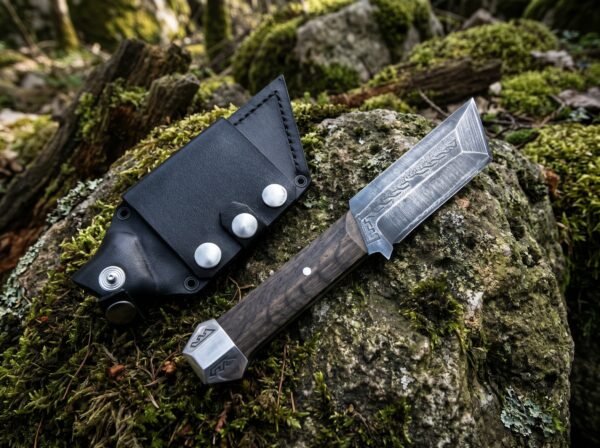
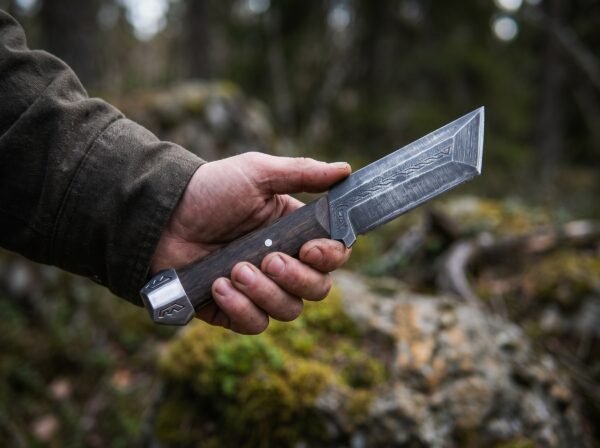
Woodsax Hand Forged High Carbon Steel Tanto Knife with Solid Wooden Handle & Leather Sheath | Bushcraft and Collector Gift | RK-662
Original price was: $179.00.$152.15Current price is: $152.15.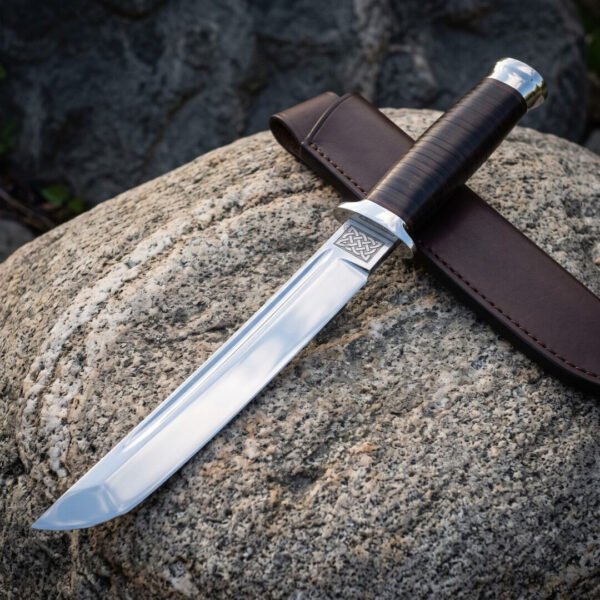
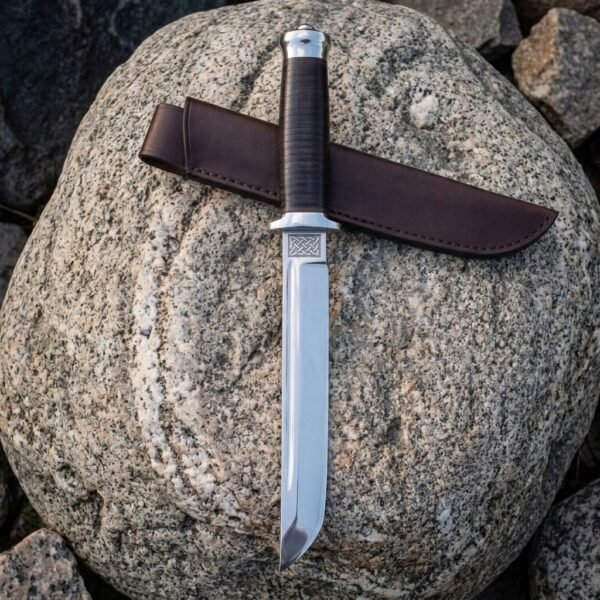
Knotguard Hand Forged High Carbon Tanto Knife with Stacked Leather Handle | Knotwork Engraved Ricasso and Steel Guard | Fullered Blade and Leather Sheath | Everyday Carry Gift | RK-2180
Original price was: $189.00.$160.65Current price is: $160.65.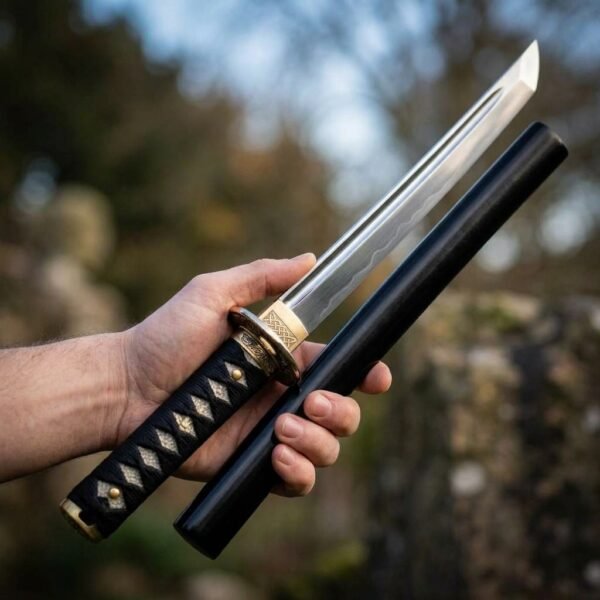
Gildsaya Hand Forged Polished Steel Japanese Tanto Sword with Brass Knotwork Habaki | Cord Wrapped Ray Skin Handle and Brass Tsuba | Black Scabbard | Norse Collector Gift | RK-2075
Original price was: $229.00.$194.65Current price is: $194.65.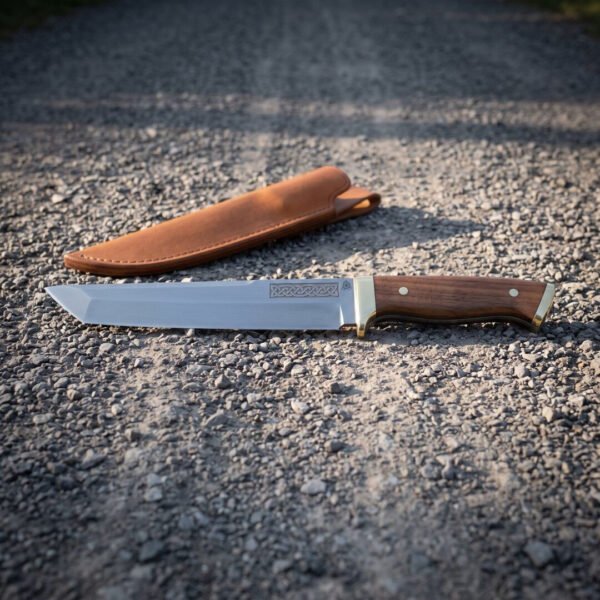
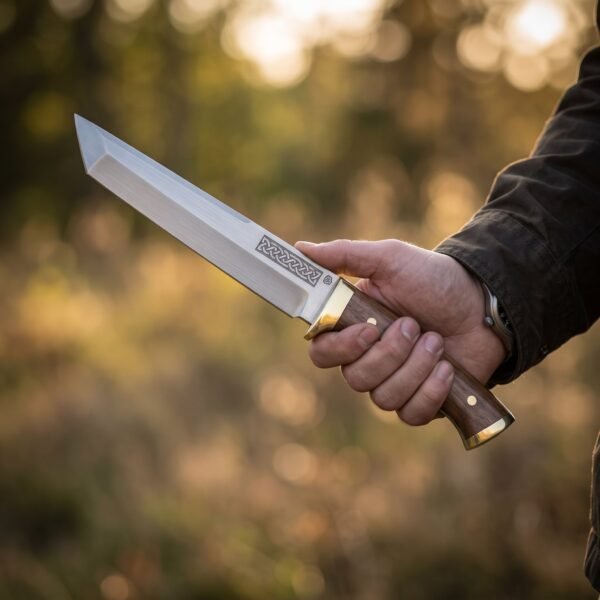
Knotsax Hand Forged 1095 Steel Tanto Knife | 14 Inch Overall | Rosewood Scales and Brass Bolster with Etched Knotwork Panel and Tan Leather Sheath | Norse Gift | RK-2109
Original price was: $189.00.$160.65Current price is: $160.65.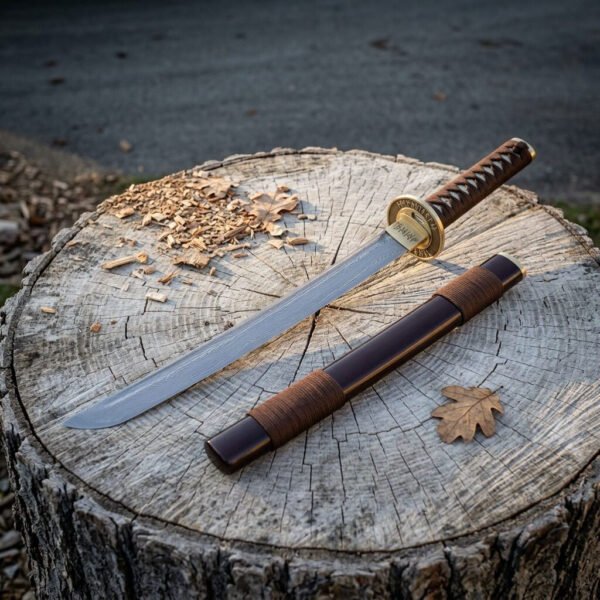
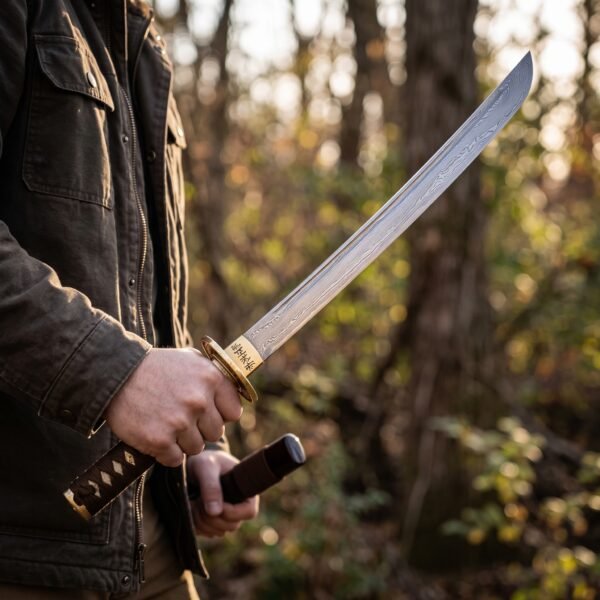
Amberoak Hand Forged Damascus Tanto | 21.5 Inch Overall with 15 Inch Blade | Cord Banded Wooden Saya | Norse Collector Gift | RK-1279
Original price was: $255.00.$216.75Current price is: $216.75.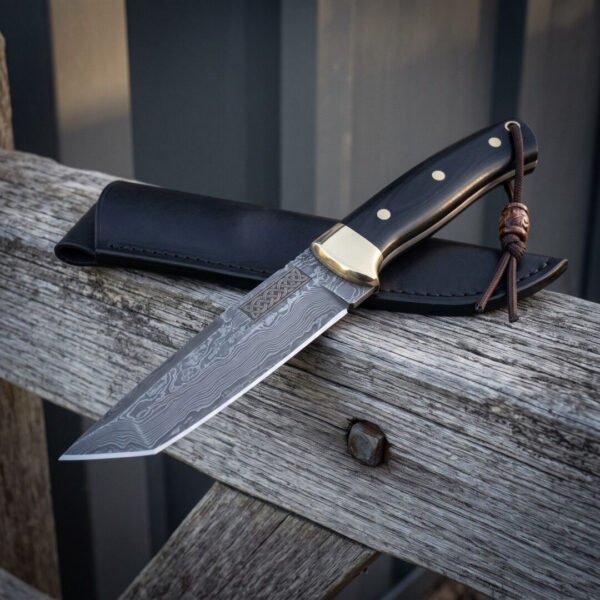
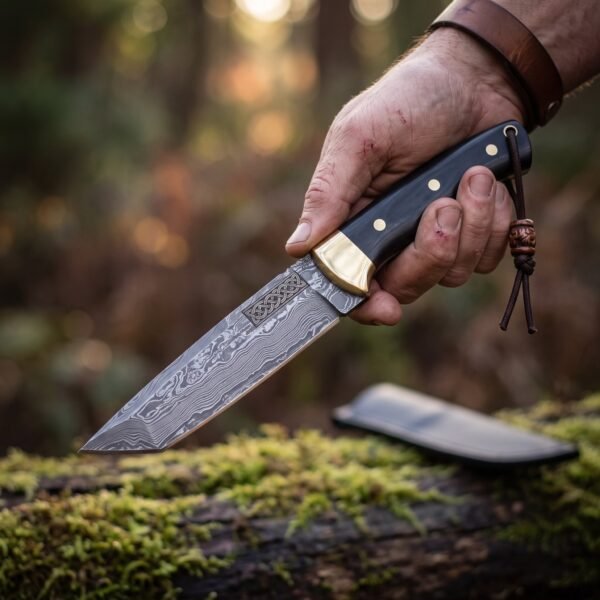
Ebonknot Hand Forged Damascus Tanto Knife with Etched Celtic Knotwork | Black Scales, Brass Bolster and Leather Lanyard | Black Leather Belt Sheath | Hunting Gift | RK-2077
Original price was: $259.00.$220.15Current price is: $220.15.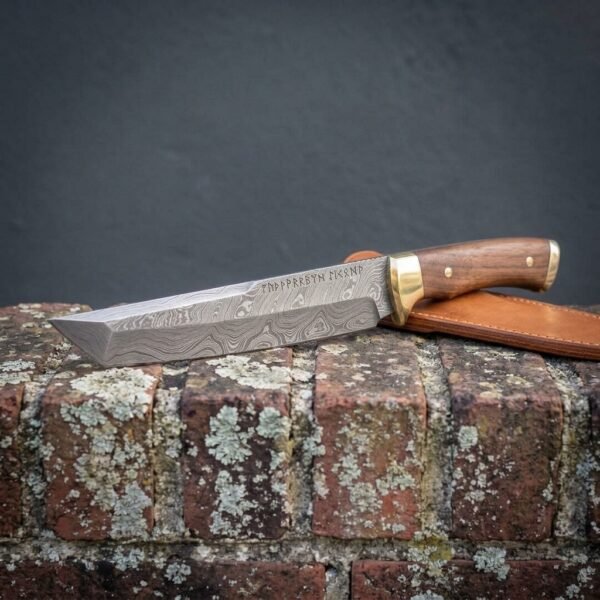
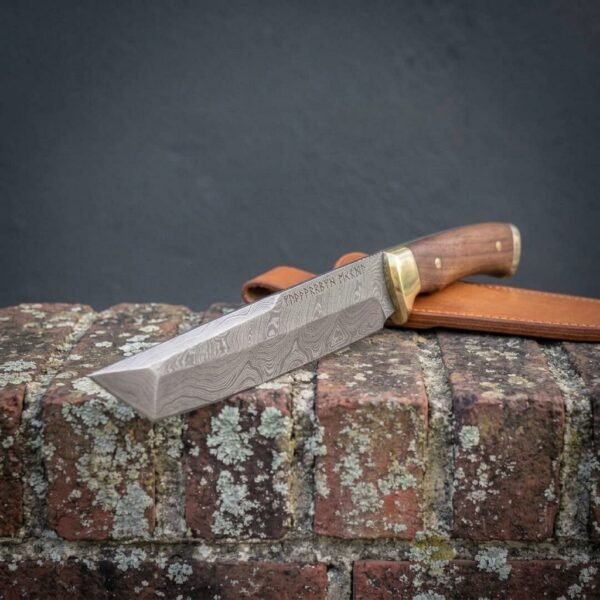
Runespine Hand Forged Damascus Tanto Knife with Walnut Scales & Etched Elder Futhark | About 12 Inches Overall | Brass Bolster and Tan Leather Sheath | Norse Gift | RK-2207
Original price was: $225.00.$191.25Current price is: $191.25.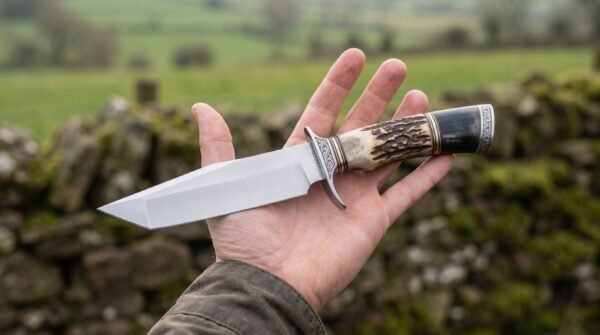
Tantoguard Hand Forged 1095 High Carbon Steel Tanto Knife with Stag Horn and Bull Horn Handle and Engraved Steel Guard and Pommel Cap | Tactical Gift | RK-583
Original price was: $129.00.$109.65Current price is: $109.65.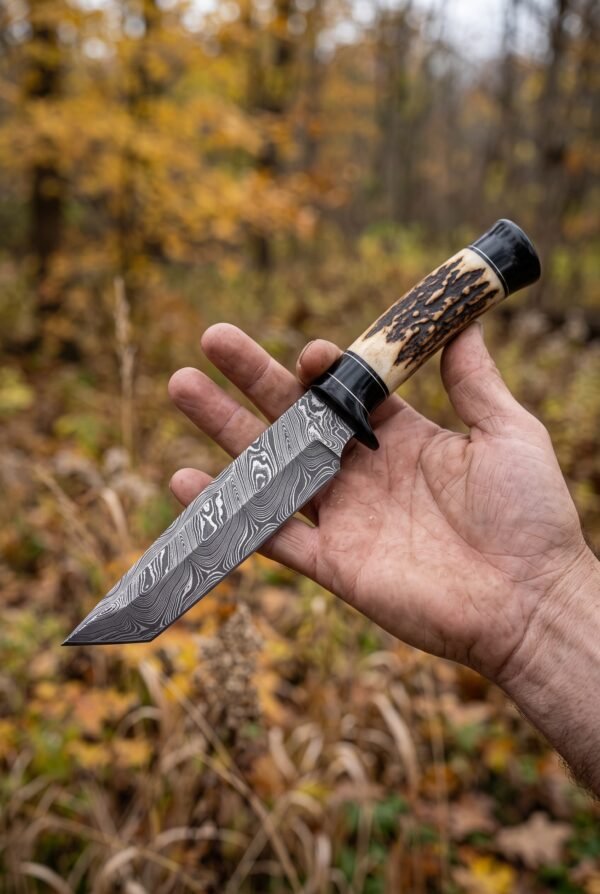
Tantostag Hand Forged Damascus Tanto Knife with Stag Horn and Buffalo Horn Handle & Leather Sheath | Tactical Collector Gift | RK-532
Original price was: $129.00.$109.65Current price is: $109.65.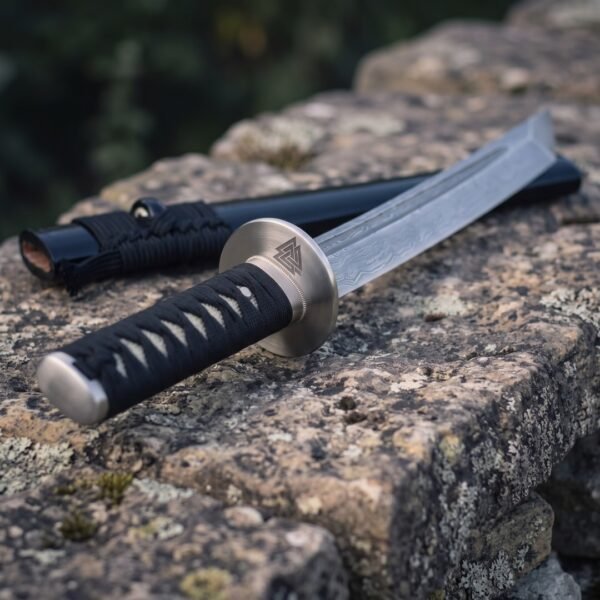
Trinesaya Hand Forged Damascus Tanto Sword with Valknut Etched Blade | Black Cord Wrapped Handle and Round Steel Tsuba | Black Scabbard | Norse Collector Gift | RK-2074
Original price was: $289.00.$245.65Current price is: $245.65.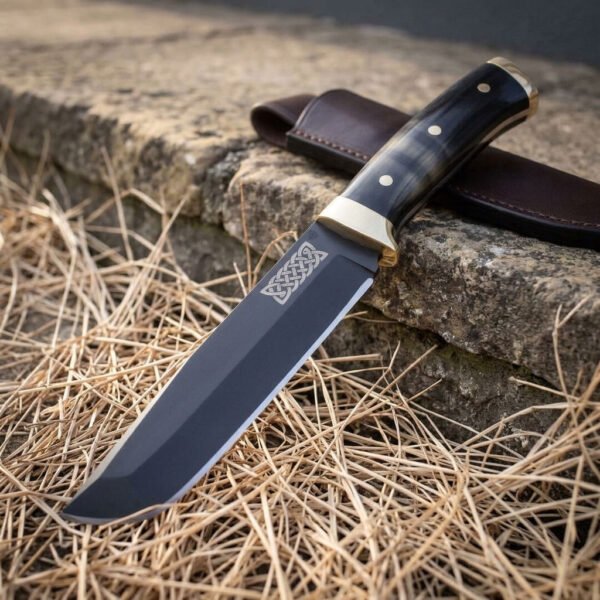
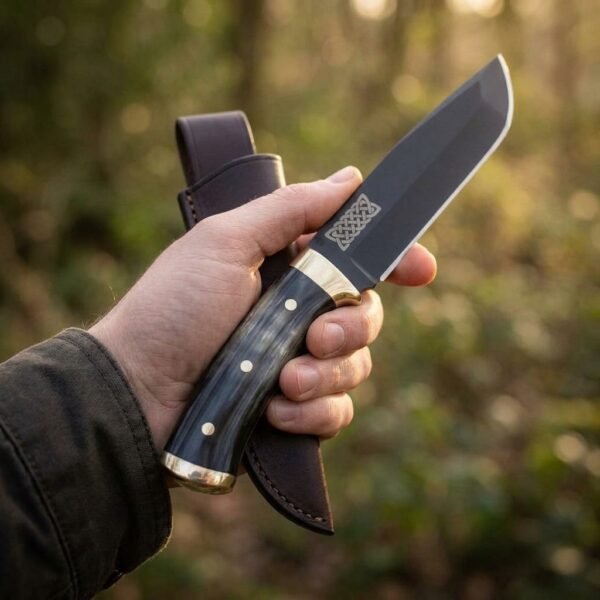
Pitchpoint Hand Forged Blackened Tanto Knife with Buffalo Horn Scales & Brass Bolster | About 11 Inches Overall | Etched Knotwork and Leather Belt Sheath | Outdoor Gift | RK-2201
Original price was: $169.00.$143.65Current price is: $143.65.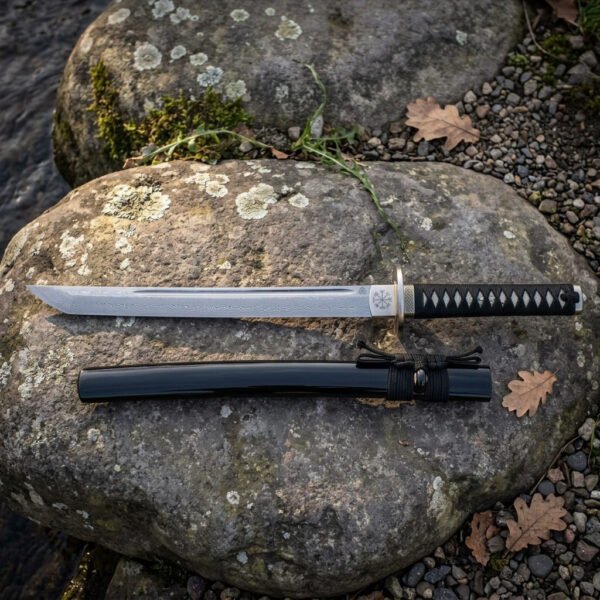
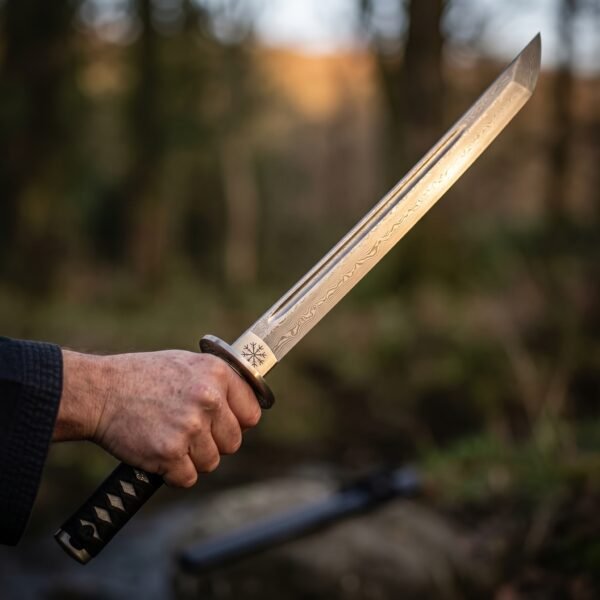
Shadowreed Hand Forged Damascus Steel Tanto | 19 Inch Overall with 12.5 Inch Blade | Black Lacquered Wooden Saya and Cord Tie | Norse Collector Gift | RK-1278
Original price was: $215.00.$182.75Current price is: $182.75.Why the point is cut at an angle
Most knife points are made by curving the edge up to meet the spine. It looks right, it slices well and it produces a tip that is thin in every direction, which is fine until you push it into something hard. The tanto does the opposite. The primary edge runs straight, then stops, and a second short edge angles up to the spine. Where the two meet you get a corner rather than a taper, and behind that corner sits the full thickness of the blade.
The practical result is a point you can lean on. A tanto tip will go through leather, cardboard and light sheet material that would roll or snap a fine clip point, and if you do damage it, the flat secondary edge is far easier to grind back than a curve is. The cost is that it is worse at the delicate work a curved belly does well. Skinning, filleting and anything that wants a rolling slice all suffer, because a tanto has no belly to roll on.
There is a difference between the Japanese blade and what most people now call a tanto. A traditional Japanese tanto usually has a gentle curve and a point formed the way a katana's is, with a small yokote line separating the tip from the body of the blade. The hard angled corner most Western makers use is a modern reinterpretation, popularised in the United States in the twentieth century. Both are here. The mounted pieces follow the Japanese line and the full tang belt knives the Western one.
The tantos in this collection
Nine pieces across a wide spread of size and mounting, from a 9.5 inch horn handled knife to a 21.5 inch blade in a leather wrapped saya. They fall into four groups.
Full tang belt knives
Three, and they are the ones to carry. The smallest is about 11 inches overall with a 6 inch blade in 1095 at 54 to 58 HRC, a straight spine, an angled tip and a flat primary grind, black coated with a bright sharpened edge and an etched knotwork panel, on black buffalo horn scales with three pins and a polished brass bolster. The Damascus version runs about 12 inches with a 7 inch blade at 58 to 60 HRC, walnut scales with brass pins, a brass bolster and an Elder Futhark rune row cut along the spine. The third takes a different route, a Western tanto point with a wide fuller and a secondary edge plane in mirror polished 1095, on stacked leather washers in dark brown with red spacers, under a polished steel guard cut with a Celtic knotwork panel and a steel cap over a through tang. All three arrive sharpened and all three ship with a fitted leather belt sheath.
Horn handled Damascus knives
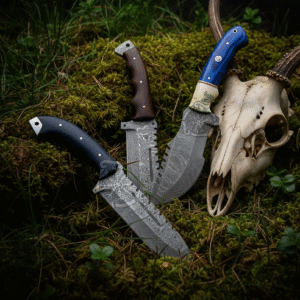
Two short knives with angled tanto points and handles in stag and buffalo horn. One is 9.5 inches overall with a 5.5 inch blade in 393 layer Damascus of 1095 and 15N20 at 58 to 60 HRC, in a mixed twist fire pattern, with custom brass file work along the handle and a leather sheath. The other is 10 inches with a 5 inch blade, engraved stag and bull horn, a hand made steel guard and bolster, and a cowhide pouch sheath cut for right hand carry.
Traditionally mounted tanto
Two, both single edged with a shallow curve rising to a fine point rather than a hard corner. One is mirror polished 1095 at 54 to 58 HRC with a visible shinogi ridge, a brass habaki collar engraved with an interlaced knotwork panel, a round brass tsuba with spacers, brass fuchi and kashira, brass menuki pins under a black cord wrap laid over pale ray skin, in a matt black fitted scabbard. The other is Damascus at 58 to 60 HRC with a Valknut cut into the flat above the collar, a small plain round steel tsuba, steel furniture and a cord loop at the butt. These are the pieces that read as small swords rather than as knives.
The longer blades
Two high carbon blades that stretch the definition. One is 19 inches overall with a 12.5 inch blade in a black lacquered wooden saya with a cord tie. The other is 21.5 inches with a 15 inch blade in a wooden saya wrapped in brown leather. By the old Japanese measure a blade past about 12 inches is drifting into wakizashi territory, so treat these as short swords that carry the tanto name and the tanto point.
Sizes, steel and fittings across the range
Every figure below comes from the specification panel of a piece on this page. These are forged and ground by hand, so read them as what to expect rather than as a guarantee to the millimetre.
| Mounting | Overall length | Blade length | Steel and hardness | Handle | Sheath | Price |
|---|---|---|---|---|---|---|
| Horn handled knife | 9.5 in | 5.5 in | Damascus at 58 to 60 HRC | Stag and buffalo horn, brass file work | Leather | 129 dollars |
| Horn handled knife with guard | 10 in | 5 in | Tool steel at 58 to 60 HRC | Engraved stag and bull horn | Cowhide pouch | 129 dollars |
| Full tang belt knife | About 11 in | About 6 in | 1095 at 54 to 58 HRC | Black buffalo horn, brass bolster | Brown leather belt sheath | 169 dollars |
| Full tang, fullered blade | Not listed | Not listed | 1095 at 54 to 58 HRC | Stacked leather with red spacers | Brown leather belt sheath | 189 dollars |
| Mounted, lacquered saya | 19 in | 12.5 in | High carbon steel | Cord tied saya mounting | Black lacquered wooden saya | 215 dollars |
| Full tang belt knife | About 12 in | About 7 in | Damascus at 58 to 60 HRC | Walnut scales, brass bolster | Tan leather sheath | 225 dollars |
| Mounted, brass furniture | Not listed | Not listed | 1095 at 54 to 58 HRC | Cord over ray skin, brass tsuba | Matt black scabbard | 229 dollars |
| Mounted, leather wrapped saya | 21.5 in | 15 in | High carbon steel | Leather wrapped saya mounting | Brown leather over wood | 255 dollars |
| Mounted, steel furniture | Not listed | Not listed | Damascus at 58 to 60 HRC | Cord wrap, steel tsuba | Matt black scabbard | 289 dollars |
One number is worth pausing on. The 393 layer count on the short Damascus knife is a real figure from its panel, and it tells you how fine the banding is rather than how good the blade is. More layers means a tighter pattern. It does not mean a better edge.
Size, carry and the law
The belt knives at 11 and 12 inches overall are the practical end of this page. A 6 or 7 inch blade on a full tang with a horn or walnut handle is a knife you can wear on a belt and use, and the sheaths are cut for exactly that.
The mounted pieces are a different proposition. A tanto in a saya is carried edge up through a sash in the traditional arrangement, and none of them come with a modern belt rig. Most people buy these for a stand or a wall.
Fixed blades of this length are legal to own almost everywhere in the United States, but carrying one is a separate question that turns on state law and often on city ordinance. Read the state by state summary before you clip anything to a belt, and treat it as a summary rather than legal advice.
Steel and hardness
Two house steels run through the range. Plain 1095 high carbon is hardened to 54 to 58 HRC. It sharpens quickly, comes back on a stone in a couple of minutes and takes either a mirror polish or a black coating depending on how it was finished. Damascus of 1095 and 15N20 is forge welded, folded, ground and acid etched, hardened to 58 to 60 HRC, so it holds an edge a little longer and takes a little more work to bring back.
One blade in this range is listed in a tool steel rather than in either house steel, at 58 to 60 HRC. Tool steels are harder to sharpen and hold an edge longer, which suits a short blade that will be used rather than sharpened often.
None of these is stainless. All of them will rust if left wet, and all of them take a grey patina over years that does no harm at all. The black coated blade is the most forgiving of the group, because the coating protects everything except the sharpened bevel.
Handles, guards and tangs
The full tang knives run the steel through the whole handle with the scales pinned either side, which is the construction you want on a knife that will be used. Three brass pins through buffalo horn or walnut is a joint that does not come apart. Where a guard is fitted it is polished steel, one of them cut with a Celtic knotwork panel.
Stacked leather washers work differently. The washers are compressed over the tang and held under a peened or capped end, and they give the most comfortable grip of anything here over a long session, because leather takes hand oil and warms up. The red spacers between the brown washers are a period touch from the same family of knives that gave us the stacked leather bowie.
Horn is the material to be careful with. Stag and buffalo horn look better with age and neither likes dry heat, so keep them off a radiator and out of a hot car, because horn shrinks as it dries and can crack or pull away from a pin.
The mounted pieces use the Japanese arrangement. A collar called the habaki locks the blade into the mouth of the scabbard, a tsuba sits against it as a guard, and the grip is bound in cord over ray skin in the alternating diamond wrap, with metal fittings at each end and small ornaments pinned under the wrap.
Sheaths, saya and care
The belt knives ship in stitched leather, some as a fitted belt sheath and one as a pouch cut for right hand carry. Leather is stiff at first and takes the shape of the blade over a few weeks.
The mounted pieces ship in a saya, a fitted wooden scabbard, one lacquered black with a cord tie and one wrapped in brown leather. A saya is friction fitted. It holds the blade by the habaki at the mouth and nowhere else, which is why you draw and sheathe slowly and never force it.
Carbon steel and leather are a poor long term pair, because leather holds moisture and its tanning agents are mildly acidic. Wipe the blade dry after use, leave a light film of mineral or camellia oil on it, and store it out of the sheath if it will sit for months. Orange spotting lifts with a fine abrasive and oil before it pits. Etched Damascus fades under hard polishing, so oil it and leave it.
Sharpening a tanto point
A tanto is easier to sharpen than a curved blade and people still get it wrong. The mistake is treating it as one edge. It is two, meeting at a corner, and each one is flat.
Sharpen the long primary edge first, flat on the stone, using the same angle along the whole length with no sweeping motion. Then lift the knife and work the short angled tip edge as its own separate flat. Do not try to roll around the corner. Rolling is what rounds the point off, and once the corner is gone the whole reason for the shape is gone with it.
For 1095 at 54 to 58 HRC a 1000 grit stone restores a working edge in a few minutes and a 3000 grit polishes it. Damascus at 58 to 60 HRC takes longer on the coarse stone and holds the result longer. The mirror polished blades will show every scratch, so use a soft touch and finish fine.
Engraving
Several of these already carry cut work, from an Elder Futhark rune row along a spine to a Valknut above a collar and knotwork panels on a guard and a habaki. Further engraving is done in the United States after the piece arrives. On a full tang knife the flat of the blade or the bolster is the usual place. On a mounted tanto the habaki and the tsuba take it best.
Text engraving is 19 dollars, a symbol is 39 dollars and a family crest is 49 dollars. Elder Futhark is a phonetic alphabet rather than a code, so a name is transliterated by sound and there is no rune for the letter C. Engraving is permanent and an engraved piece cannot be returned, so send the exact spelling and read it twice.
Where these come from and how they ship
Ransack Viking is a US company based in Chicago, Illinois. The pieces are handmade in the Czech Republic, then imported, inspected and shipped from Chicago. Engraving is done in the US after arrival.
Knives ship with the sheath or scabbard fitted. Blades arrive with a working edge and several listings state the knife is sharpened and ready to use. Two pieces of the same name will differ in etch figure, horn colour and grain, because two people made them on two different days.
How to choose
Buying a knife you will actually carry? Take the 11 inch black coated 1095 with buffalo horn scales at 169 dollars. Full tang, brass bolster, sharpened out of the box and the coating shrugs off the neglect a carbon blade usually punishes.
Buying for the pattern? The Damascus with walnut scales and the rune row along the spine. Etched pattern welding on a 7 inch blade reads at arm's length and the walnut warms up in the hand.
Buying something for a stand or a display case? Go to the mounted pieces. Cord over ray skin, a brass or steel tsuba and a fitted black saya look like what they are, and the Valknut cut above the collar is the detail people notice first.
Related collections
- Katana and Japanese swords
- Wakizashi, the next size up
- Damascus knives across the range
- Hunting knives with a curved belly
- Daggers and double edged blades
- Folding and pocket knives
- Kukri knives
- Sheaths and replacement scabbards
Guides worth reading first
- What is a tanto and why the point is shaped that way
- Katana, wakizashi and tanto compared
- Knife blade shapes and what each one is good at
- How to sharpen a knife with a whetstone
- The complete knife care guide
- Knife laws by state
Frequently asked questions
What is a tanto knife good for?
Piercing and hard use. The angled tip has the full thickness of the blade behind it, so it goes through tough material that would roll a fine curved point. It is worse at slicing and skinning, because it has no belly to roll on.
What is the difference between a Japanese tanto and a Western one?
A traditional Japanese tanto has a gentle curve and a point formed like a katana's. The hard angled corner most people picture is a modern Western reinterpretation. Both are on this page, the mounted pieces following the Japanese line and the full tang belt knives the Western one.
Are these sharp when they arrive?
Yes. Several listings state the knife is sharpened and ready to use out of the box. They are ground and finished by hand, so a few passes on a stone will take any of them further if you want more.
How do you sharpen a tanto point?
As two flat edges, not one. Do the long primary edge flat on the stone at a consistent angle, then lift the knife and work the short angled tip edge separately. Never sweep around the corner, because that rounds off the point.
Which steel should I pick?
Take 1095 at 54 to 58 HRC if the knife will be used and sharpened often, because it comes back fast on a stone. Take Damascus at 58 to 60 HRC for the etched pattern and slightly longer edge retention. Neither is stainless and both want oil.
What does the layer count mean?
How fine the banding is. One knife here is listed at 393 layers in a mixed twist fire pattern. A higher count gives a tighter pattern in the etch. It does not make the blade cut better.
Can I carry one of these on a belt?
The full tang knives, yes, and they ship with belt sheaths. The mounted pieces come in a saya and have no belt rig. Owning a fixed blade is legal almost everywhere in the United States, but carrying one depends on your state and often your city.
Where are these made?
Ransack Viking is a US company based in Chicago, Illinois. The pieces are handmade in the Czech Republic, then imported, inspected and shipped from Chicago, with engraving added in the US after arrival.
Featured pieces
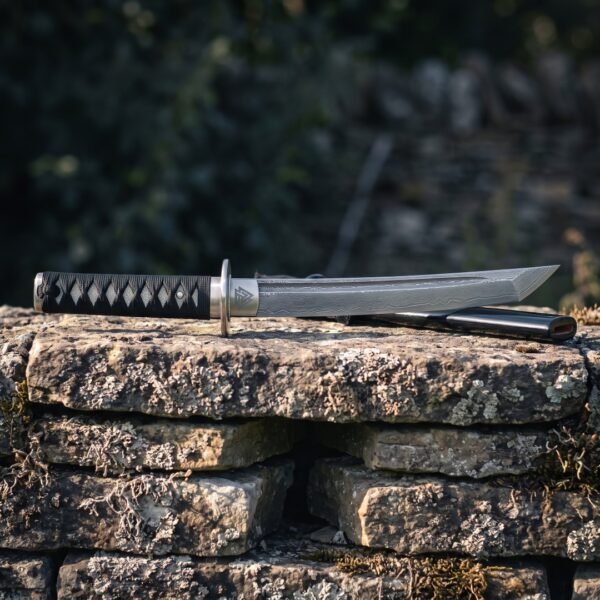 Trinesaya Hand Forged Damascus Tanto Sword with Valknut Etched Blade
Original price was: $289.00.$245.65Current price is: $245.65.
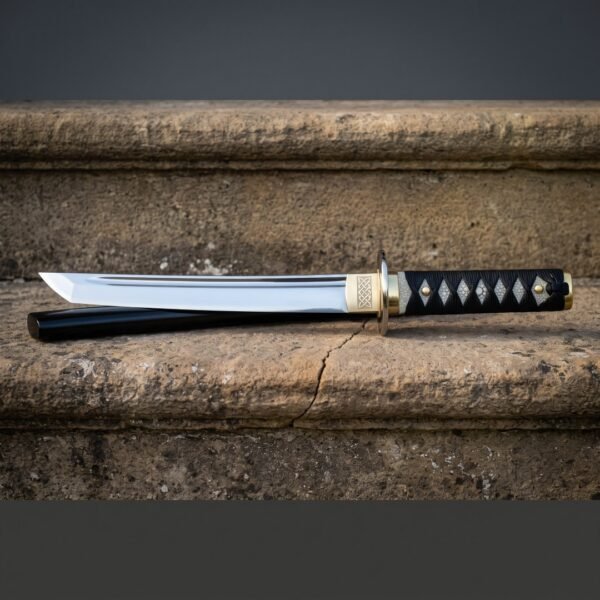 Gildsaya Hand Forged Polished Steel Japanese Tanto Sword with Brass Knotwork Habaki
Original price was: $229.00.$194.65Current price is: $194.65.
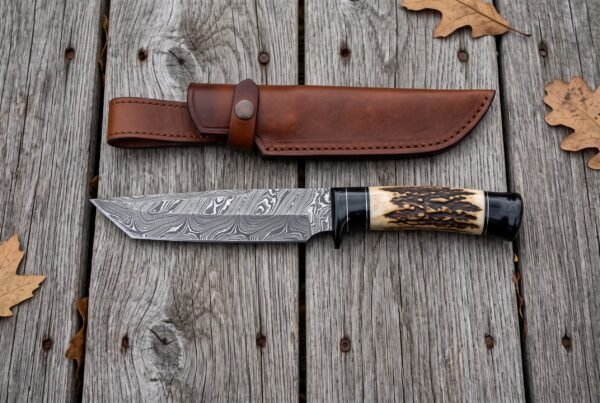 Tantostag Hand Forged Damascus Tanto Knife with Stag Horn and Buffalo Horn Handle & Leather Sheath
Original price was: $129.00.$109.65Current price is: $109.65.
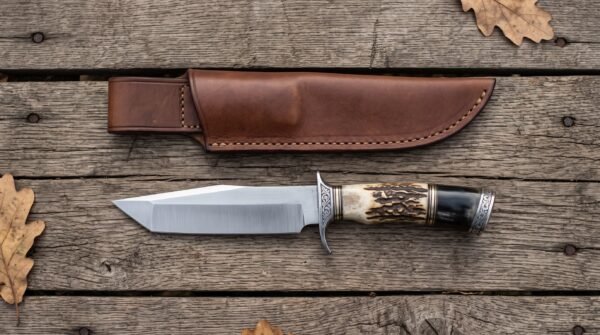 Tantoguard Hand Forged 1095 High Carbon Steel Tanto Knife with Stag Horn and Bull Horn Handle and Engraved Steel Guard and Pommel Cap
Original price was: $129.00.$109.65Current price is: $109.65.