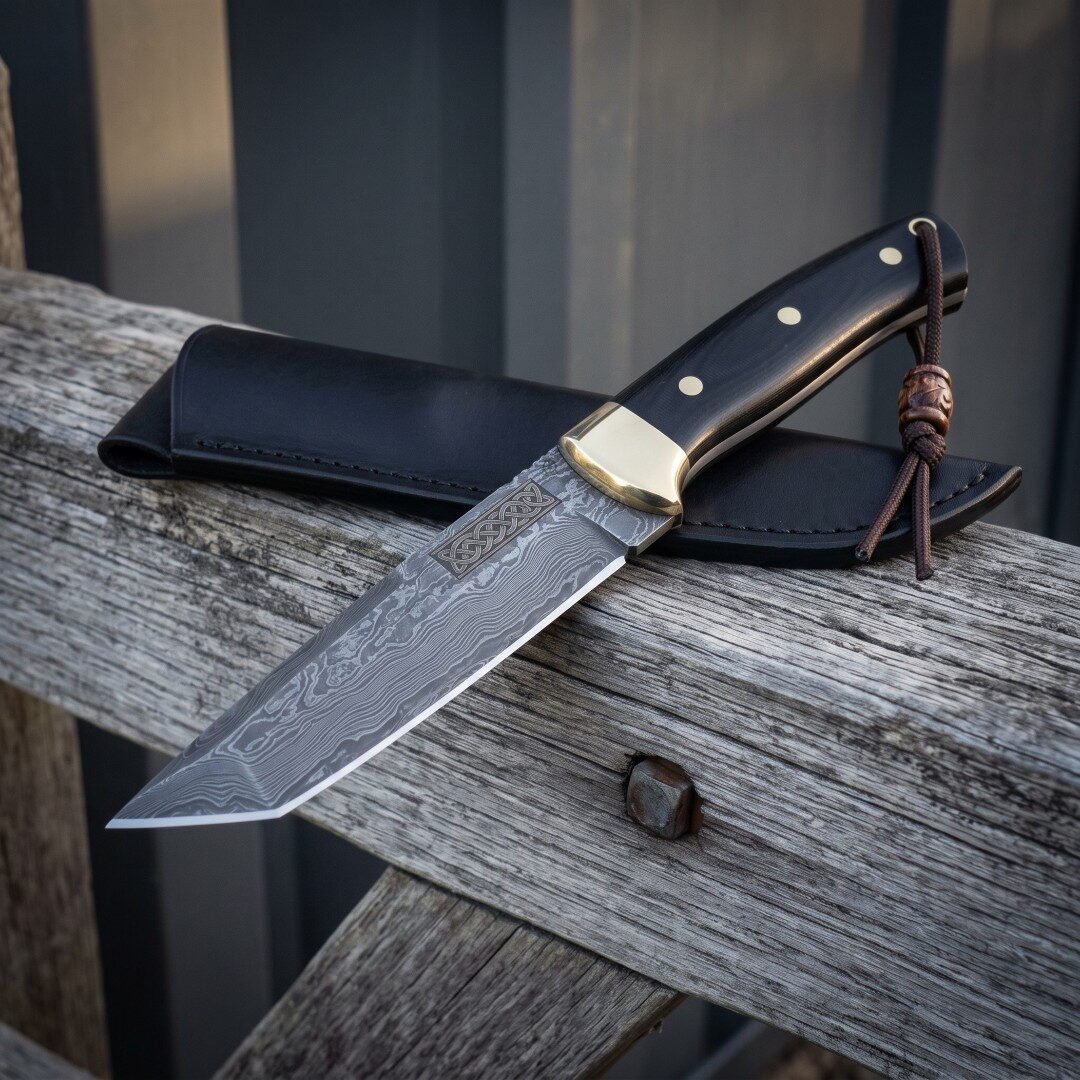
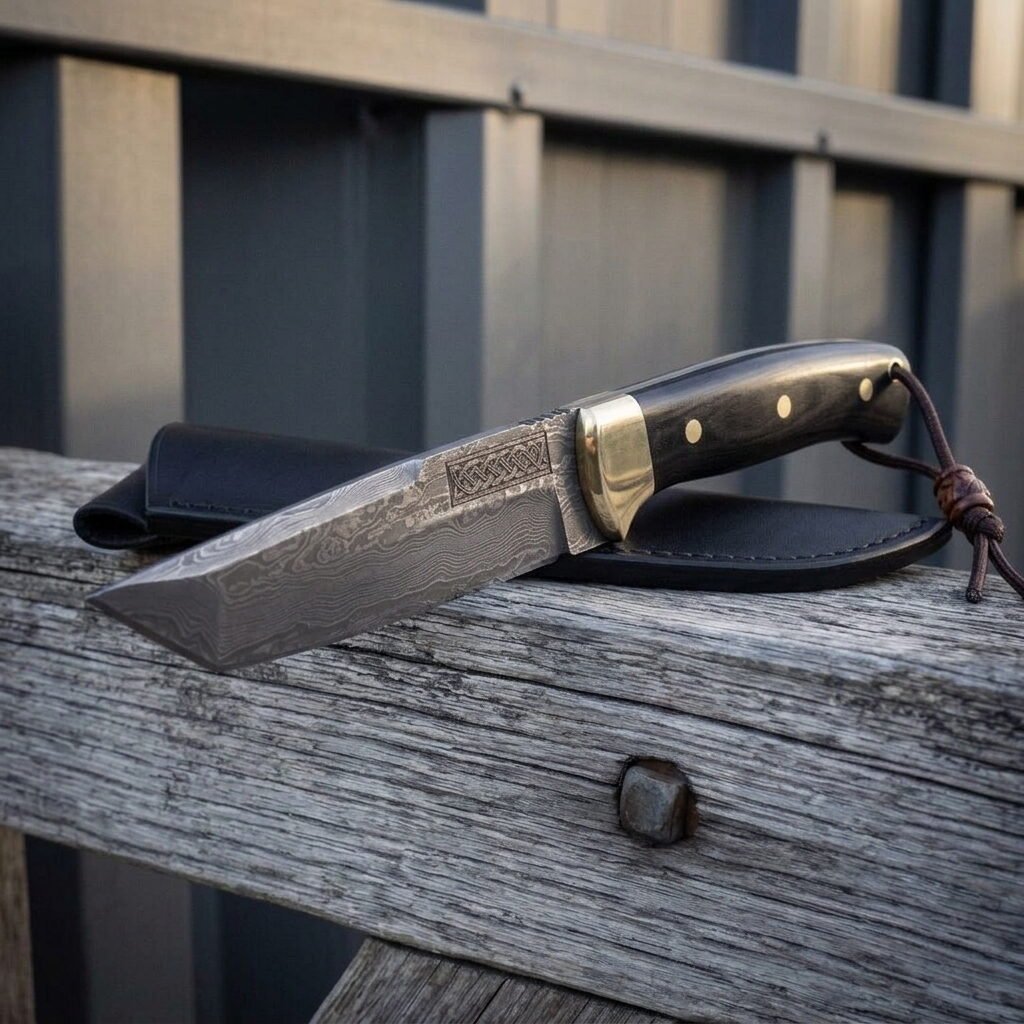
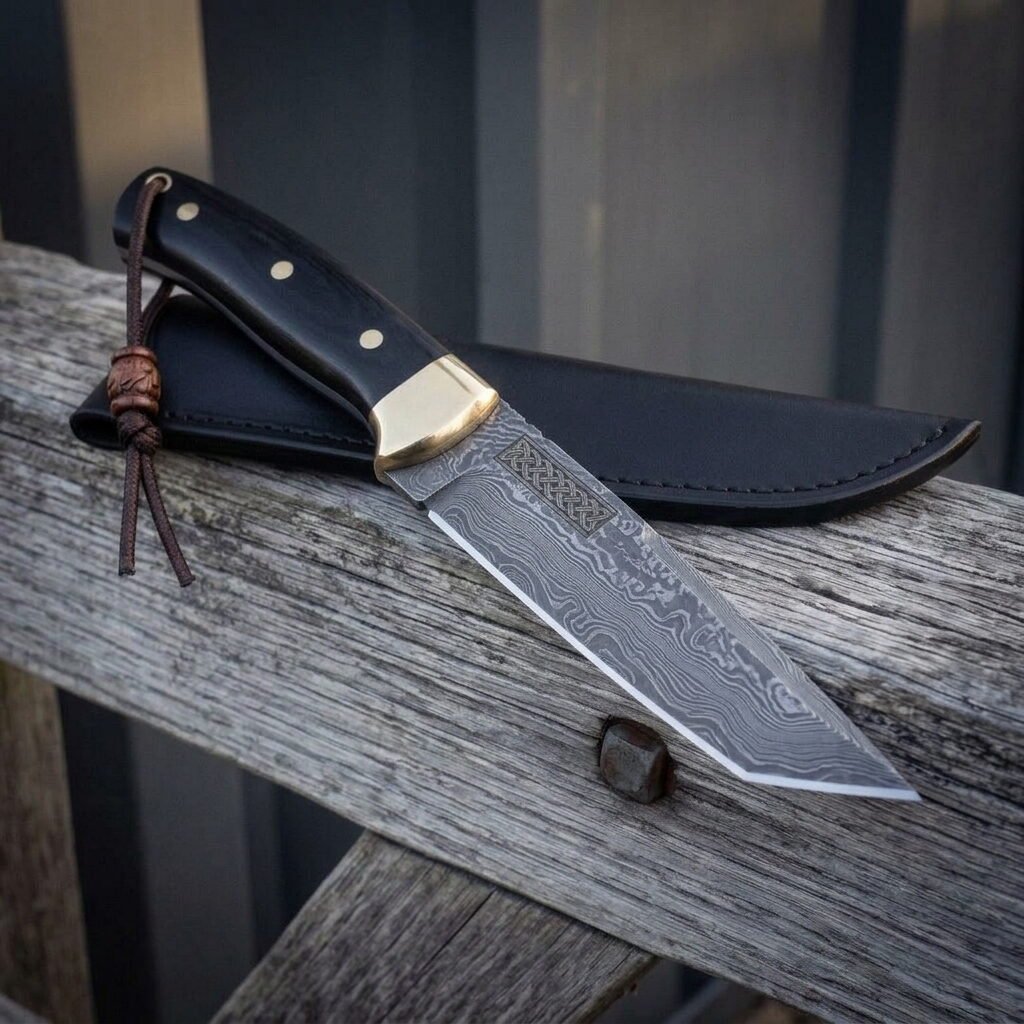
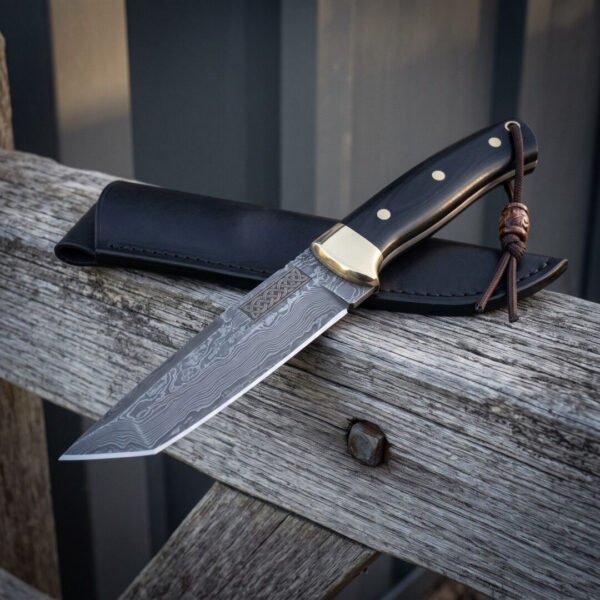
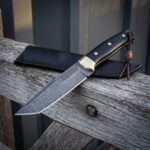
The Ebonknot is a tanto point knife with a pattern welded blade, a heavy brass bolster and black polished scales pinned through the full tang. Cut into the flat above the bolster is a framed band of Celtic interlace, and a brown leather lanyard runs through a tube set into the butt of the handle. Everything about the build is deliberately plain apart from that one etched panel, which is exactly how a knife with this much figure in the steel should be finished.
The tanto point borrows its name from the short Japanese blade, though the angular tip on this knife is the modern knife maker’s version of it rather than a copy of anything old. The spine and the main edge both run straight, and near the tip the edge breaks at a crisp angle into a short front edge that climbs to meet the spine. That corner leaves a lot of steel sitting right behind the point, which is the whole reason people choose one. The Ebonknot is made by hand in the Czech Republic, imported and checked by Ransack Viking, and shipped from our North Babylon, New York warehouse. It arrives with the fitted black leather belt sheath shown in the photographs.
The angled tip and the straight edge are what make a tanto a tanto, and the tanto guide covers what the shape is good at. Insular knotwork travelled with the Norse and came back changed, and the symbols guide covers the shapes that recur. For dressing game the skinner knives take over where a tanto stops being handy.
Specifications
| Type | Tanto point hunting knife, full tang |
|---|
| Blade | Pattern welded 1095 and 15N20 Damascus, 58 to 60 HRC |
|---|
| Blade profile | Straight spine, straight main edge meeting a short front edge at an angular tanto tip |
|---|
| Blade etching | Framed Celtic interlace panel above the bolster |
|---|
| Bolster | Heavy polished brass, wrapped around the front of the handle |
|---|
| Scales | Black polished scales pinned through the tang with contrasting pins |
|---|
| Lanyard | Brown leather lanyard through a tube in the butt |
|---|
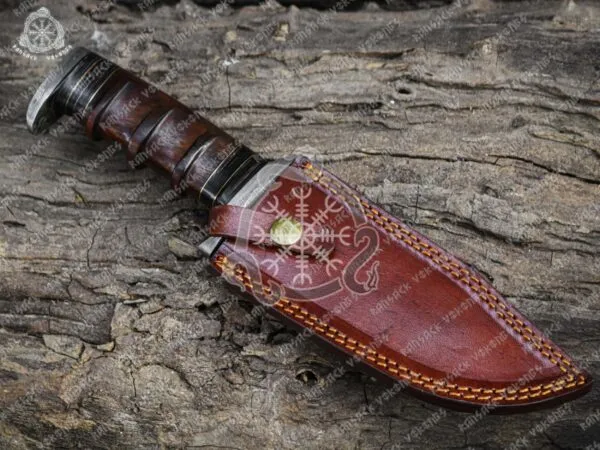
| Sheath | Black leather belt sheath, stitched |
|---|
| Finish | Etched Damascus blade, polished brass, gloss black scales |
|---|
| Included | Tanto knife, leather lanyard and fitted black leather sheath |
|---|
| SKU | RK-2077 |
|---|
What a tanto point is doing, and why the angle matters
A tanto point has no curve at the front. The main edge runs straight along the blade, then turns at a sharp corner into a short secondary edge that rises to meet the straight spine at the tip. It looks aggressive and that is why it sells, but it exists for reasons that have nothing to do with looks.
Its first effect is strength at the point. Because the spine runs straight all the way out and the front edge meets it at an angle, the tip is backed by nearly the full thickness of the blade instead of thinning away along a curve. That reinforced point will take hard pushing cuts into tough material that would be hard on a fine curved tip.
Its second effect is to give you two separate edges. The long straight main edge does the push cuts and the slicing, and the short front edge handles the tip work, so each part of the blade has its own job. On a hunting knife that matters when you are working carefully rather than chopping.
The trade is the belly. With no curve at the front, a tanto is less suited to long sweeping skinning strokes than a curved blade, and the corner where the two edges meet takes a little more care when you sharpen. Even a reinforced point is not a pry bar, and prying with the tip is still the fastest way to ruin any knife. Use it for cutting and piercing and it will outlast you.
The bolster and the lanyard
The brass block between the blade and the scales is a bolster, and it is one of those parts people assume is decoration until they see a knife without one. It caps the joint where the scales meet the ricasso, which is the exact place moisture, blood and grit would otherwise creep under the scales and start lifting them. It also adds mass directly at the balance point, which shifts the knife back into the hand and makes it feel controllable rather than blade heavy.
The third job is safety. The bolster stands proud of the edge line and stops the hand sliding forward onto the blade under a hard push. On a knife built for hard pushing cuts, and with a wet handle, that is not a small thing.
The leather lanyard through the butt is a working feature too. Looped around the wrist it keeps the knife with you if your grip opens, and looped around the fingers it gives a longer effective handle for a draw cut. It also gives you somewhere to hang the knife when it needs to dry.
The steel and the scales
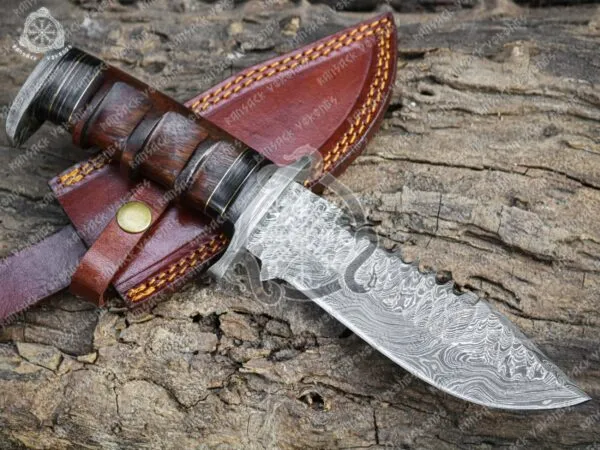
The blade is pattern welded from 1095 and 15N20, forge welded, folded and drawn, then ground and etched. The bright bands are the 15N20, which contains around two percent nickel and resists the acid, and the dark bands are the 1095. The pattern is the real internal structure of the billet exposed by the grind, not a surface finish, and it goes all the way through. Hardened and tempered to 58 to 60 HRC, the blade takes a keen edge and holds it through real cutting work.
The scales are a dark close grained material polished to a deep gloss black. We describe them honestly as black polished scales rather than naming a wood or a horn, because the finish on this piece is uniform enough that we would be guessing. What we can tell you is that they are pinned right through the full tang with contrasting pins rather than glued on, which is the construction that lasts.
Carbon Damascus is not stainless. It will take a patina with use and will spot if it is left wet, which is the price of an edge that behaves this well.
Engraving, runes and your own design
Use the rune converter on this page to turn a name, a date or a short phrase into Elder Futhark and we will cut it into the steel, the leather or the wood. If you would rather have a Viking pattern than a rune line, choose your own design in the engraving option above the add to cart button and tell us where it goes. Where a piece already carries an engraved design, your chosen engraving replaces it rather than sitting alongside it. On the Ebonknot a rune line on the flat takes the place of the Celtic interlace panel. If you want to keep the interlace, the brass bolster and the leather sheath can both be marked instead. Details are on the engraving page.
Handling and balance
With the brass bolster sitting right at the front of the handle the knife balances close to the index finger, which is where a working tanto should sit. It does not feel like a chopper and it is not meant to. This is a controlled cutting knife with enough blade to do camp work and enough point to do detail work.
The scales are shaped with a slight palm swell and the butt curves down, so the hand locks in both in a forward grip and reversed. Keep the thumb on the flat of the spine for fine control of the tanto tip, and drop it back onto the scales for a stronger push.
This is a hand made collector and field knife with a real edge. It is not a pry bar and it is not a throwing knife. Prying with the tip and throwing are the two fastest ways to damage any full tang knife and neither is covered by the warranty.
Care
Wipe the blade after every use and keep a light film of oil on it. Etched Damascus has a slightly open surface and rust will find it faster than it finds a mirror polish, particularly after cutting anything acidic or salty. Mineral oil is fine and food safe options are available if you use the knife for game preparation.
Do not store the knife in the sheath for long stretches, and never put it away damp. Feed the leather with a cream once or twice a year and let it dry naturally if it gets soaked. The brass will tone down with handling and comes back bright with a metal polish. Our steel care guide has the detail.
Damascus wants oil more than plain steel does, because the etch that shows the pattern also opens the surface, and caring for a Damascus pattern covers what to use.
Made in the Czech Republic
This knife is made by hand in the Czech Republic. Ransack Viking imports it, checks the grind, the bolster fit, the pinning and the sheath before listing it, and ships it from our North Babylon, New York warehouse. Nothing goes out drop shipped from an importer catalogue without being looked at first. Shipping in the United States is free. Processing usually takes one to two weeks with engraving adding to that. Returns are accepted within seven days. There is a genuine lifetime warranty against defects in forging, grind, heat treat and fittings, with no end date and no receipt needed.
A note on handmade variation
This knife is hand made rather than machine made or bulk produced, so what arrives will not be a pixel for pixel copy of the photograph. Pattern welded steel is never twice the same, and the way the bands flow across your blade depends entirely on how that individual billet drew out. The scales will vary in the depth of their grain, the brass will differ slightly in tone, and the etched interlace will sit a fraction differently above the bolster. The dimensions, the material and the build are the same every time. The character is not.
Frequently asked questions
Is it sharp out of the box
Yes. It arrives with a keen working edge, ready to cut. Unpack it carefully and store it out of reach of children.
Can I use this for field dressing game
Yes, it will do the job, though the straight edge and angular tip suit opening and cutting more than long skinning strokes. Clean it and dry it thoroughly afterwards, because carbon Damascus reacts with blood and will stain if it is left.
What are the scales made of
They are a dark close grained material polished to a gloss black. We would rather describe the finish honestly than name a wood or a horn we cannot verify on every single piece. They are pinned through the full tang.
Does the sheath fit a belt
Yes, it is a stitched black leather belt sheath rather than a display scabbard, so it carries on a normal belt.
Will the etched knotwork wear away
No. It is cut into the steel rather than printed onto it, so it survives sharpening, cleaning and normal use. Only heavy abrasive work on that section of the flat would reach it.
How long before it arrives
Processing is one to two weeks from our New York warehouse, then free standard shipping within the United States. Engraving is cut here after the knife arrives, so add a few days if you order it.
What is in the box
- Ebonknot Damascus tanto knife
- Brown leather lanyard fitted through the butt
- Fitted black leather belt sheath
- Light protective oil film on the blade
- Hand made in the Czech Republic, shipped from our North Babylon, New York warehouse
Explore the range
More in tanto knives, hunting knives, Viking knives and engraved and personalised pieces, or read the guides.
If this one is not it
Closest to this in the range is the Riverclaw bowie knife, 14 inches overall. If this one is not quite right, there is the Bonecreek bowie knife, 15 inches overall. Also in this group is the Emberstack bowie knife, pattern welded Damascus.
If you are putting a set together, the Brasscrow kukri knife sits alongside it. Pick the steel, the length and the fittings yourself on the custom hunting knife page.

This knife beat every expectation I had. Came in a nice gift box which made it feel even more special. Ransack Viking’s attention to detail is honestly unmatched. Shipping was fast and everything arrived well packaged.