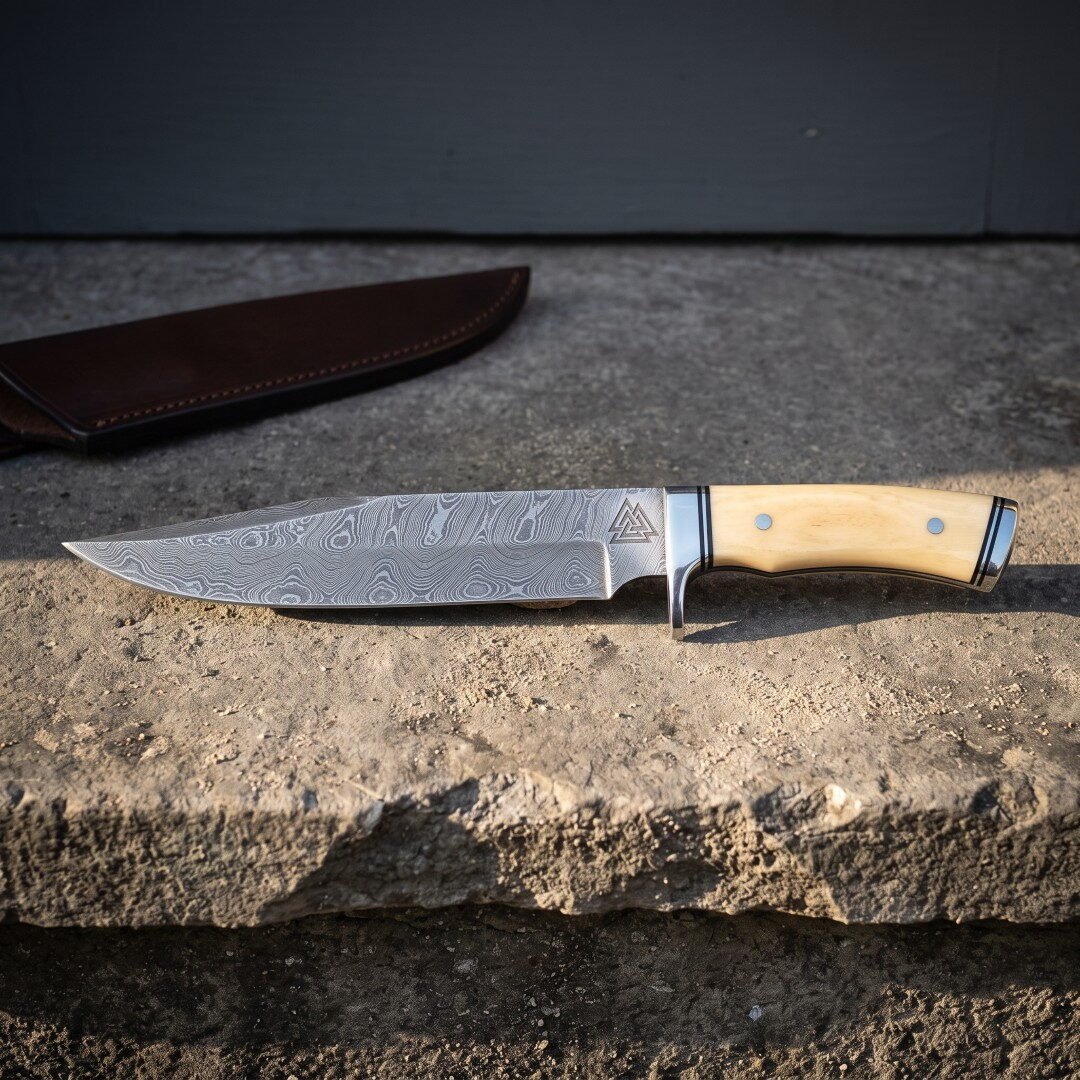
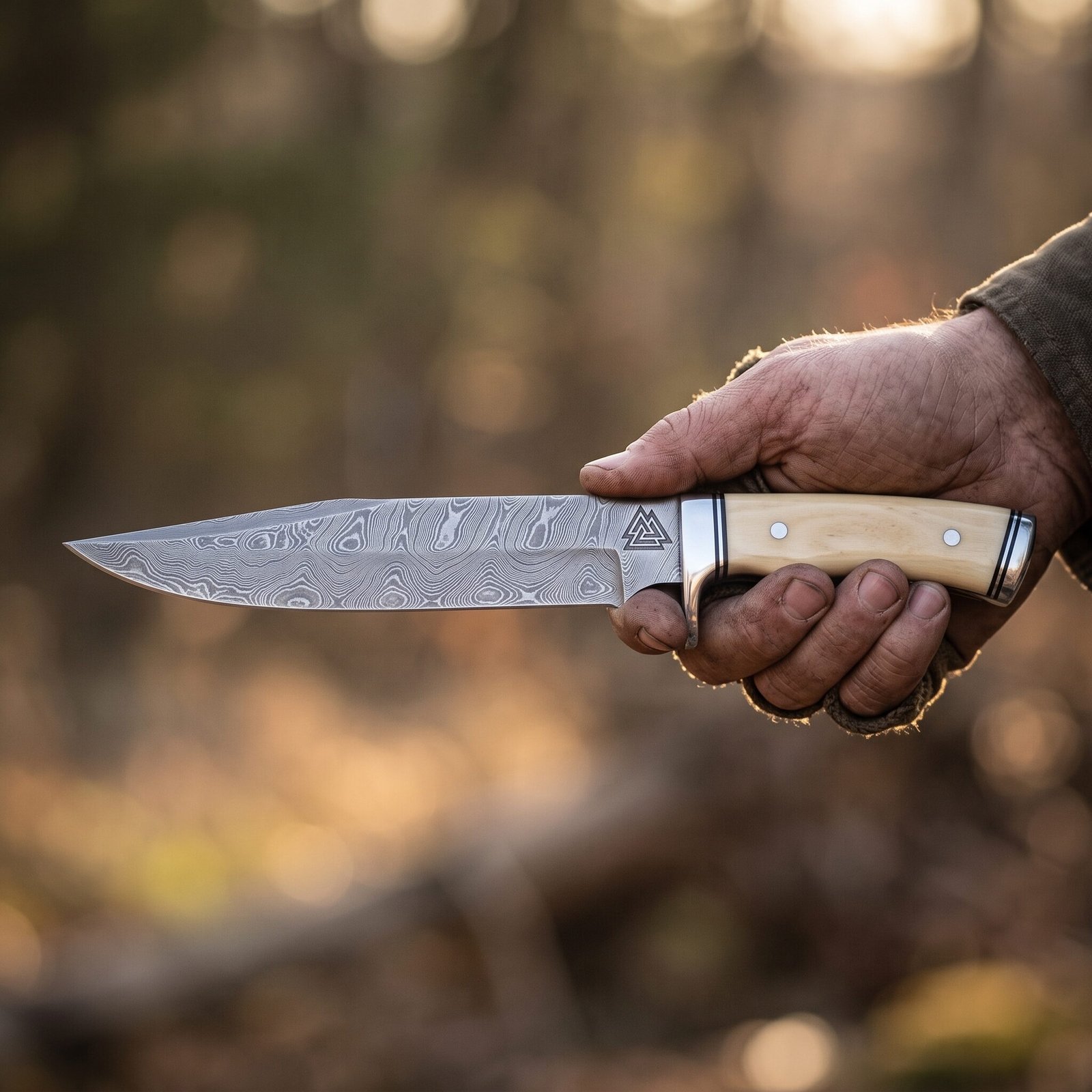
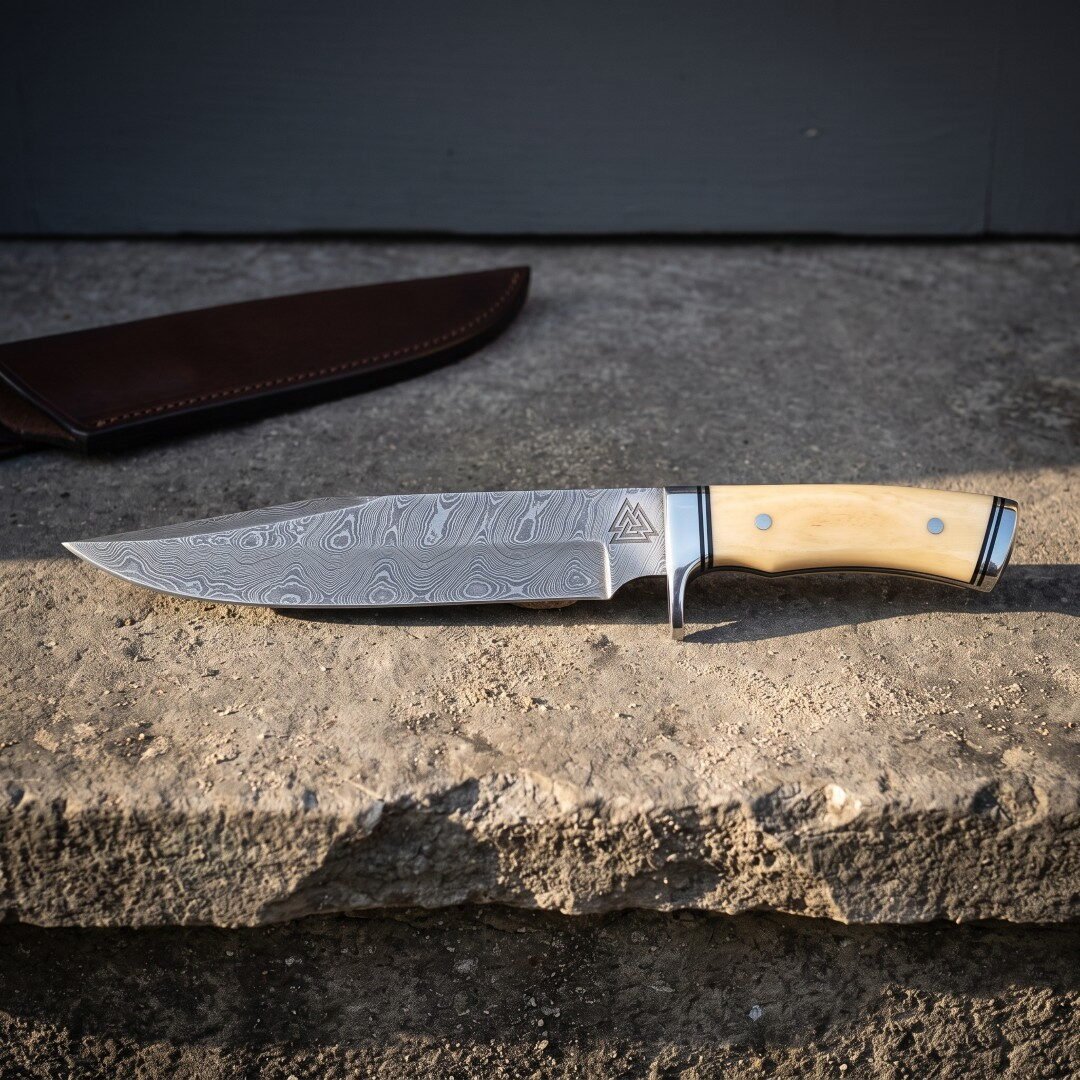
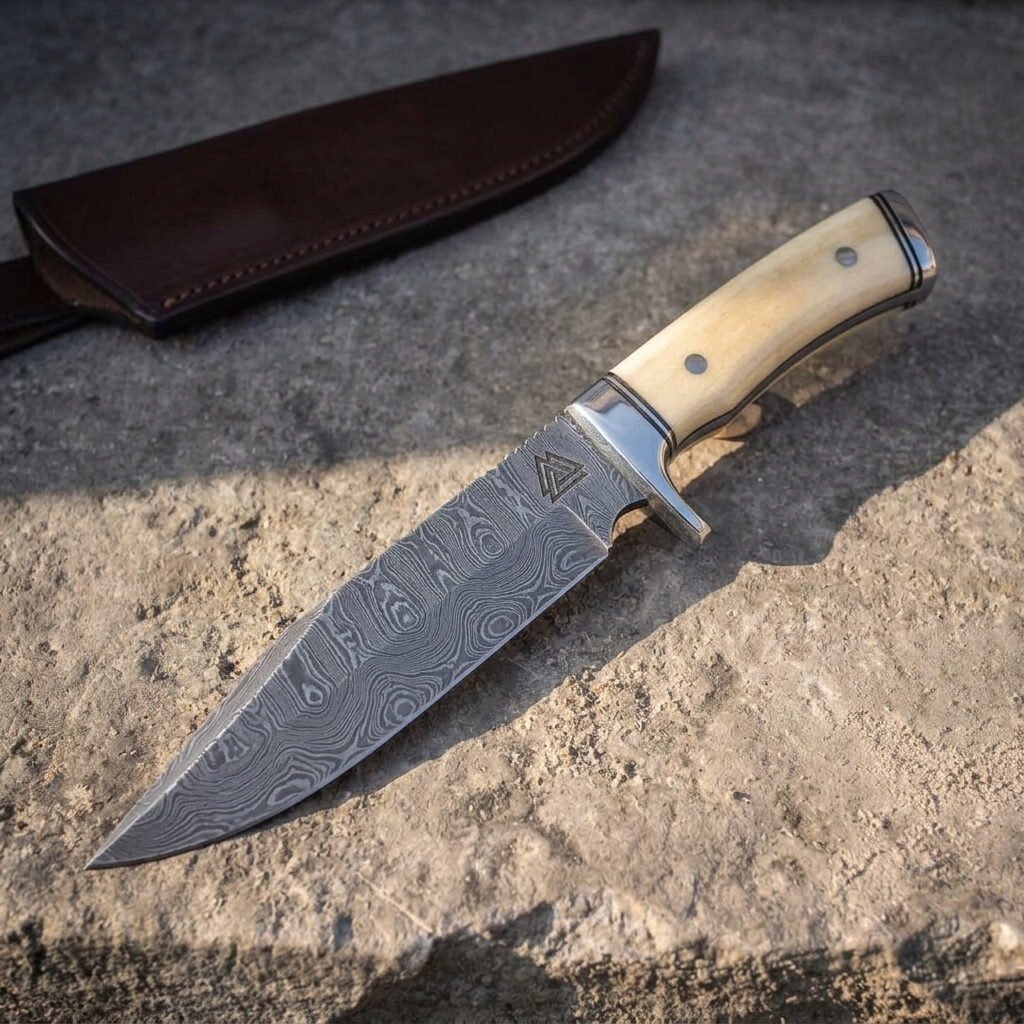
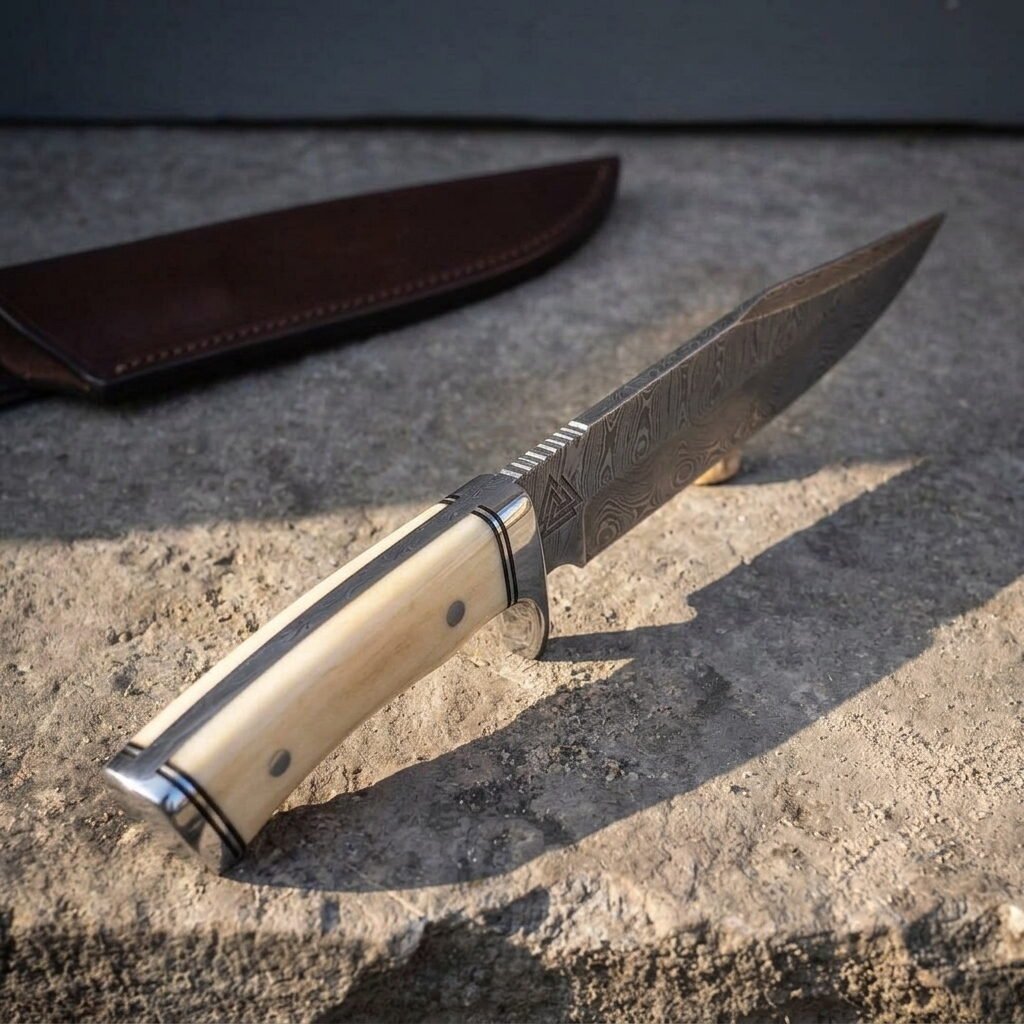
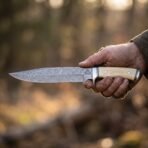
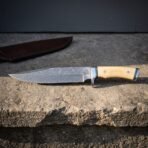
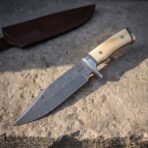
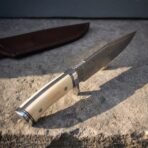
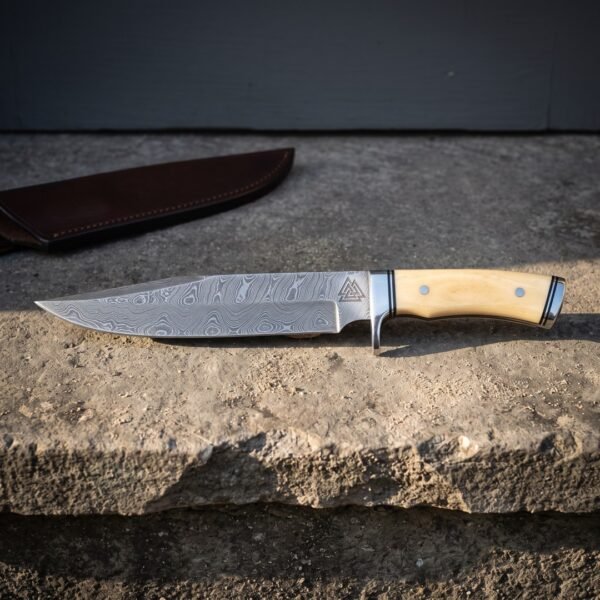
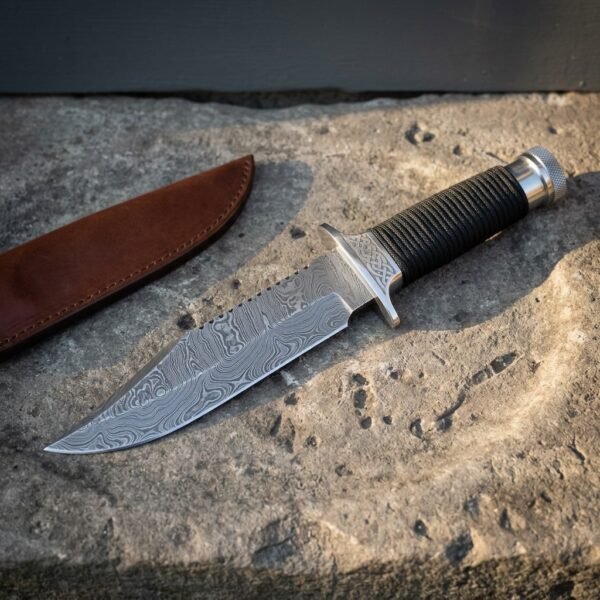
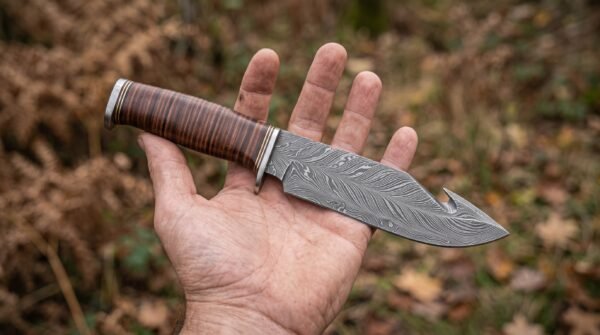
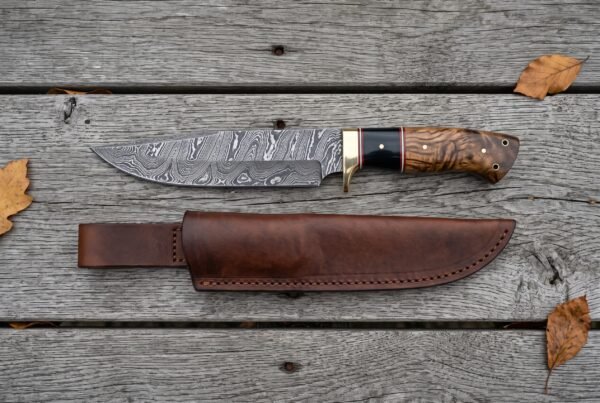
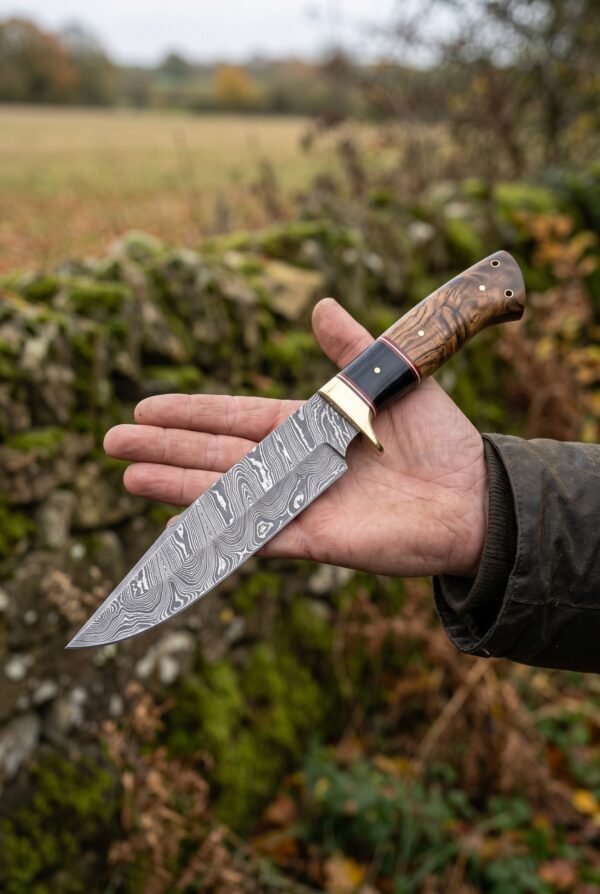
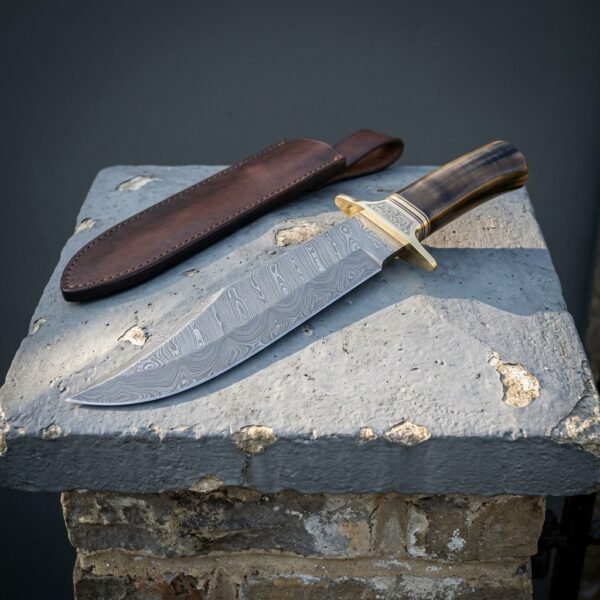
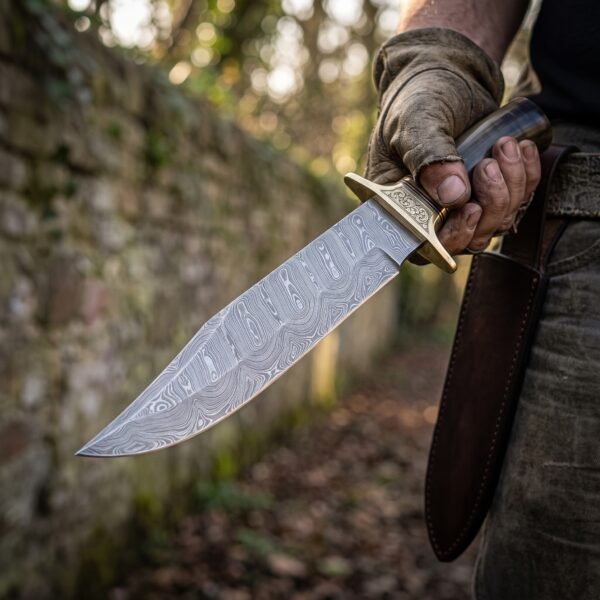
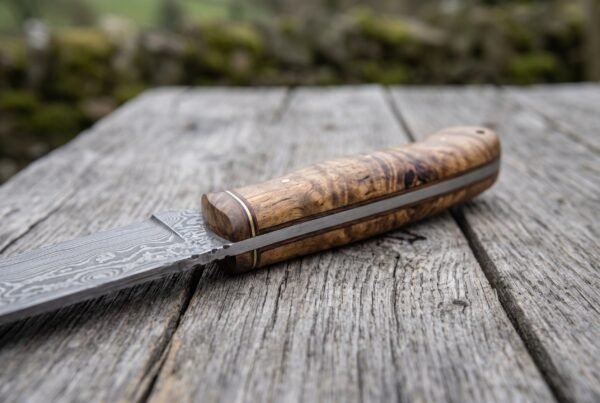
The Bonecreek is a full size bowie in 1095 and 15N20 damascus, with a long clip point, a steel guard, pale bone handle scales over dark liners and a Valknut etched into the blade at the ricasso. It comes with a hand stitched oxblood leather belt sheath. This is a working knife in size and geometry, built for field dressing, camp work and heavy cutting rather than for a display case, though it will happily sit in one.
The Valknut is the most argued over symbol in Norse art. Three triangles interlocked so that no one of them can be separated without the others, it appears carved on the Stora Hammars picture stones on Gotland, on the Tangelgarda stone and on a bedpost from the Oseberg ship burial. On several of those carvings it sits beside scenes of death, sacrifice and a figure most scholars read as Odin, which is why it is usually connected to the god who claimed the slain. Its Norse name is not recorded. Valknut is a modern Norwegian coinage meaning knot of the fallen.
Forged, folded, ground, heat treated, etched and handled in the Czech Republic. It ships with the fitted leather sheath and a care card. It is part of the Bowie knives, and the Viking knives are put together the same way.
Specifications
| Blade material | 1095 and 15N20 damascus, hardened and tempered to 58 to 60 HRC |
|---|
| Blade length | Roughly 7.5 inches, clip point with a long swedge |
|---|
| Handle length | Roughly 4.5 inches |
|---|
| Overall length | Roughly 12 inches |
|---|
| Handle | Pale bone scales over black liners on a full tang |
|---|
| Pins | Two steel pins |
|---|
| Guard | Polished steel, single downswept quillon on the edge side |
|---|
| Pommel | Polished steel butt cap with a black spacer |
|---|
| Etching | Valknut at the ricasso, cut into the pattern |
|---|
| Pattern | Flowing damascus, hand etched to bring up the layers |
|---|
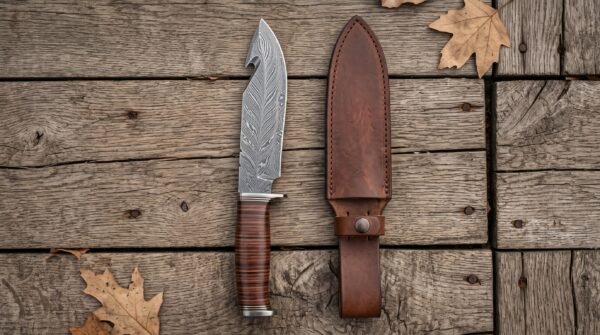
| Sheath | Oxblood vegetable tanned leather, hand stitched, belt carry |
|---|
| Included | Knife and fitted leather sheath |
|---|
| SKU | RK-1718 |
|---|
What the clip on a bowie clip point is for
Look along the spine from the handle and you will see it run straight for most of its length and then fall away in a long concave sweep to meet the edge. That falling section is the clip, and it exists to solve a problem specific to a big knife. A long blade with a full thickness spine carried all the way to the tip gives you a point like a crowbar. It will not enter cleanly, it will not follow a seam and it will not do fine work.
Clipping the spine takes material off the top of the forward section, which drops the point down toward the centre line of the blade and thins it dramatically. The result is a tip that penetrates and steers, on a knife that still has the belly and the mass to chop. The swedge, the false bevel ground along the clip, thins it further. On this knife the clip is long and shallow rather than short and sharp, which keeps more strength behind the tip. That is the version you want on a using knife rather than a duelling one.
The damascus, the bone and the leather
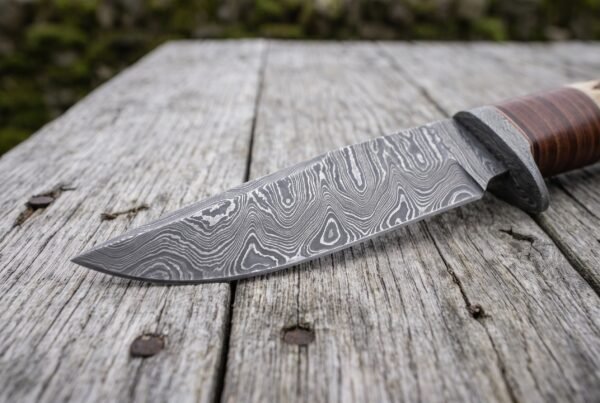
The blade is pattern welded from 1095 and 15N20 in alternating layers. The two steels behave nearly the same in the fire and the quench, which is what makes them weld reliably, but they behave completely differently in acid. 15N20 has around two percent nickel and shrugs off a ferric chloride etch. 1095 does not. Etch a finished blade and the 1095 darkens while the 15N20 stays bright, and the pattern you see is a cross section through the folded stack.
Heat treated to 58 to 60 HRC, which on a hunting blade means it holds an edge through a whole animal without stropping. The scales are bone, stabilised and pinned through a full tang over dark liners, which is a traditional bowie handle material and one that warms in the hand rather than staying cold like a metal or a synthetic. The sheath is oxblood vegetable tanned leather, wet formed to the knife, hand stitched and burnished on the edges.
Engraving, runes and your own design
Use the rune converter on this page to turn a name, a date or a short phrase into Elder Futhark and we will cut it into the steel, the leather or the wood. If you would rather have a Viking pattern than a rune line, choose your own design in the engraving option above the add to cart button and tell us where it goes. Where a piece already carries an engraved design, your chosen engraving replaces it rather than sitting alongside it.
On this knife most people put a name or a date on the ricasso or stamp it into the sheath, which keeps the damascus figure uninterrupted along the blade. The bone scales will also take a fine engraved line, and bone holds a cut beautifully because it is dense and even. If you want your own design where the Valknut sits, it replaces the Valknut. See the engraving page.
Handling and balance
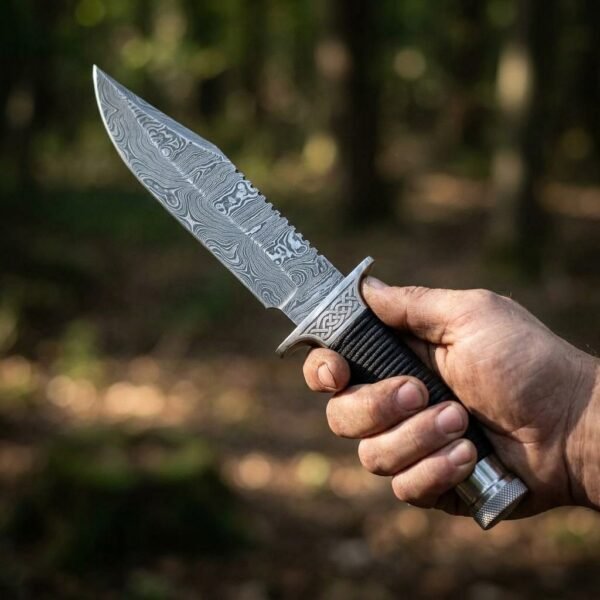
Balance sits just ahead of the guard, close to the first inch of blade, which for a bowie this size is forward enough to chop and far enough back to control. The single downswept quillon gives your index finger a hard stop, so a slippery grip in wet conditions does not run onto the edge. The bone is contoured rather than flat, and the palm swell sits into the base of the thumb.
Used as intended it will break down a deer, split kindling, clear brush and do camp kitchen work. What it will not tolerate is being used as a pry bar or a hatchet against knots and nails. Damascus at 58 to 60 HRC is genuinely hard steel and hard steel chips rather than bends. Treat the tip as the most fragile part of the knife, because it is.
Care
Wash the blade by hand in warm water, dry it immediately and oil it. Never put it in a dishwasher, which will ruin the etch, loosen the scales and rust the steel in one cycle. Because the ferric chloride etch leaves the surface faintly textured, damascus holds moisture more readily than a plain polished blade, so oiling matters more here. Camellia oil is traditional and food safe on a knife that touches meat. There is more on steel care.
Never use an abrasive polish or a scouring pad on the pattern. It will flatten the contrast permanently. Sharpen on a stone at the existing angle rather than on a powered wheel, which can overheat and soften the edge. Feed the leather sheath with a neutral balm two or three times a year, and do not store the knife in the sheath long term because leather holds damp against steel.
Made in the Czech Republic
This is a handmade piece from the Czech Republic, made in a workshop that still forges, grinds and finishes by hand instead of stamping parts out. The smiths there have kept the older way of working, and the wood, horn and leather are shaped and fitted by hand as well. Two pieces of the same design will never be identical, and that is part of what you are buying.
Ransack Viking is a United States company. We handle the import ourselves, look over every piece when it lands and ship from our warehouse in Chicago, Illinois. Engraving is done in the United States after the piece arrives, so your design goes on before we send it out.
A note on handmade variation
This is hand made, not machine made and not bulk produced, so what arrives will not be a pixel for pixel copy of the photograph. Damascus is the most variable thing we make. The figure is a slice through a folded billet, so the way the layers swirl into the clip and run out along the edge bevel is different on every blade and cannot be repeated on request.
Bone varies too. It carries its own faint grain and its own colour, from near white through to a warm cream, and no two pairs of scales match exactly. Oxblood leather takes dye at its own rate across a hide. Blade length, overall length, steel, hardness, handle construction and sheath build are the same every time. The character is not. The long form of that is the Bowie knives worth having, with the blade shapes guide next to it.
Frequently asked questions
Is it sharp out of the box
Yes. It arrives shaving sharp and ready to work. Damascus at 58 to 60 HRC takes a fine edge and holds it, so open the box carefully.
Is it a real using knife or a display piece
It is a using knife. The size, the geometry, the full tang and the heat treat are all built for field dressing, camp work and general hard cutting. It will display well but that is not what it is for.
What does the Valknut mean
Three interlocked triangles, carved on Gotland picture stones and on the Oseberg ship burial, generally read as a symbol tied to Odin and to the dead. The Norse name for it is not recorded. Valknut is a modern term meaning knot of the fallen.
Are the bone handle scales going to crack
Not in normal use. They are stabilised and pinned through a full tang over liners. Bone dislikes sudden temperature swings and prolonged soaking, so do not leave the knife in water or on a radiator.
Will the damascus pattern wash off
No. The contrast is in the steel itself, revealed by an acid etch, not printed on top. Normal washing and oiling leave it alone. Abrasive polishes and wire wheels will flatten it, so avoid those.
How long does shipping take
One to two weeks, because the billet is forged and folded after you order. US shipping is free.
What is in the box
- One hand forged 1095 and 15N20 damascus bowie with bone scales and a Valknut etch
- One hand stitched oxblood leather belt sheath, wet formed to the knife
- Care card covering washing, oiling and sharpening
- Lifetime warranty against defects in forging, grind, heat treat and fittings
- Forged and finished in the Czech Republic
Explore the range
See the rest of the bowie knives, the hunting knives, the viking knives, and the guides for more on clip points and damascus.
Worth a look beside this
Worth putting side by side with this is the Ramwhorl bowie knife, 13 inches overall. In the same category sits the Brasscliff bowie knife, 15 inches overall. A near match for this one is the Ebonknot tanto knife, pattern welded Damascus.
For a different piece from the same family, look at the Stagcarry folding pocket knife. Or start from a blank sheet on the custom Damascus knife page.

This knife is well made. Just a couple small things kept it from 5 stars. Blade quality is solid. Arrived a bit less sharp than expected but a few passes on a strop fixed it. Good product. Just not quite perfect. Nice that it ships from a US warehouse even though the craftsmanship is Czech. Not my first Ransack Viking order and it held up to their usual standard.