
An arming sword is the plain single handed sword of the medieval centuries, cruciform, double edged and sized for one hand. The six on this page are built as sparring tools rather than display pieces. Blades run about 30 inches, overall lengths sit between 36 and 38 inches, and every one is 51CrV4 spring steel hardened to 49 to 52 HRC, chosen because it bends and returns instead of taking a set or snapping under a hard bind. For the sharp collector version of the same shape, the arming swords in the main sword range carry edges and scabbards.
The six split by blade. Three run a broad fuller down most of the length, one carries a narrow fuller to about two thirds, one is diamond in section with no fuller at all, and one is a migration era form with a short lower guard and a two part pommel. Two hilts add side rings above the cross. Every edge is a blunted flat land and every point is rolled or rounded off.
They sit beside the HEMA longswords, the messers and the sideswords in the same line. Read how to choose your first HEMA sword and what flex actually means before you order.
Most of these take a custom engraving on the blade, the cross or the pommel, chosen on the product page.
If you want a single handed sword built to your own hand instead, start with the sword builder and set the blade length, the fuller, the guard, the pommel and the grip wrap.
Free US shipping
On most pieces. Heavier and oversized ones carry a flat charge.
Hand Forged
Heated, hammered and ground by hand.
Engraving available
Names, dates or Norse runes on most pieces.
Ships from New York
Inspected and dispatched from our New York warehouse. No import duty, no customs delay on US orders.
HEMA Arming Swords
The single handed sword in the sources
The arming sword is the ordinary sword of the medieval centuries. It is the one a man wore at his hip when he was carrying nothing else, and it stayed in service for roughly four hundred years because the shape worked. Cruciform hilt, straight cross, double edged blade of about 28 to 33 inches, a grip long enough for one hand and a heavy pommel above it to balance the blade back towards the guard. Nothing about it is decorative. The consensus band that modern makers build to sits at about 0.8 to 1.0 kg with a blade around 30 inches, and that is where these six live.
In the fencing treatises it is usually just called the sword. The masters who wrote the surviving books treat it as the baseline tool, the thing a student already owns before he picks up anything longer. Fiore dei Liberi gives the single handed sword its own section of the Flower of Battle, used in one hand and in two. The earlier German material treats it as half of a pair with the buckler. Later the Bolognese writers carried the same single handed sword forward and added rings to the hilt, which is how you get the sidesword, and why the two families still look so alike at the guard.
The two blade shapes that survive
Broadly, two answers exist in the archaeological record. The first is a wide blade with nearly parallel edges and a shallow fuller running down most of its length, built to cut. The second is narrower, more sharply tapered, stiff in section, often with a short fuller or none at all, built to find a gap in plate armour with the point. Both are on this page. Ashgrimm is diamond in section with no fuller anywhere, which is the later thrusting answer. Haldvane, Mirlaug and Skarnvik carry a broad fuller and sit firmly at the cutting end of the family. Faskvar and Draugmar fall between the two, with a fuller that stops part way down a blade that still tapers.
Sword and buckler, and the manuscript called I.33
The oldest surviving European fencing manual is a sword and buckler book. It is catalogued as MS I.33, it is usually dated to around 1300, and it works through a set of named guards and their counters with a single handed sword in one hand and a small round shield in the other. That pairing is why the arming sword still has a place on a club floor. It is the entry point to the longest documented tradition in the art, and many clubs teach it from a first session because the tool is short, light and easy to control.
A buckler is a small shield, usually about nine to sixteen inches across, with a deep central boss and a single bar grip behind it. It is held out at the end of the arm rather than strapped to the forearm, and much of its job is to cover the sword hand rather than the body. That changes how the sword is used. The hands work together, the buckler travels with the blade, and a bind is resolved by moving the shield as much as by moving the point.
None of these six ships with a buckler. The specification panel on each product states exactly what is in the box.
Side rings, finger rings and what they are for
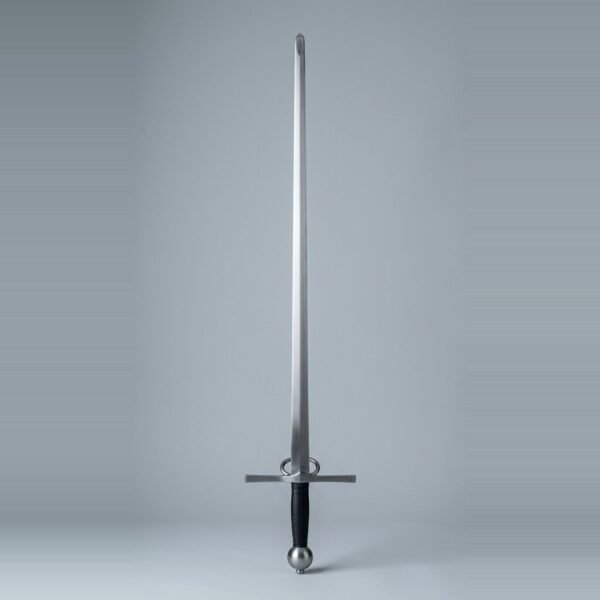
A plain cross protects the hand only as long as the hand stays behind it. Once fencers began hooking a finger over the cross to gain point control, the finger became exposed, and hilts grew a ring on each face above the block to shield it. Ashgrimm on this page carries exactly that, two side rings sitting one on each side above the cross. It is a small addition that tells you where the sword sits in the timeline, because a ringed arming sword is later than a plain one.
The distinction worth holding on to is that a side ring stands out from the flat of the blade and shields the hand from a blow that slides down the outside, while a finger ring sits forward of the cross and gives the finger somewhere safe to sit. Once both appear together, along with a knuckle bow, you have left the arming sword and arrived at the sidesword. The sideswords in this line show that next step, and the guide comparing the sidesword with the rapier follows the road further.
Fullers, taper and why one sword feels different from another
The fuller
A fuller is the shallow groove forged or ground down the centre of a blade. It is not a blood groove and it never was. It removes steel from the middle of the section, where that steel contributes least to stiffness, and leaves it at the edges where it contributes most. The result is a blade that keeps most of its rigidity while losing real mass, which shifts the balance point back towards the hand and makes the sword quicker to change direction.
How far the fuller runs matters as much as whether it exists. Haldvane and Mirlaug carry theirs down most of the blade, which keeps the piece light and cut oriented all the way towards the point. Draugmar stops at about two thirds, which leaves more steel in the last third and stiffens the point for thrusting. Faskvar runs a narrow fuller to roughly the same place on a narrower blade. Ashgrimm has none at all and gets its stiffness from a diamond section instead.
Profile taper and distal taper
Two separate things get called taper. Profile taper is how the blade narrows from the cross towards the point when you look at it flat on. Distal taper is how it thins from base to point when you look at it edge on. A sword with strong distal taper feels far livelier than its bare mass suggests, because the steel that has been removed sits at the far end of the lever. A sword with little distal taper feels heavy in the hand even when the scales say it is not.
Ransack Viking publishes no measured weight or balance point for this line, because these are forged and ground one at a time and no two come out identical. Flex is given as a named tier instead. The flex guide explains what the tiers mean.
How a trainer differs from a display sword
Steel and hardness
This is the single largest difference and it is invisible in a photograph. A display or collector sword is generally 1095 high carbon steel hardened to 54 to 58 HRC. That is the right answer for a blade that will be sharpened, will hold an edge and will hang on a wall or cut tatami. It is the wrong answer for a blade that will be struck edge on, hard, several hundred times an evening. At that hardness a blade resists bending right up until it does not, and then it takes a permanent set or breaks.
Every arming sword in this category is 51CrV4 spring steel hardened to 49 to 52 HRC instead. Softer, tougher, and specified that way on purpose. Spring steel at that hardness bends under a hard bind and returns to straight afterwards, which is exactly what a sparring blade needs to do. The trade is that it will not take or keep a fine edge, which does not matter, because these are not sharpened.
The edge and the tip
A blunt trainer does not have a rounded edge. It has a flat land, a deliberate ground flat along the edge line, typically 2 mm or wider, so the blade cannot bite into another blade or into gear. Every arming sword here is listed with that flat land. The specification panel states the figure for each piece and you should read it rather than assume.
Tips vary across the six and the difference is worth knowing before you enter an event. Haldvane, Faskvar and Skarnvik carry a rolled and flared tip of about 15 mm. Mirlaug, Draugmar and Ashgrimm are blunted and rounded off instead. Tournament gear rules are specific about this. The Berlin HEMA Cup, for one, requires a spatulated or rolled tip with a minimum diameter of 1.5 cm across its categories. A rounded tip is not the same thing as a spatulated one, so measure the piece against the ruleset your event actually publishes. Ransack Viking makes no claim of tournament legality for any sword on this page without naming the ruleset, and neither should anyone else. The tournament gear guide sets out what the published rulesets ask for.
Sizing a single handed sword
Arming swords are far less fussy about height than a longsword, because the grip takes one hand and the blade is short enough that reach differences matter less. The usual advice is to choose by blade length and by what your club drills. A 30 inch blade is the middle of the road and suits most adults. Go shorter towards 28 inches if you fence a lot of close measure or work sword and buckler almost exclusively. Go longer towards 33 inches if you want more reach in the bind and you have the wrist to control it.
Grip length is the part people get wrong. An arming sword grip is genuinely short, often no more than four inches of usable space between cross and pommel, and it should feel that way. If a single handed sword has room for a second hand it is not an arming sword, it is a hand and a half sword, and those live in the HEMA longsword category instead.
Every arming sword on this page, side by side
Every figure in the table below is taken from the specification panel of a product on this page. Nothing is estimated. Sizes vary piece to piece because each blade is forged and ground by hand, so read a stated length as nominal rather than exact.
| Piece | Overall length | Blade type | Steel and hardness | Flex | Guard or tip note |
|---|---|---|---|---|---|
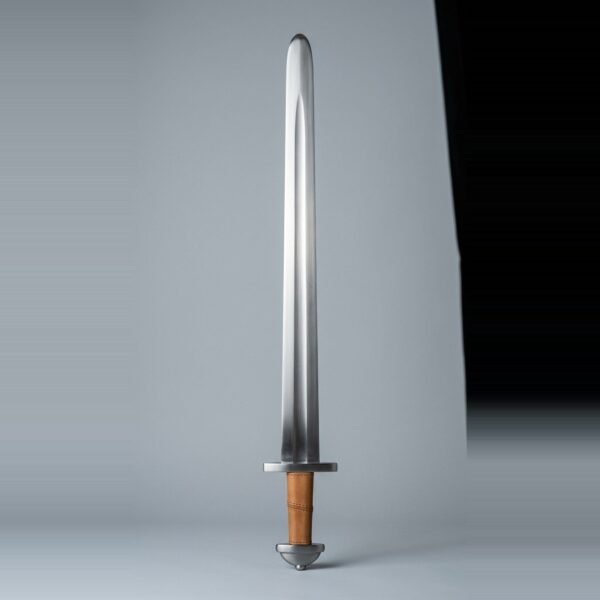
| Skarnvik migration era arming sword | About 36 inches | Broad double edged blunt with a shallow fuller down most of the length | 51CrV4 at 49 to 52 HRC | Medium tier, suited to shield and buckler drill | Short straight lower guard of plain bar stock, tip rounded and flared about 15 mm |
| Haldvane blunt arming sword | About 37 inches | Broad single hand blade, wide shallow fuller running most of the length | 51CrV4 at 49 to 52 HRC | Medium tier, the usual club setting for single hand sparring | Straight cross of plain bar section, tip rolled and flared about 15 mm |
| Faskvar blunt arming sword | About 37 inches | Narrow double edged blade, one fuller from under the cross to about two thirds | 51CrV4 at 49 to 52 HRC | Medium, the middle of the club sparring range | Plain straight steel cross bar, tip rolled and flared about 15 mm |
| Mirlaug blunt arming sword | About 37 inches | Broad double edged blade with a fuller running most of its length | 51CrV4 at 49 to 52 HRC | Medium tier, the give sits in the front third | Straight cross with small ball finials, tip blunted and rounded off |
| Ashgrimm ringed arming sword | About 37 inches | Narrow, diamond in section, no fuller anywhere in the blade | 51CrV4 at 49 to 52 HRC | Medium, the tier most clubs ask of a one handed trainer | Straight cross with two side rings, tip rounded off and not spatulated |
| Draugmar blunt arming sword | About 38 inches | Broad, with a wide fuller running about two thirds of the blade | 51CrV4 at 49 to 52 HRC | Medium, the tier most clubs ask of a one handed trainer | Plain straight cross with no rings, tip rounded off and not spatulated |
Blade lengths sit at about 30 inches on five of the six and about 31 inches on Draugmar. None ships with a scabbard.
Browse related sword categories
- Arming swords with sharpened edges and scabbards for collectors and display
- The full HEMA range, from feders to rapiers and sabres
- Sideswords, the ringed and barred hilt that grew out of this shape
- HEMA longswords and hand and a half blunts for two hands
- Feders, the purpose built longsword fencing tool with a schilt
- Messers, the single edged sword built on knife style hilt construction
- Viking swords, the broad fullered single hander that came before
- Engraved and personalised pieces across the whole catalogue
Guides worth reading first
- What HEMA is, and what the sources actually are
- How to choose your first HEMA sword without wasting money
- HEMA sword flex explained, tier by tier
- Blunt against sharp training swords, and which one you need
- HEMA tournament gear rules and what the published rulesets ask for
- Synthetic against steel trainers for a first year student
- Display sword or battle ready, what the terms actually mean
- Care and oiling for carbon and spring steel blades
Frequently asked questions
What is an arming sword trainer?
It is a single handed cruciform sword built for sparring rather than cutting. The blade is spring steel rather than high carbon, the edge is a deliberate flat land of about 2 to 3 mm instead of a ground edge, and the point is rolled or rounded so it cannot penetrate fencing gear. Everything else about the shape, the cross, the pommel and the balance follows the historical sword.
How is this different from the arming swords in the main sword range?
Those are sharpened collector and display swords in 1095 high carbon steel at 54 to 58 HRC, and most of them come with a scabbard. These six are blunt trainers in 51CrV4 spring steel at 49 to 52 HRC with no scabbard at all. Same silhouette, entirely different job. Buy the sharp version to hang or to cut, and the trainer to fence with.
Why spring steel instead of 1095?
Because 1095 hardened to 54 to 58 HRC is too hard for sparring. A blade that hard resists bending until it takes a permanent set or snaps. 51CrV4 at 49 to 52 HRC bends under a hard bind and springs back straight, which is what a sparring blade has to do several hundred times an evening. It will not hold a fine edge, and it does not need to.
Can I use an arming sword for sword and buckler?
Yes, that is the most common use for one in a club. The oldest surviving European fencing manual, MS I.33, is a sword and buckler book from around 1300, and the tradition runs from there. None of these swords includes a buckler, so you will need to source one separately in the nine to sixteen inch range with a central boss and a bar grip.
What blade length should I buy?
About 30 inches suits most adults and is what five of these six carry. Choose shorter if you work close measure or drill sword and buckler almost exclusively, longer if you want reach in the bind and have the wrist for it. Grip length matters more than people expect, and a true arming sword grip is short, with room for one hand only.
Are these legal for tournaments?
That depends entirely on the event and its published ruleset, so check the ruleset rather than the listing. Tip shape is the usual sticking point. Some events require a spatulated or rolled tip with a minimum diameter of 1.5 cm, and a rounded tip is not the same thing. Three of these six carry a rolled and flared tip and three are rounded off, so read the specification panel.
What does the fuller do?
It removes steel from the middle of the blade section where that steel does least for stiffness, which drops mass and pulls the balance back towards the hand. It is not a blood groove. How far it runs matters as much as whether it is there, because a fuller that stops early leaves steel in the last third and stiffens the point.
Where are these made and how are they shipped?
They are made by hand in the Czech Republic and imported by Ransack Viking. Every one is checked for hilt tightness, pommel seating and blade straightness at the North Babylon, New York warehouse and shipped from there. Shipping inside the United States is free, returns run for seven days, and the lifetime warranty against defects in the forging, the grind, the heat treat and the fittings needs no receipt.
Featured pieces
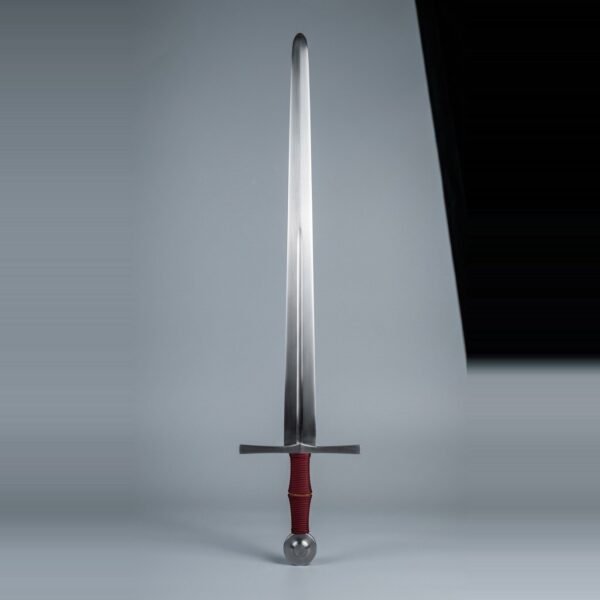 Haldvane Hand Forged 51CrV4 Spring Steel Blunt Arming Sword with Wide Shallow Fuller & Wheel Pommel
$379.00
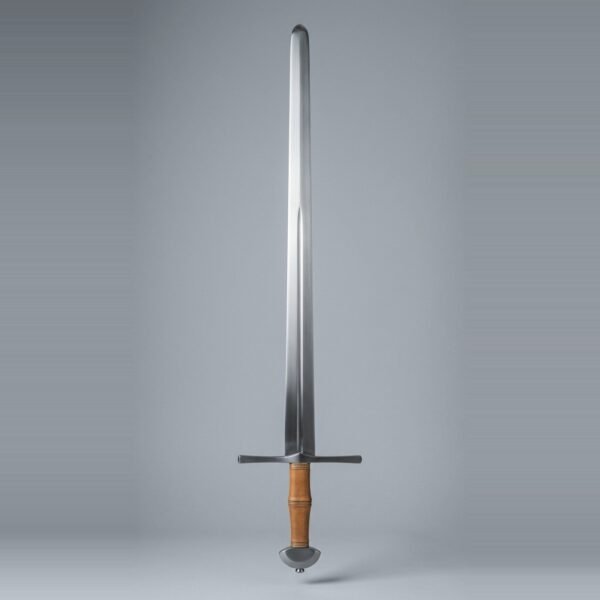 Faskvar Hand Forged 51CrV4 Blunt Arming Sword with Narrow Fuller & Demi Lune Pommel
$319.00
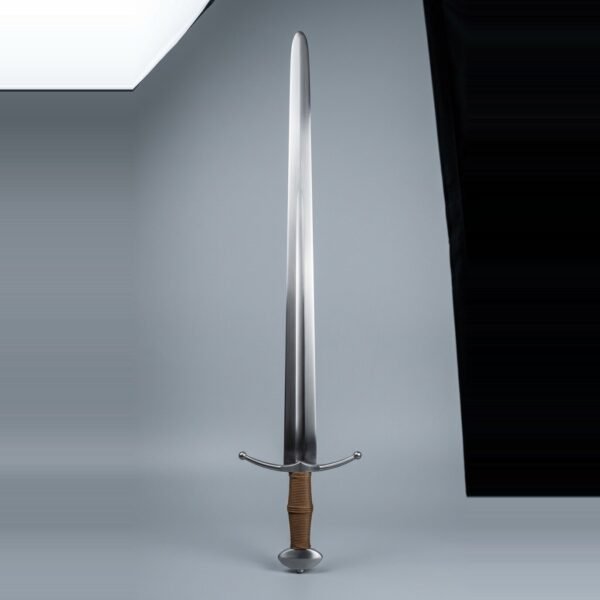 Mirlaug Hand Forged 51CrV4 Spring Steel Blunt Arming Sword with Broad Fuller & Ball Tipped Cross
$329.00
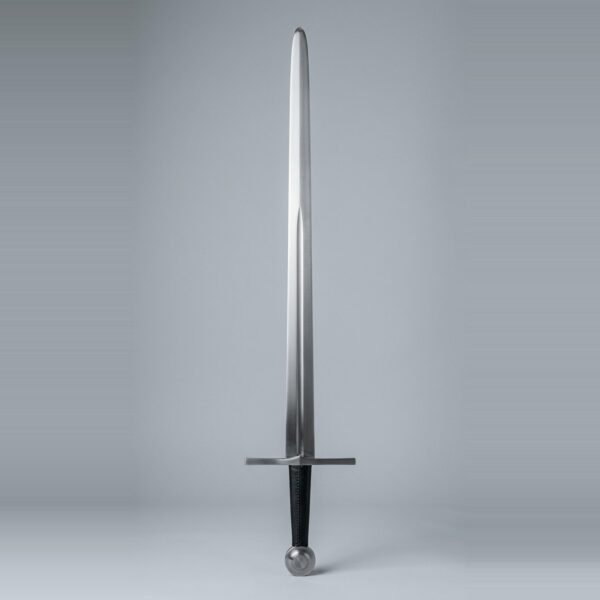 Draugmar Hand Forged 51CrV4 Spring Steel Arming Sword with Wide Fuller & Bossed Wheel Pommel
$309.00