
A Viking beer mug is a drinking vessel with a handle, built to stand on a table and hold a full measure of cold beer or mead without tipping over. That last part matters. A drinking horn has no base and has to be emptied or hung up. A mug lets you put it down and keep talking.
The vessels on this page run from about 5 to 8 inches tall and hold roughly a pint. Four materials are represented. Natural ox horn, cut and polished from a single piece with no resin or casting. Turned hardwood with a food grade stainless steel 304 liner, so it takes hot drinks as well as cold. Riveted stainless steel, some of it banded in solid brass. And carved birch, in the Nordic kuksa shape with a solid lobe handle instead of a loop. Several carry cut work on the metal, from an Elder Futhark rune line to a Mjolnir panel.
If you want one that survives a real evening, take the wood and steel lined tankard. If you want the one people pick up first, take horn.
Free US shipping
On most pieces. Heavier and oversized ones carry a flat charge.
Hand Forged
Heated, hammered and ground by hand.
Engraving available
Names, dates or Norse runes on most pieces.
Ships from Memphis
Inspected and dispatched from our Tennessee warehouse. No import duty, no customs delay on US orders.
Viking Beer Mugs
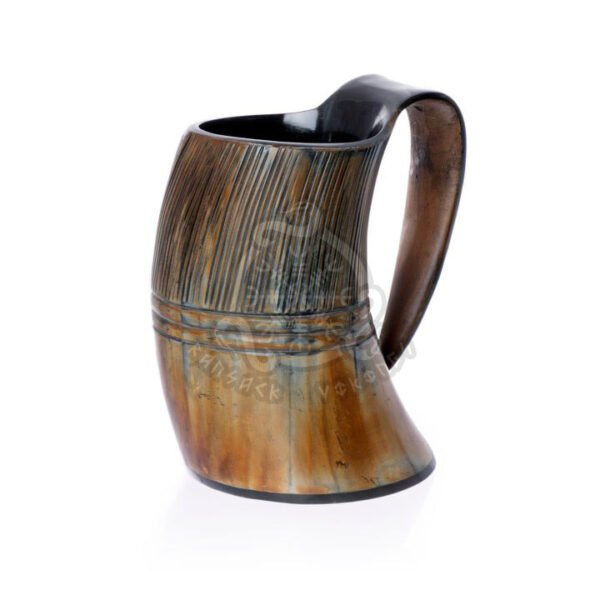
Meadhorn Handcrafted Norse Viking Beer Mug with Polished 100 Percent Natural Horn Body | Norse Drinking Groomsmen and Wedding Gift | RA-611
Price range: $149.00 through $159.00Why a Norse drinking vessel has a handle and a flat bottom
The drinking horn came first and it has one obvious flaw. It cannot stand up. A horn is a cone with a point at one end, so once it is filled you either drain it, hold it, or hang it from a stand. That is fine for a toast. It is useless for an evening where you want both hands free.
The mug solved that. Give the vessel a flat base and a handle and it becomes something you can set down mid sentence, refill, and pick up again without looking. Every piece on this page follows that logic. The body holds roughly a pint, the base is wide enough to sit steady on an uneven table, and the handle stands clear of the wall so your knuckles are not resting against cold metal.
The materials are the second half of the story. Horn, wood, steel and brass all hold cold drink well and each behaves differently in the hand. Horn is warm to touch and almost weightless when empty. Wood insulates, so a cold beer stays cold longer than it would in bare steel. Steel is the opposite, it takes the chill of the drink straight through the wall, which is pleasant on a hot day and unpleasant in February. None of these are fragile in the way glass is fragile. A tankard that goes over on a table gets a dent and a story.
The mugs in this collection
Four groups sit on this page. They are separated by what the body is made of, and that decides almost everything else about how the vessel behaves.
Natural horn mugs
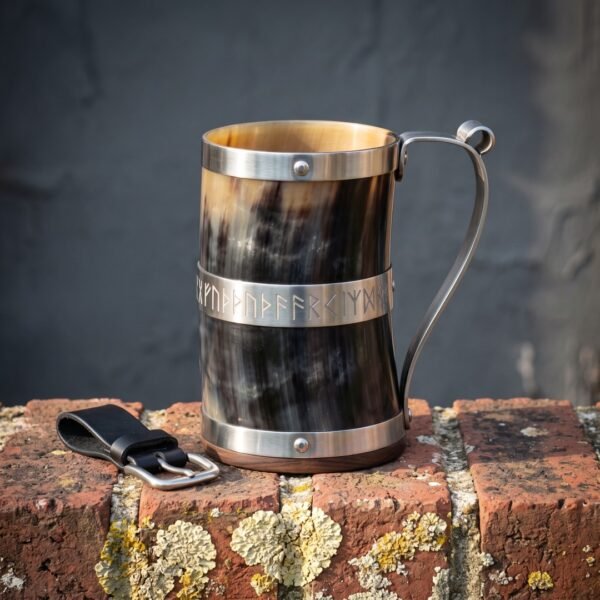
These are cut from a single piece of ox horn, hollowed, scraped and polished inside and out, with no resin and no casting. Heights run about 5.5 inches, 6.6 inches and 8 inches across the group, and because a horn is a natural cone the capacity varies slightly from one piece to the next. The colour varies too. Dark and amber marbling runs straight through the wall of the vessel rather than sitting on the surface, so no two are the same shade. The largest piece here, the banded tankard, sets a horn body on a turned hardwood base with stainless steel bands top, middle and bottom and a formed steel handle with a rolled thumb rest. Its centre band carries a cut line of Elder Futhark runes.
The one rule with horn is heat. Keratin softens and warps well below boiling, so horn vessels are for cold drink only. That was true a thousand years ago and it is still true.
Wood tankards with a stainless liner
Turned hardwood bodies with an inner cup of food grade stainless steel 304. The liner is the clever part. It means the tankard takes hot drinks as well as cold, it rinses clean in seconds, and the wood never has liquid sitting against it. Three of these stand about 17 cm tall. One smaller piece measures 5 inches tall and 3.5 inches wide and pairs wood with a carbon steel band. Bodies are engraved, one of them with a rune line, and the grain, shape and colour differ from piece to piece because the wood is turned by hand.
Solid wood and carved wooden cups
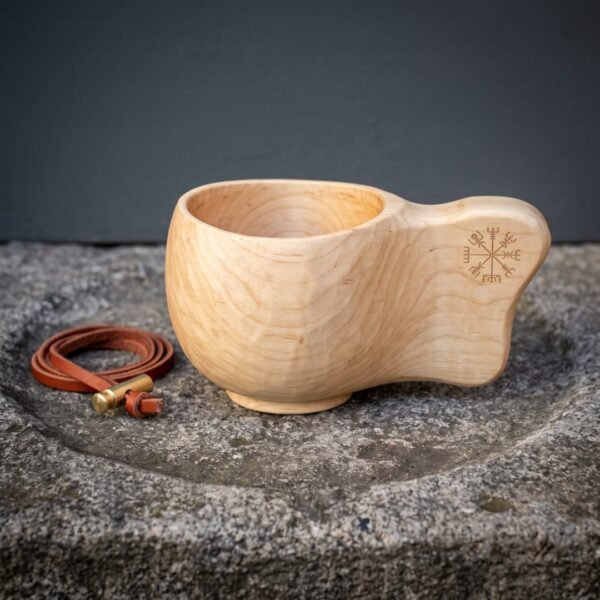
Two pieces here have no metal liner at all. The raven mug is turned from a single block of hardwood, stained to a warm walnut tone, faceted around the lower third and smooth above, with a line engraved raven panel on the body and a squared open loop handle riveted through a metal strap. The interior is sanded and sealed food safe for cold drinks. The birch kuksa is different again, carved rather than turned, so the handle comes out of the same block as the bowl. It holds about 10 fl oz to the brim and is comfortable at 8, measures roughly 3.5 inches across the rim and 6 inches wide including the handle, stands about 3 inches tall on its foot and weighs about 6 oz. The handle is a solid carved lobe with a Vegvisir burned into the face, finished with hand rubbed food safe oil and no lacquer.
Steel and brass tankards
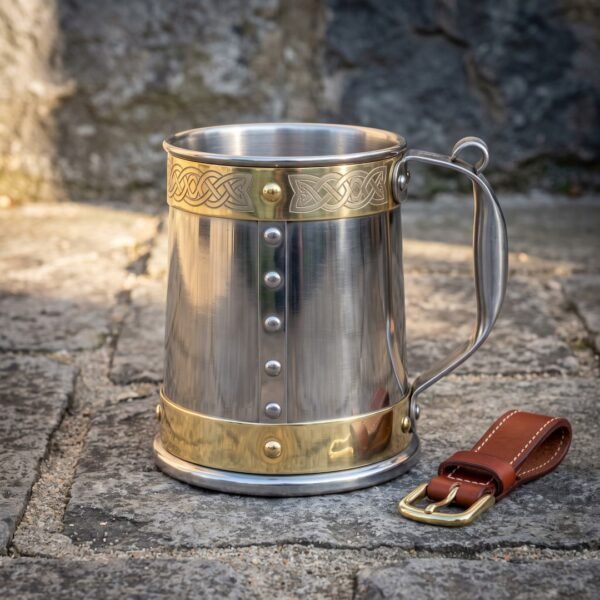
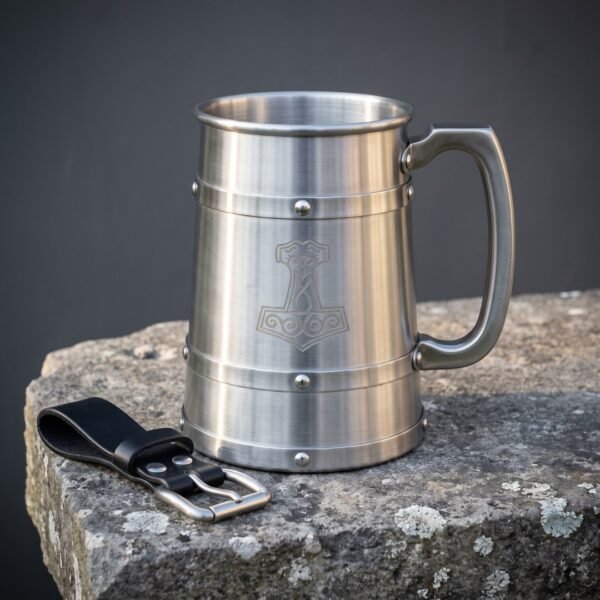
Riveted metal vessels for people who want the thing to be indestructible. One is food grade stainless steel in a brushed satin finish, about 20 fl oz, roughly 6 inches to the rim, with three raised bands held by domed rivets, a cast steel handle, and a Mjolnir hammer with knotwork detail etched into the front panel. The interior is bare with no coating or plating. The other pairs a stainless body with solid brass bands at the shoulder and the foot, both bands cut with continuous Celtic knotwork, the rolled body closed by a vertical column of domed rivets and a formed steel strap handle riveted at the foot.
Sizes, capacities and materials across the range
Every figure below is taken from the specification panel of a piece on this page. These are made by hand, so read the numbers as what to expect rather than as a guarantee to the millimetre.
| Body material | Size as listed | Capacity | Interior | Cut work | Carry fitting |
|---|---|---|---|---|---|
| Natural horn, single piece | 8 in tall | Varies with the horn | Polished horn | None | None |
| Natural horn, single piece | 6.6 in tall | Varies with the horn | Polished horn | None | None |
| Natural horn, single piece | 5.5 in tall | Varies with the horn | Hand polished | None | None |
| Ox horn on hardwood base, steel bands | Not listed | About one US pint | Sealed food safe | Elder Futhark rune band | Black leather belt hanger, steel buckle |
| Dark wood with steel liner | 17 cm tall | Not listed | Stainless steel 304 | Engraved body | None |
| Wood with steel liner | 17 cm tall | Not listed | Stainless steel 304 | Engraved body | None |
| Dark wood with steel liner | 17 cm tall | Not listed | Stainless steel 304 | Rune engraved body | None |
| Wood with carbon steel band | 5 in tall, 3.5 in wide | Not listed | Stainless steel 304 | Rune engraved body | None |
| Solid hardwood, walnut tone | Not listed | A pint with head | Sealed food safe | Line engraved raven panel | Black leather cord, metal ferrule |
| Carved birch kuksa | 3 in tall, 6 in wide | About 10 fl oz to the brim | Food safe oil | Vegvisir burned into the handle | Leather cord, brass tipped |
| Brushed stainless steel | About 6 in to the rim | About 20 fl oz | Bare stainless | Etched Mjolnir panel | Black leather belt hanger, steel buckle |
| Stainless with solid brass bands | Not listed | A pint with head | Bare stainless | Celtic knotwork on both bands | Brown leather belt hanger, brass buckle |
One number needs care. Capacity on the horn pieces is genuinely variable, because a horn is grown rather than manufactured. If you need a guaranteed measure, buy one of the steel or steel lined pieces, where the bore is formed rather than found.
How much a pint really is, and why it matters
A US pint is 16 fl oz. Most of the vessels here are sized for that plus a finger of head, which is why the stainless tankard lists 20 fl oz to the brim. Fill any of them to the very top and you will wear some of it. The sensible working line is about two thirds of the way up on a horn, and just below the top band on a tankard.
The kuksa is the exception and it is meant to be. At about 10 fl oz to the brim it is a cup, not a tankard. It is sized for coffee at a fire or a short measure of something strong, and it is the piece to take camping because it weighs 6 oz and will not break in a pack.
Materials and how they behave over time
Horn darkens and takes on a deeper polish with handling. It also hates dry heat, so keep a horn vessel away from a radiator, out of a hot car and out of a dishwasher. Hot water will warp it and there is no fixing that. Rinse in cool water, dry it standing upside down, and it will outlast you.
Hardwood moves with humidity. A sealed interior stops the drink reaching the timber, but the outside still wants a wipe of food safe oil once or twice a year to stop the surface drying out. Wood is also the best insulator on this page, which is the practical argument for the wooden tankards over the steel ones.
Stainless steel is the easy one. It takes no flavour, it does not corrode, and it goes in the sink with everything else. Brass is different. Brass darkens over months into a dull gold and eventually a brown. Metal polish on a cloth brings it straight back, or leave it and let it age, which most people do.
Birch is soft, light and close grained, and an oiled kuksa builds up a patina from whatever you drink out of it. Coffee stains it. That is considered a feature.
Handles, bands and rivets
The handles here fall into three types. Formed steel strap handles are rolled from flat stock, riveted at the foot, usually with a rolled loop or a thumb rest at the top so your thumb has somewhere to sit. Cast steel handles are heavier and stiffer. Carved and cut wooden handles, like the squared open loop on the raven mug or the solid lobe on the kuksa, sit closer to the body and load the palm rather than the fingers.
Bands do two jobs. On a horn or a rolled steel body they carry the structural load and close the seam, held by domed rivets set in a line. On brass they are also the decoration, since knotwork cuts read well in a softer metal. A rivet that starts to weep after long use can be re set, and it is worth doing rather than ignoring, because a loose band on a horn vessel lets the body flex.
Cleaning and storage without ruining anything
None of these belong in a dishwasher. Not the horn, not the wood, not the sealed interiors, and not the leather hangers. Heat and detergent are what kill drinking vessels.
Rinse with warm water and a soft brush straight after use. If something has been left overnight, a spoon of bicarbonate of soda in warm water and a soft brush will lift it without scouring. Never use bleach on horn or wood. Dry everything upside down so water leaves the bore instead of sitting in the bottom, and let a wooden piece air dry fully before it goes back on a shelf.
Store them dry and off the sealed interior. A horn or wooden vessel with a damp bore and a lid or cloth over it grows exactly what you would expect. If a piece has been sitting unused for months, rinse it before you fill it.
Engraving and gifting
Several pieces here already carry cut work, a rune line on a steel band, a Mjolnir panel, knotwork on brass, a Vegvisir burned into a wooden handle. Engraving is also added after the pieces arrive in the United States, so a name, a date or a short line of runes can go onto the metal band or onto a wooden face. Text engraving is 19 dollars, a symbol is 39 dollars, and a family crest is 49 dollars.
Elder Futhark is a phonetic alphabet rather than a code, so a name is transliterated by sound and there is no rune for the letter C. If you want a name in runes, send the spelling you want and we will transliterate it, or read the rune guide first and send exactly what you want cut.
Engraving is permanent and an engraved piece cannot be returned. Read your spelling twice before you order. This is the single most common thing people get wrong on a gift.
Where these come from and how they ship
Ransack Viking is a US company based in Memphis, Tennessee. The pieces are handmade in the Czech Republic, then imported, inspected and shipped from Memphis. Engraving is done in the US after arrival.
Because every vessel is made by hand, small differences in horn colour, wood grain, stain tone and band alignment between two pieces of the same name are normal. Two people made them on two different days. If you are buying a matched set for a wedding party, order them together and say so, and they will be picked to sit closely rather than at random.
How to choose one
If it is for a table at home and you want the piece guests reach for, buy horn. If it is going to a fair, a feast or a reenactment weekend, buy something with a leather belt hanger so you are not carrying it. If it needs to take tea and coffee as well as beer, buy a wood body with a stainless liner, because the liner is what makes hot drink safe. If it is for a pack or a fire, buy the kuksa. If you want something that will survive being dropped on stone, buy the riveted steel.
For gifts, a groomsman set works best in matching bodies with different engraving on each, and it photographs better than it sounds.
Browse related collections
- Drinking horns, the vessel that came before the mug
- Horn mugs and tankards, banded and based
- Viking home decor for the rest of the table
- Wedding and groomsmen gifts, engraved to order
- Engraved and personalised pieces across the range
- Hnefatafl boards and Viking games
- Runestones and rune sets in wood and stone
Guides worth reading first
- The Viking drinking horn, what it was and how it was used
- Buying a drinking horn without buying a bad one
- Elder Futhark runes and how names are transliterated
- The Vegvisir, what the stave actually is
- Viking wedding gifts that get used after the day
- Where our pieces are made and how they reach you
Frequently asked questions
Can you put hot drinks in a Viking beer mug?
Only in the pieces with a stainless steel liner. Those take tea and coffee as well as cold drink. Horn cannot take heat at all, because keratin softens and warps well below boiling, and a sealed wooden interior is rated for cold drinks only.
How much do these mugs hold?
Most are sized for a US pint with a finger of head. The brushed stainless tankard lists about 20 fl oz to the brim. The birch kuksa is a cup rather than a tankard at about 10 fl oz to the brim. Horn capacity varies from piece to piece because a horn is grown rather than manufactured.
Are horn mugs food safe?
Yes, for cold drink. The bore is scraped back to clean material, sanded smooth so nothing can sit in a ridge, and sealed with a food safe finish. A rough bore is what makes a cheap horn vessel taste of something. A properly polished one rinses clean in seconds.
Can these go in the dishwasher?
No. Not one of them. Heat and detergent warp horn, dry out wood, strip sealed interiors and ruin leather hangers. Rinse in warm water with a soft brush, then dry upside down so the water leaves the bore.
Will the brass bands tarnish?
Yes, over months, into a dull gold and then a brown. Metal polish on a cloth takes it straight back to bright. Plenty of people prefer the aged look and leave it alone. The stainless will not tarnish either way.
Can I have a name or runes engraved on one?
Yes, on the metal bands or a wooden face, done in the United States after the piece arrives. Text is 19 dollars, a symbol is 39 dollars and a family crest is 49 dollars. Elder Futhark has no rune for the letter C, so names are transliterated by sound. Engraved pieces cannot be returned.
Why does my mug not look identical to the photograph?
Because it was made by hand. Horn colour and marbling are grown into the material, wood grain and stain tone differ from block to block, and a turned or carved body varies slightly in shape. The specification stays the same. The character does not.
Where are these made?
They are handmade in the Czech Republic, then imported, inspected and shipped by Ransack Viking from Memphis, Tennessee. Engraving is added in the US after arrival.
Featured pieces
 Meadhorn Handcrafted Norse Viking Beer Mug with Polished 100 Percent Natural Horn Body
Price range: $149.00 through $159.00
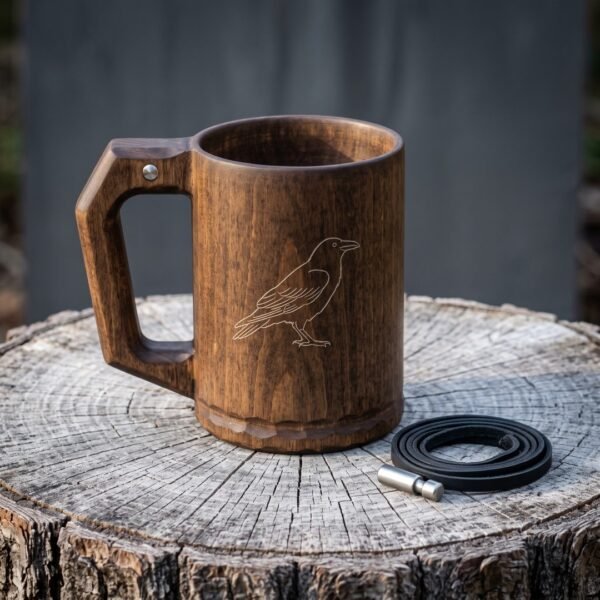 Ravencup Hand Made Hardwood Viking Beer Mug with Engraved Raven Panel
$129.00
 Birchhollow Hand Made Birch Kuksa Wooden Cup
$139.00
 Hornmoot Hand Made Ox Horn Tankard with Rune Engraved Steel Band
$189.00