
An axe concentrates the whole mass of the head into a couple of inches of edge and delivers it at the end of a lever. That is why a 2 pound head on a 28 inch haft does work a 2 pound sword cannot. The head does not need to be big. It needs to arrive fast and land twice in the same place, which is the real split between a battle axe and a bearded axe.
The axes on this page run 16 to 34 inches overall with cutting edges of 4.5 to 10 inches, and listed weights sit between about 1 lb 12 oz for a head alone and 4 lb 8 oz complete. Bearded bits, broad crescents, twin bit heads and one war hammer with a crow beak pick sit here. Heads are plain 1095 high carbon hardened to 54 to 58 HRC at the edge, or forge welded Damascus of 1095 and 15N20 at 58 to 60 HRC. Hafts are white ash, walnut or dark hardwood, most wedged and pinned through a drifted eye.
Nearly all of them ship with a stitched leather edge cover, and several are sharp enough that the cover is a warning rather than an accessory.
Free US shipping
On most pieces. Heavier and oversized ones carry a flat charge.
Hand Forged
Heated, hammered and ground by hand.
Engraving available
Names, dates or Norse runes on most pieces.
Ships from Chicago
Inspected and dispatched from our Chicago warehouse. No import duty, no customs delay on US orders.
Battle Axes
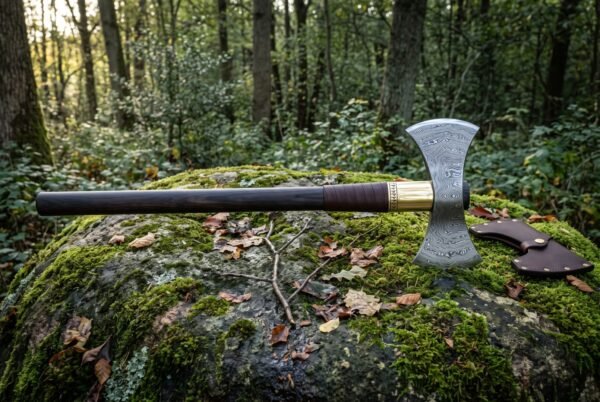
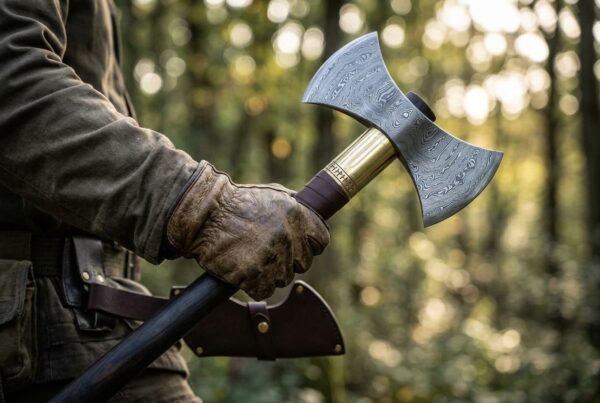
Twinbite Hand Forged Damascus Steel Double Bit Axe | 30 Inch Hardwood Haft | Damascus Head with Rune Engraved Brass Collar and Leather Sheath | Woodland Camp Gift | RK-1576
Original price was: $269.00.$215.20Current price is: $215.20.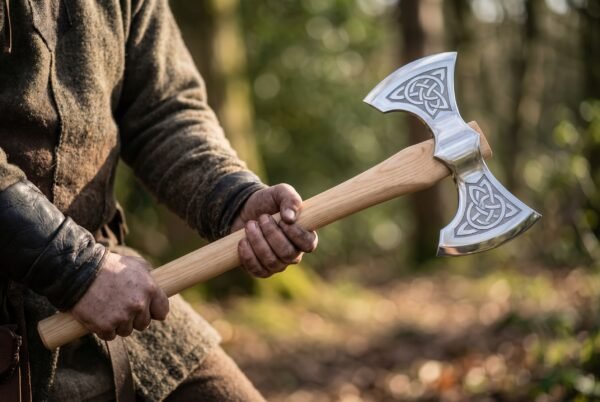
Twinbite Hand Forged 1095 Steel Double Bit Axe | 26 Inch Ash Haft | Etched Celtic Knotwork on Both Bits with Leather Head Cover | Fantasy Display Gift | RK-1557
Original price was: $269.00.$215.20Current price is: $215.20.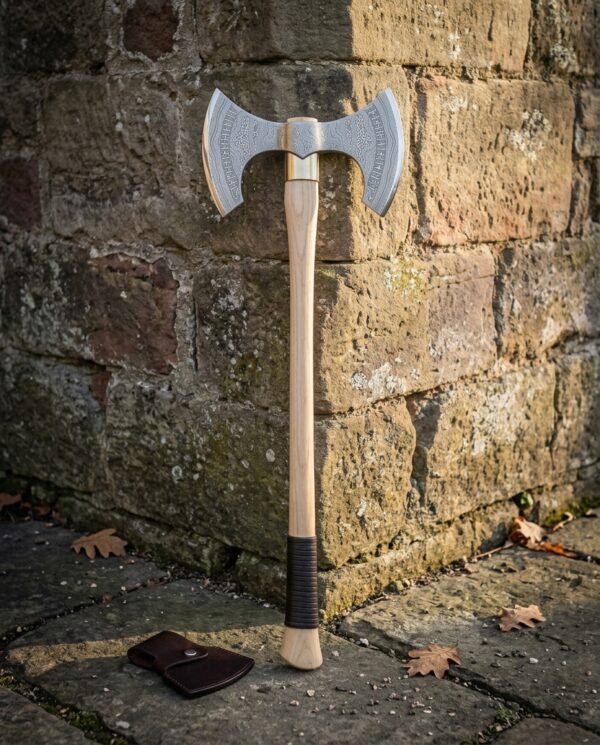
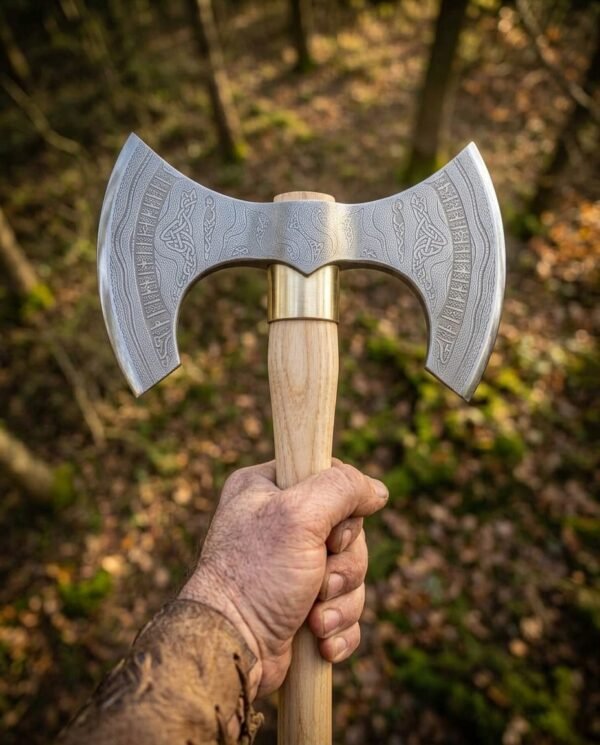
Twinbite Hand Forged High Carbon Steel Double Headed Axe | 28 Inch Overall with 6 Inch Edges | Light Wood Haft and Dark Leather Wrapped Grip | Norse Battle Collector Gift | RK-1215
Original price was: $295.00.$236.00Current price is: $236.00.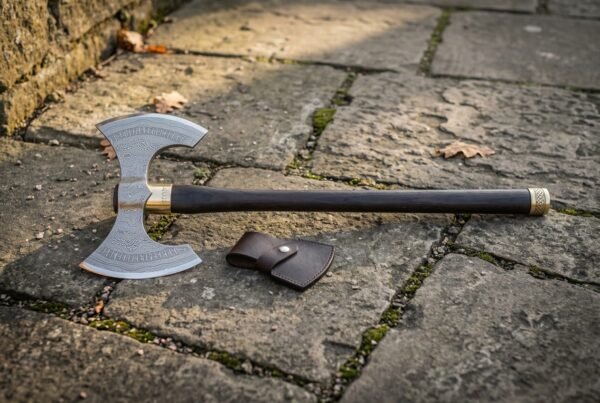
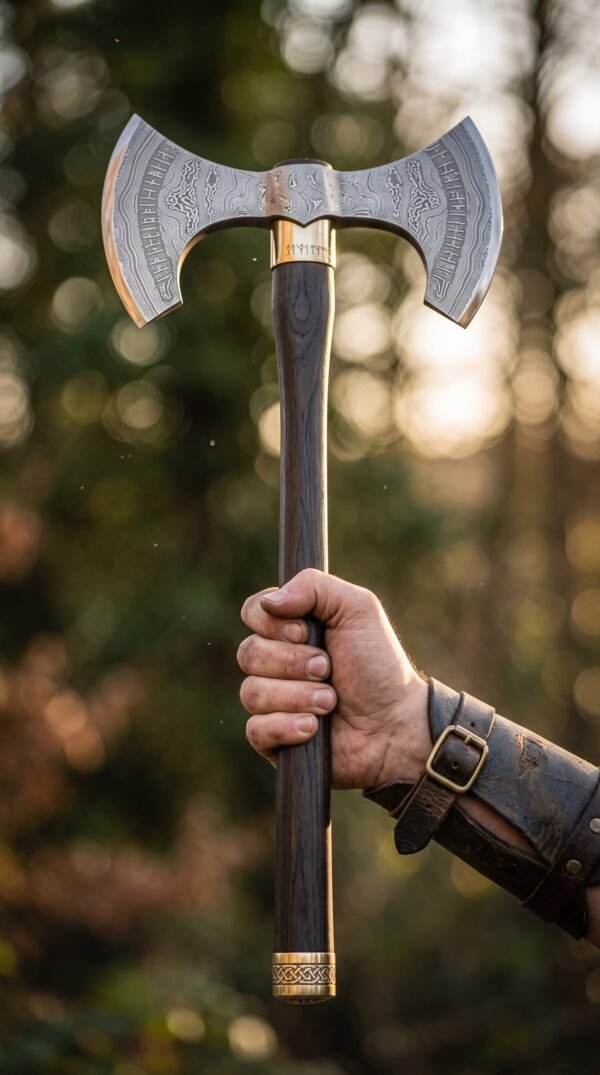
Langhewer Hand Forged Damascus Double Bit Viking War Axe | 28 Inch Overall with 6 Inch Cutting Edge | Norse Battle Collector Gift | RK-1213
Original price was: $285.00.$228.00Current price is: $228.00.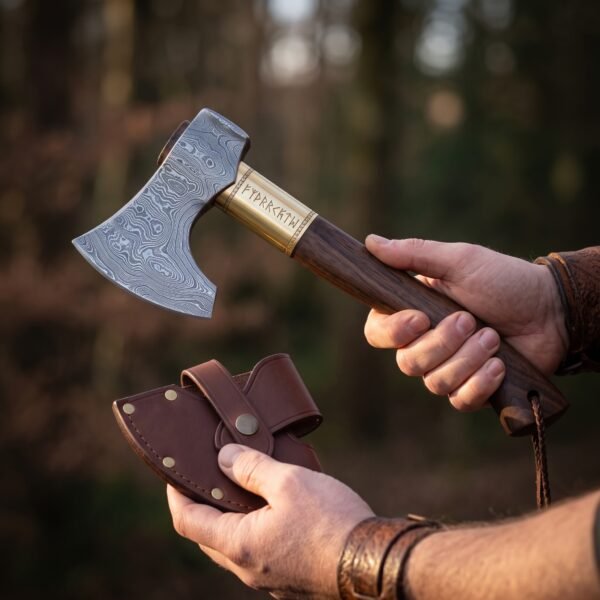
Runehewn Hand Forged 1095 and 15N20 Damascus Viking Bearded Axe | 16 Inch Walnut Haft | Brass Rune Collar and Leather Head Sheath | Norse Reenactment Gift | RK-1500
Original price was: $289.00.$231.20Current price is: $231.20.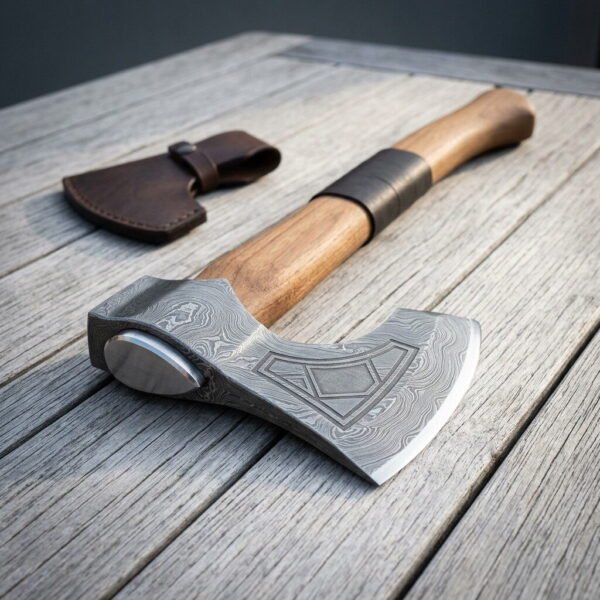
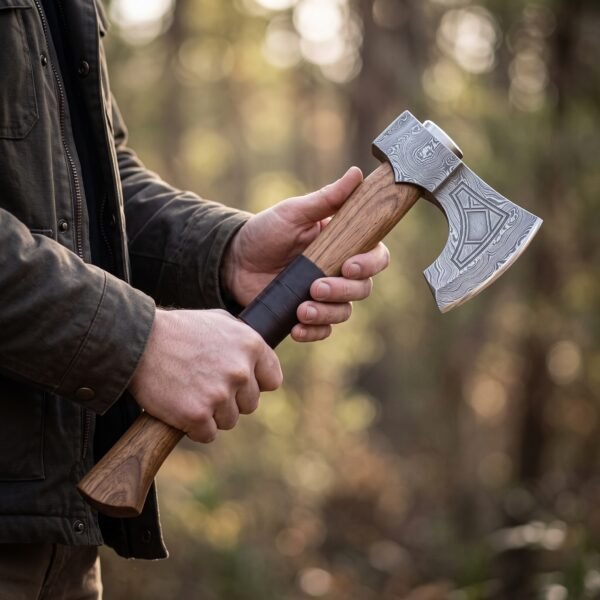
Grainwhorl Hand Forged Damascus Bearded Axe | 1095 and 15N20 Pattern Welded Head | Walnut Haft with Leather Collar and Stitched Edge Sheath | Norse Woodsman Gift | RK-1803
Original price was: $349.00.$279.20Current price is: $279.20.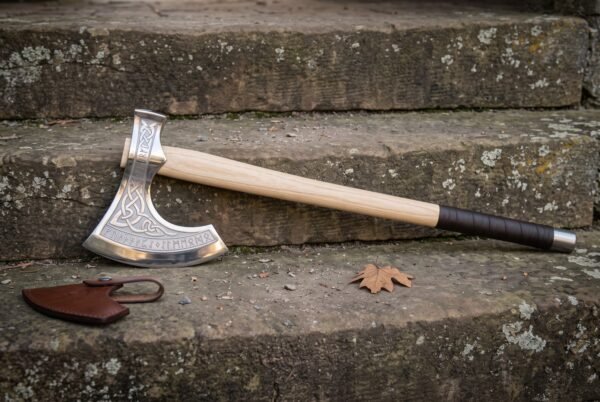
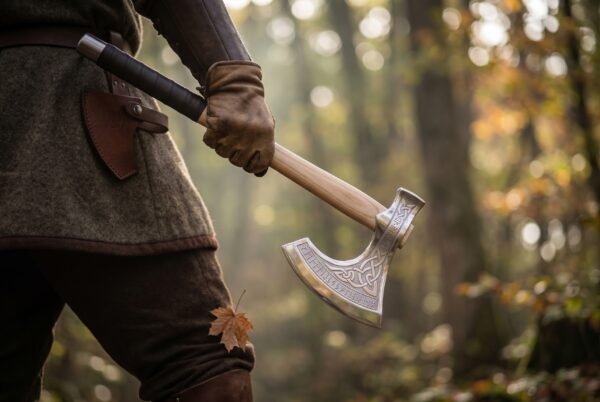
Runebeard Hand Forged 1095 Steel Bearded Viking Axe | 26 Inch Ash Haft | Etched Rune Band with Knotwork Cheeks and Leather Sheath | Norse Reenactment Gift | RK-1578
Original price was: $239.00.$191.20Current price is: $191.20.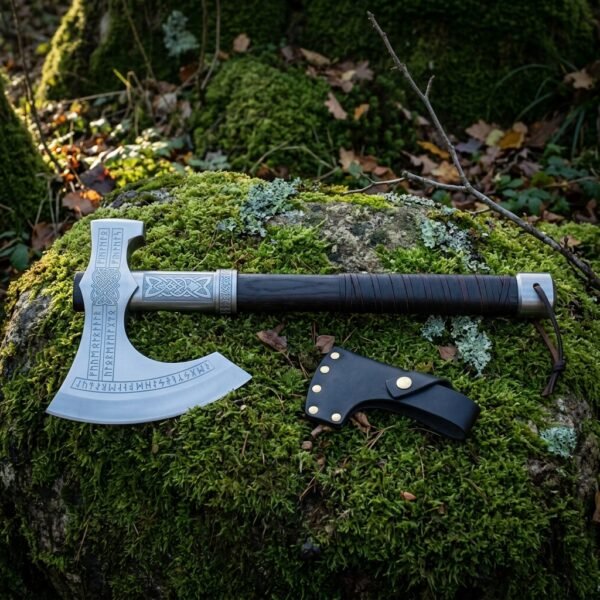
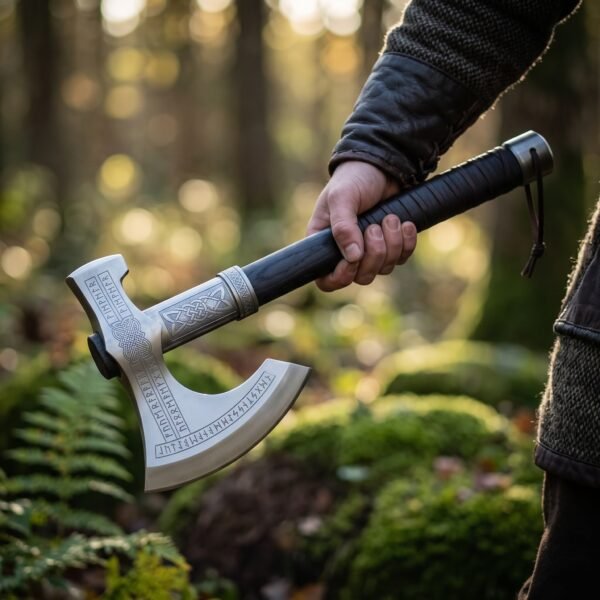
Frostrune Hand Forged High Carbon Steel Norse Runic Bearded War Axe | 24 Inch Overall with 10 Inch Cutting Edge | Norse Battle Collector Gift | RK-1220
Original price was: $645.00.$516.00Current price is: $516.00.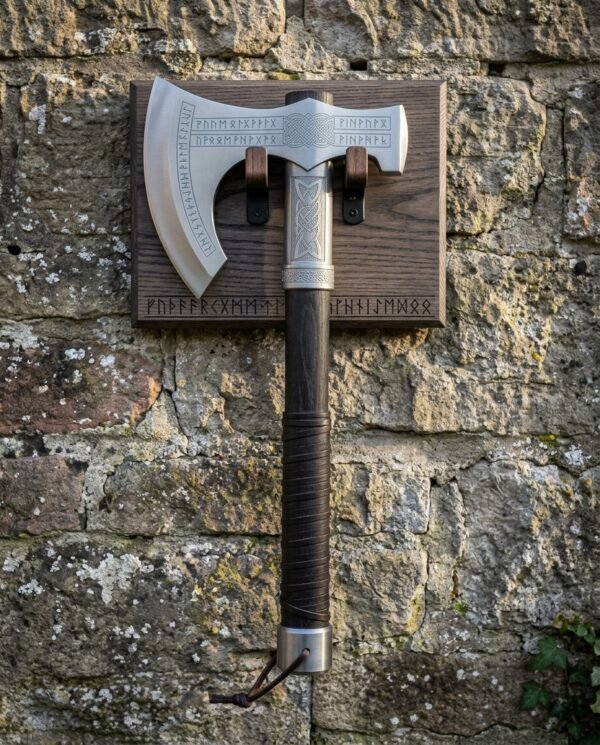
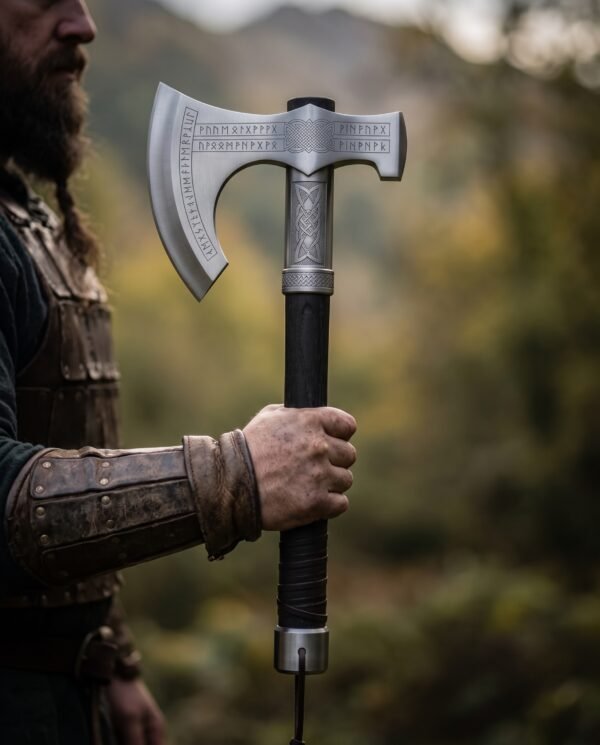
Hallwarden Hand Forged High Carbon Steel Norse Runic Bearded Axe with Rune Carved Wall Mount | Dark Leather Wrapped Ash Haft | Norse Battle Collector Gift | RK-1222
Original price was: $725.00.$580.00Current price is: $580.00.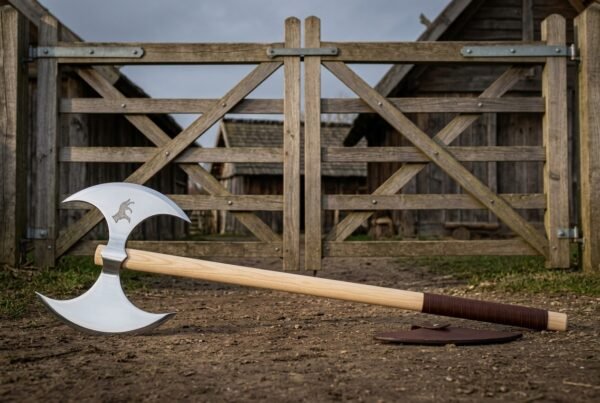
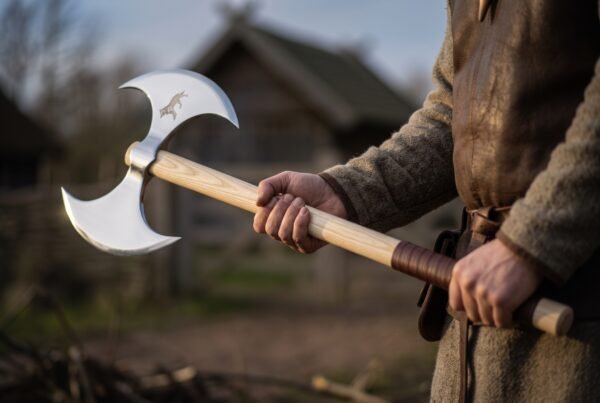
Twincrescent Hand Forged 1095 Steel Double Headed Viking Axe | 34 Inch Haft | Twin Crescent Bits and Etched Beast Motif with Leather Blade Cover | Norse Gift | RK-1903
Original price was: $339.00.$271.20Current price is: $271.20.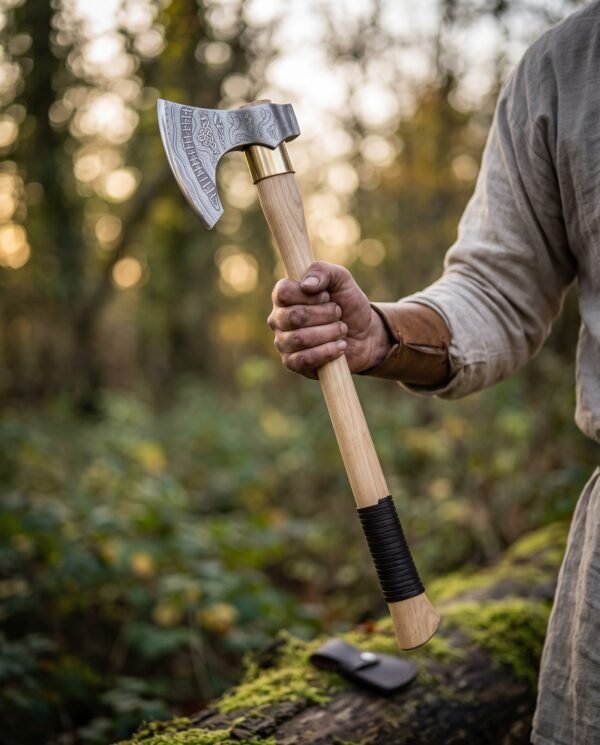
Ashwarden Hand Forged Damascus Viking Battle Axe | 21 Inch Overall with 5 Inch Cutting Edge | Pale Ash Haft and Straight Grain and Oil Finish | Norse Battle Collector Gift | RK-1212
Original price was: $165.00.$132.00Current price is: $132.00.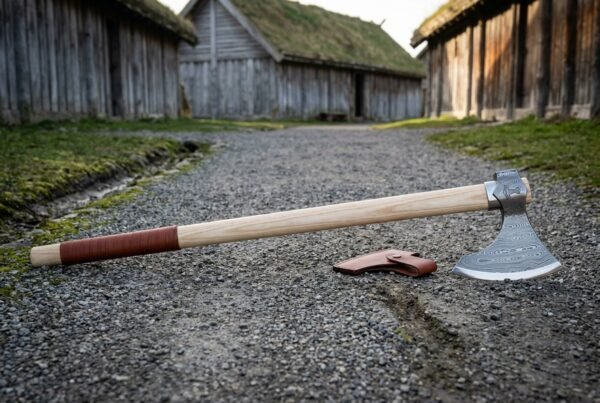
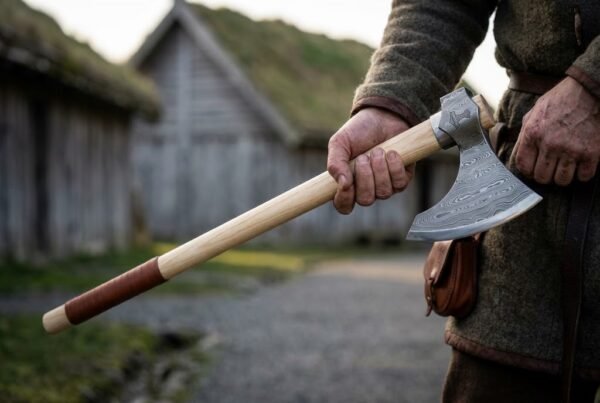
Hammerpoll Hand Forged Damascus Viking Axe | 32 Inch Ash Haft | Mjolnir Stamped Poll and Bearded Bit with Leather Edge Cover | Norse Collector Gift | RK-1906
Original price was: $389.00.$311.20Current price is: $311.20.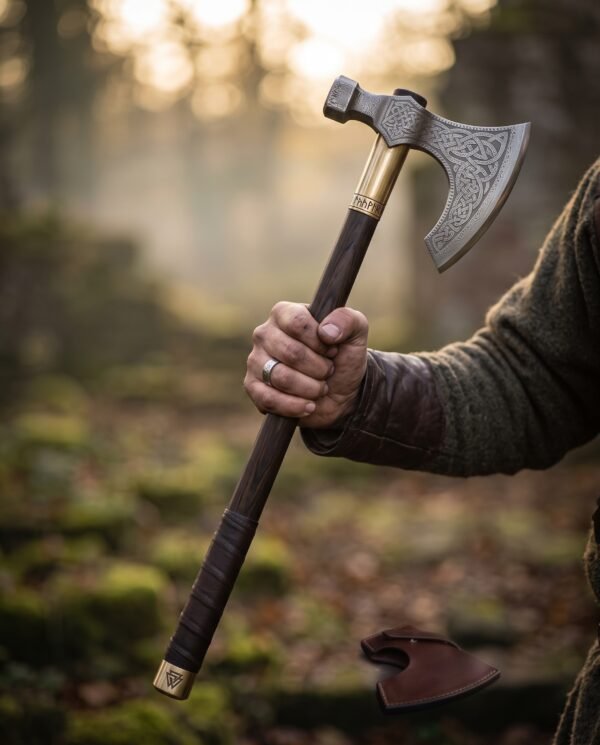
Knotbeard Hand Forged Carbon Steel Long Hafted Viking Bearded Axe | Long Haft Bearded Head | Etched Knotwork Brass Collar and Leather Mask | Norse Gift | RK-1537
Original price was: $329.00.$263.20Current price is: $263.20.Why the axe beat the sword on numbers
A sword is expensive. It is several pounds of good steel worked from end to end, and every inch of it has to be right. An axe is a fist sized lump of iron with a hardened edge welded or forged into the front, hung on a length of ash that anybody could cut and shape. In the Viking Age that made the axe the ordinary answer and the sword the exception, which is why axe heads turn up in Scandinavian graves in numbers swords never approach.
The physics helps too. Mass concentrated behind a short edge, swung at the end of a lever, delivers a great deal of energy into a very small area. A sword spreads its weight along three feet of blade and cuts by drawing. An axe puts everything into one point of impact. That is why the same tool that split firewood on a Tuesday went on a longship on Wednesday.
The cost is control. An axe is heavy at the far end, so it wants to keep going once it is moving and it is slow to bring back. Everything in axe design after that is an attempt to fix this. A beard cuts weight out of the lower bit while keeping the cutting edge long. A thin cheek reduces mass without losing edge. A hammer poll balances the head so it does not want to rotate in flight. All three appear on this page.
The axes in this collection
Fourteen pieces sit here. They separate by head form first and by steel second, and the range runs from a 16 inch hand axe to a 34 inch two hand crescent on a wall mount.
Bearded axes
The classic Norse profile, with the lower edge drawn down into a beard so the cutting edge stays long while the head stays light. Five here. Two are Damascus at 58 to 60 HRC, one with a deep hooked lower edge and a hand cut geometric panel in a lozenge frame, one at 16 inches overall with an upswept toe, a dropped heel and a brass eye band stamped with the first aett of the Elder Futhark. The others are 1095 with acid etched surface decoration, one with a squared hammer poll, a brass collar carrying a rune line and a brass butt cap cut with a Valknut.
Broad crescent axes
Two 34 inch pieces with a 10 inch cutting edge measured along the curve and a head 11 inches from horn to horn. Both are 1095 at 56 to 58 HRC at the edge with a softer eye and poll, both have a deep cut Elder Futhark rune band on both faces filled in frost blue, and both are hung on American ash wrapped full length in oiled leather cord. One weighs about 4 lb 6 oz and ships with a saddle stitched, copper riveted black leather head sheath. The other comes with a carved timber wall plaque of 24 by 8 inches, blackened steel cradle hooks and keyhole hangers routed into the back, at about 7 lb on the wall with fixings supplied.
Double bit axes
Three twin headed pieces, at 26, 28 and 30 inches overall. Bit widths run 4 to 7 inches and complete weights reach 4 lb 6 oz. One is a twin crescent head 11 inches across the horns with roughly 7 inches of arc on each bit and Norse animal ornament etched into the upper cheek. A double bit head is symmetrical, so it hangs true, and you get two edges: one kept keen and one kept for rough work.
The Damascus axes and the war hammer
Three heads on this page are forge welded 1095 and 15N20, hardened to 58 to 60 HRC at the edge and acid etched so the layers read across the cheek. One is a bearded bit with a squared hammer face and a Mjolnir stamped above the eye. One is the walnut hafted bearded axe. The third is not an axe at all but a war hammer with a crow beak pick opposite the face, 26 inches overall with an 8 inch head, brass langets riveted down the haft and a brass ferrule, at about 2 lb 6 oz.
Sizes, steel and fittings across the range
Every figure below comes from the specification panel of a piece on this page. Heads are forged and hafts are shaped and hung by hand, so read the numbers as what to expect rather than as exact.
| Head form | Overall length | Cutting edge | Steel and hardness | Haft and fittings | Listed weight |
|---|---|---|---|---|---|
| Bearded axe | 16 in | 4.5 in toe to heel | Damascus at 58 to 60 HRC | Walnut, brass rune collar, lanyard | Not listed |
| Bearded axe | 21 in | 5 in horn to beard tip | High carbon, soft eye and poll | Pale ash, wedged, leather edge guard | Head about 1 lb 12 oz |
| Bearded axe, etched | 26 in | 6 in along the curve | 1095 at 54 to 58 HRC at the edge | Ash, steel collar, upper langet | About 2 lb 10 oz |
| Double bit axe | 26 in | 4 in each side | 1095, 54 to 56 HRC at the bits | Ash, wedge hung, buckled cover | Head about 2 lb 8 oz |
| War hammer with crow beak | 26 in | 8 in face to beak tip | Damascus at 58 to 60 HRC | Dark hardwood, brass langets and ferrule | About 2 lb 6 oz |
| War axe, sweeping bit | 28 in | 6 in | High carbon, soft eye and poll | Ash, oil finished, stitched head cover | Head about 2 lb |
| Double headed axe | 28 in | 4.5 in each side | High carbon, soft through the eye | Light wood, leather wrapped grip | Head about 2 lb 8 oz |
| Double bit axe, etched | 30 in | 7 in across both edges | 1095 at 54 to 58 HRC at the edges | Dark hardwood, brass collar, pinned | About 4 lb 6 oz |
| Bearded axe, hammer poll | 32 in | 5 in along the bearded bit | Damascus at 58 to 60 HRC | White ash, leather wrapped butt, cross wedge | About 3 lb 4 oz |
| Twin crescent double head | 34 in | About 7 in of arc each bit | 1095 at 54 to 58 HRC at the edges | White ash, cross wedge, leather butt | About 4 lb 8 oz |
| Broad crescent, rune band | 34 in | 10 in along the crescent | 1095 at 56 to 58 HRC at the edge | American ash, leather cord full length | About 4 lb 6 oz |
| Broad crescent with wall mount | 34 in | 10 in along the crescent | 1095 at 56 to 58 HRC at the edge | Ash, carved plaque 24 by 8 in, cradle hooks | About 7 lb mounted |
| Bearded axe, long haft | Long hafted | Bearded blade, hammer poll | 1095 at 54 to 58 HRC at the edge | Dark hardwood, brass collar and butt cap | Not listed |
| Bearded axe, hooked edge | Not listed | Deep hooked lower edge | Damascus at 58 to 60 HRC | Walnut, leather collar band, snap sheath | Not listed |
Two figures are easy to confuse. Head weight and complete weight are not the same thing, and a listing quoting a 2 lb head on a 28 inch haft will feel heavier in the hand than a 2 lb 6 oz war hammer on a 26 inch one, because the mass sits further from your grip.
How the head is hung
The eye is the hole through the head, and on these it is drifted rather than drilled, which means a tapered punch is driven through hot steel and the metal is displaced around the opening rather than cut away. That keeps the grain of the steel running around the eye instead of through it, and it is why a properly drifted eye does not split.
The haft is fitted from below and wedged from above. A wooden wedge driven into a kerf in the top of the haft spreads the wood inside the eye and locks it. Several heads here add a steel cross wedge driven at right angles to the first, and several are also pinned through the cheek. Both are belt and braces, and both are what you want on a head you intend to swing.
Langets are steel or brass straps that run down the haft below the head and are riveted through. They protect the wood from an overstrike, which is the swing that lands short and buries the top of the haft into the log instead of the bit. Overstrikes are how most hafts die.
Hafts, ash and grain
Most of these are hung on white or American ash, and there is a reason ash has been the default haft timber for millennia. It is stiff along its length, it flexes without splintering, and it fails slowly and audibly rather than suddenly. Walnut and dark stained hardwood appear on the shorter and more decorative pieces, both denser and both less forgiving of an overstrike.
Oil the haft once or twice a year with boiled linseed or a hardwax oil, and pay attention to the end grain at the butt, which drinks it. A dry haft shrinks, and a shrunken haft loosens in the eye. If a head ever moves, stop using the axe and have it re hung rather than pounding the wedge deeper.
Steel, hardening and the soft eye
Almost every listing here describes a hard edge and a softer eye and poll. That is deliberate and it is the oldest trick in axe making. A fully hardened axe head would crack the first time it hit a knot, so only the bit is taken to full hardness and the body is left tough. On the 1095 pieces that means 54 to 58 HRC at the edge, and on the Damascus heads 58 to 60 HRC.
The Damascus here is 1095 and 15N20 forge welded, folded and acid etched. The nickel bearing 15N20 resists the acid and stays bright, the 1095 darkens, and the contrast is the pattern. On an axe cheek there is a broad flat surface for that pattern to run across, which is why the Damascus pieces are the ones people hang on a wall.
Several 1095 heads here carry acid etched surface decoration rather than pattern welding, and the listings say so plainly. Etched knotwork is a surface treatment. It is attractive and it is not Damascus, and anyone selling you otherwise is hoping you cannot tell.
Sharpening and use
Sharpen an axe with a file and a puck, not a bench stone. Clamp the head, work a mill file from the middle of the bit toward each corner following the existing bevel, then finish with a round sharpening puck in circles, coarse side first. Match the angle already there. An axe bevel is convex, and flattening it into a knife edge will make it bite deeper and then chip.
Use the middle of the bit. The corners are thin and they are where chips start. Chop into green wood, brush and limbs rather than seasoned hardwood, and never treat an axe as a splitting wedge or hammer the poll with a rock. Only the head with an actual hammer face is meant to be struck with anything.
Several listings state directly that the axe is sharp and not suitable for contact reenactment. Take that seriously. A sharpened edge and a foam padded event do not go together.
Care, rust and storage
These are carbon steel and they rust. Wipe the head down after use, especially after green wood, because sap is acidic and it marks steel fast. Leave a light film of oil on the bit and cheeks.
Store an axe hanging or on a rack rather than leaning on its edge, and keep the leather cover for transport rather than long storage, because leather traps moisture against steel. Grey patina is harmless. Orange spotting lifts with fine abrasive and oil.
Engraving and gifting
Most axes here can be engraved after they arrive in the United States. Names, dates and rune lines go on the cheek or along the beard. Text engraving is 19 dollars, a symbol is 39 dollars and a family crest is 49 dollars.
Elder Futhark is a phonetic alphabet rather than a cipher, so a name is transliterated by sound, and there is no rune for the letter C. Engraving is permanent and an engraved piece cannot be returned, so read the spelling back twice.
Where these come from and how they ship
Ransack Viking is a US company based in Chicago, Illinois. The pieces are handmade in the Czech Republic, then imported, inspected and shipped from Chicago. Engraving is done in the US after arrival. Nearly every axe here ships with a stitched leather edge cover or head sheath.
Because each head is forged and each haft shaped by hand, no two are identical. Hammer texture, etch depth and the exact figure of the grain vary from one piece to the next.
How to choose
Decide first whether this is a working axe or a wall piece. For work, take a bearded head of 5 to 6 inches on a 26 to 28 inch ash haft in plain 1095. It is light enough to swing all afternoon, easy to file sharp and cheap enough to be honest about.
For a wall, take one of the 34 inch crescents or a Damascus head, where the etched cheek and the rune band do the work at three paces. The version supplied with the carved plaque and cradle hooks solves the mounting problem for you. And if this is a gift, the 16 inch Damascus hand axe is the one people pick up and do not put down.
Browse related categories
- Bearded axes, the full Norse range
- Dane axes, the long hafted two hand pattern
- Double headed axes with twin bits
- Throwing axes and hawks
- War axes and heavier fighting patterns
- Replacement handles and hafts
Guides worth reading first
- Battle axe or bearded axe: what the difference buys you
- How to choose a Viking axe
- How to sharpen an axe with a file and a puck
- Viking axe history and what the finds tell us
Frequently asked questions
What is a battle axe?
An axe built for fighting rather than felling, which in practice means a thinner cheek, a lighter head and a longer haft than a woodcutting axe of the same edge length. The Norse version is usually bearded, with the lower edge drawn down to keep the cut long and the head light.
What size should I buy?
For a one hand axe you can actually use, 21 to 28 inches overall with a 5 to 6 inch edge. For two hands and for display, 30 to 34 inches with a broader bit. The 16 inch piece here is a hand axe, closer to a large hatchet in feel.
Are they sharp?
Yes. Every head arrives ground and finished with a working edge, and several listings state plainly that the axe is sharp and not suitable for contact reenactment. Handle accordingly, keep the leather cover on when it is not in use and treat it as a tool rather than a prop.
What is a bearded axe?
One where the bit drops below the eye into a hook, the beard. It gives you a long cutting edge without the weight a full depth head would carry, and the hook itself lets you choke up behind the beard for close control when carving or shaping.
Why is the eye softer than the edge?
Because a fully hardened axe head cracks. Only the bit is taken to full hardness, at 54 to 58 HRC on the 1095 heads here and 58 to 60 on the Damascus, while the body and eye are left tougher so they absorb shock instead of splitting.
Is the etched pattern Damascus?
Not on every piece, and the listings say which is which. Damascus is forge welded 1095 and 15N20 folded together, and the pattern goes through the steel. Etched knotwork is a surface treatment on a plain carbon head. Both look good. Only one is layered steel.
How do I look after the haft?
Oil it once or twice a year with boiled linseed or a hardwax oil, and do not forget the end grain at the butt. Keep it out of dry heat. If the head ever moves in the eye, stop using the axe and have it re hung rather than driving the wedge deeper.
Where are these axes made?
They are handmade in the Czech Republic, then imported, inspected and shipped by Ransack Viking from Chicago, Illinois. Engraving is added in the United States after arrival.
Featured pieces
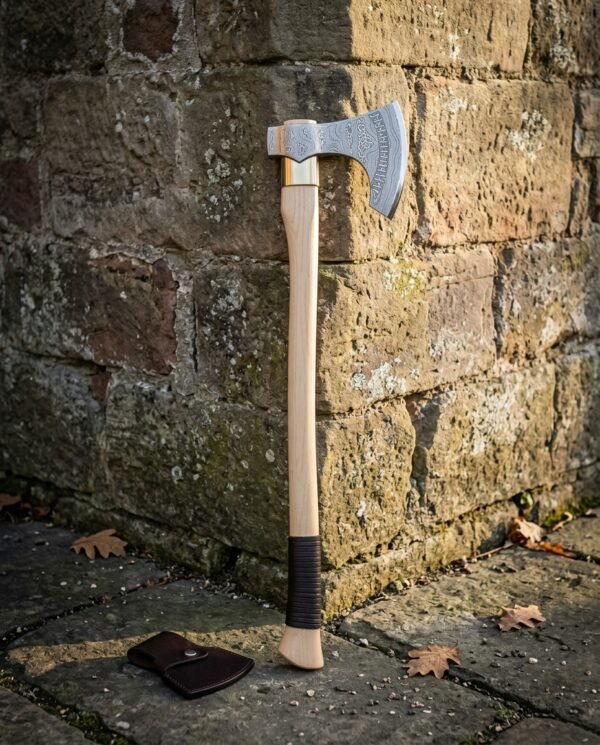 Ashwarden Hand Forged Damascus Viking Battle Axe
Original price was: $165.00.$132.00Current price is: $132.00.
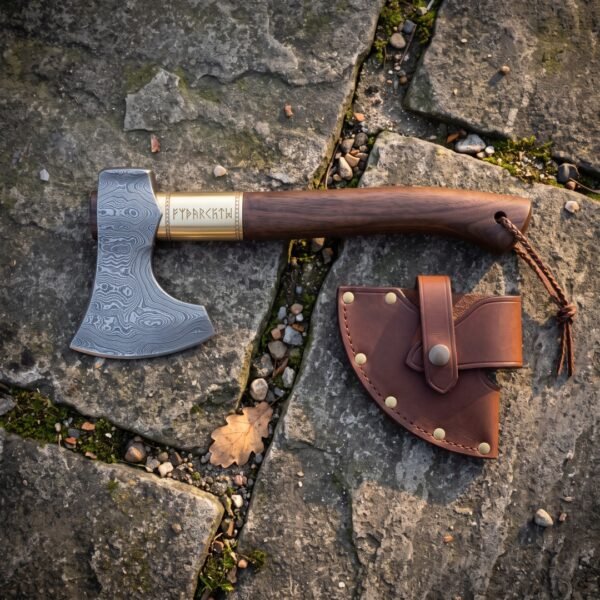 Runehewn Hand Forged 1095 and 15N20 Damascus Viking Bearded Axe
Original price was: $289.00.$231.20Current price is: $231.20.
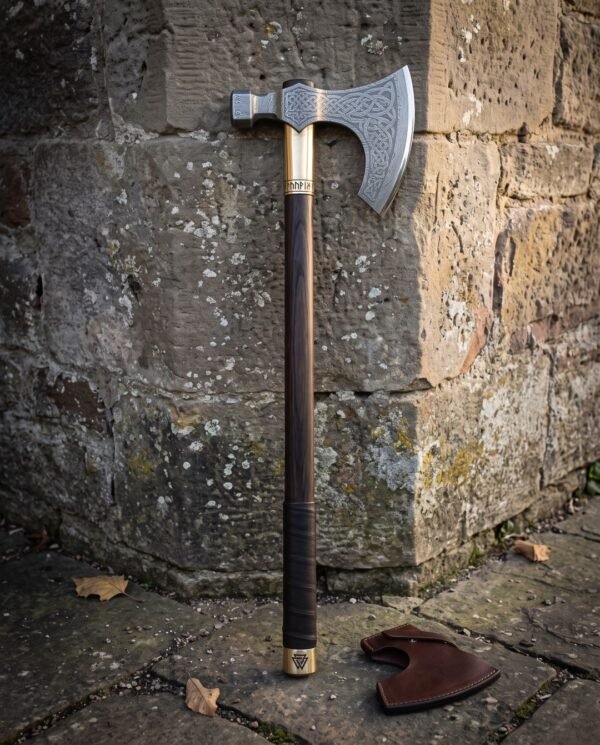 Knotbeard Hand Forged Carbon Steel Long Hafted Viking Bearded Axe
Original price was: $329.00.$263.20Current price is: $263.20.
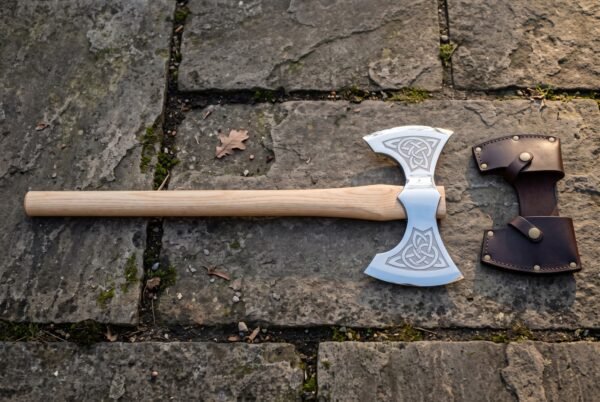 Twinbite Hand Forged 1095 Steel Double Bit Axe
Original price was: $269.00.$215.20Current price is: $215.20.