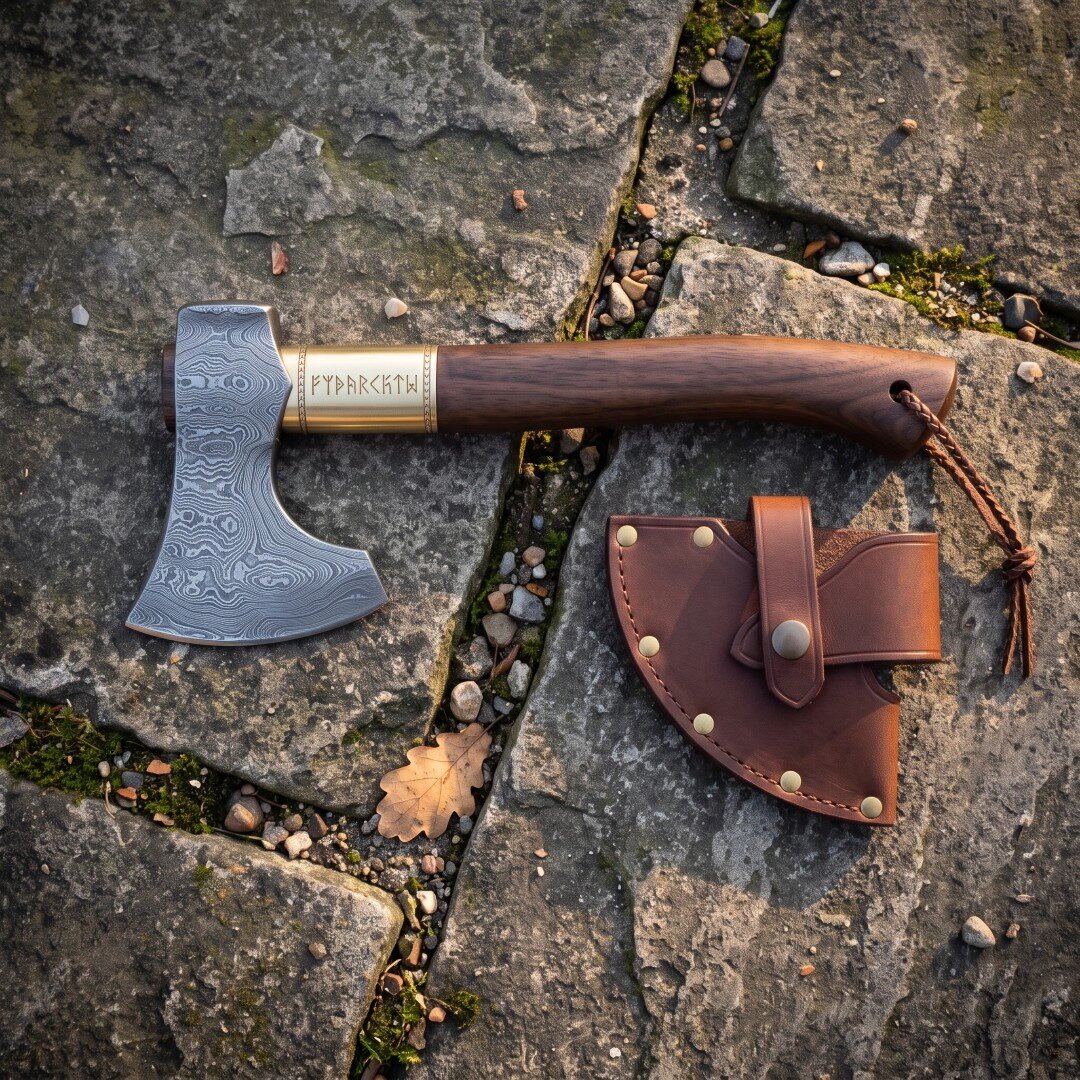
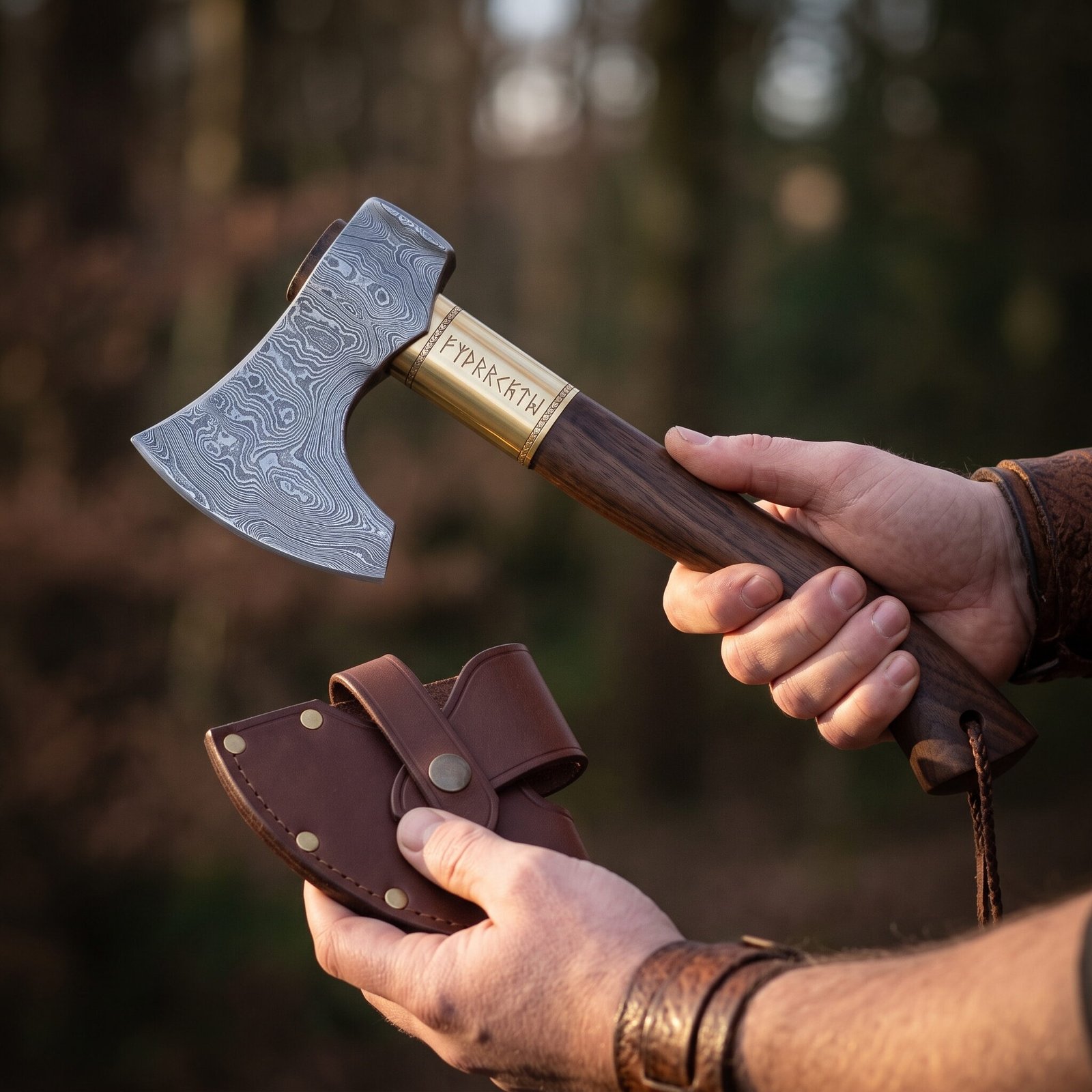
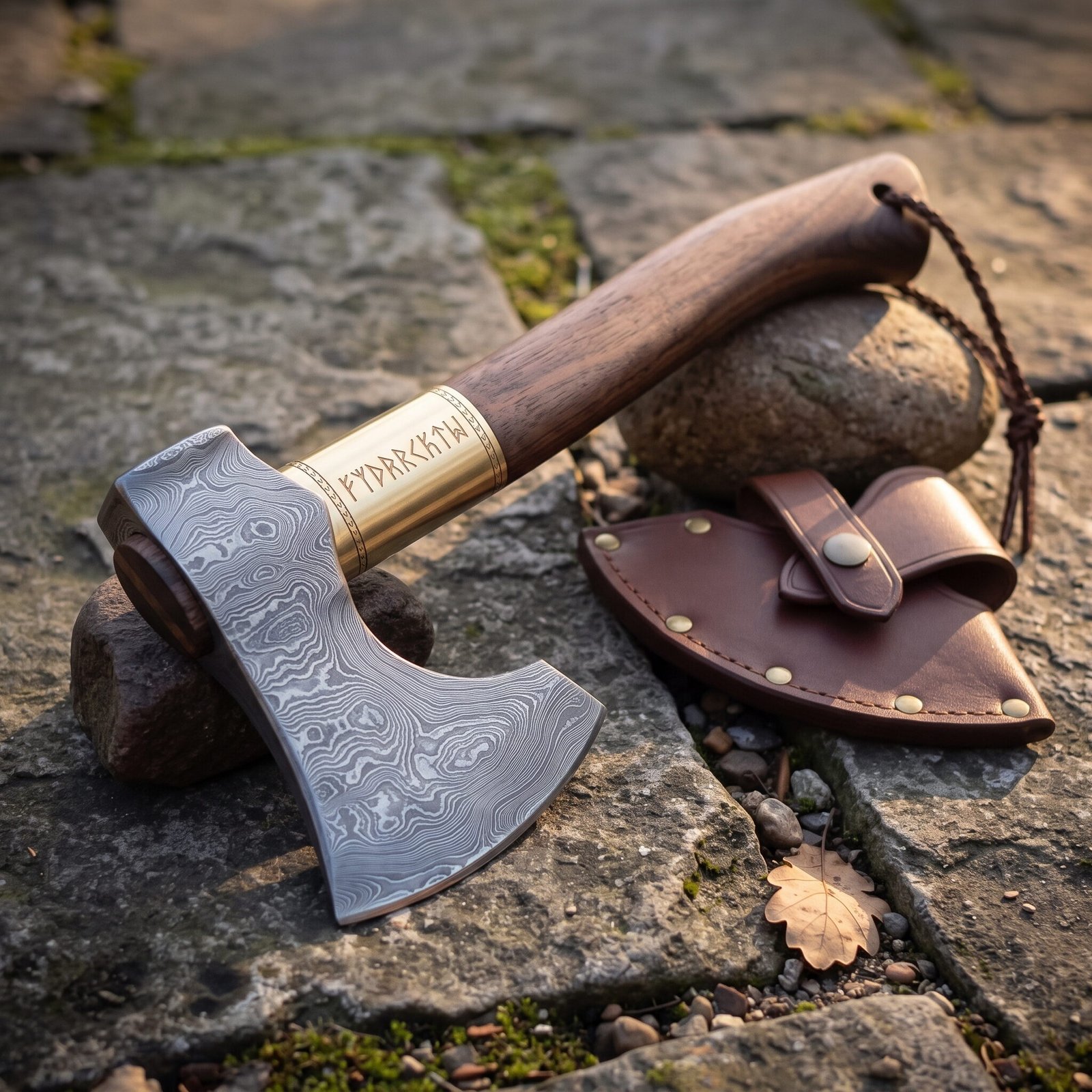
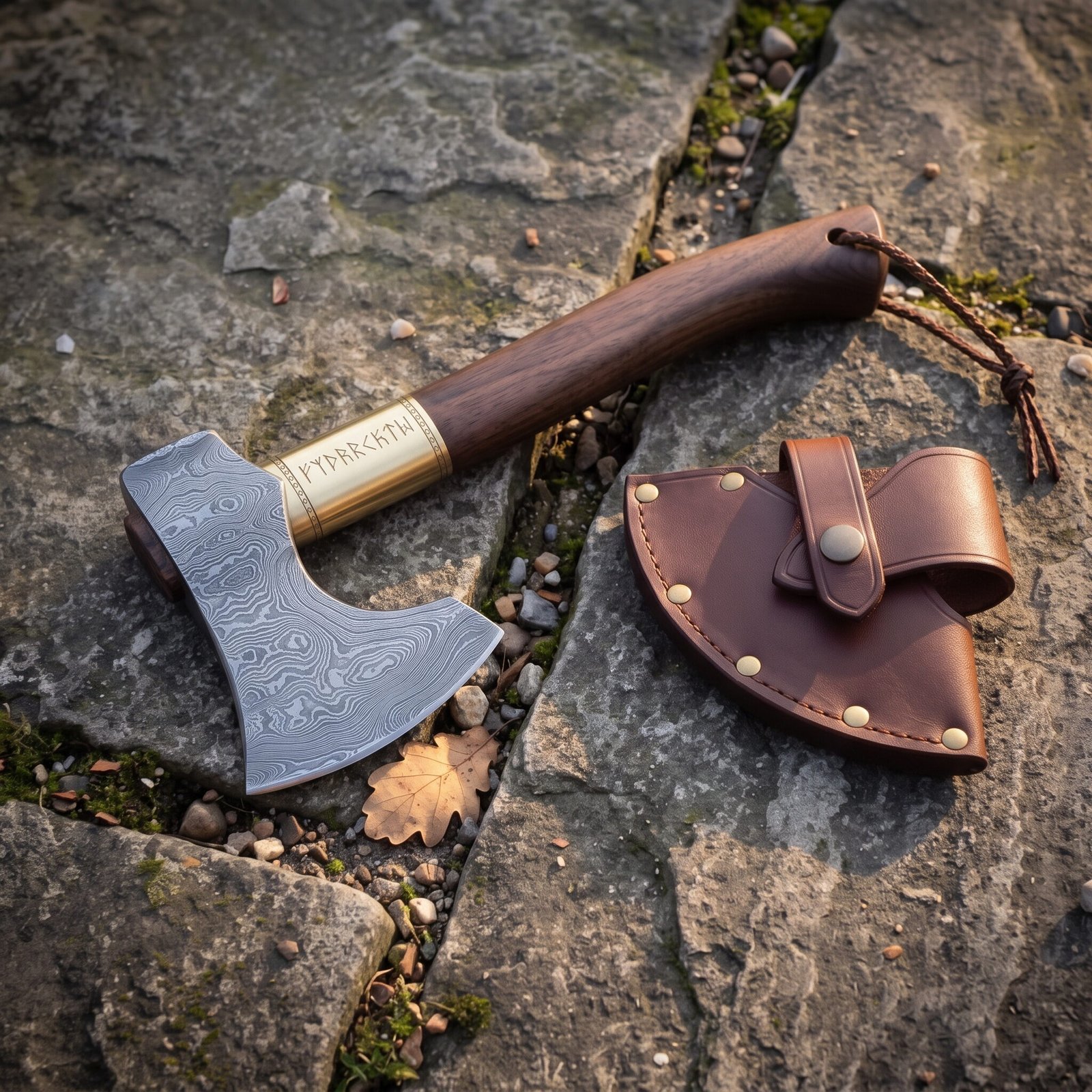
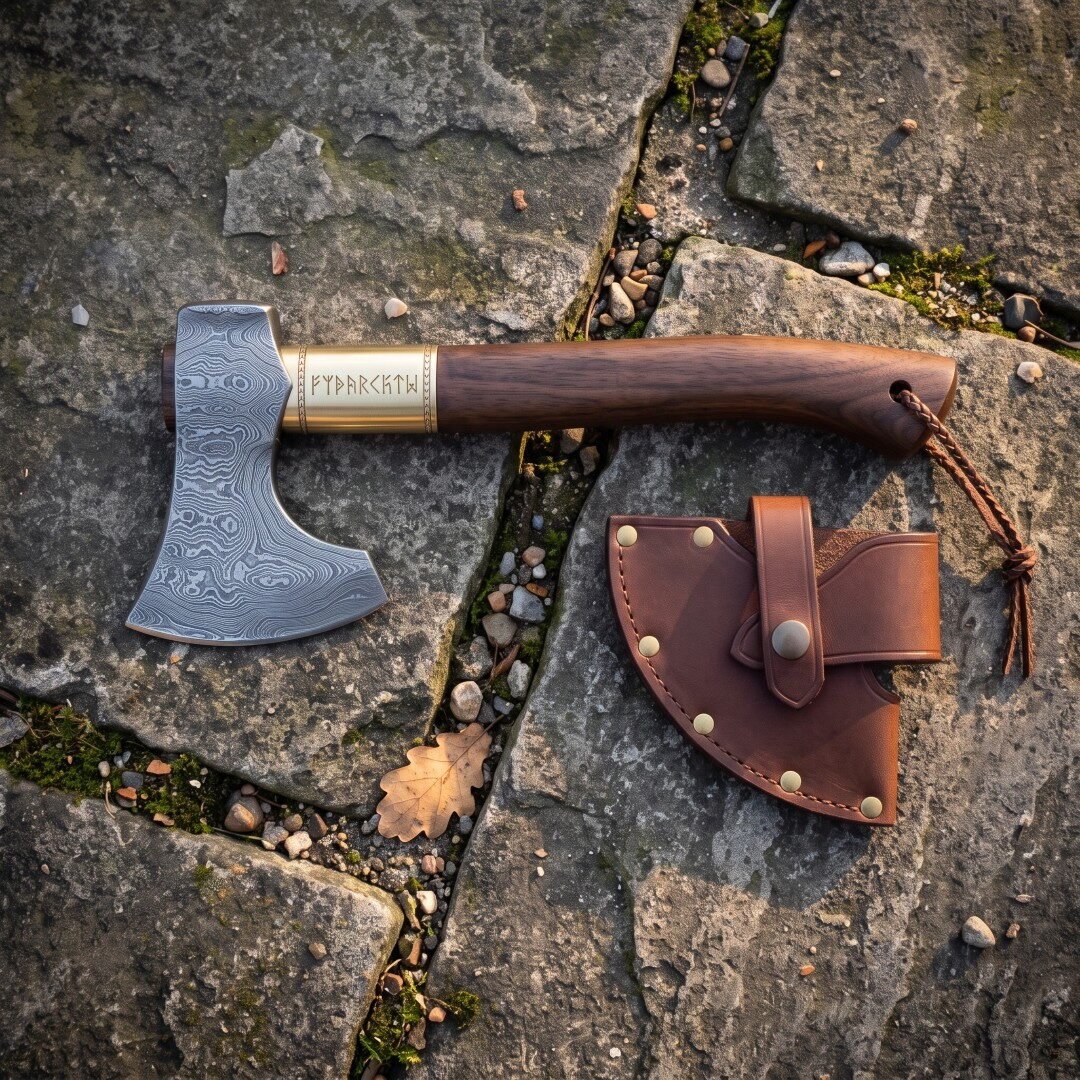
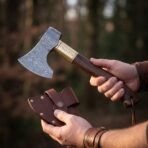
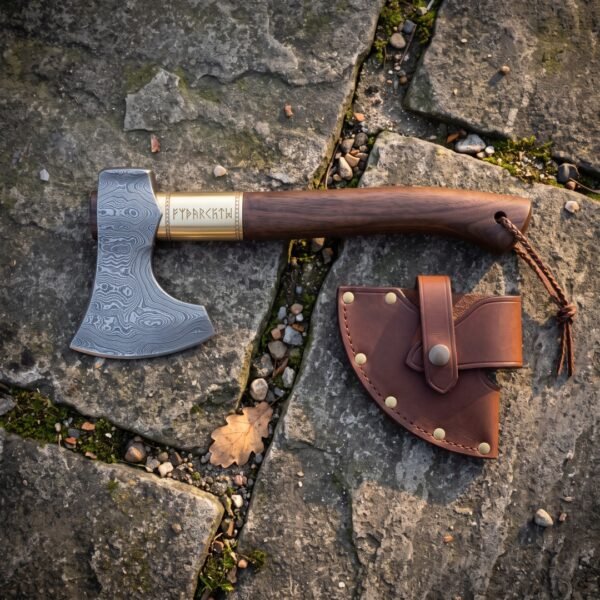
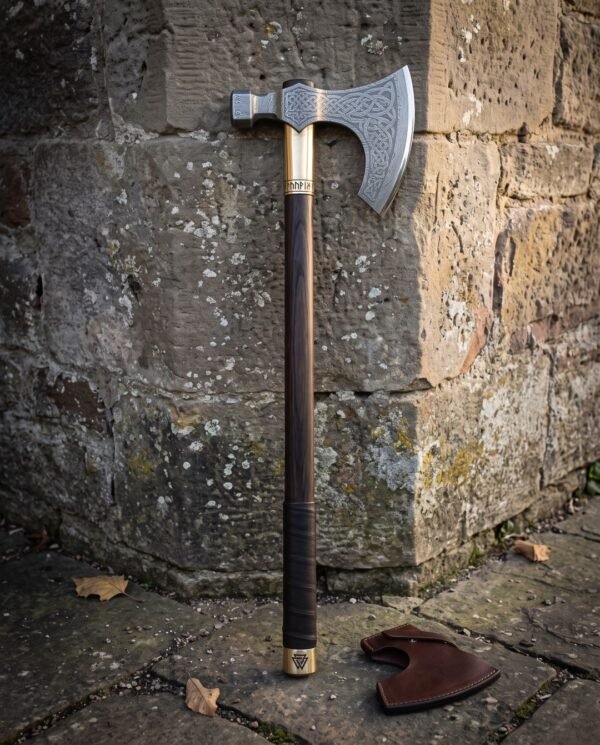
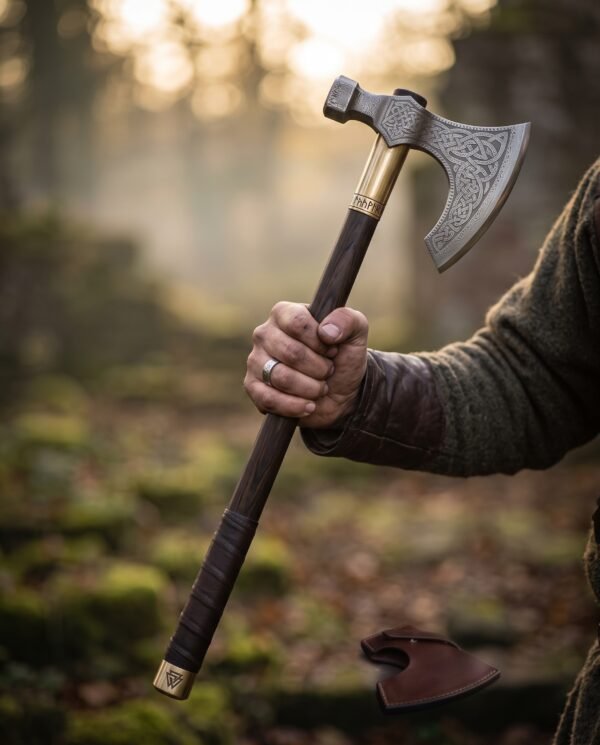
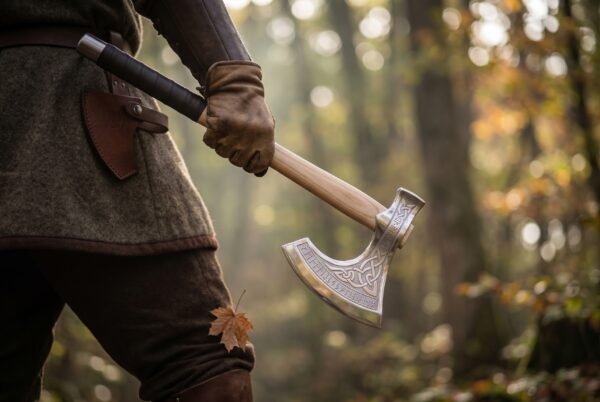
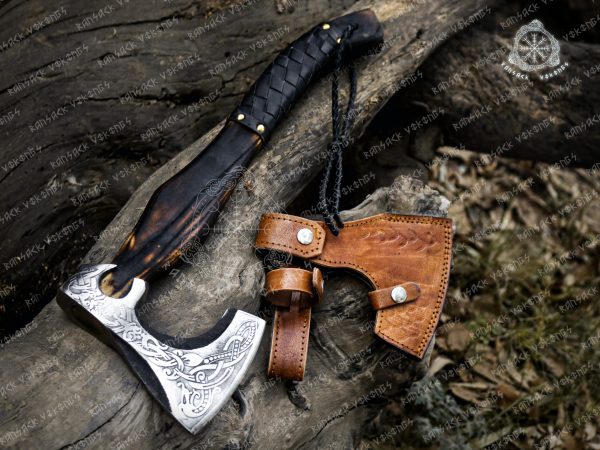
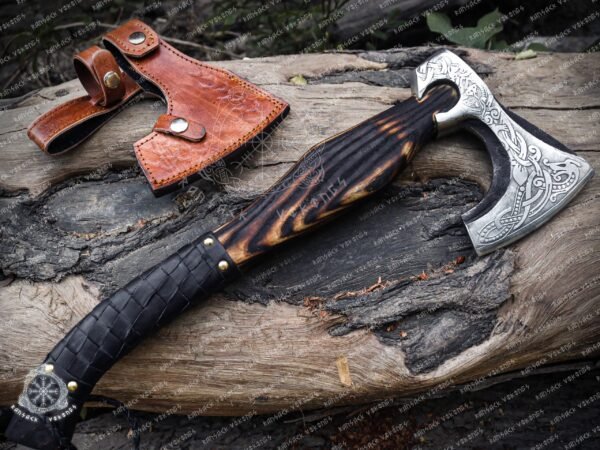
The Runehewn is a bearded Viking axe with a pattern welded head, a brass collar at the eye stamped with Elder Futhark, a walnut haft and a leather wrist lanyard. The head is forged from a 1095 and 15N20 billet and hardened to 58 to 60 HRC, and the pattern you can see running through the cheek is real forge welded Damascus rather than an etched surface print. Two steels with different nickel content are folded and welded together, and etching darkens one and leaves the other bright, so the figure runs through the whole thickness of the bar.
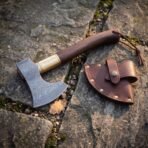
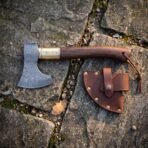
The runes on the collar are the first aett of the Elder Futhark, the eight characters f u th a r k g w, which is where the word futhark comes from in the same way that alphabet comes from alpha and beta. The Elder Futhark was in use from roughly the second century to the eighth and has twenty four characters in three groups of eight. Every Runehewn is forged, ground, heat treated, collared and hung in a Czech Republic workshop, and it ships with the fitted leather head sheath shown in the photograph. Why the beard is cut out of the blade at all is explained in what is a bearded axe.
Specifications
| Head material | Hand forged Damascus, 1095 and 15N20 pattern welded billet |
|---|
| Hardness | 58 to 60 HRC |
|---|
| Head style | Bearded Viking axe with an upswept toe and a dropped beard |
|---|
| Cutting edge | Approximately 4.5 inches from toe to heel |
|---|
| Overall length | Approximately 16 inches |
|---|
| Haft | Walnut, swelled toward the butt, oil finished, wedged through the eye |
|---|
| Collar | Brass band at the eye stamped with the first aett of the Elder Futhark |
|---|
| Lanyard | Braided leather lanyard through the butt |
|---|
| Sheath | Brown leather head sheath with brass rivets around the edge and a snap strap |
|---|
| SKU | RK-1500 |
|---|
Why the Viking axe head is so thin
Pick up an original Viking axe head in a museum case and the first thing that strikes you is how little steel there is. Many weigh under two pounds and the blade is often only a few millimetres thick behind the edge. That is not poverty of material, it is design. A war axe is not a splitting tool. It has to cut through a shield rim, a mail sleeve or an arm at the end of a fast swing, and a thin blade with a long edge does that far better than a heavy wedge would, while leaving the axe quick enough to recover between blows.
The beard, the section of edge that hangs below the eye, is what buys the length without the weight. It stretches the cutting edge downward on the same small head, and it creates a hook. A bearded axe can catch a shield rim and pull it aside, which is a documented Norse technique and the reason the shape survived for centuries after the Viking age in carpentry.
The head is hung on a wedged haft rather than glued. The eye is drifted with a slight taper so the wood is drawn tight as it is driven home, then wedged. That means the hang is serviceable. If the walnut ever dries and loosens in a hot house, the wedge can be driven further or the haft replaced, which is not possible with an epoxied head.
The Damascus, the brass and the walnut
1095 and 15N20 is the standard pairing for pattern welded blades and it works because both are high carbon steels that harden in the same quench. The 1095 brings the carbon, the 15N20 brings the nickel that makes the pattern show after an acid etch, and the finished billet behaves like a good simple carbon steel rather than a compromise between two different alloys. At 58 to 60 HRC the edge takes a very fine finish and holds it.
It is not stainless and it is not rust proof. The etch that reveals the pattern is itself controlled corrosion, so the surface will spot if it is left wet or stored in damp leather. Keep it oiled and it will darken slowly into a deeper, more contrasty figure, which is exactly what you want.
The collar is brass, stamped rather than engraved, so the rune shapes are pressed into the metal and stay crisp under handling. The haft is walnut, a dense, close grained hardwood that darkens beautifully with oil and hand contact, finished with oil rather than lacquer so it does not raise blisters and can be topped up with anything you have. The leather lanyard through the butt is there so the axe can hang from a wrist or a peg.
Engraving, runes and your own design
Use the rune converter on this page to turn a name, a date or a short phrase into Elder Futhark and we will cut it into the steel or the leather. If you would rather have a Viking pattern than a rune line, choose your own design in the engraving option above the add to cart button and tell us where it goes. Where a piece already carries an engraved design, your chosen engraving replaces it rather than sitting alongside it. On the Runehewn that matters, because the brass collar already carries the futhark row, so your line takes the place of it. If you want the futhark kept, ask for your runes on the leather sheath instead. Full detail is on the engraving page.
Handling, display and honest limits
This is a sharp axe on a sixteen inch haft, and it is best thought of as a display and collection piece that happens to be fully functional rather than as a camp tool. It will cut, and the geometry that makes it a good cutter makes it a poor splitter, because a thin blade wants to bury itself in a round of firewood rather than pop it apart.
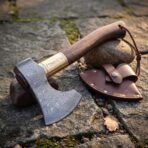
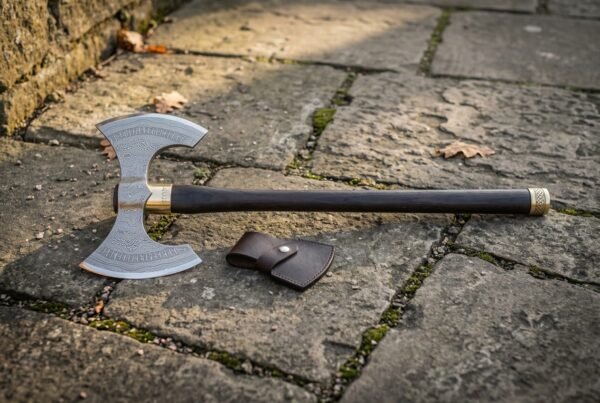
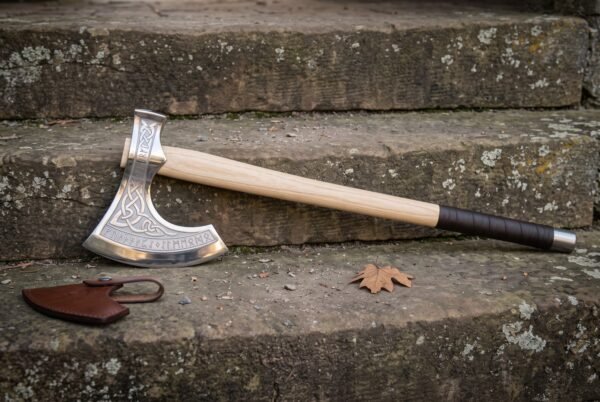
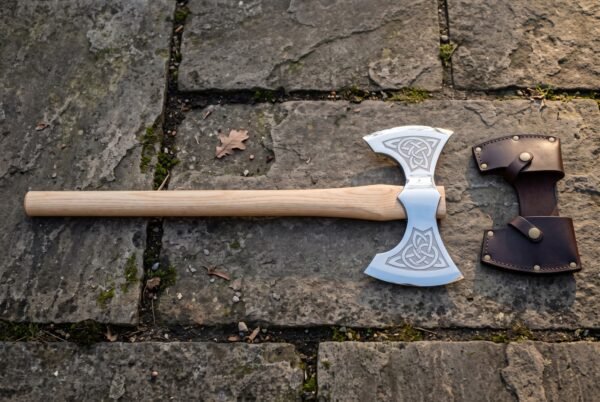
It is not for sparring. A live edge has no place in any form of contact reenactment, and combat groups use blunt or rebated steel for exactly that reason. Displayed, it hangs from the lanyard, sits on a rack or lies on a shelf with the sheath fitted. The stone paving and the leaf in the photograph are setting rather than product.
Care
Wipe the head dry after handling and put a light film of oil on it before it is put away, because Damascus rusts more visibly than plain steel does and pattern welded surfaces show every spot. If rust appears, a nylon pad and oil will lift it without hurting the etch, and we can re etch a head that has been cleaned back too far. Sharpen with a fine stone or a rod, holding the existing convex bevel rather than grinding a new flat one. Feed the leather sheath and lanyard two or three times a year with a neutral cream, and never store the head inside damp leather. Our full notes on pattern welded steel are on the steel care page. Sharpening starts with a file, and how to sharpen an axe takes it through to the strop.
Made in the Czech Republic
The work behind this piece happens in a Czech Republic workshop that has kept to the old methods. Steel is forged and heat treated by hand, the grind is taken down by eye rather than by machine, and the handle, fittings and sheath are cut and finished one at a time. Because of that, every piece carries small marks of the hand that made it.
Ransack Viking is a United States company. We import direct, check each piece when it reaches us, and ship from our Chicago, Illinois warehouse. Engraving is added here in the United States after arrival, so the piece you receive is finished to your order.
A note on handmade variation
This axe is hand made, not machine made or bulk produced, so what arrives will not be a pixel for pixel copy of the photograph. The Damascus figure is unique to every head because it depends on how the billet moved under the hammer, and the walnut grain, the tone of the brass and the colour of the leather vary as well, because each piece is worked by hand from natural materials. The dimensions, the material and the build are the same every time. The character is not.
Frequently asked questions
Is this real Damascus
Yes. It is forge welded from 1095 and 15N20 and then etched, so the pattern runs through the steel. It is not an etched print on a plain bar, and we would tell you if it were.
Is it sharp when it arrives
Yes. It leaves the shop with a working edge along the full beard. Unpack it carefully and keep the sheath on it when it is not in your hand.
Can I fight with it at an event
No. It carries a live edge and no reenactment society will allow that in contact. Combat groups use blunted or rebated steel, and this is a sharp display and collection axe.
What do the runes say
They are the first eight characters of the Elder Futhark, f u th a r k g w, which is the row the alphabet is named after rather than a word or a phrase.
Will the Damascus rust
It can, because it is high carbon steel and not stainless. Wipe it, oil it and keep it out of damp leather and it will darken rather than corrode.
How long before it arrives
Processing is one to two weeks because the billet is welded and the head forged to order, and shipping is free within the United States. Engraved orders take a few days more.
What is in the box
- One Runehewn bearded Viking axe with a 1095 and 15N20 Damascus head at 58 to 60 HRC
- Walnut haft with a fitted leather wrist lanyard
- Brass collar stamped with the first aett of the Elder Futhark
- Fitted brown leather head sheath with a stud closure
- Lifetime warranty against defects in forging, grind, heat treat and fittings
- Forged and finished in the Czech Republic
Explore the range
See more in Viking axes, battle axes and Norse arms, or read the guides before you choose a head.
If this one is not it
In the same category sits the Runebeard battle axe, forged from 1095. A near match for this one is the Grainwhorl battle axe, pattern welded Damascus. Closest to this in the range is the Knotbeard battle axe.
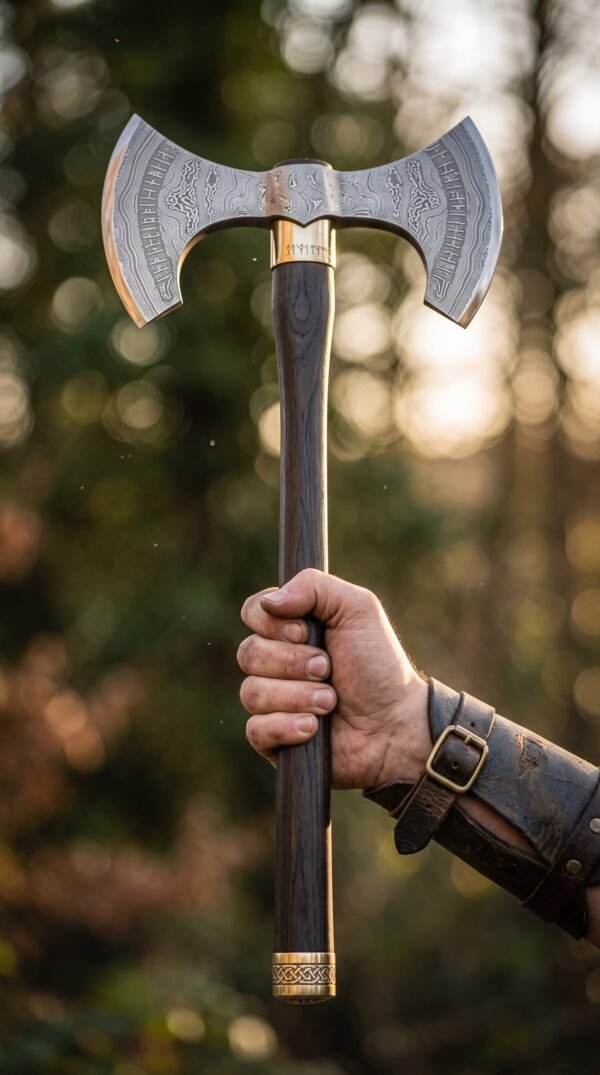
Fitting out further, the Twinbite double headed axe belongs with it. Pick the steel, the length and the fittings yourself on the custom Viking axe page.


Bought this on a whim and it turned out to be one of my favorite purchases this year. Even the small engravings are crisp and clean. Worth every penny.
Got this as a birthday gift and the reaction was priceless. Even the small engravings are crisp and clean. Came in a nice gift box which made it feel even more special. Love it.
Five stars isn’t even enough honestly. Nice touch that it ships from within the US even though it’s crafted in the Czech Republic. Fit and finish is museum quality. You can tell real craftsmen made this by hand. Can’t recommend this enough.
Happy with this one for the most part. Sheath is nice. Wish it had more padding but it does the job. Ransack Viking usually delivers solid quality and this was no exception. Nice that it ships from a US warehouse even though the craftsmanship is Czech. Still very happy with it and would recommend.
Photos don’t do this axe justice at all. Edge retention has been great even after regular use. Shipping was fast and everything arrived well packaged.
It’s okay. Not great not bad. Blade edge needed some sharpening out of the box. Handle material felt a bit different than pictured. Not bad, not amazing either. It’s Czech made and US shipped. Packaging was just okay though.
I collect stuff like this and this axe is on another level. Weight and balance make it feel like a real functional piece not some cheap replica. Even the small engravings are crisp and clean. If you’re on the fence just get it. You won’t regret it.
This axe beat every expectation I had. Damascus blade holds a razor edge right out of the box. Love it.
No regrets on this purchase at all. Came in a nice gift box which made it feel even more special. Shipping was fast and everything arrived well packaged.
Absolutely blown away by this axe. Edge retention has been great even after regular use. This is going straight into my display case.