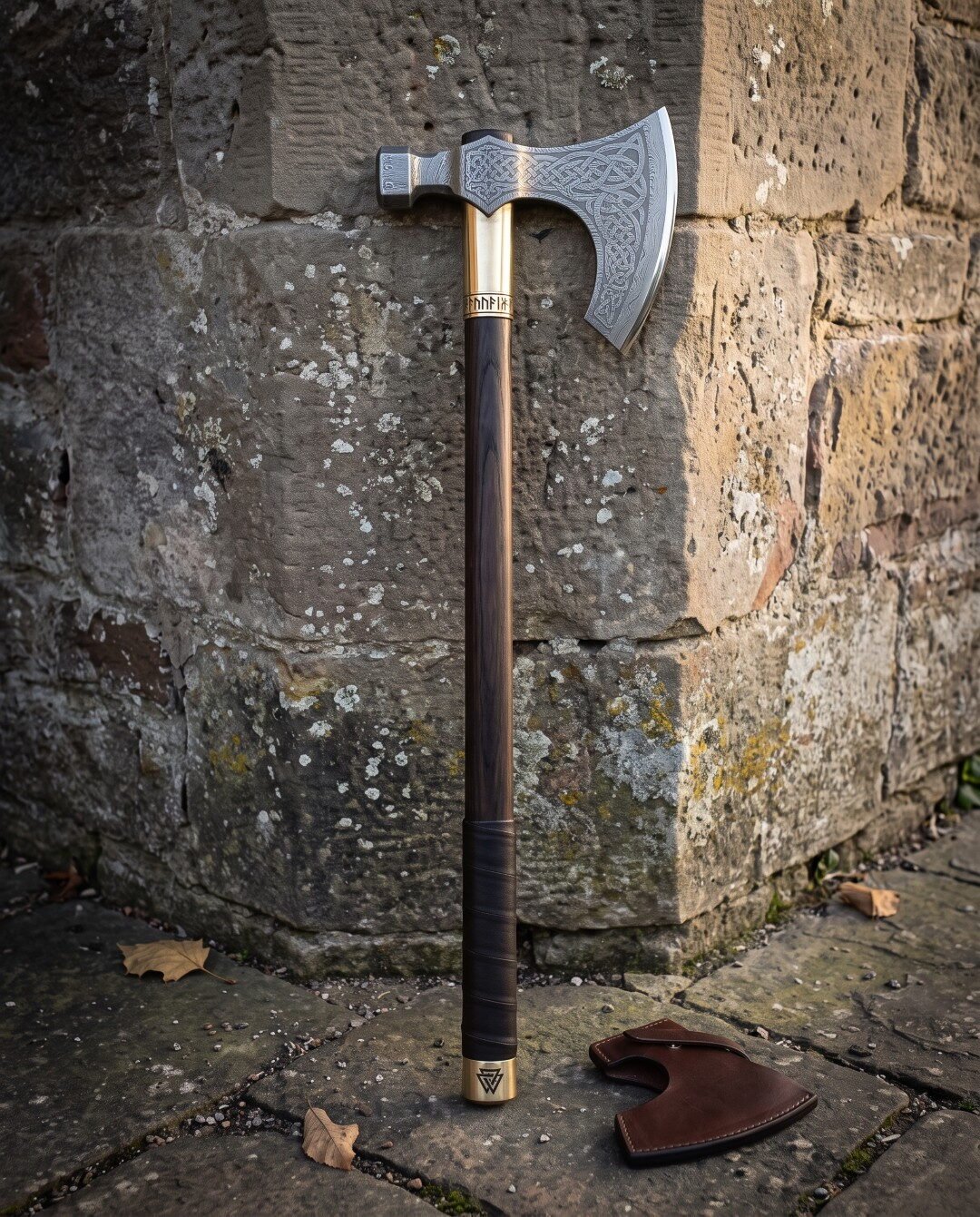
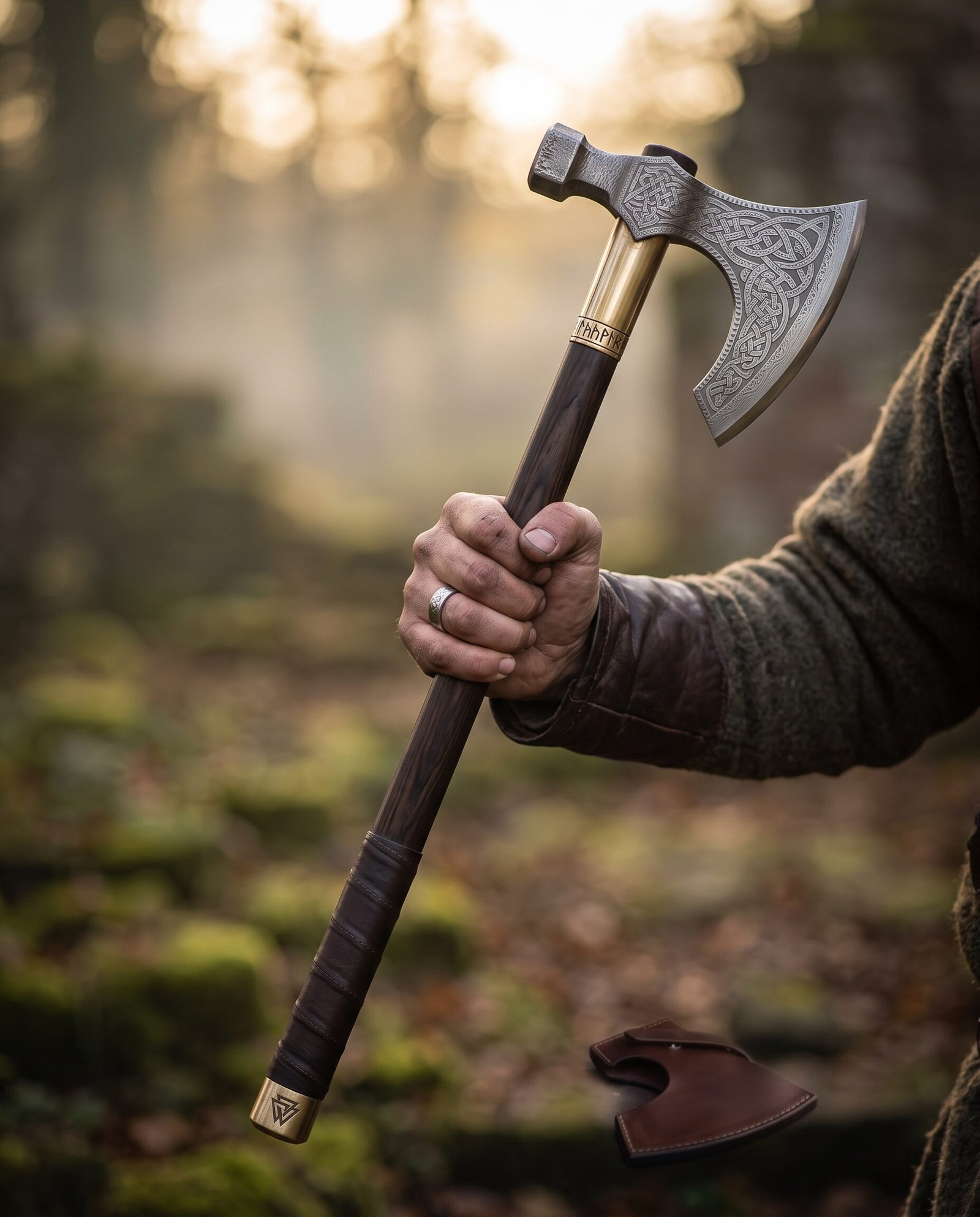
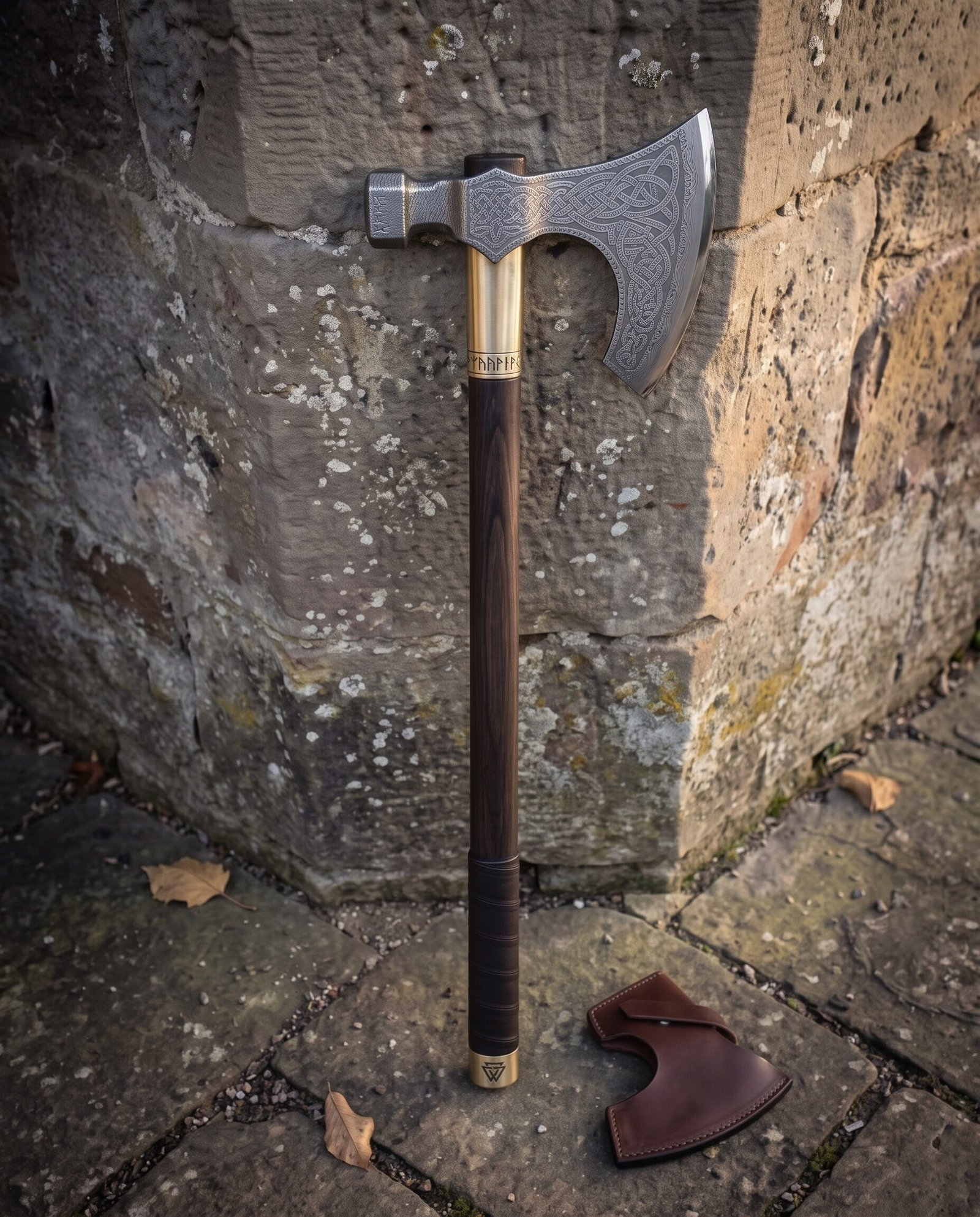
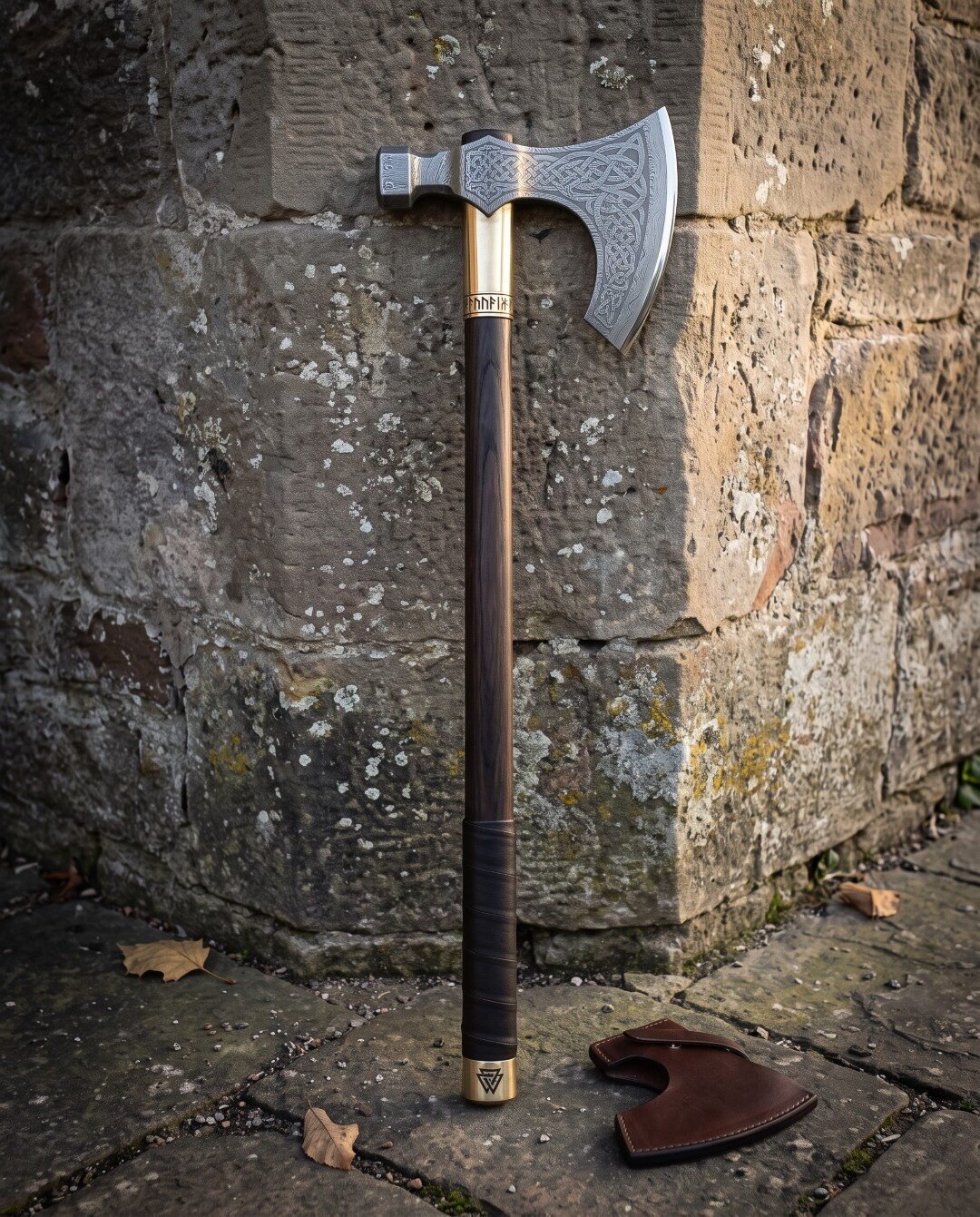
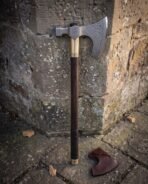
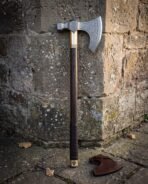
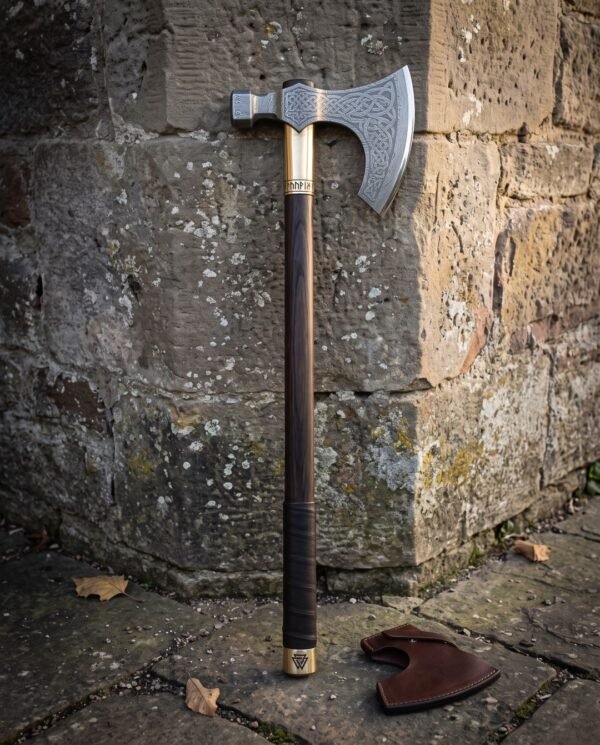
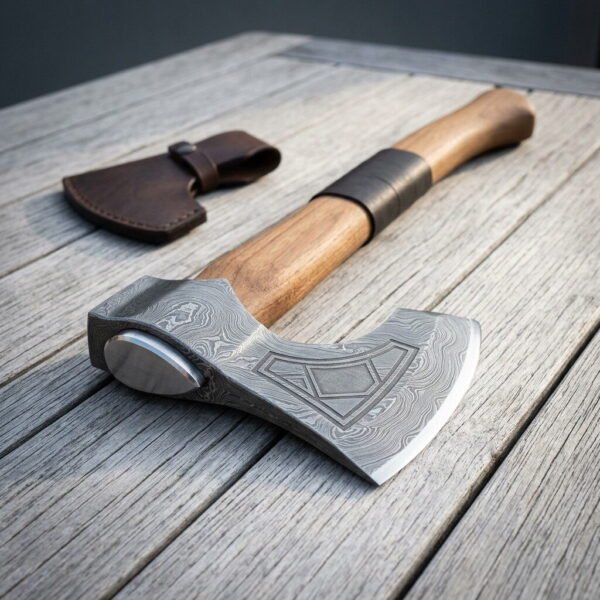
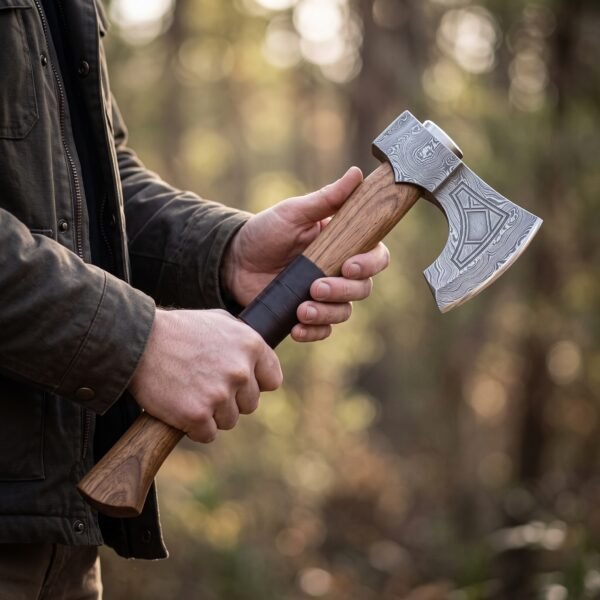
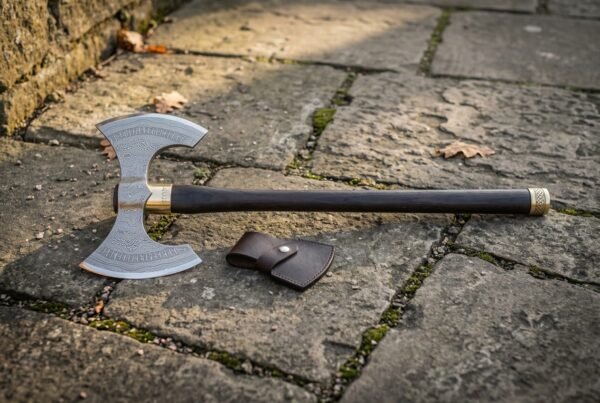
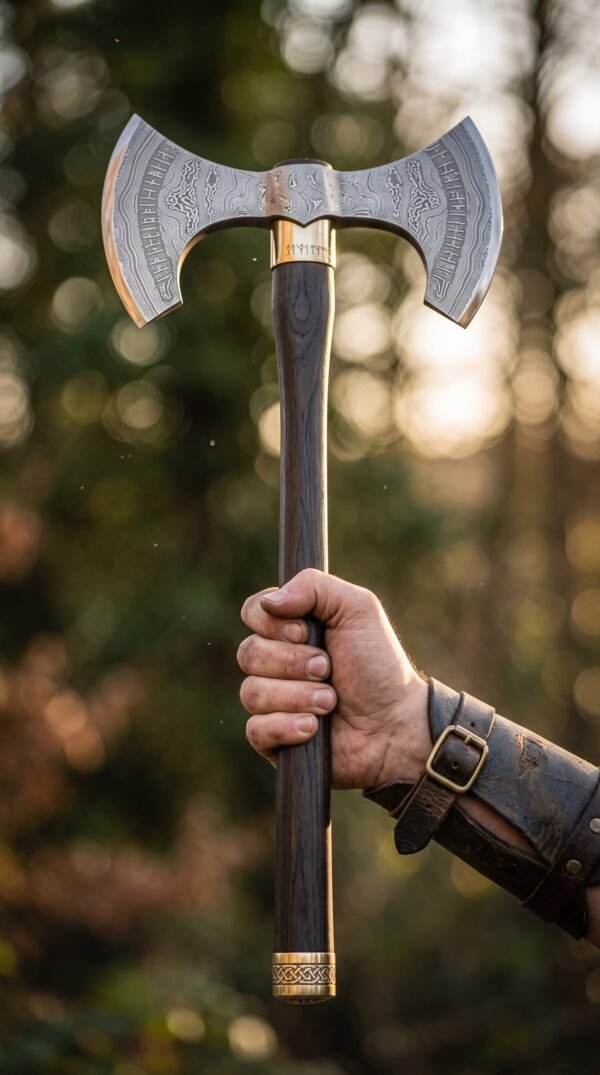
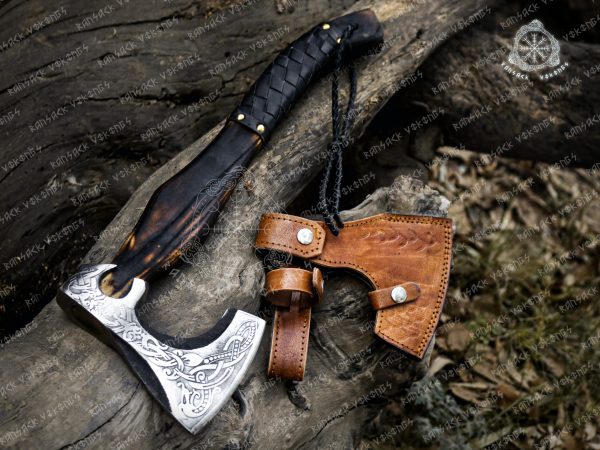
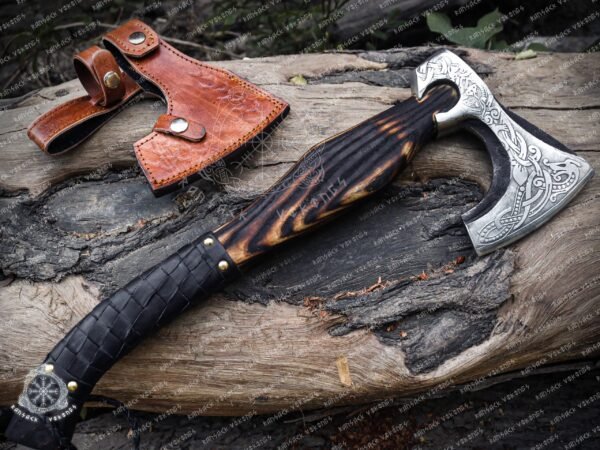
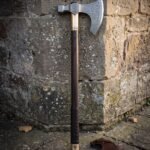
A bearded axe on a long haft, with a deep sweeping beard dropping well below the eye, a hammer poll squared off at the back, and interlaced knotwork etched across the cheek and down into the beard. The panel on the cheek is an etched surface design cut into the steel and darkened. It is not Damascus, and we would rather say that plainly than let the photograph imply otherwise. Below the head sits a brass collar carrying a line of Elder Futhark, the haft is dark hardwood with a leather wrapped grip, and a brass butt cap at the base carries a Valknut. The beard itself is the functional part of the design. Dropping the lower edge of the blade well below the eye buys a long cutting edge without adding the weight a full width head would need, and it opens a gap behind the beard where a hand can choke right up under the head for close work.
Head, collar and cap are forged, etched and fitted, and the haft shaped and wrapped, in a Czech Republic workshop. It ships with the brown leather blade mask shown. Why the beard is cut out of the blade at all is explained in what is a bearded axe.
Specifications
| Type | Long hafted Viking bearded axe |
|---|
| Head material | 1095 high carbon steel |
|---|
| Hardness | 54 to 58 HRC at the edge |
|---|
| Head form | Deep bearded blade with a squared hammer poll |
|---|
| Surface | Etched interlaced knotwork across the cheek and down into the beard, darkened |
|---|
| Collar | Long brass collar under the head, engraved with an Elder Futhark rune line |
|---|
| Haft | Dark hardwood, long and straight |
|---|
| Grip | Brown leather wrap over the lower part of the haft |
|---|
| Butt | Brass cap engraved with a Valknut |
|---|
| Included | Brown leather blade mask |
|---|
| SKU | RK-1537 |
|---|
What the beard is for
The beard is not styling. On a Norse axe head the metal is expensive and the haft is not, so the design problem is how to buy the longest possible cutting edge for the least possible steel. Dropping the heel of the blade downward, below the line of the eye, does exactly that. You get a tall edge that will bite deep into a shield rim or a log, while the mass stays concentrated near the eye where it does the most good, and the head stays light enough to swing quickly.
The gap the beard opens behind the blade is the second gift. Slide your hand up the haft into that gap and you are holding the axe just below the head, which turns a swinging tool into a carving one. Norse woodworkers used that grip constantly for shaping and hewing, and the same grip is why a bearded axe is still the shape carvers reach for a thousand years later.
The hammer poll on the back is a working surface, not ballast. It is for driving wedges, setting stakes and knocking things together on a camp site. It is not a substitute for a proper forging hammer and it should never be used to strike hardened steel.
Steel, the etch, and what it really is
The head is 1095 taken to 54 to 58 HRC at the edge. That is the right window for an axe. Harder and the edge chips when it meets a knot or a nail. Softer and it rolls and needs constant dressing. In this range it takes a keen edge, holds it through real work, and any damage shows up as a rolled edge you can steel back rather than a chip you have to grind out.
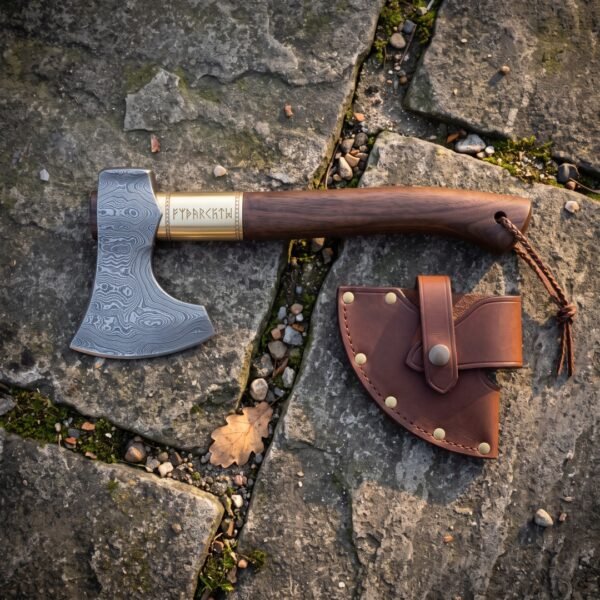
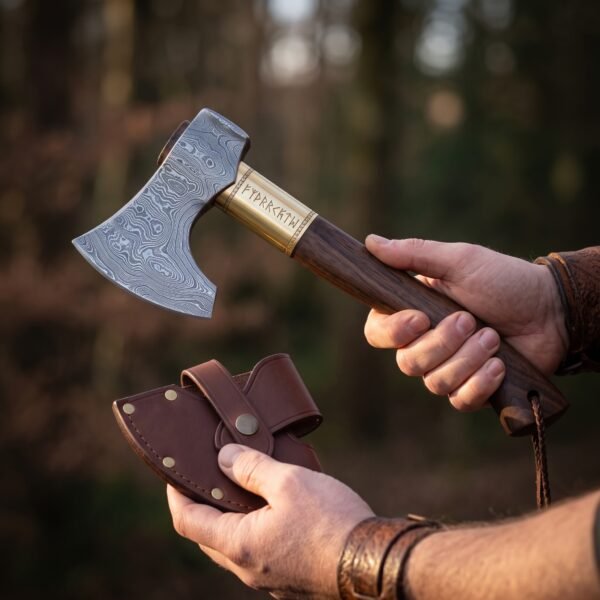
The knotwork is an etch. The design is masked and then bitten into the surface of the steel with acid, and the recess is darkened so the pattern reads against the bright ground. That is a different thing from Damascus, where the pattern is the layered structure of the bar itself and runs all the way through it. An etch sits in the top fraction of a millimetre. It is durable and it will not wipe off, but it can be polished away over many years of hard use on the cheek, and it is honest to tell you that rather than let you assume you are buying pattern welded steel.
The collar and butt cap are brass, chosen because brass takes a crisp engraved line and because it will not rust where the haft meets the head and moisture collects.
Engraving, runes and your own design
Use the rune converter on this page to turn a name, a date or a short phrase into Elder Futhark and we will cut it into the steel or the leather. If you would rather have a Viking pattern than a rune line, choose your own design in the engraving option above the add to cart button and tell us where it goes. Where a piece already carries an engraved design, your chosen engraving replaces it rather than sitting alongside it, so on this axe your rune line goes onto the brass collar in place of the one shown, or onto the leather mask if you would rather keep the collar as it is. Full detail is on the engraving page.
Display and mounting
A long hafted axe hangs best horizontally on two pegs, one under the head and one under the haft, so the weight is carried at both ends and the haft is not stressed at a single point. If you hang it head up on a single hook you will eventually see the haft take a set. Keep it off an exterior wall and out of direct sun, since sun dries the leather wrap and shrinks the haft away from the head. If you would rather stand it in a corner, stand it on the butt cap rather than resting the edge on the floor, and leave the mask on.
Care
Wipe the head after use and put a light film of oil on it, paying attention to the seam where the steel meets the haft, because that is where water sits. Do not oil the etched panel with anything abrasive and never take a wire wheel to it. Touch the edge up with a file and a stone rather than a bench grinder, which will burn the temper out of a thin edge in seconds. Feed the leather grip wrap and the mask with a neutral conditioner once or twice a year, and rub the haft with boiled linseed annually. Polish the brass only if you want it bright, since brass darkens naturally and many people prefer it that way. There is more in our guide to steel care. Sharpening starts with a file, and how to sharpen an axe takes it through to the strop.
Made in the Czech Republic
This piece is made by hand in the Czech Republic, in a workshop that still works the old way. The steel is forged, ground, heat treated and finished by smiths who learned the trade from the people before them, and the wood, horn and leather are cut and fitted by hand rather than pressed out on a line. That is also why no two pieces come out exactly the same.
Ransack Viking is a United States company. We import these pieces ourselves, check every one when it lands and ship from our warehouse in Chicago, Illinois. Engraving is done here in the United States after the piece arrives, so your runes or your own design go on before it leaves for you.
A note on handmade variation
This is hand made, not machine made or bulk produced, so what arrives will not be a pixel for pixel copy of the photograph. The etch bites a little differently on every head so the knotwork varies in depth and contrast, dark hardwood runs from near black to deep brown in the same board, and the leather wrap settles into its own pattern of overlaps. Grain, tone, hammer texture and exact profile vary because each one is worked by hand from natural materials. The dimensions, the material and the build are the same every time. The character is not.
Frequently asked questions
Is the pattern on the head Damascus?
No. It is an etched surface design in a plain 1095 head. Damascus is a layered bar where the pattern runs all the way through, and this is not that. We would rather be clear about it.
Is it sharp, and will it cut wood?
Yes on both counts. It arrives with a working edge and at 54 to 58 HRC it is a genuine cutting tool, not a wall hanger. It is not a felling axe though, and it is not shaped for splitting rounds.
Can I use it for reenactment combat?
No. It is a sharp axe. Contact reenactment requires blunted, inspected axes passed against your group rules, and no sharp axe belongs in a bout.
Why brass on a Viking axe?
Brass and bronze fittings turn up throughout Norse metalwork, on scabbard mounts, brooches and harness. It also takes an engraved line far more cleanly than steel and does not rust at the head joint.
Does the leather mask fit over the whole edge?
Yes, it is cut to the head and covers the edge from the toe to the point of the beard, held closed on the blade.
How long before it ships?
Processing is one to two weeks because each axe is forged, etched and hafted to order, then free shipping within the United States. Returns are accepted within seven days.
What is in the box
- Hand forged 1095 bearded axe head with etched knotwork and a hammer poll
- Long hardwood haft with leather wrapped grip and brass butt cap
- Engraved brass collar, carrying your rune line or design if selected
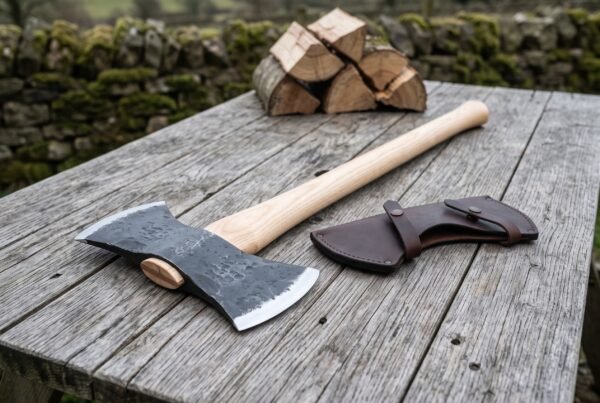
- Brown leather blade mask
- Care card and lifetime warranty against defects
- Forged and finished in the Czech Republic
Explore the range
See more in Viking axes, battle axes, Norse arms and splitting and felling axes, or read the guides.
Other pieces in this group
Closest to this in the range is the Twinbite battle axe, forged from 1095. If this one is not quite right, there is the Runehewn battle axe, pattern welded Damascus. Also in this group is the Hammerpoll battle axe, pattern welded Damascus.
If you are putting a set together, the Thunderclad war axe sits alongside it. Nothing here exactly right, build one to your own spec on the custom Viking axe page.


I collect stuff like this and this axe is on another level. Came in a nice gift box which made it feel even more special. Shipping was fast and everything arrived well packaged.