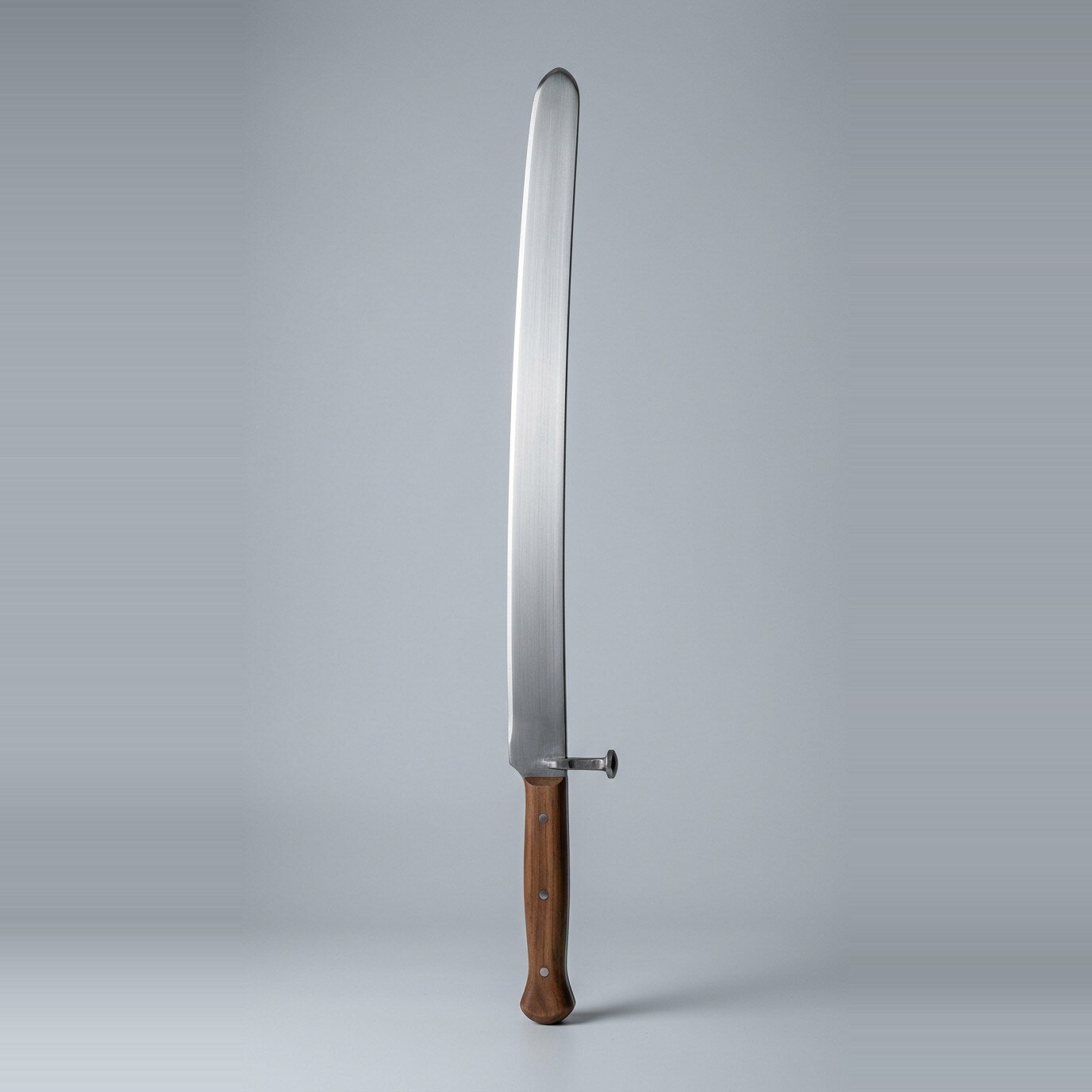
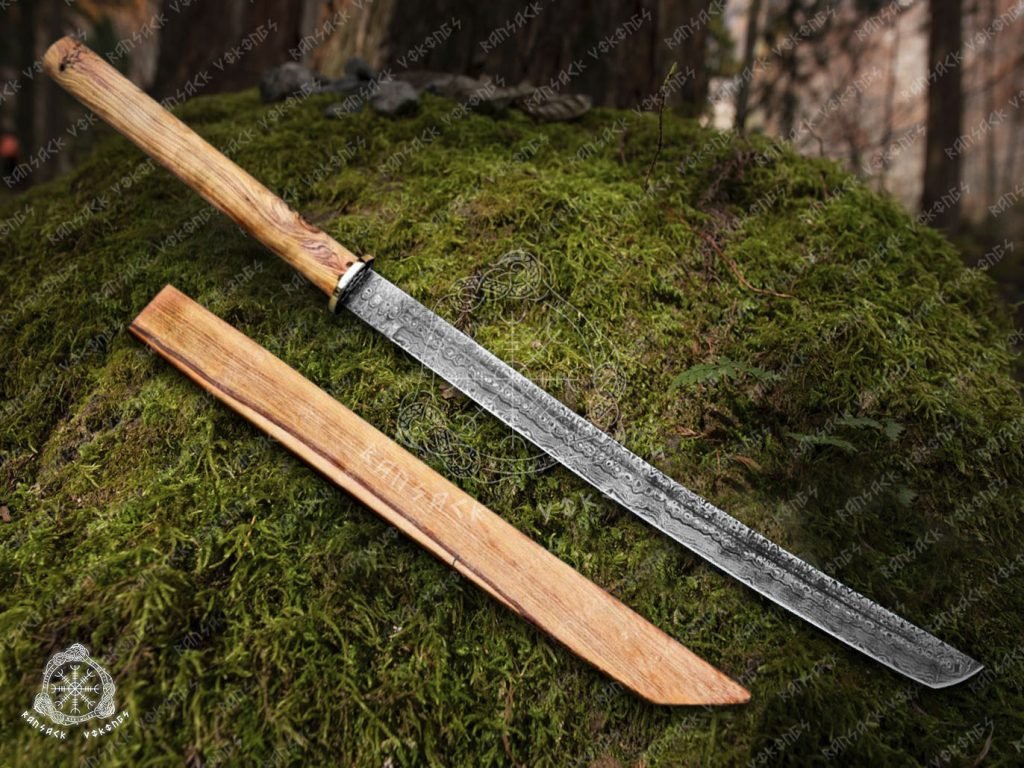
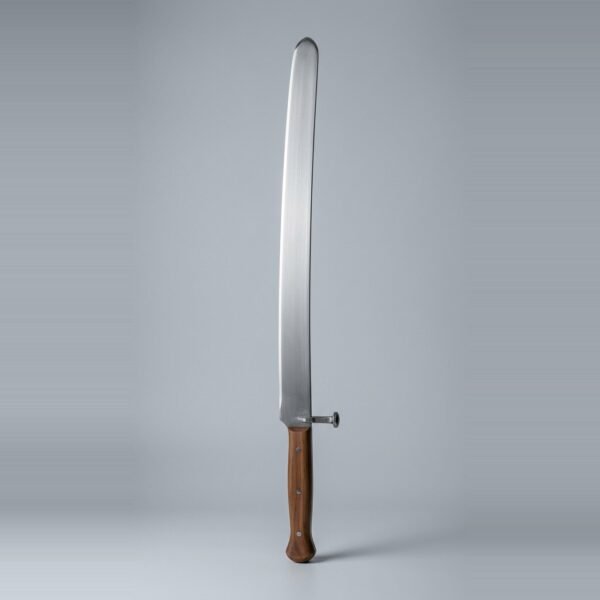
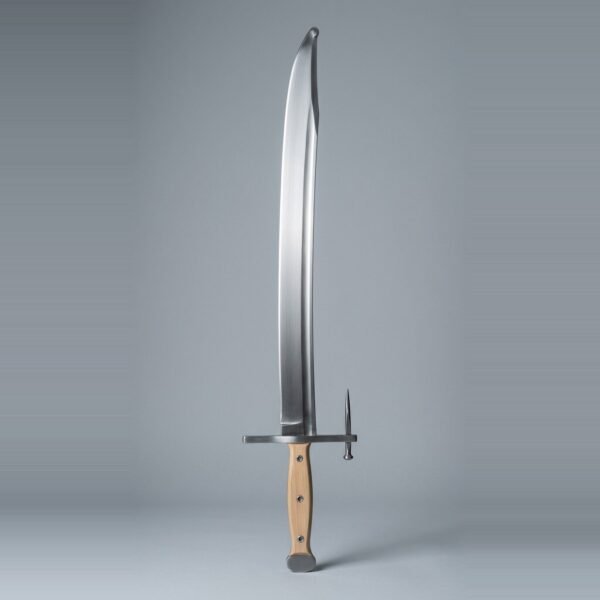
The Ostrevak is a steel dussack. There is no cross on it at all. The only hand protection is a nagel, a steel bar peened straight through the blade above the grip and finished flush on both sides, standing out on the knuckle side to cover the hand. That single fitting is the whole guard and it is what makes a dussack a dussack rather than a short messer.
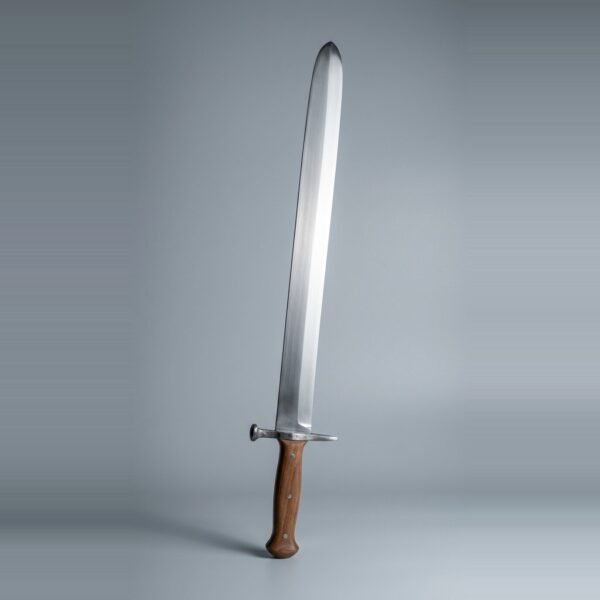
The tip is rounded and blunt. There is no point on this piece and there never was meant to be. The blade is broad and single edged, the scales are wood held on by three steel rivets through the tang, and the whole thing is built in spring steel for hard use in a class. It is a trainer, plainly and only.
The dussack is the best entry point into Joachim Meyer’s system and it is a cheap one. Read the dussack guide and HEMA sword flex explained before you order, and see the curved single edged blades it leads into in HEMA sabres. The dussack sits beside the single edged military forms in the sabre guide.
Specifications
| Material | 51CrV4 spring steel, hardened to 49 to 52 HRC |
|---|
| Overall length | About 31 inches, hand made so it varies a little piece to piece |
|---|
| Blade length | About 25 inches |
|---|
| Blade type | Broad single edged dussack blade, straight spine, no fuller |
|---|
| Edge | Blunted, about 3 mm flat land, not sharpened |
|---|
| Tip | Rounded and blunt. There is no point on this piece |
|---|
| Guard | None. No cross of any kind |
|---|
| Nagel | Steel nagel peened straight through the blade and finished flush on both faces |
|---|
| Grip | Wooden scales held by three steel rivets through the tang |
|---|
| Flex | Medium, the range dussack drill wants |
|---|
| Included | Dussack only, no scabbard, covered by the lifetime warranty |
|---|
| SKU | RK-3035 |
|---|
The dussack in the Meyer 1570 tradition
Joachim Meyer published his Gründtliche Beschreibung der Kunst des Fechtens in Strasbourg in 1570, and the dussack has a whole section of it to itself. Meyer treats it as a teaching tool as much as a fighting form. The wards, the cuts, the guards and the whole logic of taking and giving the line are laid out on the dussack first, and a student who has learned them there carries them across to the longsword and the rapier.
What Meyer describes is a short, broad, single edged blade with a hand guard and no point worth speaking of. The cuts run in the familiar pattern and the footwork is the same footwork he teaches everywhere else. Because the blade is short and the tip is safe, two students can work at speed early in their training without the equipment bill that longsword sparring brings.
The dussack also stands on its own as a civilian sidearm form. The shape descends from the eastern European tesak and it survived in fencing schools long after the sword itself went out of daily carry. Clubs that teach Meyer usually start new members here for a term, and many of them find they like it more than the longsword they came for. Meyer was teaching townsmen and apprentices rather than soldiers, and a blade that costs little, breaks rarely and carries no point at all is exactly what that job asks for.
A peened nagel, a rounded tip and why spring steel suits it
Look closely at the guard, or rather at where a guard would be. There is no cross. A single steel nagel is driven through a hole in the blade itself and peened over on both faces so it sits flush, standing proud on the knuckle side to cover the hand. That is a simple, strong and entirely period arrangement, and it is far tougher than a cross that relies on a shoulder in the tang.
The blade is 51CrV4 spring steel hardened to 49 to 52 HRC. Spring steel is chosen because it bends and returns instead of taking a set or snapping under a hard bind. Dussack practice is close and busy and blades meet constantly, so this matters. The flex sits in the medium range, which is where dussack drill wants it: enough give to be safe on a thrusting motion, enough body to hold a bind.
The tip is rounded and blunt with no point at all, and that is the single most useful safety feature on the whole piece. It does not make the dussack harmless, because a broad blunt blade still hits hard and still needs a mask, gloves and a gorget. It does mean the most dangerous thing about a sword is simply absent.
Engraving, runes and your own design
Use the rune converter on this page to turn a name, a date or a short phrase into Elder Futhark and we will cut it into the steel or the grip.
Engraving is cut in the United States once the dussack arrives in North Babylon. Runes and text are $19, a symbol is $39 and a family crest is $49. The blade is broad and flat here, so a name or a club motto sits well along the forte, and the scales will take a small mark if you would rather keep the steel plain.
If you would rather have your own design than a rune line, choose your own design in the engraving option above the add to cart button and tell us where it goes. Where a piece already carries an engraved design, your chosen engraving replaces it rather than sitting alongside it. More on the engraving page.
Handling and balance
We publish no weight and no point of balance for this dussack. A photograph provides no scale, every piece is finished by hand, and a number made up for a listing would be a fiction. What follows is a description of the design instead.
A dussack is short and broad, so the mass sits closer to the hand than it does on any sword in the range. That is what makes it a good teaching blade. A beginner can hold a guard for a whole class without their shoulder giving out, and the cuts can be drilled slowly and repeatedly without the fatigue that a longsword brings after twenty minutes.
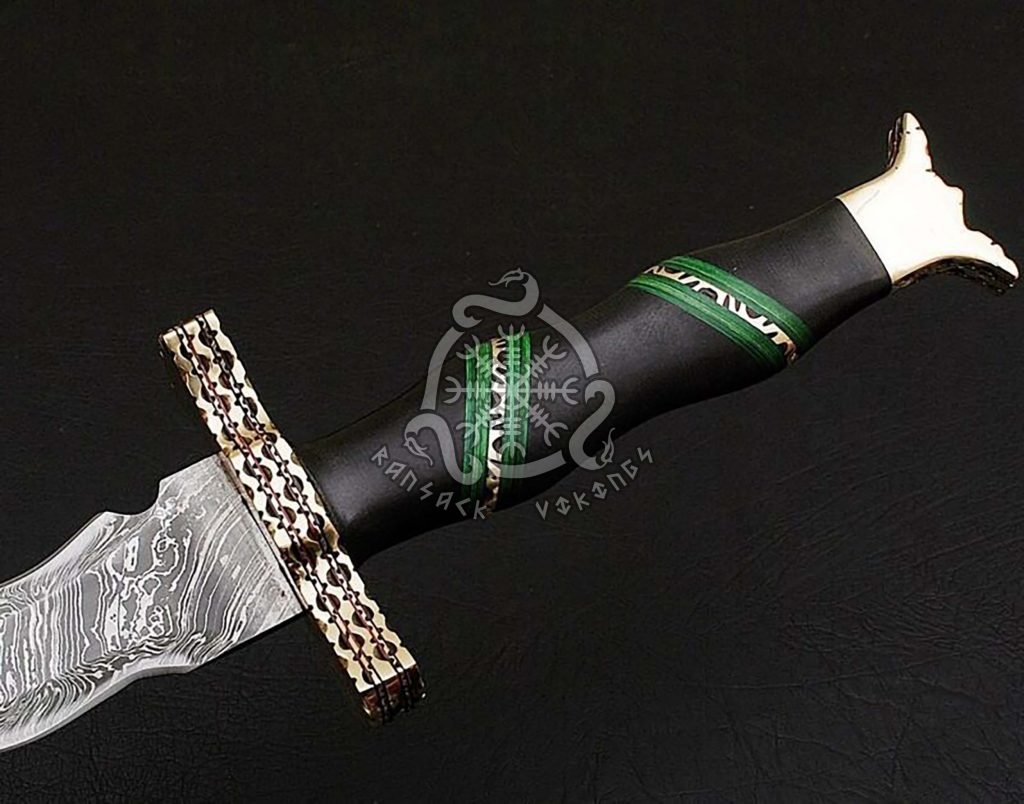
The riveted scale grip is straightforward and it fills the hand. With no cross and only a nagel, the hand sits close to the blade, so the edge is easy to index by feel. Fencers moving here from a cross hilted sword usually need a session to stop reaching for a quillon that is not there.
Care
Wipe the blade after every class and keep a light film of oil on it. Pay attention to the base of the nagel where it passes through the blade, since that is where sweat sits and where rust will start if it is left. A cotton bud does the job better than a rag.
Check the peening on the nagel and on the three rivets from time to time. A dussack takes a lot of percussion for its size and it is a piece that gets loaned out to new members, so it lives a harder life than most. Burrs raised on the edge land by another blade should be filed down before the next session. Our care guide covers the rest.
Made in the Czech Republic
Made by hand in the Czech Republic and imported by Ransack Viking. Nothing here is drop shipped out of an importer catalogue straight to a customer. Every one is checked for hilt tightness, pommel seating and blade straightness at our North Babylon, New York warehouse, and ships from there. Shipping in the United States is free, returns run for seven days, and the lifetime warranty against defects in the forging, the grind, the heat treat and the fittings has no end date and needs no receipt.
The only work done in the United States is engraving, cut after arrival at the warehouse. Country of origin is stated on every listing we publish, because anyone buying a training blade deserves to know where it was made.
A note on handmade variation
This is hand forged. It is not machine made, not cast and not bulk produced, so what arrives will not be a pixel for pixel copy of the photograph on this page.
The nagel is set and peened by hand, so its exact position and the shape of the peen will differ from one dussack to the next. The scales are wood and will vary in grain and tone. The blade may run a little wider or narrower and a little over or under the quoted length, and the satin finish will show the direction of the last pass.
A defect is different. A nagel that works loose in its hole, a blade that takes a set in ordinary drill, a cracked scale, a soft heat treat. Those are covered for as long as you own it, with no receipt and no end date.
Frequently asked questions
Whether a dussack has a cross
Not this one. There is no cross at all. A single nagel peened straight through the blade is the entire guard, which is the defining feature of the form.
Whether it has a point
No. The tip is rounded and blunt and there is no point on this piece. That is how a dussack is supposed to be.
What tradition it belongs to
Joachim Meyer’s 1570 treatise, which devotes a full section to the dussack and uses it to teach the principles that carry over to longsword and rapier.
Whether it is a good first HEMA blade
It is one of the best. It is short, it is cheap, it has no point, and the technique transfers directly into everything else Meyer teaches.
Whether protective gear is still needed
Yes. A broad blunt blade hits hard. A mask, gloves and a gorget are the minimum, whatever the tip is shaped like.
Whether a scabbard is included
No. Dussacks do not ship with one and we do not supply one for this piece.
What is in the box
- One Ostrevak steel dussack, about 31 inches overall.
- Care and handling card.
- Lifetime warranty against defects in the forging, the grind, the heat treat and the fittings.
- Your engraving already cut, if you chose it at checkout.
Explore the range
Curved single edged blades sit in HEMA sabres and the messers that share the riveted hilt are in HEMA messers. For the longsword material Meyer teaches beside the dussack, see HEMA longswords and the feders. Everything is gathered in the HEMA swords hub, and the reading sits in the guides hub.
Worth a look beside this
If the fit is not quite right, Kaldrast hanger sabre, about 36 inches overall, Kjeldhar stirrup hilt sabre, about 36 inches overall, Reifholm leather dussack, about 26 inches overall and Molgarth langes messer, about 35 inches overall cover much the same ground.
Browse the HEMA sabre category or step up to the HEMA sword hub for the complete set, or start from scratch on the custom sword builder.








Reviews
There are no reviews yet