
A HEMA rapier is a long narrow thrusting sword built for the Italian and Spanish schools that ran from about 1540 until the smallsword pushed it aside around 1715. Four pieces sit in this group, part of the wider HEMA sword range, and they cover the hilt families a fencer meets: paired triangular shell plates, a pierced shallow dish with a branch bar, a dished shell with long quillons, and a solid Spanish cup.
Three of the four are blunt trainers in 51CrV4 spring steel hardened to 49 to 52 HRC. Spring steel is used because it bends and returns instead of taking a set or snapping under a hard bind. The fourth is a sharp in 1095 at 54 to 58 HRC, sold for test cutting rather than sparring. Blades run about 39 to 40 inches, with overall lengths near 47 to 48 inches. If the names confuse you, read rapier against sidesword first.
Tip shape decides what you can enter. Rounded tips are not allowed on rapier under the Berlin HEMA Cup gear requirements, which ask for a spatulated or rolled tip of at least 1.5 cm, so read the tip row in each specification table against your own ruleset. The broader cut and thrust pieces live in HEMA sideswords, and the single edged side of the art sits in HEMA sabres.
Most pieces here take a custom engraving on the blade, the guard or the grip, chosen on the product page.
If you would rather have a sword built to your own reach, start with the sword builder and set the blade length, the guard, the pommel and the grip wrap yourself.
Free US shipping
On most pieces. Heavier and oversized ones carry a flat charge.
Hand Forged
Heated, hammered and ground by hand.
Engraving available
Names, dates or Norse runes on most pieces.
Ships from New York
Inspected and dispatched from our New York warehouse. No import duty, no customs delay on US orders.
HEMA Rapiers
What a rapier is, and when people carried one
The rapier is a civilian sword. It arrives in the middle of the sixteenth century, around 1540, and it is displaced by the smallsword by about 1715. In between it is the sword a man of standing wore in town, the sword that the fencing masters of Italy and Spain built their books around, and the sword that settled a great many arguments in the street and behind the church wall.
The proportions follow the job. Surviving examples sit at roughly one kilogram. The average blade length across the surviving corpus is near 104 cm, Italian pieces run past 115 cm and the longest reach about 130 cm, and blade width at the shoulder is 2.5 cm or less. That is a long, narrow, heavily hilted sword built to hold the line and reach an opponent before he reaches you, with enough hand protection that the fingers can sit over the quillon block without being taken off.
What it is not is a light stage prop. A real rapier is a substantial thing, slow to change line if you hold it badly and extremely fast if you hold it well.
The Italian school and the Spanish school
Almost everything written about the rapier in the modern art comes down two lines of descent, and the sword you buy should follow the line you train.
The Italian line
The Italian tradition is the one most English speaking clubs begin with, because the material is broad, the translations are good, and the movement reads well to a beginner. It works from measure and tempo. You place the point, you gain the opponent's blade, you close the line and you step. The guards are held with the sword arm extended or close to it, the offhand is live and usually carries a dagger, and the fight is decided by who owns the centre.
Italian rapiers tend to be long. Swept hilts and dished shell hilts belong here, and the very long quillons seen on some Italian pieces are functional rather than decorative, because a long quillon is what lets you catch and hold a blade that has already come past your point.
The Spanish line
The Spanish tradition, the destreza, works from geometry and footwork rather than from the bind. The body moves off the straight line rather than down it, the sword is generally carried with the arm extended and the point high, and the offhand is used more sparingly.
The Spanish cup hilt is the sword most people picture when they hear the word. It appears in the early seventeenth century, and it is the most efficient hand protection ever fitted to a civilian sword. A deep steel cup, quillons that run well past the cup on both sides, a knuckle bow that ties the cup to the pommel, and a grip long enough to let the thumb ride up. Historical cups often carried a rompepuntas, a rolled or turned rim around the edge of the cup meant to trap an incoming point rather than let it skate off into the arm.
Hilt families, and what each one is for
The swept hilt
The swept hilt is the Italian answer. Bars sweep from the quillon block forward over the fingers and back to the pommel in a cage that looks organic rather than engineered. It is light for the amount of cover it gives, it is the most photogenic hilt ever made, and it is the one that takes the most skill to forge well, because every bar has to meet its neighbour cleanly and every joint is visible.
The cup hilt
The Spanish cup is the opposite approach. Instead of many bars, one solid dish of steel. Nothing gets through it. The cost is mass out in front of the hand, which changes how the sword handles, and a cup hilt sword feels point heavy to somebody coming off a swept hilt.
The Pappenheimer
The German answer, named for Gottfried Heinrich zu Pappenheim, is a pair of pierced shell plates set either side of the blade at the quillon block, usually with a swept cage above them. It gives you most of the cover of a cup with much less mass and it is the hilt that bridges the Italian and Spanish approaches.
The dish and the shell
Between the swept hilt and the full cup sits a family of shallow dishes and single or paired shell plates. A shallow dish gives frontal cover without the mass of a cup, and when it is paired with a knuckle bow and a branch bar it protects nearly as well. Shells are often set in pairs, one to each side, and they are lighter still.
The three ring hilt
A simpler and older form. Rings are fitted above and below the quillon block, the fingers pass through the largest of them, and a knuckle bow ties the assembly together. A three ring hilt on a long narrow thrusting blade is a rapier. The same hilt on a broad cutting blade is a sidesword.
Sizing a rapier, and the navel rule
There is one fitting rule that is worth more than every chart on the internet. Stand the sword on its point on the floor in front of you. The quillons should sit at about your navel. Higher than that and the sword is long for you, and you will struggle to recover the point after an extension. Lower and you are giving away reach you could have had.
That rule matters more on rapier than on any other type because rapier is a measure game. The whole art is built on knowing exactly how far you can reach without committing your body, and a sword that is two inches wrong makes that calculation wrong every single time.
The pieces on this page run about 47 to 48 inches overall with blades near 39 to 40 inches. That suits most adults of average height. If you are notably short or notably tall, measure against the navel rule before you order, and use the builder if the answer is that nothing standard fits you.
Blade section and taper
A rapier blade is not a flat bar. The common sections are the diamond, the lenticular, the hexagonal and the ridged section with a raised spine running down the middle of each face. The section is what gives a narrow blade the stiffness to take a hard parry without folding, and it is why a rapier can be 40 inches long and 2.5 cm wide at the shoulder and still hold a line under pressure.
Taper is the other half. Most rapiers taper gently for the first half of the blade and then harder through the foible, so the forte stays stiff for the bind while the last third gets light and fast. On the blunt trainers here the taper is what carries the flex. The give sits out in the foible, so the blade loads on a thrust and unloads cleanly, while the part of the blade you actually parry with stays firm.
Fullers are rare on true rapier blades and common on sideswords, which is a quick way to tell them apart in a photograph. Three of the four pieces here carry a raised central ridge and no fuller at all.
The tip rule, and why it decides your purchase
The Berlin HEMA Cup gear requirements are the clearest published statement of the standard most European events work to, and they say two things that matter here. Permitted tip shapes are spatulated or rolled, with a minimum diameter of 1.5 cm across all four tournament categories. And rounded tips are explicitly not allowed on rapier and sabre.
That second line catches a lot of buyers out. A blade that ends in a smooth rounded stub looks safe, and for drill it is, but it concentrates force on a small area and it can slide between the bars of a mask in a way a broad flared button cannot. Events that follow the Berlin standard will turn it away at gear check.
So read the tip row on every product page. Two of the rapiers here carry a rolled and flared tip about 15 mm across. One is blunted and rounded off and is described that way plainly, because it is a drill and club sparring piece rather than an event entry. One is a sharp with an acute point and no blunting of any kind, and it is not a sparring blade at all. Never take a claim of tournament legality from any seller, including this one, without the name of the ruleset attached.
The offhand, and the daggers that go with a rapier
Rapier is rarely fenced with one hand empty. The single rapier is a real discipline and a good place to start, but the classic pairing is rapier and dagger, and after that rapier and cloak, rapier and buckler, and in a few sources rapier and a second rapier.
The offhand dagger is a fencing tool in its own right. A parrying dagger has a long straight blade, long quillons and usually a ring or a side ring, and it is used to catch, deflect and trap rather than to stab first. The main gauche is the broader term for the same idea.
When you add an offhand dagger, look at the dagger types guide and match the blade length to your rapier rather than picking the prettiest.
Steel, hardness and flex on these four
The three blunt trainers use 51CrV4 spring steel hardened to 49 to 52 HRC. That is deliberately softer than the 1095 at 54 to 58 HRC used on the sharps and on the display swords elsewhere on this site. A trainer that is too hard is dangerous, because hard steel does not bend, it breaks, and a rapier blade that breaks under a bind sends a sharp stub forward at speed. Spring steel at this hardness bends and returns.
Flex on all three trainers sits in the medium range, which is the band most rapier clubs ask for. Too light and the blade whips on a thrust and takes the point off line. Too stiff and the thrust lands hard on the person receiving it. Medium is the compromise the art has settled on, and the flex guide explains how the tiers are measured and why published numbers vary between makers.
The sharp is a different thing entirely. It is 1095 at 54 to 58 HRC, stiff, with a ground edge along the length and an acute point. It is sold for test cutting and for the display case. It is not to be used against another person under any circumstances.
The four rapiers on this page compared
Every figure in the table below is taken from the specification panel of a product on this page. Nothing is estimated. Sizes vary piece to piece because each blade is forged and ground by hand, so read a stated length as nominal rather than exact.
| Piece | Overall length | Blade type | Steel and hardness | Flex | Guard or tip note |
|---|---|---|---|---|---|
| Ceravalt shell plate rapier trainer, RK-3020 | About 47 inches | Narrow thrusting blade with a raised central ridge and no fuller | 51CrV4 spring steel, 49 to 52 HRC | Medium, tuned to load on a thrust | Paired triangular shell plates over the quillon block. Rolled and flared tip, about 15 mm across |
| Corvalde dish hilt rapier, RK-3024 | About 48 inches | Narrow thrusting blade, ridged in section, tapering hard to the point | 51CrV4 spring steel, 49 to 52 HRC | Medium, with the give carried in the foible rather than the forte | Shallow pierced dish, knuckle bow and branch bar, no rompepuntas rim. Tip blunted and rounded off, not a spatulated tournament tip |
| Velstrand cup hilt rapier, RK-3031 | About 47 inches | Long straight double edged rapier blade, ridged through the middle | 1095 high carbon steel, 54 to 58 HRC | Stiff. A cutting and thrusting sharp, not a sparring blade | Solid unpierced steel cup with no rompepuntas, long quillons with ball finials, knuckle bow. Acute sharp point, no blunting of any kind |
| Fenrholt dished shell rapier trainer, RK-3039 | About 47 inches | Narrow and thrust oriented, raised central ridge, no fuller | 51CrV4 spring steel, 49 to 52 HRC | Medium tier | Dished shell with two small rings and unusually long quillons. Rolled and flared tip, about 15 mm across |
Browse related sword categories
- HEMA sideswords, the broader cut and thrust ancestor of the rapier
- Smallswords and spadroons, the light thrusting swords that replaced the rapier
- HEMA sabres and dussacks for the single edged side of the art
- HEMA feders built for longsword sparring and tournament entry
- HEMA longswords, blunt trainers and one nylon waster
- The full HEMA sword range, all forty nine pieces in one place
- The wider rapier collection, including display and collector pieces
- Daggers, including the offhand blades that pair with a rapier
Guides worth reading first
- What is HEMA, and what a club night actually looks like
- Rapier against sidesword, told apart by blade and hilt
- How to choose your first HEMA sword without wasting money
- HEMA sword flex explained, tier by tier
- Blunt against sharp training swords, and which you need
- HEMA tournament gear rules, tips, edges and masks
- The smallsword and spadroon guide, for what came after the rapier
- The steel glossary, spring steel against high carbon
Frequently asked questions
What length of rapier should I buy?
Stand the sword on its point in front of you and the quillons should sit at about your navel. The pieces on this page run about 47 to 48 inches overall with blades near 39 to 40 inches, which suits most adults of average height. If the navel rule puts you well outside that, order through the builder instead.
Is a rapier the same thing as a sidesword?
No. A sidesword is broader, shorter and made to cut as well as thrust, and it usually carries a fuller. A rapier is longer, narrower, ridged rather than fullered, and built around the thrust. The hilts overlap, which is where the confusion starts, so judge by the blade.
Can I take one of these to a tournament?
Read the tip row on the product page against the ruleset of the event you are entering. Two of these carry a rolled and flared tip about 15 mm across, which matches the shape the Berlin HEMA Cup gear requirements ask for. One is rounded off, and rounded tips are not allowed on rapier under that standard. One is a sharp and is not a sparring blade at all.
Why is the trainer steel softer than the steel on your sharps?
Because hard steel does not bend, it breaks. A blunt trainer at 54 to 58 HRC can snap under a hard bind and leave a stub travelling forward at speed. Spring steel at 49 to 52 HRC bends and comes back, which is what you want in a blade that will be bound against another blade a few thousand times a year.
Do these come with a scabbard?
No. Nothing in this group ships with a scabbard. The specification panel on each product page lists exactly what is in the box, and it is the sword, a cloth wrap on some pieces and a care card.
What is a rompepuntas?
It is the rolled or turned rim found around the edge of many Spanish cup hilts, meant to catch an incoming point rather than let it skate off the cup and into the arm. The cup hilt on this page does not have one, and the product page says so.
Do I need an offhand dagger to start?
No. Single rapier is a complete discipline and most clubs teach it first. Add a dagger once the sword hand is reliable, and match the dagger to the rapier rather than buying on looks.
Can I have a rapier engraved?
Yes. Engraving is done in the United States after the sword arrives, so it does not delay the order from the Czech Republic. Text and runes are 19 dollars, a symbol is 39 dollars and a family crest is 49 dollars, chosen above the add to cart button.
Featured pieces
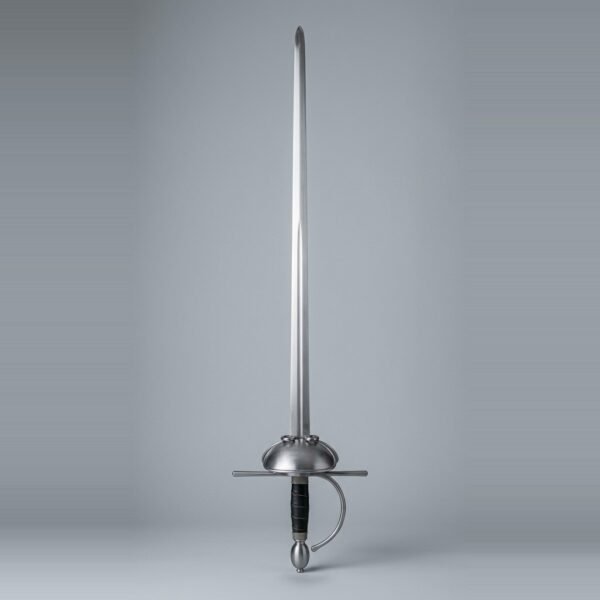 Fenrholt Hand Forged 51CrV4 Rapier Trainer with Dished Shell Guard & Very Long Quillons
$459.00
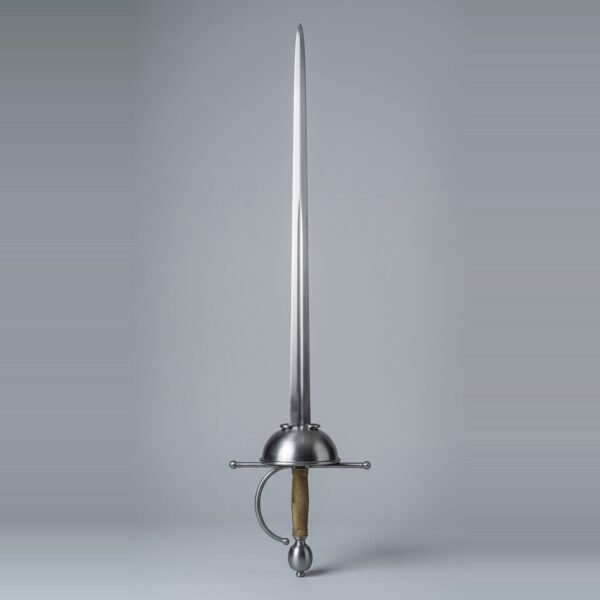 Velstrand Hand Forged 1095 Cup Hilt Rapier with Solid Unpierced Cup & Sharp Acute Point
$579.00
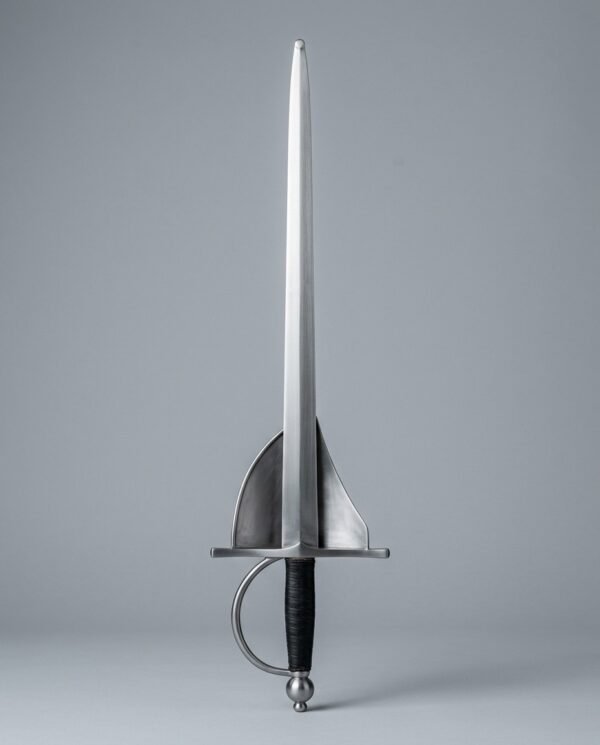 Ceravalt Hand Forged 51CrV4 Spring Steel Rapier Trainer with Shell Plate Guard & Ridged Blade
$499.00
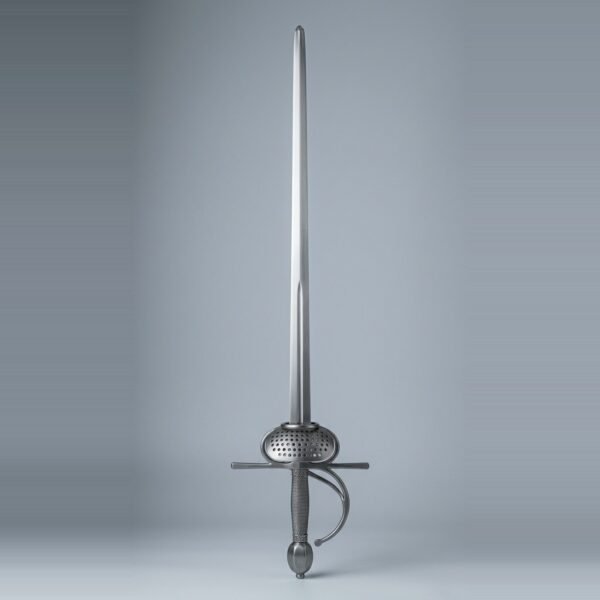 Corvalde Hand Forged 51CrV4 Spring Steel Rapier with Pierced Shallow Dish & Branch Bar Guard
$529.00