Blog
Types of Daggers: Rondel, Bollock, Dirk, Stiletto and More

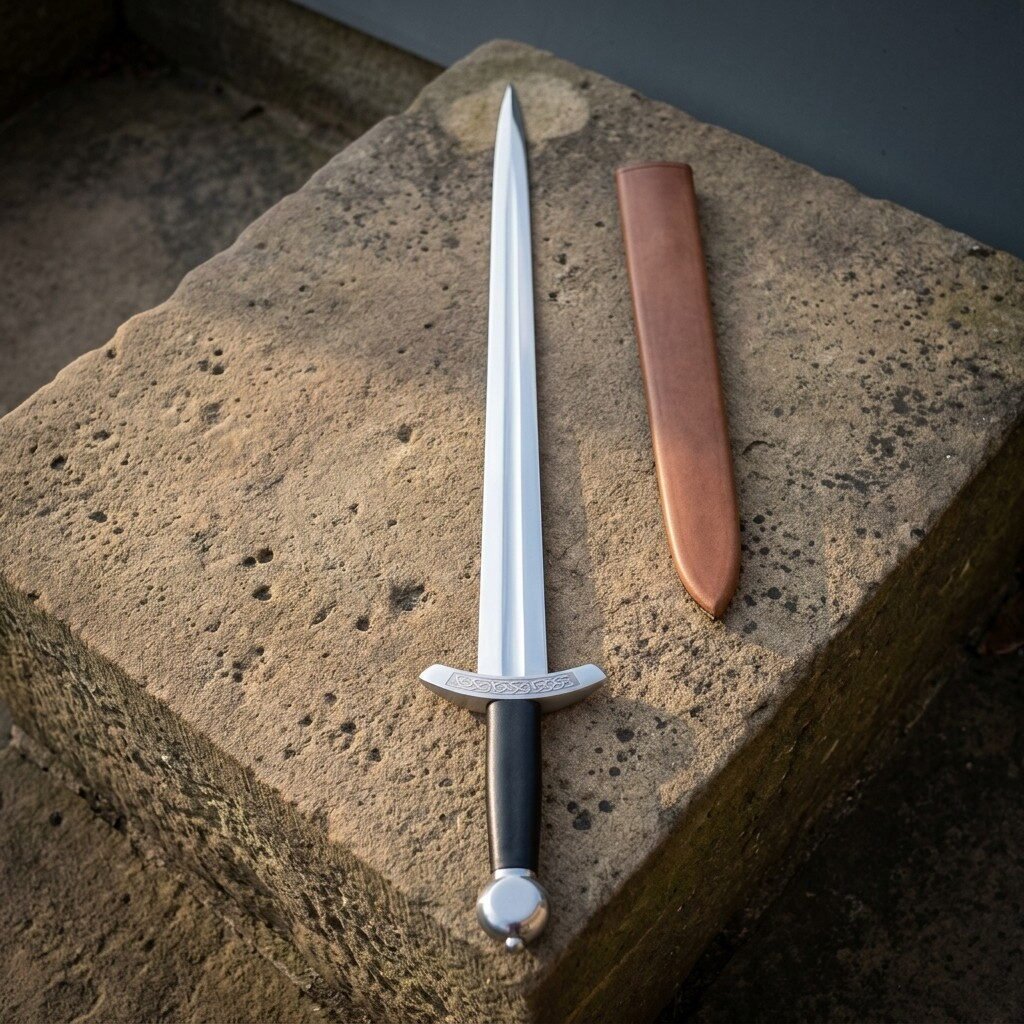
A dagger is a short blade built primarily to thrust, usually with a point strong enough to punch and a grip made for a reverse or forward hold. The main historical families are the rondel with its two discs, the bollock with its lobed guard, the Scottish dirk, the needle pointed stiletto, the baselard, the ear dagger and the broad cinquedea. Each solves a different problem, and none is the generic fantasy dagger.
What actually makes a dagger a dagger
Modern usage says a dagger is double edged and symmetrical, and a knife is single edged. That is a useful shorthand and it is how most legislation draws the line, but it describes the historical objects badly. Plenty of things everyone calls daggers, including the bollock dagger and the Scottish dirk, carry a single edge with a back that is only sharpened near the point.
The better test is intent. A dagger is optimised for the thrust. It has a stiff blade, a point reinforced rather than thinned, a guard or a hand stop that keeps the fist from sliding forward under load, and a grip that works when held point down. A knife is optimised for cutting. Once you look for that, the families sort themselves out. If you want the vocabulary for blade profiles first, our guide to knife blade shapes is the shortest way in.
The medieval European families
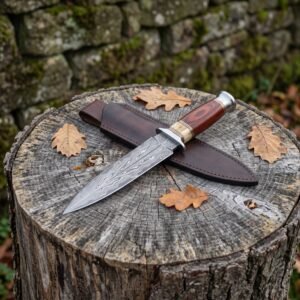 Steelpommel Hand Forged Damascus Dagger Knife with Wood and Bone Handle and Steel Guard and Pommel & Leather Sheath | Collector Display Gift | RK-468
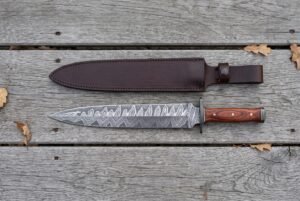 Longspire Hand Forged Damascus Dagger Knife with Rosewood Handle & Leather Sheath | Large Collector Display Gift | RK-477
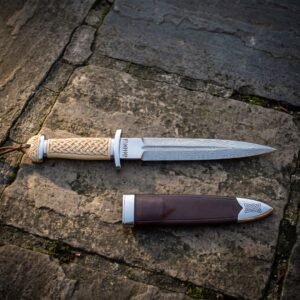 Bonewhorl Hand Forged Damascus Celtic Dagger | 14 Inch Overall with 9 Inch Double Edged Blade | Carved Bone Handle, Elder Futhark Etching and Leather Sheath | Norse Gift | RK-1964
The rondel dagger
The rondel is defined by two flat discs, one as a guard and one as a pommel, sandwiching a cylindrical grip. It appears in the fourteenth century and stays in service into the sixteenth, and it shows up constantly on tomb effigies and in manuscript illustration hanging beside a knight’s sword.
The blade is stiff and narrow, frequently of triangular or diamond section, sometimes with no true cutting edge at all. That geometry exists for one purpose: to be driven into a gap. Against a man in mail and plate the vulnerable places are the visor, the armpit, the groin and the back of the knee, and the rondel is a tool for reaching them. The rear disc lets you put the heel of your palm behind the pommel and drive with body mass rather than arm strength.
The bollock dagger
The bollock dagger takes its name, with no ambiguity intended, from the two rounded lobes that form its guard. It runs from the thirteenth century into the eighteenth, and it is heavily represented in England, the Low Countries and Scandinavia. Victorian curators found the name embarrassing and relabelled it the kidney dagger, which is why both terms are still in circulation.
These were civilian as much as military. They turn up in ordinary contexts, they were carried openly at the belt, and the lobes do a real job by giving the hand a positive stop when the point meets resistance. When the Mary Rose was raised in 1982 after sinking in 1545, the recovered material included a substantial number of bollock daggers, which tells you how ordinary they were among the crew of a warship.
Quillon daggers and baselards
A quillon dagger is essentially a sword hilt in miniature: a straight cross guard, a grip, a pommel. It is the least specialised of the group and the longest lived, because nobody ever improved on it.
The baselard is a fourteenth and fifteenth century form with a hilt shaped like a capital letter I, a straight bar at the guard and a matching bar at the pommel. It was fashionable in Switzerland, Germany and northern Italy and drew moralising complaints from writers who thought civilians were carrying too much steel.
Ear daggers and the cinquedea
The ear dagger has two flat discs splayed out at the pommel like a pair of ears, an idea that reaches Europe through Nasrid Spain in the fifteenth century and becomes fashionable in Italy. The cinquedea goes the opposite way: a very broad triangular blade, sometimes wide enough at the base to justify its name, which refers to a width of five fingers. Italian civic fashion around 1500 loved it, and the broad flats gave engravers a canvas.
The Scottish dirk
The dirk grows out of the bollock dagger. Take the lobed guard, let the lobes shrink into carving on the base of a cylindrical wooden grip, and lengthen the single edged blade, and you have the seventeenth and eighteenth century Highland dirk. The characteristic interlace carving on the hilt is a later refinement, and full dress dirks acquired matching small knives and forks tucked into the sheath.
The naval dirk is a separate line. It is a small side arm carried by midshipmen and junior officers in European navies from the eighteenth century, closer to a very short sword than to a fighting knife, and it survives today mostly as a piece of dress uniform.
The stiletto
The stiletto is the least apologetic blade on this list. Italian in origin, in general use from the late sixteenth century, it has a needle like blade of round, square or triangular section with no cutting edge whatsoever. It exists to penetrate and nothing else. That made it easy to conceal and gave it a reputation, deserved or not, as an assassin’s tool.
There is a second and much less dramatic stiletto. Artillery crews carried a version, the fusetto, with a graduated scale engraved along the blade, used for measuring bores and clearing vents. The same shape, a completely different job.
The modern American usage of stiletto for a switchblade profile is a twentieth century borrowing with nothing in common with the Italian original beyond a slim silhouette.
Outside Europe
The katar of the Indian subcontinent has a transverse grip held in the fist between two side bars, so the blade projects straight out from the knuckles and the thrust is delivered with a punching motion. Some have broad reinforced points made specifically for mail.
The jambiya of the Arabian peninsula is a short, sharply curved double edged blade worn at the front of the belt, and it functions as a marker of status and regional identity as much as a working blade. The Persian pesh kabz has a T shaped spine and a blade that narrows to a very stiff point, again a mail defeating design. The kris of the Indonesian and Malay world may be straight or waved, is forged from layered iron and nickel bearing meteoric or high nickel material, and carries a ritual significance that has nothing to do with fighting.
The Norse and early medieval end
Northern Europe before the high middle ages leans on the seax rather than the dagger. The seax is a single edged knife that runs from a small utility blade up to the long fighting seax, and the broken back profile with its abrupt angled clip is one of the most recognisable shapes in early medieval archaeology. It is a cutter that thrusts adequately rather than a thruster that cuts. Our article on the history of the seax covers the range and the finds, and the seax section of the shop shows how the profiles differ in hand.
The modern fighting knife
Trench fighting in the First World War brought purpose built close quarter blades back into military issue, and the Second World War produced the shape most people picture when they hear the word dagger: a slim double edged blade with a straight cross guard and a tapering grip, of which the Fairbairn Sykes fighting knife, adopted by British commandos in 1941, is the definitive example. Its descendants are still in production everywhere. Anyone who wants to see what else has been done with that outline since 1941 can browse the dagger collection at Black Mamba Knives, which will take longer than you planned.
What to look for if you are buying one
Start with what the blade is for, because a thrusting dagger and a working knife are built to different priorities and a piece that tries to be both fails at each.
Check the tang. On a dagger the point takes axial load, so a full tang running through the grip and peened or nutted at the pommel is what you want. A short stub epoxied into a handle is a wall fitting pretending otherwise. Grip the handle and try to twist gently: any movement at all is a fault.
Check the point geometry. A dagger point should be reinforced with thickness carried well toward the tip. A point that has been ground thin to look aggressive will roll or snap the first time it meets anything hard.
Ask what the steel is and at what hardness. A stated grade and a stated hardness number mean the heat treatment was controlled. Vague language means nobody measured. If the blade has a rippled surface, understand that it is forge welded layered steel, and our piece on what Damascus steel is explains how to read the pattern and what it does and does not tell you.
Look at the sheath. A dagger sheath has to retain a blade that is often symmetrical and has no natural friction point, so a poor sheath is a genuine hazard rather than an inconvenience. Leather should be stitched and welted, not glued flat.
Finally, check the law where you live before you buy. Double edged blades and concealable fixed blades are restricted in many places, and rules vary sharply between countries, states and cities.
What we sell
Our daggers range covers Norse and Celtic styled pieces, double edged thrusting blades and decorative display daggers, with overall length, blade length and fittings listed on each page. House steel is plain 1095 run at 54 to 58 HRC. Where a piece is Damascus, it is 1095 and 15N20 forge welded and run at 58 to 60 HRC. If you want the single edged early medieval end of the family instead, look at the Viking seax and Viking knives sections, and if you want something that will actually go in a pack and get used, the hunting knives range is the practical corner of the catalogue. The engraved knotwork and rune panels on our pieces are decorative work, not copies of specific excavated finds. Ransack Viking is a US company in Chicago, Illinois. Every piece is handmade in the Czech Republic the old way, then imported, inspected and shipped from Chicago. Engraving is done in the US after arrival.
The smallest curved blade in this group has its own page in what a karambit is. At the other end of the size range, the seax and the Bowie are compared in seax and Bowie side by side, and our pick of the latter is in the best Bowie knife.
The rondel also survives as a fencing tool with a blunted point rather than an armour piercing one, and HEMA tournament gear rules explains what an event will accept on the dagger line.
Questions people ask
What is the difference between a dagger and a knife?
Modern usage and most legislation call a blade a dagger when it is double edged and symmetrical. Historically the line is about intent instead. A dagger is built to thrust, with a stiff blade, a reinforced point and a guard that stops the hand sliding forward. A knife is built to cut. Several classic daggers, including the bollock and the Highland dirk, carry only one edge.
What was a rondel dagger used for?
Reaching the gaps in armour. The rondel has a stiff narrow blade, often of triangular or diamond section with little or no cutting edge, and two flat discs sandwiching the grip. The rear disc lets you set the heel of your palm behind the pommel and drive the point with body weight rather than arm strength, aiming at the visor, armpit, groin or the back of the knee.
Why is it called a bollock dagger?
Because of the two rounded lobes that form the guard, and the name is exactly as blunt as it sounds. It was in use from the thirteenth century into the eighteenth, particularly in England, the Low Countries and Scandinavia. Victorian museum curators found the term indelicate and renamed it the kidney dagger, which is why you still see both names on the same object, one of them a euphemism.
Is a dirk the same as a dagger?
A dirk is a specific type of dagger. The Highland dirk descends from the bollock dagger, with the lobes reduced to carving on a cylindrical wooden grip and the single edged blade lengthened, and it takes its familiar form in the seventeenth and eighteenth centuries. The naval dirk is a separate line entirely: a small dress side arm carried by junior officers, closer to a very short sword.
What is a stiletto dagger?
An Italian thrusting blade in general use from the late sixteenth century, with a needle like blade of round, square or triangular section and no cutting edge at all. It penetrates and does nothing else, which made it easy to conceal and earned it a reputation it has never lost. Artillery crews used a version with a measuring scale on the blade for clearing vents and gauging bores.
What should I check before buying a dagger?
Four things. That the tang runs the full length of the grip and is peened or nutted rather than glued in. That the point carries real thickness toward the tip instead of being ground thin for looks. That the steel grade and hardness are stated as numbers rather than adjectives. And that the sheath retains the blade properly, since a symmetrical blade has little natural friction to hold it in place.
What the shop carries
Ready to ship, the Wolfgleam Roman pugio dagger and the Longspire dagger knife. The Duskthorn Norse dagger and the Knotbone Celtic dagger are the other two.
A rondel you can fence with
The Norvakt rondel dagger trainer has two discs and a capped point, which is the polite version of the original. What HEMA is explains where dagger work fits, and the HEMA training range has the swords to go with it.
Shop the range
Steelpommel Hand Forged Damascus Dagger Knife with Wood and Bone Handle and Steel Guard and Pommel & Leather Sheath | Collector Display Gift | RK-468Longspire Hand Forged Damascus Dagger Knife with Rosewood Handle & Leather Sheath | Large Collector Display Gift | RK-477Bonewhorl Hand Forged Damascus Celtic Dagger | 14 Inch Overall with 9 Inch Double Edged Blade | Carved Bone Handle, Elder Futhark Etching and Leather Sheath | Norse Gift | RK-1964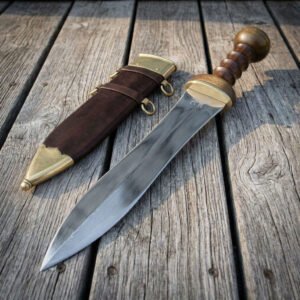 Wolfgleam Hand Forged Damascus Roman Pugio Dagger | 16 Inch Overall | Twin Fullered Waisted Blade with Brass Faced Wooden Guard and Ribbed Hardwood Grip | Legionary Collector Gift | RK-1657
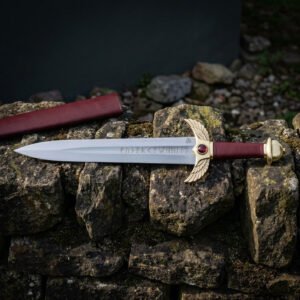 Goldplume Hand Forged 1095 Steel Rune Engraved Dagger | 18 Inch Overall | Brass Winged Guard with Red Cabochon and Red Scabbard | Norse Gift | RK-1864
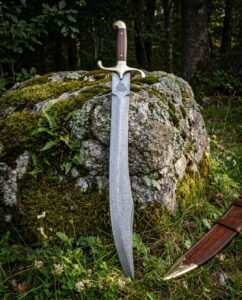 Wolfnotch Hand Forged Damascus Viking Long Seax with Rosewood Grip | Curved Clip Point Blade and Valknut Etch | Brass Guard and Tooled Leather Sheath | Norse Warrior Gift | RK-1613