
Blog
Viking Armour: Mail, Lamellar and What Norsemen Actually Wore

Viking armour came down to a mail shirt, an iron helmet and a round shield. Most men who sailed on a raid owned none of the first two. Mail cost a farm animal or several, helmets were rare enough that exactly one near complete Viking Age example has ever been dug up, and the shield did the work. Everything else you have seen on screen is guesswork in costume.
What the record actually holds
Norse graves are generous with blades and stingy with armour, which tells you plenty about what people could afford to put in the ground. Iron rusts, mail rusts faster than a solid bar because every ring is thin wire with a huge surface area, and a mail shirt was valuable enough to be handed down rather than buried. So the sample is small, and any confident claim about a typical Viking kit deserves suspicion.
The Norse word was brynja. Fragments turn up across Scandinavia, but the find that anchors the whole discussion is Gjermundbu in Norway, excavated in 1943. That grave, dated to the tenth century, produced a corroded lump of mail rings along with the helmet described below. It was not a wearable shirt when it came out of the soil. It was a mass of rings fused by rust, and the reconstruction of what it once was is an argument rather than a photograph.
Elsewhere the evidence is scraps. A few rings clinging to a spearhead. A patch preserved by contact with a bronze fitting. Written sources and later sagas mention mail often enough that it was clearly known and clearly prized, and the value implied in law codes and poems puts it well beyond an ordinary farmer.
Helmets
There is one. The Gjermundbu helmet is the only reasonably complete helmet from the Viking Age proper, and even it came out in pieces and was rebuilt. It is a rounded iron cap made from panels riveted to a frame, with a spectacle shaped guard covering the eyes and the bridge of the nose. There is no horn anywhere on it. Horned helmets are a nineteenth century stage costume, not an archaeological find.
Push back a century or two and the picture is richer, because helmet finds from the Vendel period in Sweden and from Anglo-Saxon England are more numerous and better preserved. The boat graves at Vendel and Valsgarde gave up helmets with eye guards and decorated panels. The Sutton Hoo helmet from Suffolk, a seventh century burial, has a full face mask and tinned bronze panels showing warriors and animals. The Coppergate helmet, found in York in 1982 and dated to the eighth century, is Anglian rather than Norse and carries a mail curtain hanging from the back and sides to guard the neck.
Those are the parents and cousins of the Viking helmet rather than the thing itself, but they show the construction methods a Norse smith would have known: riveted panels over a browband and frame, sometimes a nasal bar, sometimes mail at the neck.
Lamellar
Excavations at the Birka garrison site in Sweden turned up several hundred small iron plates with paired holes, the classic signature of lamellar armour. Lamellar is rows of small plates laced together with cord or leather rather than woven from rings. The Birka plates are real and the dating is Viking Age, but where they came from is debated. Lamellar was widespread in the Byzantine world and across the steppe, and Birka sat on the trade road east. Whether a Swede was wearing armour made locally or armour bought in Kiev or Constantinople is a question the plates cannot answer.
How mail was made
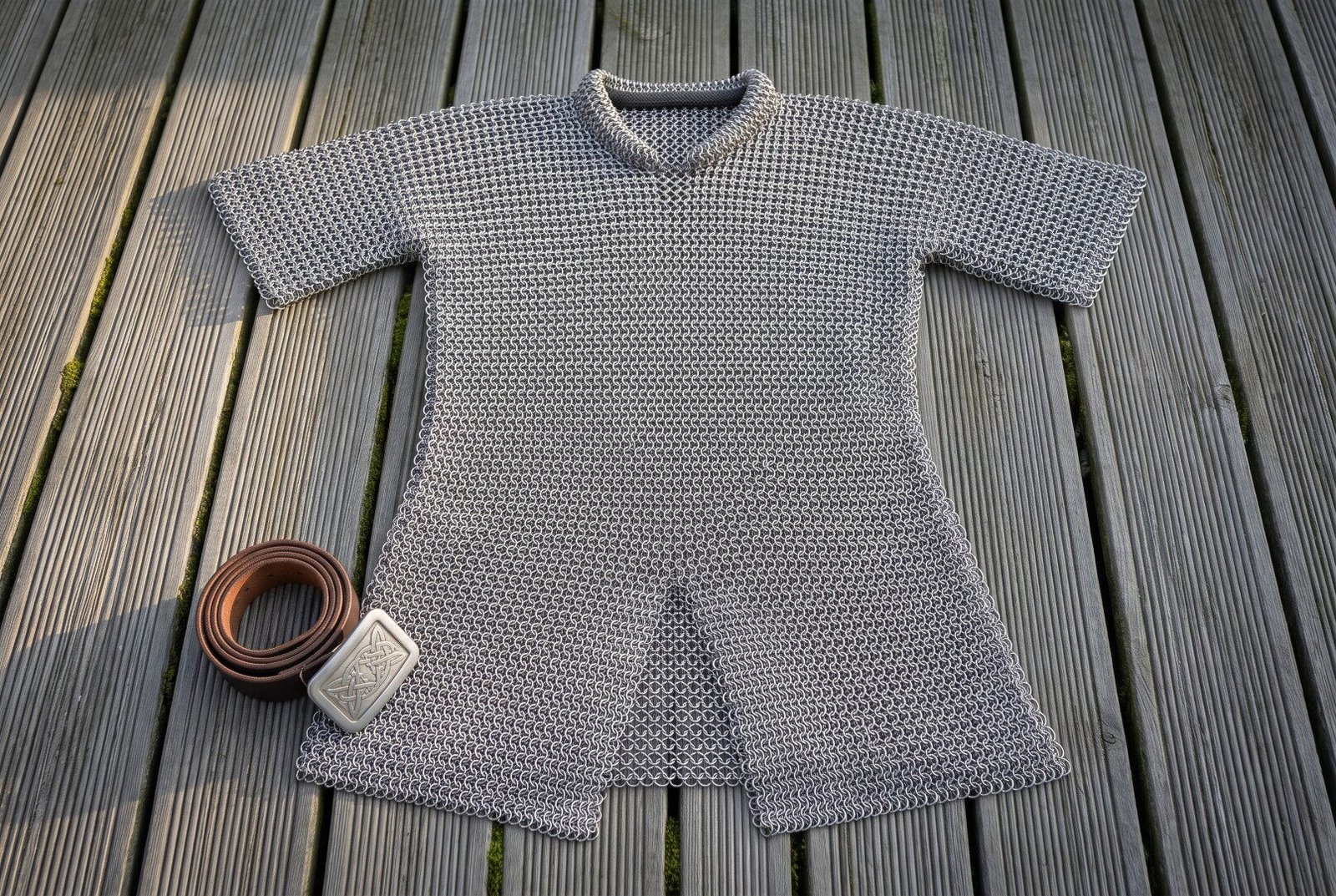
Start with iron wire, drawn or hammered down to roughly one to two millimetres in the surviving examples. Wind it around a rod, cut the coil into open rings, then build the fabric one ring at a time. Each ring passes through four others in the pattern usually called four in one, which is why a mail shirt drapes like cloth and holds together like a net.
 Ringwarden Hand Made Butted Chainmail Hauberk | Thigh Length with Short Sleeves | 9 mm Mild Steel Rings and Split Skirt | Norse Reenactment Gift | RK-1519
 Ringmantle Hand Woven Butted Chainmail Shirt | Chest 46 Inch Short Sleeve | Blackened Mild Steel Rings with 4 in 1 European Weave | Norse Reenactment Gift | RK-1581
 Stormquilt Hand Made Padded Gambeson | Charcoal Cotton Canvas Over Wool | Channel Quilted Body, Standing Collar and Brass Grommet Lacing | Medieval Gift | RK-1474
The step that separates historical mail from cheap modern mail is closure. In the period pieces, roughly half the rings are riveted shut, with the overlapping ends flattened, punched and pinned with a tiny wedge of iron. The alternating half are often solid, punched out of sheet as complete rings. That gives a fabric that resists being pulled open by a point. Butted mail, where the ring ends are pushed together and left, does not exist in the archaeological record for a good reason: a spear point opens it.
The labour is the real cost. A knee length hauberk runs to tens of thousands of rings, and every one of them was cut, shaped and closed by hand. That is why a mail shirt appears in inheritance disputes, why it was worth stripping off the dead, and why the man in the shield wall next to you probably did not own one.
How a helmet was built
Two approaches show up in the finds. The first raises a bowl from a single sheet, which takes serious hammer work and a smith who can move metal without tearing it. The second, more common in northern Europe, builds a frame from iron bands and rivets four panels into the gaps. That is the spangenhelm method, and it lets a smith make a strong helmet out of smaller pieces of sheet, which mattered when good iron sheet was hard to come by.
Add a browband for stiffness, then whatever face protection the owner paid for: a nasal bar, a pair of spectacle guards, cheek plates, or a mail aventail riveted to the lower edge. Inside, a leather or textile liner and a chin strap keep the thing off the skull and stop it spinning under a knock.
What armour did in a fight
Mail is excellent against a cut and much weaker against a thrust or a heavy impact. A sword edge sliding across riveted rings will not open the fabric, but the force still arrives. Men in mail died of broken ribs and crushed organs without a single ring being cut, which is why padding underneath matters and why blunt arms stayed useful for as long as armour did.
The shield was the primary defence and it was the piece almost everyone had. Round, roughly 80 to 90 centimetres across in the Gokstad ship examples, built from butted planks of soft wood, faced with hide or linen, with an iron boss over a central hand grip. Sixty four shields were found along the rails of the Gokstad ship. That ratio tells you where the money went: everybody bought a shield, some bought a helmet, few bought mail.
Axes and spears were the arms most men brought. If you want the story of how the axe moved from farm tool to the defining Norse arm, our post on Viking axe history covers it, and you will notice that the reason an axe worked so well is exactly the reason armour mattered so much.
The parts that did not survive
Cloth and leather rot, and that single fact has produced a century of speculation about padded jackets and hardened leather cuirasses. There is no Viking Age gambeson in the ground. Padded textile armour is well documented in Europe from the twelfth and thirteenth centuries onward, and it is reasonable to think people wore something under mail before then, because mail against a linen shirt is unpleasant and does nothing about impact. Reasonable is not proven, and anyone who tells you exactly what a Viking wore under his brynja is filling a gap with imagination. Hardened leather armour has even less behind it, appearing constantly in fantasy art and almost never in a report from a dig.
What to look for when you buy
Riveted or butted
Riveted mail is historically correct, much stronger and several times the price. Butted mail is lighter on the wallet, looks right at a distance, and is fine for display, costume and light contact work. Many reenactment groups accept butted mail for the ranks and require riveted for anything involving thrusting. Check your group’s rules before you spend, because the price gap is not small.
Weight and fit
A knee length hauberk in mild steel will run somewhere between 10 and 20 kilograms depending on ring size and wire gauge, and all of it hangs from your shoulders unless you belt it at the waist. Belt it. Your shoulders will raise the point within the hour. A short sleeved, thigh length shirt is the sensible first purchase for most people. Check the chest measurement and add room for whatever goes underneath.
Helmet gauge and liner
Sheet thickness is quoted in gauge, and lower numbers mean thicker steel. An 18 gauge helmet is a display and light costume piece. A 16 gauge helmet has enough substance for contact work if your group allows it. A helmet without a liner and a chin strap is a hat, so look for a padded or suspended liner and a strap that actually adjusts.
Rust
Mild steel mail and helmets rust, reliably and without apology. Keep both dry, oil them, and store mail loose in a bag rather than folded flat in a damp box. If a shirt does bloom with surface rust, the traditional fix is to tumble it in a bag with sand and a little oil until the rings polish each other clean.
The armour we stock
Our Viking armour range is built around the pieces people actually use: mail, helmets and the padded layers that go under them. The chainmail section holds butted mild steel hauberks in natural and blackened finishes, coifs with leather bound face openings, and mail gauntlets, all hand woven in a four in one weave. Helmets split into two groups: the Norse shapes in our Viking helmet range, including spangenhelms, nasal helms and spectacle helmets that follow the Gjermundbu and Vendel patterns, and the later European shapes in medieval helmets, where you will find great helms, sallets and visored helms. Several helmets carry engraved knotwork or runes on the browband, and if you want to know what those marks meant before you wear one, our guide to Viking symbols and their meanings is a good place to start. Ransack Viking is a US company in Chicago, Illinois. Every piece is handmade in the Czech Republic the old way, then imported, inspected and shipped from Chicago. Engraving is done in the US after arrival.
The three metal options are set against each other in chainmail, plate and lamellar compared, and mail needs its own upkeep, covered in looking after mail.
Questions people ask
Did Vikings wear horned helmets?
No. Not one helmet from the Viking Age has horns on it, and the single near complete example, from Gjermundbu in Norway, is a plain riveted iron cap with a spectacle guard. The horned image comes from nineteenth century opera and painting, roughly a thousand years after the fact. We do sell horned helmets, and we call them what they are: costume.
How much did a mail shirt cost a Viking?
No price list survives, so any exact figure you are given was invented by whoever typed it. What we can say is that mail took tens of thousands of hand made rings and weeks of skilled labour, it was named in inheritance disputes, and it was stripped from the dead as a prize. Everything in the written record points to a cost far beyond an ordinary farmer, closer to livestock or land than to a tool.
Is butted mail good enough for reenactment?
It depends entirely on your group. Many societies allow butted mail in the ranks for display and light contact, and ban it for anything involving thrusts, because butted rings spring open under a point. Riveted mail is the historically correct choice and costs several times as much. Ask your group’s kit officer before you buy anything.
What is the difference between a coif and a hauberk?
A coif is the mail hood that covers the head, neck and shoulders, usually worn under or with a helmet. A hauberk is the mail shirt, running from the shoulders to somewhere between the hip and the knee, with sleeves that stop anywhere from the shoulder to the wrist. Many people buy the coif first because it is lighter, cheaper and does a lot of visual work.
Did Vikings wear leather armour?
There is very little evidence for it. Leather rots, so absence of finds is not proof of absence, but no Viking Age leather cuirass has been recovered and the written sources do not describe one. Leather in the period shows up as belts, straps, shoes, scabbards and helmet liners. The hardened leather chestplate was invented by costume departments and has been repeating itself since.
What gauge steel should a reenactment helmet be?
Lower gauge numbers mean thicker steel. An 18 gauge helmet suits display, cosplay and photography. If you intend to take blows in it, look for 16 gauge or heavier and check that it has a proper padded liner and an adjustable chin strap, since the liner is what actually keeps the impact off your skull.
Pieces in the catalogue
The catalogue carries the Ringwarden butted chainmail hauberk and the Wyrmscale scale armour shirt. So do the Runecuff leather Viking bracers and the Stormquilt padded gambeson.
Shop the range
Ringwarden Hand Made Butted Chainmail Hauberk | Thigh Length with Short Sleeves | 9 mm Mild Steel Rings and Split Skirt | Norse Reenactment Gift | RK-1519Ringmantle Hand Woven Butted Chainmail Shirt | Chest 46 Inch Short Sleeve | Blackened Mild Steel Rings with 4 in 1 European Weave | Norse Reenactment Gift | RK-1581Stormquilt Hand Made Padded Gambeson | Charcoal Cotton Canvas Over Wool | Channel Quilted Body, Standing Collar and Brass Grommet Lacing | Medieval Gift | RK-1474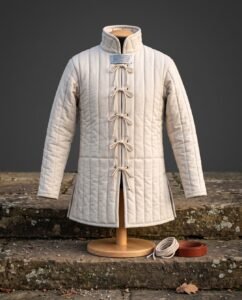 Palewarden Hand Made Linen Gambeson | Natural Undyed Cloth Over Wool | Channel Quilted Body, Tall Standing Collar and Cord Loop Lacing | Viking Gift | RK-1475
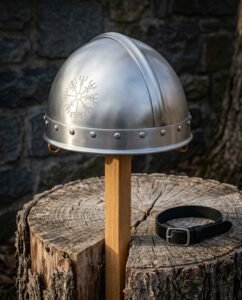 Vegcrown Hand Forged Steel Viking Spangenhelm | 16 Gauge Mild Steel | Riveted Brow Band Leather Liner and Chin Strap | Norse Reenactment Gift | RK-1539
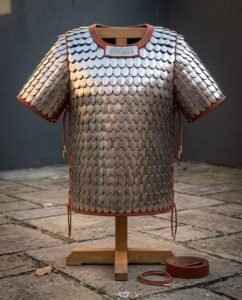 Wyrmscale Hand Made Steel Scale Armour Shirt | 18 Gauge Mild Steel Scales | Russet Leather Binding and Brass Rivets | Norse Reenactment Gift | RK-1531
40 thoughts on “Viking Armour: Mail, Lamellar and What Norsemen Actually Wore”
Comments are closed.