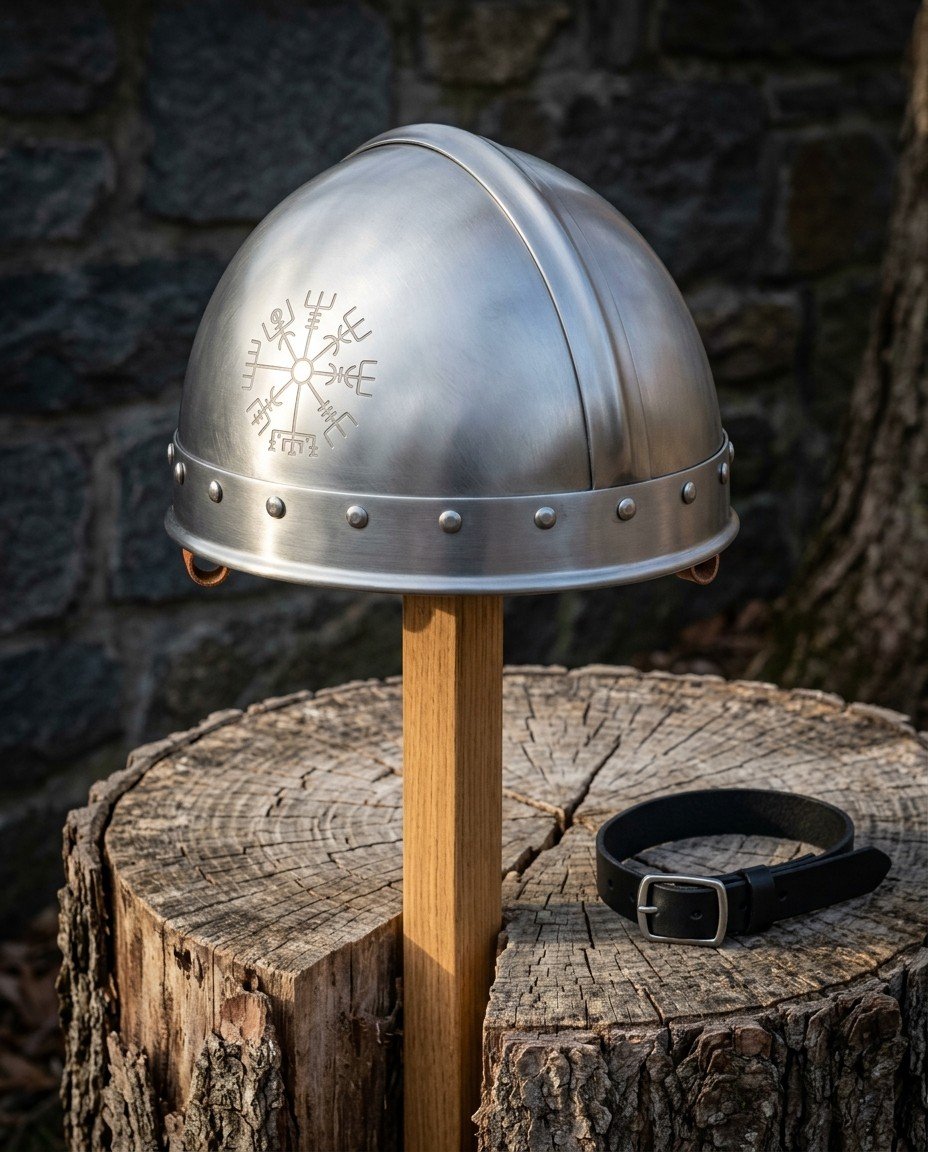
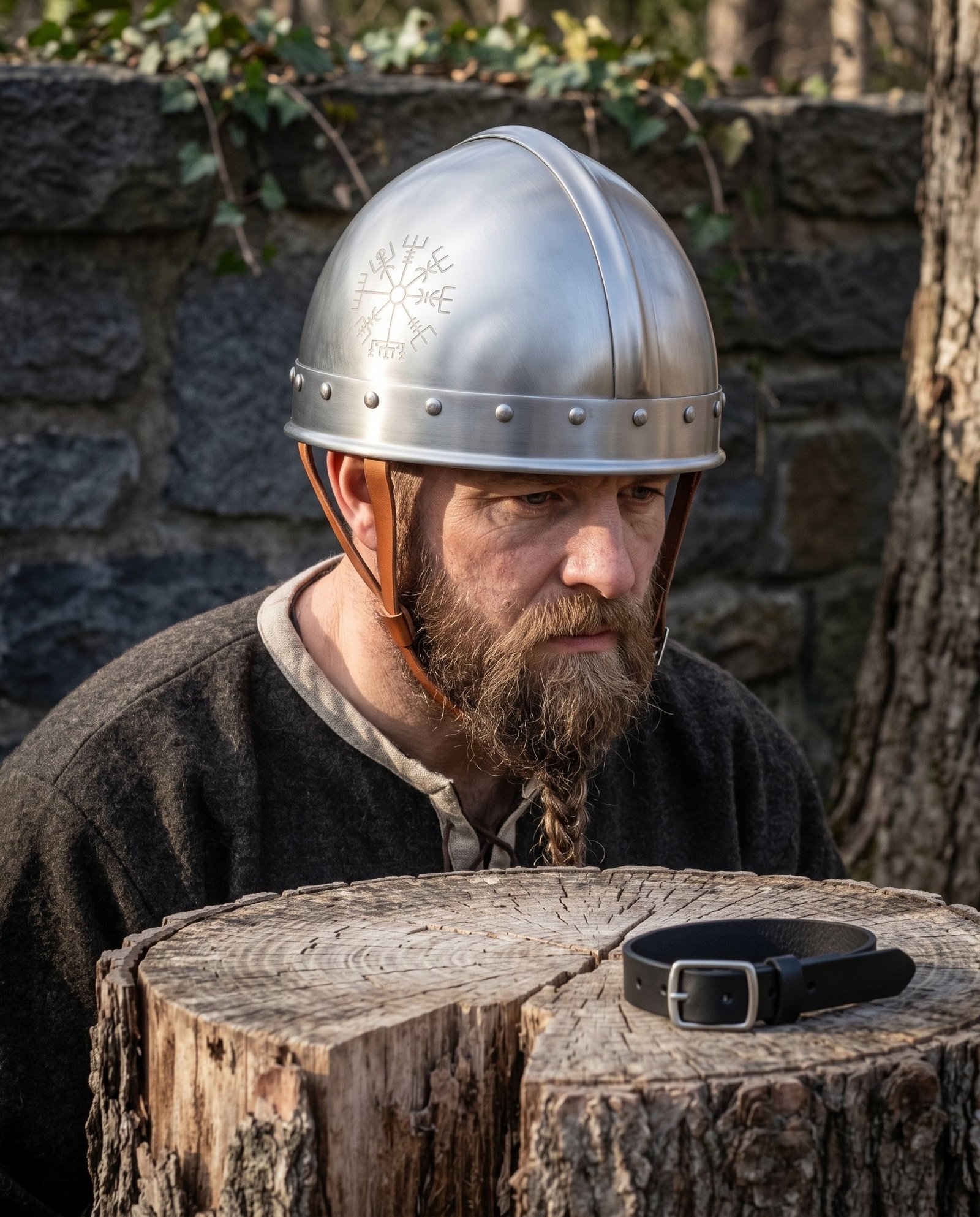
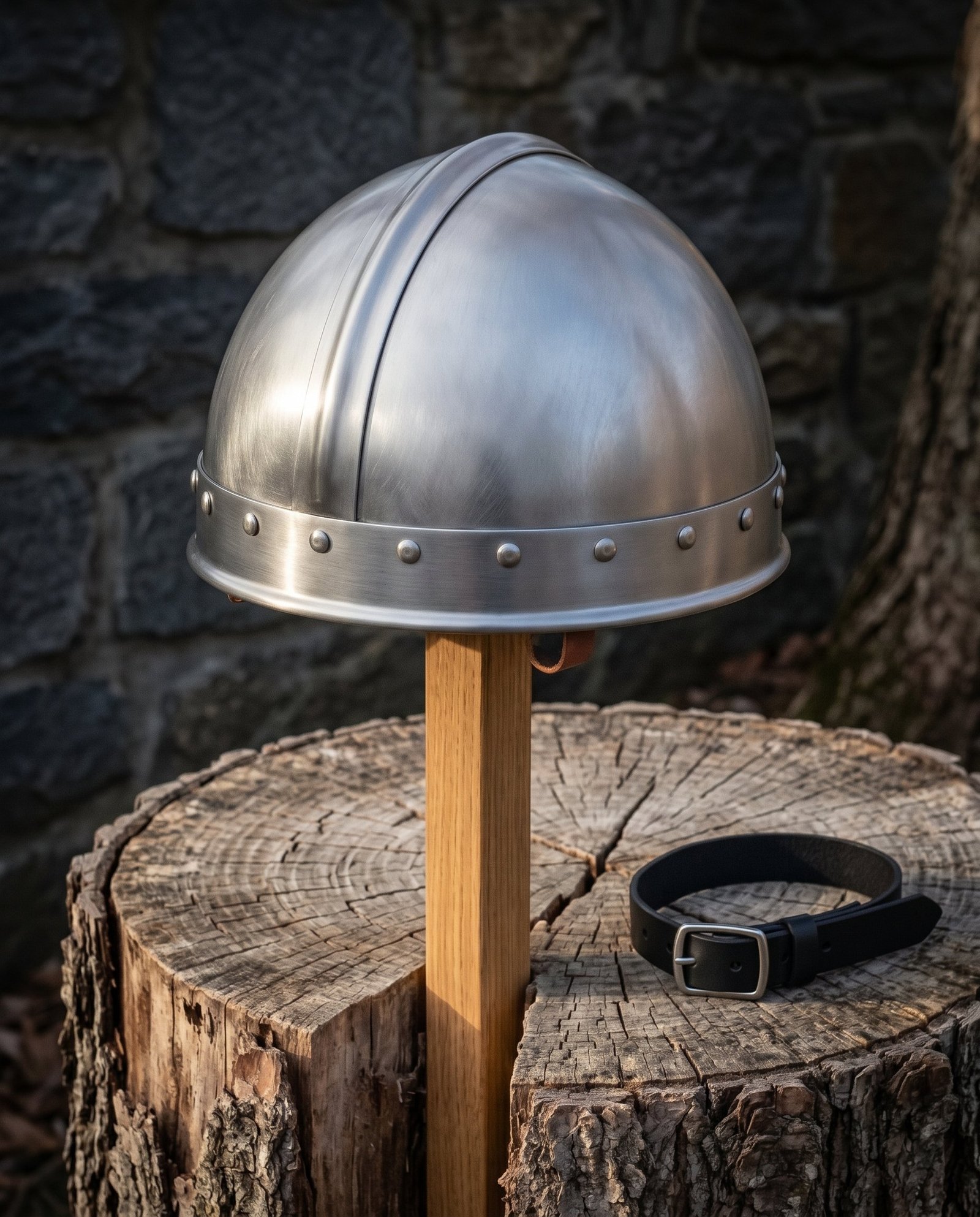
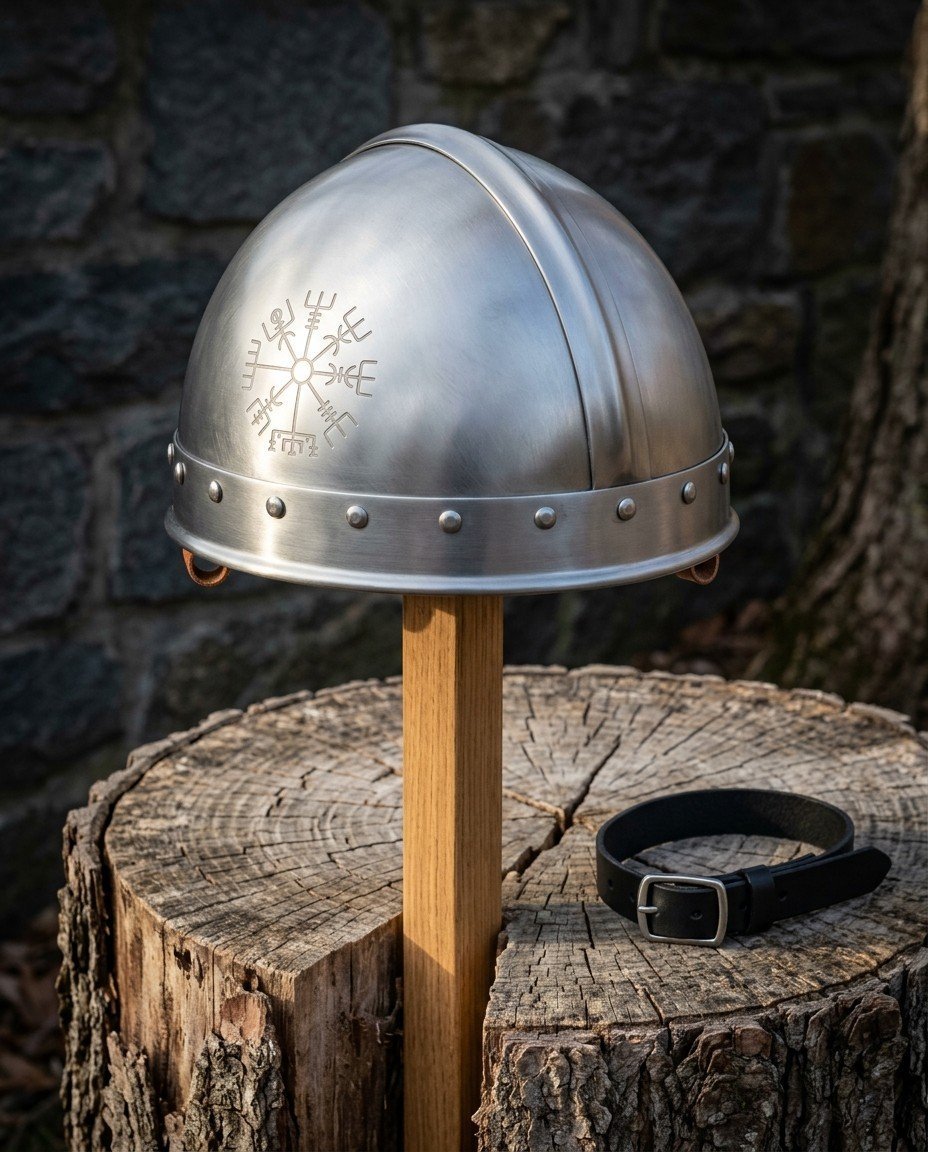
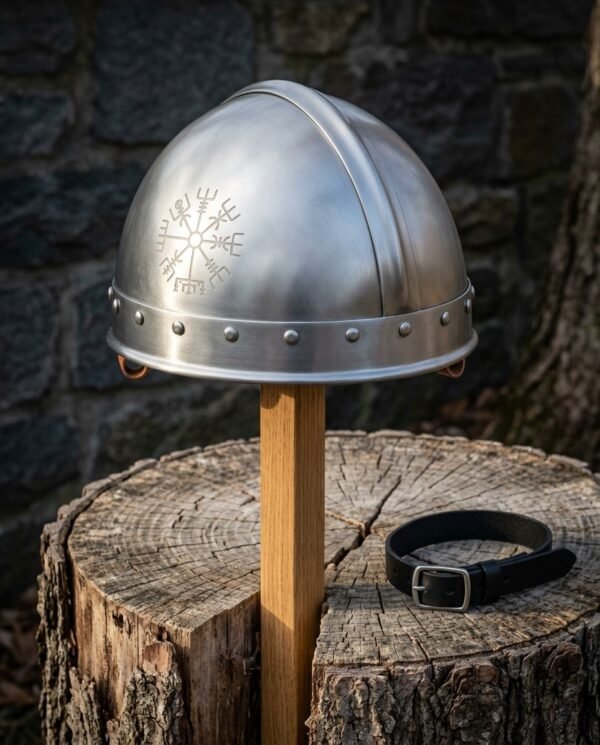
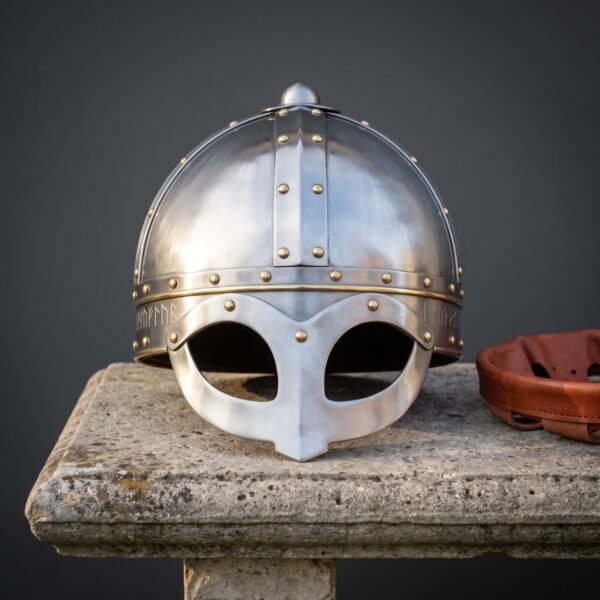
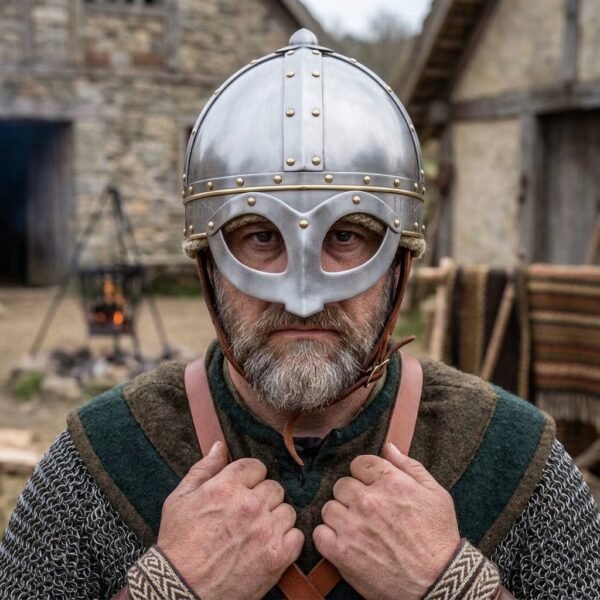
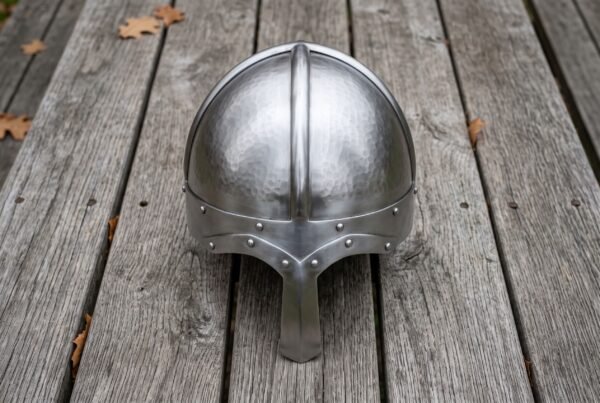
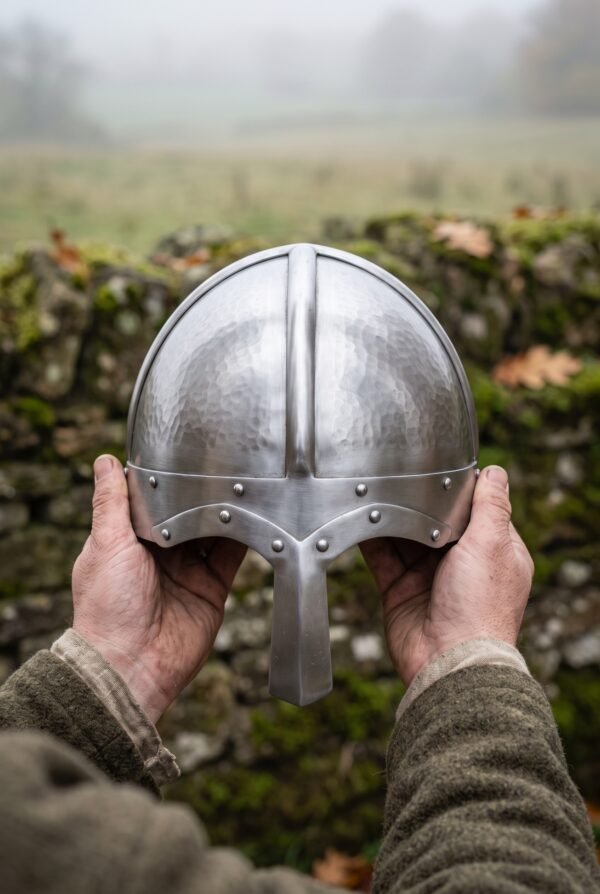
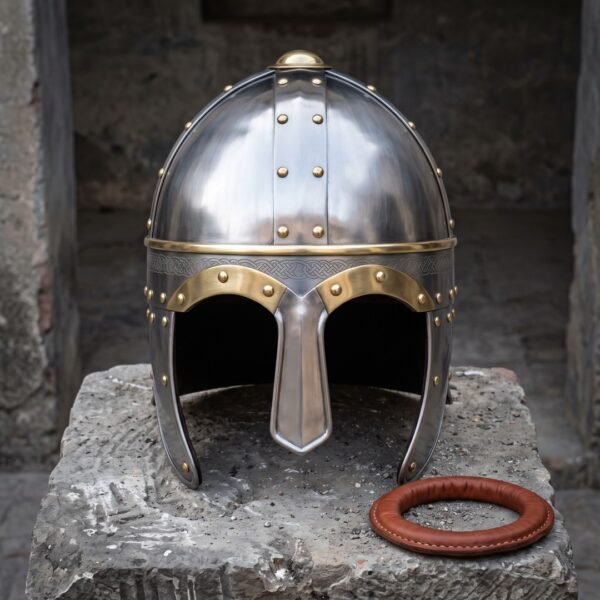
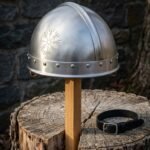
A Norse helmet built the way the surviving originals were built, from shaped steel panels drawn up over a former and joined along a raised central ridge that runs front to back over the crown, then set into a brow band riveted right around the head with domed rivets. The Vegvisir is engraved on the left front quarter. The word spangenhelm comes from the German for a clasp or brace, and it describes the construction exactly. Making a helmet from panels held in a frame was not a compromise, it was the sensible answer to a real problem, because raising a one piece bowl from a flat sheet without tearing it takes enormous skill and a great deal of time, and a helmet made in sections could be built faster, repaired locally, and made from smaller pieces of the most expensive material on the site.
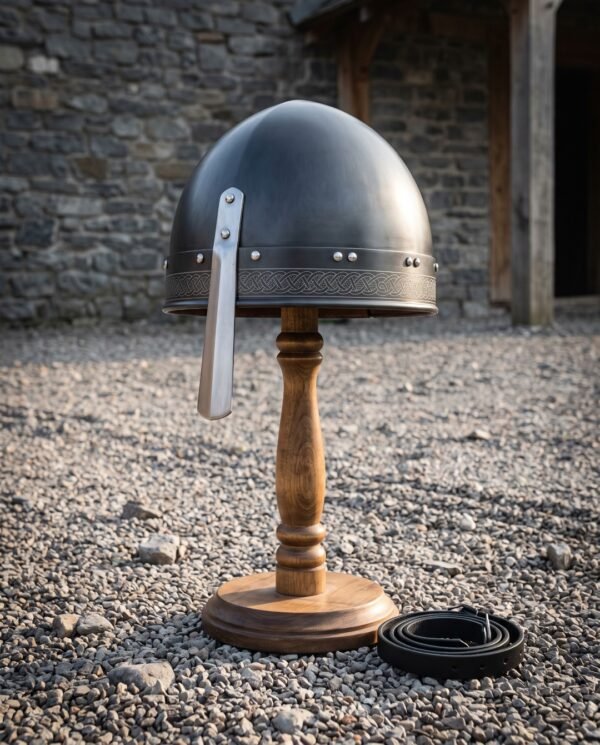
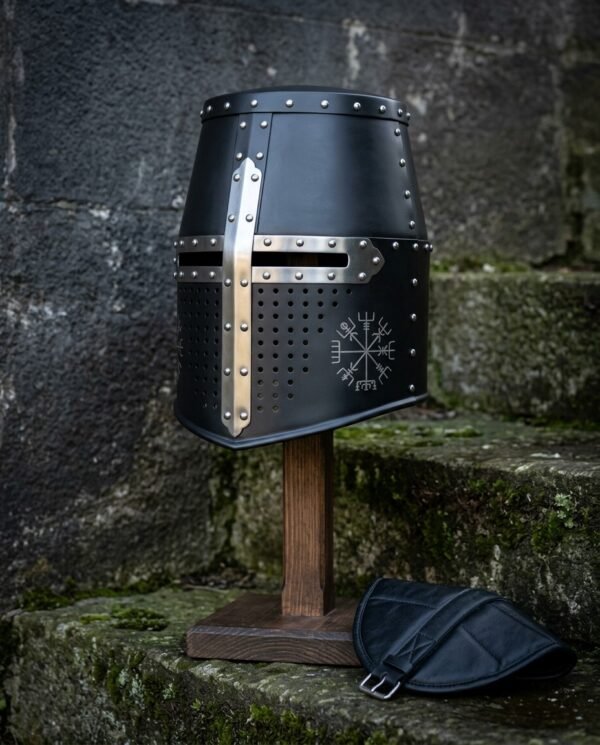
Raised, dished, riveted and engraved in a Czech Republic workshop, and it ships with its riveted leather liner and an adjustable chin strap fitted to the loops at the rim. The wooden post it is standing on and the loose belt lying on the stump are studio props. Only a handful of Viking age helmets survive, and what Viking helmets actually looked like goes through every one of them.
Specifications
| Type | Viking spangenhelm, ridged panel construction |
|---|
| Material | Mild steel, 16 gauge |
|---|
| Construction | Shaped panels joined on a raised central ridge running front to back, riveted brow band |
|---|
| Rivets | Domed steel, set right around the brow band |
|---|
| Nasal | None, open face |
|---|
| Engraving | Vegvisir on the left front quarter |
|---|
| Lining | Leather suspension liner on riveted loops at the rim |
|---|
| Fittings | Adjustable tan leather chin strap with a buckle |
|---|
| Finish | Satin steel |
|---|
| SKU | RK-1539 |
|---|
What the ridge and the brow band are actually doing
The raised ridge over the crown is the strongest part of the helmet and it is deliberately placed where the strongest part needs to be. A vertical cut from a sword or an axe lands on the top of the head, and a rolled, doubled ridge running front to back is far stiffer against that blow than a smooth curve of the same gauge, in exactly the way a folded sheet of paper carries load a flat one cannot. It also deflects. A blade landing on a raised rib slides off to one side rather than sitting in the dent it makes.
The brow band does two jobs at once. It ties every panel together at the bottom edge, which is what stops the whole assembly from spreading under a blow, and it puts a doubled thickness of steel across the forehead and around the temples, which is the second most likely place to be hit and the least forgiving place to be hit thinly.
The rivets are not just fasteners either. Domed rivet heads standing proud of the surface break up a sliding edge, so a cut that has already been deflected by the curve does not get a clean run across the metal.
16 gauge mild steel and what it is and is not
This helmet is 16 gauge mild steel, which is close to a millimetre and a half. That is a real, substantial helmet weight. It has the mass and the sound of proper armour, it will take handling, transport and display without deforming, and it is far heavier than the thin decorative helmets sold as costume.
It is not certified armour. It has not been tested or approved against any combat sports standard, and it is not rated for full contact reenactment, HEMA, buhurt or any activity where somebody strikes at your head with intent. Those disciplines require kit inspected and passed against a specific rule book, usually at heavier gauge with a fitted suspension system and often with additional face protection. What this helmet is right for is display, costume, film and stage work, LARP where your rules permit steel, and light reenactment and living history where contact is not part of the programme. We would rather set that out plainly here than have you find out in a shield wall.
Mild steel is the correct material for a helmet bowl. It draws and dishes without cracking, it dents rather than shattering, and a dent can be raised back out on a stake. A hardened bowl of the same gauge would be a worse helmet, not a better one.
Engraving, runes and your own design
Use the rune converter on this page to turn a name, a date or a short phrase into Elder Futhark and we will cut it into the steel or the leather. If you would rather have a Viking pattern than a rune line, choose your own design in the engraving option above the add to cart button and tell us where it goes. Where a piece already carries an engraved design, your chosen engraving replaces it rather than sitting alongside it, so on this helmet your line would take the place of the Vegvisir on the left front quarter. A rune line reads well curved around the brow band as an alternative, and we are happy to put it there instead. Full detail is on the engraving page.
Fit and sizing
A helmet is made to a stated head size and cannot be adjusted more than an inch or so after the fact, so measure carefully before you order. Run a tape around your head at the widest point, just above the ears and around the back of the skull where it swells, and take that measurement over any padding you intend to wear underneath. An arming cap adds a surprising amount, often the better part of an inch, and a helmet fitted to a bare head will not go on over one. Height matters too, because a bowl sized for circumference alone can still sit too low over the brows on a shallow skull. The leather liner gives you some adjustment through the suspension, but it cannot fix a helmet ordered a size out, so if you are between sizes go up and pad it in.
Care
Bright steel and sweat are a bad combination, so wipe the inside of the bowl out after wearing and let the liner dry fully before it goes away. Put a light film of mineral oil or a purpose made armour oil over the outside once or twice a season, and pay attention to the seams beside the ridge and behind the brow band where moisture collects and where a rag does not naturally reach. Feed the liner and chin strap with a neutral leather conditioner. Store it on a stand, on a shelf or in a padded bag, never in a sealed plastic box and never with the liner damp. If it takes a dent, raise it out from the inside over a rounded stake rather than hammering the outside. There is more in our guide to steel care. Fit, steel gauge and the shapes worth avoiding are covered in buying a Viking helmet.
Made in the Czech Republic
The work behind this piece happens in a Czech Republic workshop that has kept to the old methods. Steel is forged and heat treated by hand, the grind is taken down by eye rather than by machine, and the handle, fittings and sheath are cut and finished one at a time. Because of that, every piece carries small marks of the hand that made it.
Ransack Viking is a United States company. We import direct, check each piece when it reaches us, and ship from our Chicago, Illinois warehouse. Engraving is added here in the United States after arrival, so the piece you receive is finished to your order.
A note on handmade variation
This is hand made, not machine made or bulk produced, so what arrives will not be a pixel for pixel copy of the photograph. A raised bowl carries the record of the stake and the hammer, so the sweep of the panels and the exact set of the ridge differ from one helmet to the next, and the rivets sit where the metal wanted them rather than on a printed grid. Grain, tone, hammer texture and exact profile vary because each one is worked by hand from natural materials. The dimensions, the material and the build are the same every time. The character is not.
Frequently asked questions
Can I wear this for full contact reenactment?
No. It is not certified armour and it is not rated for full contact. Buhurt, heavy reenactment and HEMA all require inspected kit passed against a specific rule set. This is display, costume, LARP and light living history kit.
Does it come with a liner?
Yes. A leather suspension liner is fitted to the riveted loops at the rim, along with an adjustable chin strap. The belt lying on the stump in the photograph is a studio prop.
How do I measure for it?
Tape around your head at the widest point above the ears, over any arming cap you plan to wear. Order to that number, and go up rather than down if you are between sizes.
Why does it have no nasal?
Because this pattern does not use one. Nasal helms and ridged panel helms both existed side by side in the Norse world, and this is the panel and brow band form. If you want a nasal bar, look at the nasal helms in the Viking helmet range.
How heavy is it?
Sixteen gauge mild steel gives a helmet with real weight, comparable to a genuine period helm. It sits on the crown through the liner rather than on the brow, which is why a proper liner matters so much.
How long before it ships?
Processing is one to two weeks because each helmet is raised to your stated size, then free shipping within the United States. Returns are accepted within seven days.
What is in the box
- Hand raised 16 gauge steel spangenhelm with riveted brow band
- Leather suspension liner fitted to the rim loops
- Adjustable leather chin strap with buckle
- Engraved Vegvisir, or your rune line or design if selected
- Care card and lifetime warranty against defects
- Forged and finished in the Czech Republic
Explore the range
See more in Viking helmets, medieval helmets, Viking armour and Roman and Greek helmets, or read the guides.
Compare it with these
Another in the same line is the Wyrmgaze Viking helmet. Next along the rack is the Skyglass Viking helmet. For a straight comparison, see the Gazeward Viking helmet.
The Moonhorn lamellar armor covers the other half of the same kit. Pick the steel, the length and the fittings yourself on the design your own page.



Showed up right on time and looked even better than the photos. Feels way more premium in person than the listing photos. Ransack Viking’s attention to detail is honestly unmatched. Already planning my next purchase from this shop.
Incredible craftsmanship on this one. Feels way more premium in person than the listing photos. If you’re on the fence just get it. You won’t regret it.
Got this as a birthday gift and the reaction was priceless. Feels way more premium in person than the listing photos. I keep coming back to Ransack Viking because it’s always this good. Couldn’t be happier with this.
Very disappointed with this piece. Doubt I’ll be ordering from here again.
Got this as a gift and now I want one for myself too. This shop clearly takes pride in their work.