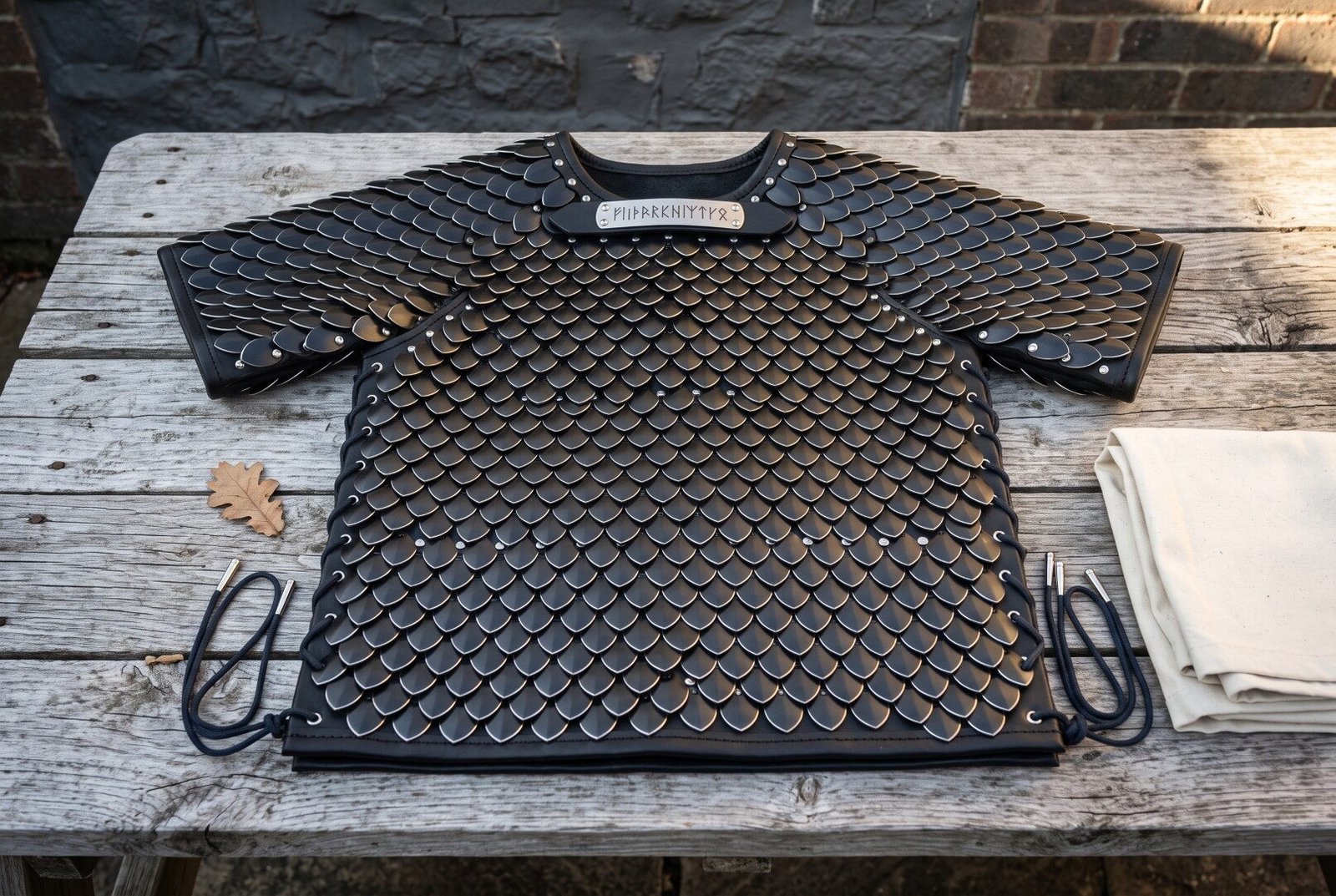
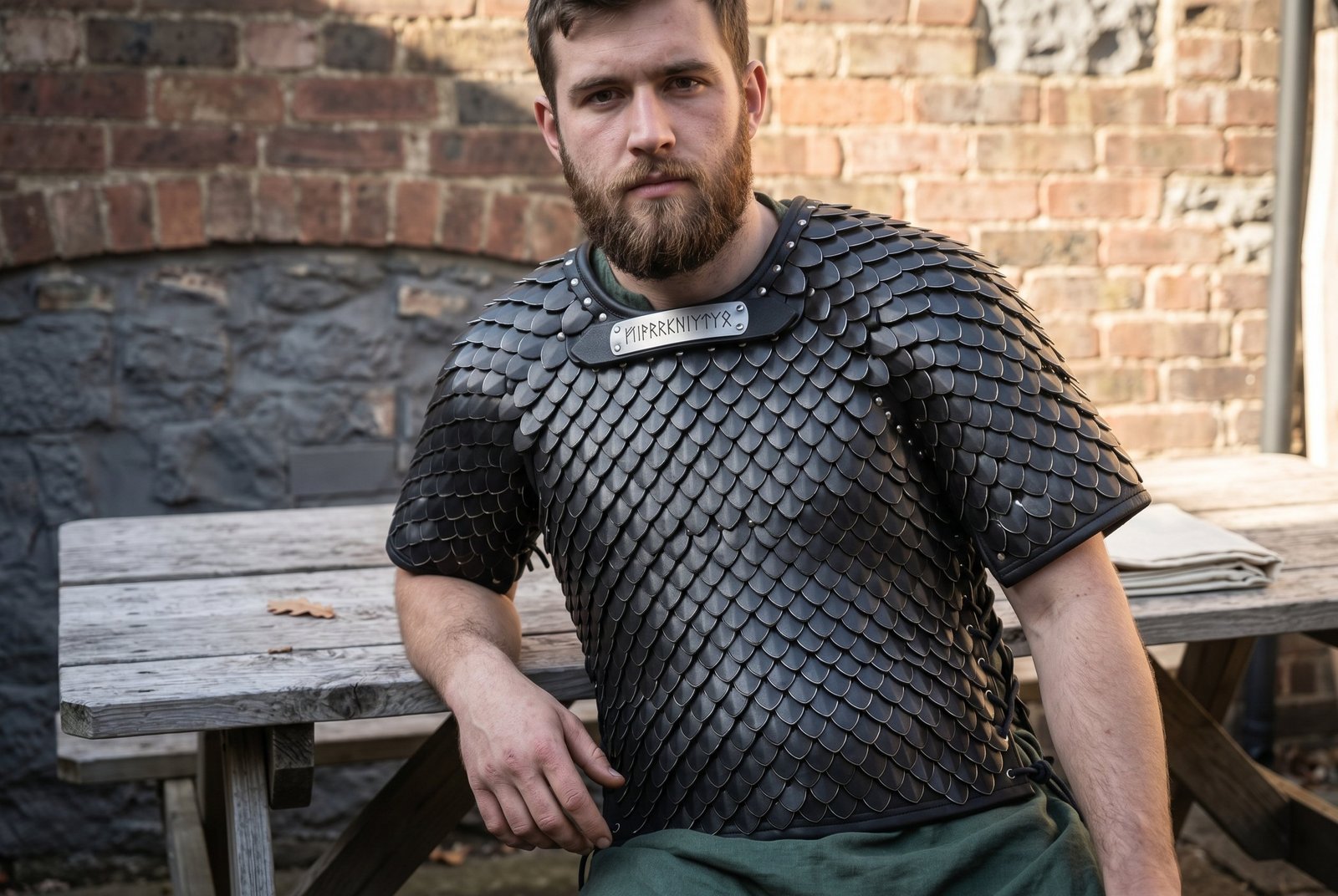
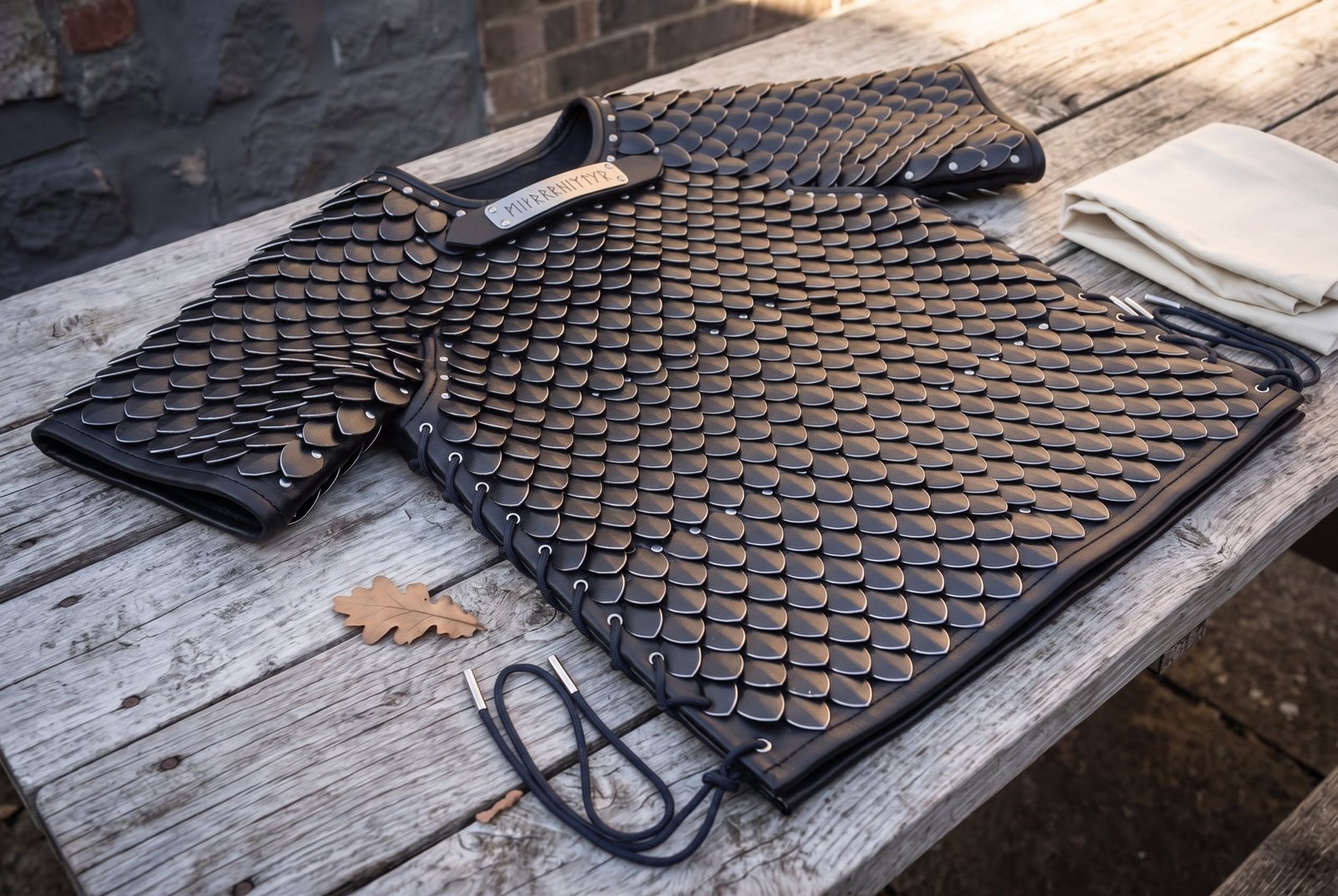
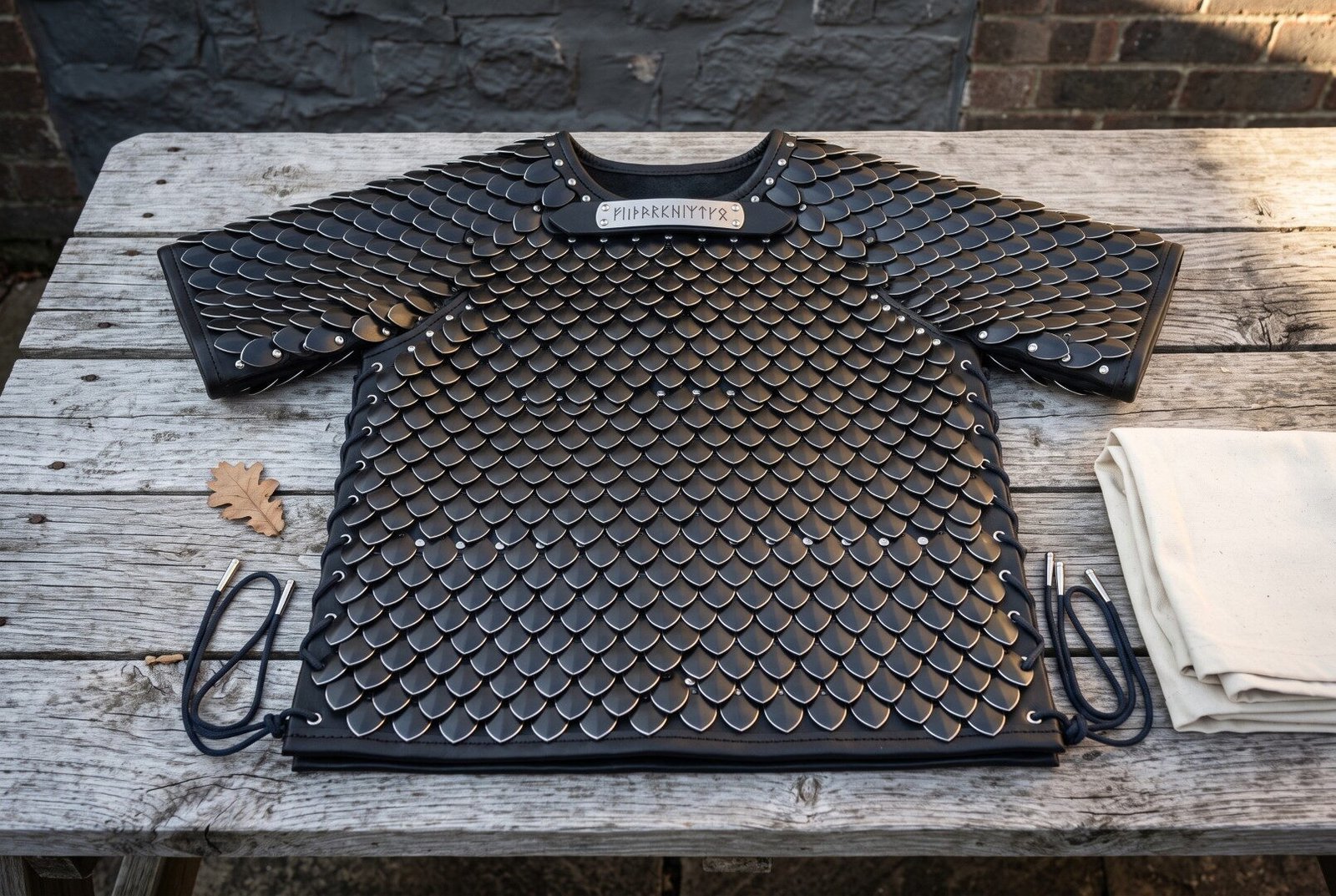
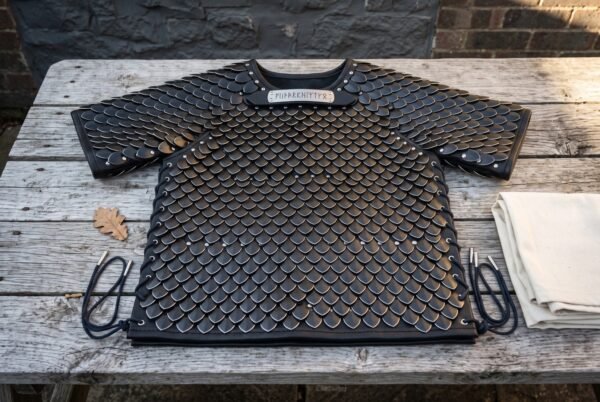
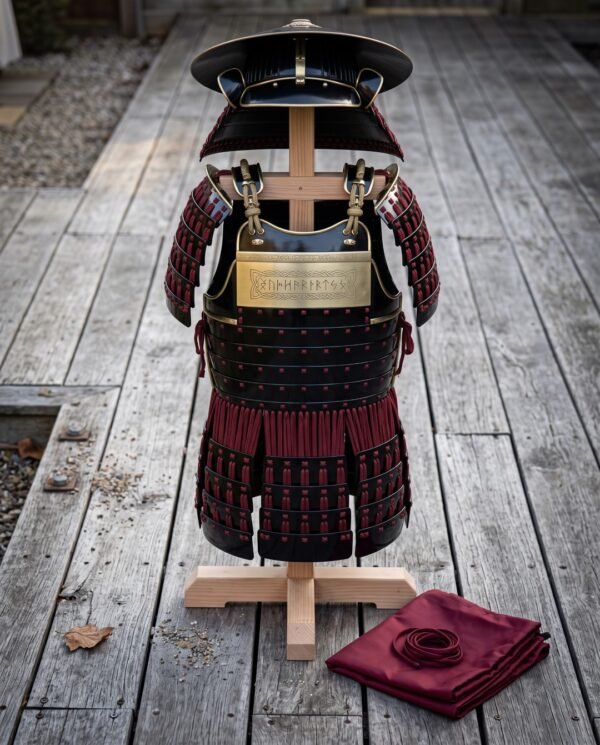
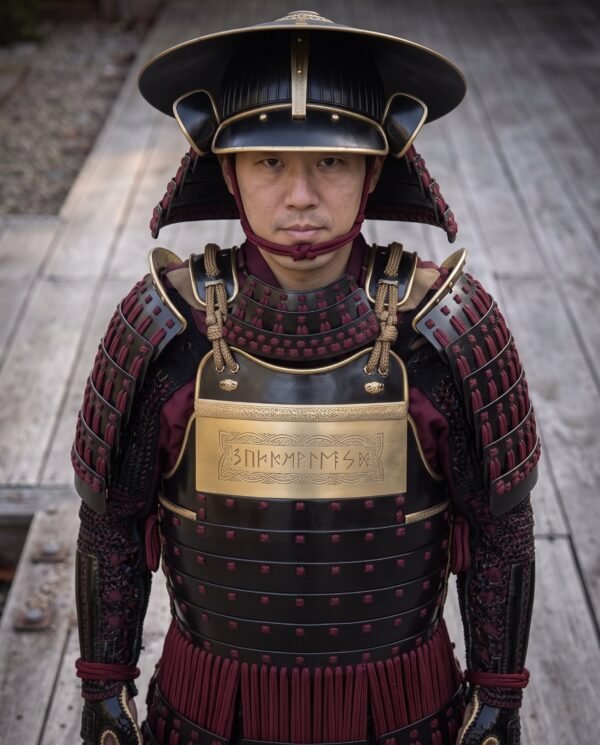
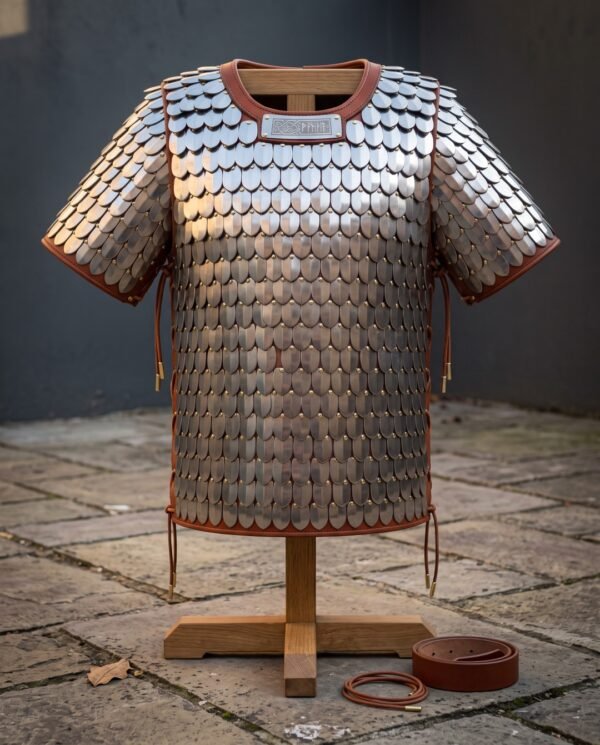
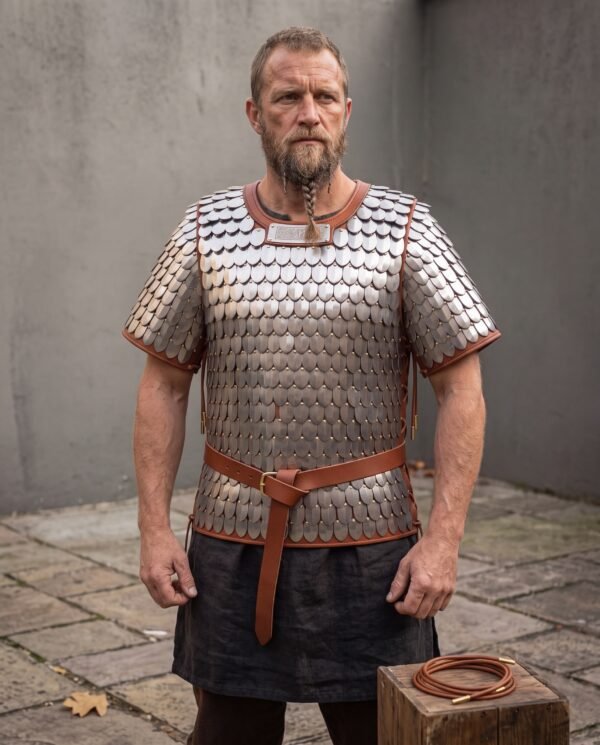
The same construction as a bright scale shirt taken in the opposite direction. Several hundred steel scales, each blackened and then riveted through its head to a black leather foundation, bound at the neck, hem, armholes and cuffs in black leather, laced at both sides with cord finished in metal aiglets, and finished at the throat with a steel plaque carrying a line of Elder Futhark. Blackened armour is not a modern fantasy invention. Munition harness across late medieval Europe was very often left black from the forge or deliberately blued, because a black finish is a layer of controlled oxide that keeps worse oxide off, and because it saved the enormous labour of polishing a hundred sets of armour bright. Bright armour was the expensive option, not the default.
Every scale is cut, blackened, drilled and riveted in a Czech Republic workshop, and the leatherwork is cut and stitched in the same building. It ships as the shirt with its side lacing fitted. The folded cream cloth beside it in the photograph is a studio prop and is not included. Scale and lamellar fail differently from mail, which we compare in chainmail versus plate versus lamellar.
Specifications
| Type | Short sleeved scale armour shirt with a round neck, blackened |
|---|
| Scale material | Mild steel, 18 gauge, blackened finish |
|---|
| Scale shape | Round bottomed, overlapping down and across |
|---|
| Foundation | Black leather faced backing |
|---|
| Rivets | Steel, one per scale head, with a row of rivets along each shoulder |
|---|
| Binding | Black leather at neck, hem, armholes and cuffs |
|---|
| Closure | Black cord side lacing with metal aiglets, both sides |
|---|
| Detail | Bright steel throat plaque riveted at both ends, with an Elder Futhark rune line |
|---|
| SKU | RK-1540 |
|---|
Why the scales are hung and not sewn flat
Every scale on this shirt is fixed at one point only, through its head. That single rivet is what turns a sheet of overlapping metal into armour rather than a metal jacket. Because the tail of each scale hangs free, it can lift slightly and slide over the scale beneath it, which means the shirt bends at the waist and the shoulder without any of the plates fighting each other. Sew the scales flat along their whole length and the garment becomes a board.
It also changes what happens when something hits you. A cut landing on a hung scale drives it down and back into two or three layers stacked behind it, so the blow has to defeat all of them at once and much of its energy goes into moving metal sideways rather than through you. Against a slashing edge that is genuinely effective, and it is the reason scale survived alongside mail for centuries in every part of the world that had metalworkers.
Where it is weak is upward. A point driven from below can catch under the free tail of a scale and lift it, and no amount of good work at the bench changes that geometry. Our scales overlap sideways as well as vertically, which closes most of the openings, and the shirt is meant to be worn over padding, which is where the rest of the answer lies.
18 gauge, the blackened finish, and honest limits
The scales are 18 gauge mild steel, about a millimetre and a quarter. That is display and light reenactment weight. The shirt has real mass, it hangs and moves like armour, and it will take normal handling and travel. It is not certified armour, it is not rated for full contact combat, and if your group runs heavy fighting you need kit inspected against that rule book rather than this. Saying that clearly costs us a few sales and saves somebody an injury, which is the right trade.
The black finish is an oxide layer, not paint and not a powder coat. That matters for two reasons. It will not chip off in flakes the way a sprayed finish does, and it can be touched up. It also means it is a sacrificial layer rather than a permanent seal, so a blackened shirt still wants oiling, and where scales rub each other constantly at the shoulder you will see the black wear through to bright steel over time. That wear pattern is what real armour looks like after a few seasons and most owners come to prefer it.
Engraving, runes and your own design
Use the rune converter on this page to turn a name, a date or a short phrase into Elder Futhark and we will cut it into the steel or the leather. If you would rather have a Viking pattern than a rune line, choose your own design in the engraving option above the add to cart button and tell us where it goes. Where a piece already carries an engraved design, your chosen engraving replaces it rather than sitting alongside it, so on this shirt your line takes the place of the rune line on the throat plaque. Cut lines show up strongly against a blackened ground, which makes this one of the better pieces in the range to personalise. Full detail is on the engraving page.
Fit and sizing
This is built to a stated chest size, so measure over the layers you actually intend to wear rather than over a bare torso. A gambeson adds several inches to a chest measurement and a heavy wool tunic adds more than people expect. Take your torso length from the top of the shoulder down to where you want the hem to fall, since a scale shirt hanging too low fouls a sword belt and one sitting too high leaves a gap above the belt line. Shoulder width matters as much as chest, because the sleeve heads have to sit on the point of the shoulder for the rows to fall correctly. The cord side lacing gives you a genuine range of adjustment in both directions, but it will not rescue a shirt ordered two sizes out. If you are between sizes, take the larger and lace it in.
Care
A blackened finish resists rust better than bright steel but it does not stop it, and a scale shirt has hundreds of edges for damp to sit on. Wipe it down after wearing, hang it somewhere with moving air and let it dry completely before it goes away. Give the scales a light film of mineral oil or armour oil with a rag once or twice a season, working it into the overlaps rather than just the faces. Feed the black leather binding and the lacing with a neutral conditioner so the corners at the armholes do not dry and crack. Store it on a broad hanger or laid flat, never folded hard, never in a sealed bag. There is more in our guide to steel care. Steel plates rust like anything else, so treat them as in caring for chainmail and steel armour.
Made in the Czech Republic
This is a handmade piece from the Czech Republic, made in a workshop that still forges, grinds and finishes by hand instead of stamping parts out. The smiths there have kept the older way of working, and the wood, horn and leather are shaped and fitted by hand as well. Two pieces of the same design will never be identical, and that is part of what you are buying.
Ransack Viking is a United States company. We handle the import ourselves, look over every piece when it lands and ship from our warehouse in Chicago, Illinois. Engraving is done in the United States after the piece arrives, so your design goes on before we send it out.
A note on handmade variation
This is hand made, not machine made or bulk produced, so what arrives will not be a pixel for pixel copy of the photograph. Blackening is a chemical process and it takes slightly differently on every batch of scales, so you will see shifts from deep charcoal to near black across the shirt and warm highlights where the light catches an edge. Grain, tone, hammer texture and exact profile vary because each one is worked by hand from natural materials. The dimensions, the material and the build are the same every time. The character is not.
Frequently asked questions
Will the black finish wear off?
It will wear through to bright steel at the shoulders and anywhere the scales rub hard, over seasons rather than months. That is normal for a blackened finish and it can be redone. It does not flake like paint.
Is this rated for full contact fighting?
No. At 18 gauge this is display and light reenactment weight. It is not certified armour. Heavy fighting requires kit inspected against your group rule set.
How does it compare to the bright steel version?
Identical construction and gauge. The differences are the blackened scales, the black leather and cord, and the steel rivets in place of brass. Choose on how you want it to look.
Does it need a gambeson under it?
Yes, or at least a heavy padded tunic. Scale worn against a shirt will chafe at the armholes and the padding is what turns a spread impact into something you barely notice.
Can I add sleeves or a longer skirt later?
Yes. The construction is modular, and extra rows or full sleeves can be built and laced or riveted on. Ask before you order so we can leave the right attachment points.
How long before it ships?
Processing is one to two weeks because each shirt is built to your stated size, then free shipping within the United States. Returns are accepted within seven days.
What is in the box
- Blackened steel scale armour shirt with black leather binding
- Cord side lacing with metal aiglets fitted both sides
- Engraved steel throat plaque, carrying your rune line or design if selected
- Care card and lifetime warranty against defects
- Forged and finished in the Czech Republic
Explore the range
See more in scale and lamellar armour, Viking armour, leather armour and chainmail armour, or read the guides.
Also in this part of the catalogue
If this one is not quite right, there is the Nightscale lamellar armor. Also in this group is the Moonhorn lamellar armor. Sitting beside it in the catalogue is the Wyrmscale lamellar armor.
From the same corner of the shop, there is the Spikerim shield boss. Or start from a blank sheet on the design your own page.


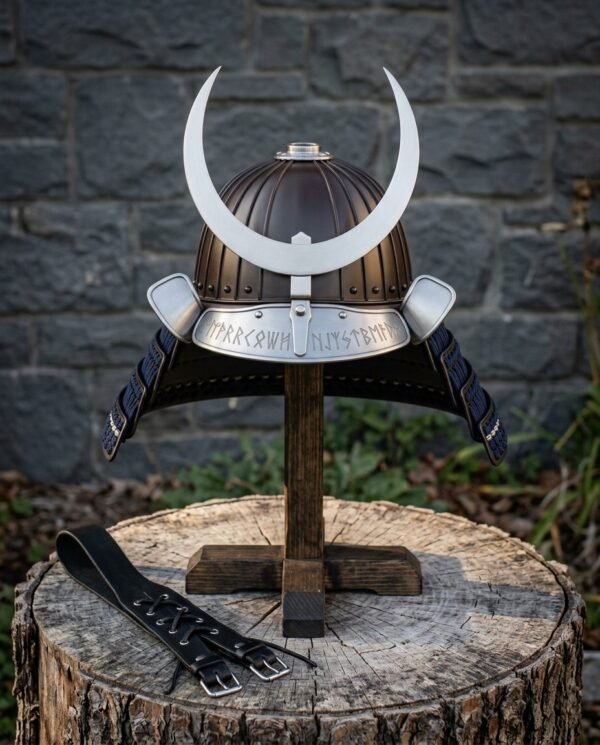
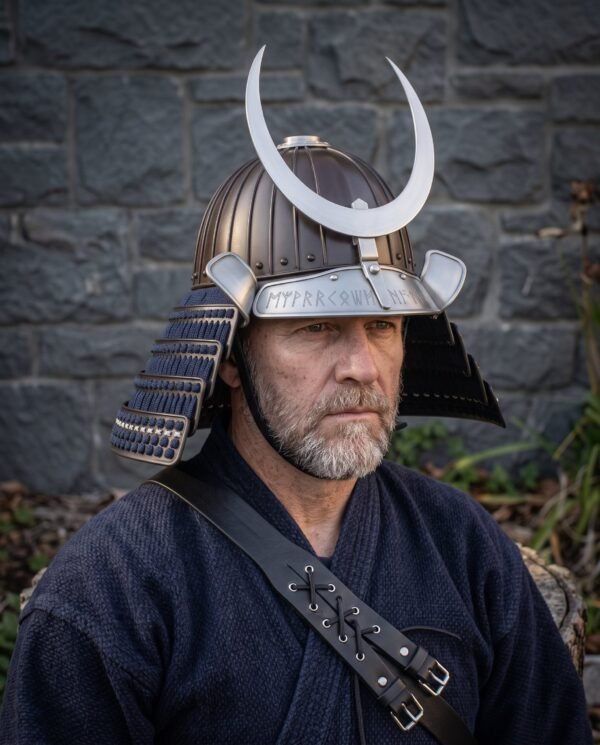
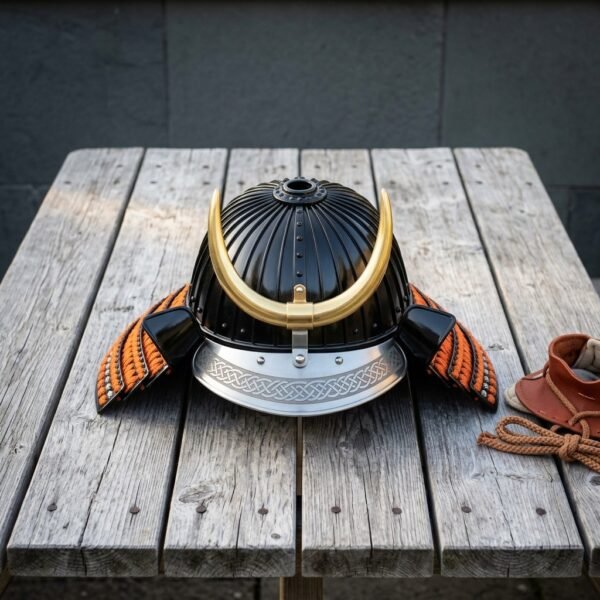
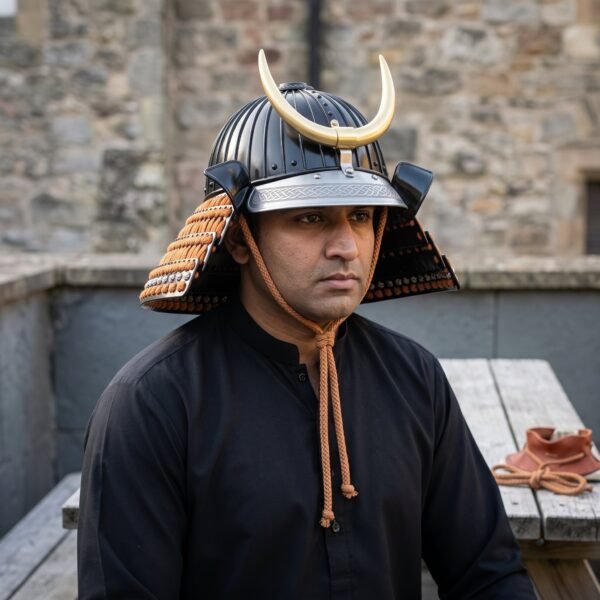
Been eyeing this display piece for months and it did not disappoint. Made overseas in the Czech Republic yet shipped from a US location so no long customs wait.
No regrets on this purchase at all. Mounting hardware included made it easy to hang. Easily the best looking piece in my collection room now. This shop clearly takes pride in their work.
Incredible craftsmanship on this one. You can tell it’s real Czech blacksmith work and shipping from the States made delivery painless.