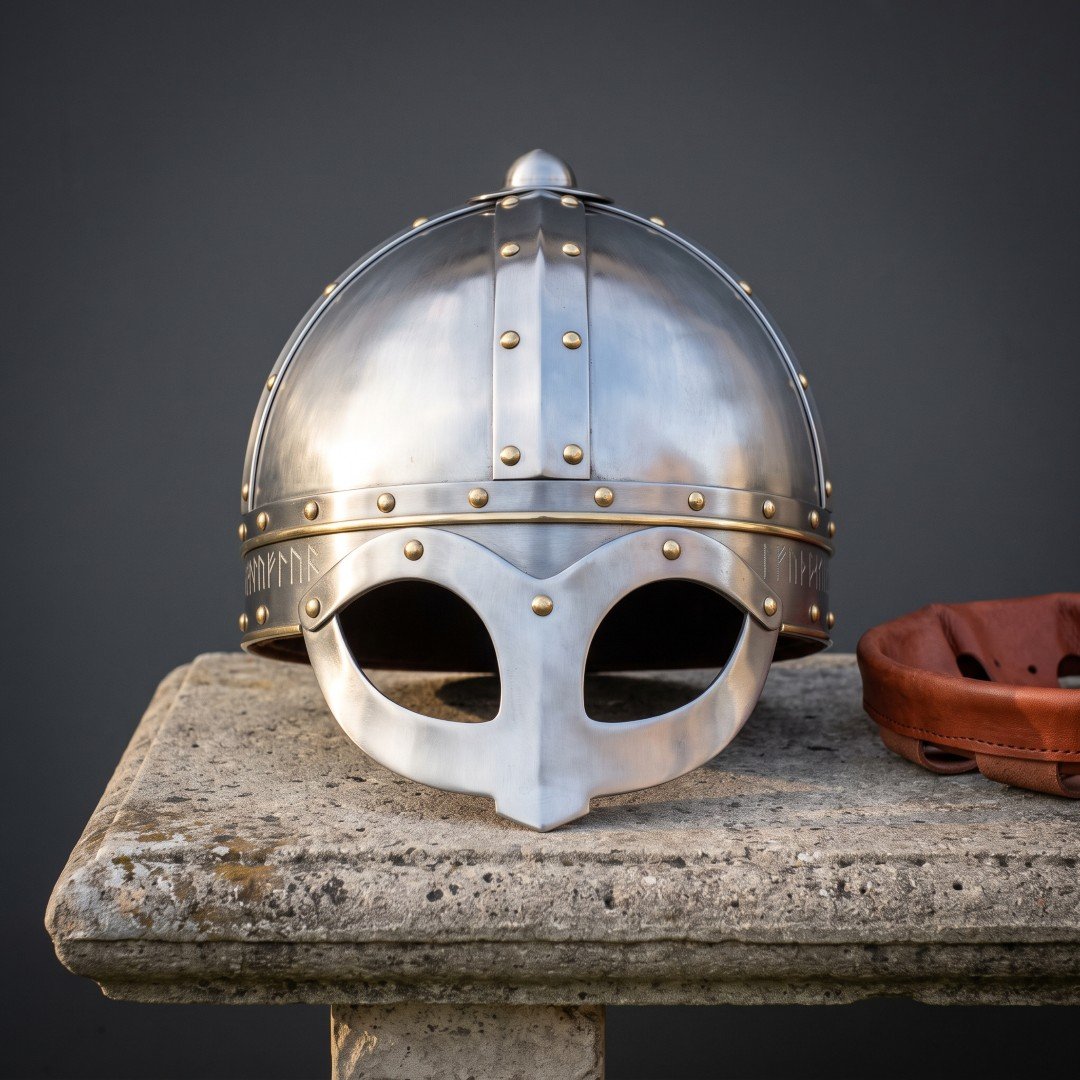
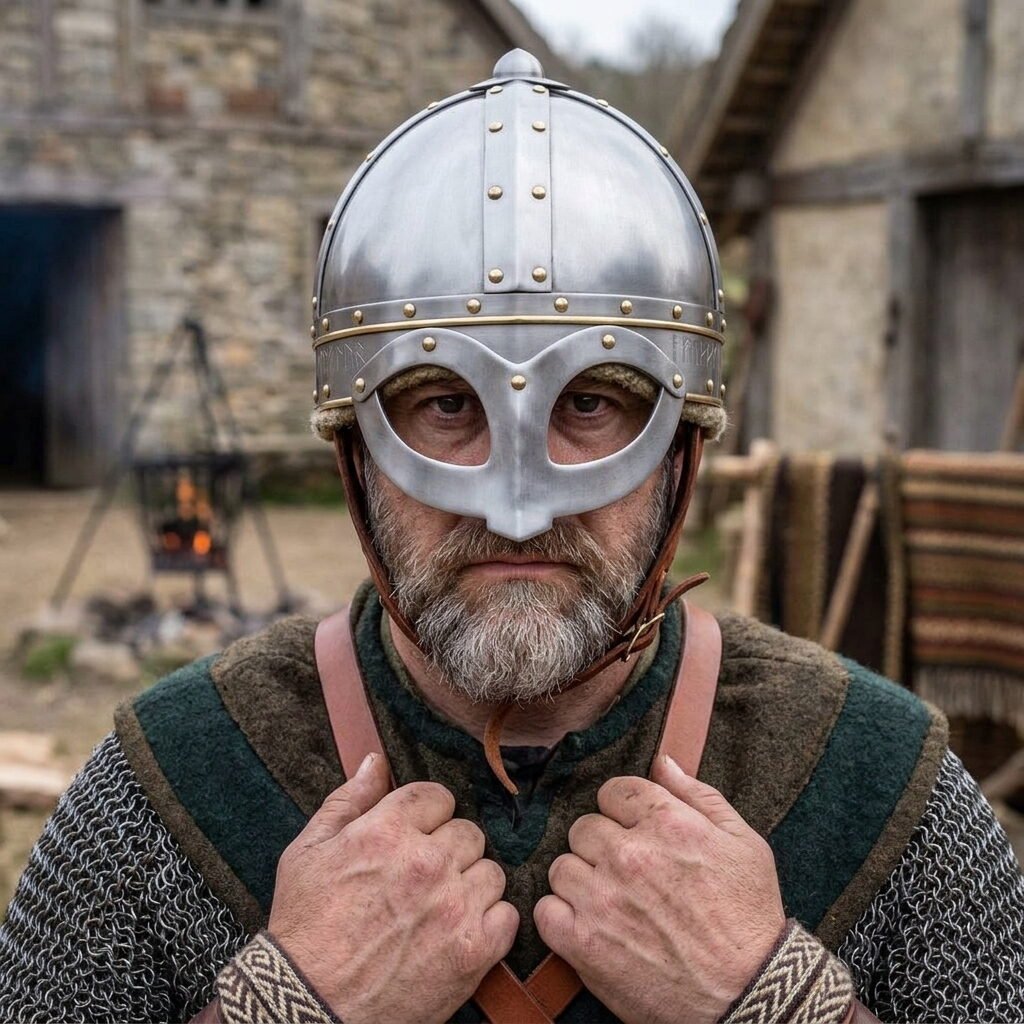
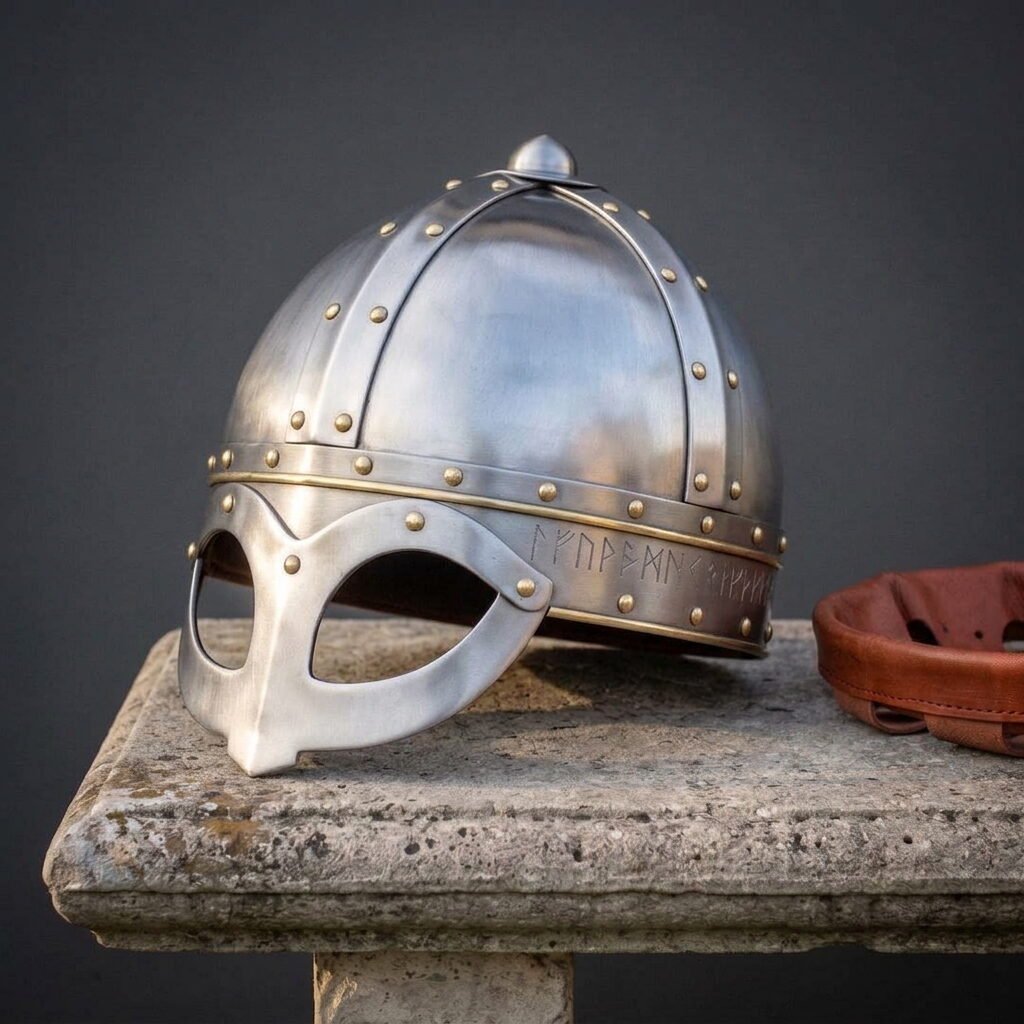
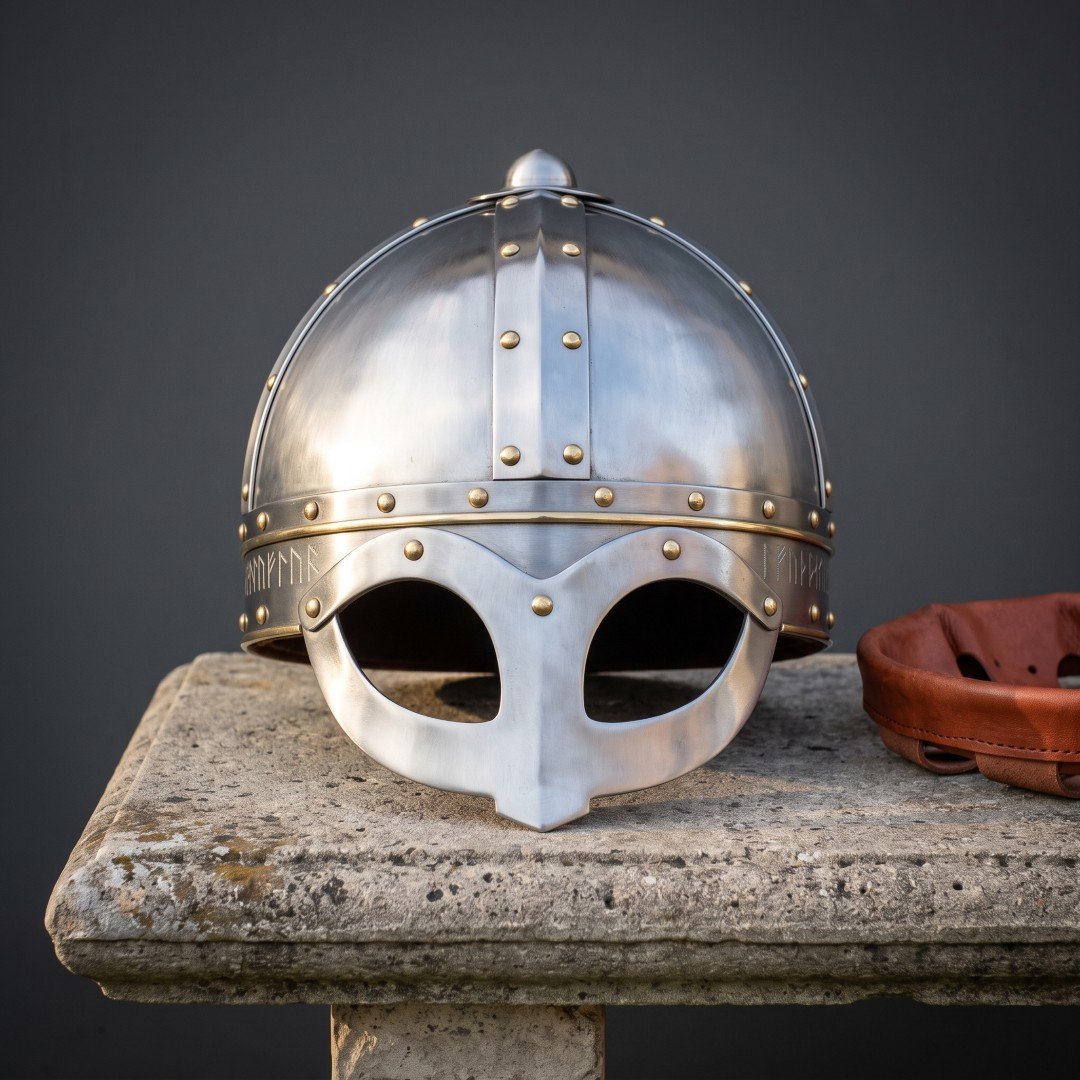
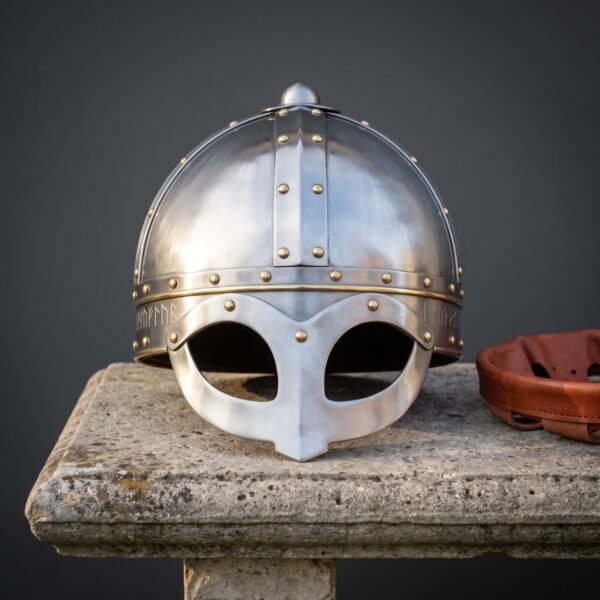
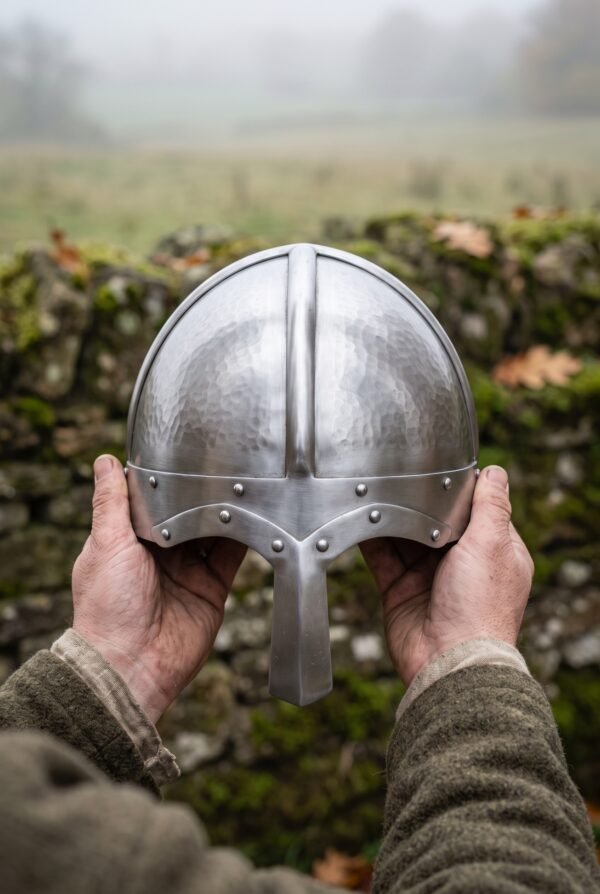
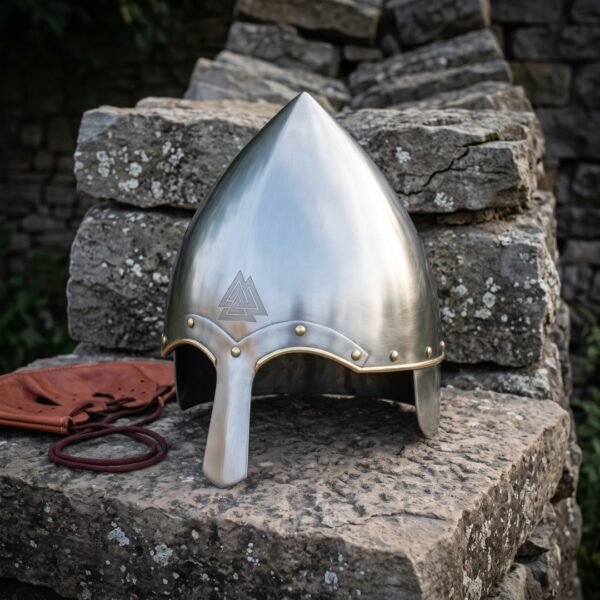
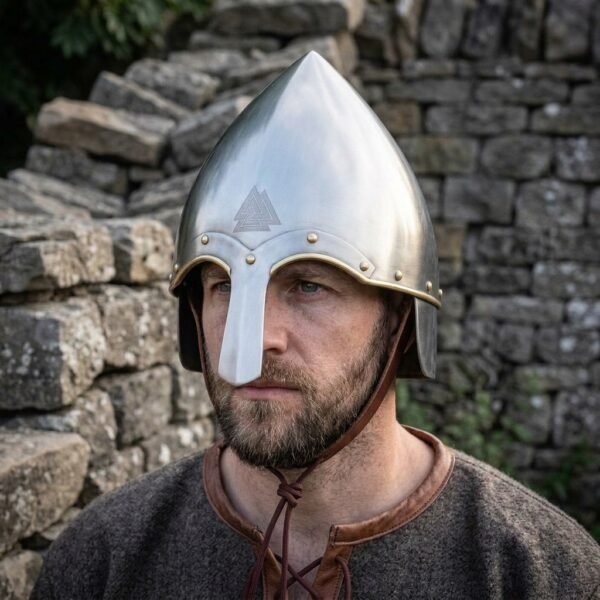
Gazeward is a hand forged Viking spectacle helmet built the way the originals were built, from separate steel plates riveted to a frame rather than raised from one sheet. The skull is four panels held by a brow band and a crossing pair of bands over the crown, all closed with domed brass rivets, and the front carries the feature that gives this type its name, a one piece face guard with two large cut openings for the eyes and a bar of steel running down between them to cover the nose.
The type is not a museum guess. It comes from a real find, the helmet recovered from a tenth century burial mound at Gjermundbu in Ringerike, Norway, in 1943. That helmet is still the only reasonably complete Viking age helmet ever found anywhere, and its spectacle guard is where every helm of this shape on the market traces back to. Ours is forged, riveted, engraved and lined in the Czech Republic. The brow band carries a cut line of Elder Futhark runes and the helmet ships with a fitted leather liner and an adjustable chin strap already installed. Only a handful of Viking age helmets survive, and what Viking helmets actually looked like goes through every one of them.
Specifications
| Material | Mild steel skull and face guard, brass rivets and brass browband trim |
|---|
| Gauge | 18 gauge mild steel, approximately 1.2 mm |
|---|
| Construction | Four panel riveted skull on a brow band and crossing crown bands, one piece spectacle face guard |
|---|
| Rivets | Domed brass rivets along the bands and around the face guard |
|---|
| Browband | Brass trimmed, with a cut Elder Futhark rune line |
|---|
| Crown | Raised round finial at the top |
|---|
| Size or fit | Fits a head circumference of roughly 22 to 24 inches over the liner |
|---|
| Weight | Approximately 4 to 5 pounds depending on liner |
|---|
| Lining | Fitted brown leather liner, adjustable leather chin strap |
|---|
| Finish | Polished steel |
|---|
| Intended use | Display, costume, light reenactment and photography |
|---|
| SKU | RK-1431 |
|---|
What the spectacle guard actually does
People assume the two big cut openings are decoration. They are not. The problem the guard solves is that the eyes and the bridge of the nose are the softest target on a helmeted head and also the one place you cannot cover with solid steel, because a fighter who cannot see is finished. A mail veil hanging over the face is heavy, it swings, and a thrust drives the rings back into the eye anyway.
The spectacle answer is a rigid single piece of steel that arches over both brows, drops down the middle of the face as a nose bar, and sweeps out and down around the cheekbones, leaving two eye holes cut into it. The steel takes a descending cut on the forehead and turns it sideways. It takes a thrust coming in low and lets it skate off the nose bar. Because it is one piece rather than three separate pieces, there is no join at the bridge of the nose to collapse when it is hit, which is the weak point of a plain riveted nasal bar.
The cost is peripheral vision, and it is a real cost. Wearing one of these you lose a slice of your lower and side view, which is why the openings on the Gjermundbu original and on this reproduction are cut generously wide rather than pinched down into slits. Put it on and give yourself a minute before you try to walk down stairs in it.
The steel, the gauge and what that means
The skull and guard are 18 gauge mild steel, about 1.2 mm through. Mild steel is low carbon steel. It cannot be hardened by heat treatment the way a blade can, and that is exactly why it is the right material here. It is tough rather than hard, so it dents and deforms under a heavy impact instead of shattering, which is what you want between a blade and a skull. Every helmet in the historical record is a low carbon iron or steel piece for the same reason.
Be clear on what 18 gauge means for use. Eighteen gauge is the standard weight for display helmets and for light reenactment where blows to the head are not permitted. It is not the 14 gauge that full contact steel fighting organisations require, and this helmet is not certified for any combat standard. Buy it to wear, to photograph and to display. Do not buy it expecting to take repeated hits in the head in a Buhurt line. The brass on the browband and the rivets is decorative and is a genuine period choice, since Viking age smiths used copper alloy trim on exactly this kind of fitting.
Engraving, runes and your own design
Use the rune converter on this page to turn a name, a date or a short phrase into Elder Futhark and we will cut it into the steel or the leather. If you would rather have a Viking pattern than a rune line, choose your own design in the engraving option above the add to cart button and tell us where it goes. Where a piece already carries an engraved design, your chosen engraving replaces it rather than sitting alongside it. On this helmet the brow band is the engraving field, so your runes or your pattern go there in place of the line shown in the photographs. There is more detail on the engraving page.
Fit and sizing
This helmet is made to a stated size rather than moulded to your head. It fits a head circumference of roughly 22 to 24 inches measured around the brow, with the leather liner and the chin strap taking up the range. Measure with a soft tape around your head just above the ears and across the middle of the forehead, and take the larger number if you are between sizes.
Two things change the fit more than people expect. A padded arming cap under the helmet, which you should wear, adds close to half an inch of circumference. Long hair worn up adds more again. If you intend to wear a coif or an arming cap, size for that rather than for a bare head. The face guard position is fixed relative to the skull, so a helmet that sits too high will put the eye openings too low and you will be looking at the steel rather than through it.
Care
Polished mild steel rusts if you let it. Wipe the helmet down after every wear, especially inside where sweat collects around the browband, and put a thin film of light machine oil or a paste wax over the outside before it goes away. If it is going on a shelf for months, oil it properly and keep it out of a damp garage.
Surface rust that does appear comes off with fine steel wool or a green scouring pad and oil, worked in the direction of the existing polish lines. Do not use aggressive abrasives on the brass, which is soft, and do not put the leather liner anywhere near solvent. Our fuller notes are on the steel care page. Fit, steel gauge and the shapes worth avoiding are covered in buying a Viking helmet.
Made in the Czech Republic
This piece is made by hand in the Czech Republic, in a workshop that still works the old way. The steel is forged, ground, heat treated and finished by smiths who learned the trade from the people before them, and the wood, horn and leather are cut and fitted by hand rather than pressed out on a line. That is also why no two pieces come out exactly the same.
Ransack Viking is a United States company. We import these pieces ourselves, check every one when it lands and ship from our warehouse in Chicago, Illinois. Engraving is done here in the United States after the piece arrives, so your runes or your own design go on before it leaves for you.
A note on handmade variation
This is hand made rather than machine made or bulk produced, so what arrives will not be a pixel for pixel copy of the photograph. Hammer texture across the panels, the exact spacing of the rivets, the tone of the brass and the precise depth of the cut runes all vary because each helmet is worked by hand. The dimensions, the material and the build are the same every time. The character is not.
Frequently asked questions
Can I wear this for full contact reenactment
No. It is 18 gauge, which is the display and light reenactment weight. Full contact steel fighting groups require 14 gauge or heavier and their own inspection, and this helmet is not certified to any of those standards. It is built to wear, to photograph and to display.
How well can you see out of it
Better than you would guess and worse than with a bare head. Straight ahead is clear. You lose a band of lower peripheral vision to the cheek sweeps and a little to the sides. Walk around in it indoors before you wear it anywhere with steps or a crowd.
Is the spectacle helmet historically accurate
The type is, and it comes from the Gjermundbu find of 1943 in Norway, which remains the only near complete Viking age helmet ever excavated. Our reproduction follows that shape. The engraved rune line on the browband is our own addition and is not part of the original.
Does it come with a liner and strap
Yes. A fitted brown leather liner and an adjustable leather chin strap are installed before it ships. You should still wear a padded arming cap underneath for comfort and to keep the steel off your scalp.
Will it rust
Polished mild steel will rust if it is stored damp or left with sweat on it. Wipe it down and oil it after wearing and it will stay bright for decades. Any light surface rust cleans off with fine steel wool and oil.
How long does it take to ship
Processing is one to two weeks because each helmet is raised, riveted and lined to order, then shipping is free within the United States. Returns are accepted within seven days. Custom engraving adds a few days.
What is in the box
- One riveted steel Viking spectacle helmet with brass fittings
- Fitted brown leather liner, installed
- Adjustable leather chin strap, fitted
- Care card with oiling notes
- Forged and finished in the Czech Republic
Explore the range
See more in viking helmets, medieval helmets and viking armor, or read the guides.
Other pieces in this group
Closest to this in the range is the Thornpeak Viking helmet. If this one is not quite right, there is the Brassbrow Viking helmet. Also in this group is the Browhold Viking helmet.
If you are putting a set together, the Nightvane leather armor sits alongside it. Nothing here exactly right, build one to your own spec on the design your own page.




Pretty impressed. Just a couple minor things I’d tweak. Would still tell others to give this a try.