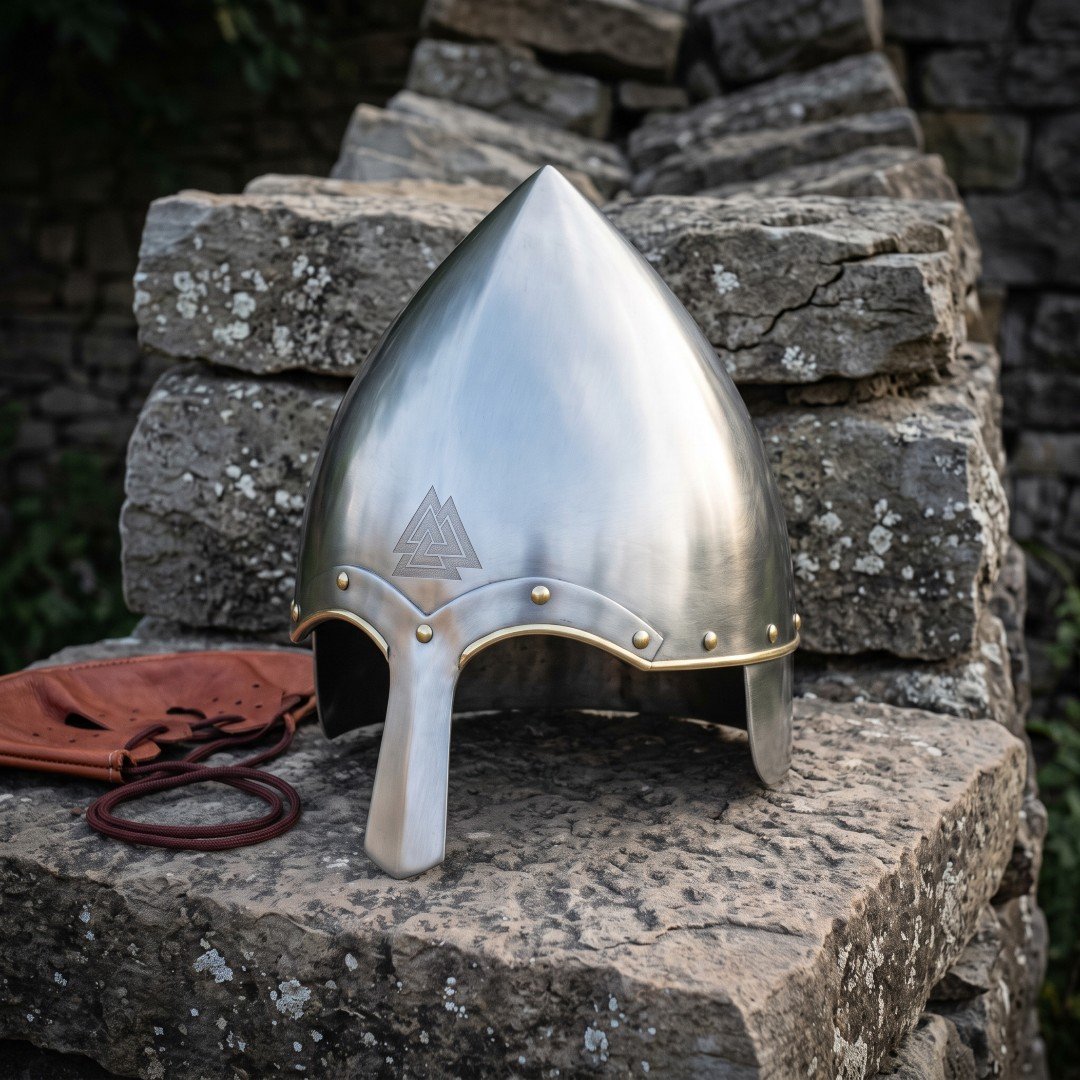
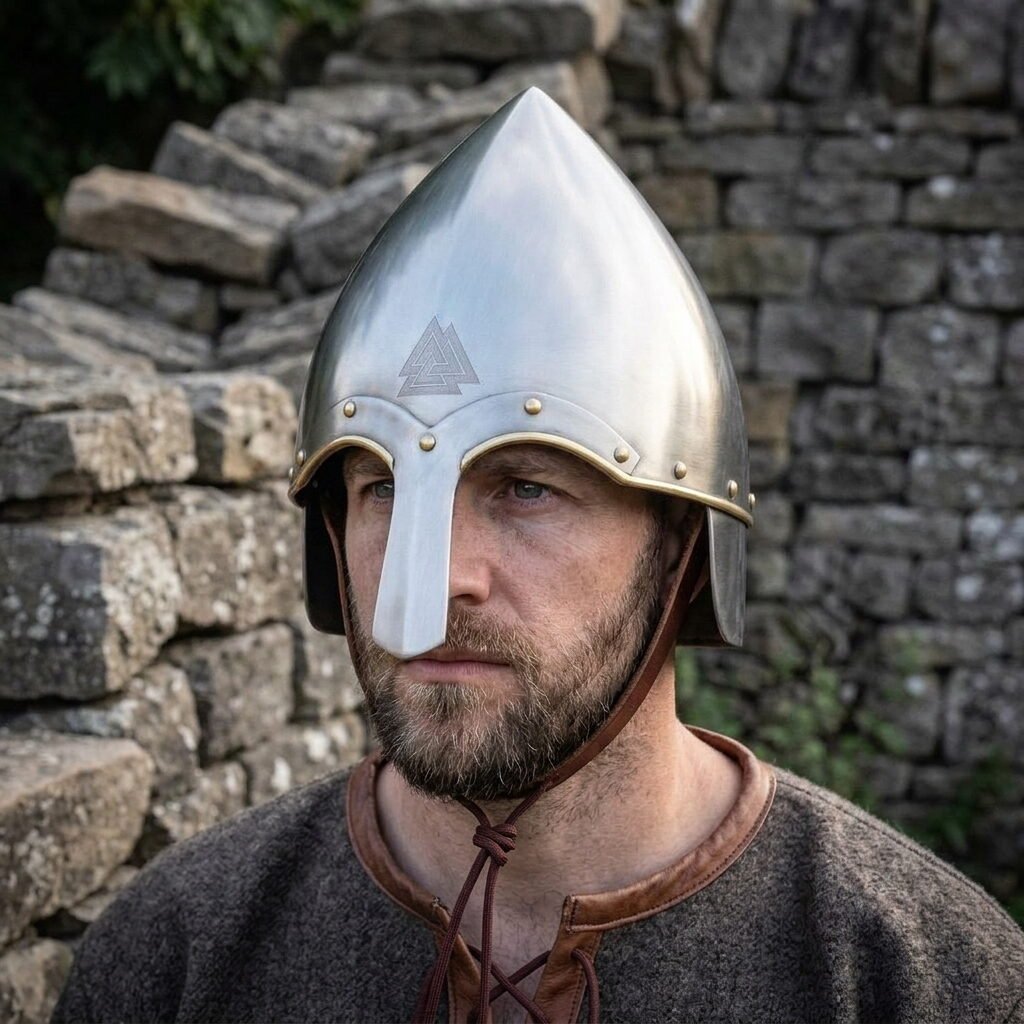
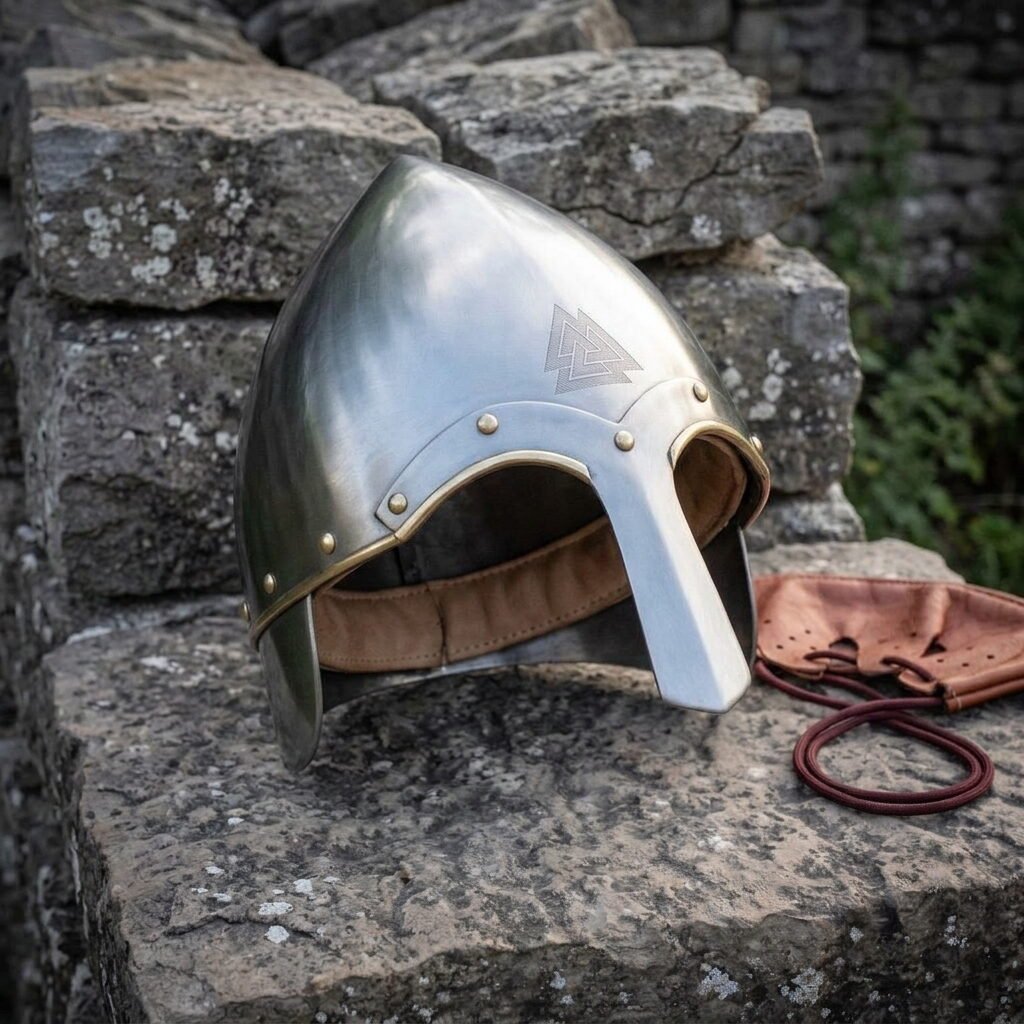
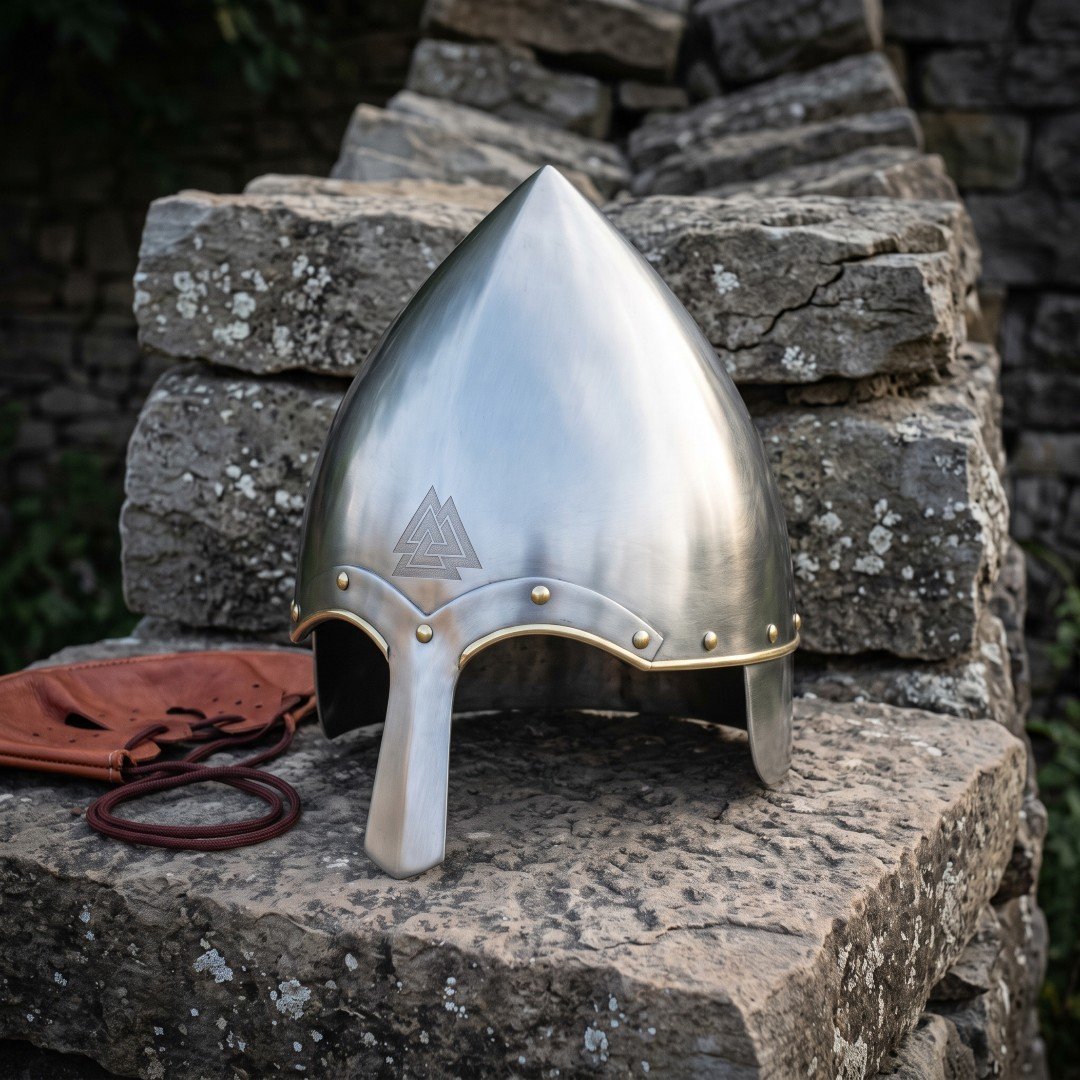
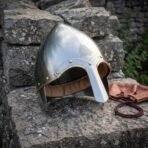
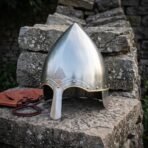
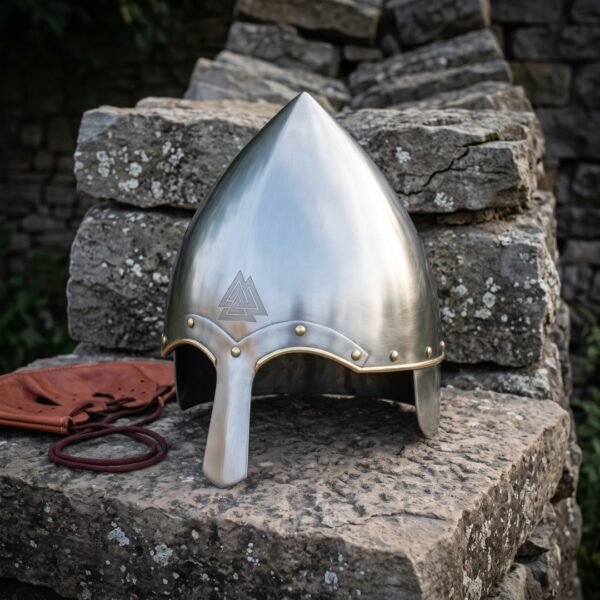
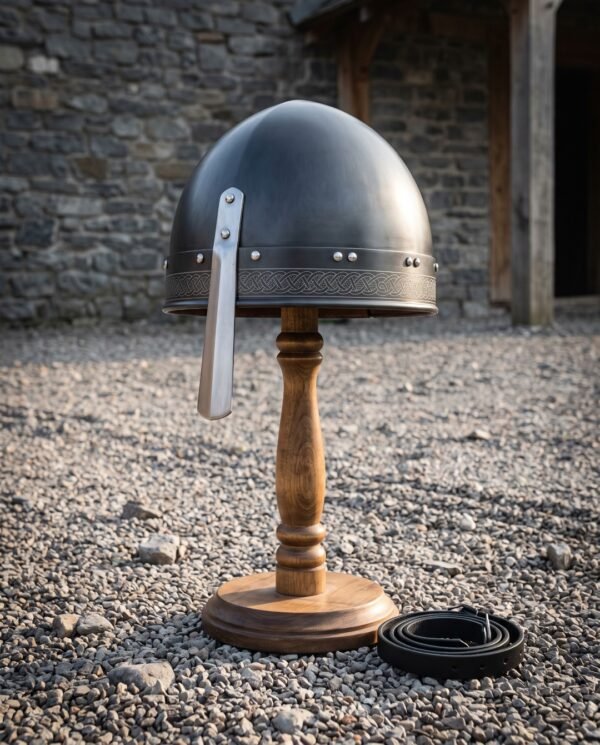
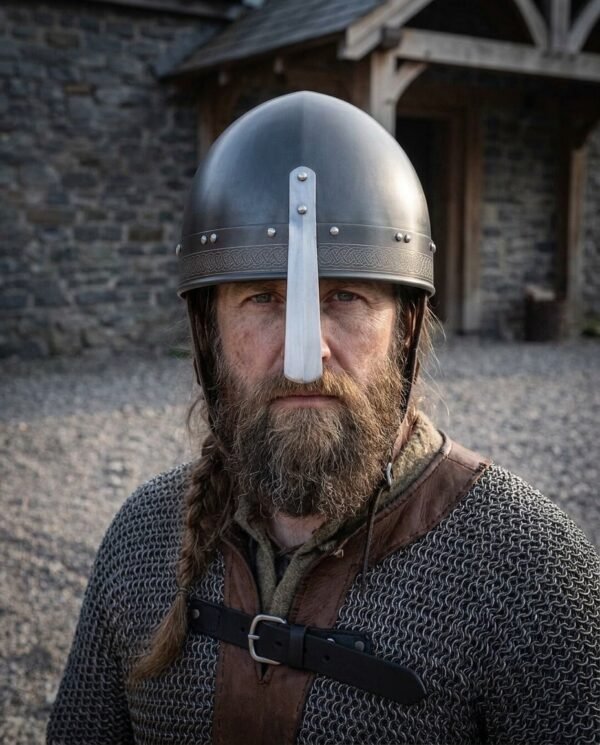
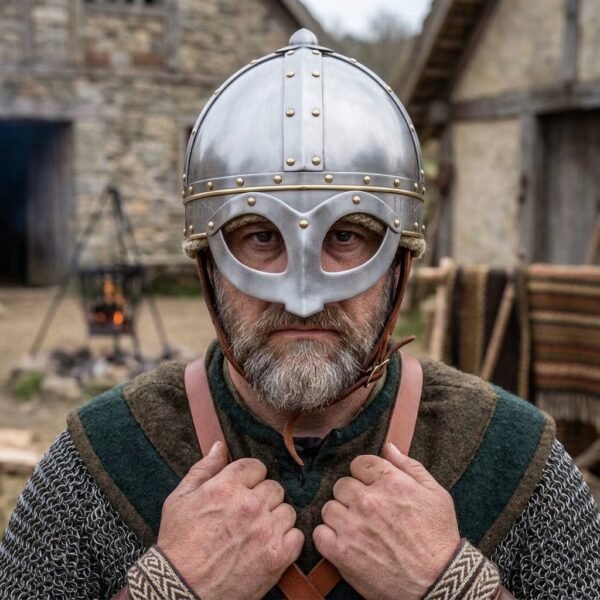
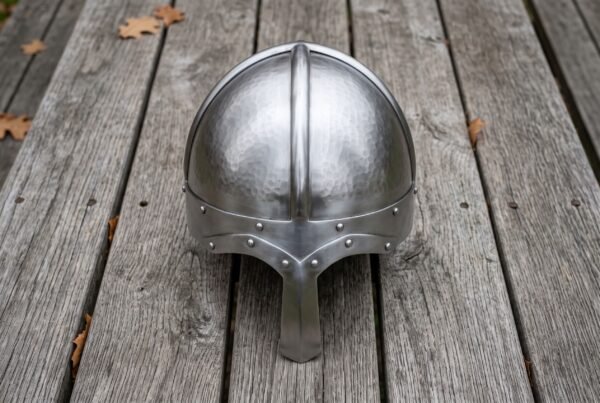
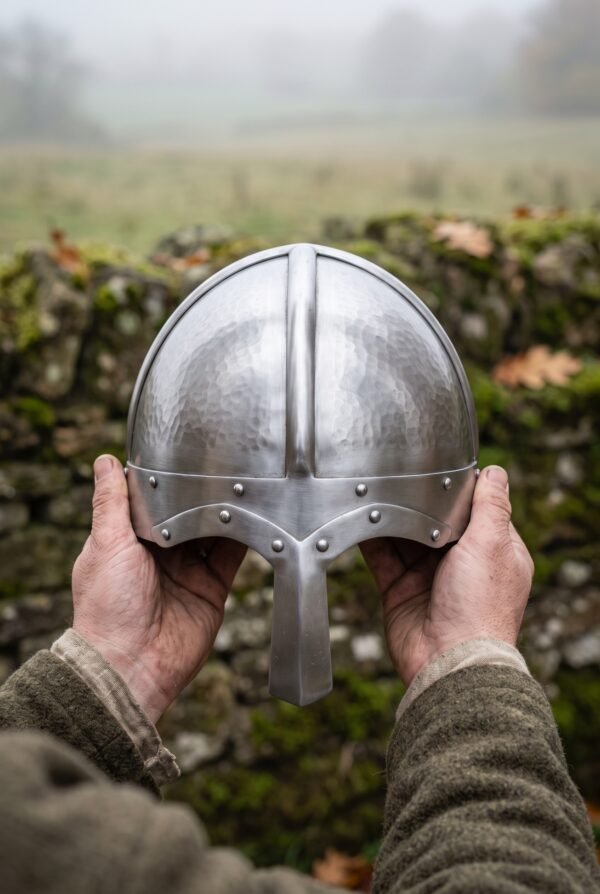
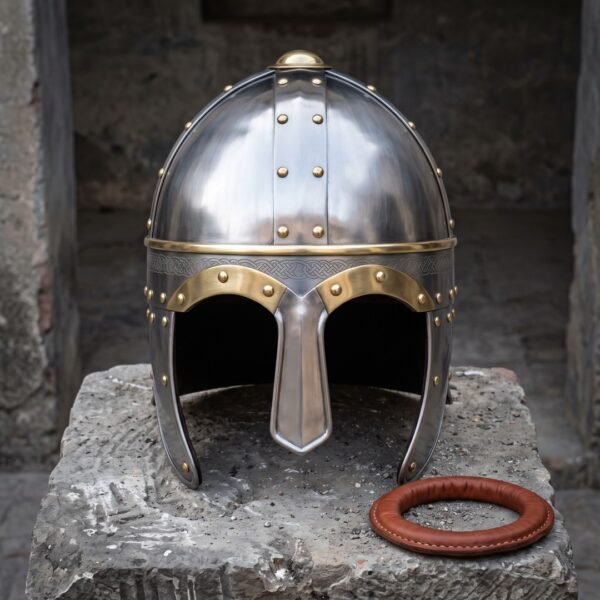
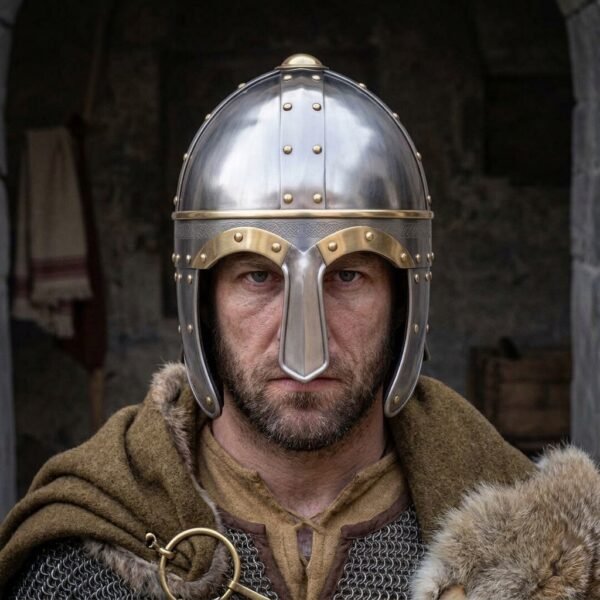
Thornpeak is a hand forged Viking helmet of the conical nasal type, a skull drawn to a distinct point at the crown, a steel browband arched over the eyes and trimmed with a narrow brass edge and a broad nasal bar dropping down over the face. Brass domed rivets pick out the browband and the nasal fixing, and the brow carries a cut valknut, the three interlocked triangles that appear on the Gotland picture stones and on the Oseberg ship burial timbers, almost always in scenes involving Odin and the dead.
The conical helmet is the northern European fighting helm of the tenth to twelfth centuries and it appears across an enormous range, from Scandinavia through the Rus lands and into the Byzantine world, which is one reason the shape is sometimes given a Norman name and sometimes a Rus one. It is the helmet the mail clad figures wear across the Bayeux Tapestry. Ours is raised, riveted, engraved and lined in a Czech Republic workshop, and it ships with a fitted leather liner and adjustable cord. Only a handful of Viking age helmets survive, and what Viking helmets actually looked like goes through every one of them.
Specifications
| Material | Mild steel skull, browband and nasal, brass edging strip and brass rivets |
|---|
| Gauge | 18 gauge mild steel, approximately 1.2 mm |
|---|
| Construction | Conical skull drawn to a point, with a riveted steel browband arched over the eyes and a broad nasal bar dropping from it |
|---|
| Browband | Steel, trimmed along the lower edge with a narrow brass strip, fixed with brass domed rivets |
|---|
| Size or fit | Fits a head circumference of roughly 22 to 24 inches over the liner |
|---|
| Weight | Approximately 4 to 5 pounds with the liner fitted |
|---|
| Lining | Fitted brown leather liner with an adjustable drawcord |
|---|
| Chin strap | Brown leather straps |
|---|
| Engraving | Valknut cut into the brow of the skull above the nasal |
|---|
| Finish | Satin polished steel against brass fittings |
|---|
| Intended use | Display, costume, light reenactment and photography |
|---|
| SKU | RK-1443 |
|---|
Why a helmet comes to a point
The cone is not a stylistic choice. It is the best available answer to a very specific problem, which is that the most common way to kill a man in a shield wall is to bring something heavy down onto the top of his head.
Think about what a descending blow meets. On a flat surface, the whole force of the strike is delivered straight into the metal and through into the skull beneath, because there is nowhere for the energy to go sideways. On a rounded dome, a blow landing anywhere except the exact crown meets a sloping surface and part of that force is turned into sideways motion, so the blade skids. On a cone, every single point of the surface is sloped, including near the top, and the slope is steeper than a dome of the same height. A blade coming down onto a cone is far more likely to slide off down the side than to bite.
The point also does something a dome cannot. It moves the crown, the highest and most struck spot, up and away from the skull, so even a blow that does land squarely has further to travel and more metal in the way before it reaches bone. That is the entire reason helmets across Europe, central Asia and the Middle East independently arrived at the same conical answer. It works, and it costs almost nothing in weight.
The steel, the brass and what 18 gauge means
The skull and nasal are 18 gauge mild steel, around 1.2 mm. Mild steel is low carbon and cannot be hardened by heat treatment, which is the correct property for armour. It bends and dents under a heavy hit rather than cracking, and a dented helmet keeps working while a cracked one does not. Every helmet in the archaeological record is soft iron or low carbon steel for the same reason.
The browband is steel, trimmed along its lower edge with a narrow brass strip, and the rivets are brass. Copper alloy fittings on iron helmets are well documented in Viking age and later finds, partly for the colour contrast. The brass will not rust, but the steel band under it needs the same oiling as the skull.
Be clear about the use case. Eighteen gauge is the display and light reenactment weight. Full contact steel fighting organisations require 14 gauge or heavier and run their own inspections, and this helmet is not certified to any of those standards. Buy it to wear, to photograph and to display, not to take repeated head strikes in.
Engraving, runes and your own design
Use the rune converter on this page to turn a name, a date or a short phrase into Elder Futhark and we will cut it into the steel or the leather. If you would rather have a Viking pattern than a rune line, choose your own design in the engraving option above the add to cart button and tell us where it goes. Where a piece already carries an engraved design, your chosen engraving replaces it rather than sitting alongside it. On this helmet the brow of the skull is the engraving field, so your runes or your chosen symbol take the place of the valknut. If you would rather keep the valknut and add a rune line, we can run one along the browband instead, so say so in the order notes. More on the engraving page.
Fit and sizing
This helmet is made to a stated size rather than shaped to your head. It fits a head circumference of roughly 22 to 24 inches measured around the brow, with the leather liner and its drawcord taking up the range. Measure with a soft tape just above the ears and across the middle of the forehead, and round up if you fall between numbers.
Wear a padded arming cap under it. It is not a comfort preference, it is how the helmet is designed to sit, and it adds about half an inch of circumference that you need to allow for. Long hair worn up adds more again. A conical skull sits differently on the head from a rounded one, riding a little higher, so give yourself a few minutes to let the liner settle before you decide the fit is wrong. The nasal position is fixed relative to the browband, so a helmet worn too high puts the nasal above the nose and one worn too low sits on the brows.
Care
Satin polished mild steel rusts if it is left with sweat or damp on it. Wipe the helmet inside and out after every wear, particularly under the browband where perspiration collects, and put a light film of machine oil or paste wax on the outside before it is stored. Do not store it in a damp garage and never seal it in a plastic bag, which traps moisture against the steel.
Surface rust lifts with fine steel wool and oil, worked along the existing polish direction. The brass edging and rivets want a soft cloth and nothing abrasive, since brass polish and steel wool will both scratch it and remove the mellowing that makes it look right. Keep solvents away from the leather liner and let it dry naturally. Our fuller notes are on the steel care page. Fit, steel gauge and the shapes worth avoiding are covered in buying a Viking helmet.
Made in the Czech Republic
This piece is made by hand in the Czech Republic, in a workshop that still works the old way. The steel is forged, ground, heat treated and finished by smiths who learned the trade from the people before them, and the wood, horn and leather are cut and fitted by hand rather than pressed out on a line. That is also why no two pieces come out exactly the same.
Ransack Viking is a United States company. We import these pieces ourselves, check every one when it lands and ship from our warehouse in Chicago, Illinois. Engraving is done here in the United States after the piece arrives, so your runes or your own design go on before it leaves for you.
A note on handmade variation
This is hand made rather than machine made or bulk produced, so what arrives will not be a pixel for pixel copy of the photograph. The planishing texture on the skull, the exact sweep of the cone, the tone of the brass and the depth of the cut valknut all vary because each helmet is raised and finished by hand. The dimensions, the material and the build are the same every time. The character is not.
Frequently asked questions
Is a conical helmet actually Viking
Yes, the type is well attested across northern Europe in the tenth to twelfth centuries, in Scandinavia, the Rus lands and beyond, and it is what the mailed figures wear throughout the Bayeux Tapestry. It is sometimes called a Norman helm and sometimes a Rus helm, which reflects how widely the shape travelled.
Can I fight in it
Not in full contact. It is 18 gauge, the display and light reenactment weight, and it carries no combat certification. Full contact steel fighting requires heavier plate and inspected equipment.
What does the valknut mean
Nobody knows for certain, which is the honest answer. Three interlocked triangles appear on Gotland picture stones and on the Oseberg burial timbers, consistently in contexts involving Odin and the dead, so the association is strong. The name valknut is a modern Norwegian coinage rather than a Norse word.
Does it come with a liner
Yes. A fitted brown leather liner with an adjustable drawcord is installed before the helmet ships. You should still wear a padded arming cap underneath for comfort and to keep the steel off your scalp.
Will the brass tarnish
It will mellow and darken, which is what brass is supposed to do and what makes an aged helmet look right. If you want it bright, a soft cloth and a gentle brass wadding will bring it back, but do not use steel wool or abrasive paste on it.
How long before it ships
Processing is one to two weeks because each helmet is raised, riveted and lined to order, then shipping is free within the United States. Returns are accepted within seven days. Custom engraving adds a few days.
What is in the box
- One hand raised conical nasal helmet with steel browband, brass edging and brass rivets
- Fitted brown leather liner with adjustable drawcord, installed
- Valknut cut into the brow of the skull
- Care card with oiling and brass notes
- Forged and finished in the Czech Republic
Explore the range
See more in viking helmets, medieval helmets and viking armor, or read the guides.
Close to this one
Another in the same line is the Cairnhelm Viking helmet. Next along the rack is the Vegcrown Viking helmet. For a straight comparison, see the Hornkeep Viking helmet.
The Ridgehelm Medieval helmet covers the other half of the same kit. Nothing here exactly right, build one to your own spec on the design your own page.

Did not expect this level of quality for the price. Fit is excellent and the steel gauge feels genuinely protective. Couldn’t be happier with this.