The sallet is the helmet that solved a problem nobody had managed to solve for two hundred years: how to see and breathe properly while still being able to shut your face away when it mattered. Its answer was to hang the whole front of the helmet on a pair of pivots so the wearer could lift it clear with one hand, and to carry the skull down far enough at the back to cover the nape of the neck. By the middle of the fifteenth century it had spread across Germany, Italy, France and England, and it is arguably the best looking helmet ever made.
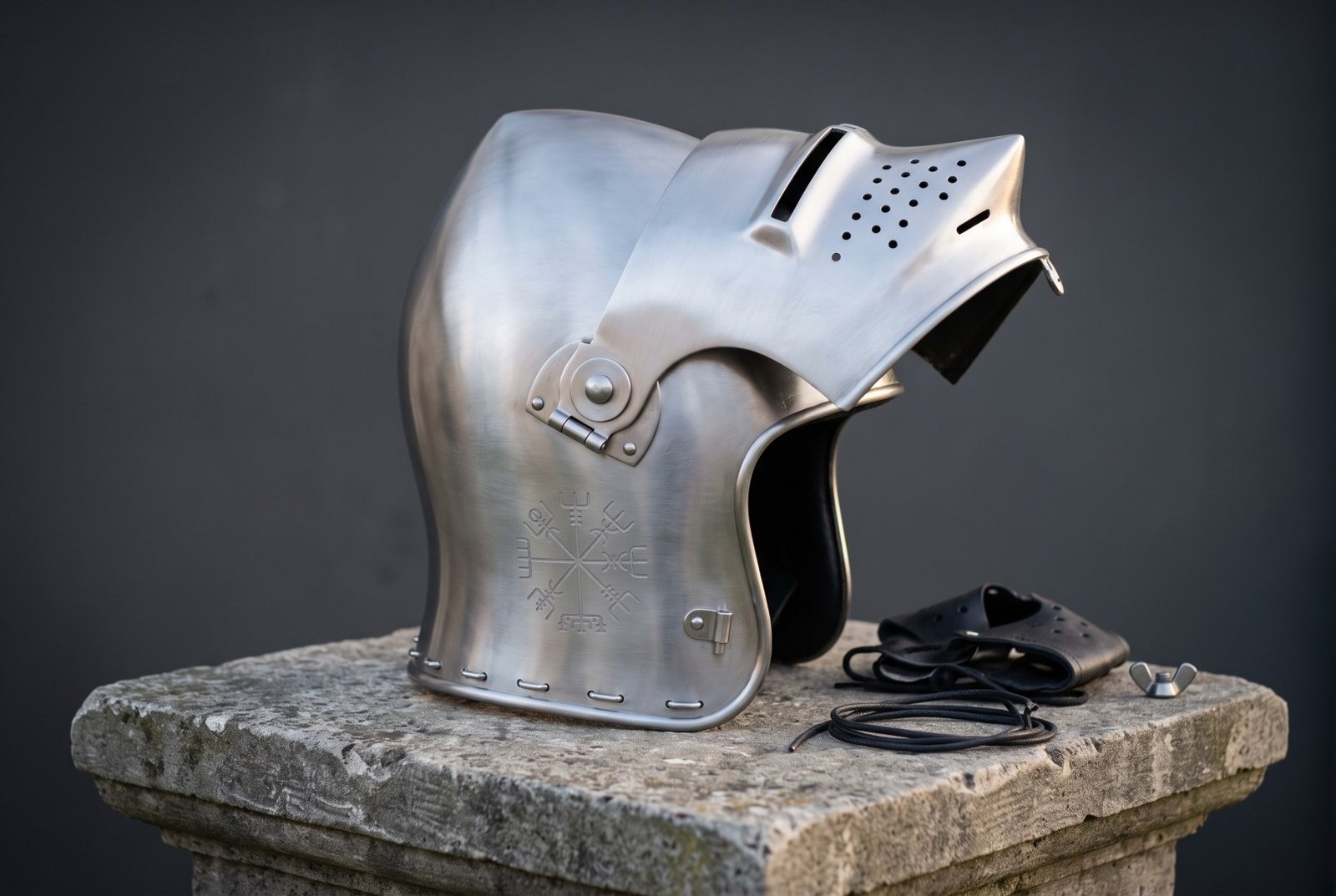
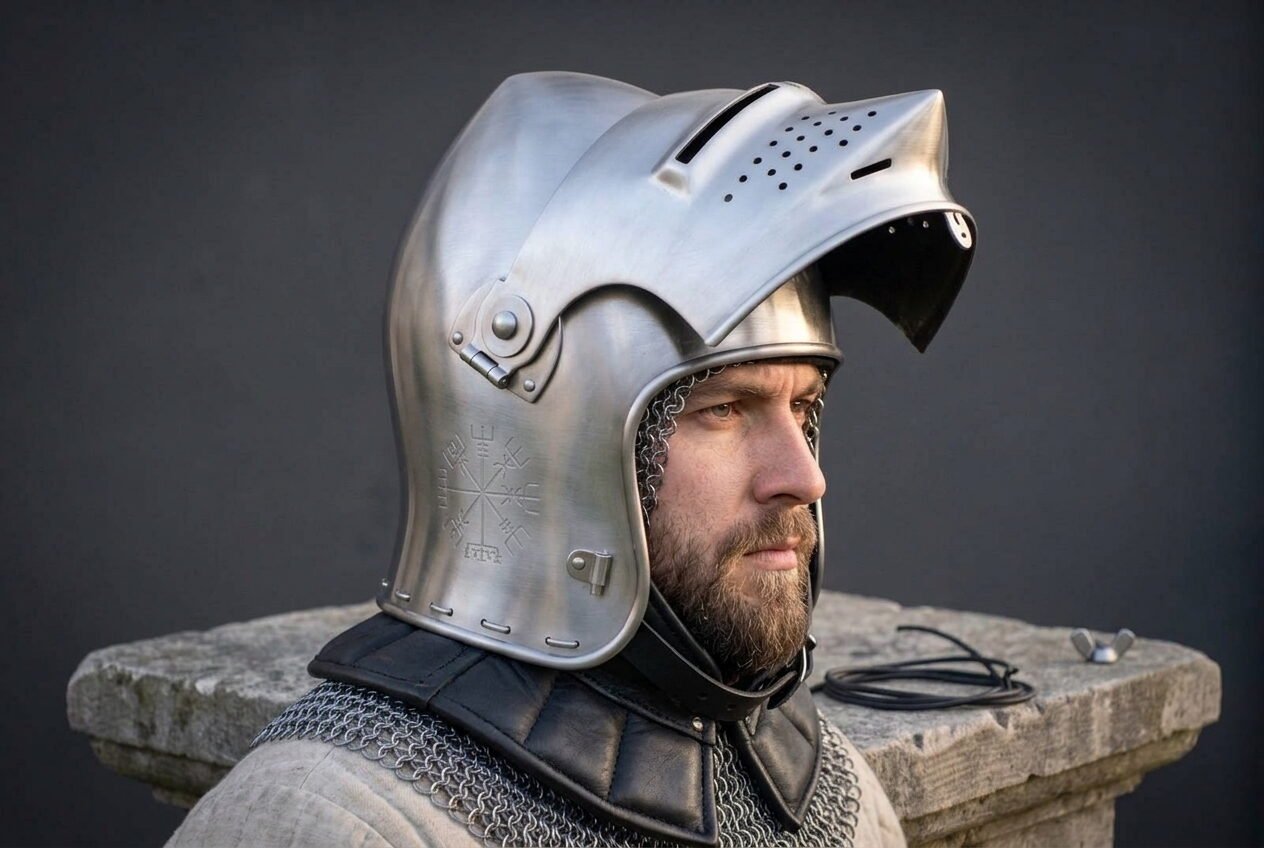
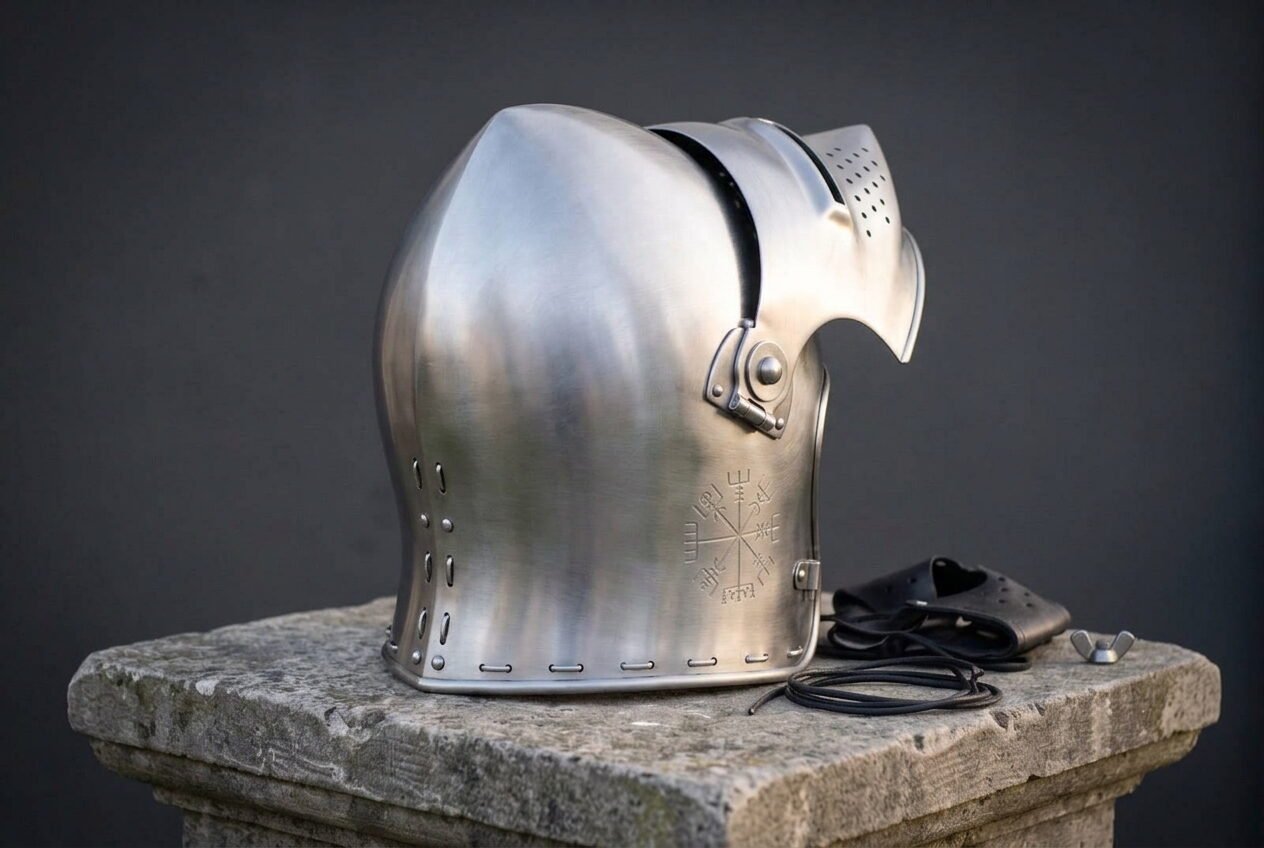
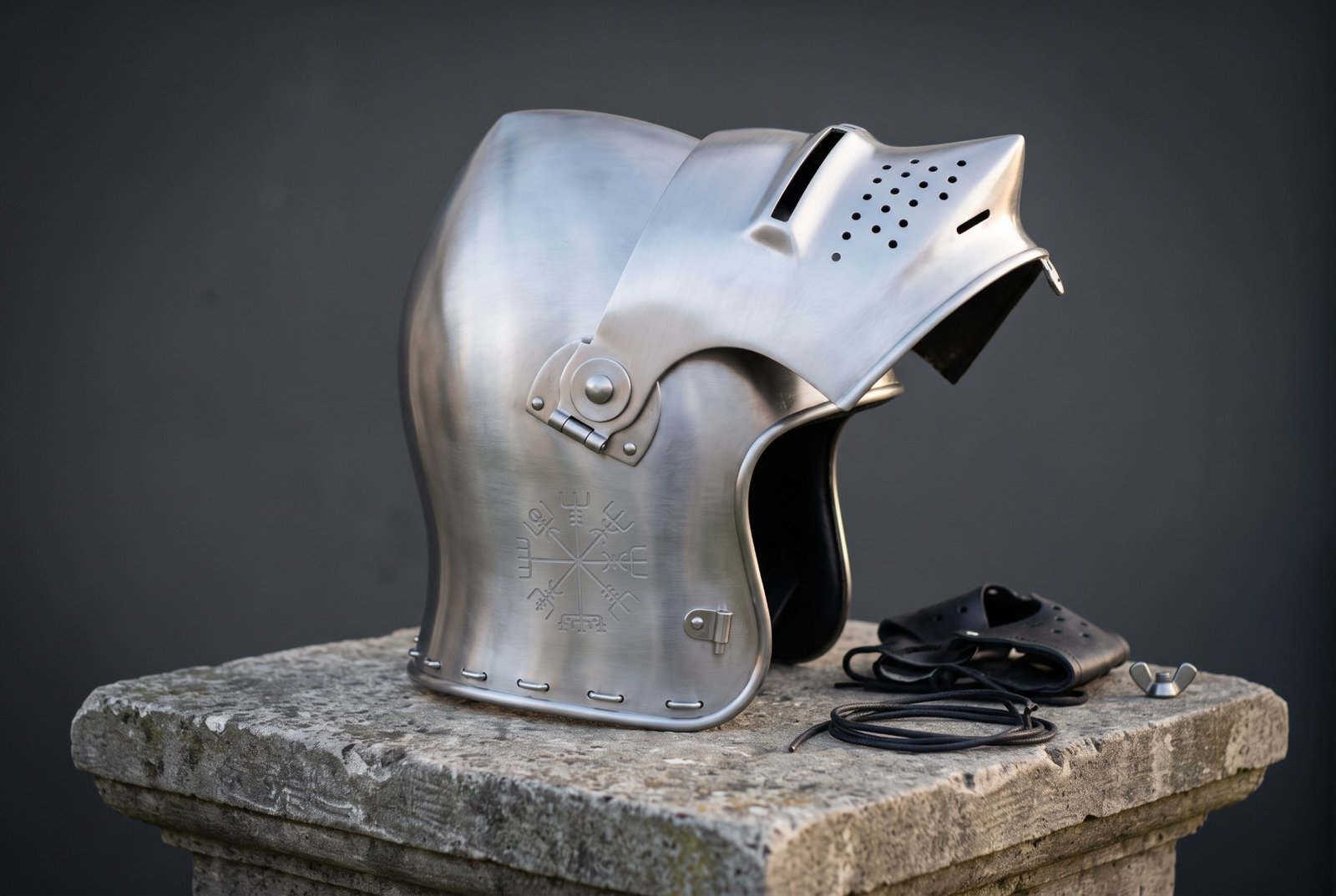
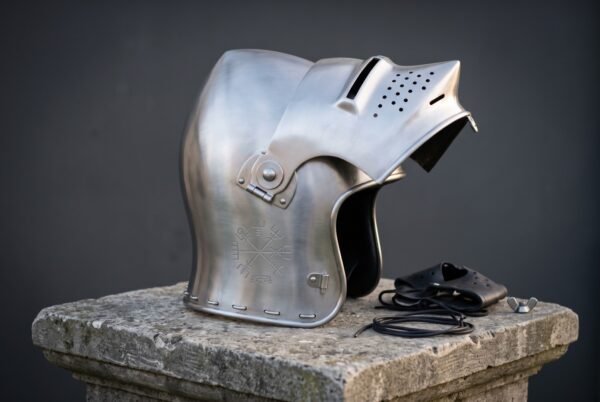
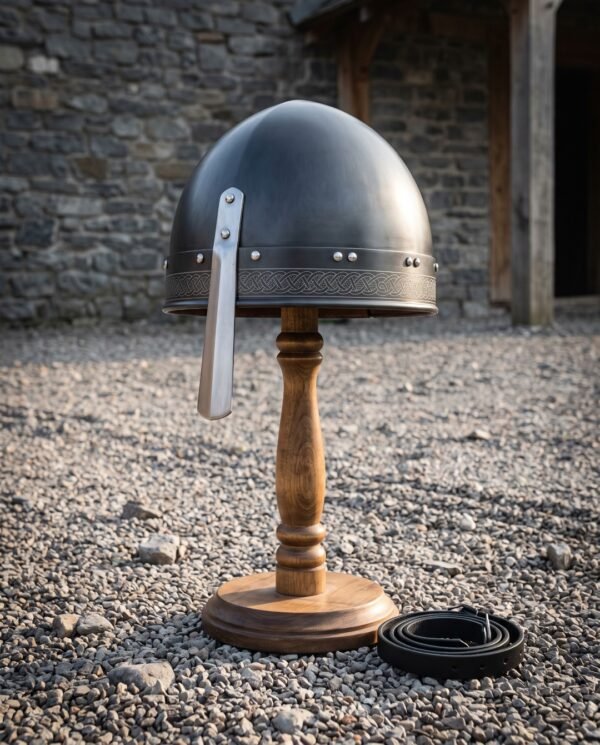
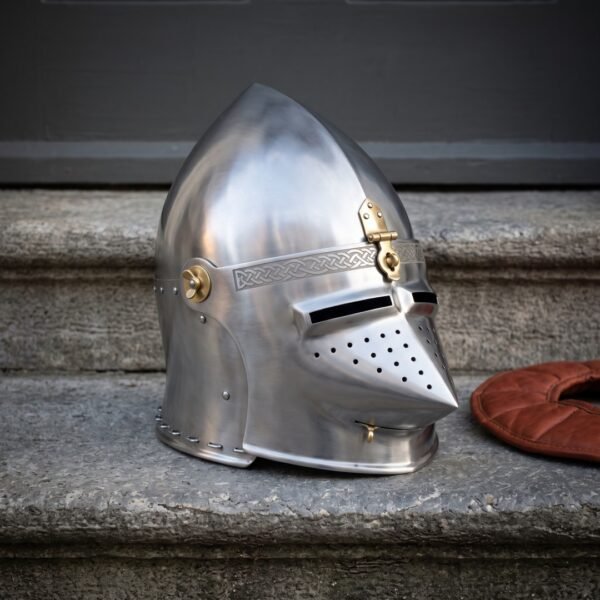
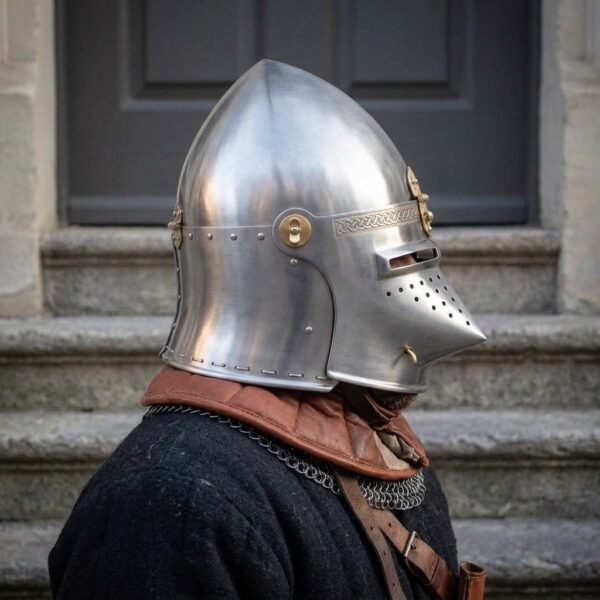
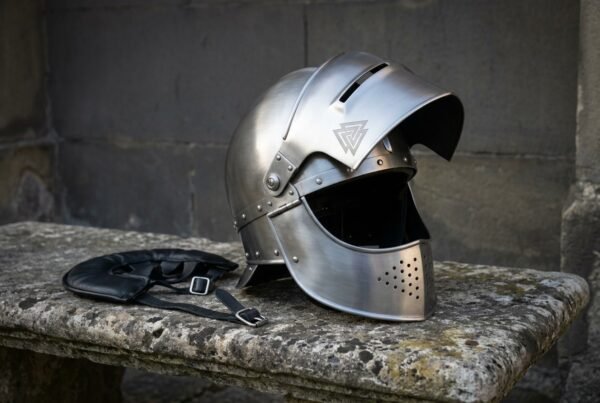
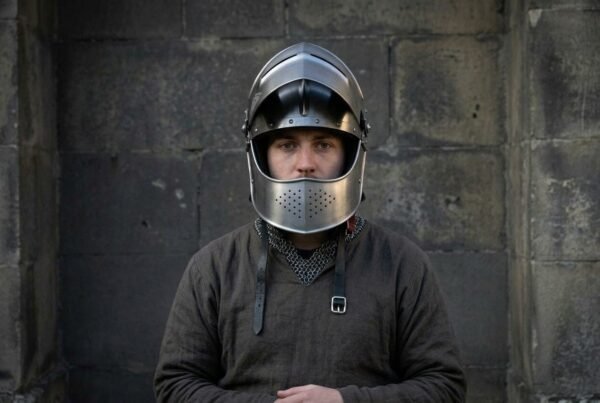
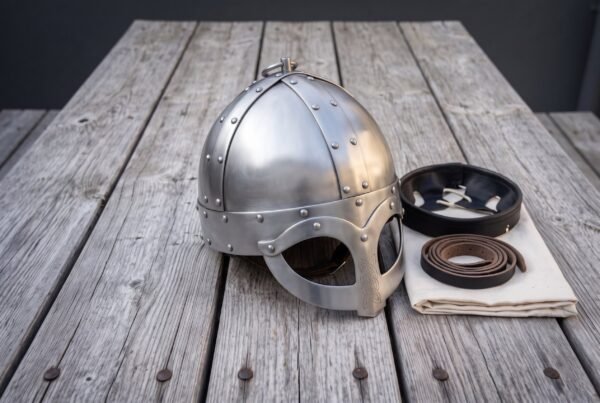
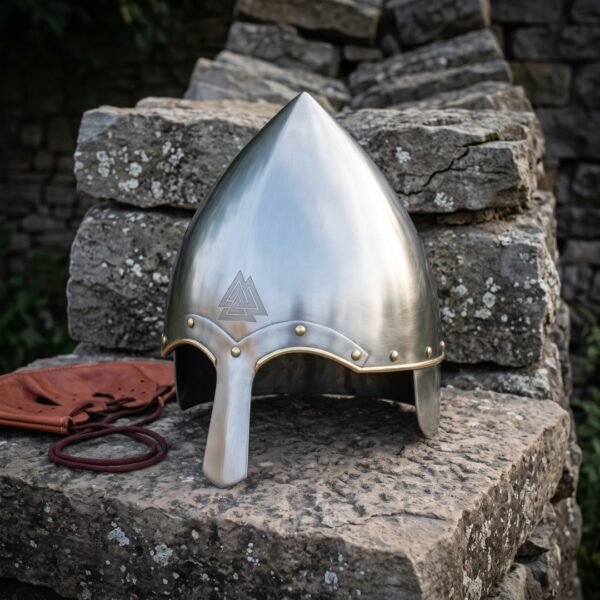
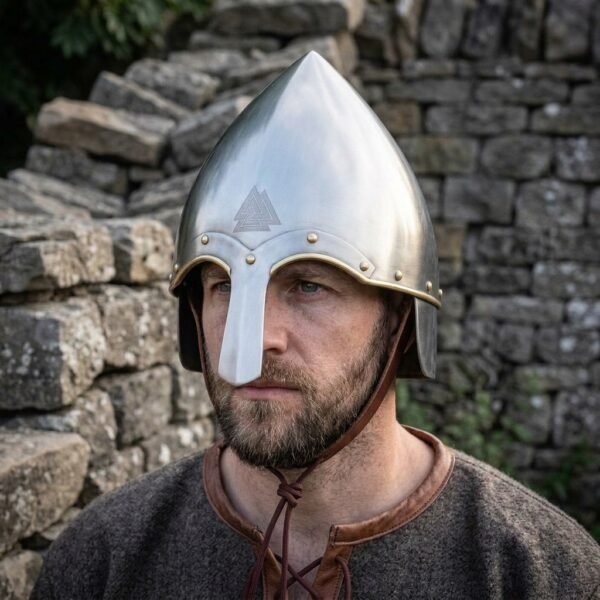
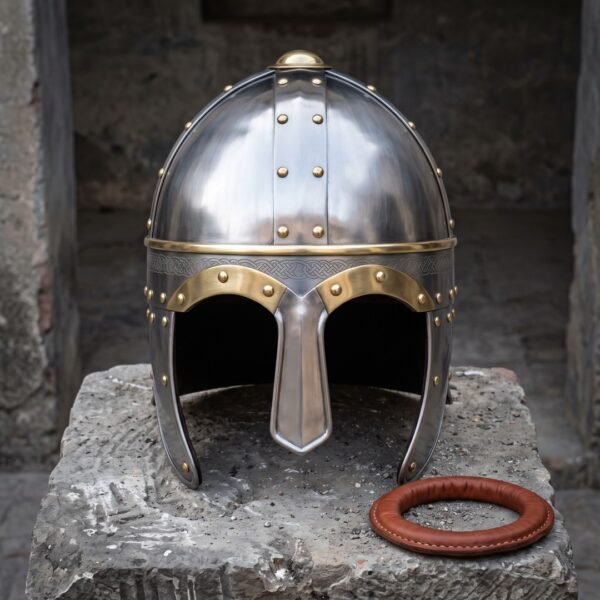
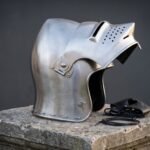
This one is raised and finished in the Czech Republic. The skull drops to the nape with a slight outward flare, the visor pivots on riveted hinges at both temples and carries a vision slit with a cluster of breath holes on its right side, and a Vegvisir compass is chased into the side of the skull. Lining rivet holes run around the lower edge and black leather fittings with a lacing cord and a wing nut are supplied loose, as in the photographs, so you can set them where they suit you. The stone plinth in the photograph is studio furniture and is not included. Fit, steel gauge and the shapes worth avoiding are covered in our notes on buying a helmet.
Specifications
| Material | Mild steel, hand raised and planished, brushed finish |
|---|
| Gauge | 16 gauge, approximately 1.6 mm |
|---|
| Type | Sallet with a skull that runs down to the nape and flares out slightly at the rear edge |
|---|
| Visor | Pointed visor pivoted on riveted hinge plates at both temples, lifts clear of the face |
|---|
| Ventilation | Horizontal vision slit with a cluster of punched breath holes on the right side of the visor |
|---|
| Decoration | Chased Vegvisir compass on the side of the skull |
|---|
| Rivets | Line of rivets around the lower edge of the skull |
|---|
| Fittings | Black leather chin strap pieces, lacing cord and a wing nut, supplied loose |
|---|
| Lining | No liner fitted, worn over an arming cap or mail coif |
|---|
| Size | Fits a head circumference of roughly 22 to 24 inches over an arming cap |
|---|
| Weight | Approximately 5 lb 8 oz |
|---|
| SKU | RK-1476 |
|---|
Why the rear and the visor go together
Look at the profile. The skull runs down at the back to the nape of the neck and flares out slightly at the edge. That shape does two things at once. It covers the back of the neck, which on earlier helmets was left to a mail coif, and it puts steel behind the head to balance a hinged visor hanging off the front, so the helmet does not tip forward every time you look down.
The visor is the other half of the idea. It pivots on rivets set through the temples rather than sliding or lifting straight up, which means one hand can throw it open and it stays open, and gravity holds it shut when it is down. The vision slit is cut fairly generously by fifteenth century standards, and the breath holes are grouped on one cheek rather than both. That asymmetry is genuine practice. Holes weaken the plate, and the right side of the face is the side turned away from an opponent when you stand in a left foot forward guard, so that is where you put them.
Being straight about what this is: a wearable display and living history helmet at 16 gauge. It is not certified combat armour, there is no fitted suspension liner, and mild steel at this weight is display and light reenactment weight, not full contact weight. If you fight in steel, buy a helmet built and inspected to your society’s standard.
Steel and gauge
Sixteen gauge is roughly 1.6 mm and it is the correct weight for a helmet of this shape. Anything lighter and the flared lower edge loses its stiffness and starts to flex, which is exactly where it needs to be rigid. The skull is raised from sheet rather than pressed, so the metal thickens where it climbs into the dome instead of thinning out across the crown.
Armour is described by gauge and by whether it is mild or spring steel, never by blade grades, and there is no hardened edge on a helmet to quote a hardness for. The chased Vegvisir is cut into the surface with a graver rather than acid etched, so the line has a cut edge that catches light instead of a flat frosted bottom.
Engraving, runes and your own design
Use the rune converter on this page to turn a name, a date or a short phrase into Elder Futhark and we will cut it into the steel or the leather. If you would rather have a Viking pattern than a rune line, choose your own design in the engraving option above the add to cart button and tell us where it goes. Where a piece already carries an engraved design, your chosen engraving replaces it rather than sitting alongside it, so the Vegvisir shown here gives way to whatever you choose. The visor face, the skull side and the chin strap are all workable surfaces. See the engraving page.
Fit and sizing
A sallet is sized around the head and it must be worn over padding. The standard build takes a head circumference of roughly 22 to 24 inches measured around the brow, with an arming cap making up the difference. Without a cap the helmet will rotate on your head and the vision slit will end up somewhere useless.
Measure around your head just above the ears and eyebrows, then add the thickness of whatever goes underneath. If you plan to wear a mail coif under the sallet, which is historically correct and looks superb, tell us, because a coif adds a genuine half inch or more all round. Two other things affect fit on a visored helmet that people forget: the length of your face from brow to chin, and whether you wear glasses. Send both and we will set the visor pivots to suit. If your measurements are outside the standard range we will build to your head rather than send you something that does not fit.
Care
The inside of a visored helmet is the wettest part of any harness, because your breath condenses on cold steel and runs down inside the visor. Wipe both faces dry after every wear and keep a film of light machine oil or paste wax on them. Put a drop of oil on the visor pivots occasionally and check the rivets are still tight, since a loose pivot lets the visor rattle and wears the hole oval. Store the helmet upright with the visor open so air can move through it, never sealed in a bag and never with a damp cap inside. Surface bloom lifts with fine steel wool worked along the direction of the polish and then reoiled. Our notes on steel care apply to armour as much as to blades. Steel headgear wants the same care as mail, set out in caring for chainmail and steel armour.
Made in the Czech Republic
This is a handmade piece from the Czech Republic, made in a workshop that still forges, grinds and finishes by hand instead of stamping parts out. The smiths there have kept the older way of working, and the wood, horn and leather are shaped and fitted by hand as well. Two pieces of the same design will never be identical, and that is part of what you are buying.
Ransack Viking is a United States company. We handle the import ourselves, look over every piece when it lands and ship from our warehouse in Chicago, Illinois. Engraving is done in the United States after the piece arrives, so your design goes on before we send it out.
A note on handmade variation
This helmet is hand made, not machine made or bulk produced, so what arrives will not be a pixel for pixel copy of the photograph. The exact flare of the rear edge, hammer texture under the polish, rivet placement and the depth of the chased line all vary, because every helmet is worked by hand from natural materials. The dimensions, the material and the build are the same every time. The character is not.
Frequently asked questions
Does the visor actually open?
Yes. It swings on riveted pivots at both temples, opens with one hand and stays where you put it. It is a working hinge, not a fixed decorative front.
Is it wearable or display only?
Fully wearable, sized to your head, and intended for display, living history and costume. It is not certified combat armour and should not be used for full contact fighting.
Is a liner fitted?
Not fitted. Rivet holes are set around the lower edge, the black leather fittings and lacing cord shown in the photographs come loose in the box, and the helmet is sized to be worn over a separate arming cap or a mail coif.
Can I wear glasses under it?
Often yes, but tell us before we build. Glasses change where the vision slit needs to sit relative to your eyes and we can set the visor accordingly.
Why are the breath holes only on one cheek?
Because that is historical practice. Perforating a plate weakens it, so the holes go on the side turned away from an opponent rather than on both cheeks.
How long does it take to ship?
Processing is one to two weeks because the skull is raised and fitted to your size. Shipping inside the United States is free and returns are accepted within seven days.
What is in the box
- One hand raised steel sallet with a hinged visor
- Hinged visor fitted on riveted temple pivots
- Black leather chin strap with buckle hardware, supplied loose
- Chased Vegvisir, or your own engraving in its place
- Light protective oil coat applied before packing
- Care and storage card
- Forged and finished in the Czech Republic
Explore the range
See more in medieval helmets, plate armor, chainmail armor and engraved and personalized, or read the guides.
Also in this part of the catalogue
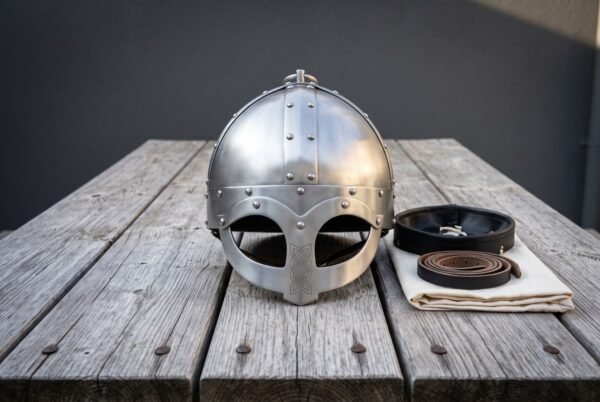
Next along the rack is the Cruxward Medieval helmet. For a straight comparison, see the Nightcrux Medieval helmet. Worth putting side by side with this is the Grimbeak Medieval helmet.
If you are putting a set together, the Stormquilt gambeson sits alongside it. Or start from a blank sheet on the design your own page.



Reviews
There are no reviews yet