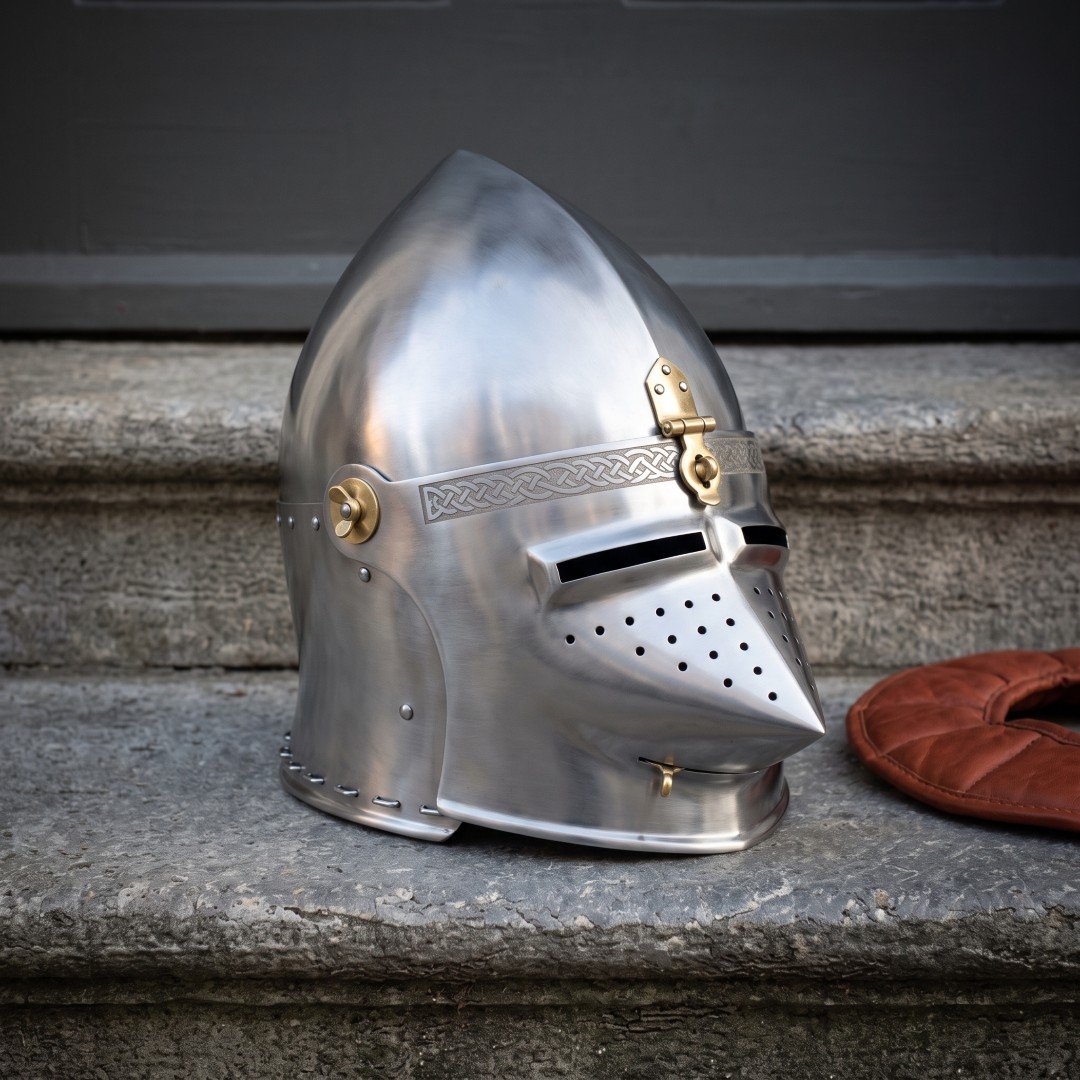
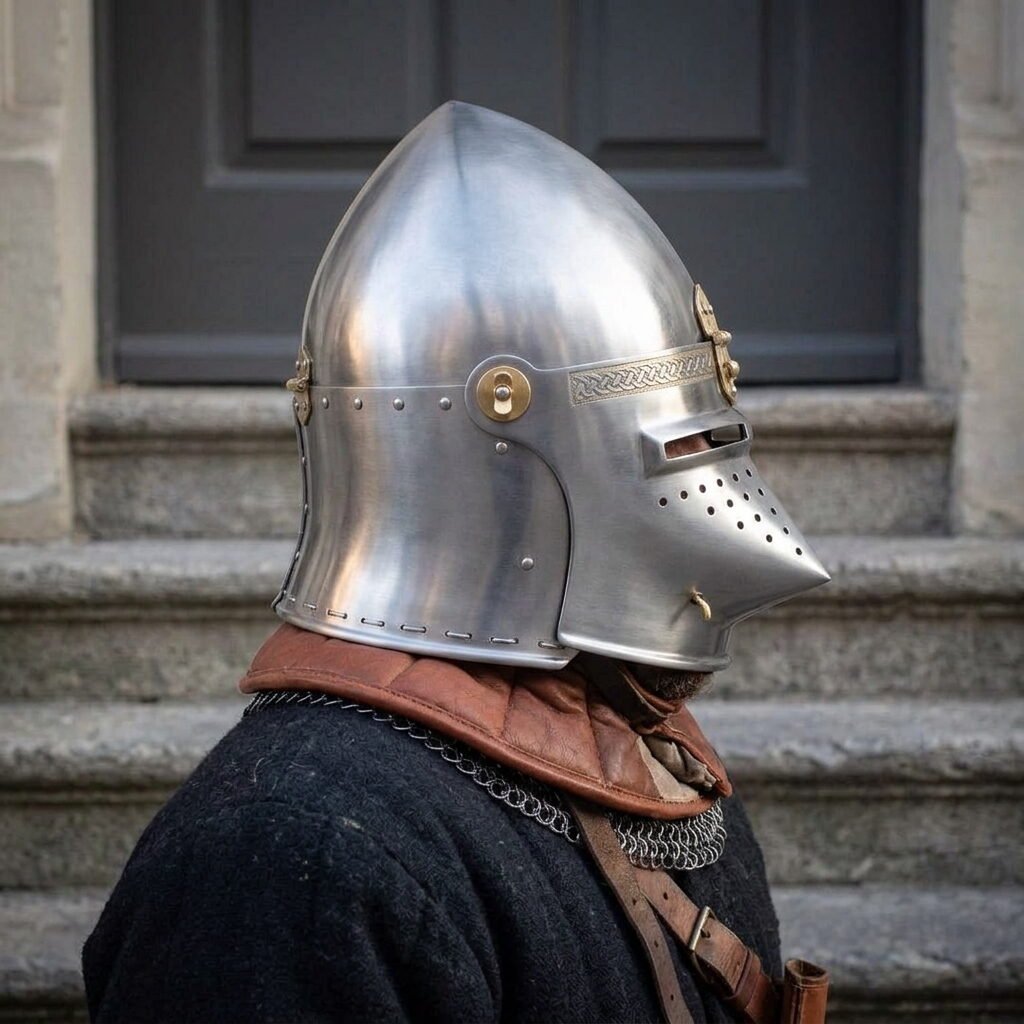
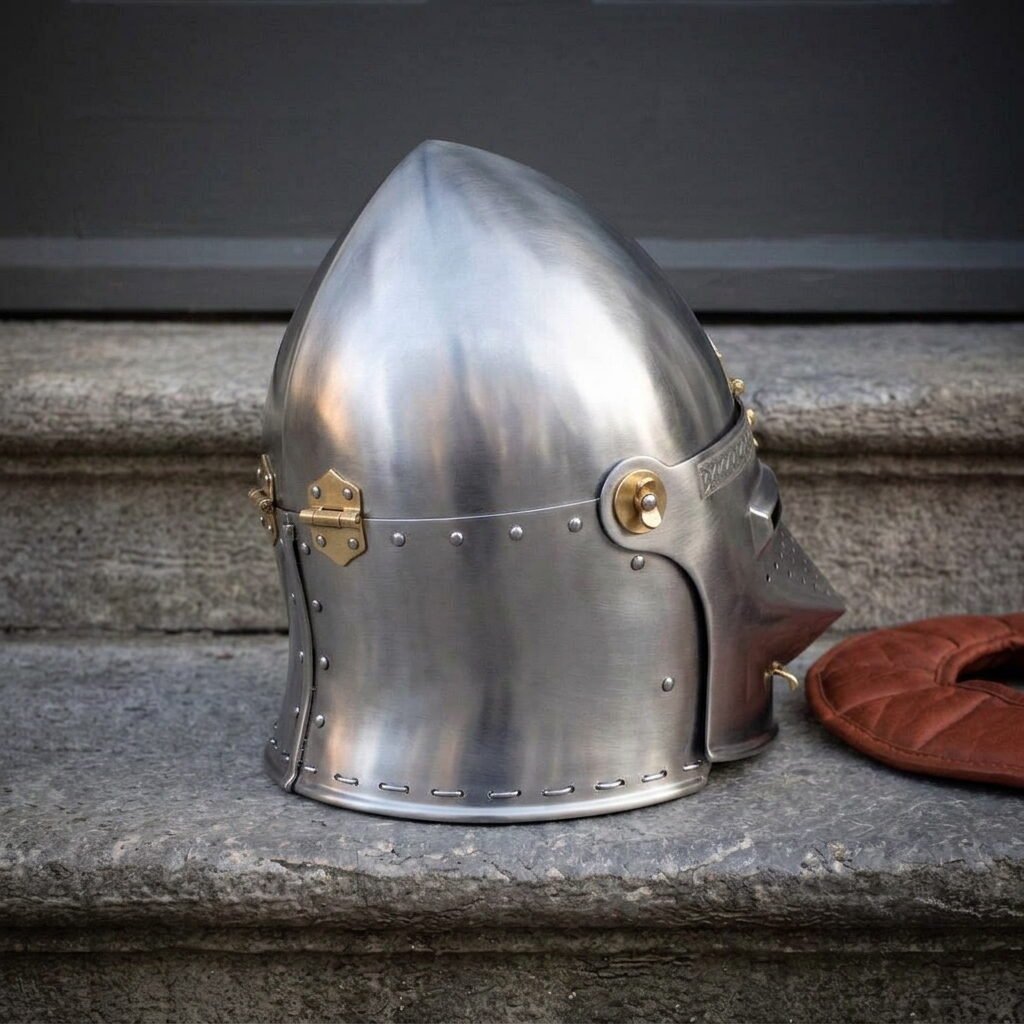
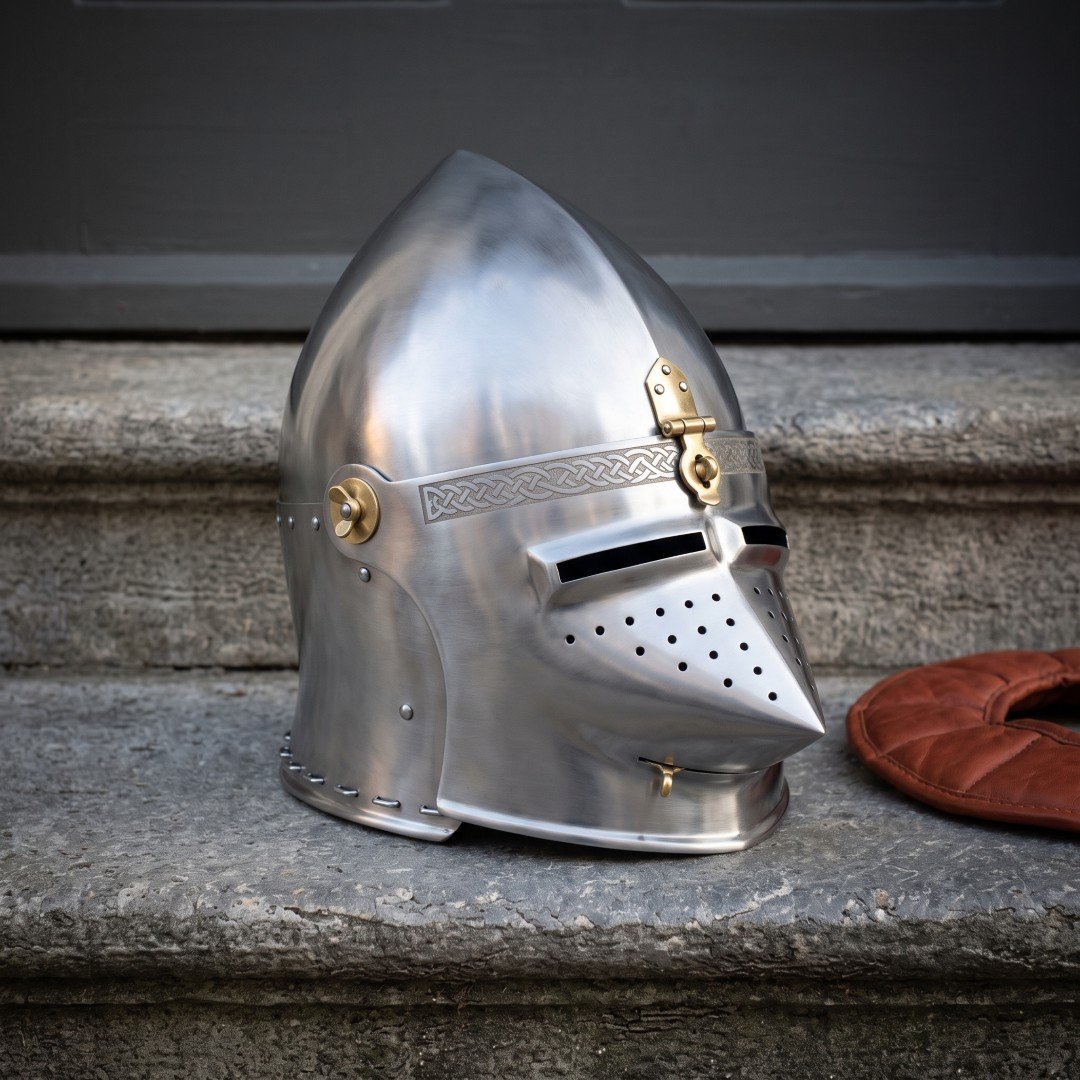
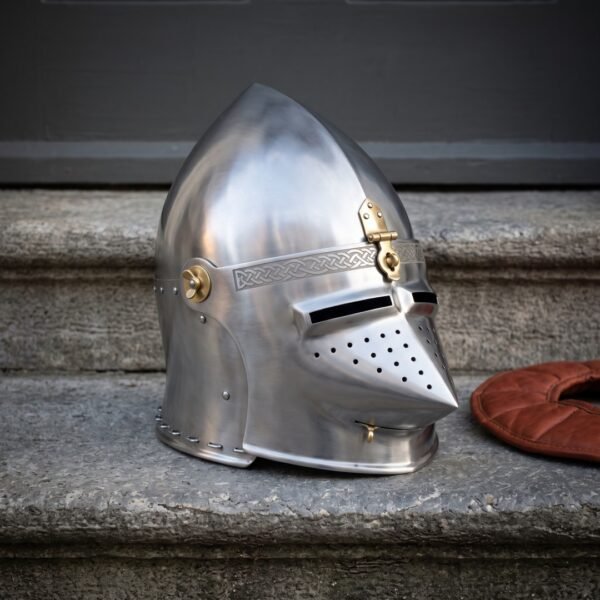
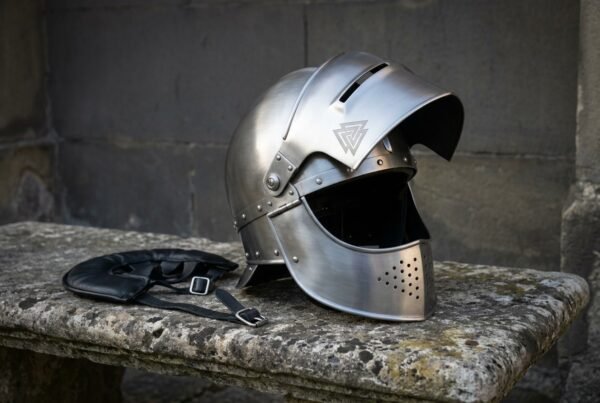
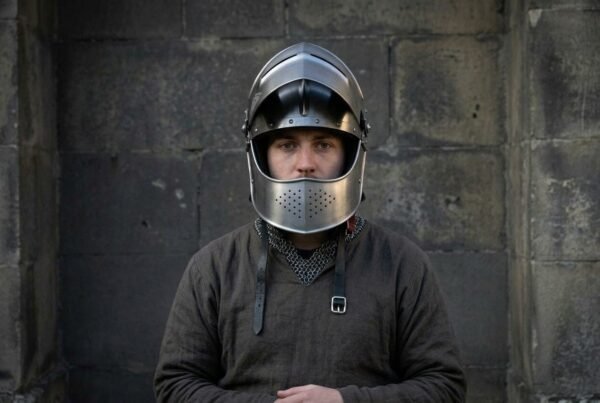
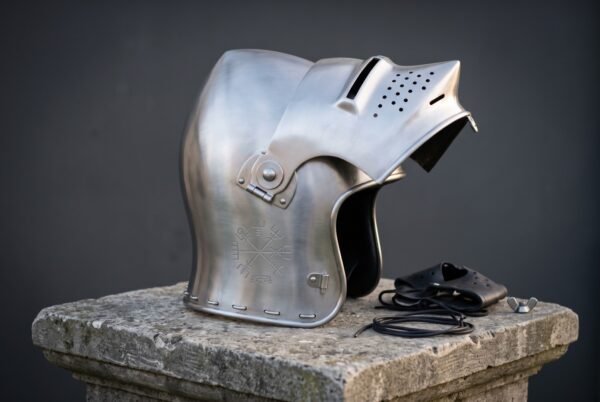
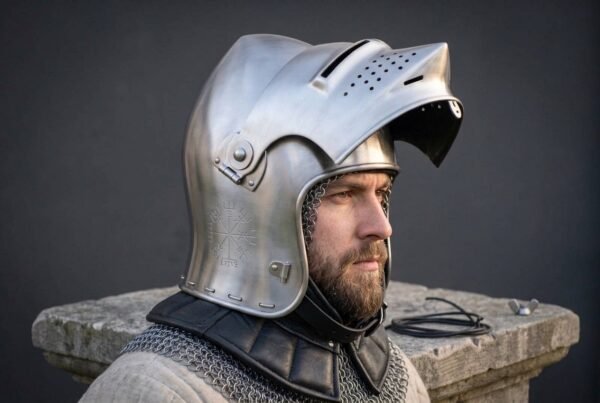
The Grimbeak is a bascinet with a pointed hounskull visor, the helmet that most people picture when they picture a fourteenth century knight. The skull is raised to a tall ogival point that sweeps back over the crown, the visor hinges at two brass mounts on the temples and latches at the side, and a band engraved with interlace runs across the brow where the visor pivots. Below the eye slit the snout is drilled with a field of breath holes on the right side only.
That asymmetry is a real detail from the originals rather than a decorative choice. On many surviving visors the breaths are cut heavily on one side and sparsely on the other, because the left side of a jousting or fighting knight is the side that takes the lance. Air on the right, solid steel on the left. The Germans called the whole thing a Hundsgugel, a dog hood, and it dominated European harness from roughly 1370 to 1410 before the great bascinet and the armet replaced it. Every Grimbeak is raised, drilled, hinged and finished in a Czech Republic workshop. Fit, steel gauge and the shapes worth avoiding are covered in our notes on buying a helmet.
Specifications
| Material | Mild steel sheet, hand raised, polished satin, with brass fittings |
|---|
| Gauge | 18 gauge, approximately 1.2 mm |
|---|
| Style | Bascinet with a pointed hounskull visor and a flared neck |
|---|
| Visor | Pivots on round brass mounts at the temples, single vision slit, breath holes drilled to one side, brass latch pin at the lower edge |
|---|
| Decoration | Engraved interlace band across the brow and a brass hinge plate on the visor |
|---|
| Rivets | Row of steel rivets around the lower edge of the skull |
|---|
| Head size | Fits approximately 22 to 24 inch head circumference |
|---|
| Weight | Approximately 5 to 6 pounds |
|---|
| Lining | None fitted, intended to be worn over a padded arming cap |
|---|
| Intended use | Display, film and light reenactment. Not rated for full contact combat |
|---|
| SKU | RK-1495 |
|---|
Why the visor comes to a point
A flat visor stops a blow by absorbing it. A pointed one tries never to absorb it at all. Every surface on a hounskull snout is angled away from the centre line, so a lance head, a sword tip or a mace that comes in level with the face meets a sloped plane and slides off to the side. The steel does not have to be thick if the geometry does the work, and that is the entire design philosophy of late fourteenth century head armour.
The point buys two other things. It creates a pocket of air in front of the mouth, so a man in a closed helm is not breathing against a plate an inch from his lips, which matters enormously when you are working hard. It also lets the wearer be heard. Sound out of a flat visor is muffled and directionless. Sound out of a snout is projected forward, which is why the men who had to give orders wore them.
The vision slit is deliberately narrow and set under a brow that overhangs it. You lose peripheral vision and you gain a face that cannot be reached by a point. Because the visor is hinged rather than fixed, it lifts clear for eating, talking and breathing between bouts, and on the originals it could often be lifted off entirely at the hinges so the bascinet could be worn open. Our brass hinges do the same job and the latch on the side holds the visor closed against its own weight.
The steel and the gauge
The skull is raised from a single sheet of 18 gauge mild steel, roughly 1.2 mm, and finished to a satin polish. Eighteen gauge is the display and light reenactment weight. It is right for events, photography, stage and film work, and it keeps the helmet at five to six pounds so it is comfortable to wear for a long day. It is not battle rated. Societies that fight full contact in steel specify much heavier stock, usually 14 gauge or thicker and often in hardened or spring steel, and the Grimbeak is not built or certified to those standards. We would rather set that out clearly on the product page than let a buyer discover it in the line.
Mild steel is chosen for the raising itself as well as the price. A helmet skull is beaten out of a flat disc into a deep compound curve, and a work hardening alloy fights that process and splits at the rim. Mild steel moves cleanly, takes the planishing, and dents rather than cracks if it is ever knocked. The brass hinges, latch and trim are cut and fitted by hand and will mellow with age.
Engraving, runes and your own design
Use the rune converter on this page to turn a name, a date or a short phrase into Elder Futhark and we will cut it into the steel or the leather. If you would rather have a Viking pattern than a rune line, choose your own design in the engraving option above the add to cart button and tell us where it goes. Where a piece already carries an engraved design, your chosen engraving replaces it rather than sitting alongside it. On the Grimbeak the brow band is the obvious place, and a rune line there takes the place of the interlace already cut into it. A motto along the lower edge of the skull is the other common request. Full detail is on the engraving page.
Fit and sizing
This helmet is made to a stated size, not moulded to your head. Take a tape around your skull just above the ears and across the brow, then allow for the arming cap that goes underneath. A padded cap adds roughly half an inch to three quarters of an inch to that circumference and a heavily quilted one adds more.
With a visored helmet the vertical position matters more than it does with an open helm. If the helmet sits too low the vision slit drops below your eye line and you find yourself looking at the inside of the steel. If it sits too high the chin is exposed. Padding at the crown of the arming cap is how you tune that, and half an inch of extra wool at the top of the cap will move the slit exactly where you want it.
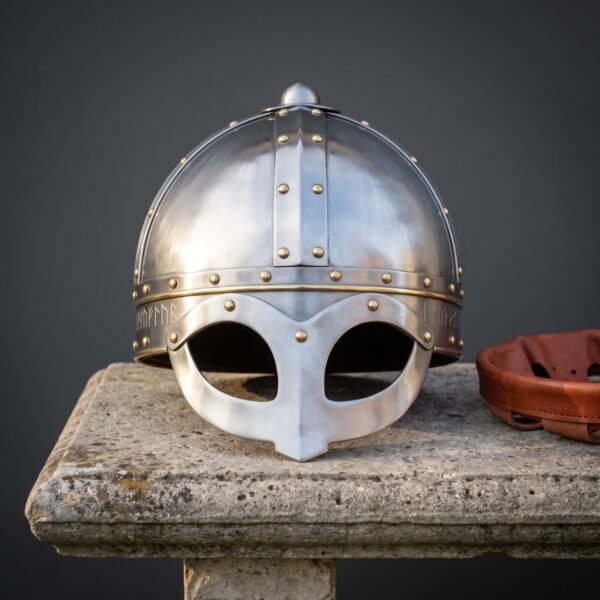
Never wear it bare headed. Steel resting directly on the skull is uncomfortable within minutes and offers no protection from impact at all, because there is nothing to spread the load. The padded leather cap shown beside the helmet in the photograph is a photography prop and is not included.
Care
Polished mild steel wants oil and dry air. Wipe it down with a lightly oiled cloth after each handling session, because sweat and fingerprints will etch a satin finish within days if they are left on it. Work oil into the visor hinges once or twice a year so the pivots stay smooth, and check the latch for wear. Store it on a stand or a shelf with the visor closed but not latched, so the hinges are not carrying weight in one position for months at a time. Silica gel in a display case is worth more than any coating if your room is humid. Our full notes on protecting bare steel are on the steel care page. Steel headgear wants the same care as mail, set out in caring for chainmail and steel armour.
Made in the Czech Republic
Every piece we sell is made by hand in the Czech Republic. The smiths there work the way the trade has been worked for a long time, heating and hammering the steel, taking the bevels down by eye, and fitting the handle and the leather one at a time. There is no automated line anywhere in it, so small differences from one piece to the next are normal and expected.
Ransack Viking is a United States company based in Chicago, Illinois. We bring the pieces in ourselves, inspect them on arrival and ship them from our own warehouse. If you add engraving, that is carried out here in the United States before your order goes out.
A note on handmade variation
This helmet is hand made, not machine made or bulk produced, so what arrives will not be a pixel for pixel copy of the photograph. The planishing texture on the skull, the exact sweep of the snout, the pattern of the drilled breaths and the tone of the brass vary from one helmet to the next, because each one is worked by hand from natural materials. The dimensions, the material and the build are the same every time. The character is not.
Frequently asked questions
Does the visor open
Yes. It is hinged on brass mounts at the temples and lifts clear of the face, with a side latch that holds it closed. You can wear it open or closed and change between the two without tools.
Can I fight in it
Not in full contact steel combat. At 18 gauge this is a display and light reenactment helmet. Combat societies require heavier and usually hardened stock, and this is not certified to their standards.
How well can you see and breathe
You see through one narrow slit, so forward vision is clear and peripheral vision is poor. Breathing is better than most people expect, because the snout holds a pocket of air in front of the mouth and the drilled breaths let it move.
Why are the holes only on one side
Because that follows the originals. The left side faced the incoming lance, so it was left solid, and the air holes were concentrated on the right. It is a real historical detail rather than a manufacturing shortcut.
Does it come with a liner or a chin strap
No liner is fitted. It is designed to be worn over a padded arming cap, which is the period correct arrangement and gives a far better fit than glued in foam. The leather cap in the photograph is a prop and is not included.
When will it arrive
Processing is one to two weeks because each helmet is raised and fitted to order, and shipping is free within the United States. Add a few days if you have ordered engraving.
What is in the box
- One Grimbeak pig faced bascinet in 18 gauge mild steel
- Hinged hounskull visor with brass hinge plates and a side latch
- Engraved interlace brow band
- Care card covering oiling the steel and the hinges
- Lifetime warranty against defects in forging, grind, heat treat and fittings
- Forged and finished in the Czech Republic
Explore the range
See more in medieval helmets, Viking helmets and plate armor, or read the guides before you choose a size.
Near neighbours in the shop
Sitting beside it in the catalogue is the Aegiscrest Greek helmet. Another in the same line is the Crimsonlace lamellar armor. Next along the rack is the Beakshade leather armor.
Fitting out further, the Wyrmgaze Viking helmet belongs with it. You can have this made your way instead on the design your own page.

Was nervous ordering something like this online but so glad I did. Rivets and trim are all solid. Nothing feels flimsy. Will definitely order again for another gift.