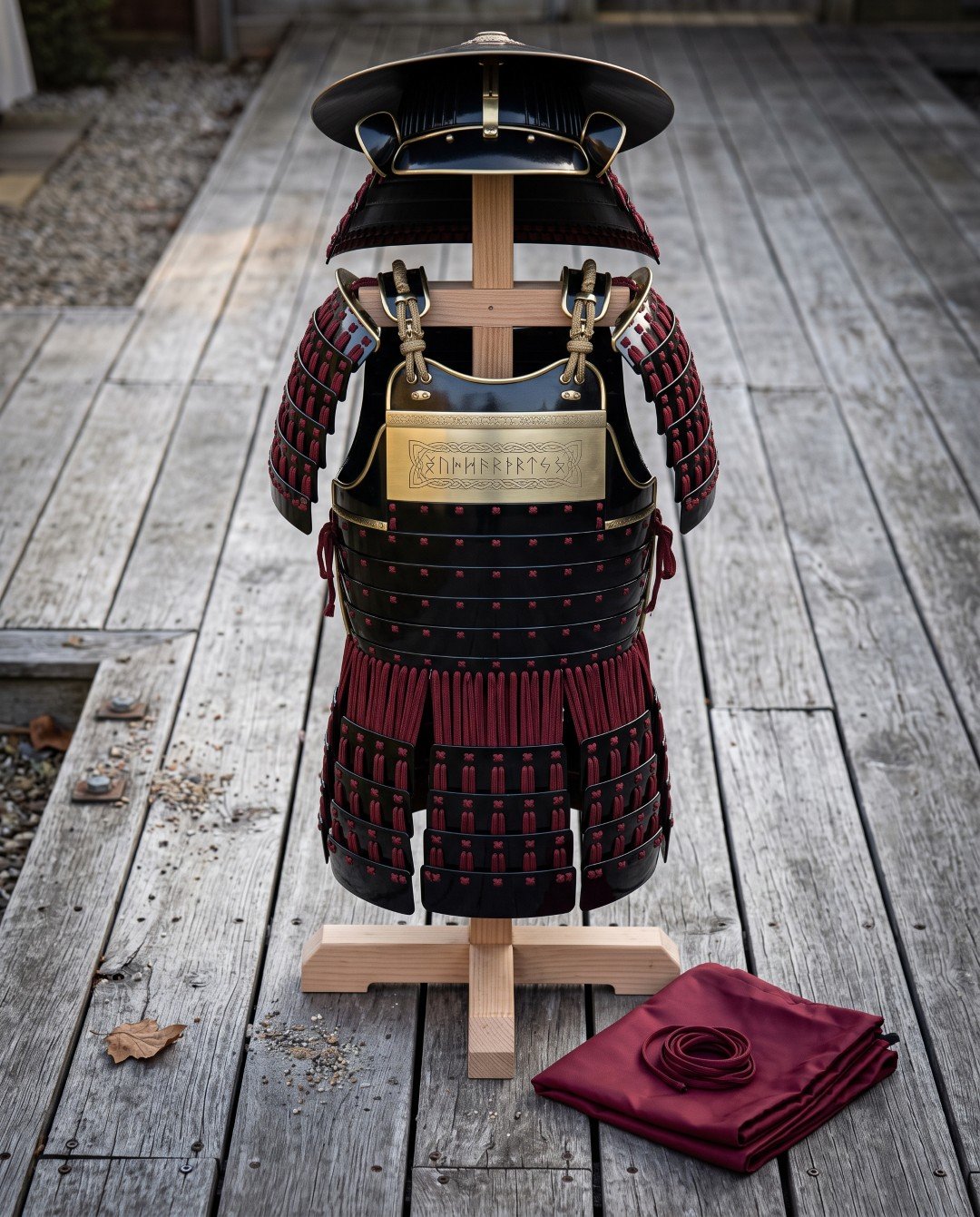
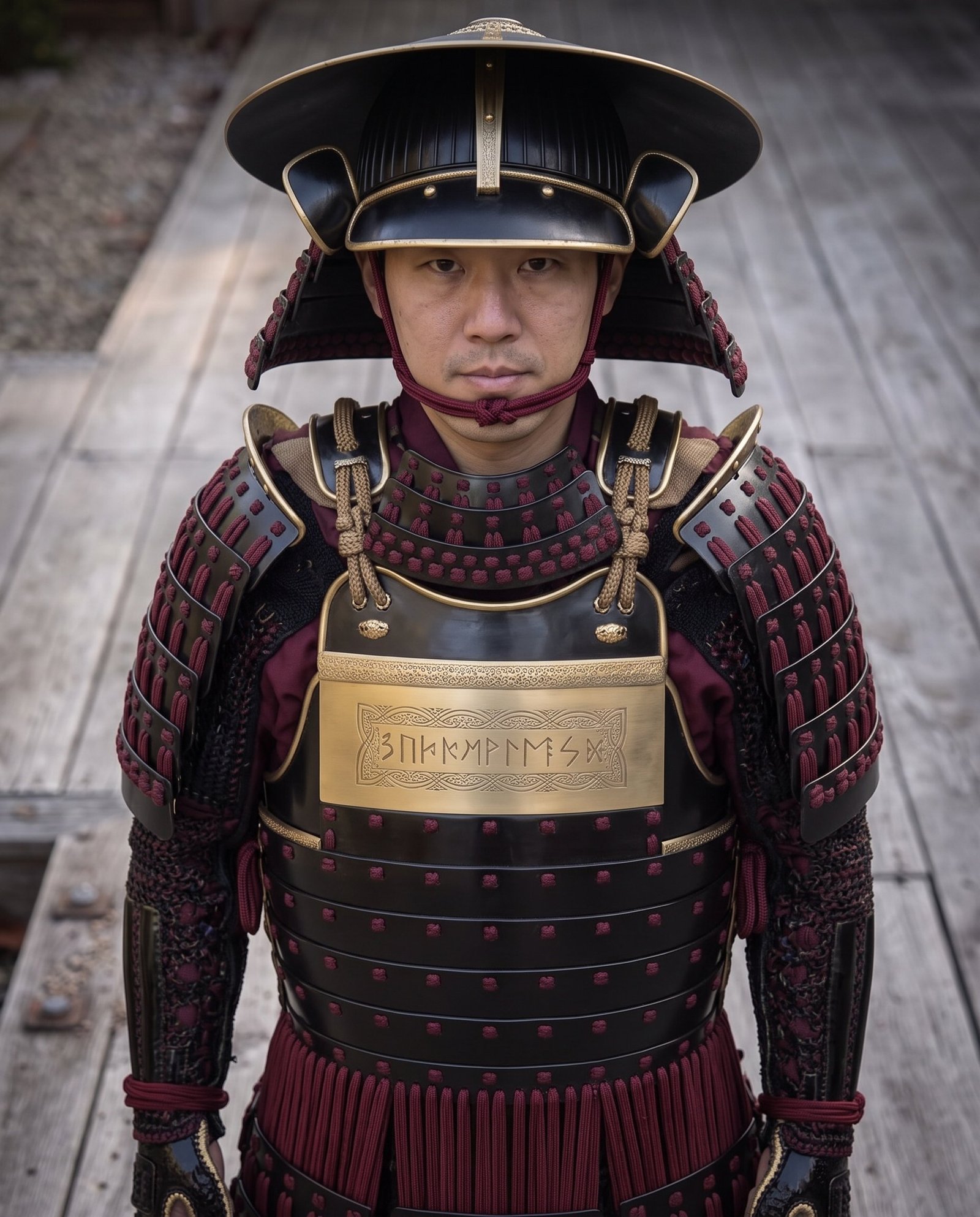
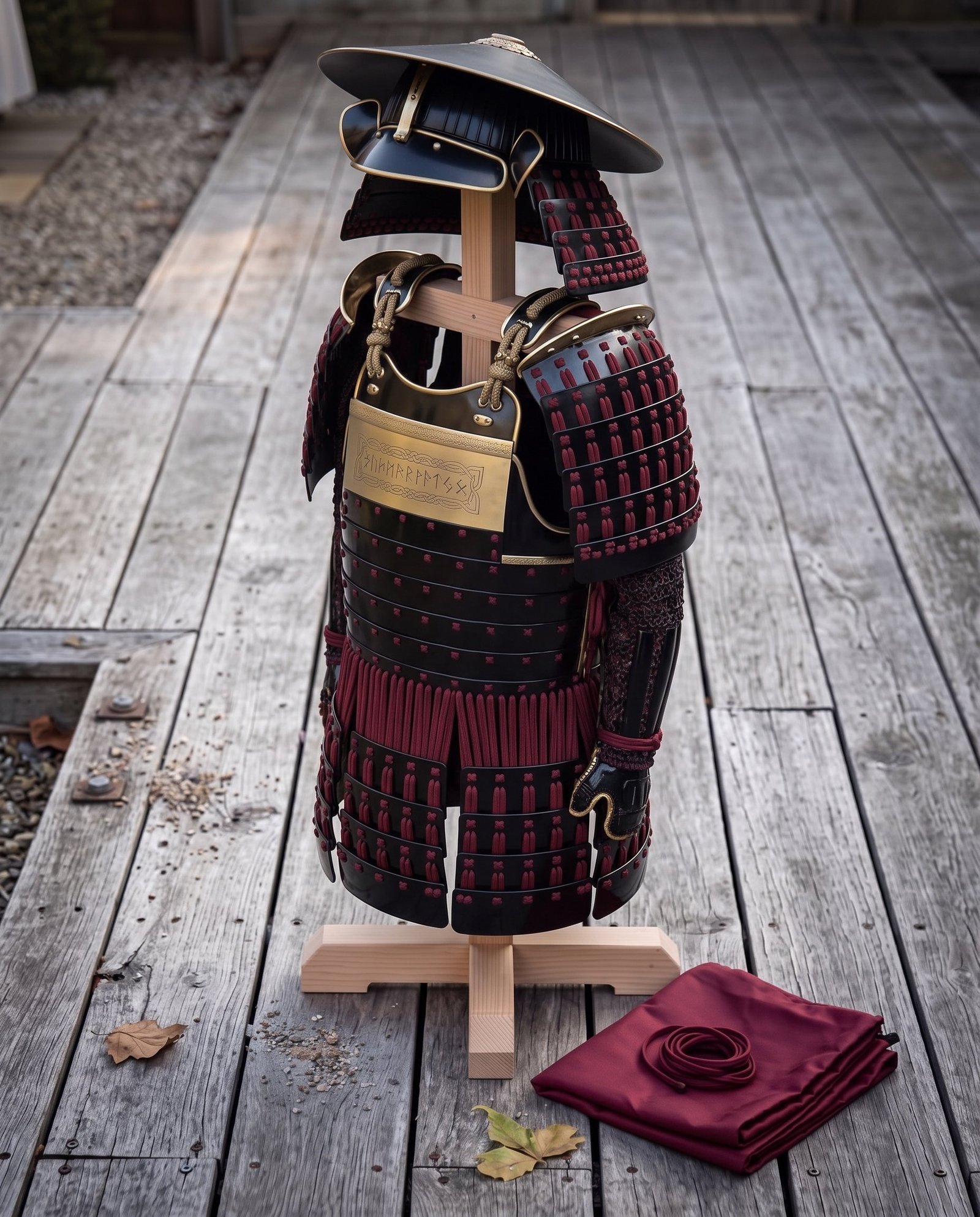
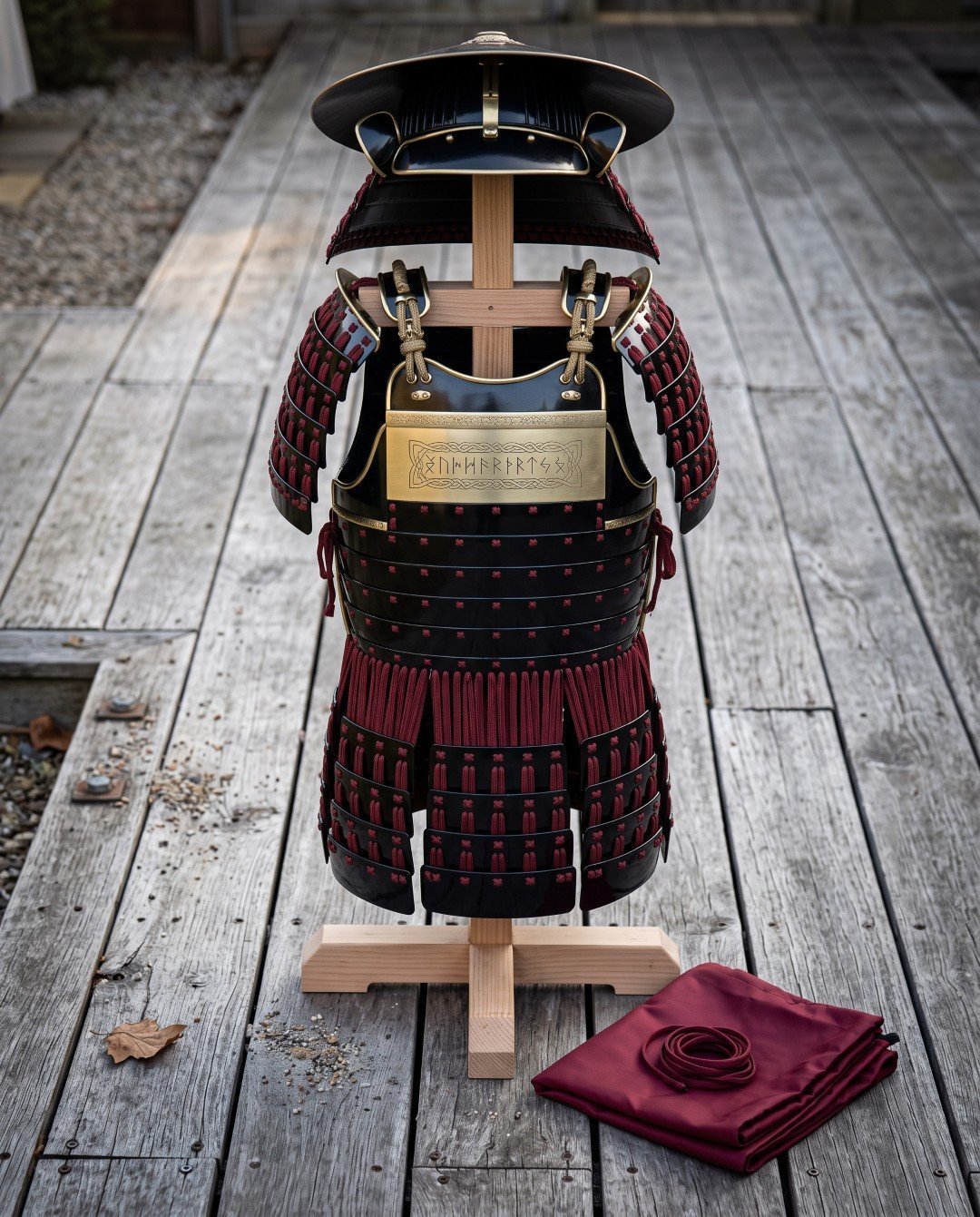
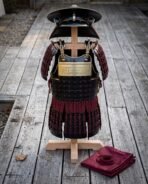
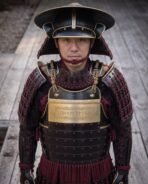
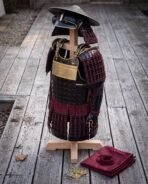
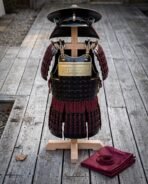
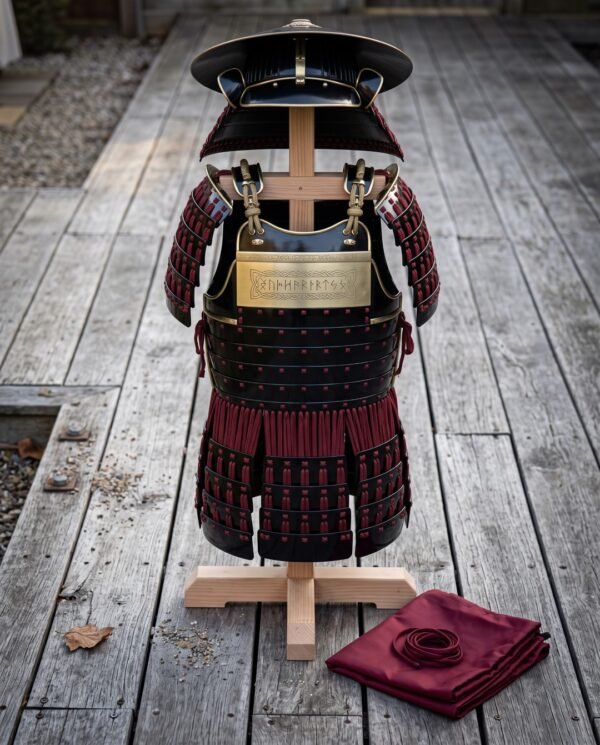
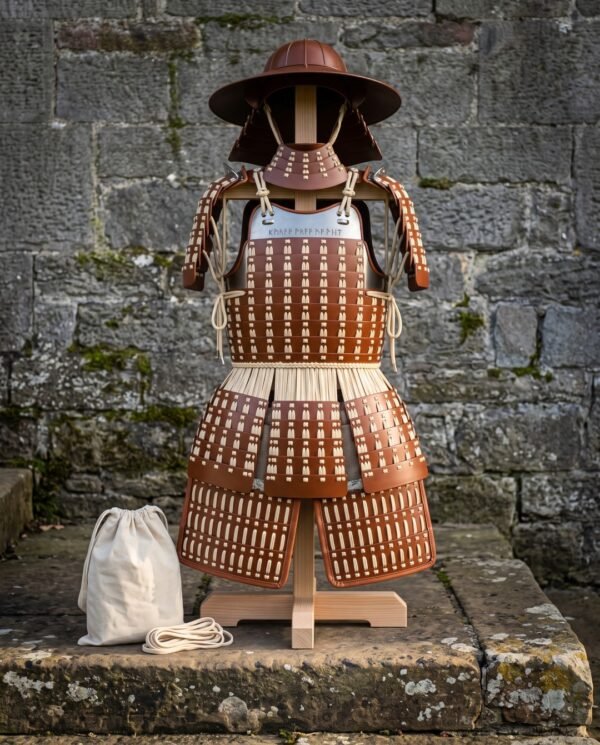
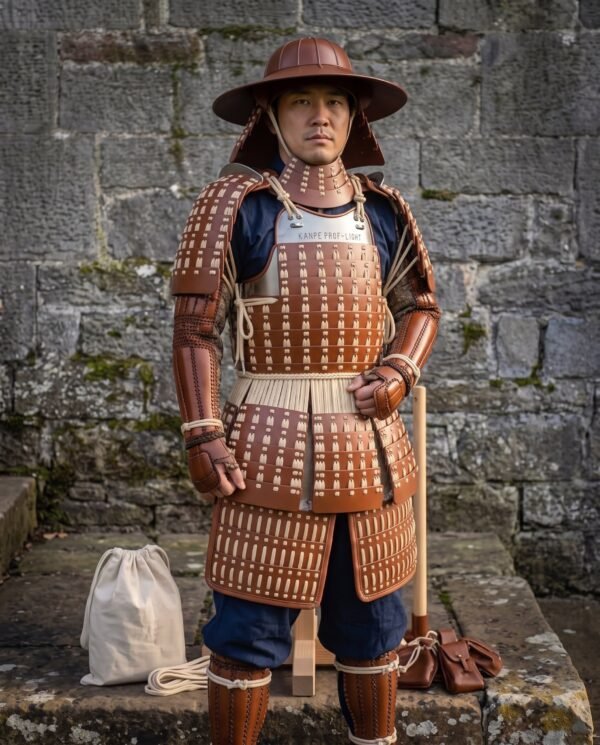
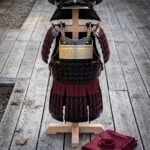
This is a samurai armour set rather than anything Norse, and it is listed here as exactly that. A black lacquered steel cuirass built from lamellar plates laced together with deep crimson cord, a pair of sode hanging at the shoulders, a skirt of kusazuri hanging in panels below the waist, and a broad brimmed lacquered jingasa with a brass finial and a lacquered neck guard behind it. The one thing on it that is not Japanese is the large engraved brass plaque across the chest, which carries an Elder Futhark rune line inside a knotwork border. The lacing is the heart of the whole system. In Japanese armour it is called odoshi, and the colour of the cord was a statement of allegiance and rank long before it was a fashion choice, with crimson among the most prized because good red dye was expensive and it read clearly across a battlefield.
Every plate is cut, formed, lacquered and laced in a Czech Republic workshop, and the brass plaque is engraved here. It ships as the armour set. The wooden stand it hangs on and the folded crimson cloth and cord on the ground in the photograph are studio props and are not included. Scale and lamellar fail differently from mail, which we compare in chainmail versus plate versus lamellar.
Specifications
| Type | Samurai style lamellar armour set, do maru form |
|---|
| Plate material | Mild steel, 18 gauge, black lacquered |
|---|
| Lacing | Crimson cord odoshi throughout |
|---|
| Body | Lacquered do with a brass edged solid upper breast and horizontal lacquered rows below, laced in crimson |
|---|
| Shoulders | Pair of sode in lacquered rows, laced in matching crimson |
|---|
| Shoulder straps | Brass edged straps tied with tan cord |
|---|
| Skirt | Kusazuri panels hanging from the waist line |
|---|
| Helmet | Broad brimmed lacquered jingasa with brass rim, brass finial, brass edged turnbacks and a laced lacquered neck guard |
|---|
| Breast plaque | Engraved brass plaque with an Elder Futhark rune line inside a knotwork border |
|---|
| Stand | Not included |
|---|
| Use | Display, costume, stage and film |
|---|
| SKU | RK-1543 |
|---|
How lamellar differs from scale and from plate
People use scale and lamellar as if they were the same word. They are not, and the difference is structural. In scale armour every plate is fixed to a backing of leather or cloth, and the backing carries the load. In lamellar there is no backing at all. Each small plate is drilled with rows of holes and laced directly to its neighbours, above, below and to either side, so the cords themselves are the garment. Take the plates away and you have a net. Take the cords away and you have a pile of steel.
That gives lamellar two properties nothing else has. It is enormously strong for its weight, because the load spreads through the whole lattice of cord rather than through one line of stitching, and it can be repaired anywhere by anyone with cord and a needle. It also flexes in a very specific way. Rows slide over each other vertically but resist spreading horizontally, which is why a lamellar cuirass bends at the waist but does not gape at the sides.
Its historic weakness was water. Wet cord stretches and rots, wet lamellar gets heavy and slack, and Japanese armourers spent centuries lacquering plates and later switching to solid plate sections precisely to reduce the amount of exposed lacing. The solid upper breast on this cuirass is that same idea.
Lacquer, steel and honest limits
The plates are 18 gauge mild steel finished in black lacquer. Lacquer on Japanese armour was never decoration alone. It sealed the steel against rust in a very humid climate, it stiffened the plate slightly, and it gave a surface that shed rain rather than soaking it up, which mattered enormously for an armour held together with cord.
Be clear on what this is for. At 18 gauge this is display and light reenactment weight. It is not certified armour, it is not rated for full contact combat of any kind, and it should not be worn into any bout where somebody strikes at you. Lacquer chips under impact and cord cuts, so a contact hit does cosmetic damage even when it does no other harm. This set is right for display, for collections, for costume, for stage and film work, and for photography. It is a magnificent thing on a stand and it should live on one.
Engraving, runes and your own design
Use the rune converter on this page to turn a name, a date or a short phrase into Elder Futhark and we will cut it into the steel or the leather. If you would rather have a Viking pattern than a rune line, choose your own design in the engraving option above the add to cart button and tell us where it goes. Where a piece already carries an engraved design, your chosen engraving replaces it rather than sitting alongside it, so on this set your line takes the place of the rune line on the brass breast plaque. Given the piece, a good number of buyers ask for a Japanese kanji or a family mon on that plaque instead of runes, and we will cut that if you send us the artwork. Full detail is on the engraving page.
Display and mounting
This set is designed to be shown on an armour stand, which is how Japanese armour has always been stored, and a proper stand does more than look right. It carries the weight of the do on a shoulder bar so the lacing is not loaded, it holds the kusazuri hanging free so the cords do not take a permanent bend, and it keeps the sode from crushing. Do not hang the set from a hook through the shoulder mounts, do not fold it into a box, and do not stack anything on top of it.
Give it a spot out of direct sunlight, because ultraviolet light fades crimson dye faster than any other colour on the piece, and away from a radiator or a fireplace, since dry heat makes lacquer brittle. If you are shipping or moving it, take the helmet off first and support the do from underneath rather than lifting it by the shoulder straps.
Care
Lacquer wants a soft dry cloth and nothing else. Do not use solvents, alcohol, furniture polish or any household spray on it, because most of them will haze the surface permanently. Dust the plates and let the cord alone as much as possible, since handling is what frays odoshi. If a section of lacing loosens over time, it can be relaced rather than replaced, which is the whole advantage of the construction. Keep the brass fittings clean with a soft cloth and only polish them if you want them bright. Never get the cord wet, and if it does get damp, hang the set on the stand and let it dry slowly in moving air. There is more in our guide to steel care. Steel plates rust like anything else, so treat them as in caring for chainmail and steel armour.
Made in the Czech Republic
The work behind this piece happens in a Czech Republic workshop that has kept to the old methods. Steel is forged and heat treated by hand, the grind is taken down by eye rather than by machine, and the handle, fittings and sheath are cut and finished one at a time. Because of that, every piece carries small marks of the hand that made it.
Ransack Viking is a United States company. We import direct, check each piece when it reaches us, and ship from our Chicago, Illinois warehouse. Engraving is added here in the United States after arrival, so the piece you receive is finished to your order.
A note on handmade variation
This is hand made, not machine made or bulk produced, so what arrives will not be a pixel for pixel copy of the photograph. Lacquer is applied and levelled by hand so the depth of black and the way it holds light differ across a set, crimson cord takes dye in batches that vary slightly in tone, and the exact fall of the kusazuri depends on how the lacing settles. Grain, tone, hammer texture and exact profile vary because each one is worked by hand from natural materials. The dimensions, the material and the build are the same every time. The character is not.
Frequently asked questions
Is this Viking armour?
No. It is a samurai style lamellar armour set and we list it honestly as that. The only Norse element is the engraved rune plaque on the chest, which you can replace with anything you like.
Does the stand come with it?
No. The wooden stand and the folded cloth in the photograph are studio props. We strongly recommend buying a stand, because this armour should be stored hanging rather than folded.
Can it be worn?
It can be worn for display, costume, photography and stage work. It is not certified armour and it is not for contact fighting of any kind.
What is included in the set?
The lacquered do, the pair of sode, the kusazuri skirt and the jingasa with its neck guard, all laced and fitted, plus the engraved brass breast plaque.
Can the lacing colour be changed?
Yes. Odoshi colour was historically a statement of allegiance, so it is a natural thing to specify. Ask before ordering and we will lace it in the colour you want.
How long before it ships?
Processing is one to two weeks because every set is plated and laced to order, then free shipping within the United States. Returns are accepted within seven days.
What is in the box
- Black lacquered steel do with crimson cord lacing and brass edging
- Pair of sode shoulder guards, laced to match
- Kusazuri skirt panels hanging from the waist line
- Broad brimmed lacquered jingasa with brass finial and neck guard
- Engraved brass breast plaque, carrying your rune line or design if selected
- Care card and lifetime warranty against defects
- Forged and finished in the Czech Republic
Explore the range
See more in scale and lamellar armour, plate armour, leather armour and medieval helmets, or read the guides.
If this one is not it
Also in this group is the Silkscale lamellar armor. Sitting beside it in the catalogue is the Ashscale lamellar armor. Another in the same line is the Nightcrest lamellar armor.
For a different piece from the same family, look at the Thornpeak Viking helmet. Pick the steel, the length and the fittings yourself on the design your own page.




This armor piece is a genuine work of art. Rivets and trim are all solid. Nothing feels flimsy. Ransack Viking’s attention to detail is honestly unmatched. This will be a family heirloom for sure.
A bit disappointed with this one honestly. Might work for someone less picky than me.
Best armor piece I’ve ever owned. Already planning my next purchase from this shop.