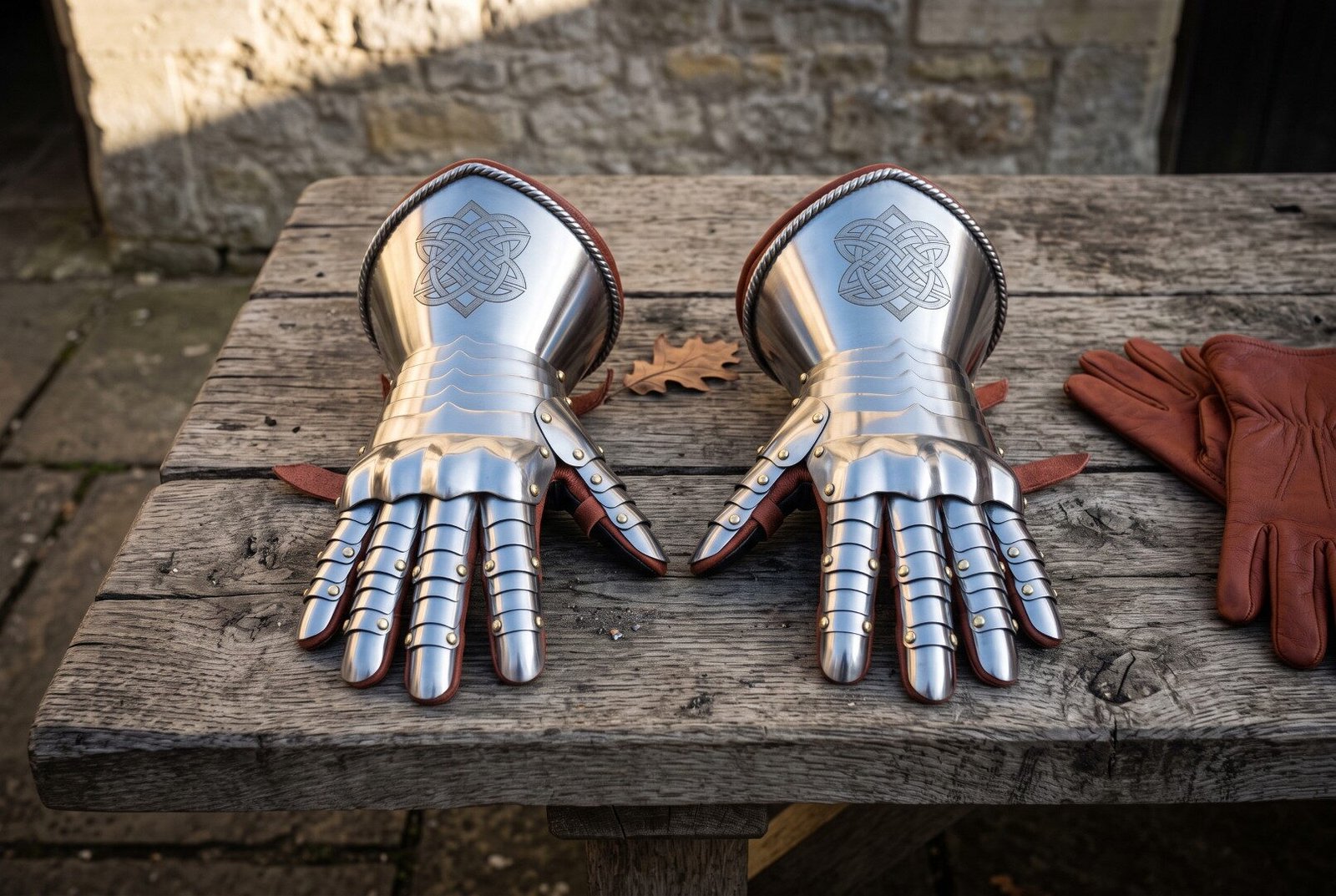
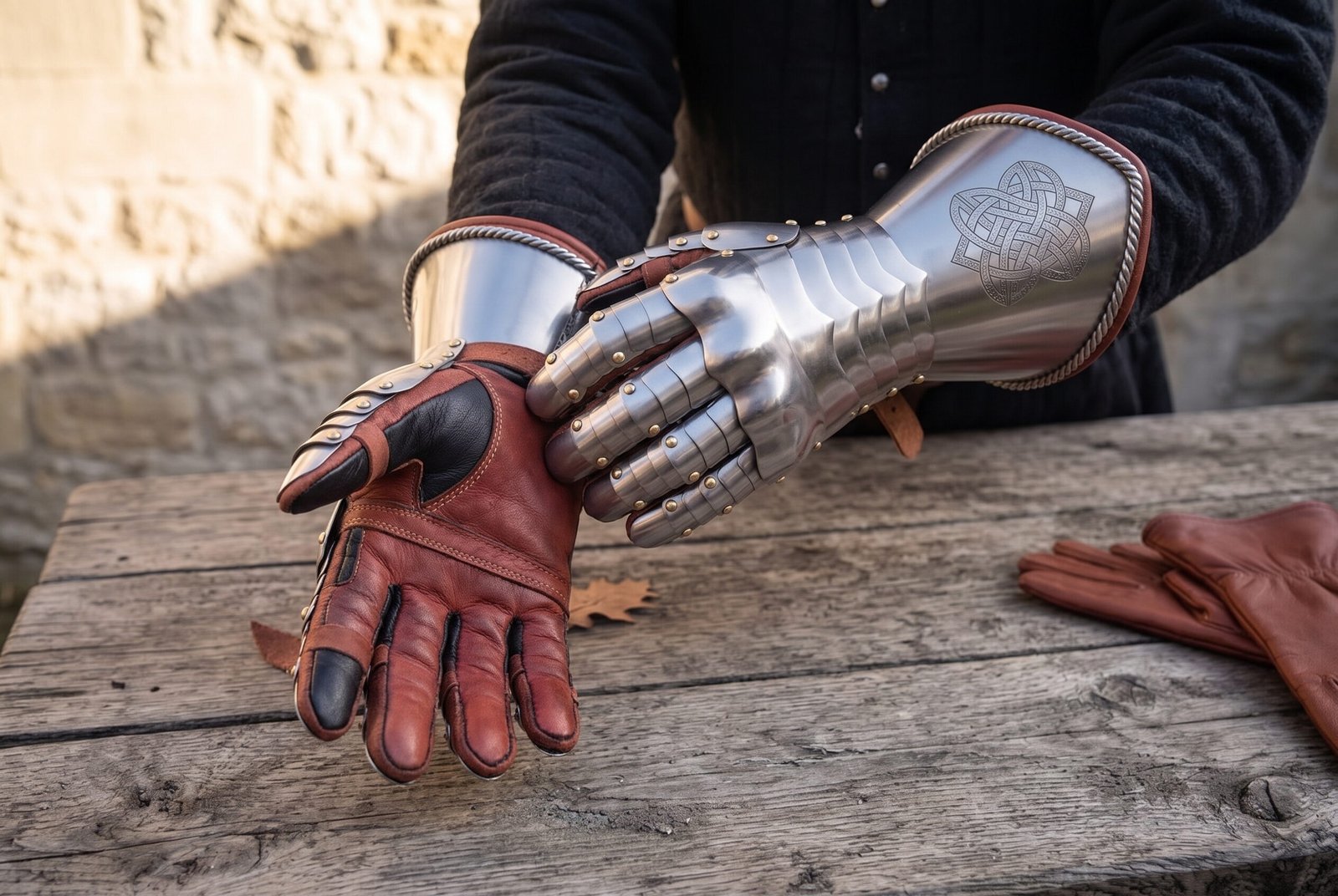
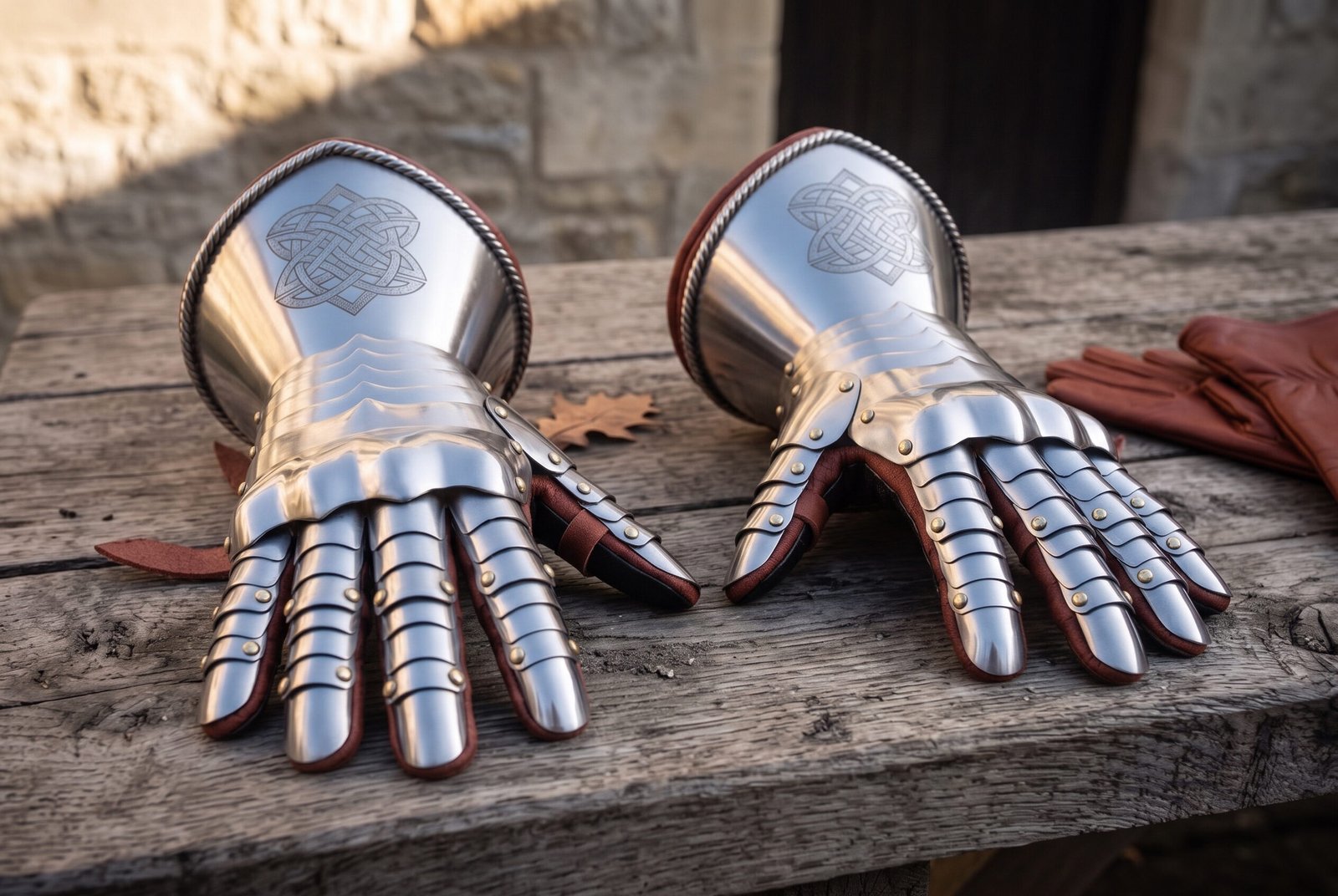
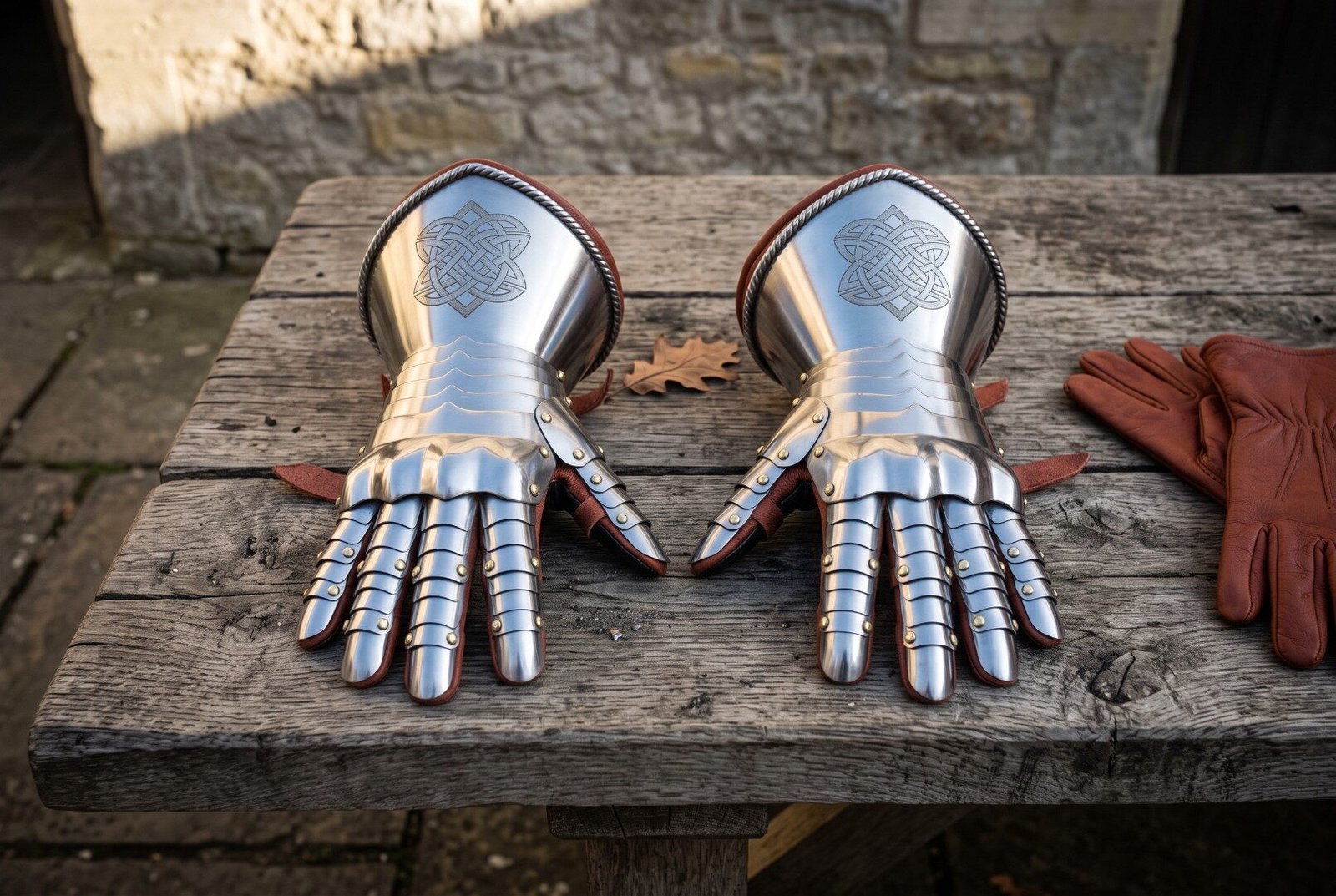
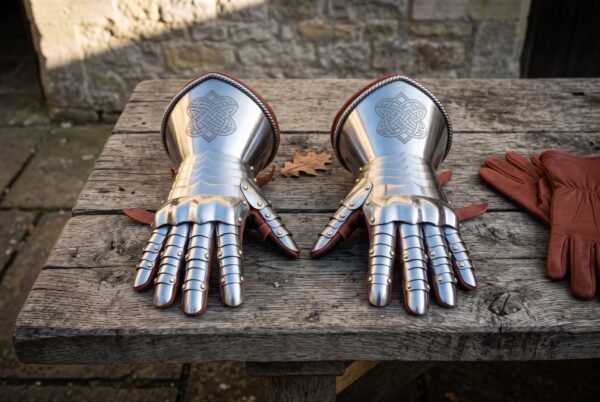
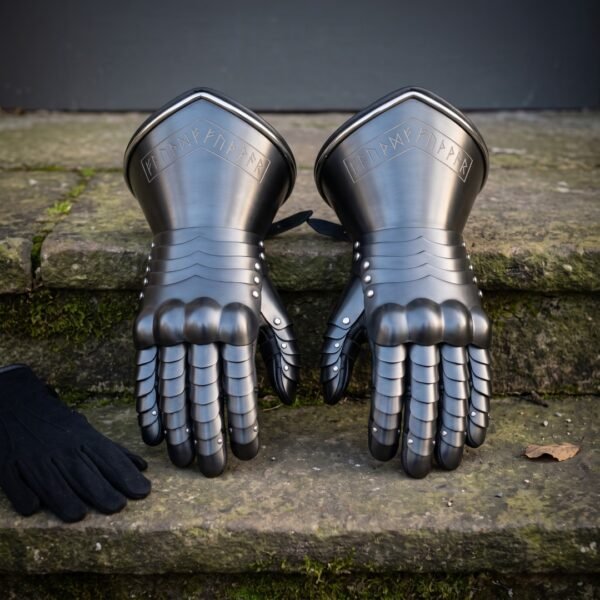
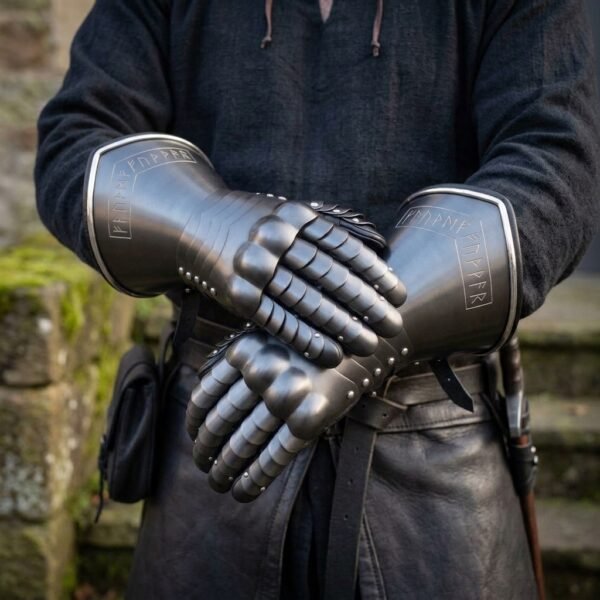
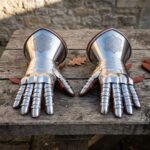
Handwarden is a pair of finger gauntlets, the kind where every finger gets its own stack of small overlapping plates rather than being covered by a single mitten shell. The cuffs are flared bell cuffs with a roped edge and an etched knotwork panel on each, and the plates are riveted onto brown leather gloves which are supplied with them. Look at the fingers and you can count the lames. Each joint has its own plate, each plate overlaps the one below it, and the whole stack articulates as the finger closes.
Finger gauntlets are the harder of the two forms to make, which is why mitten gauntlets stayed in use so long. A mitten gauntlet is stronger and quicker to build because the fingers move as one unit behind a single plate. A finger gauntlet lets you work a buckle, hold a rein, pick up a cup and keep proper control of a hilt, at the cost of dozens of small plates and rivets that all have to move together. From the fourteenth century onwards a knight who could afford the choice generally chose fingers. Every pair is raised, cut, articulated, riveted and finished by hand in the Czech Republic. Free shipping inside the United States, one to two weeks processing, seven day returns, and a genuine lifetime warranty against defects in the forging, the grind, the heat treat and the fittings, with no end date and no receipt needed. Norse knotwork sits inside a wider vocabulary, set out in Viking symbols and their meanings.
Specifications
| Material | Mild steel plates on a full grain leather glove base |
|---|
| Gauge | 18 gauge mild steel, polished bright |
|---|
| Form | Finger gauntlet, individual articulated lames on every digit |
|---|
| Back of hand | Overlapping metacarpal plates stepping down to a knuckle lame |
|---|
| Thumb | Separate articulated thumb lames riveted to the glove |
|---|
| Cuff | Flared bell cuff with a roped rolled edge and an etched knotwork panel |
|---|
| Articulation | Overlapping lames on sliding rivets across the knuckles and each joint |
|---|
| Glove base | Red brown leather gloves with darker palm patches, plates riveted through to the leather |
|---|
| Size and fit | Made to a stated glove size, supplied as a matched left and right pair |
|---|
| Finish | Bright polished steel with a leather lined interior |
|---|
| Intended use | Display, costume and light reenactment, not full contact steel |
|---|
| SKU | RK-1457 |
|---|
How a gauntlet articulates, and why the cuff flares
The trick in a plate gauntlet is that steel does not bend and a hand does. The answer, worked out in the fourteenth century and never improved on, is to cut the cover into narrow strips and let them slide over each other. Each lame overlaps the next in the direction of the joint, and the rivets that hold them are set in short slots rather than round holes so the plates can travel a few millimetres as the finger closes. Stack enough of them and a rigid material follows a curling motion perfectly.
The flared bell cuff is doing something different. It is there to cover the wrist and the bottom of the forearm without stopping the wrist from rotating, and the flare means it can be wide at the opening for the hand to pass through while the plate above closes down neatly on the arm. The roped edge, that twisted rolled rim, is not decoration either. Rolling the edge of a plate over on itself removes a sharp edge that could cut a glove or a hand, stiffens the whole rim so the plate resists folding, and gives the metal somewhere to go so a struck edge deforms rather than splitting. Every good piece of plate armour has rolled or turned edges for exactly that reason.
The steel, the leather and the etching
These are mild steel at 18 gauge, polished bright. Mild steel is the correct material for armour and should never be confused with blade steel. It is soft enough to be dished and rolled without cracking, and when it takes a blow it dents rather than shattering. Eighteen gauge is the standard weight for display and light reenactment armour, which is exactly what these are. They are not full contact combat gauntlets, they are not certified armour and we are not going to imply otherwise. Anyone fighting heavy steel needs a purpose built combat gauntlet at a heavier gauge with a properly protected thumb.
The knotwork on each cuff is etched rather than engraved, which suits a large shallow panel on a curved plate far better than a cut line would. The gloves are full grain leather, dyed brown, with the plates riveted through so the steel travels with the hand instead of shifting on it.
Engraving, runes and your own design
Use the rune converter on this page to turn a name, a date or a short phrase into Elder Futhark and we will cut it into the steel or the leather. If you would rather have a Viking pattern than a rune line, choose your own design in the engraving option above the add to cart button and tell us where it goes. Where a piece already carries an engraved design, your chosen engraving replaces it rather than sitting alongside it. On Handwarden the cuff panels already carry knotwork, so a rune line ordered for the cuffs takes its place. Full detail is on the engraving page.
Fit and sizing
Measure your hand as you would for any glove. Take a tape around the widest part of the palm without the thumb, and measure from the base of the palm to the tip of the middle finger. Order to the larger of the two figures. If you are between sizes, size up, because a tight plate gauntlet fights every time you close your fingers and there is no give in the steel at all.
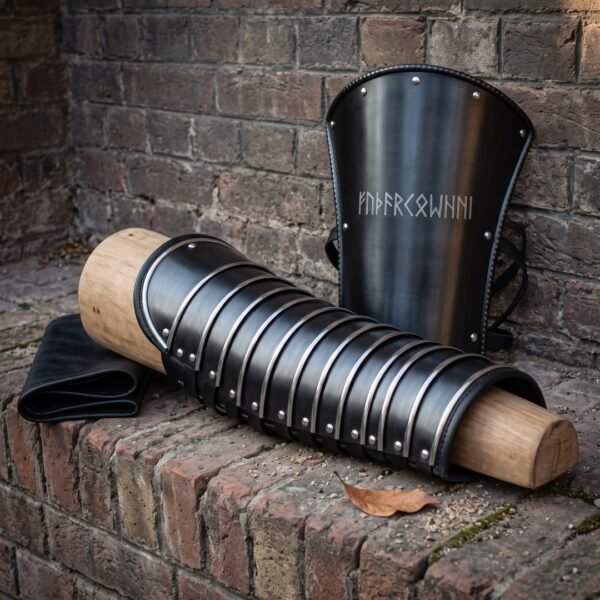
Also think about the arm above the hand. If you wear vambraces or a padded sleeve, the cuff has to sit over or under them cleanly, so decide which before you order and allow for it. Gauntlet cuffs almost always go over a vambrace rather than under it.
Care
Bright polished steel wants to be dry and oiled. Wipe the plates down after every wear, because sweat that runs into the sliding rivets is what stiffens the articulation over a season. Once dry, put a thin film of light oil or paste wax over the plates and work a drop of oil into each sliding rivet so the lames keep moving freely. Store them opened out rather than crushed. Feed the leather gloves with a neutral conditioner two or three times a year. If a rivet loosens, it can be re set rather than replaced. Our steel care page covers oiling and rust removal in more detail. Steel armour wants oiling and dry storage, which we cover in caring for chainmail and steel armour.
Made in the Czech Republic
Every piece we sell is made by hand in the Czech Republic. The smiths there work the way the trade has been worked for a long time, heating and hammering the steel, taking the bevels down by eye, and fitting the handle and the leather one at a time. There is no automated line anywhere in it, so small differences from one piece to the next are normal and expected.
Ransack Viking is a United States company based in Chicago, Illinois. We bring the pieces in ourselves, inspect them on arrival and ship them from our own warehouse. If you add engraving, that is carried out here in the United States before your order goes out.
A note on handmade variation
These gauntlets are hand made and not machine made or bulk produced, so what arrives will not be a pixel for pixel copy of the photograph. Lame spacing, the exact sweep of the cuff flare, polish depth, the bite of the etch and the tone of the leather all vary because each pair is worked by hand from natural materials. The dimensions, the material and the build are the same every time. The character is not.
Frequently asked questions
Can I close my hand in them?
Yes. Each finger has its own stack of articulated lames on sliding rivets, so the fingers curl properly. You can hold a hilt, a haft or a cup. Fine work like doing up a small buckle is awkward, as it is in any gauntlet.
Are these safe for full contact reenactment?
No. At 18 gauge these are display and light reenactment gauntlets. Heavy steel fighting needs a purpose built combat gauntlet at a heavier gauge with a fully protected thumb, and most groups will fail these at inspection.
Do the leather gloves come with them?
Yes. The plates are riveted onto full grain leather gloves and the pair is supplied complete and ready to wear.
Do the cuffs go over or under a vambrace?
Over, in almost every case, which is how a period harness was assembled. Allow for that when you size, especially if your vambrace is bulky.
Will the polished steel rust?
It can. Mild steel is not stainless and sweat is the worst offender. Dry them after wear, oil the plates and the rivets, and they will stay bright.
How long does it take to ship?
One to two weeks, because each pair is cut, articulated and riveted to your size. Engraved orders sit at the longer end. Shipping inside the United States is free.
What is in the box
- One matched pair of articulated steel plate gauntlets, left and right
- Full grain leather gloves with the plates riveted through
- Etched knotwork cuff panels, or your own Elder Futhark line in their place
- Oiling and articulation care notes
- Forged and finished in the Czech Republic
Explore the range
See more in plate armor, chainmail armor and Viking armor, or read the guides for how articulated plate is laid out.
Others in the same line
Worth putting side by side with this is the Bandwarden plate armor. In the same category sits the Nightband plate armor. A near match for this one is the Nightplate plate armor.
For a different piece from the same family, look at the Grimhold chainmail armor. You can have this made your way instead on the design your own page.

This piece is well made. Just a couple small things kept it from 5 stars. Solid piece. Packaging could’ve been a bit sturdier. Good overall quality. Just a couple very minor details off. Minor nitpicks aside, good quality piece.