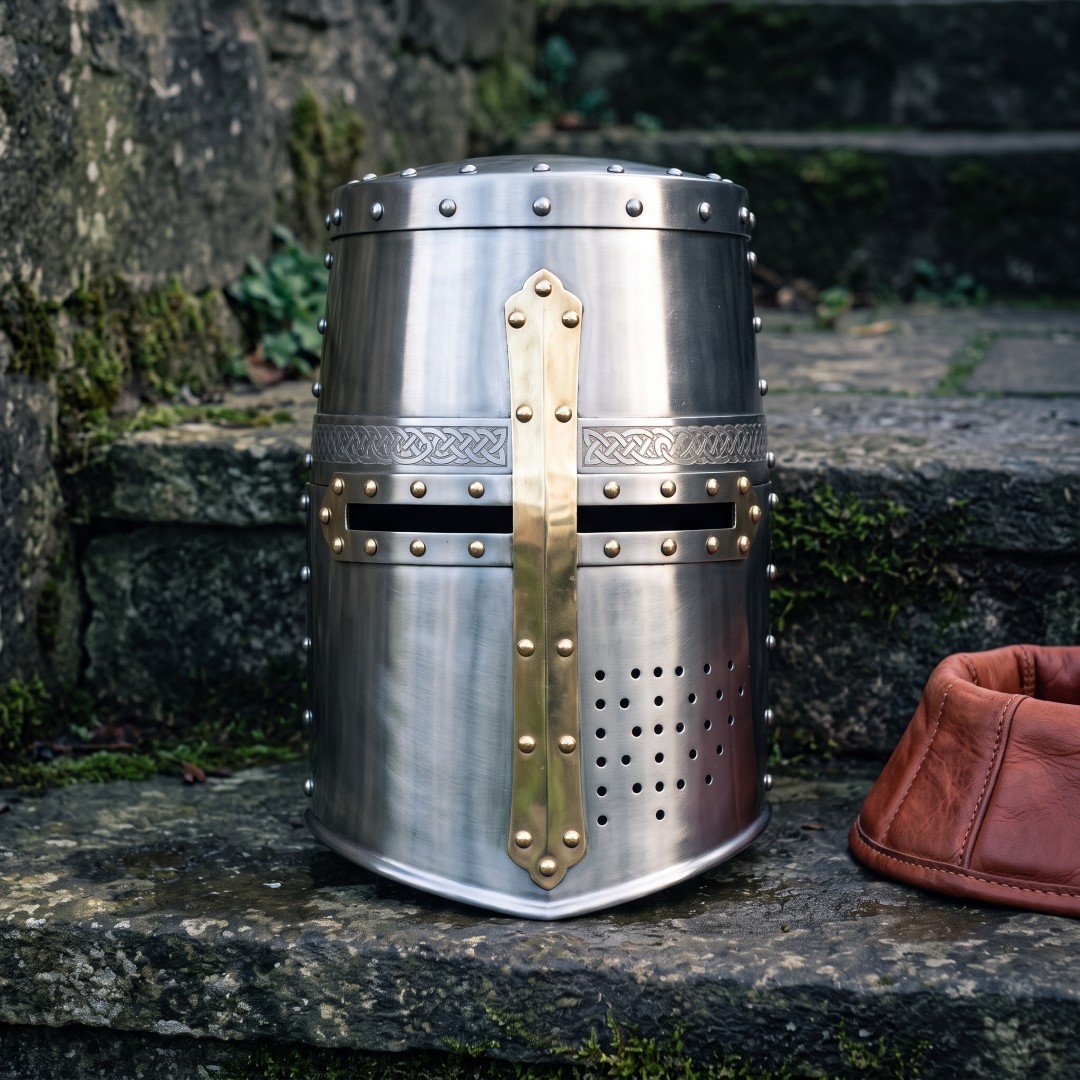
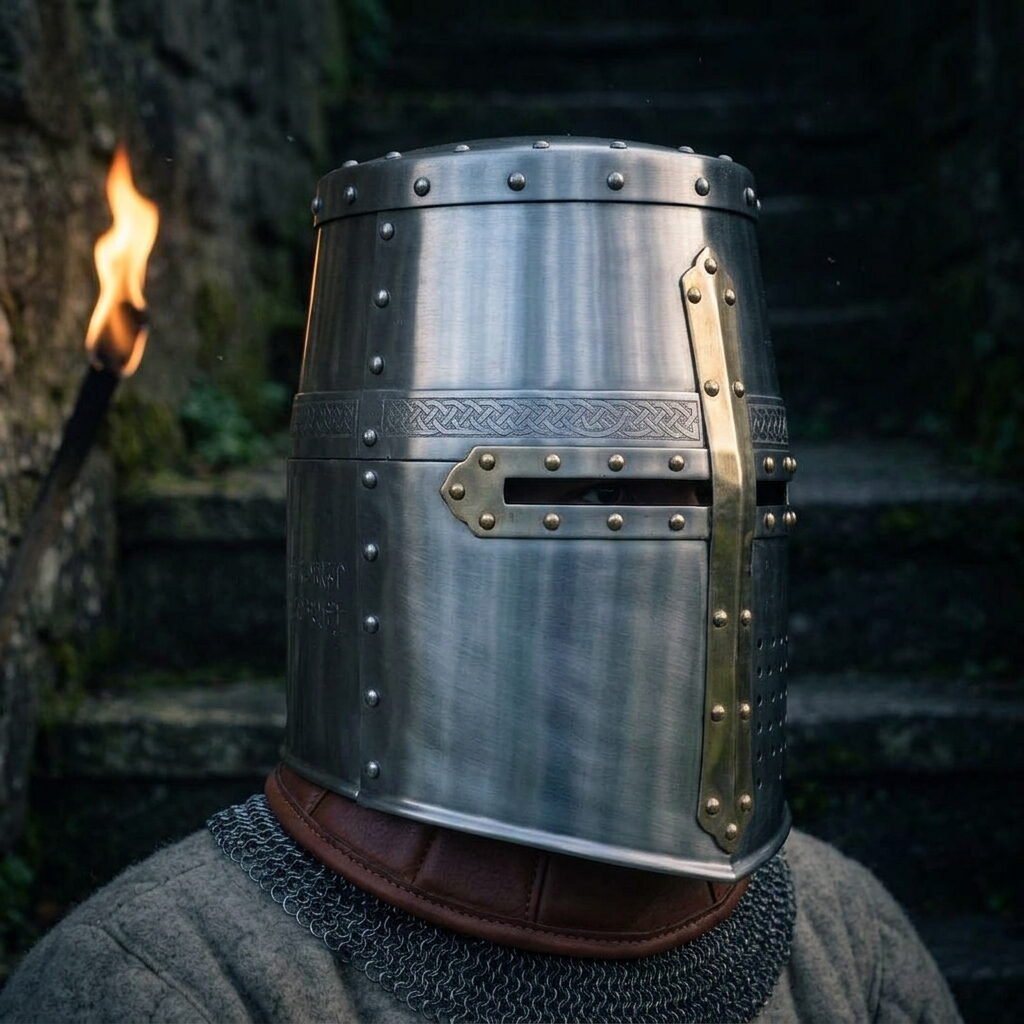
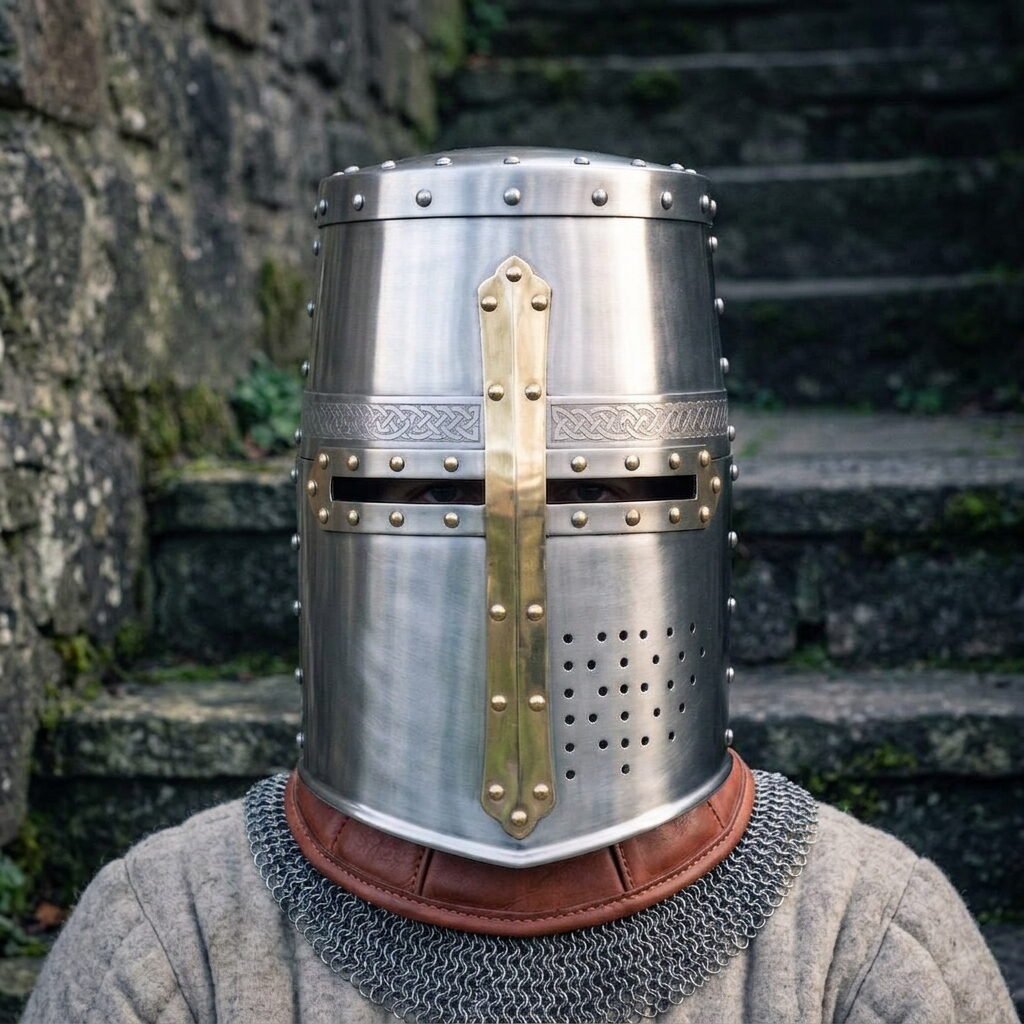
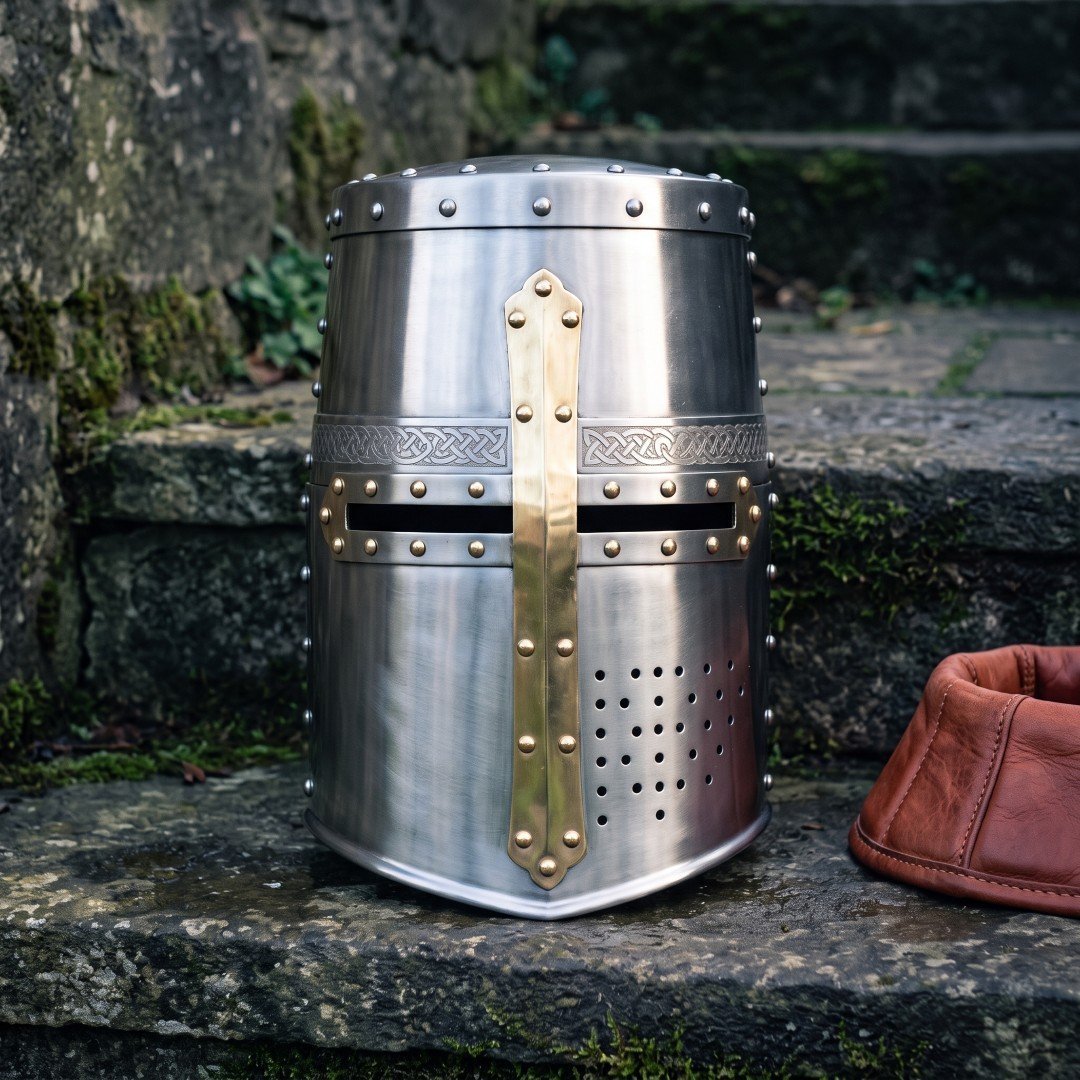
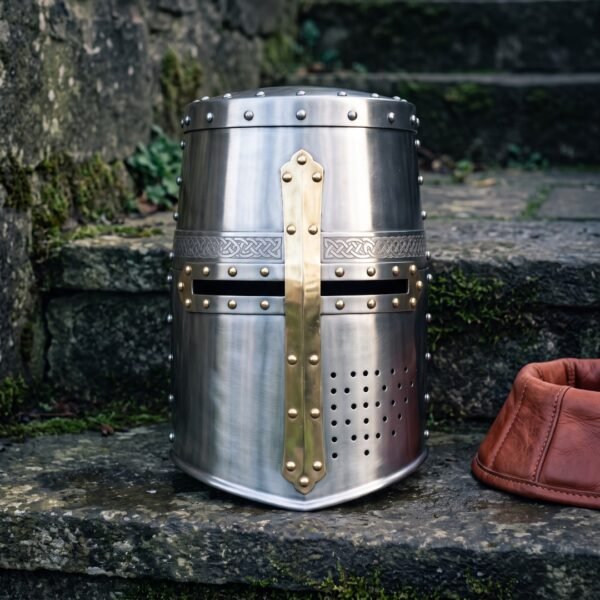
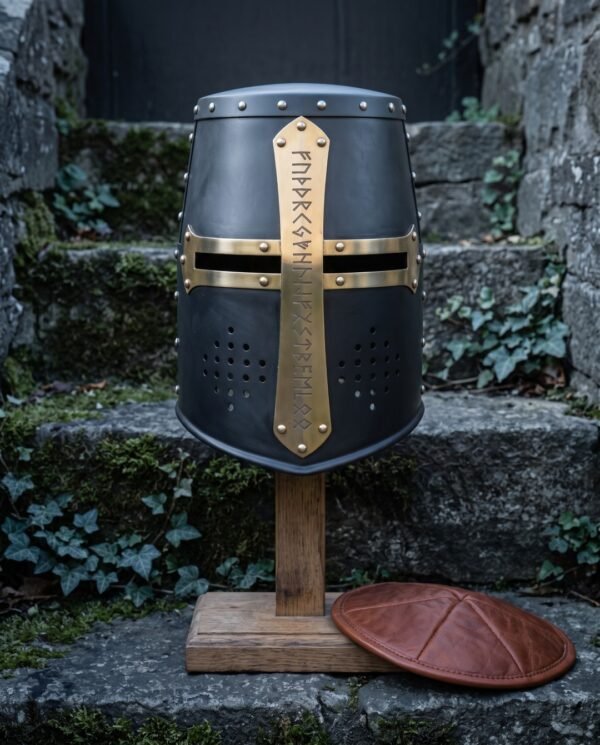
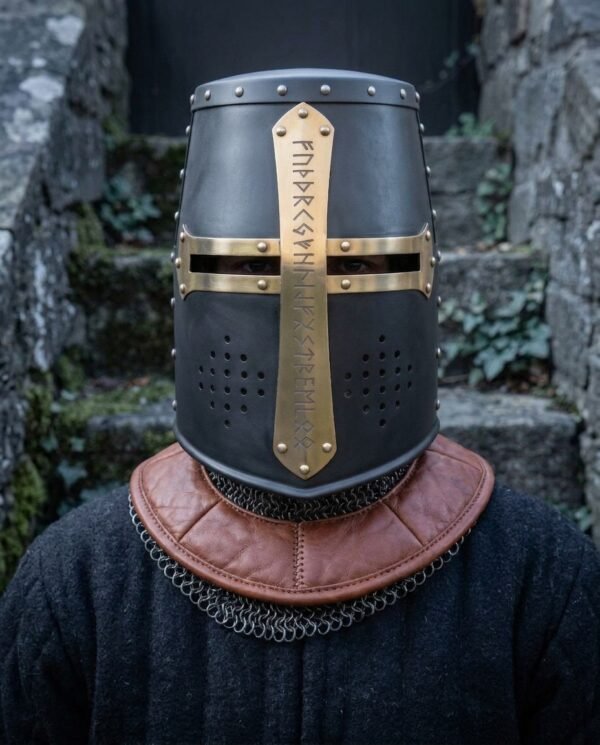
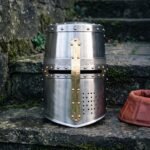
A flat topped great helm built from riveted steel plates, with a brass cross reinforce running from the crown down the face, a band of engraved knotwork above the sight, a pair of horizontal eye slits and a field of drilled breath holes across one cheek. The top plate is riveted down to the sides with domed rivets all round, the lower edge sweeps to a point at the chin and the whole thing sits over the head and rests on the shoulders rather than gripping the skull.
The flat top is the interesting part, because it turned out to be a mistake. A helm with a level crown takes the full force of a downward blow square on, with nothing to deflect it, and within a couple of generations armourers had responded by drawing the top up into a cone, which is the helm we now call a sugarloaf. Watching a design fail and get fixed inside about fifty years is rare in medieval equipment and this is one of the clearest examples of it. The version here is the earlier flat topped shape, which is the one everyone pictures when they think of a crusader helmet. Cut, formed, riveted and engraved in a Czech Republic workshop. The leather arming cap in the photograph is a studio prop and is not included. Fit, steel gauge and the shapes worth avoiding are covered in our notes on buying a helmet.
Specifications
| Material | Mild steel plates with a solid brass cross reinforce |
|---|
| Gauge | 16 gauge, approximately 1.6 mm |
|---|
| Shape | Flat topped great helm, the lower edge sweeping to a point at the chin |
|---|
| Construction | Riveted plate construction with domed steel rivets round the crown and down the seams, no welded seams on show |
|---|
| Reinforce | Brass bar from crown to chin and brass frames above and below the sight, set with brass rivets |
|---|
| Vision | Two horizontal eye slits either side of the brass bar |
|---|
| Ventilation | Grid of drilled breath holes on one cheek, side to your choice |
|---|
| Decoration | Engraved knotwork band in the steel around the brow, above the sight |
|---|
| Size or fit | Built to a stated head circumference, worn over a padded arming cap |
|---|
| Weight | Approximately 7 to 9 pounds |
|---|
| Lining | Internal suspension liner and chin tie fitted, arming cap not supplied |
|---|
| SKU | RK-1523 |
|---|
Why a great helm rests on your shoulders
Most helmets fit the head. A great helm does not, and that is deliberate. It is a bucket that goes over everything, over a mail coif and a padded cap, and it is built with enough internal space that it can turn slightly without turning your neck. On a horse that matters, because a helm clamped to the skull transfers every impact directly into the neck, while a helm carried partly on the shoulders spreads that load across the trapezius and the collarbones.
The consequence is the price you pay for the protection. Vision is two slits, so your peripheral view is almost nothing and you find yourself turning your whole upper body to look at things. Hearing is muffled. Air comes in through the breath panel and it is never quite enough, and inside twenty minutes of exertion the inside of a great helm is hot, loud and close. Anyone who tells you a great helm is comfortable has never worn one for an hour. It was worn because a lance to the face is worse.
The brass cross is structure as much as ornament. It is a reinforce, a second layer of metal laid over the face where the plates join and where a point would most likely land, riveted through into both the front plate and the crown. Every rivet you can see on this helm is doing a job, holding plate to plate, reinforce to plate or liner band to shell.
Steel, gauge and honest limits
This is mild steel at 16 gauge, roughly 1.6 mm, which is a step heavier than the 18 gauge we use for wearable display body armour, because a helmet is the one place where thickness earns its weight. It still is not certified armour. It is right for display, film, stage, costume, museum mounts, living history and light contact, and it is not built or rated for full contact steel combat leagues, which specify their own gauges, liner standards and impact testing for head protection.
Take head protection seriously and do not treat that as a formality. A helmet is the one item where buying the wrong specification has consequences you cannot undo. If you fight buhurt or heavy list, buy a league approved helmet from a maker who certifies to your rules, and hang this one on the wall.
Engraving, runes and your own design
Use the rune converter on this page to turn a name, a date or a short phrase into Elder Futhark and we will cut it into the steel or the leather. If you would rather have a Viking pattern than a rune line, choose your own design in the engraving option above the add to cart button and tell us where it goes. Where a piece already carries an engraved design, your chosen engraving replaces it rather than sitting alongside it. On this helm the band above the sight already carries knotwork and that is what your line would replace, and the brass cross itself takes a cut beautifully because bright brass shows a line better than steel does. See the engraving page.
Fit and sizing
Measure the circumference of your head above the ears and across the brow, then tell us everything you plan to wear under it. A great helm is normally worn over a padded arming cap and often over a mail coif as well, and both of those together can add two inches or more to the measurement. Build it to a bare head and it will not go on over the kit you actually own.
Two more numbers help. The distance from the top of your head to the point of your chin sets the depth of the helm, and your neck to shoulder measurement tells us how far the lower edge can come down before it fouls your collarbones. If you intend to wear it seated on a horse or with a high collared coat, say so, because the rear edge is what usually catches.
Care
Wipe the outside after handling and keep a light film of oil on the steel. The inside matters more than owners expect, because condensation from your own breath collects on the underside of the top plate and runs down the inner faces, so dry the interior after every wearing and re oil it two or three times a year. Polish the brass with any metal polish or let it darken, both look right. Store it upright on a stand or a padded ring rather than resting on the rim, and never stack anything on top of the flat crown. Check the liner rivets each season. The routine on steel care applies here. Steel headgear wants the same care as mail, set out in caring for chainmail and steel armour.
Made in the Czech Republic
This is a handmade piece from the Czech Republic, made in a workshop that still forges, grinds and finishes by hand instead of stamping parts out. The smiths there have kept the older way of working, and the wood, horn and leather are shaped and fitted by hand as well. Two pieces of the same design will never be identical, and that is part of what you are buying.
Ransack Viking is a United States company. We handle the import ourselves, look over every piece when it lands and ship from our warehouse in Chicago, Illinois. Engraving is done in the United States after the piece arrives, so your design goes on before we send it out.
A note on handmade variation
This is hand made, not machine made or bulk produced, so what arrives will not be a pixel for pixel copy of the photograph. Rivet spacing is set by hand, the sweep of the lower edge is trimmed by eye to the size we are building, and the planishing texture under the finish is never the same twice. The dimensions, the material and the build are the same every time. The character is not.
Frequently asked questions
Can I actually see out of it
Enough to walk, stand and be photographed, and not much more. Two slits give you a narrow forward view with almost no peripheral vision, which is authentic and is also the main reason a great helm is a display and parade helmet for most owners.
Can I fight in it
Not full contact. It is 16 gauge with no impact certification and no league approval. For light contact, stage, film and display it is right, and for heavy list or buhurt you need a certified helmet.
Does it come with a padded cap
No. It has an internal suspension liner and a chin tie, and you need an arming cap under it. Measure your head over that cap, and over a coif too if you wear one.
Which side are the breath holes on
Your choice. Tell us at the order stage and we will drill the panel on the side you want, or on both if you would rather have the airflow than the extra plate.
Will the brass cross tarnish
Yes, and it looks better for it, dropping to a warm honey against bright steel. Any metal polish brings it back to gold if you prefer that.
How long does it take to make
One to two weeks of processing because each helm is built to your measurements, then shipping is free inside the United States.
What is in the box
- One riveted steel great helm with a flat crown
- Brass cross reinforce, riveted in place
- Engraved knotwork band above the sight
- Internal suspension liner and chin tie
- Care sheet for steel and brass
- Lifetime warranty against defects in forming, riveting and fittings
- Forged and finished in the Czech Republic
Explore the range
See more in medieval helmets, viking helmets, plate armor and kite shields and bucklers, or read the guides on helmet sizing.
Worth a look beside this
Worth putting side by side with this is the Duskwarden plate armor. In the same category sits the Nightplate plate armor. A near match for this one is the Handwarden plate armor.
For a different piece from the same family, look at the Nightcrest lamellar armor. Or start from a blank sheet on the design your own page.


Did not expect this level of quality for the price. Exactly the look I wanted for my collection. Already telling my friends to check this out.
Showed up right on time and looked even better than the photos. Rivets and trim are all solid. Nothing feels flimsy. Looks incredible with the rest of my reenactment kit. Beyond happy with how this turned out.
This helmet is a genuine work of art. Fit is excellent and the steel gauge feels genuinely protective. Looks incredible with the rest of my reenactment kit. Already telling my friends to check this out.
Been eyeing this helmet for months and it did not disappoint. Rivets and trim are all solid. Nothing feels flimsy. Love it.
Got this as a birthday gift and the reaction was priceless. Looks incredible with the rest of my reenactment kit. Worth every penny.