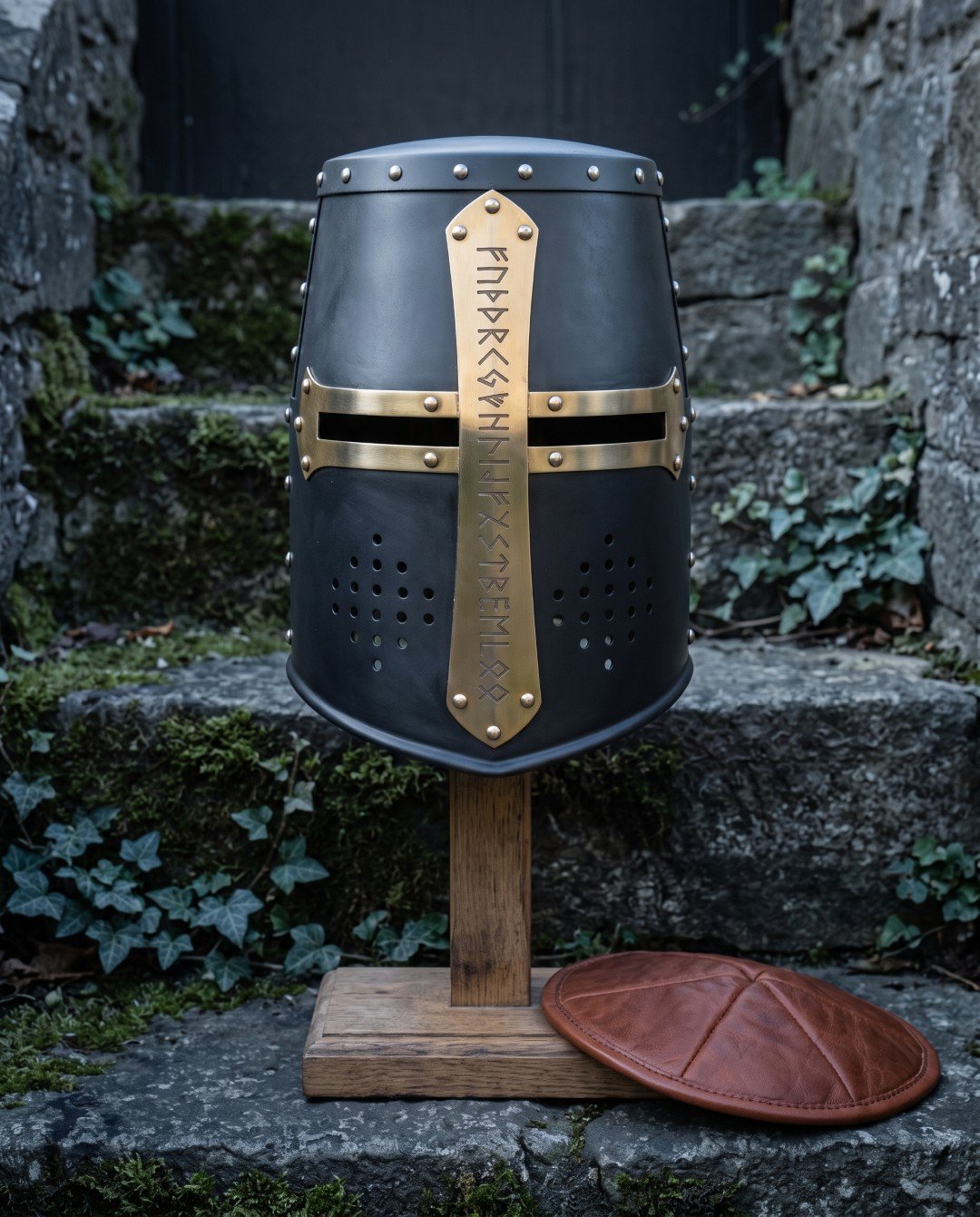
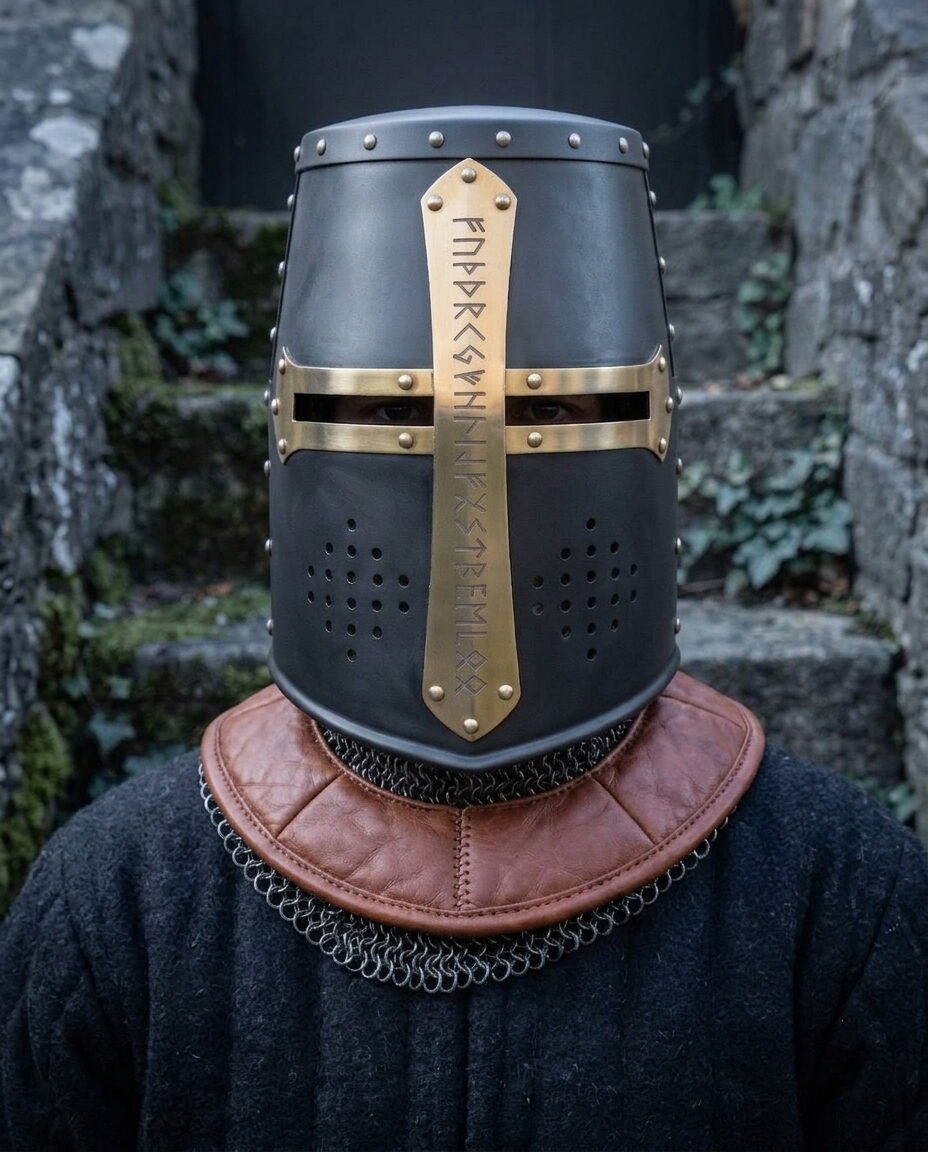
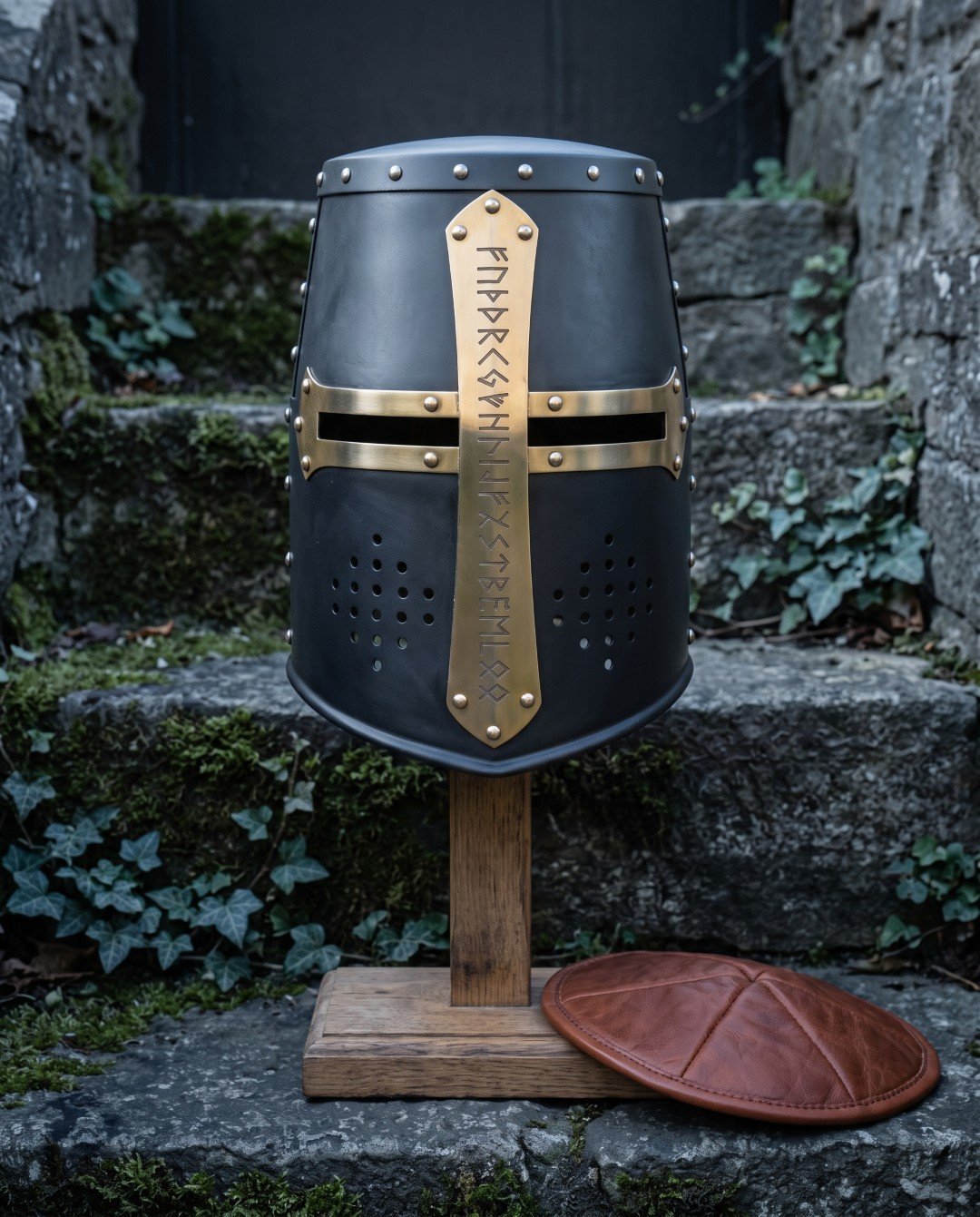
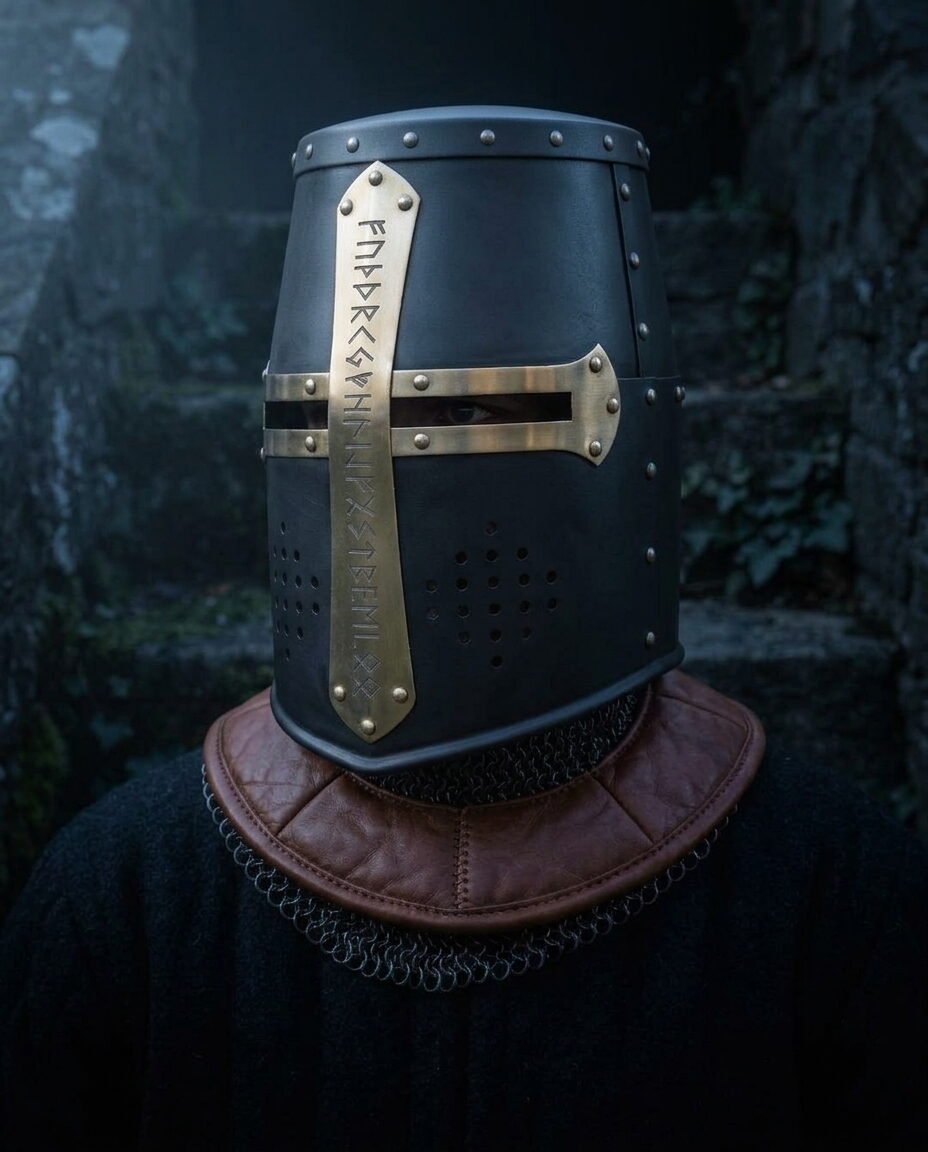
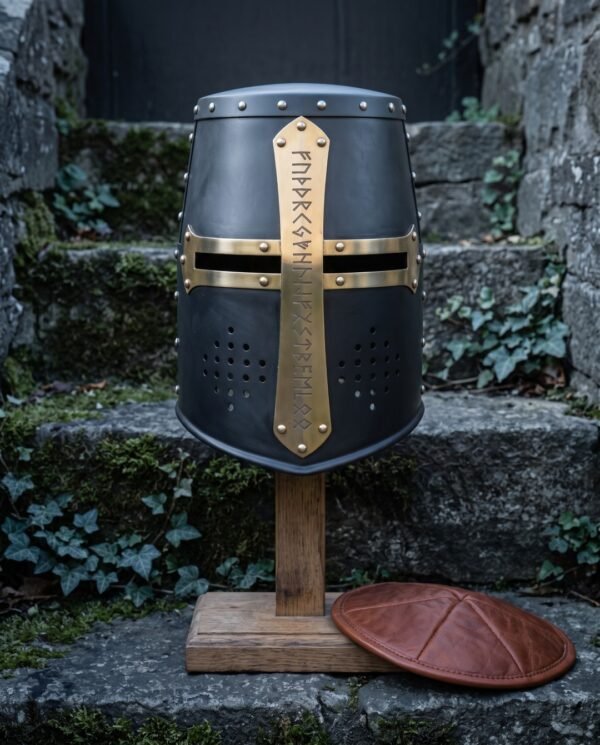
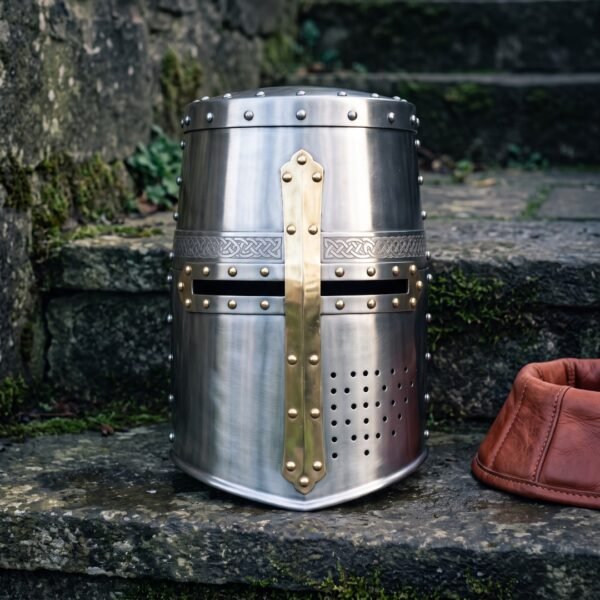
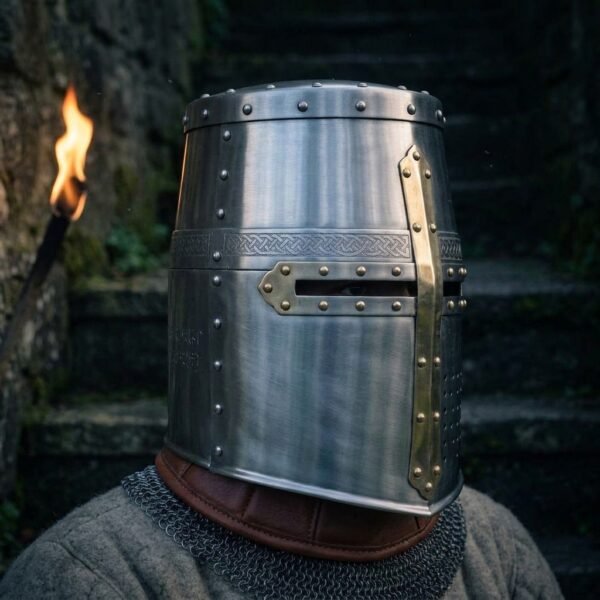
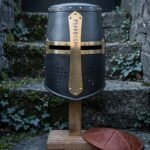
The Duskwarden is a flat topped great helm in blackened steel, built from riveted plates with a domed crown ring, a brass cross reinforce across the face, twin horizontal vision slits and two fields of drilled breaths below them. The vertical arm of the cross is stamped along its length with a line of Elder Futhark, and the whole helm drops over the head and rests on the shoulders rather than sitting on the skull.
The great helm arrived around the year 1200 and it is the first European helmet that encloses the head completely. It also carries its own famous flaw. A flat top means a vertical blow lands square on the plate and delivers all of its energy into the crown, and armourers worked that out inside two generations. By the middle of the thirteenth century the top was being drawn up into a point, which is the helmet we now call a sugarloaf, so that a descending sword or axe would slide off instead. The flat top survived anyway, because it looks like authority and because it was cheaper to build. Every Duskwarden is cut, riveted, pierced and blackened in a Czech Republic workshop. Fit, steel gauge and the shapes worth avoiding are covered in our notes on buying a helmet.
Specifications
| Material | Mild steel plate, blackened finish, with brass cross and trim |
|---|
| Gauge | 16 gauge, approximately 1.5 mm |
|---|
| Style | Flat topped great helm, riveted plate construction |
|---|
| Crown | Flat top plate joined by a riveted crown band |
|---|
| Face | Brass cross reinforce, brass bands above and below the twin horizontal vision slits |
|---|
| Breaths | Two fields of drilled breath holes, one each side of the cross |
|---|
| Decoration | Elder Futhark line stamped down the vertical arm of the brass cross |
|---|
| Head size | Fits approximately 22 to 24 inch head circumference over padding |
|---|
| Weight | Approximately 7 to 8 pounds |
|---|
| Lining | None fitted, intended to be worn over an arming cap and ideally a mail coif |
|---|
| Included | Padded brown leather cap and wooden helmet stand |
|---|
| Intended use | Display, film and light reenactment. Not rated for full contact combat |
|---|
| SKU | RK-1502 |
|---|
The cross is a structure, not a symbol
The face of a great helm is the largest unsupported panel on the whole piece, and it is also the panel that has a lance coming at it. Cut two long horizontal slits across it for vision and you have removed most of its stiffness in exactly the place it needs to be strong. The cross reinforce is the answer. A vertical bar down the centre line and a horizontal bar across the brow put two ribs across that panel, and a rib is what stops a flat sheet from folding. Riveted through, the cross ties the front plate to the side plates so the whole front acts as one structure.
Everything else about the design follows from the same idea. The helm is a series of plates riveted together, not a single raised bowl, so a hit that deforms one plate does not distort the whole helmet. The vision slits are narrow and set high, with the brow bar hanging over them, so a point sliding down the face cannot get in. The breaths are drilled in clusters rather than as a large opening, for exactly the reason a grille is better than a hole.
The great helm was almost never worn alone. Underneath went a padded arming cap, and over that a mail coif, and the helm sat on top of both and rested on the shoulders. That layering is what made it survivable and it is also why it looks so large in the surviving examples. It was never meant to be a close fit on a bare head.
The steel, the gauge and the blackening
This helm is built from 16 gauge mild steel, roughly 1.5 mm, which is a step heavier than the 18 gauge found on most display helmets. It brings the weight to around seven to eight pounds and it makes the plates feel solid rather than tinny when you handle it. It is still a display and light reenactment piece. Full contact steel combat requires heavier stock again, usually 14 gauge and thicker at the crown, often in hardened or spring steel, and the Duskwarden is not built or certified to any fighting standard. We would rather be blunt about that than have someone learn it the hard way.
The black finish is a controlled oxide with oil over it rather than paint. The advantage is that it is part of the surface, so a scuff shows grey steel rather than lifting a flake of coating, and it can be renewed. The disadvantage is that it is not a barrier the way paint is, so the helmet still needs to be kept dry and oiled. The brass cross and trim are cut, filed, stamped and riveted by hand, and they are left bright against the black, which is the whole visual point of the piece.
Engraving, runes and your own design
Use the rune converter on this page to turn a name, a date or a short phrase into Elder Futhark and we will cut it into the steel or the leather. If you would rather have a Viking pattern than a rune line, choose your own design in the engraving option above the add to cart button and tell us where it goes. Where a piece already carries an engraved design, your chosen engraving replaces it rather than sitting alongside it. On the Duskwarden the vertical arm of the brass cross already carries a rune line, so your text takes its place there, and the horizontal brow arm is the alternative if you want both. Full detail is on the engraving page.
Fit and sizing
A great helm is sized differently from a close fitting helmet. It is meant to be roomy, because the padding and the coif underneath take up the space and because the load is carried on the shoulders rather than the crown. Measure your head above the ears and across the brow, then add generously for an arming cap and a coif if you intend to wear both.
What decides whether it works is the height of the vision slits against your eyes, and that is set by the padding on top of your head rather than by the shell. Build the arming cap up at the crown until the slits sit level with your eyes when the helm is resting on your shoulders. Too little padding and you are looking at the inside of the steel above the slits.
Do not wear it on a bare head. Seven pounds of steel with nothing between it and your skull is unpleasant immediately and offers no impact protection at all. The wooden helmet stand and the padded leather cap shown beside the helm are included.
Care
Blackened steel needs oil more than bright steel does, because the finish is porous. Wipe it down with a lightly oiled cloth after handling and before it goes into storage, and pay attention around the rivet heads where moisture collects. Keep metal polish away from the black finish entirely, because it will cut straight through it and leave bright patches, and use polish only on the brass with a cotton bud if you want it brighter. Store it on a stand or upright on a shelf rather than resting face down on the cross. Our full notes on protecting steel are on the steel care page. Steel headgear wants the same care as mail, set out in caring for chainmail and steel armour.
Made in the Czech Republic
This piece is made by hand in the Czech Republic, in a workshop that still works the old way. The steel is forged, ground, heat treated and finished by smiths who learned the trade from the people before them, and the wood, horn and leather are cut and fitted by hand rather than pressed out on a line. That is also why no two pieces come out exactly the same.
Ransack Viking is a United States company. We import these pieces ourselves, check every one when it lands and ship from our warehouse in Chicago, Illinois. Engraving is done here in the United States after the piece arrives, so your runes or your own design go on before it leaves for you.
A note on handmade variation
This helm is hand made, not machine made or bulk produced, so what arrives will not be a pixel for pixel copy of the photograph. The depth and mottle of the blackened finish, the exact spacing of the rivets and drilled breaths, and the tone of the brass vary from one helm to the next, because each one is worked by hand from natural materials. The dimensions, the material and the build are the same every time. The character is not.
Frequently asked questions
Does it rest on my head or my shoulders
On your shoulders, with padding underneath taking the rest. That is how a great helm is designed to be worn and it is why it looks oversized compared with a close fitting helmet.
Can I fight in it
No. At 16 gauge it is a display and light reenactment helm. Combat societies require heavier and often hardened steel and their own certification, and this is not built to that standard.
How is the vision
Two horizontal slits give a good forward band and almost no peripheral vision, which is authentic and genuinely limiting. Stand still for a minute before you walk about in it.
Will the black finish wear off
It wears at the high points with handling, which most owners like, and it can be renewed. It is an oxide in the surface rather than a paint film, so scuffs show grey steel rather than flaking.
What do the runes say
The stamped line on the vertical arm is Elder Futhark. If you want a specific name, date or phrase in its place, use the rune converter on this page and we will cut yours instead.
How long does it take
Processing is one to two weeks because each helm is cut, riveted and blackened to order, and shipping is free within the United States.
What is in the box
- One Duskwarden flat topped great helm in blackened 16 gauge mild steel
- Riveted brass cross reinforce with a stamped Elder Futhark line
- Twin vision slits and two drilled breath fields
- Padded leather cap
- Wooden helmet stand
- Care card covering oiling a blackened finish and polishing the brass
- Lifetime warranty against defects in forging, grind, heat treat and fittings
- Forged and finished in the Czech Republic
Explore the range
See more in medieval helmets, plate armor and kite shields and bucklers, or read the guides before you choose a size.
Other pieces in this group
Also in this group is the Steelmarch plate armor. Sitting beside it in the catalogue is the Grimward plate armor. Another in the same line is the Nightplate plate armor.
For a different piece from the same family, look at the Nightcrux Medieval helmet. Nothing here exactly right, build one to your own spec on the design your own page.

This helmet beat every expectation I had. Padding and straps make it comfortable to wear for hours. Already telling my friends to check this out.