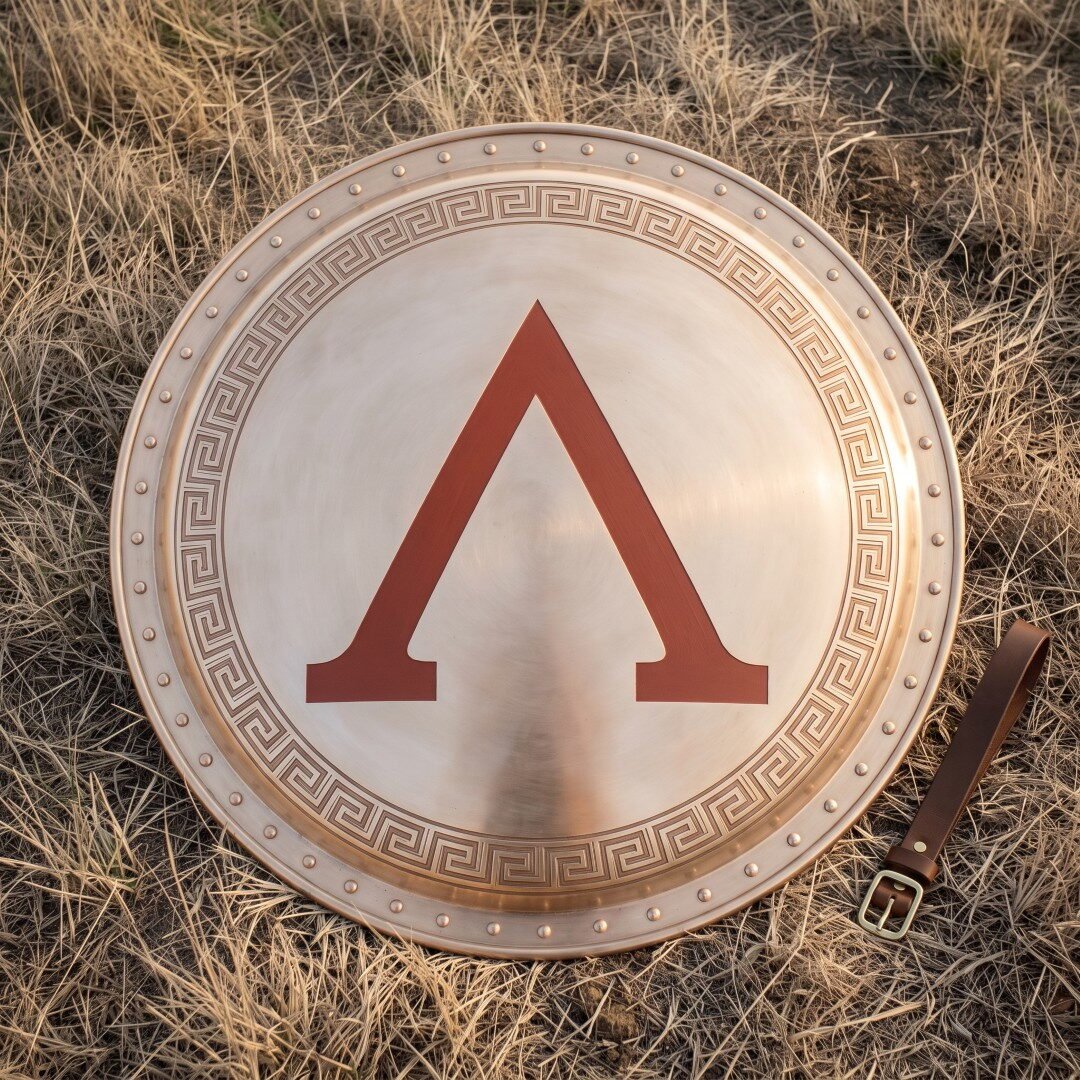
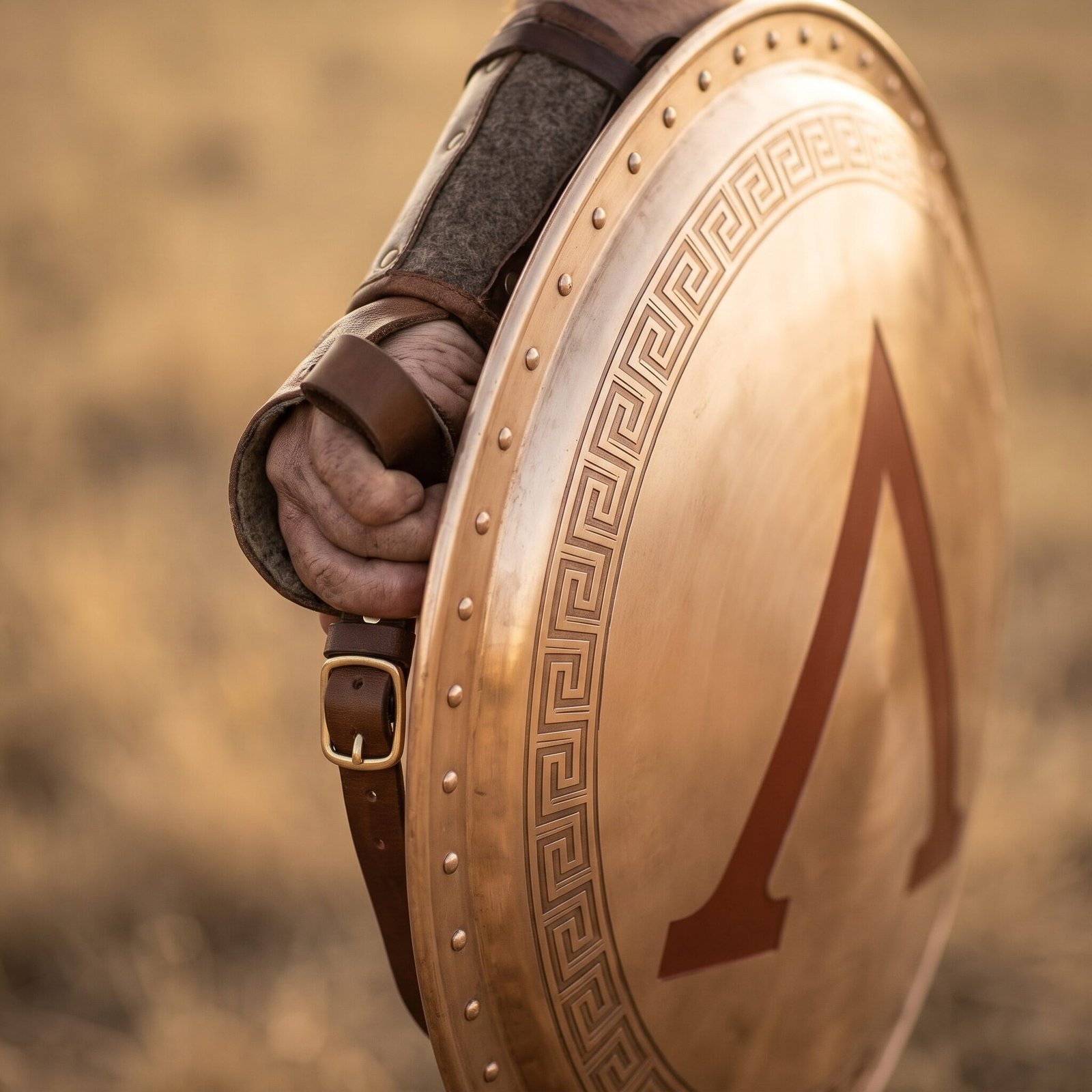
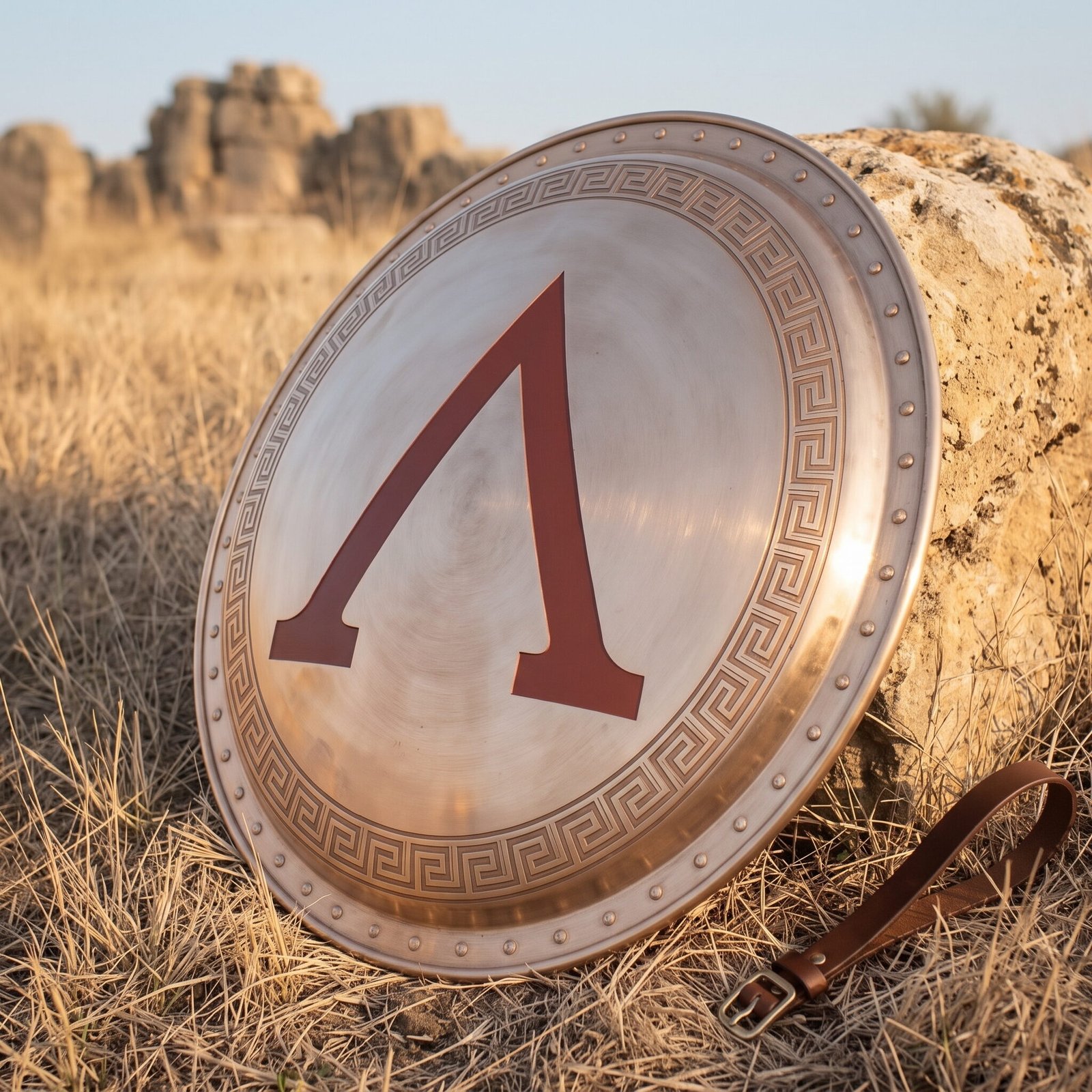
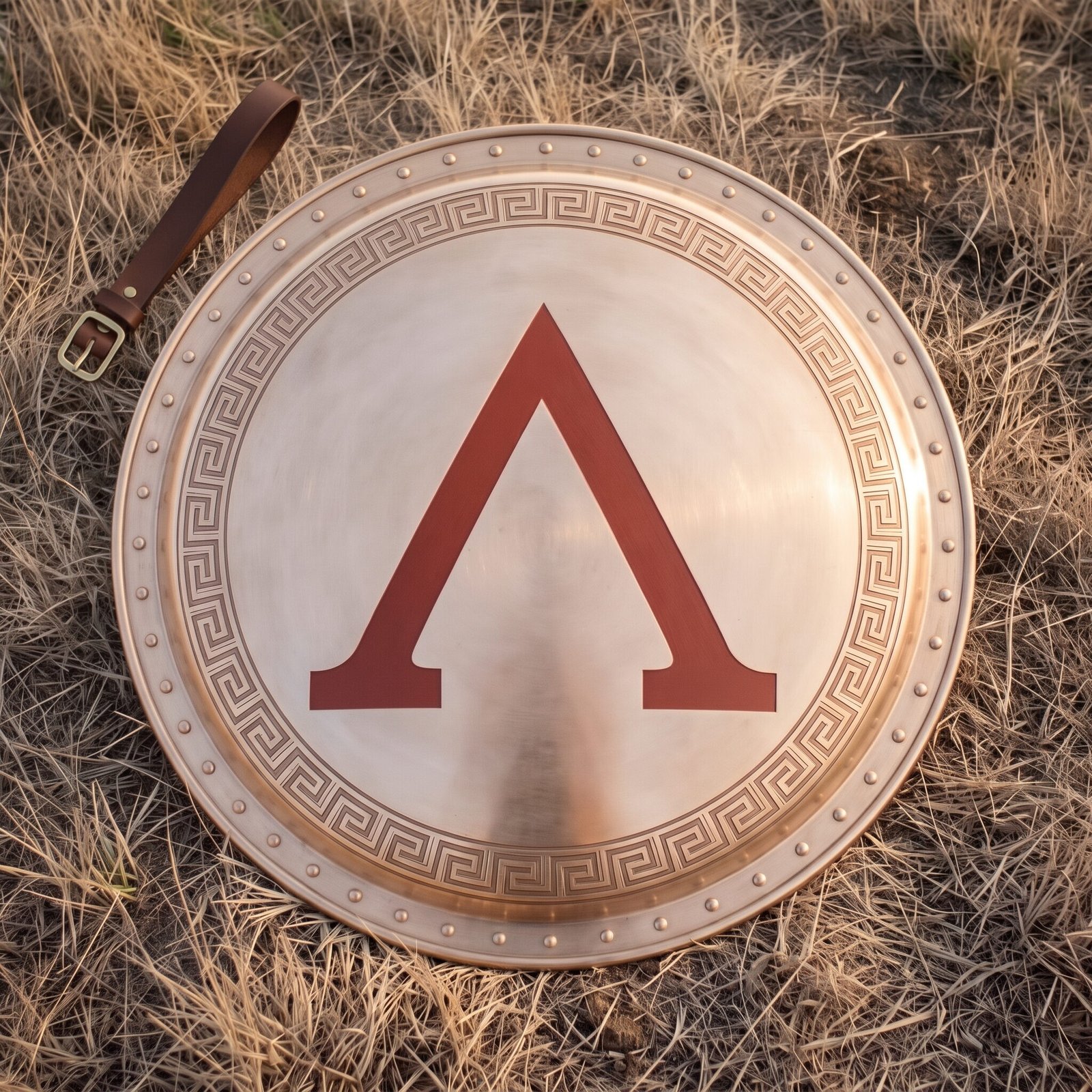
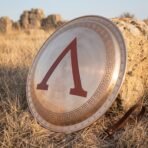
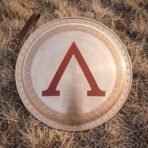
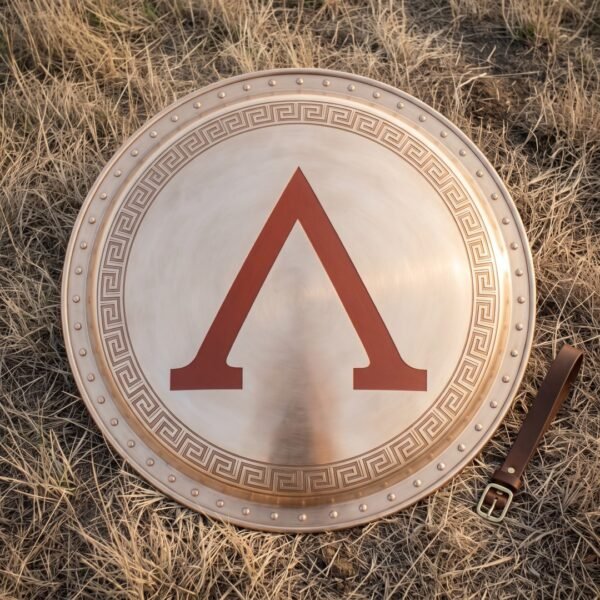
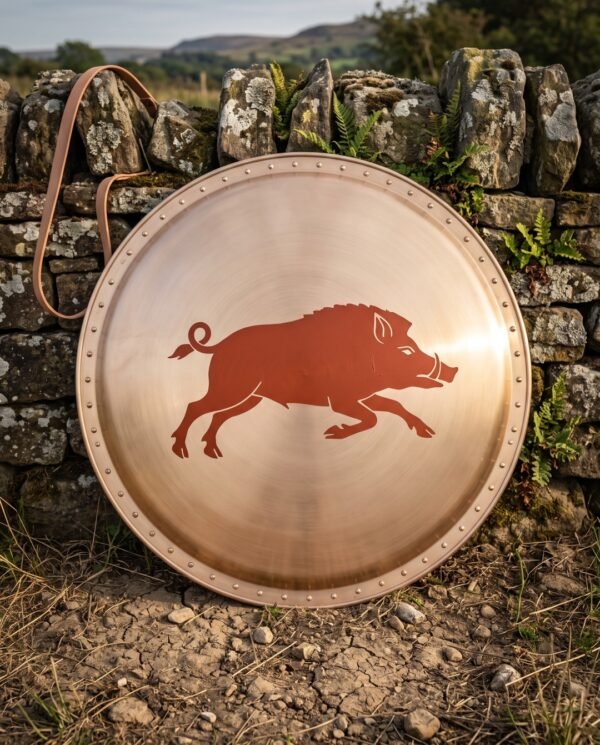
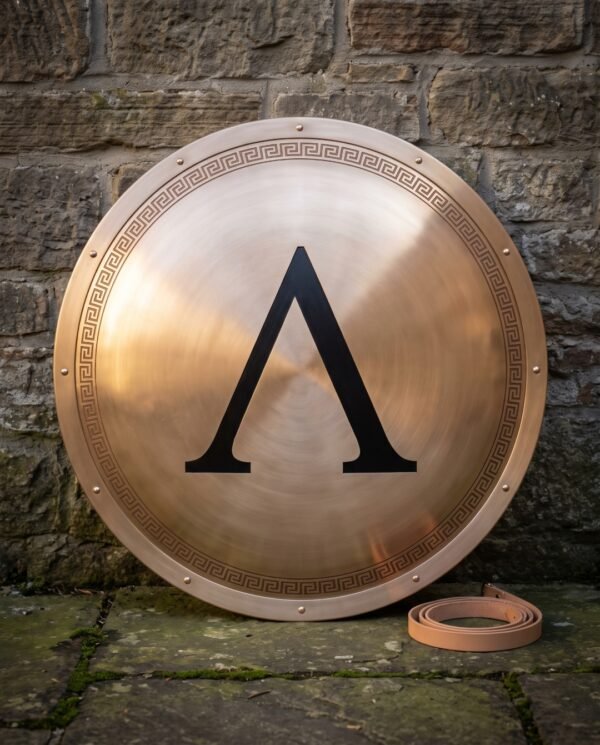
The Crimsonward is a Spartan aspis with a bronze toned steel face, a crimson lambda across the centre, and a bronze rim engraved with a running Greek meander and set with a ring of domed rivets around the outer flange. The body is dished into the shallow bowl that gives the aspis its strength, and the face is finished with a spun radial texture so it throws light differently as you move around it.
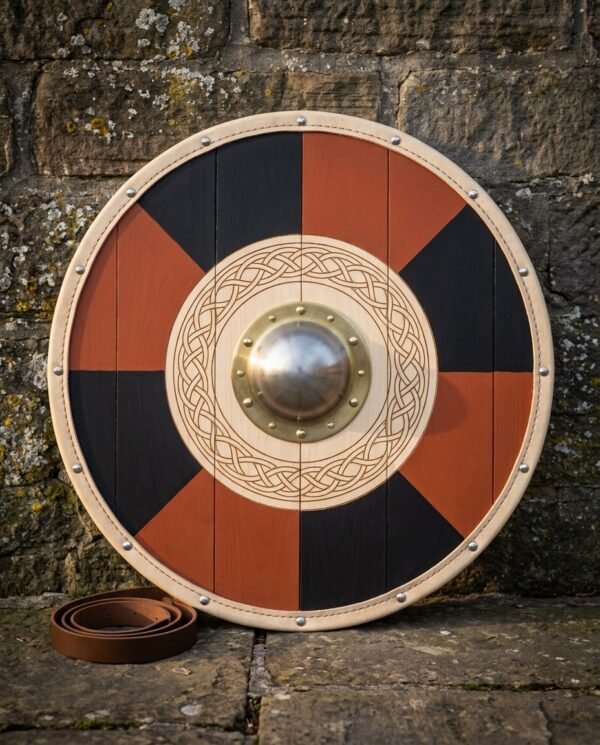
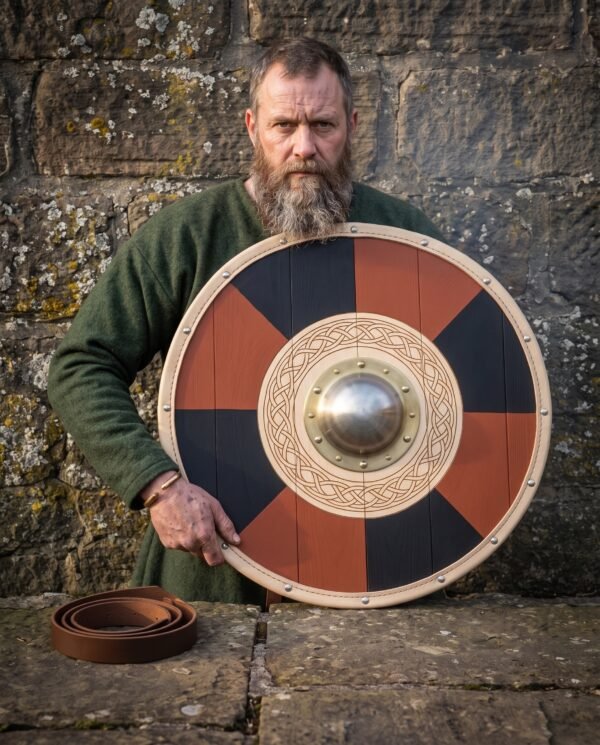
The lambda is the letter L, and it stands for Lakedaimon, the state whose army we call Spartan. A Greek comic poet of the late fifth century is the earliest source for Spartans carrying it, which is why you will find historians pointing out that the device is later and less universal than films suggest. What is entirely real is what the shield meant to the men who carried it. A hoplite could drop his spear and keep his place in the line, but a man who dropped his shield exposed his neighbour, and that is the origin of the mother telling her son to come back with his shield or on it. Every Crimsonward is dished, faced, engraved and fitted in a Czech Republic workshop. The round shield of the north worked on the same principles, covered in our guide to Viking shields.
Specifications
| Body | Laminated hardwood core, dished to a shallow bowl |
|---|
| Facing | Steel sheet over the full face, spun and finished in a warm bronze tone |
|---|
| Rim | Bronze finished outer flange set with a ring of domed rivets |
|---|
| Border | Engraved Greek meander band running just inside the rim |
|---|
| Diameter | Approximately 30 inches |
|---|
| Weight | Approximately 13 to 15 pounds |
|---|
| Device | Hand painted crimson lambda for Lakedaimon |
|---|
| Fittings | Leather forearm band with a brass buckle at the centre and a leather grip at the rim, riveted through |
|---|
| Intended use | Display, film and light reenactment. Not rated for full contact combat |
|---|
| SKU | RK-1503 |
|---|
Why the rim is the most important part of the shield
On an aspis the rim does three separate jobs and it is worth understanding all of them before you look at the face again. The first is structural. A dished disc of laminated timber wants to flatten out over time and with impact, and a stiff metal flange around the circumference holds the bowl in its shape the way the hoop holds a barrel. Take the rim off and the shield loses most of its rigidity.
The second is protection of the edge. The perimeter is exposed end grain and it is what catches a spear that skates across the face. Cladding it in metal turns the weakest line on the shield into the hardest, and the rivets you can see around the flange are what tie that cladding through into the body so it cannot peel.
The third is ergonomic and it is easy to miss. The rim on an aspis is broad and it is the part that rests on the shoulder. A thin edge would cut into the collarbone within minutes, and a broad rolled flange spreads that load across a hand width of bone and muscle, which is what makes fifteen pounds carryable for as long as a battle line has to stand.
The meander engraved along that flange is the oldest continuous decorative motif in Greek art, running from geometric pottery in the ninth century BC through temple architecture to shield borders. It is a single unbroken line folded back on itself, which is why it is sometimes read as a symbol of unity or of a river without an end.
Steel under a bronze finish
The originals were bronze faced, because that is what a Greek workshop had. This one is faced in steel sheet and finished in a warm bronze tone across the face and the rim alike, so from a few feet away it reads as the bronze shield a hoplite carried. The crimson lambda sits on that warm ground the way it would have on an original, and the engraved meander and the ring of rivets frame it at the border.
The core is laminated hardwood, dished so the grain of each layer crosses the one beneath. That is the same principle the Greeks used with layered poplar and willow, and it is the reason a thin panel can take a blow without splitting along the grain. At around thirteen to fifteen pounds this shield is close to the weight of a real aspis, and a good deal of that weight sits out at the rim rather than the centre, which makes it feel heavier at arm length than the number suggests.
The face is spun rather than hammered flat, which leaves the radial texture visible under raking light. The lambda is hand painted onto that surface rather than applied as a film, so it has slightly soft edges and will not lift or bubble.
Engraving, runes and your own design
Use the rune converter on this page to turn a name, a date or a short phrase into Elder Futhark and we will cut it into the steel or the leather. If you would rather have a Viking pattern than a rune line, choose your own design in the engraving option above the add to cart button and tell us where it goes. Where a piece already carries an engraved design, your chosen engraving replaces it rather than sitting alongside it. On the Crimsonward the bronze rim is engraved with the meander, so a rune line there takes the place of part of that border. Most buyers who want both keep the meander and put their line on the leather grip instead. Full detail is on the engraving page.
Hanging and display
This shield is at its best on a wall with a light source to one side, because the spun face and the engraved meander both depend on raking light. Hang it on two hooks bearing on the rim, or on a pair of French cleats, and fix into studs rather than plasterboard anchors. Thirteen to fifteen pounds will pull an anchor out of drywall eventually and it will take the plaster with it.
If you would rather it stand, lean it back a few degrees against a wall so the weight rests on the lower rim rather than balancing on the edge, or use a floor easel rated for the weight. Handled and carried, remember it is held on the forearm band and the rim grip together, and that it sits to the left of the body rather than square in front of it.
Care
The finished face shows fingerprints and they will mark it if they are left. Wipe it with a lightly oiled cloth after handling and give it a proper wipe before it goes into storage or a case. Keep polish out of the engraved meander, because it dries white in the recesses and then has to be picked out with a brush. Dust the painted lambda dry rather than wet. Feed the leather grip twice a year with a neutral cream so it does not dry and split where it is riveted. Keep the shield out of a damp basement, because a wood cored panel will move with humidity. Our notes on protecting a polished steel surface are on the steel care page. If it is going on a wall rather than into a line, choosing a shield for display covers size and mounting.
Made in the Czech Republic
Every piece we sell is made by hand in the Czech Republic. The smiths there work the way the trade has been worked for a long time, heating and hammering the steel, taking the bevels down by eye, and fitting the handle and the leather one at a time. There is no automated line anywhere in it, so small differences from one piece to the next are normal and expected.
Ransack Viking is a United States company based in Chicago, Illinois. We bring the pieces in ourselves, inspect them on arrival and ship them from our own warehouse. If you add engraving, that is carried out here in the United States before your order goes out.
A note on handmade variation
This shield is hand made, not machine made or bulk produced, so what arrives will not be a pixel for pixel copy of the photograph. The radial pattern in the spun face, the exact weight and edge of the painted lambda, the depth of the engraved meander and the spacing of the rim rivets vary from one shield to the next, because each one is worked by hand from natural materials. The dimensions, the material and the build are the same every time. The character is not.
Frequently asked questions
Is this the same as your bronze faced hoplon
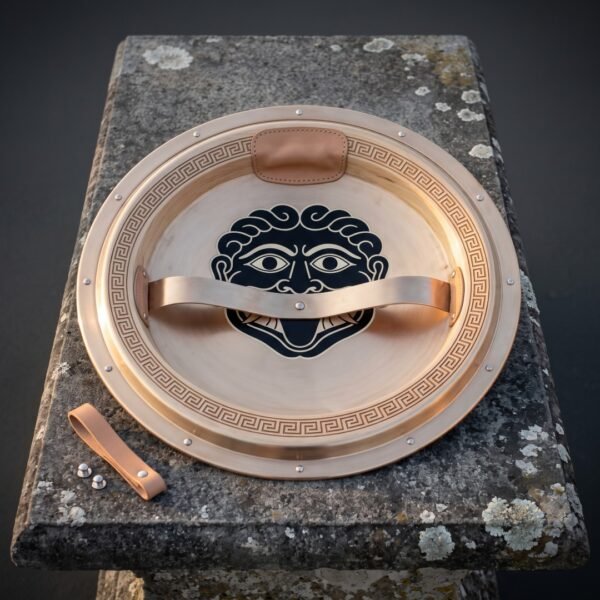
No. That one has a bronze face with a black lambda and a Gorgon painted inside the bowl. This one has a bronze toned steel face with a crimson lambda and an engraved meander rim, and it is a slightly smaller diameter.
How is it held
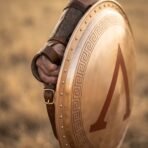
On a forearm band at the centre and a leather grip at the rim, the two fitting hoplite system. The broad rim rests on the shoulder, which is what makes the weight manageable.
Can I use it in contact fighting
No. It is built for display, photography, film and light drill. Reenactment societies that fight in steel set their own shield standards and this is not certified to them.
Did Spartans really use the lambda
The evidence is later and thinner than films suggest, with the earliest reference coming from a comic poet of the late fifth century BC. It is a genuine ancient device and it was not universal.
Will the steel face rust
It can if it is handled and left. Keep it wiped and lightly oiled and it will keep its finish for years. A display case with a little silica gel is the easiest solution in a humid room.
How does it ship
Flat in an oversized carton with free shipping within the United States, after one to two weeks of processing while it is dished, faced and fitted to order.
What is in the box
- One Crimsonward Spartan aspis, approximately 30 inches across
- Bronze toned steel facing over a dished laminated hardwood core
- Bronze finished rim with an engraved meander and a ring of domed rivets
- Forearm band and leather rim grip, riveted through the body
- Lifetime warranty against defects in forging, grind, heat treat and fittings
- Forged and finished in the Czech Republic
Explore the range
See more in round shields, Roman and Greek helmets and kite shields and bucklers, or read the guides before you choose a diameter.
Near neighbours in the shop
A near match for this one is the Gorgonward Greek shield. Closest to this in the range is the Twinhawk Greek shield. If this one is not quite right, there is the Legionwall Greek shield.
The Stormquilt gambeson covers the other half of the same kit. You can have this made your way instead on the design your own page.


Reviews
There are no reviews yet