
Blog
Viking Shields: Construction, Colours, Size and How They Were Used

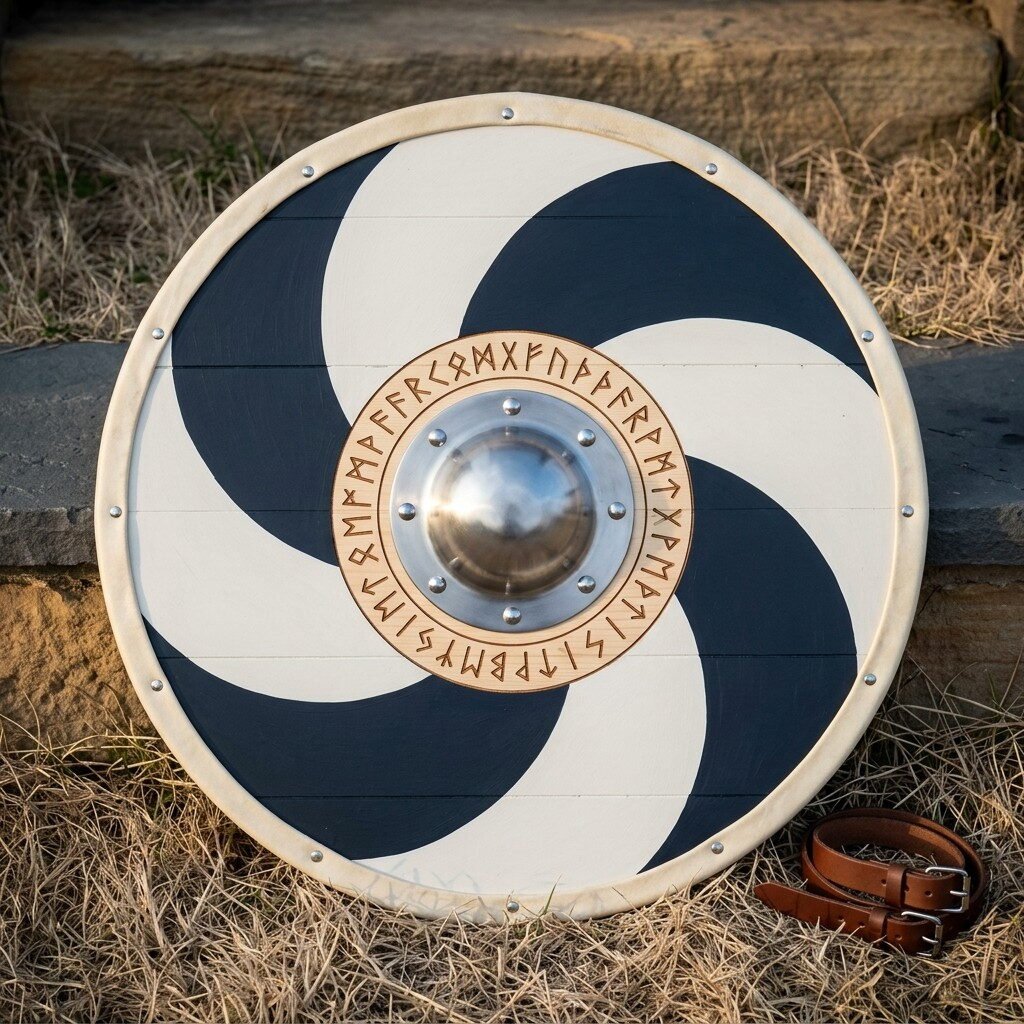
A Viking Age shield was a round board of thin planks, usually 75 to 95 centimetres across, with a hand hole in the middle covered by a domed iron boss. The fighter held a wooden bar behind that dome in one fist. It was light, it was built to be damaged, and it was closer to a consumable than to an heirloom.
What a Viking shield actually was
Start with the shape, because that is the part most people get right. The round board dominates the Norse record from the eighth century to the eleventh. Kite shields arrive late, spreading with Norman practice in the eleventh century, and you can watch the changeover happening in the Bayeux Tapestry, where round and kite boards stand in the same line.
What people get wrong is the weight and the build. A film shield is a slab of oak an inch thick with a leather strap for the forearm, because that is what reads as heroic on camera. The excavated shields are nothing like that. They are thin, centre gripped, and closer to a large wooden plate than to a door. That single difference changes everything about how the thing was handled.
How a Viking shield was built
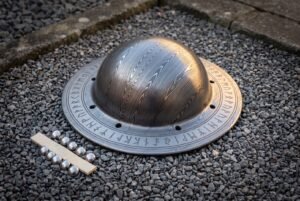 Stormeye Hand Forged Steel Viking Shield Boss with Pattern Etched Dome & Rune Cut Flange | Shield Building Gift | RK-1437
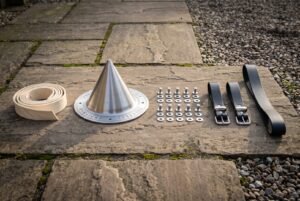 Spikerim Hand Forged Steel Conical Viking Shield Boss and Fitting Kit with Rune Ring Engraving & Black Leather Straps | Shield Building Gift | RK-1544
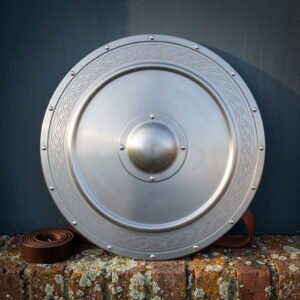 Ringwall Hand Made Steel Round Shield with Engraved Celtic Knotwork Border | 24 Inch Diameter | Riveted Rim, Domed Centre Boss and Leather Strap | Norse Reenactment Gift | RK-1818
The boards
Planks were butted edge to edge rather than overlapped, and held together by the boss, the rim treatment and in some cases glue and small battens across the back. The Gokstad ship burial in Norway, excavated in 1880, gave up sixty four shields hung along the vessel’s sides. Those boards were pine, roughly 94 centimetres in diameter, and about 7 millimetres thick through the middle, thinning toward the edge. Seven millimetres is thin. Stand a wooden ruler on edge and you are close, which is not the object most people are picturing.
Species varied with what grew nearby. Pine, fir, linden, willow, poplar and alder all appear in the wider northern European record. What they share is low density and a fibrous structure that swallows a cut instead of splitting cleanly along it. Oak, heavy and prone to running splits, is rare in shield boards even though it was everywhere as building timber. That is a choice, not an accident. They had oak. They did not want it.
The boss and the grip
The centre of the board was cut away and a hemispherical iron boss riveted over the hole. The boss did two jobs. It covered the bare hand inside the hole, and it gave the face a hard point that could turn a blade or be driven into an opponent. Boss forms are one of the more useful dating tools in Norse archaeology, because their profiles shift over time from taller conical shapes toward lower hemispheres with wider flanges.
Across the back of the hole ran a grip bar. Sometimes it was a single length of wood spanning the full diameter, acting as a spine as well as a handle. Sometimes it was shorter and reinforced with iron. The hand sat inside the hollow of the boss with the fingers closed around the bar, much the way you would hold a suitcase handle turned on its side.
Facing and edging
Here the evidence thins out, and honest writing matters more than confidence. Rawhide or leather edging is often described as standard, but direct traces survive on only a handful of finds. A shield recovered at Trelleborg in Denmark carried remains of a hide edge stitched around the rim, and the board measured about 85 centimetres across in fir. Iron edge clamps turn up at Birka and elsewhere, usually as short U shaped fittings rather than a continuous band.
Facing the front with leather or linen would make sense as reinforcement, and later Norwegian law codes such as the Gulathing law describe shields of layered boards bound with iron. Those codes are medieval rather than Viking Age, so they tell you where the practice ended up, not where it started. The plain truth is that we have far more bosses than boards, because iron survives in the ground and thin softwood does not.
Colours and painted decoration
Shields were painted, and the Gokstad boards are the clearest proof. They alternated yellow and black around the ship’s side. The pigments available in the period were the ordinary earth colours: ochres for yellow and red, chalk or lime for white, charcoal or bone for black. Traces of red, white and black have been reported from a shield at Ballateare on the Isle of Man.
Skaldic verse is thick with shield imagery, and poets describe painted scenes and bright discs. Reading a heraldic system into that is a step too far. Heraldry proper is a twelfth century development. A Norse shield could carry a spiral, a segmented pinwheel, a plain field of colour or a beast, and any of those is defensible. A coat of arms is not, whatever the seller has printed on the face. If you want a grounding in the marks that genuinely belong to the period, our guide to Norse symbols and their meanings separates the attested from the modern inventions.
Size, weight and why both were low
Take the Gokstad figures at face value and a bare board of that diameter in pine at 7 millimetres weighs very little. Add a boss, rivets, a grip and an edge treatment and most careful reconstructions still land somewhere between two and three and a half kilograms. That is roughly a full water bottle held at arm’s length, heavy enough after ten minutes and nothing like the ten kilogram monsters people imagine. Nobody crossed the North Sea to fight behind a coffee table.
Light and wide is a specific design answer. A broad face covers you from chin to thigh. A thin board absorbs an axe bite and holds the head, which is a feature rather than a flaw if you can then twist and strip the haft out of the other man’s hands. A heavy board would resist damage better, but nobody could move it fast enough for that to matter.
How shields were used
The shield wall
The skjaldborg, the shield wall, is real but overstated in popular retellings. Most of the vivid descriptions come from sagas written down two or three centuries after the events, and from poetry that was never trying to be a field manual. What we can say is that overlapping round boards in a line is a natural formation for this equipment, and that Norse and Anglo Saxon armies both fought on foot in dense formations.
Single combat and active defence
A centre gripped shield is an active tool. You do not hold it up and hide behind it. You punch with the boss, catch a blade near the rim where the leverage is best, roll the incoming line off the face, and use the edge to trap a shaft. Later fencing manuals that deal with buckler work show the same principles at a smaller scale, and reenactors fighting with accurate reproductions arrive at the same conclusions on their own.
Pair the shield with a one handed sword or a short hafted axe and the system makes sense. Pair it with the long two handed axe and it does not, which is one reason the huscarl’s long axe is usually shown with the shield slung or absent. Our piece on Viking axe history covers how the hafted arms of the period divided up by job.
What survives, and what does not
The honest summary is that bosses are common and boards are rare. Iron bosses turn up in graves across Scandinavia, the British Isles, Ireland and along the Rus trade routes. Complete or near complete wooden boards come from a short list of waterlogged or metal rich burials where conditions happened to preserve timber. Everything else is inference: stains in soil, rivet spacing, mineralised scraps stuck to corroded iron.
That thin record is why reconstruction arguments never fully settle. Was every shield faced in leather? We do not know. Was rawhide edging universal or regional? We do not know. Anyone who tells you otherwise is filling a gap with confidence rather than evidence, and confidence is a great deal cheaper than evidence.
What to look for if you are buying one
Decide first what the shield is for, because display and contact use pull in opposite directions.
For display, board thickness and rim finish matter less than the face. Look at how the paint is laid down, whether the boss is domed and riveted rather than pressed and glued, and whether the rim is finished at all or left as a raw sawn edge. A cheap shield gives itself away at the rim, every time.
For reenactment or contact work, ask about the boss and the rivets. Steel in the 14 to 16 gauge range, riveted through the board rather than screwed, is what you want. Check that the grip bar is fixed with more than glue, because that joint takes every impact you catch. Ask what the board is made of, and treat good laminated plywood as a legitimate modern answer rather than a compromise, since ply behaves closer to a historical shield than a single slab of hardwood does.
Weight is the fastest sanity check of all. Anything much above four kilograms for a 24 inch round is heavier than the surviving evidence supports.
What we stock
Our Viking shields range runs from painted round boards to Norman kite shapes, and the round shields section is the closer match to the Gokstad and Trelleborg profile if that is the look you are after. Bosses are steel, domed and riveted through the face, with the grip fixed behind. Some pieces carry engraved knotwork bands or rune rings around the rim, which is a modern decorative choice rather than a claim about any particular find. If you are assembling a full kit, the wider Viking armour section holds helmets, mail and bracers, and the Viking axes range gives you the hand axe that pairs properly with a centre gripped board. Ransack Viking is a US company in Chicago, Illinois. Every piece is handmade in the Czech Republic the old way, then imported, inspected and shipped from Chicago.
The two board shapes are set against each other in round shield or kite shield. If the shield is for a wall, see picking a shield for display.
Questions people ask
How big was a Viking shield?
The best evidence comes from Gokstad in Norway, where the sixty four shields were about 94 centimetres across. A board from Trelleborg in Denmark measured roughly 85 centimetres. Most reconstructions sit between 75 and 95 centimetres, which is about 30 to 37 inches. Modern reproductions are often built a little smaller, around 24 inches, which has less to do with authenticity than with doorways and wall space.
How heavy was a Viking shield?
Lighter than almost anyone expects. The Gokstad boards were pine about 7 millimetres thick, so the bare wood weighed very little. With an iron boss, rivets, a grip bar and an edge treatment, a full sized reconstruction usually lands between two and three and a half kilograms. Anything much above four kilograms is heavier than the surviving evidence supports, and your shoulder will tell you so inside ten minutes.
Did Vikings paint their shields red?
Painted shields are attested. The Gokstad boards were alternately yellow and black, and traces of red, white and black have been reported from a shield at Ballateare on the Isle of Man. Skaldic poetry is full of colour imagery. Red was available as an ochre and is entirely plausible, but the notion that red carried a fixed meaning or served as a signal is a modern story rather than a documented one, and it is usually told by whoever has a red one in stock.
Were Viking shields round or kite shaped?
Round through almost the whole Viking Age. The kite shield arrives late, spreading with Norman practice in the eleventh century, and the Bayeux Tapestry shows both shapes standing side by side. If you want something that reads as Norse rather than Norman, choose a round board with a central boss. A kite shield suits a later eleventh century or crusading impression instead.
How was a Viking shield held?
By a single bar behind the central hole, gripped in one fist, with the hand covered by the iron boss over the top. There was no forearm strap of the kind later medieval knights used. That centre grip is exactly why the board could be moved so quickly, punched forward with the boss, and rotated to strip an axe head out of the wood once it bit.
What wood were Viking shields made from?
Low density species dominate: pine, fir, linden, willow, poplar and alder all appear in the northern European record. Gokstad used pine and the Trelleborg board was fir. These woods take a cut without splitting along the grain the way oak does, and they keep the finished shield light. Modern reproductions often use laminated plywood, which behaves closer to a historical board than a single hardwood slab.
Where to see these
The catalogue carries the Huginward Viking round shield and the Ravenward Viking round shield. So do the Emberward Viking round shield and the Rimbind boss fitting kit.
The buckler manuals today
Those buckler manuals are still being read, and people still train from them on club nights. What HEMA is explains who those people are. The Elmgarth sidesword trainer is a Bolognese piece, and HEMA sideswords has the rest.
Shop the range
Stormeye Hand Forged Steel Viking Shield Boss with Pattern Etched Dome & Rune Cut Flange | Shield Building Gift | RK-1437Spikerim Hand Forged Steel Conical Viking Shield Boss and Fitting Kit with Rune Ring Engraving & Black Leather Straps | Shield Building Gift | RK-1544Ringwall Hand Made Steel Round Shield with Engraved Celtic Knotwork Border | 24 Inch Diameter | Riveted Rim, Domed Centre Boss and Leather Strap | Norse Reenactment Gift | RK-1818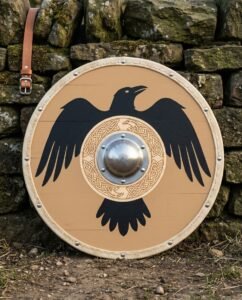 Huginward Hand Made Viking Round Shield | 30 Inch Planked Body | Steel Dome Boss with Engraved Knotwork Roundel and Rawhide Rim | Norse Reenactment Gift | RK-1498
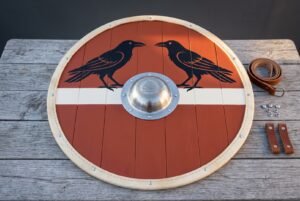 Ravenhold Hand Made Viking Round Shield | 24 Inch Diameter | Twin Ravens on Red and White with Steel Valknut Boss | Norse Reenactment Gift | RK-1433
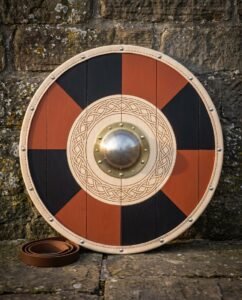 Emberward Hand Made Viking Round Shield | 30 Inch Planked Linden Face | Steel Boss with Carved Knotwork and Rawhide Rim | Norse Reenactment Gift | RK-1521