
Blog
Viking Ships, the Longship and What It Could Do

The Viking ship is the only piece of Norse technology that was genuinely ahead of everyone else in Europe, and it is the reason the period has a name. Without a hull that could cross open ocean and then be rowed up a river too shallow for anything else, the raids do not happen, Iceland is not settled, and Newfoundland is not reached five centuries before Columbus.
The good news for anyone who wants facts rather than atmosphere is that we have the ships. Several of them, dug out of clay and mud, well enough preserved to be measured, dated and rebuilt. This is one of the few subjects in Norse studies where the evidence is physical and abundant.
How they were built
The defining technique is clinker construction. Planks, called strakes, are laid so that each overlaps the one below and is fastened through the overlap with iron rivets, over a light internal frame. That is the opposite of the carvel method used in the Mediterranean, where planks meet edge to edge over a heavy skeleton.
The consequence is a shell that flexes. A clinker hull in a seaway visibly works, twisting with the waves rather than resisting them, and it can be built far lighter for its length than a rigid hull. It is also fast to repair, since a damaged strake can be cut out and replaced.
The keel is a single shaped timber running the length of the ship, which is what makes a Viking hull hold a course under sail instead of sliding sideways. The oak for it was chosen standing and split rather than sawn, so the plank followed the grain and kept its strength. Strakes were radially split from large logs, which produces a plank that is stronger and more flexible than a sawn one and wastes an enormous amount of wood.
Steering was by a side rudder mounted on the right rear quarter. That is the origin of the word starboard, from the steering side, and of port, the side you put against the dock so as not to crush the thing.
The sail was a single square sail on a central mast, made of wool, and probably treated with grease or tar. Wool sails were extraordinarily labour intensive. Estimates of the fleece and spinning time behind a single large sail run into years of one person’s work, which puts the textile industry behind the Viking Age into a perspective the swords never get.
Longship or cargo ship
The word longship is used loosely and covers only half the story. Norse shipbuilding produced two distinct families, and the difference is the difference between a raid and an economy.
 Keelbrand Hand Forged High Carbon Hand and a Half Sword with Longship Etched Blade | Brass Ball Pommel and Trefoil Guard | Leather Grip and Scabbard | Norse Collector Gift | RK-2172
 Prowshear Hand Forged Damascus Bearded Axe with Engraved Longship | 20 Inch Haft and 7 Inch Edge | Hooked Horn and Riveted Leather Collar and Blade Mask | Norse Gift | RK-2134
 Hammerlight Hand Forged High Carbon Steel Viking Arming Sword | 36 Inch Overall Length | Brass Hilt with Oxblood Leather Grip | Mjolnir Etched Gift | RK-2150
Warships
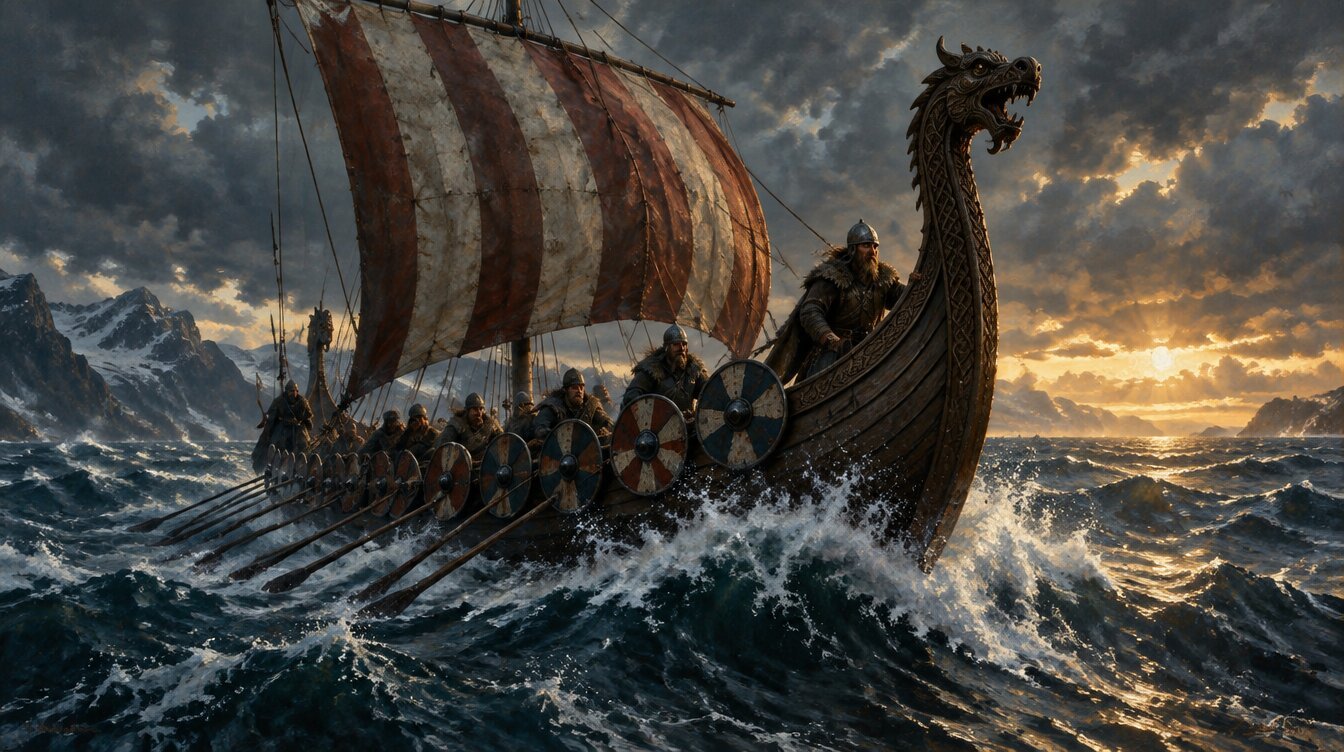
Long, narrow, shallow, built for speed and for carrying people. Ratios of length to beam around seven or eight to one. Rowed from benches along the sides with the crew doubling as the fighting force, and sailed when the wind allowed. Draught shallow enough to run up a beach or a riverbank, which removed the need for a harbour and is the single tactical fact that explains the period.
The Norse categorised them by rowing benches. A karvi is small, around sixteen benches, and doubles as a working boat for a well-off farmer. A snekkja is the standard warship, with around twenty benches and perhaps forty to fifty men. A skeid is bigger. A dreki, dragon ship, is the largest class, thirty benches or more, and is named for the carved head at the stem.
Cargo ships
The knarr is the one that mattered more and gets a fraction of the attention. Shorter, much broader, deeper in the water, decked at the ends with an open hold amidships, and crewed by a handful of people rather than a war band. It sailed rather than rowed. This is the hull that carried settlers and livestock to Iceland and Greenland, and it is what made a North Atlantic colony possible.
The ships we actually have
Four finds carry most of the weight.
The Oseberg ship, from a burial mound in Norway, was built around 820 and buried in 834 with two women and a very large quantity of goods including a wagon and sledges. It is the most ornate Norse ship known, covered in carving, and probably better suited to sheltered water than to open ocean.
The Gokstad ship, buried around 900 in Norway, is the seagoing one. Around twenty three metres long, sixteen oar positions a side, and strong enough that a replica sailed the Atlantic.
The Tune ship, found in the same region, is more fragmentary but adds to the picture.
The Skuldelev ships are the most informative group. Five vessels sunk deliberately in Roskilde fjord in Denmark around 1070 to block a channel, excavated in 1962, and now in the Viking Ship Museum at Roskilde. They include two cargo ships of different sizes and two warships, so they show a working fleet rather than a single prestige burial.
Skuldelev 2 is the important one. Dendrochronology dates its timber to around 1042 and places its origin in the Dublin area, which is direct physical evidence that a ship in a Danish fjord was built in Norse Ireland. It is roughly thirty metres long and would have carried around sixty five to seventy men.
Roskilde 6, found in 1997 during museum construction, is the longest Viking ship known at just over thirty seven metres, built around 1025.
What they could actually do
This is where reconstructions earn their keep, because a ship in a museum tells you its shape and nothing about its behaviour.
Havhingsten fra Glendalough, the Sea Stallion, is a full reconstruction of Skuldelev 2, launched at Roskilde in 2004. In 2007 it sailed from Roskilde to Dublin, retracing the route the original timber came from, and returned the following year. It carried a crew of sixty five and the voyage was instrumented, which turned a great deal of speculation into measurement.
The general picture from reconstruction work is a cruising speed of five to ten knots under sail with bursts substantially higher in the right conditions. Rowing is slower and is for manoeuvring, for calm, and for the last stretch into a river.
The other useful data point is older. In 1893 a replica of the Gokstad ship, named Viking, was built at Sandefjord in Norway and sailed across the Atlantic under Magnus Andersen with a crew of eleven, reaching Chicago for the World’s Columbian Exposition in July of that year. Andersen recorded a top speed of ten knots and reported that the hull’s flexing, which alarmed everyone at first, was exactly what kept it intact. The ship still exists, in Illinois.
Ship names
Named ships appear throughout the saga material, mostly royal ones, and the naming habit is well attested even where the ships themselves are not.
Ormen Lange, the Long Serpent, belonged to Olaf Tryggvason and is the most famous. It was built in Norway at the end of the tenth century, described as the largest ship in the country, and was lost with him at the battle of Svolder around the year 1000. He also had Ormen Skammi, the Short Serpent, and Trana, the Crane.
Olaf Haraldsson had Visundr, the Bison. Earl Eirik Hakonarson had Jarnbardinn, usually rendered Iron Beard or Iron Ram, described as reinforced at the bow for ramming.
The mythology has two more, and the sources behind them are described on the page about what Norse mythology actually is. Skidbladnir belongs to Freyr, always has a fair wind, and folds up small enough to go in a pouch. Naglfar is made from the nails of the dead and sails at Ragnarok, which is why Snorri says the dead should have their nails trimmed before burial, so as not to hurry it along. Both appear on the page for Ragnarok.
Saga ship names should be read with the same caution as everything else written down centuries later. The names are probably genuine tradition. The dimensions attached to them in the sagas are frequently not, and Ormen Lange’s stated size has been argued over for a long time.
Burials
Ships were also graves. Oseberg and Gokstad are both burials, and the practice ranges from complete vessels under mounds down to stone settings laid out in the shape of a hull.
Ibn Fadlan’s account of a Rus funeral on the Volga in 922 describes a ship burning with a dead chieftain aboard, which is the only eyewitness description of the practice from anyone who was actually there. It should be read knowing that he was an outsider recording a group whose customs may not have matched those of Scandinavia itself. The people involved are covered on the page for famous Vikings.
What ships have to do with the rest of it
Everything. The shallow draught explains the raids on monasteries up rivers. The knarr explains Iceland and Greenland. The Dublin-built warship in a Danish fjord explains how connected the Norse world was.
It also explains what people carried. Fighting kit on a ship had to be compact and useful, which is part of why the axe and the spear were far more common than the sword. That is set out on the pages for Viking axe history and the Viking spear, and what they wore is on the page for Viking armour.
Carrying it
Longship and prow motifs are among the genuinely period-appropriate designs, since ships appear on Gotland picture stones, on coins and scratched into wood at Bergen. Ransack Viking is a US company in Chicago, Illinois. Pieces are handmade in the Czech Republic, then imported, inspected and shipped from Chicago, and engraving is cut here after arrival. Plain 1095 runs 54 to 58 HRC and Damascus of 1095 and 15N20 runs 58 to 60. US orders ship free and tracked with no import duty, and everything carries a lifetime warranty against defects. The relevant ranges are bearded axes, Viking swords and Viking home decor. The rest of the writing is in the guides.
Questions people ask
What is a Viking longship?
A long, narrow, shallow-draught warship built by overlapping planks riveted together over a light frame, powered by oars and a single square sail. The shallow hull let it be run straight onto a beach or up a river, which removed the need for a harbour and is the single fact that explains how the raids worked.
How fast could a Viking ship go?
Reconstruction sailing suggests a cruising speed of roughly five to ten knots under sail, with higher bursts in strong conditions. The 1893 Gokstad replica Viking recorded ten knots crossing the Atlantic. Rowing is much slower and was used for manoeuvring, for calms, and for the final approach up a river.
What is the difference between a longship and a knarr?
A longship is narrow and shallow and built to carry people fast. A knarr is shorter, much broader and deeper, with an open cargo hold and a small crew, and it sailed rather than rowed. The knarr is the hull that carried settlers and livestock to Iceland and Greenland, and it did more for Norse history than any warship.
Which real Viking ships have been found?
The Oseberg ship of about 820, the Gokstad ship of about 900 and the Tune ship, all from Norwegian burial mounds, and the five Skuldelev ships deliberately sunk in Roskilde fjord in Denmark around 1070 and raised in 1962. Roskilde 6, found in 1997, is the longest known at just over thirty seven metres.
What were Viking ships called?
By class, a karvi is a small vessel of around sixteen benches, a snekkja the standard warship, a skeid larger, and a dreki or dragon ship the largest. Individual ships had names too. Olaf Tryggvason’s Ormen Lange, the Long Serpent, is the best known, alongside Ormen Skammi, Trana, Visundr and Jarnbardinn.
Was a Viking ship really built in Dublin?
Yes. Skuldelev 2, one of the warships sunk in Roskilde fjord, has been dated by tree rings to around 1042 with its timber originating in the Dublin area. It is direct physical proof of how connected the Norse world was, and the reconstruction Sea Stallion sailed the same route to Dublin in 2007.
How were Viking ships built?
Clinker built: overlapping planks riveted through the overlap over a light internal frame, with a single shaped keel timber running the length. Planks were split radially from oak rather than sawn, which follows the grain and gives a stronger, more flexible board at the cost of a lot of wood. The result flexes with the sea instead of fighting it.
Did Viking ships have dragon heads on the front?
Some did, and the largest class was named for them. No carved stem head has survived attached to an excavated ship, so the shapes people picture come from other carvings, from the Bayeux Tapestry and from later art. An Icelandic law is recorded requiring such heads to be removed when approaching land so as not to frighten the land spirits.
From the shop
Ready to ship, the Prowshear bearded axe and the Keelbrand arming sword. The Prowcrown longsword and the Ashreaver Viking spear are the other two.
Shop the range
Keelbrand Hand Forged High Carbon Hand and a Half Sword with Longship Etched Blade | Brass Ball Pommel and Trefoil Guard | Leather Grip and Scabbard | Norse Collector Gift | RK-2172Prowshear Hand Forged Damascus Bearded Axe with Engraved Longship | 20 Inch Haft and 7 Inch Edge | Hooked Horn and Riveted Leather Collar and Blade Mask | Norse Gift | RK-2134Hammerlight Hand Forged High Carbon Steel Viking Arming Sword | 36 Inch Overall Length | Brass Hilt with Oxblood Leather Grip | Mjolnir Etched Gift | RK-2150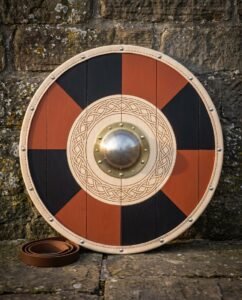 Emberward Hand Made Viking Round Shield | 30 Inch Planked Linden Face | Steel Boss with Carved Knotwork and Rawhide Rim | Norse Reenactment Gift | RK-1521
 Stormwheel Hand Made Viking Round Shield | 24 Inch Diameter | Navy and White Pinwheel with Steel Boss and Elder Futhark Rune Ring | Norse Reenactment Gift | RK-1553
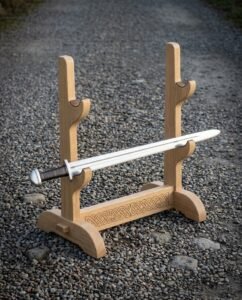 Oakrest Hand Made Oak Sword Display Stand | Two Tier Table Top Rack | Knotwork Engraved Crossbar with Wide Footed Oak Base | Norse Display Gift | RK-1783