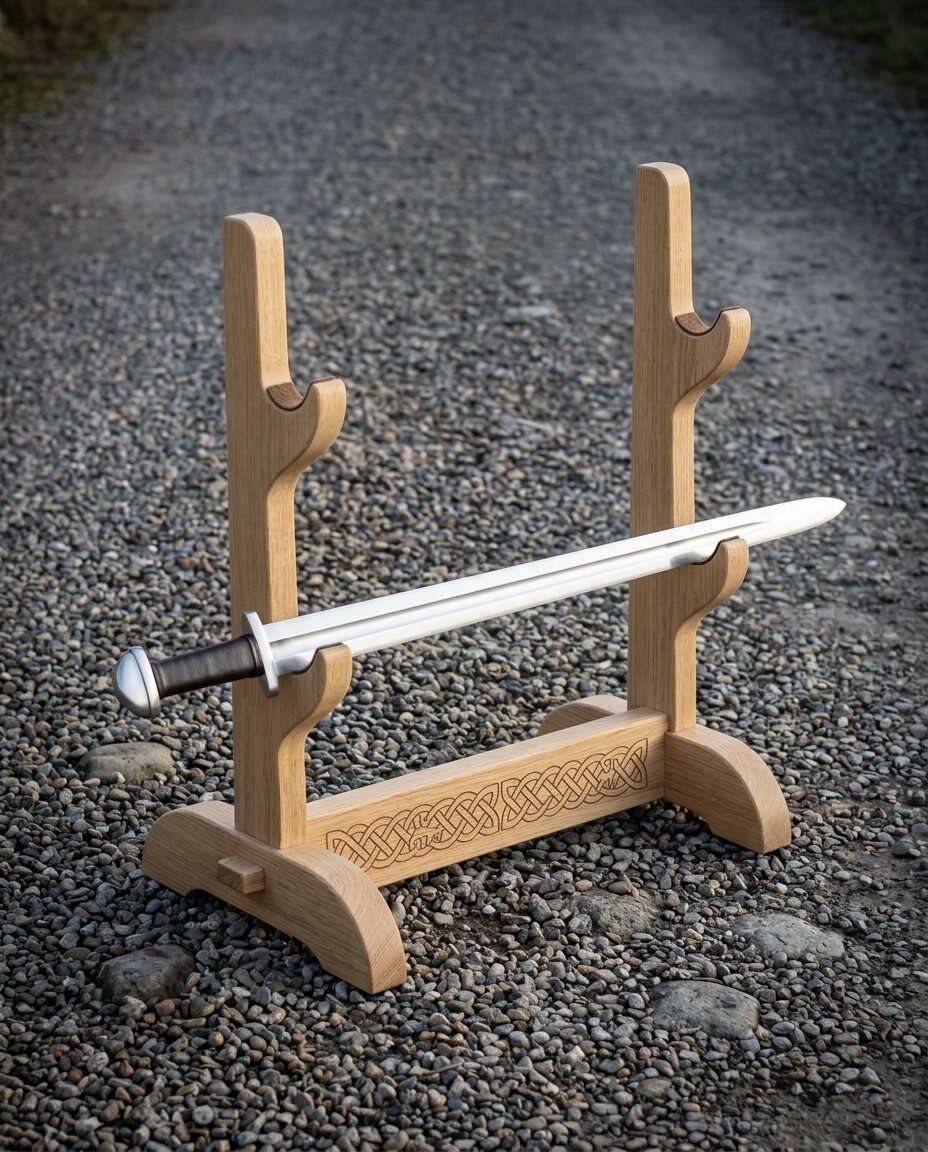
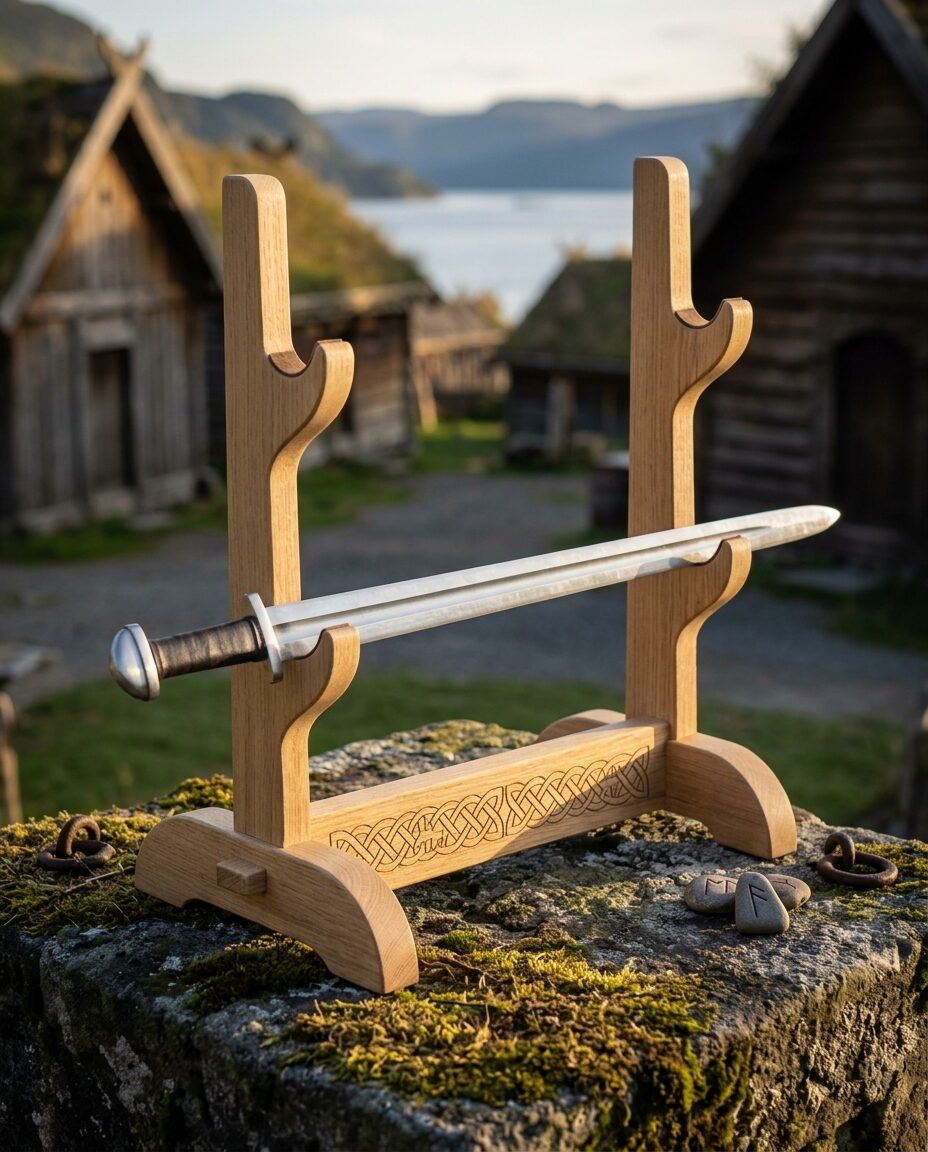
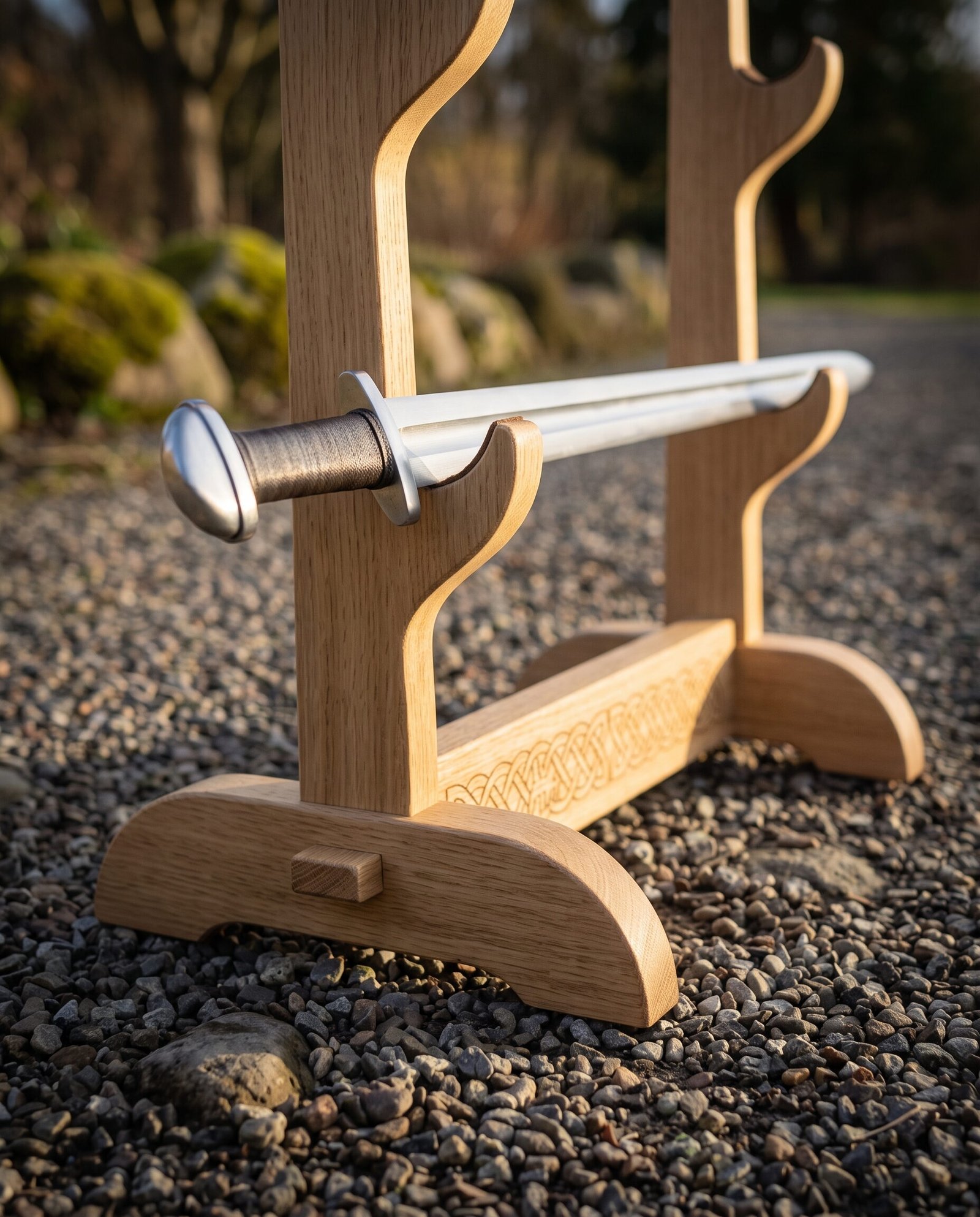
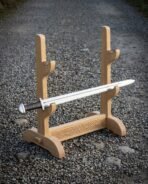
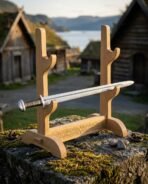
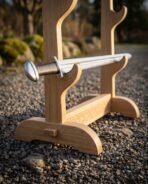
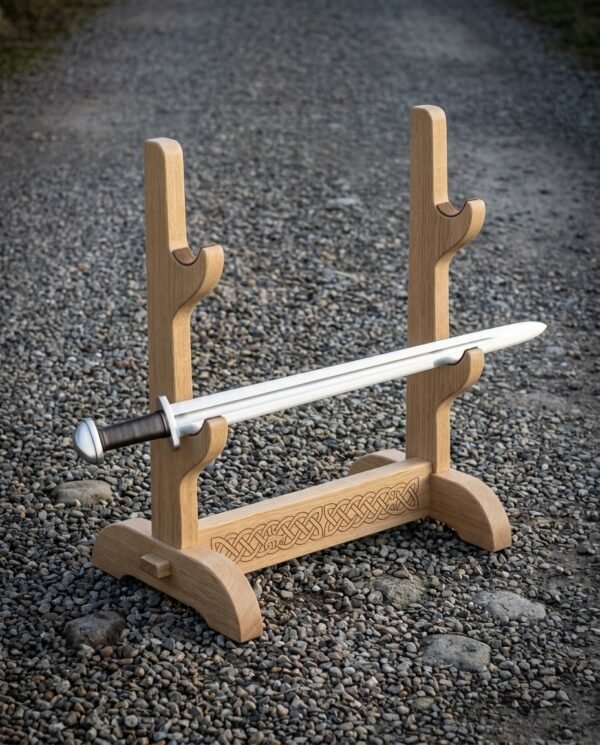
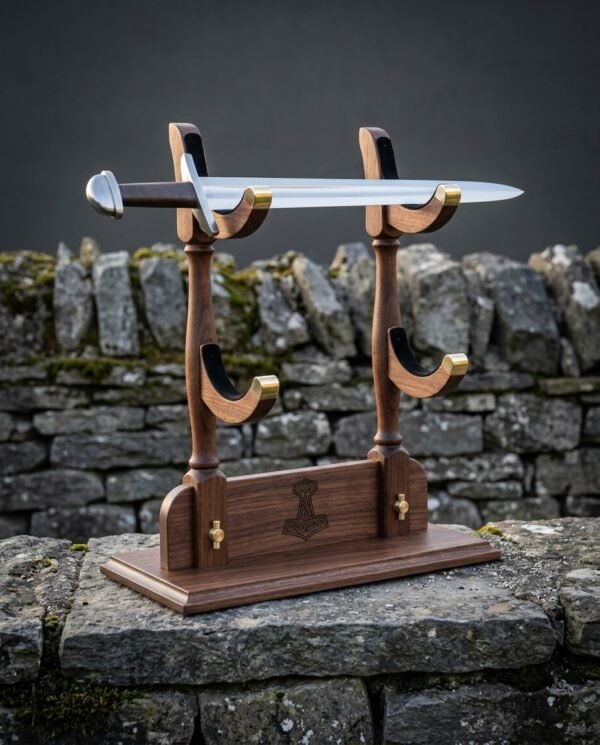
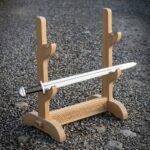
This is a two tier table top stand for displaying swords. Two shaped oak uprights carry two pairs of cut cradles, one above the other, and they are joined by a long oak stretcher engraved along its face with a band of running knotwork. The stretcher passes through both uprights as a through tenon, and the whole thing sits on two curved feet wide enough that a loaded stand will not tip. The sword shown in the photograph is there for scale and is not included.
Stands like this are a genuinely old idea rather than a modern shop fitting. Japanese katana kake, European armoury racks and the pegged wall stands recorded in medieval inventories all solve the same problem, which is that a sword lying flat on a surface is a sword that gets knocked, scratched and eventually sat on. Standing it in a corner is worse, because the tip takes the entire weight on one point and the blade slides. A cradle spreads the load across two points and takes the blade off every surface it could damage or be damaged by.
Made, cut, jointed, engraved and oiled by hand in the Czech Republic, and shipped assembled. If the sword stands and displays brought you here, the scabbards and sheaths are the obvious next stop.
Specifications
| Material | Solid oak throughout |
|---|
| Capacity | Two tiers, one sword or hafted piece per tier |
|---|
| Uprights | Two shaped oak uprights, each with an upper hook cradle and a lower cradle |
|---|
| Joinery | Low stretcher between the uprights, tenoned through, with the tenon ends showing on the feet |
|---|
| Engraving | Running knotwork band cut along the face of the stretcher |
|---|
| Base | Two curved feet, wide set for stability when loaded |
|---|
| Finish | Clear oiled oak, grain and ray fleck left visible |
|---|
| Placement | Table top, shelf, mantel or cabinet |
|---|
| Not included | Swords. The blade in the photograph is for scale |
|---|
| SKU | RK-1783 |
|---|
How a sword should sit on a stand
There is a right way round and most people get it wrong the first time, so it is worth saying plainly. Rest the sword with the edge upward and the spine or the flat in the cradle.
Two reasons. First, an edge resting in a notch is an edge slowly being blunted by wood, and the pressure is concentrated on the narrowest part of the blade. Second, on a curved single edged sword, edge up is how a katana is traditionally rested, because it keeps any oil on the blade from running down into the cradle and off the steel.
The two cradles on each tier should carry the blade well apart, not close together in the middle. Support near the ends stops the blade flexing under its own weight over the years, which straight blades will do if they are left resting on a single central point for long enough.
Put the heaviest piece on the bottom tier. This is not a rule about the stand’s strength so much as about its centre of gravity. A heavy longsword on the top tier and nothing below it raises the whole assembly’s balance point and makes it easier to tip with a passing elbow.
Leave a scabbarded sword scabbarded if you like the look. The cradles are cut generously enough to take a blade in leather.
Oak and the through tenon
The joint is the part worth paying attention to. The long stretcher does not simply butt into the uprights and rely on glue. It passes right through them and shows its end on the outside face, which is a through tenon, and it is the oldest reliable way to join two pieces of wood at right angles.
The reason it matters here is racking. A stand is a frame, and frames fail by leaning sideways rather than by breaking. A glued butt joint resists that with nothing but the glue line. A through tenon puts a solid block of oak inside a solid mortise, so the joint resists twist mechanically. You can pick a well made stand like this up by one upright, loaded, and it will not lozenge.
Oak is used because it is dense, hard and stable. It resists denting from a guard knocking against it, it holds a crisp cut edge on a cradle rather than crushing, and it takes an engraved line cleanly. It is also open grained, which is where the visible ray fleck and the warm streaking come from, and no two boards do it the same way.
The finish is a penetrating oil rather than a lacquer, so it soaks into the wood and hardens there instead of sitting on top as a film that can chip.
Engraving, runes and your own design
Use the rune converter on this page to turn a name, a date or a short phrase into Elder Futhark and we will cut it into the steel, the leather or the wood. If you would rather have a Viking pattern than a rune line, choose your own design in the engraving option above the add to cart button and tell us where it goes. Where a piece already carries an engraved design, your chosen engraving replaces it rather than sitting alongside it.
The stretcher already carries a knotwork band, so an engraving ordered there replaces it. It is the best surface on the whole piece for a long line, and a full name in Elder Futhark fits comfortably. The outer faces of the two uprights will each take a shorter line or a single stave. See the engraving page.
Mounting and display
This is a free standing table top piece and it needs no fixing. Put it on a shelf, a mantel, a cabinet top or a sideboard, somewhere with enough depth that the feet sit fully supported rather than overhanging a front edge.
Leave clearance at both ends. A stand loaded with two swords is wider than the stand itself by a considerable margin, and the commonest damage to a displayed sword happens when someone walks past a tip that was sticking out further than they expected.
Keep it out of direct sunlight. Sun will fade oak unevenly, bleach a leather grip and dry a scabbard, and the stand will fade around the swords so you get a visible outline when you move them.
If the surface is a polished table, four small felt pads under the feet are worth adding. Oak on lacquer will mark a table over years of small movements.
Care
Dust with a dry cloth. Once a year, a thin coat of any furniture or hardwood oil rubbed in and buffed off keeps the oak fed and the colour even. Skip the silicone sprays, which leave a film that resists oil afterwards.
If a cradle picks up a mark from a guard, it will usually rub out with fine abrasive paper and a re oil. That is one of the advantages of an oiled finish over a lacquered one.
Where a carbon steel blade is going to live on the stand for months, oil the blade before you rest it and check it every few weeks. See our steel care notes. Wood in contact with steel will hold humidity against it, so a blade that sits in a cradle all year wants more attention than one that lives in a case.
Made in the Czech Republic
The work behind this piece happens in a Czech Republic workshop that has kept to the old methods. Steel is forged and heat treated by hand, the grind is taken down by eye rather than by machine, and the handle, fittings and sheath are cut and finished one at a time. Because of that, every piece carries small marks of the hand that made it.
Ransack Viking is a United States company. We import direct, check each piece when it reaches us, and ship from our Chicago, Illinois warehouse. Engraving is added here in the United States after arrival, so the piece you receive is finished to your order.
A note on handmade variation
This stand is hand made rather than machine made or bulk produced, so what arrives will not be a pixel for pixel copy of the photograph. Oak is a natural material and no two boards are alike. The tone can sit anywhere between pale honey and a deeper amber, the ray fleck shows strongly on some pieces and hardly at all on others, and the grain runs where it runs. The knotwork is cut by hand rather than printed, so its rhythm is a person’s.
The dimensions, the material, the joinery and the build are the same every time. The character is not. There is more on that in how to hang a blade on a wall, and in safety and storage if you want the background.
Frequently asked questions
Is the sword included?
No. The blade in the photograph is there to show scale. You are buying the stand only.
How many swords does it hold?
Two, one per tier. It will also take axes, a short spear, a scabbarded blade or a mix of them.
Which way up should the sword sit?
Edge upward, with the spine or the flat resting in the cradle. An edge resting in wood gets blunted and, on a curved blade, oil runs off the steel.
Will it hold a full sized longsword?
Yes. The cradles are cut for full sized blades and the feet are set wide enough that a loaded stand is stable. Put the heaviest piece on the bottom tier.
Does it need assembly?
No. It ships assembled with the stretcher already tenoned through both uprights.
Can I have a name cut into the crossbar?
Yes, and it is the best surface on the piece for one. Your engraving replaces the knotwork band rather than sitting beside it.
What is in the box
- Oakrest two tier oak sword stand, assembled
- Wood care card
- Made and finished in the Czech Republic
Explore the range
See the rest of the sword stands and displays, the Viking home decor, the Viking swords to put on it, and the guides.
Compare it with these
Another in the same line is the Stavecradle sword stand. Next along the rack is the Ravenperch sword stand. For a straight comparison, see the Runeledge sword stand.
The Rookhelm Viking home decor covers the other half of the same kit. Pick the steel, the length and the fittings yourself on the design your own page.

Perfect gift. Perfect quality. No complaints. It’s handmade in the Czech Republic but ships from a US warehouse so it arrived quicker than I expected. Steel blade holds a razor edge right out of the box. This is going straight into my display case.
Got this as a birthday gift and the reaction was priceless. Fit and finish is museum quality. You can tell real craftsmen made this by hand. Already telling my friends to check this out.
Photos don’t do this sword justice at all. Steel blade holds a razor edge right out of the box. Highly recommend this one.