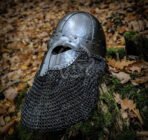
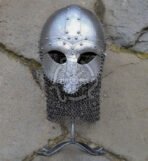
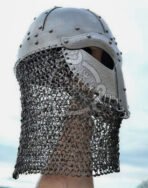
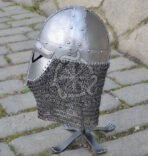
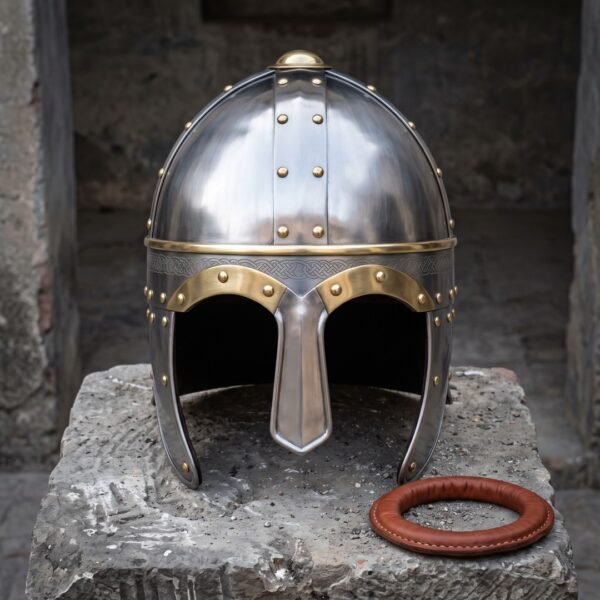
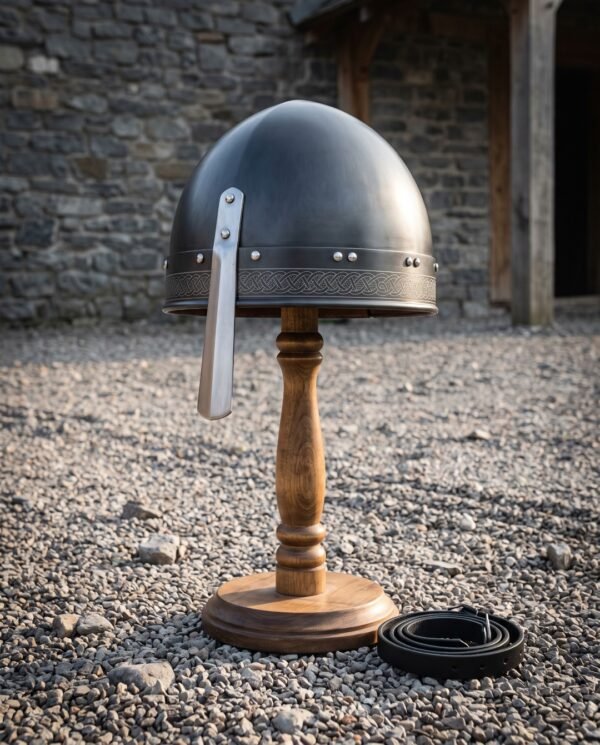
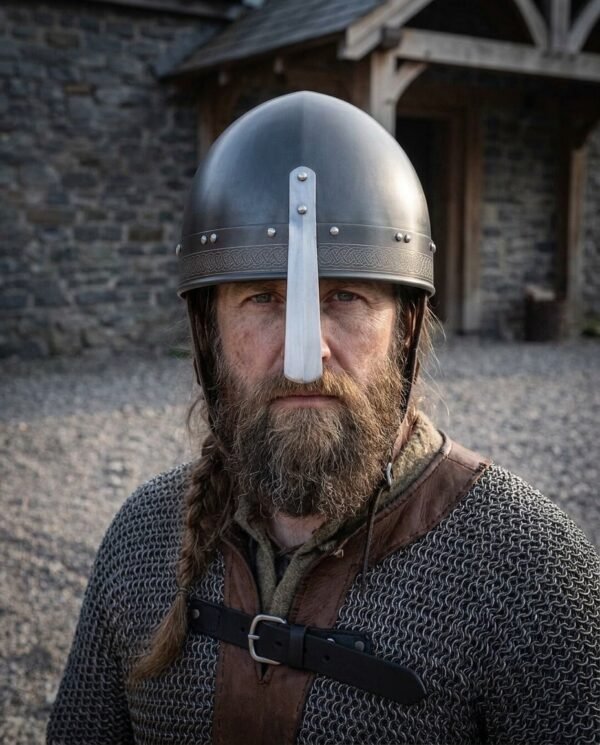
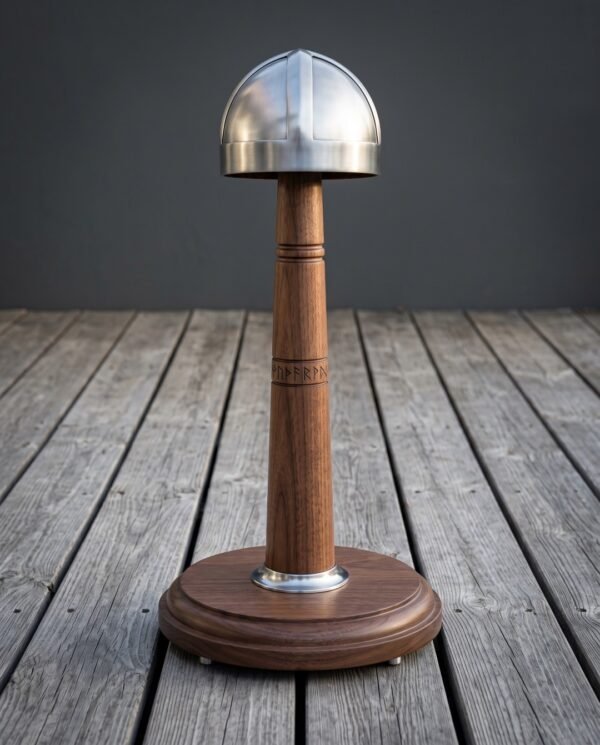
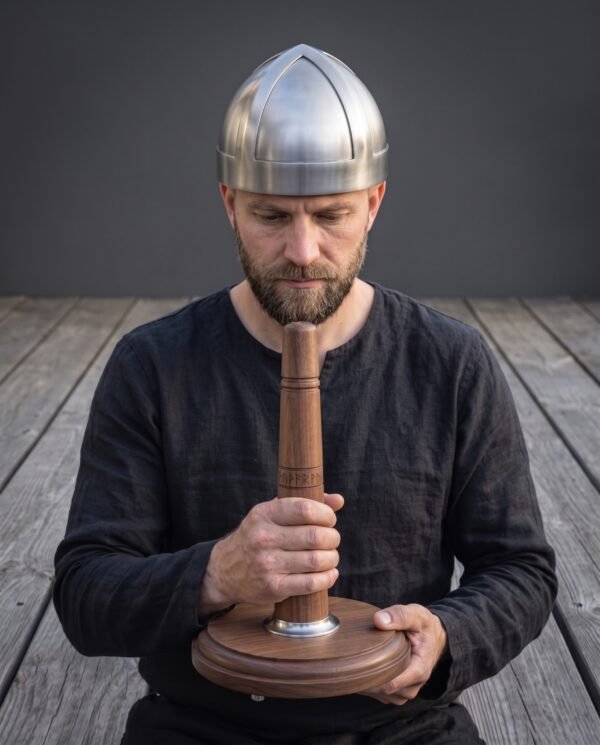
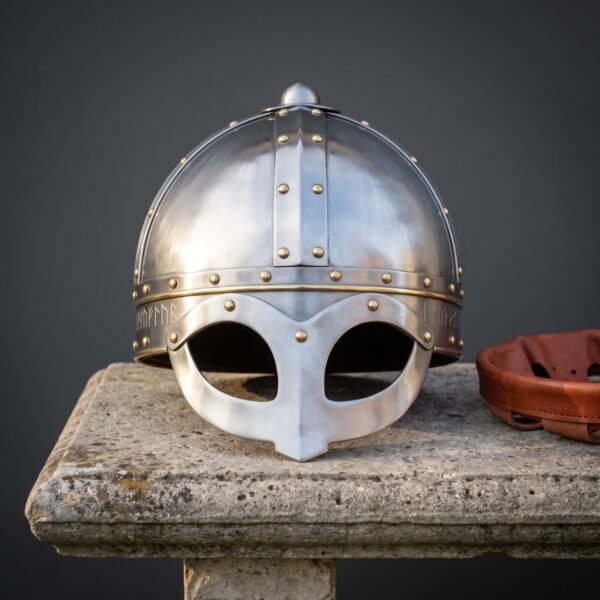
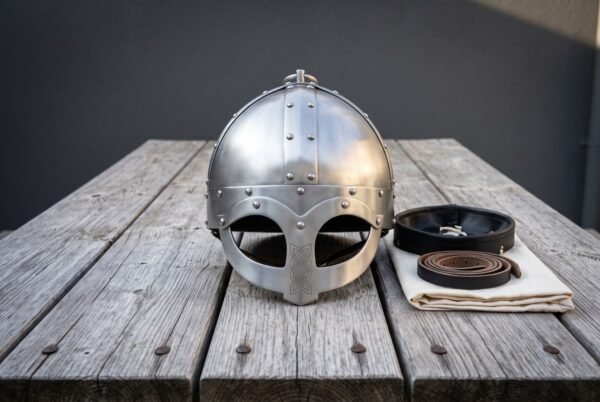
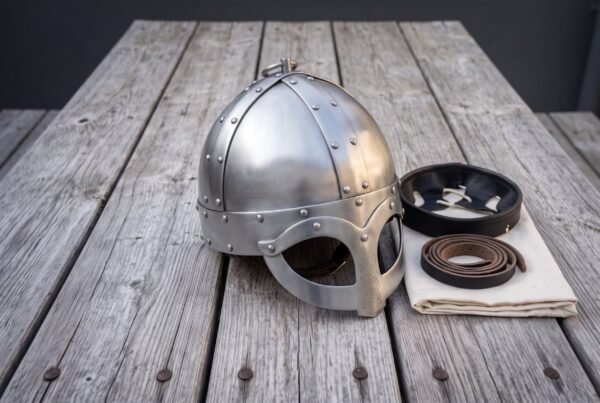
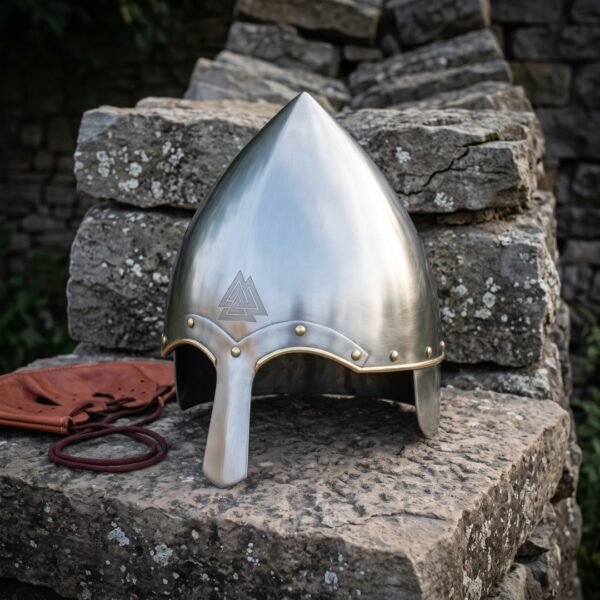
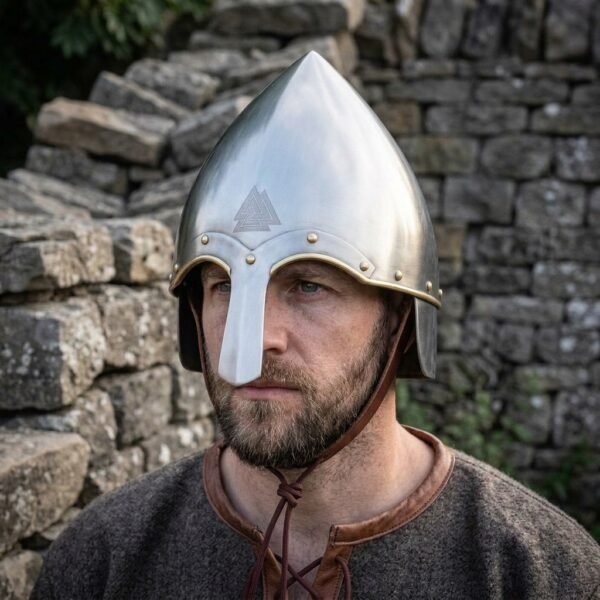
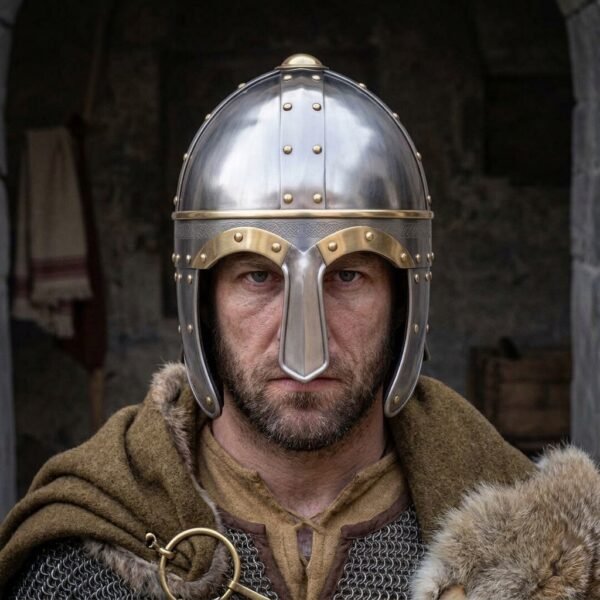
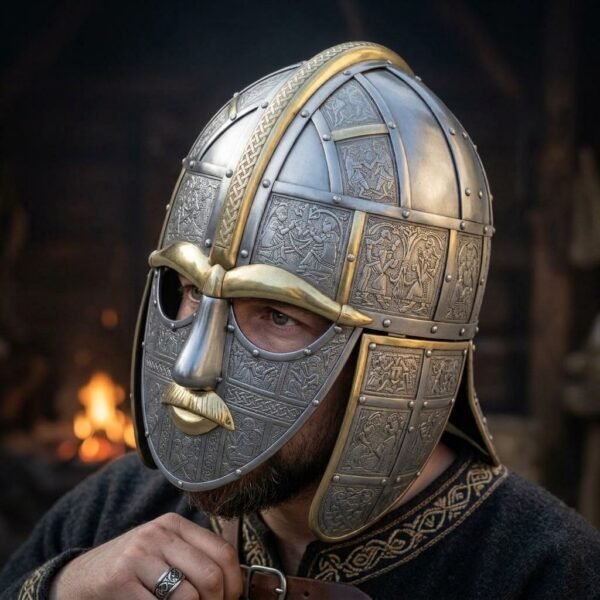
The Ironcrown is a handcrafted Viking helmet raised from steel plate 2 mm thick, made for reenactment, costume and wall display. It has no horns on it, and that is not an omission. It is the single most important thing to say about any Viking helmet, so it is worth saying at the top rather than burying it. Fit and steel gauge decide whether a helmet is any good, as buying a Viking helmet explains.
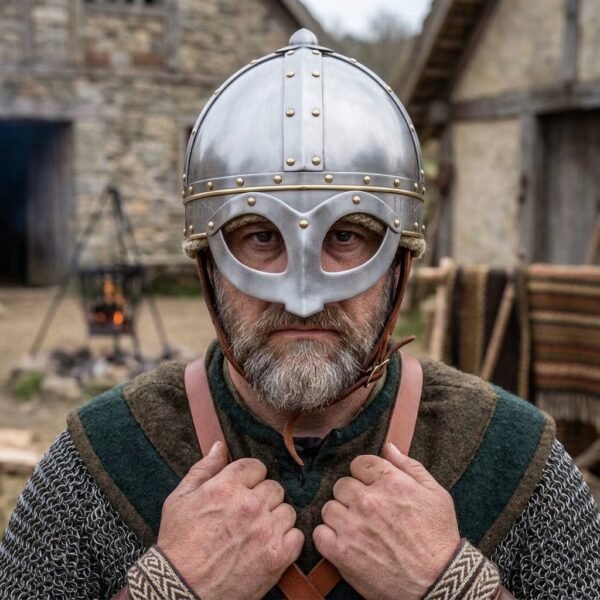
There is exactly one near complete helmet from the Viking Age anywhere in the archaeological record. It was pulled out of a burial mound at Gjermundbu in Ringerike, Norway, in 1943, and it is now in the Museum of Cultural History in Oslo. It is iron, it is roughly conical, it is built from four plates riveted to a browband and two crossing bands, and the front carries a striking spectacle shaped guard that covers the eyes and the nose in one piece. There is fragmentary evidence for a mail curtain hanging at the back to protect the neck. What there is not, anywhere on it, is a horn. A second candidate has since emerged in the Yarm helmet from North Yorkshire, found during drainage work in the 1950s, forgotten in a museum store and reassessed in 2020 as plausibly Anglo Scandinavian and tenth century. Two helmets, roughly, from three centuries of Norse activity across half of Europe. That is how thin the evidence is, and neither one has horns.
Every Ironcrown is formed, riveted, dressed and finished in a Czech Republic workshop and packed with protective wrapping. Shipping inside the United States is free, processing takes one to two weeks, and returns are accepted within seven days.
Specifications
| Material | Hand formed steel shell |
|---|
| Shell thickness | 2 mm |
|---|
| Construction | Shaped, dressed and finished by hand |
|---|
| Intended use | Reenactment, cosplay, costume and wall display |
|---|
| Engraving | Available on request |
|---|
| SKU | RK-628 |
|---|
Where the horns actually came from
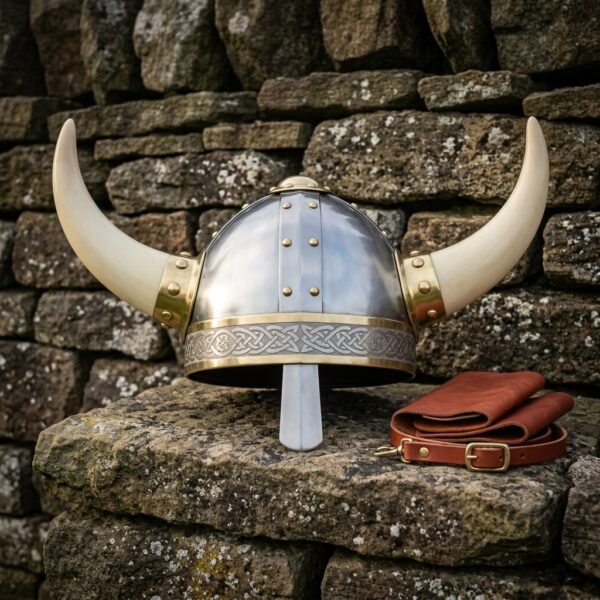
This is the question we get asked more than any other, so here is the full answer. Horned helmets do exist in Scandinavian archaeology. The pair found in a bog at Vekso on Zealand in Denmark are magnificent, curving, unmistakably horned bronze helmets. They date to around 900 BC. That is the Nordic Bronze Age, and it is somewhere near two thousand years before the first raid on Lindisfarne. They almost certainly served a ritual or ceremonial purpose rather than a military one, and no Viking ever saw one.
The Viking horned helmet as a popular image is a nineteenth century invention with a fairly precise birthday. National Romantic painters had been putting wings and horns on Norse figures for decades, but the version that stuck came from Carl Emil Doepler, the costume designer for the first complete staging of Wagner Der Ring des Nibelungen at Bayreuth in 1876. He put horned helmets on stage, the production was enormously influential, and the image escaped into advertising, illustration and eventually cartoons. It has never left.
Think about it practically for a moment as well. A horn gives an opponent a lever to twist your head, catches on everything in a shield wall, and adds weight in exactly the wrong place. The whole point of a helmet is that things slide off it. That is why the surviving Norse and Anglo Saxon helmets are smooth, rounded or conical, and why this one is too.
Why steel and not aluminium or resin
Plenty of costume helmets are vacuum formed plastic, cast resin or spun aluminium, and they are lighter and cheaper. They also look and sound like what they are. Steel has a weight and a coldness in the hand that no substitute reproduces, it takes and holds a dressed metal finish rather than a paint layer that chips, and it can be knocked back into shape rather than shattering if it is dropped. At 2 mm the shell is substantial. Most costume helmets sold as Viking helmets are between 0.8 and 1.2 mm, and the difference is immediately obvious when you pick one of each up.
Steel does have one requirement that plastic does not, which is that it will oxidise if you leave it damp. That is a two minute a year problem rather than a real one, and it is covered below. If you want the wider argument about carbon steel, stainless and the corrosion trade off as it applies across our range, it is set out in Damascus versus stainless.
How a Norse helmet was built
The construction method worth knowing is called spangenhelm, from the German for clasp or band. Rather than beating a whole helmet from one sheet, which is difficult, slow and wastes a lot of metal, the smith made a skeleton of iron bands. A browband ran around the head, and two or more bands arched over the crown and crossed at the top. The gaps between those bands were then filled with separate shaped plates, riveted in place from behind.
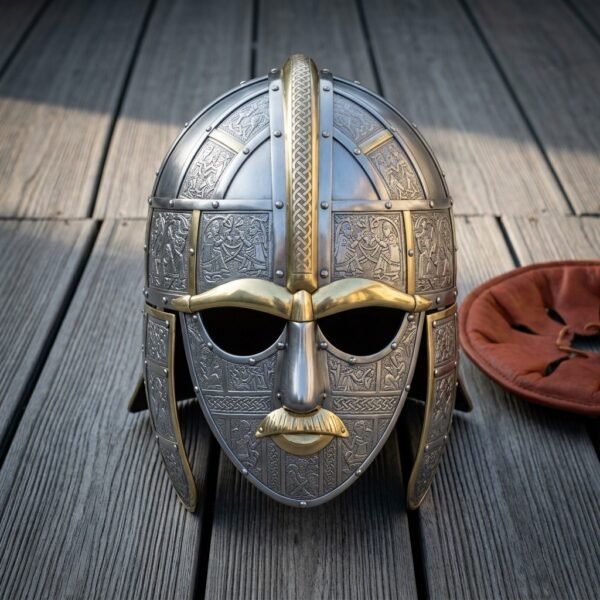
This is a genuinely clever piece of engineering for a period without rolled sheet steel. It lets you use smaller pieces of metal, it means a damaged plate can be replaced without rebuilding the whole helmet, and the frame itself adds rigidity exactly where a downward blow lands. The Gjermundbu helmet is built this way with four plates, and so are most of the earlier Vendel and Valsgarde helmets from Sweden, which are the richly decorated pre Viking helmets people often mistake for Norse ones. The nasal bar, that vertical strip down the front of the face, appears across the whole of northern Europe for the same reason it appears here. It stops a straight thrust or a downward cut running into the face without blocking your vision.
Engraving, runes and your own design
Use the rune converter on this page to turn a name, a date or a short phrase into Elder Futhark and we will cut it into the steel or the handle. If you would rather have a Viking pattern than a rune line, choose your own design in the engraving option above the add to cart button and tell us whether it goes on the blade or the handle. Where a piece already carries an engraved design, your chosen engraving replaces it rather than sitting alongside it. On a helmet the browband and the nasal are the two places a rune line reads best, and knotwork or a Jelling style beast sits well across the side plates. Tell us the placement at checkout. Detail on the engraving page.
Care and upkeep
Wipe the shell down after handling, because skin oils and sweat are mildly acidic and will mark bare steel over a few weeks. Keep it somewhere dry rather than a garage, a basement or a shed, and do not store it wrapped in a plastic bag, which traps moisture against the metal. Two or three times a year, wipe a thin film of light oil or paste wax over the outside and the inside. That is the entire maintenance routine.
If surface rust appears, it lifts easily with fine steel wool or a green pad and a little oil, then re oil the bare area. Do not use household bleach or a strong acid descaler. The full routine is in steel care. There is no edge anywhere on this piece and nothing on it to sharpen, but if you own blades from the range, the technique for those is written up in sharpening with a whetstone.
Made in the Czech Republic
This is a handmade piece from the Czech Republic, made in a workshop that still forges, grinds and finishes by hand instead of stamping parts out. The smiths there have kept the older way of working, and the wood, horn and leather are shaped and fitted by hand as well. Two pieces of the same design will never be identical, and that is part of what you are buying.
Ransack Viking is a United States company. We handle the import ourselves, look over every piece when it lands and ship from our warehouse in Chicago, Illinois. Engraving is done in the United States after the piece arrives, so your design goes on before we send it out.
A note on handmade variation
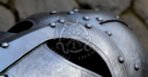
This helmet is made by hand. It is not machine made and it is not bulk produced, so what arrives will not be a pixel for pixel copy of the photograph. The hammer texture across the shell, the tone of the finish, the exact placement of rivets and the precise curve of the crown all vary, because each one is worked by hand from raw steel. The thickness, the construction and the overall form are the same every time. The character is not, and small asymmetries are the mark of a raised shell rather than a pressed one.
Frequently asked questions
Did Vikings really not wear horned helmets?
They did not. No horned helmet has ever been recovered from a Viking Age context anywhere. The horned image comes from nineteenth century opera costume and Romantic painting, and the genuine horned helmets from Denmark are Bronze Age, roughly two thousand years earlier.
Can I wear this for reenactment or is it display only?
It is made for costume, cosplay and light reenactment as well as display. It is not certified combat armour and should not be treated as protective equipment or used in full contact fighting.
How do I know it will fit my head?
The shell is made to a single size. If you are buying it to wear rather than to display, message us before you order and we will give you the internal measurement of the batch being made, so you can compare it against your own head circumference.
Is there a liner or padding inside?
It ships as a bare steel shell. If you intend to wear it for any length of time, a simple padded arming cap worn underneath makes an enormous difference to comfort and is how it was done historically.
Will it rust on a wall?
Not in a normal heated room. Wipe it down after handling and give it a thin coat of oil or wax two or three times a year. Avoid damp garages and basements, and never store it sealed in plastic.
What was a Viking helmet actually made of?
Wrought iron, worked into a frame of bands with shaped plates riveted between them. Helmets were expensive and comparatively rare, which is a large part of why so few have survived to be dug up.
What is in the box
- One Ironcrown handcrafted Viking helmet with a 2 mm steel shell
- Protective packaging
- Forged and finished in the Czech Republic
Explore the range
Related collections: Viking Helmet, Viking Shields, Viking Axes and Swords. The archaeology and the care notes are in the guides.
Also in this part of the catalogue
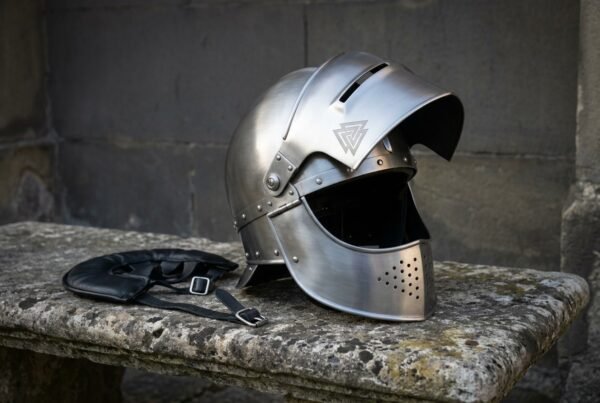
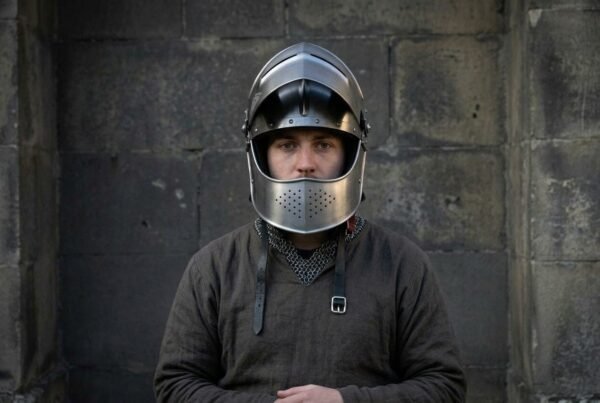
Sitting beside it in the catalogue is the Hornreave Viking helmet. Another in the same line is the Skyglass Viking helmet. Next along the rack is the Gazeward Viking helmet.
Fitting out further, the Ravenward round shield belongs with it. Or start from a blank sheet on the design your own page.




Reviews
There are no reviews yet