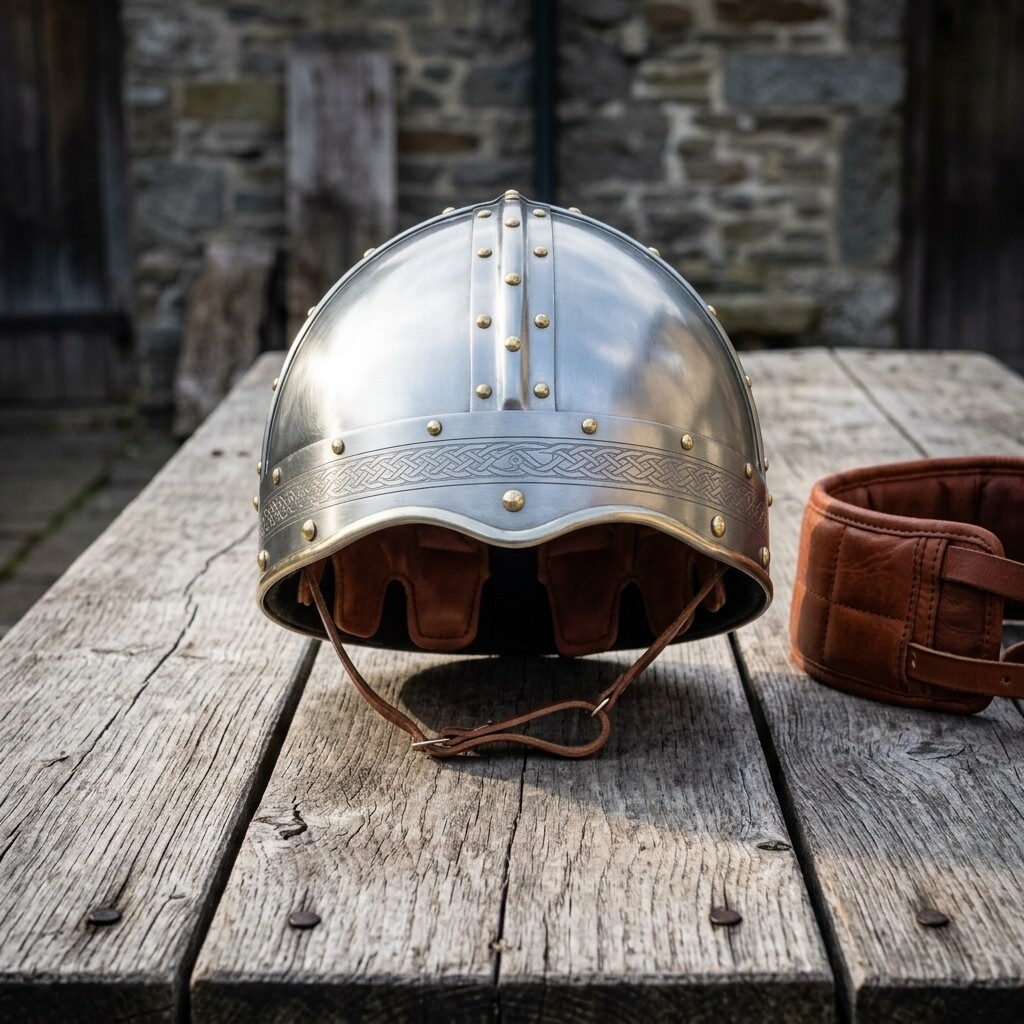
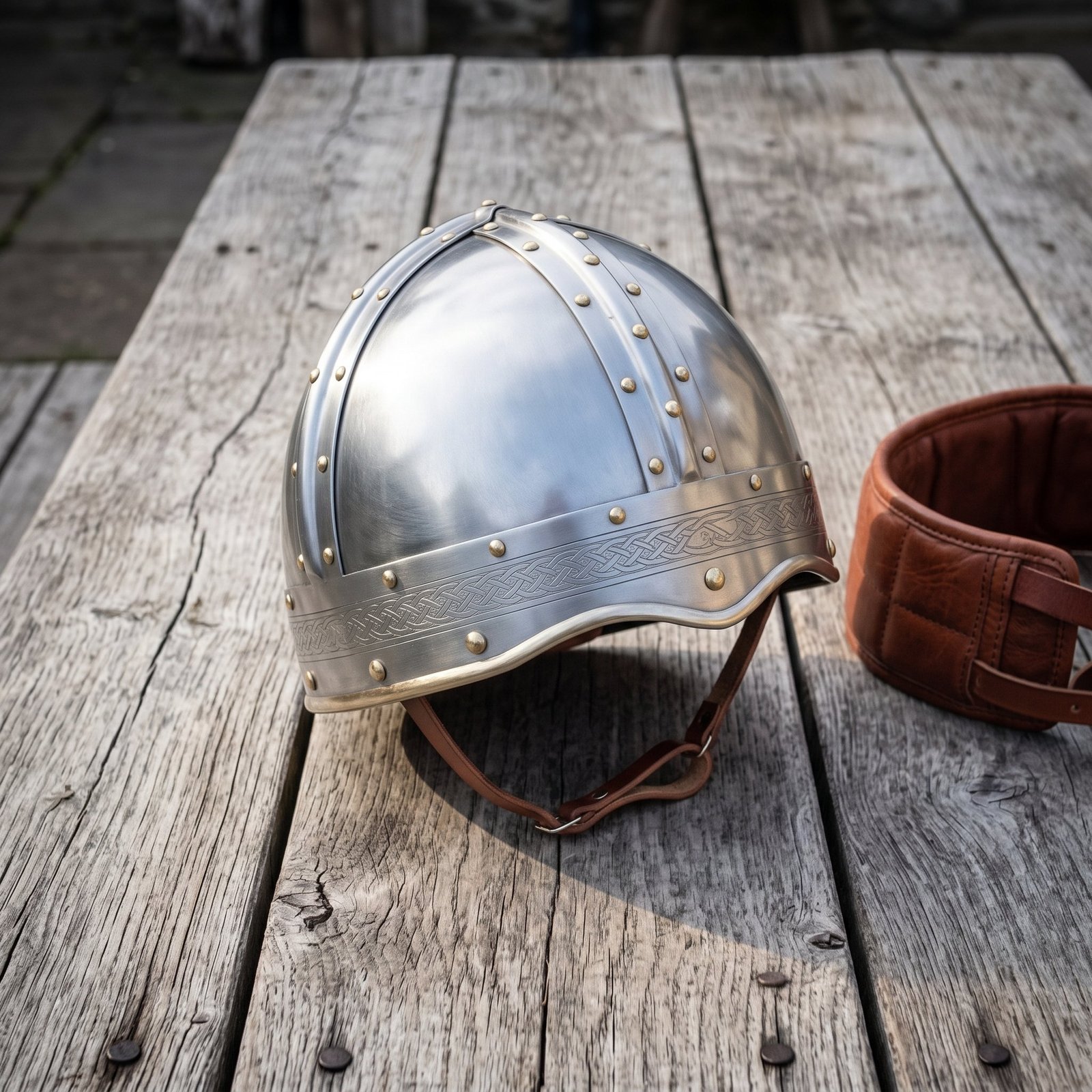
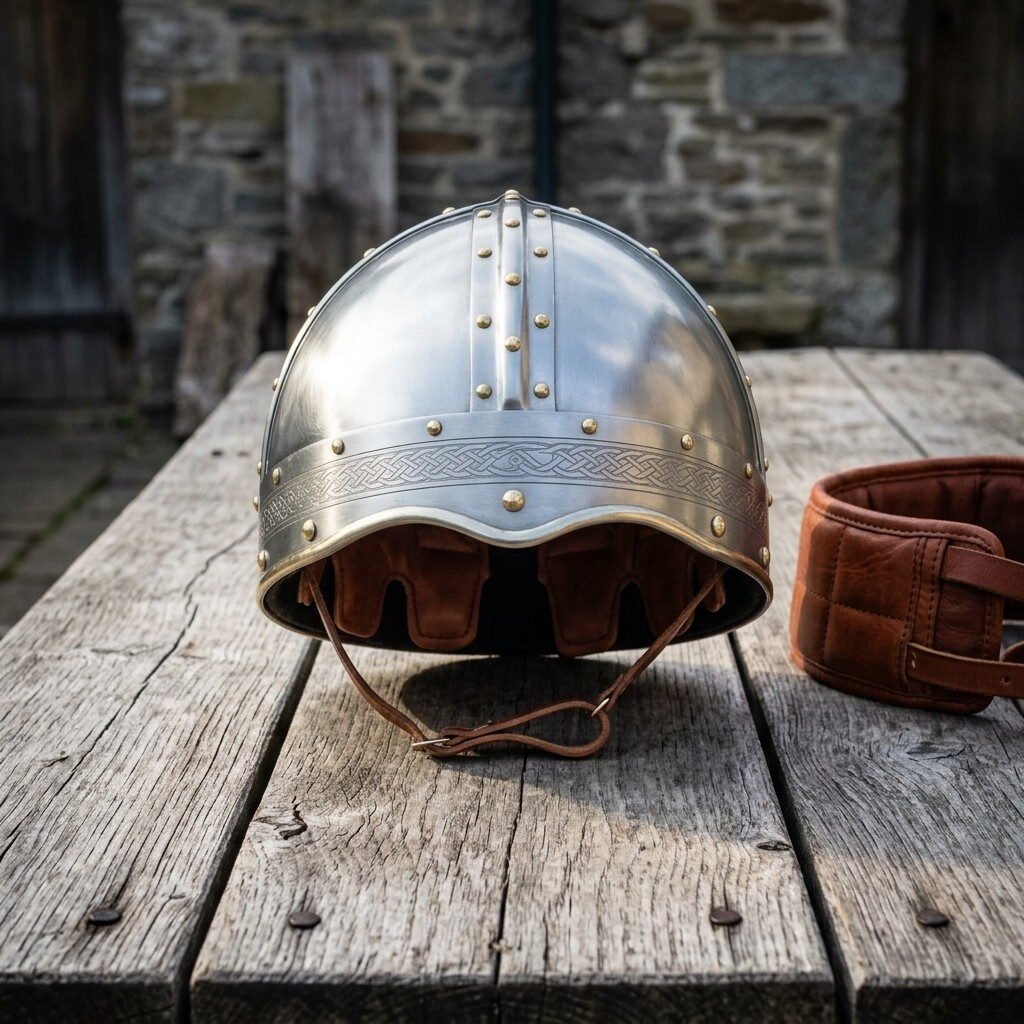
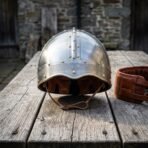
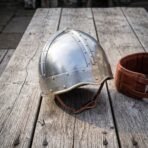
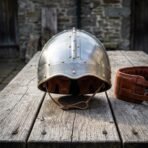
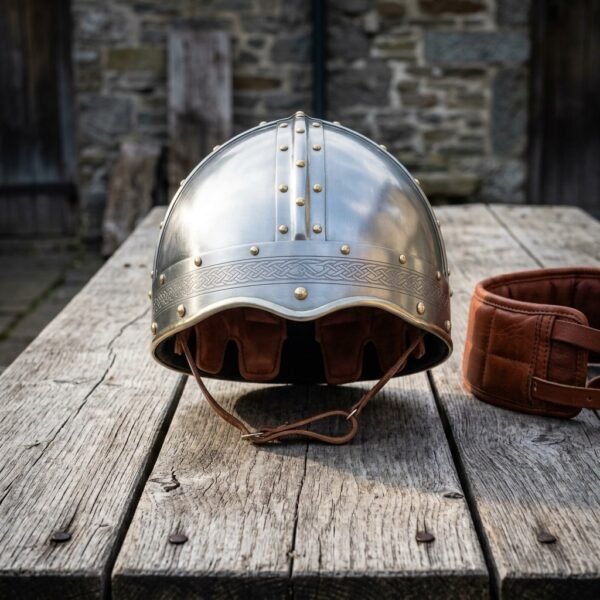
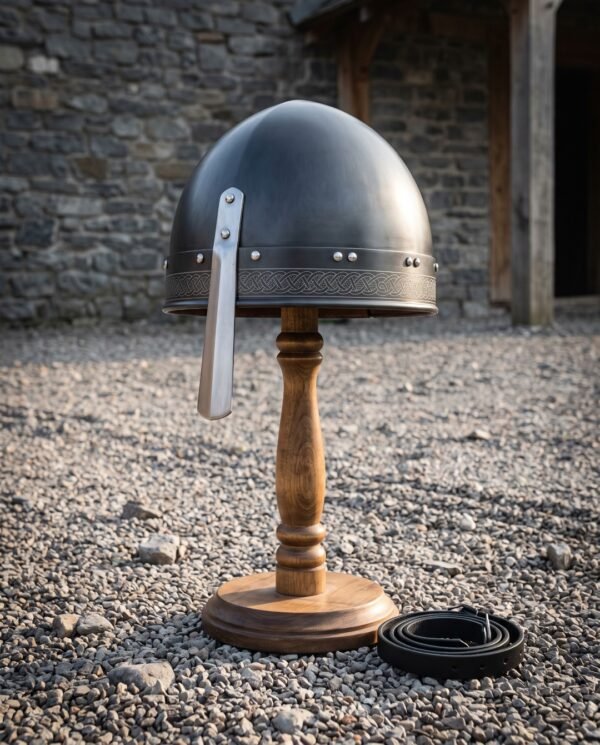
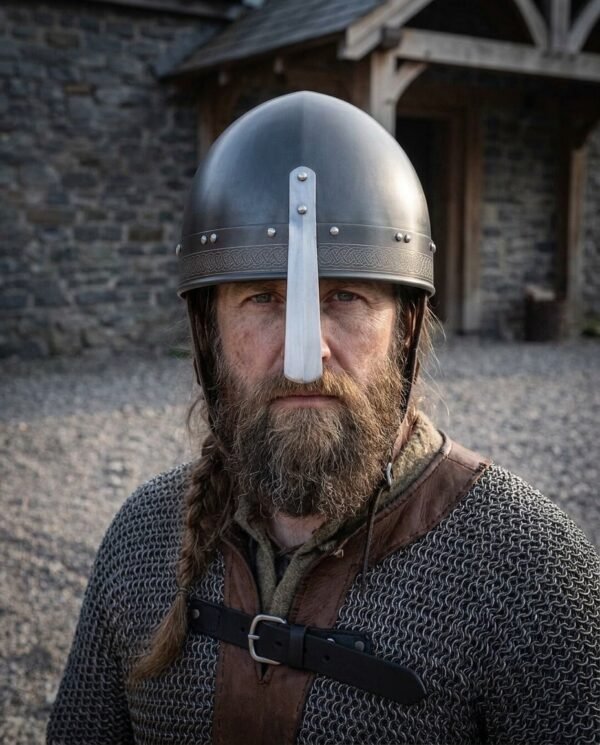
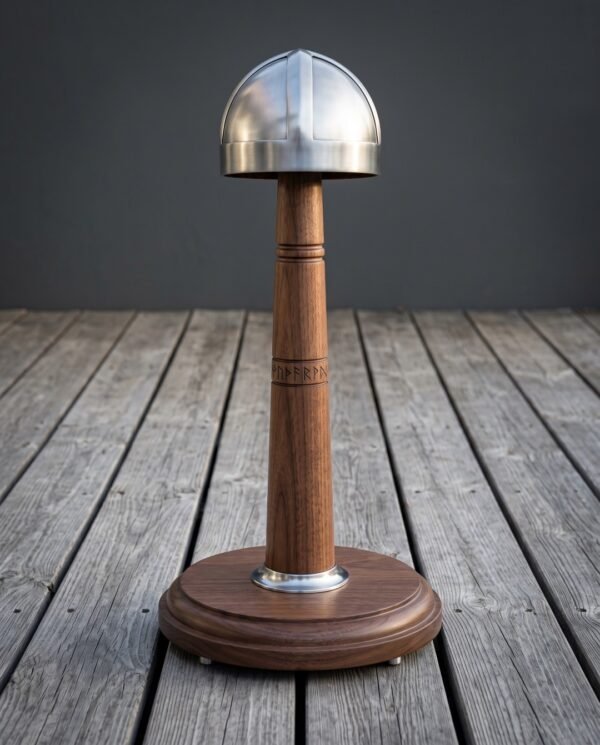
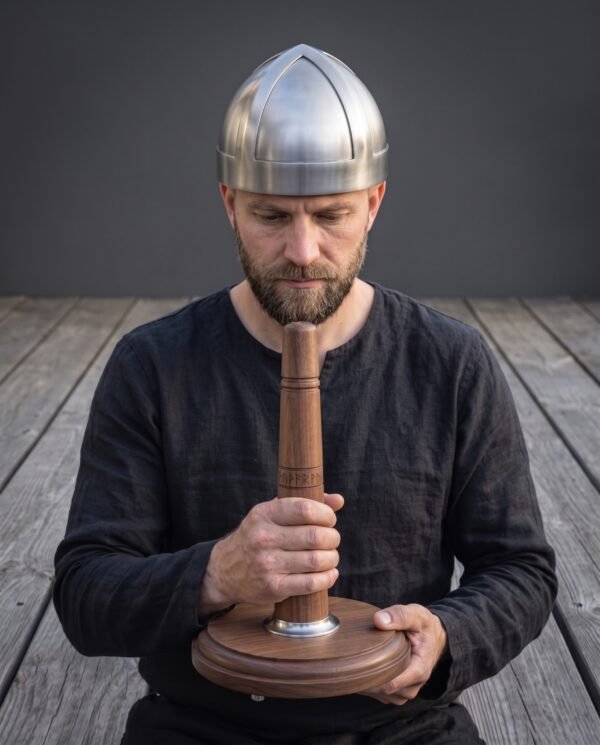
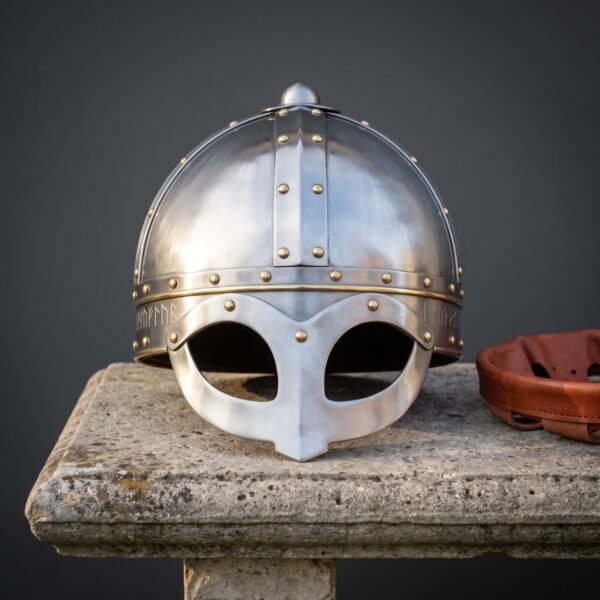
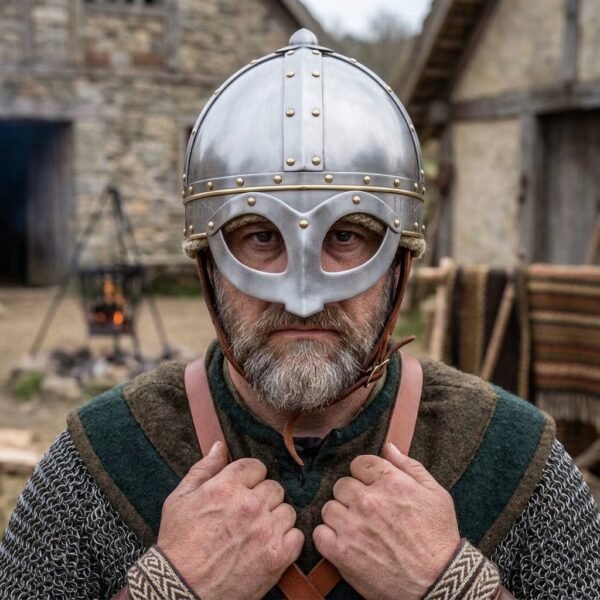
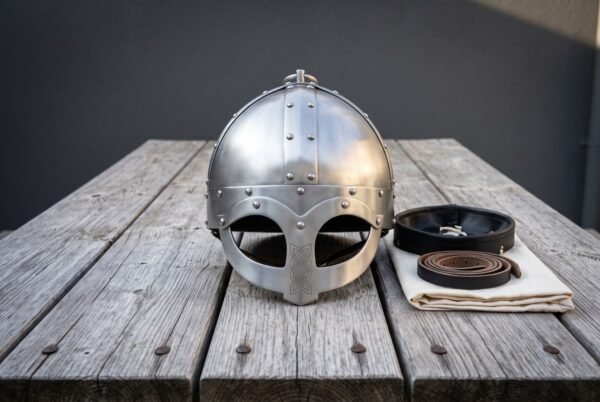
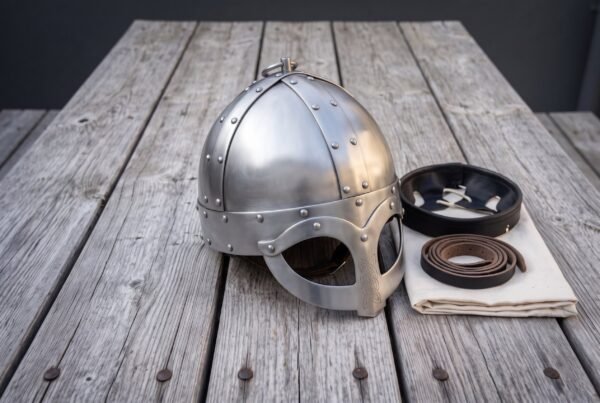
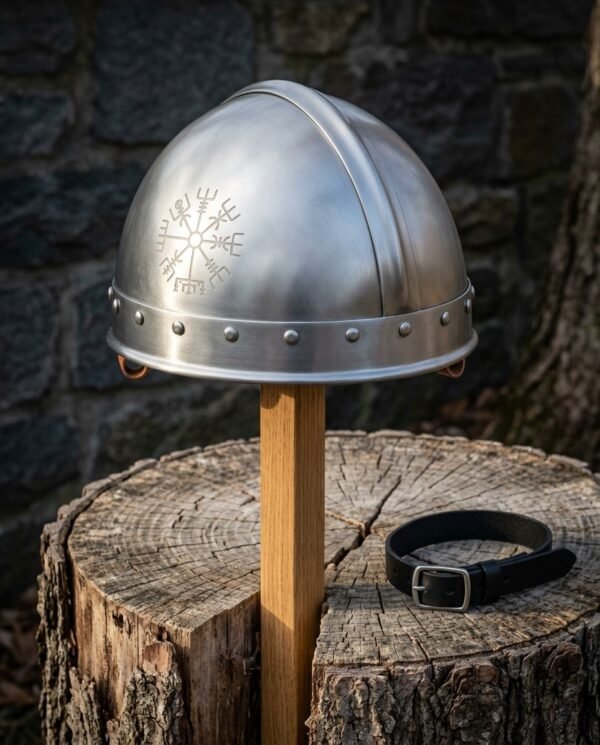
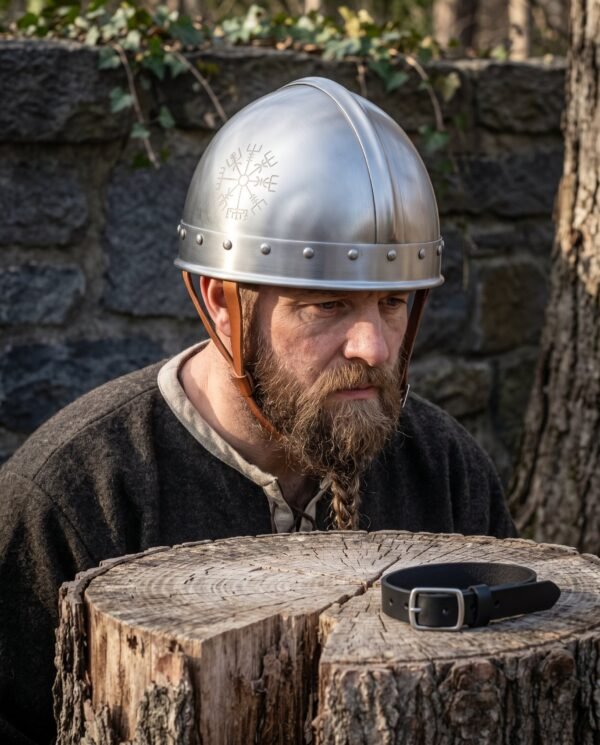
A riveted Norse dome helm built the way a spangenhelm is supposed to be built: a browband running right around the head, a ridge band over the crown from front to back, and shaped plates riveted into the frame between them. The browband is steel, engraved with a running knotwork border, and every rivet head across the dome is brass against the bright steel, with a thin brass trim along the lower edge. Inside there is a scalloped brown suede liner and a leather chin strap with a buckle.
The reason helmets were made in pieces rather than raised from one sheet has almost nothing to do with strength and everything to do with the material. Good iron and early steel arrived from the bloomery in small billets, and turning those billets into one unbroken bowl deep enough to cover a skull is brutally difficult work. Riveting a frame and filling it with four smaller shaped plates lets you build the same helmet from stock you actually have, and it lets you replace a damaged plate instead of the whole helm. That is why the spangenhelm shows up from the Black Sea to Scandinavia across roughly seven centuries. This one is raised, riveted, engraved and lined in the Czech Republic. Only a handful of Viking age helmets survive, and what Viking helmets actually looked like goes through every one of them.
Specifications
| Material | Mild steel dome with an engraved steel browband and brass rivets |
|---|
| Gauge | 16 gauge, light reenactment weight |
|---|
| Construction | Riveted browband with a double ridged band running front to back over the crown |
|---|
| Decoration | Engraved knotwork border around the steel browband |
|---|
| Rivets and trim | Domed brass rivet heads along the ridge band and browband, thin brass trim along the lower edge |
|---|
| Size or fit | Standard adult, roughly 22 to 24 inch head circumference |
|---|
| Weight | Approximately 4 lb |
|---|
| Lining | Scalloped brown suede liner fitted inside the bowl |
|---|
| Fittings | Brown leather chin strap with a ring buckle |
|---|
| SKU | RK-1559 |
|---|
What the bands are doing
Run your thumb along the ridge band from the brow to the nape. That single strip of steel is the spine of the helmet. It stops the dome from flattening under a blow to the top of the head, in exactly the way a keel stops a hull from folding. The browband does the same job around the circumference, and it is also where every load ends up: a helmet is carried on the head by that band and the liner behind it, not by the plates.
The infill plates between the bands are the least structural part of the helmet, and that is by design. They are there to close the gaps and to slide a point outward, and if one is dented or split it can be drilled out and replaced without touching the frame. That repairability is the quiet genius of the pattern, and it is why the spangenhelm outlasted several centuries of changing fashion in everything else.
The rivets themselves matter more than they look. Every one is set through both layers and peened over, so the joint is mechanical rather than glued or welded. Peened rivets flex slightly under shock instead of shearing, and a helmet made this way absorbs a hit across the whole frame rather than concentrating it in one seam.
Steel gauge, brass and the liner
This is 16 gauge mild steel, roughly 1.5 mm. That is a real step up from the 18 gauge that most display helmets are made from: it is meaningfully stiffer under the hand and it takes a knock without denting the way thinner stock does. It is still not certified combat armour. Full contact leagues that permit head strikes set their own standards, usually 14 gauge or a spring steel bowl with an approved suspension liner, and no helmet should ever go into that environment without being checked against the rules of the group running it. For display, costume, photography, drill and non contact reenactment, 16 gauge is the sweet spot between weight and presence.
The browband is steel, engraved rather than stamped, and the brass rivet heads and edge trim will patinate to a warm gold over years. If you prefer them bright, a little metal polish restores them in minutes.
The liner is real suede, cut in scallops and riveted around the browband so it can be adjusted with a drawcord. A liner is not a comfort extra. It is what holds the steel off your skull, and the air gap between the two is a significant part of how a helmet works at all.
Engraving, runes and your own design
Use the rune converter on this page to turn a name, a date or a short phrase into Elder Futhark and we will cut it into the steel or the leather. If you would rather have a Viking pattern than a rune line, choose your own design in the engraving option above the add to cart button and tell us where it goes. Where a piece already carries an engraved design, your chosen engraving replaces it rather than sitting alongside it. On this helm the knotwork border around the steel browband is where a rune line goes, and it takes a name beautifully at that scale. See the engraving page.
Fit and sizing
Made to one standard adult size suiting roughly a 22 to 24 inch head circumference, measured with a soft tape just above the eyebrows and around the widest part of the back of the skull. The suede liner and its drawcord take up the slack, so a head at the smaller end of that range still sits securely rather than rattling around.
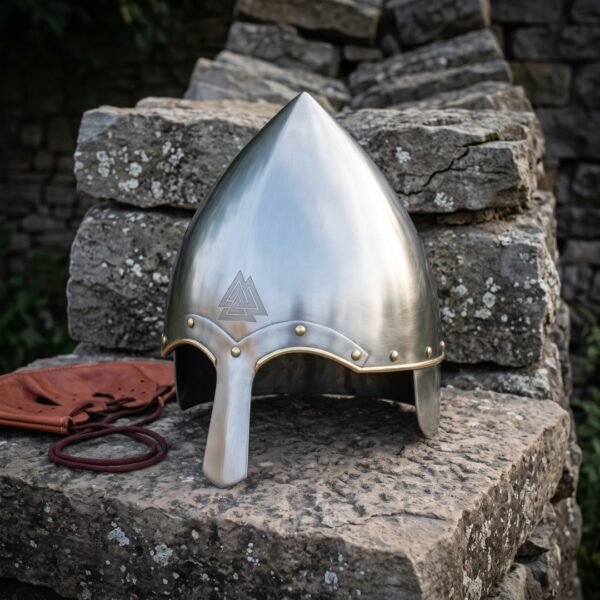
Fit it so the browband sits just above your eyebrows and the helm does not tip forward when you nod. If you plan to wear a padded arming cap under it, and most people at events do, measure over the cap. A cap adds roughly half an inch all round and it changes the fit noticeably. The brown padded arming cap shown beside the helmet in the photograph is a studio prop and is not included.
Care
Wipe the steel dry after every wearing, because sweat under a liner is the fastest way to rust a helmet from the inside, which is where nobody looks until it is too late. Lift the liner and check under it a few times a year. Give the bowl a thin film of light machine oil or a metal wax monthly, inside and out. Feed the suede liner and the chin strap with a suitable leather product once or twice a year. Store it upright on a stand or with the bowl supported rather than resting on its browband edge, and never sealed in plastic. Our notes on protecting a steel finish are on the steel care page. Fit, steel gauge and the shapes worth avoiding are covered in buying a Viking helmet.
Made in the Czech Republic
Every piece we sell is made by hand in the Czech Republic. The smiths there work the way the trade has been worked for a long time, heating and hammering the steel, taking the bevels down by eye, and fitting the handle and the leather one at a time. There is no automated line anywhere in it, so small differences from one piece to the next are normal and expected.
Ransack Viking is a United States company based in Chicago, Illinois. We bring the pieces in ourselves, inspect them on arrival and ship them from our own warehouse. If you add engraving, that is carried out here in the United States before your order goes out.
A note on handmade variation
This helmet is hand made, not machine made or bulk produced. What arrives will not be a pixel for pixel copy of the photograph. The dish of each infill plate is worked over a stake by hand so the curve is never identical twice, the rivet spacing is set by eye, the engraved knotwork on the browband runs with its own rhythm, and the suede takes colour differently from hide to hide. The gauge, the dimensions and the build are the same every time. The character is not.
Frequently asked questions
Can I fight in this?
Not in a full contact league without checking their rules first. At 16 gauge it is stiffer than a display helm but it carries no combat certification, and head protection standards vary between groups. Use it for display, drill, costume and non contact reenactment.
Does it come lined?
Yes. A scalloped suede liner is fitted and adjustable with a drawcord, and a leather chin strap with a buckle is fitted as well. Both are ready to wear out of the box.
Will it fit over an arming cap?
Usually, if your head is at the middle or lower end of the 22 to 24 inch range. Measure over the cap you plan to wear rather than over bare hair, because a padded cap adds around half an inch all round.
Is the browband brass?
No. The browband is steel with the knotwork engraved into it rather than stamped or printed. The brass is in the rivet heads and the thin trim along the lower edge, which will patinate warm over time and polish bright again whenever you want it to.
Did Viking helmets have horns?
No. Not one horned helmet has ever been excavated from a Viking Age warrior context. The horned image comes from nineteenth century opera and painting. This helmet is the shape the archaeology actually supports.
How long before it ships?
Processing is one to two weeks because each helm is dished, riveted and lined to order. Shipping inside the United States is free and returns are accepted within seven days.
What is in the box
- One riveted 16 gauge steel spangenhelm
- Engraved steel browband with knotwork and brass rivets throughout
- Scalloped suede liner with an adjustable drawcord
- Leather chin strap with buckle
- Care and warranty card
- Forged and finished in the Czech Republic
Explore the range
See the rest of the Viking helmets, the medieval helmets, the chainmail armour, and the guides.
Near neighbours in the shop
A near match for this one is the Vegcrown Viking helmet. Closest to this in the range is the Browhold Viking helmet. If this one is not quite right, there is the Kinhelm Viking helmet.
The Eaglecrest Greek helmet covers the other half of the same kit. You can have this made your way instead on the design your own page.





Reviews
There are no reviews yet