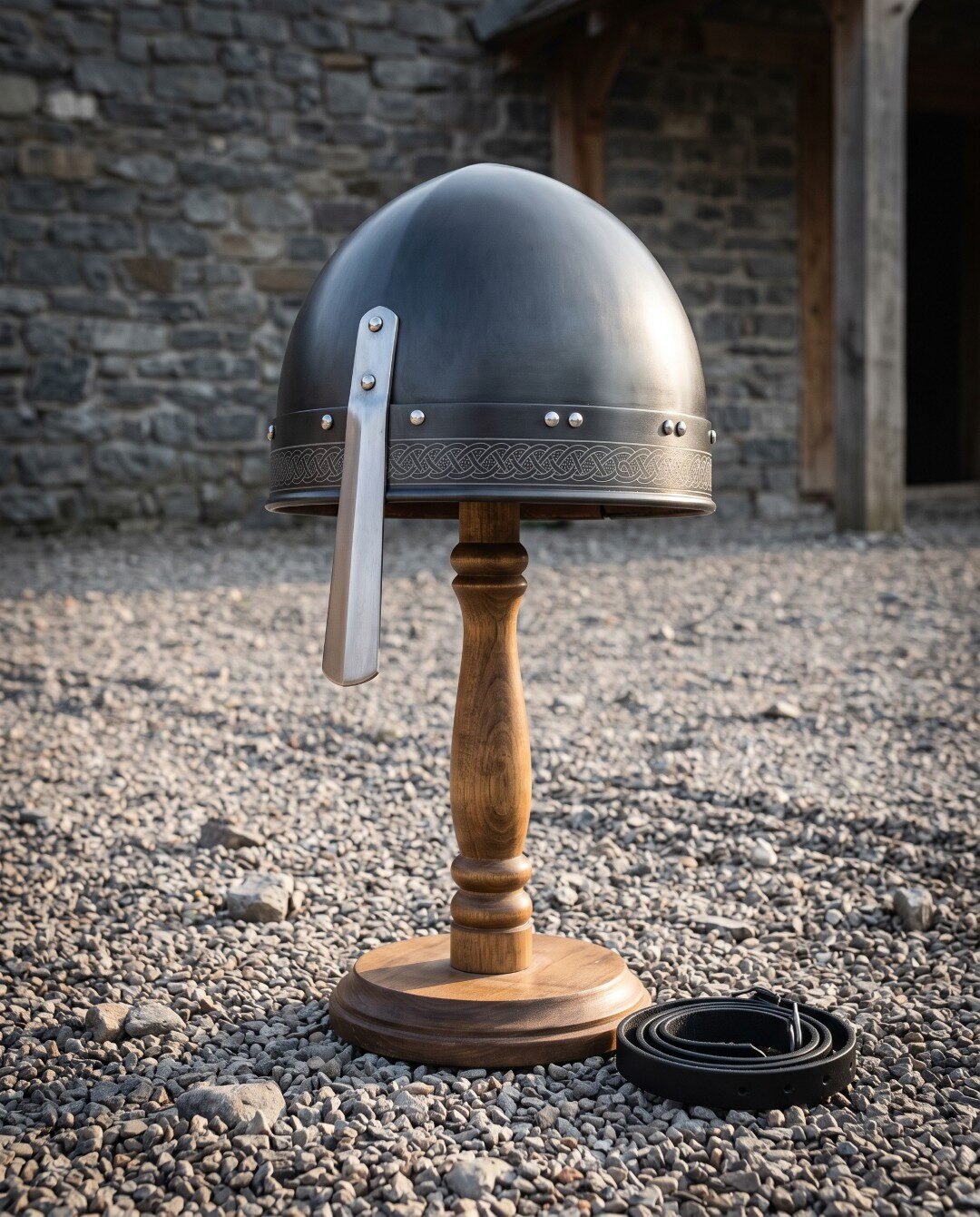
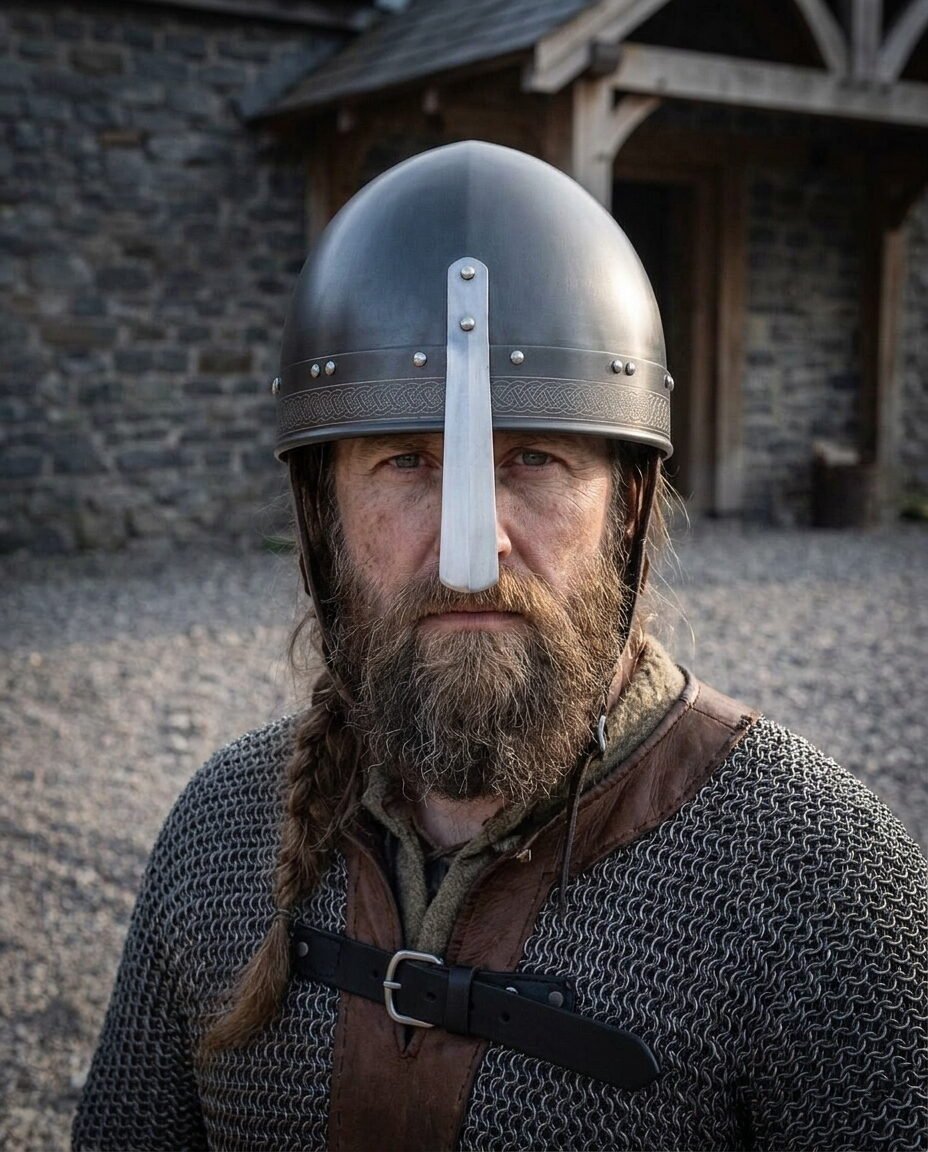
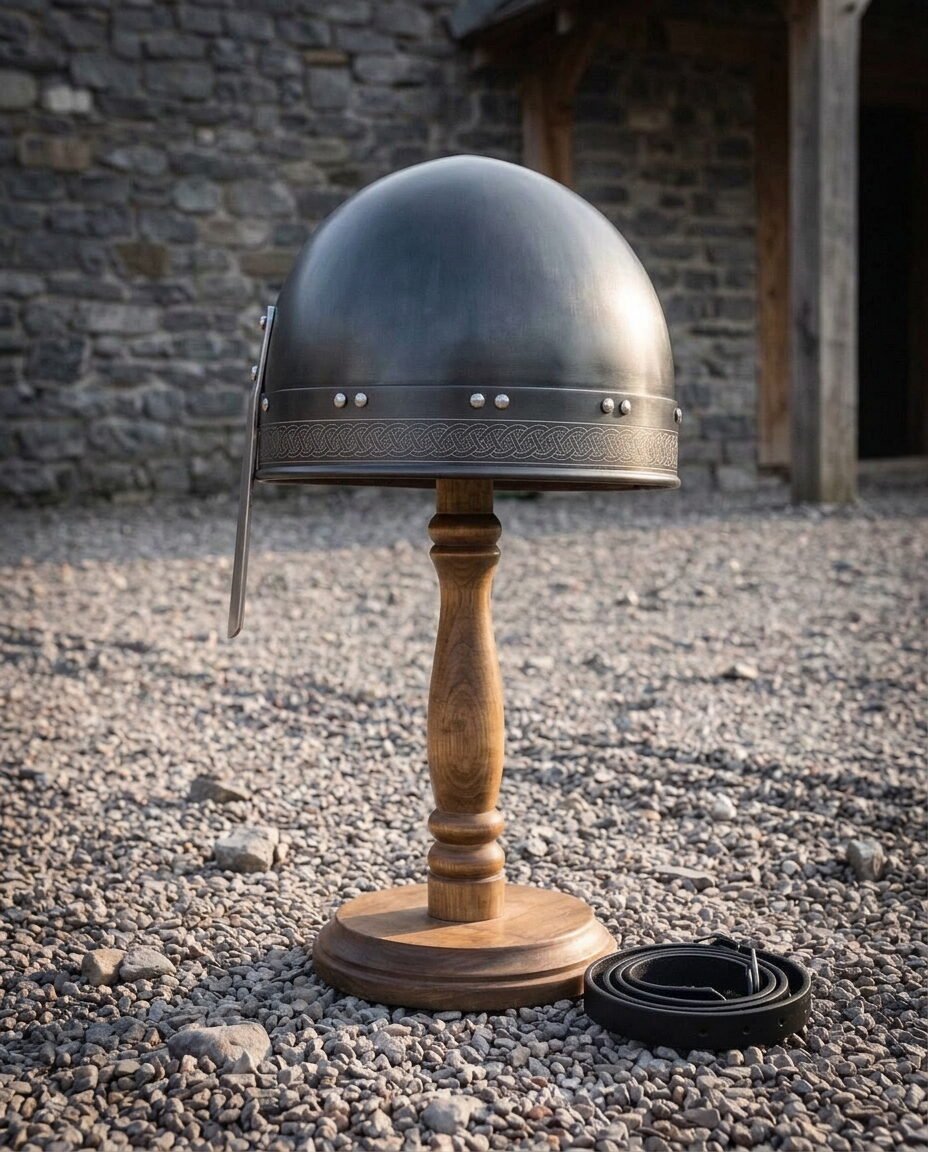
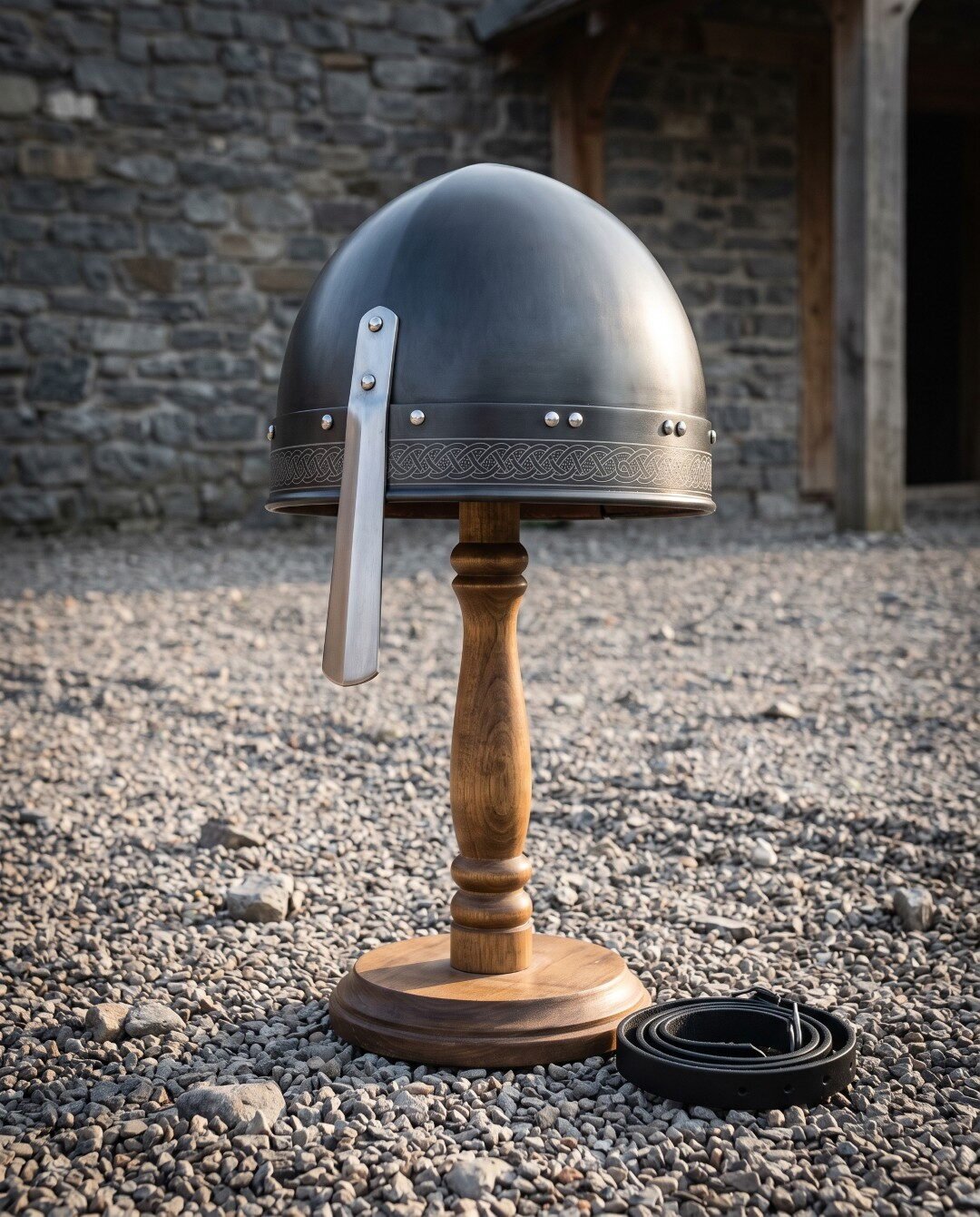
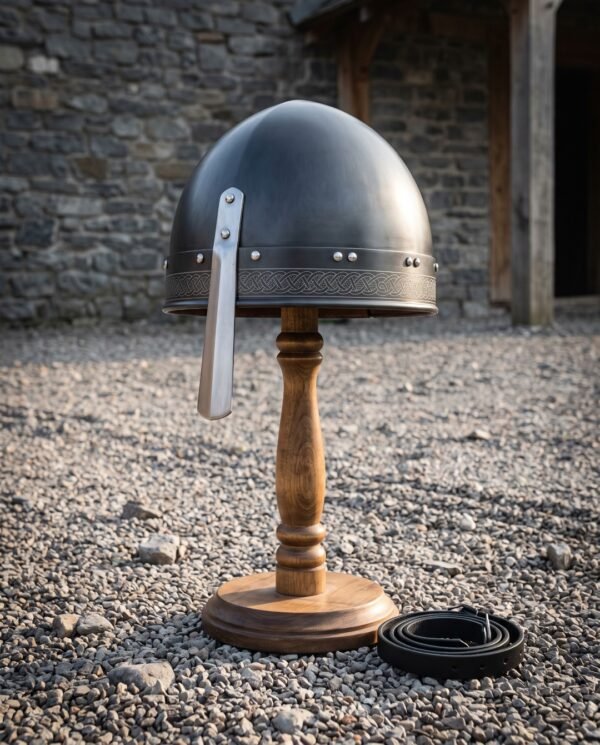
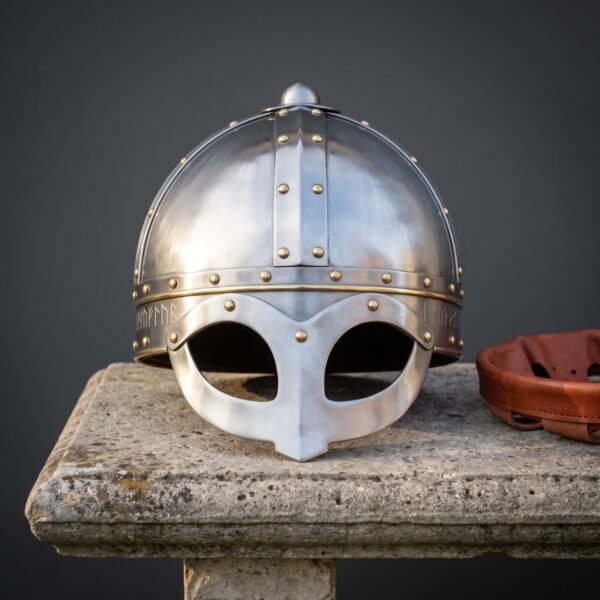
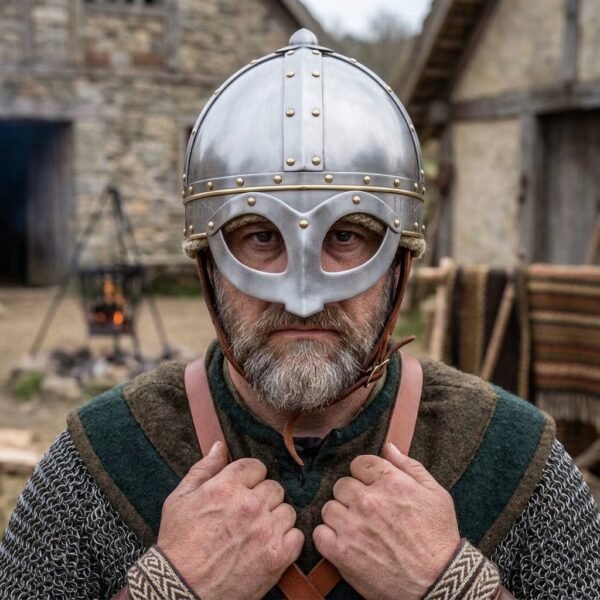
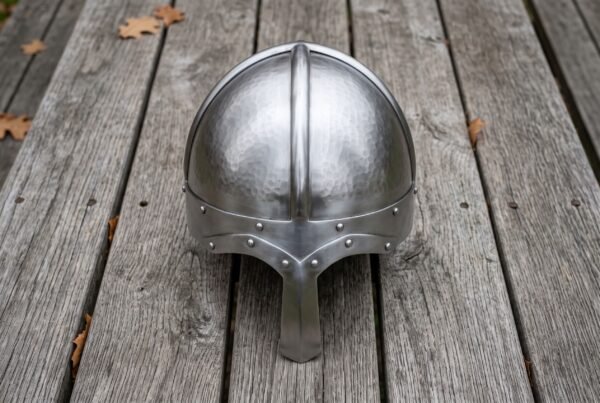
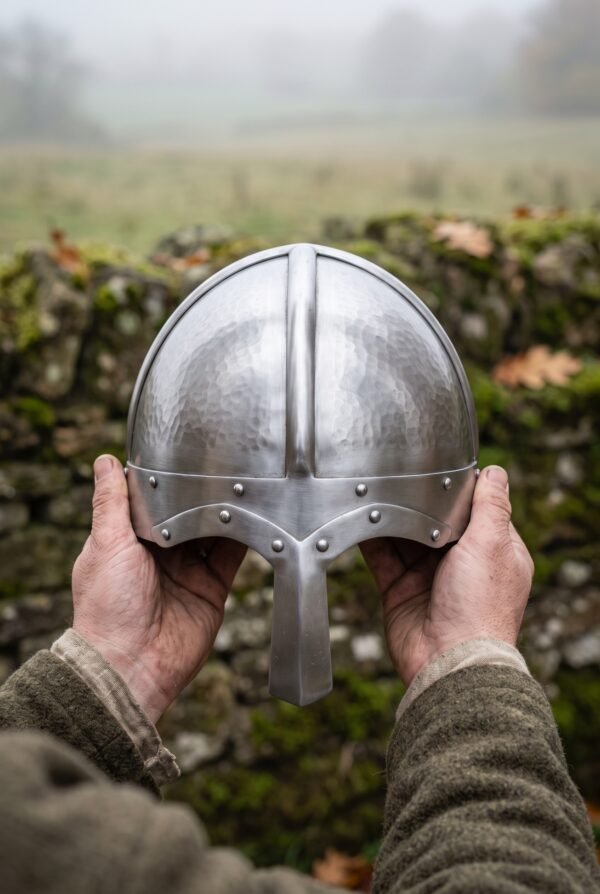
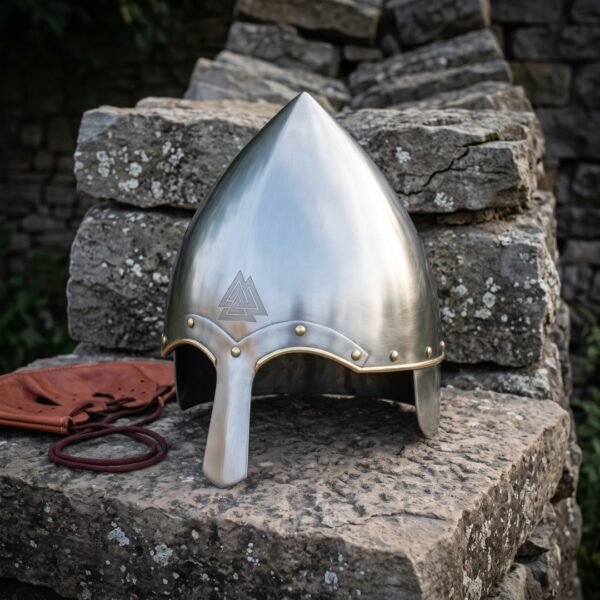
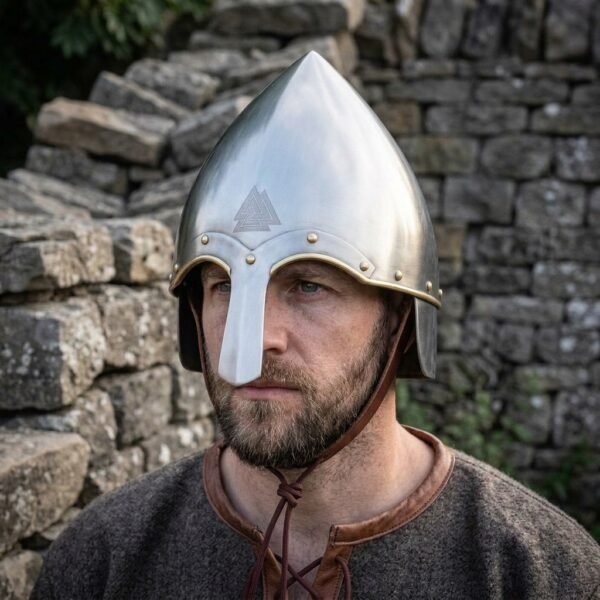
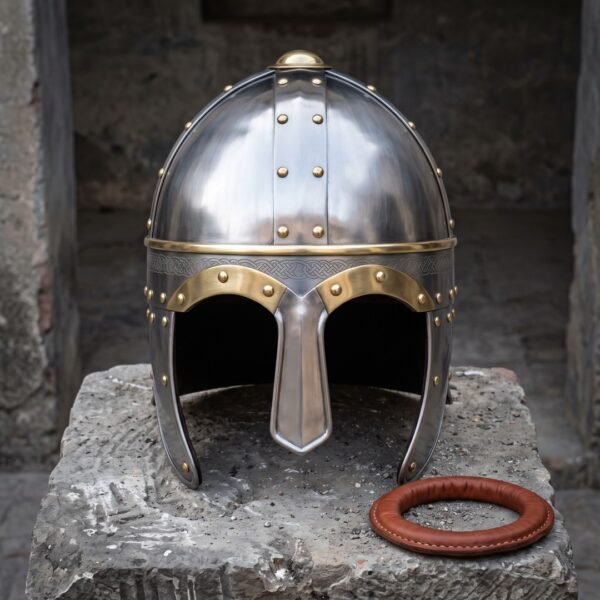
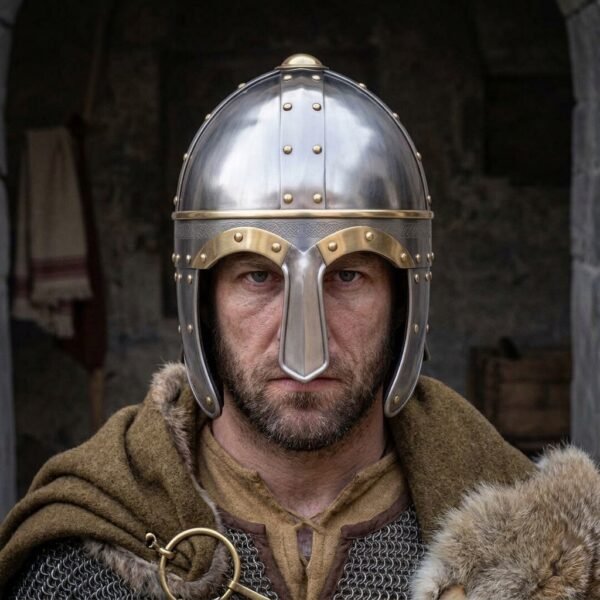
Browhold is a hand forged medieval helmet of the nasal type, with a smoothly rounded skull raised from a single sheet of steel, a heavy browband running around the base and a broad nasal bar dropping down the centre of the face. The browband is engraved with a running knotwork band and fixed with domed rivets, and the nasal is riveted to the front of that band so it hangs clear of the wearer and can be gripped and pulled if the helmet needs to come off in a hurry.
This shape sits right at the hinge between the Viking age and the high medieval period. Helmets built exactly this way, a rounded or slightly conical skull with a browband and a nasal, are what the Normans are wearing all the way along the Bayeux Tapestry, and the same type turns up in Scandinavia, in the Rus lands and across northern Europe for roughly three centuries. It was the standard European fighting helmet for longer than the great helm ever was. Ours is raised, riveted, engraved and lined in a Czech Republic workshop. The turned wooden stand shown in the photographs is staging and is not included. Fit, steel gauge and the shapes worth avoiding are covered in our notes on buying a helmet.
Specifications
| Type | Medieval nasal helmet with a rounded, slightly peaked skull |
|---|
| Material | Mild steel skull, browband and nasal bar |
|---|
| Gauge | 18 gauge mild steel, approximately 1.2 mm |
|---|
| Construction | Skull raised from a single sheet, browband fixed with paired domed rivets |
|---|
| Nasal | Broad straight nasal bar, riveted at the front with two rivets |
|---|
| Engraving | Running knotwork band cut into the browband |
|---|
| Finish | Darkened gunmetal skull and browband, bright polished nasal bar |
|---|
| Size or fit | Fits a head circumference of roughly 22 to 24 inches over the liner |
|---|
| Weight | Approximately 4 to 5 pounds with the liner fitted |
|---|
| Lining | Leather liner and an adjustable black leather chin strap with buckle |
|---|
| Intended use | Display, costume, light reenactment and photography |
|---|
| SKU | RK-1438 |
|---|
The nasal bar, and why one strip of steel was enough
A nasal looks almost absurdly minimal for a face defence. One bar, covering the nose and nothing else, leaving the eyes, cheeks and jaw wide open. It survived for three hundred years because it is a very good answer to the actual threat.
The blows that kill a helmeted man come down and across, from a sword, an axe or a spear held above shoulder height. A descending cut that clears the browband is heading for the bridge of the nose and the eye sockets, which is where the skull is thinnest and where a strike will end the fight instantly. Put a vertical bar of steel down that line and a descending cut hits the bar and skates off to one side. The bar also catches the thrust that comes in slightly off centre, which is the other way a point reaches the face.
What it deliberately does not do is enclose you. A nasal helm leaves your full field of view, your breathing and your hearing intact, which matters more in a shield wall or a mounted charge than covering your cheeks does. Every fully enclosed helmet in history buys protection by taking those things away, and for three centuries most fighting men decided the trade was not worth it. The rounded skull on this helmet does the rest of the work, because a curved surface deflects almost any blow that is not perfectly square.
One piece raising against spangenhelm construction
There are two ways to build a helmet skull and this one uses the harder method. A spangenhelm is assembled from separate panels riveted to a framework of bands, which is quicker, forgiving of small errors and easy to do in a workshop with limited tooling. Almost every Viking age helmet we know of is built that way, including the Gjermundbu find.
Raising the skull from a single sheet is different work. A flat disc of steel is worked over a stake with repeated hammer blows, pushing the metal in from the edge so it thickens and rises into a dome, and it has to be annealed several times along the way or it will work harden and split. The reward is a skull with no joints in it. There is no rivet line to be driven inward by a blow and nothing to fail along a seam. It is also lighter for the same protection, because the frame bands of a spangenhelm are dead weight.
The gauge is 18, about 1.2 mm, and the alloy is mild steel. Mild steel cannot be hardened by heat treatment and that is intentional, since a hardened helmet cracks where a soft one dents. Be clear about what 18 gauge means though. It is the standard weight for display and light reenactment. It is not the 14 gauge that full contact steel fighting organisations demand, and this helmet is not certified to any combat standard.
Engraving, runes and your own design
Use the rune converter on this page to turn a name, a date or a short phrase into Elder Futhark and we will cut it into the steel or the leather. If you would rather have a Viking pattern than a rune line, choose your own design in the engraving option above the add to cart button and tell us where it goes. Where a piece already carries an engraved design, your chosen engraving replaces it rather than sitting alongside it. On this helmet the browband is the engraving field, so your rune line or your chosen pattern replaces the knotwork band shown in the photographs. There is more on the engraving page.
Fit and sizing
This helmet is made to a stated size rather than shaped to your head. It fits a head circumference of roughly 22 to 24 inches measured around the brow, with the leather liner and chin strap taking up the difference. Measure with a soft tape just above the ears and across the middle of the forehead, and round up if you are between numbers.
Wear a padded arming cap under it. That is not a comfort preference, it is how the helmet is meant to work, and it adds roughly half an inch of circumference which you need to allow for when you size. Long hair worn up adds more. The nasal position is fixed relative to the browband, so a helmet riding too high will put the nasal above your nose and a helmet riding too low will sit on your eyebrows. The liner is adjustable enough to correct small errors but not large ones.
Care
Darkened mild steel rusts if it is left with sweat or damp on it. Wipe the helmet inside and out after every wear, paying attention to the inside of the browband where perspiration runs down, and put a light film of machine oil or paste wax over the outside before it goes into storage. Keep it out of damp garages and never bag it in sealed plastic.
Any surface rust that does appear lifts with fine steel wool and oil, worked gently so it does not lift the darkened finish more than it has to. Keep solvents away from the leather liner and let a wet liner dry naturally rather than near a heater. Our fuller guidance is on the steel care page. Steel headgear wants the same care as mail, set out in caring for chainmail and steel armour.
Made in the Czech Republic
This is a handmade piece from the Czech Republic, made in a workshop that still forges, grinds and finishes by hand instead of stamping parts out. The smiths there have kept the older way of working, and the wood, horn and leather are shaped and fitted by hand as well. Two pieces of the same design will never be identical, and that is part of what you are buying.
Ransack Viking is a United States company. We handle the import ourselves, look over every piece when it lands and ship from our warehouse in Chicago, Illinois. Engraving is done in the United States after the piece arrives, so your design goes on before we send it out.
A note on handmade variation
This is hand made rather than machine made or bulk produced, so what arrives will not be a pixel for pixel copy of the photograph. Planishing texture across the skull, the exact darkening of the browband, the tone of the polish and the depth of the cut knotwork all vary because every helmet is raised and finished by hand. The dimensions, the material and the build are the same every time. The character is not.
Frequently asked questions
Is this a Viking helmet or a medieval one
Both, honestly. The nasal helm spans the late Viking age and the high medieval period, and helmets of this shape appear on Norse, Norman and wider northern European figures alike. It suits a tenth century impression as readily as an eleventh or twelfth century one.
Can I fight in it
Not in full contact. It is 18 gauge, the display and light reenactment weight, and it carries no combat certification. Full contact steel fighting groups require 14 gauge or heavier and run their own inspections.
Is the skull one piece or riveted panels
One piece. The skull is raised from a single sheet over a stake, so there is no seam anywhere in it. Only the browband and the nasal bar are riveted on, which is a harder way to build a helmet and a stronger one.
Does the nasal get in the way
Less than you expect. Your brain merges the two eyes and the bar sits on your natural blind spot, so after a few minutes you stop noticing it. It does interfere with drinking from a cup, which is the traditional complaint.
Is the wooden stand included
No. The turned stand in the photographs is there to hold the helmet for the picture and is not part of the order. The helmet ships with its leather liner and chin strap fitted.
How long before it ships
Processing is one to two weeks because each skull is raised and finished to order, then shipping is free within the United States. Returns are accepted within seven days. Custom engraving adds a few days.
What is in the box
- One hand raised steel nasal helmet with engraved browband
- Leather liner, fitted
- Adjustable black leather chin strap, fitted
- Care card with oiling notes
- Forged and finished in the Czech Republic
Explore the range
See more in medieval helmets, viking helmets and plate armor, or read the guides.
Worth a look beside this
A near match for this one is the Ironvisor Viking helmet. Closest to this in the range is the Kinhelm Viking helmet. If this one is not quite right, there is the Vendelgaze Viking helmet.
The Cruxward Medieval helmet covers the other half of the same kit. Or start from a blank sheet on the design your own page.

My whole family was impressed when I unboxed it. Padding and straps make it comfortable to wear for hours. Looks incredible with the rest of my reenactment kit. Exactly the look I wanted for my collection. Couldn’t be happier with this.