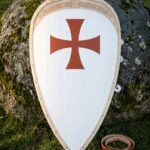
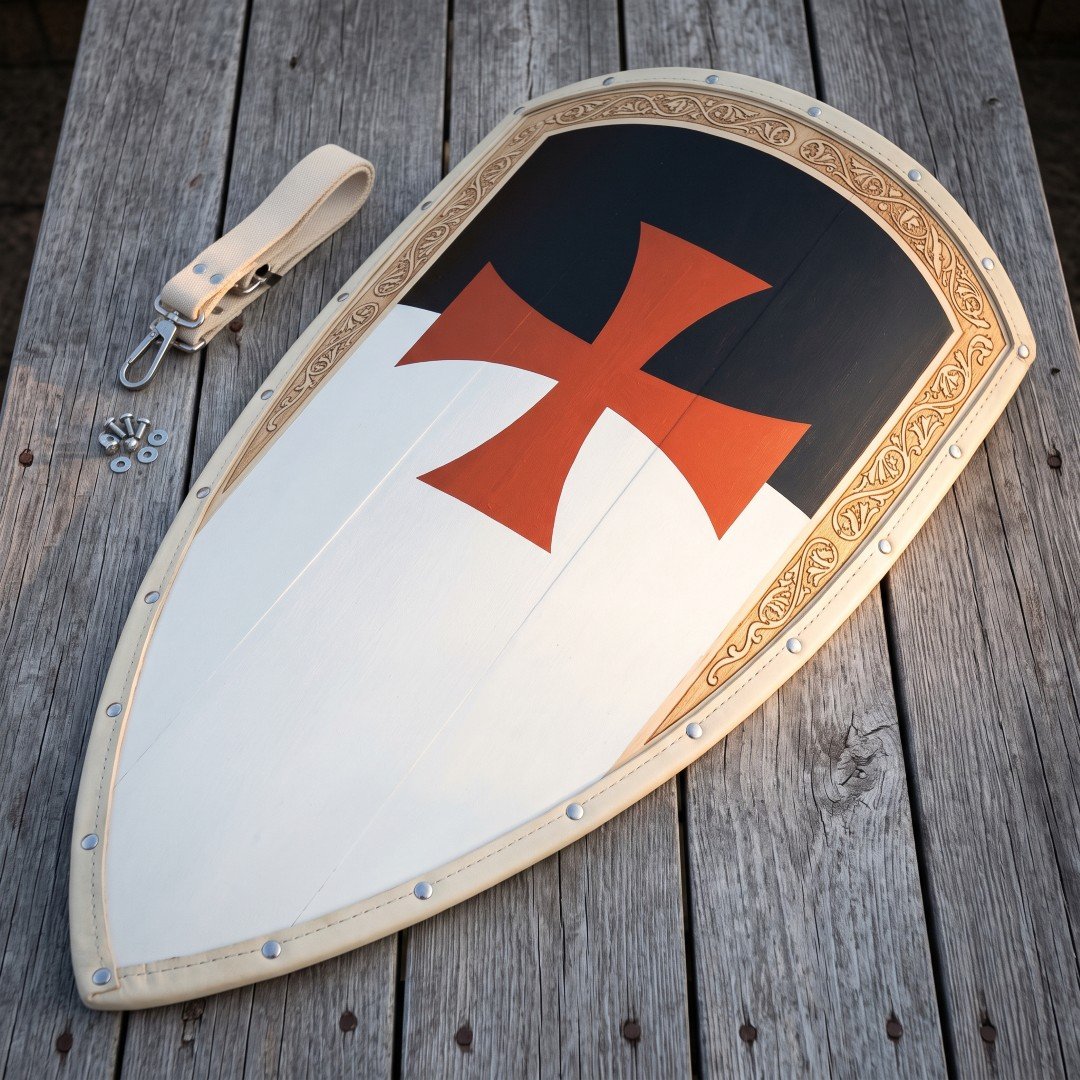
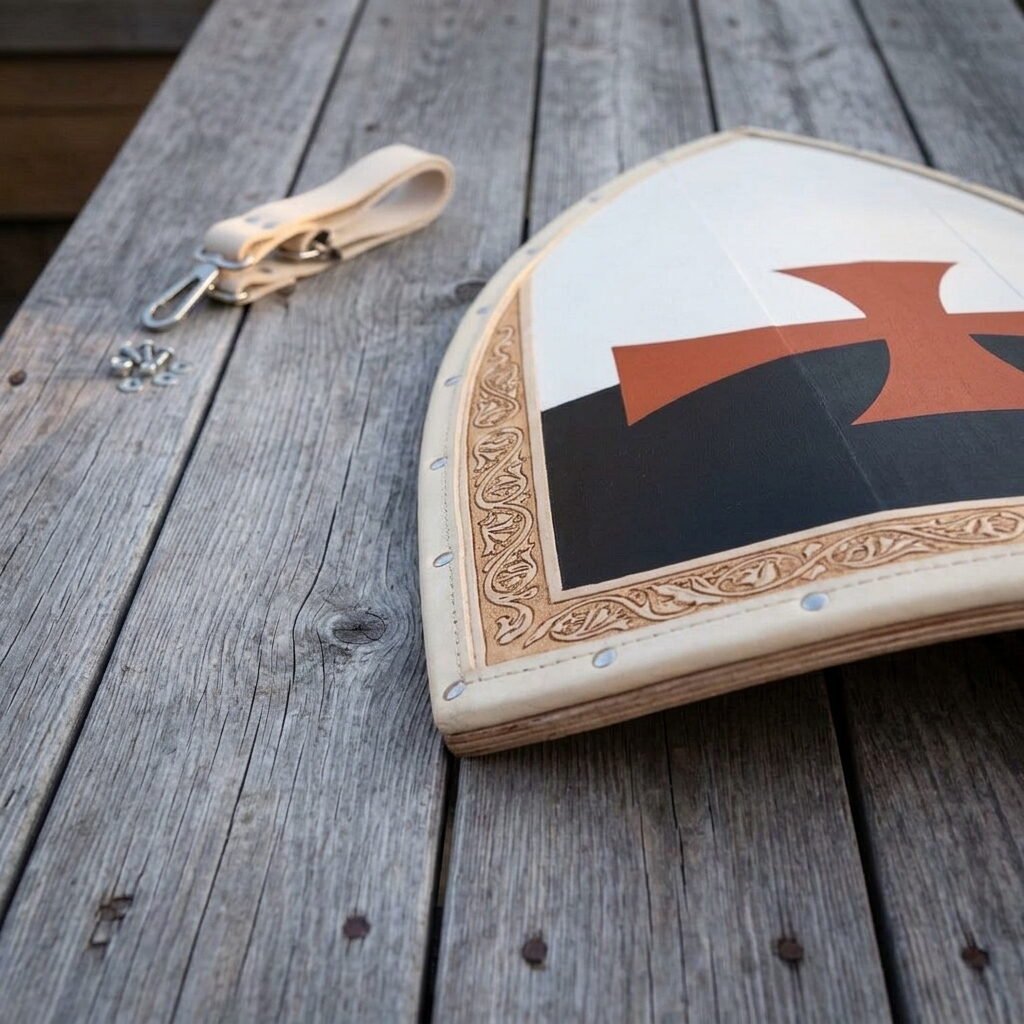
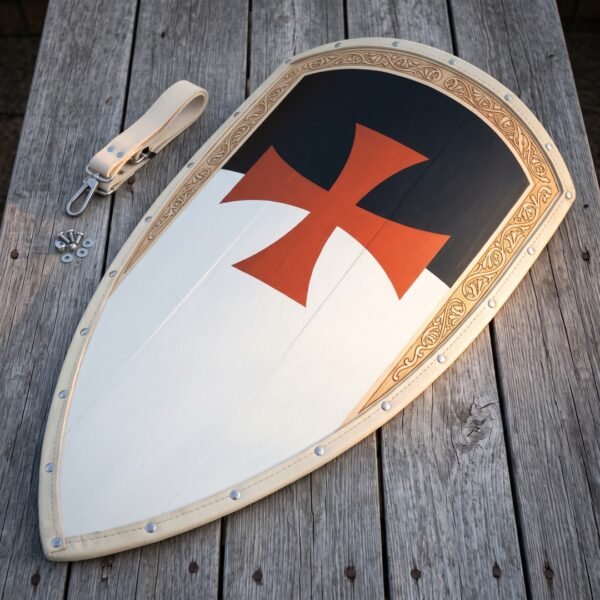
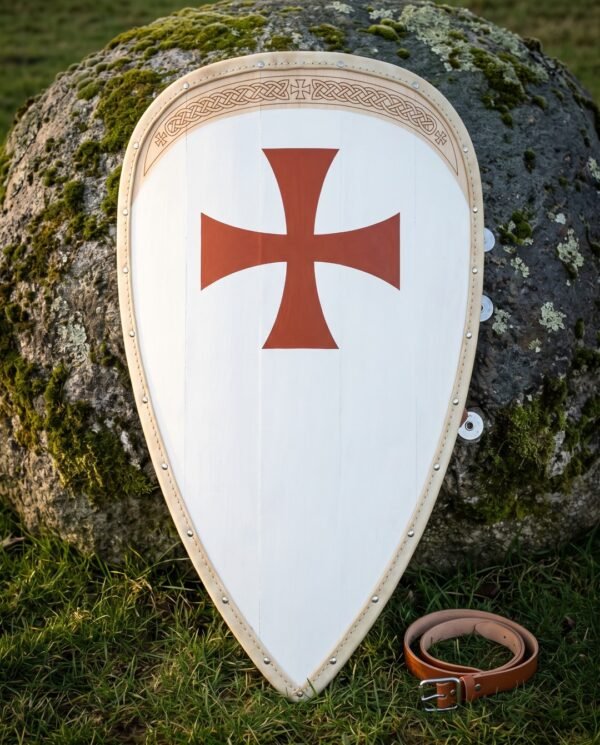
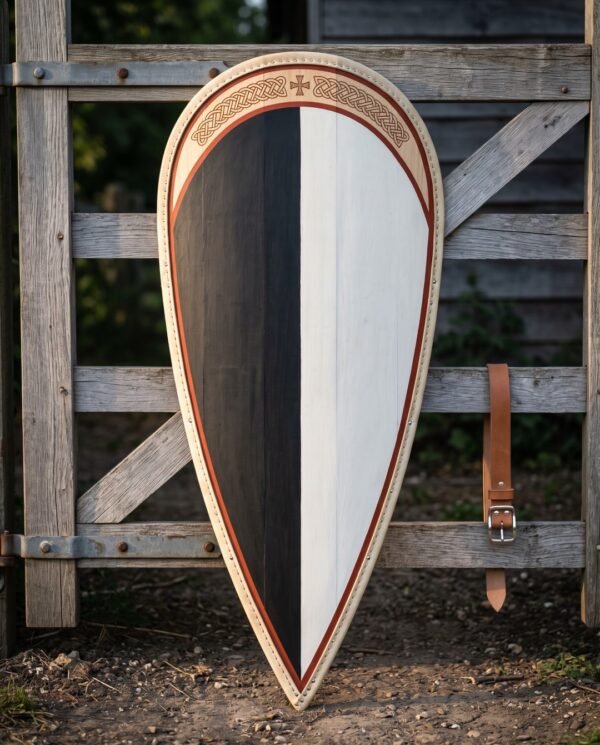
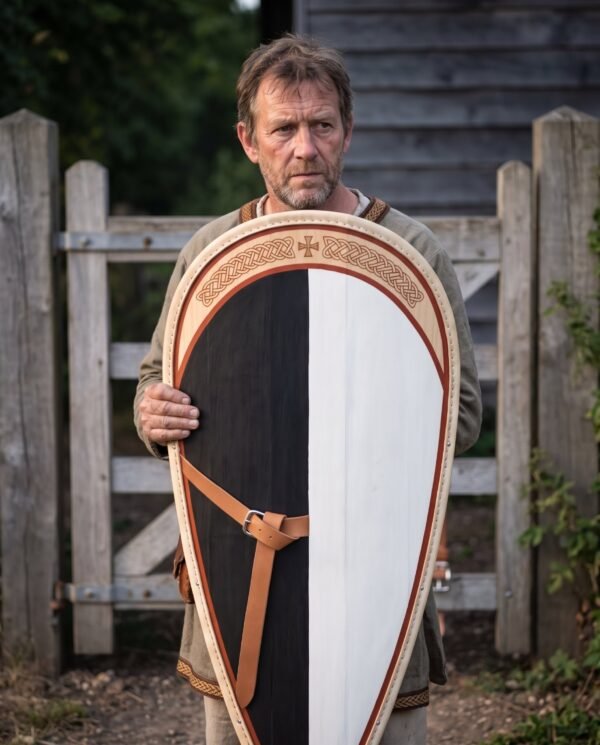
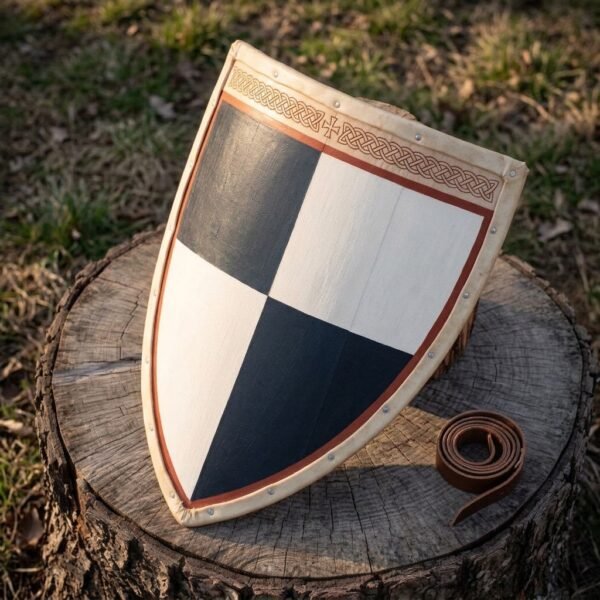
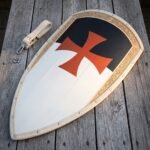
Crossmarch is a hand made kite shield, planked in wood, faced and painted, bound at the edge in rawhide and finished with a wide tooled leather border strip running all the way round the edge. The field is divided black above and white below with a red cross pattee laid across the join, the arms of the cross flaring outward from a narrow centre in the way the pattee is properly drawn. The border strip carries a running scroll of hand cut ornament along its whole length.
The kite shield arrives in northern Europe in the eleventh century and takes over almost immediately, and the reason is the horse. A round shield covers a man standing behind it, but a man on horseback has a long exposed left leg hanging down the flank of the animal that a round board simply cannot reach. Stretch that board into a long taper and the point covers the thigh and the knee while the rounded top still protects the shoulder and the head. Every mounted figure on the Bayeux Tapestry is carrying one. Ours is planked, painted, bound and engraved in a Czech Republic workshop. Why the shape changed from round to kite is set out in round shield versus kite shield.
Specifications
| Material | Planked wood body, hand painted face |
|---|
| Size | Approximately 40 inches tall by 20 inches at the widest point |
|---|
| Shape | Gently curved top with rounded shoulders, tapering to a long point |
|---|
| Design | Black upper field and white lower field with a red cross pattee across the join |
|---|
| Border | Tan leather strip with hand tooled running scrollwork all the way round |
|---|
| Rim | Cream rawhide edging, stitched and riveted with steel rivets |
|---|
| Fittings supplied | Leather arm loop, cream leather guige strap with steel snap hook and buckle, and shield rivets, supplied loose |
|---|
| Intended use | Display, wall mounting, costume and light reenactment |
|---|
| SKU | RK-1439 |
|---|
Enarmes, guige and why a kite shield is strapped rather than gripped
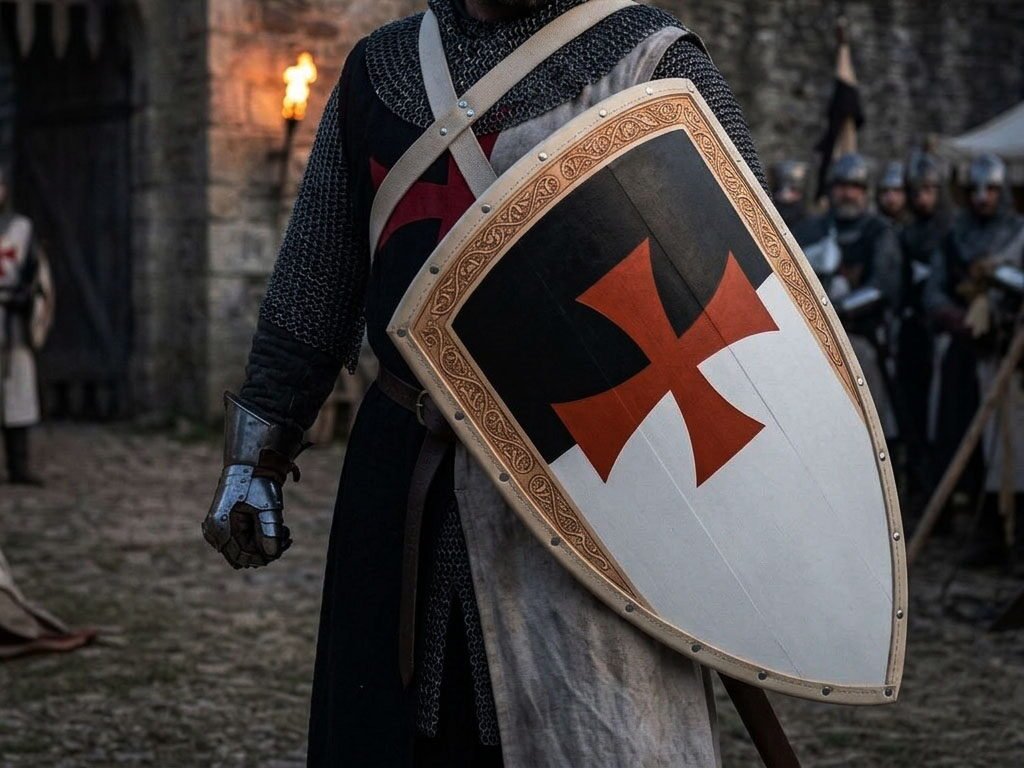
A Viking round shield is held in the fist on a single bar at the centre. A kite shield is not, and the difference is fundamental to how it works. The kite is carried on enarmes, a set of leather loops on the back through which the forearm passes, so the shield hangs on the arm rather than on the hand. That leaves the hand free to hold reins, and it puts the weight along the length of the forearm rather than at the end of a lever, which is the only way a board this large can be carried for any length of time.
The second strap is the guige, a long adjustable belt that goes over the shoulder and across the chest. It does two jobs. Riding with the shield slung on the guige takes the whole weight off the arm on the march, and in a fight it acts as a safety line so a shield knocked loose stays with you instead of falling away. On the tapestry you can see the guige plainly on almost every mounted figure.
Because the shield hangs from straps rather than a fist, the enarmes have to be set to your specific forearm. Loops that are too far apart let the shield rock, and loops too close together mean you cannot control the point. That is why the arm loop, the guige and the rivets come loose in the box rather than fixed at some average position. Lay the shield face down, put your arm where it wants to be with the top edge at your shoulder, and mark from there.
The wood, the rawhide and the painted field
The body is planked, boards butted and glued edge to edge, exactly as the surviving medieval boards were built. Planked construction lets the face flex slightly under an impact and gives it a predictable failure line along a plank join, rather than the sudden brittle split you get across the grain of a solid slab. The plank lines stay visible through the paint and they are meant to be.
The rawhide bound edge is the piece that keeps the whole thing alive. A bare wooden edge splits inward when a blow lands on it, opening the board along its length. Rawhide applied wet shrinks hard as it dries and clamps every plank end together, so an edge strike bites into hide instead of into wood. The tooled leather border strip running all the way round does the same protective job along the whole edge while carrying the ornament.
The field is painted by hand rather than printed, and the cross is laid as a true pattee with flaring arms. Be clear on use. This is built for display, wall mounting, costume and light reenactment. It is not made to any full contact combat standard, where organisations specify board thickness, rim construction and edge padding and inspect against them.
Engraving, runes and your own design
Use the rune converter on this page to turn a name, a date or a short phrase into Elder Futhark and we will cut it into the steel or the leather. If you would rather have a Viking pattern than a rune line, choose your own design in the engraving option above the add to cart button and tell us where it goes. Where a piece already carries an engraved design, your chosen engraving replaces it rather than sitting alongside it. On this shield the tooled leather border strip is the engraving field, so your runes, a motto or your own device take the place of the running scrollwork shown. Read the engraving page for what will fit in that band.
Mounting and display
A kite shield is a strong wall piece because the long taper draws the eye downward and fills a tall narrow space that most objects cannot. Hang it from two points rather than one, with heavy picture hooks or a French cleat catching the rim on both sides of the widest part, so the weight is shared and the shield cannot swing.
Do not hang it by the guige strap alone. Leather creeps under a constant load over years and a shield that comes off a wall onto a hearth is not a repair you will enjoy. If you want it both usable and displayed, fit the enarmes and guige first, then hang the board from the rim and leave the straps free. Keep it out of direct sunlight if you can, because strong sun will fade a painted red over a few summers.
Care
Keep it dry and keep it indoors. Painted plank and rawhide both take on moisture, and a shield stored in a damp garage will lift paint at the plank joints and soften the rim binding. Indoors it needs nothing beyond an occasional dusting with a soft cloth.
If the painted face is marked, wipe it with a barely damp cloth rather than any cleaner, since solvents will lift hand applied paint quickly. The rivets and any steel fittings will spot in humid air, so a light wipe of oil once or twice a year keeps them clean. General notes on steel fittings are on the steel care page. If it is going on a wall rather than into a line, choosing a shield for display covers size and mounting.
Made in the Czech Republic
This piece is made by hand in the Czech Republic, in a workshop that still works the old way. The steel is forged, ground, heat treated and finished by smiths who learned the trade from the people before them, and the wood, horn and leather are cut and fitted by hand rather than pressed out on a line. That is also why no two pieces come out exactly the same.
Ransack Viking is a United States company. We import these pieces ourselves, check every one when it lands and ship from our warehouse in Chicago, Illinois. Engraving is done here in the United States after the piece arrives, so your runes or your own design go on before it leaves for you.
A note on handmade variation
This is hand made rather than machine made or bulk produced, so what arrives will not be a pixel for pixel copy of the photograph. Plank lines fall where the boards fall, the painted edges are laid by hand so their line weight varies, the rawhide takes its own colour as it dries and the cut scrollwork has its own rhythm. The dimensions, the material and the build are the same every time. The character is not.
Frequently asked questions
Is this shield usable or only for the wall
It is genuinely usable for costume, film, photography and light reenactment, and it hangs beautifully. It is not built to any full contact fighting standard, so do not take it into a line where people are hitting each other with steel.
Does it come with straps fitted
No, and that is deliberate. The leather arm loop, the guige strap and the rivets come loose in the box so you can set the enarmes to your own forearm. Straps fitted at an average position suit nobody exactly.
What is the difference between a guige and an enarme
The enarmes are the loops on the back that your forearm passes through and that carry the shield in use. The guige is the long strap over your shoulder that takes the weight on the march and keeps the shield with you if it is knocked loose.
Is the cross historically Templar
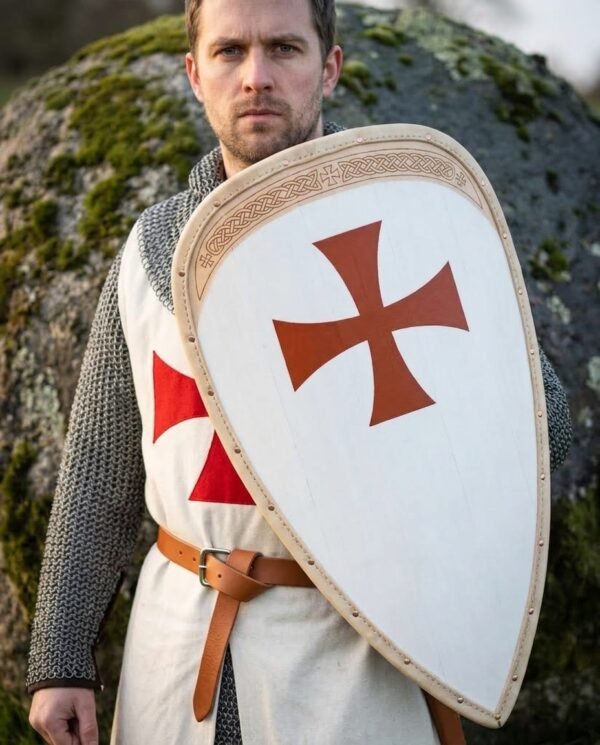
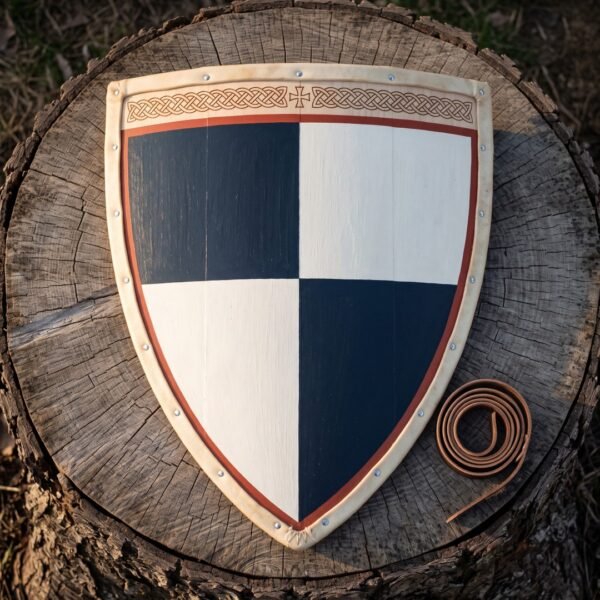
The red cross pattee on a white field is the device most associated with the Order of the Temple, granted to them in the mid twelfth century. The black and white division of the field here is our own design decision rather than a documented Templar arrangement.
How big is it and will it fit my wall
Roughly 40 inches tall by 20 inches at the widest point. Measure a 40 by 20 rectangle on your wall before ordering, because a kite shield reads much larger in a room than it does in a photograph.
How long does it take to ship
Processing is one to two weeks because each shield is planked, painted and bound to order, then shipping is free within the United States. Returns are accepted within seven days. Custom border engraving adds a few days.
What is in the box
- One planked kite shield, painted, rawhide bound, with tooled leather border strip
- Leather arm loop and guige strap, supplied loose
- Set of shield rivets for fitting the straps
- Fitting notes for setting the enarmes to your forearm
- Made by hand in the Czech Republic
Explore the range
See more in kite shields and bucklers, round shields and shield bosses, or read the guides.
Other pieces in this group
For a straight comparison, see the Palewing buckler. Worth putting side by side with this is the Wavewarden buckler. In the same category sits the Stormwing buckler.
From the same corner of the shop, there is the Nightvane leather armor. Nothing here exactly right, build one to your own spec on the design your own page.



Reviews
There are no reviews yet