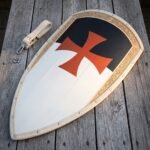
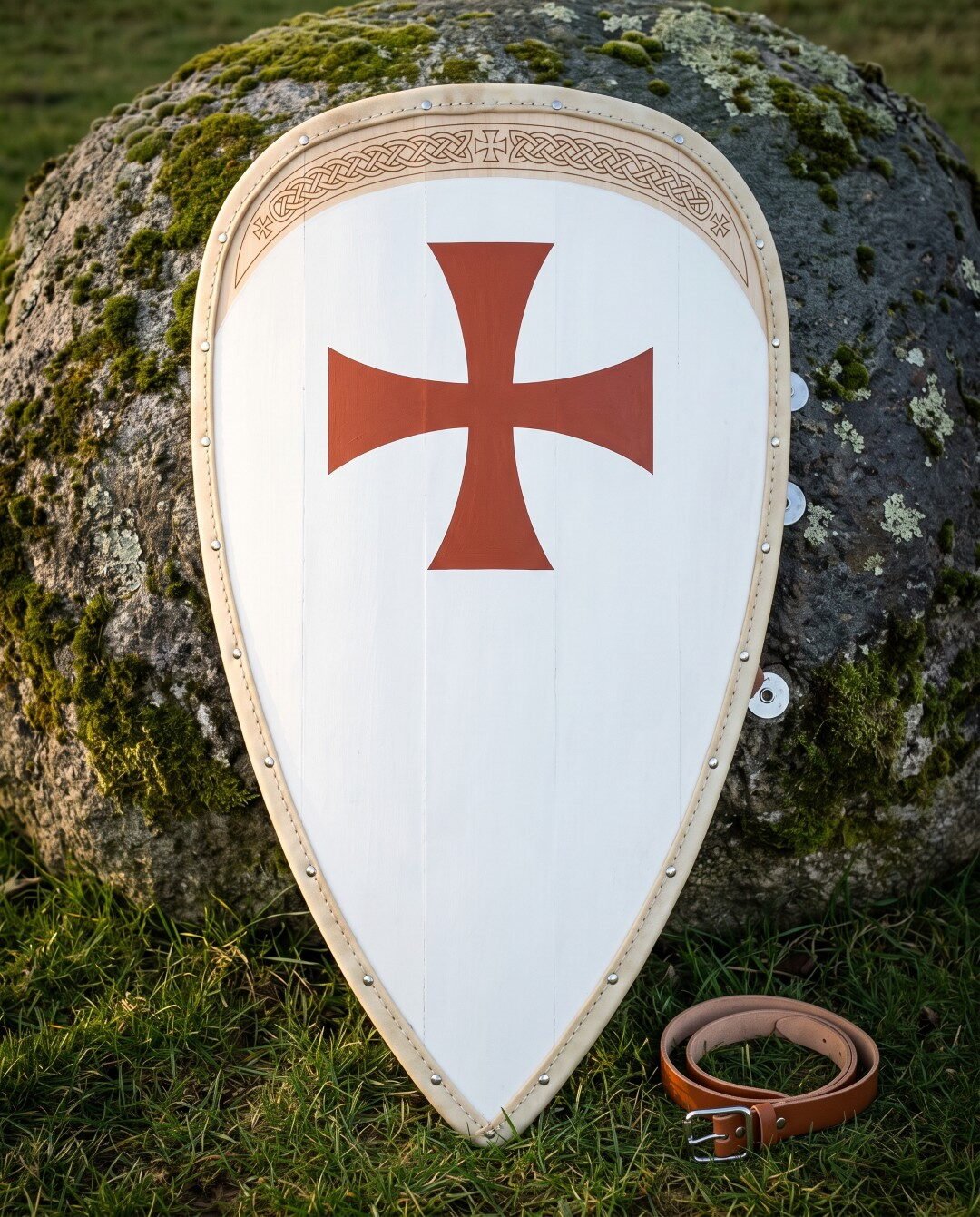
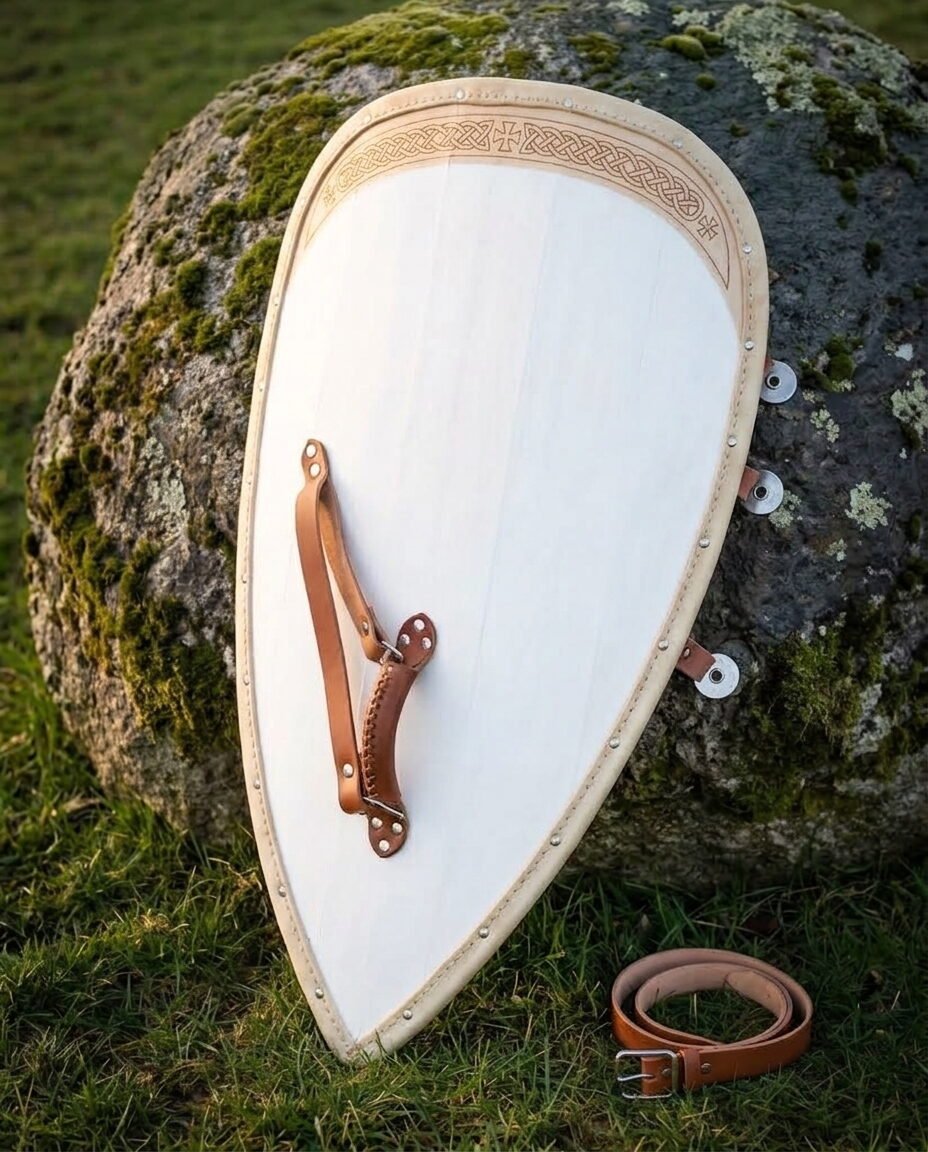
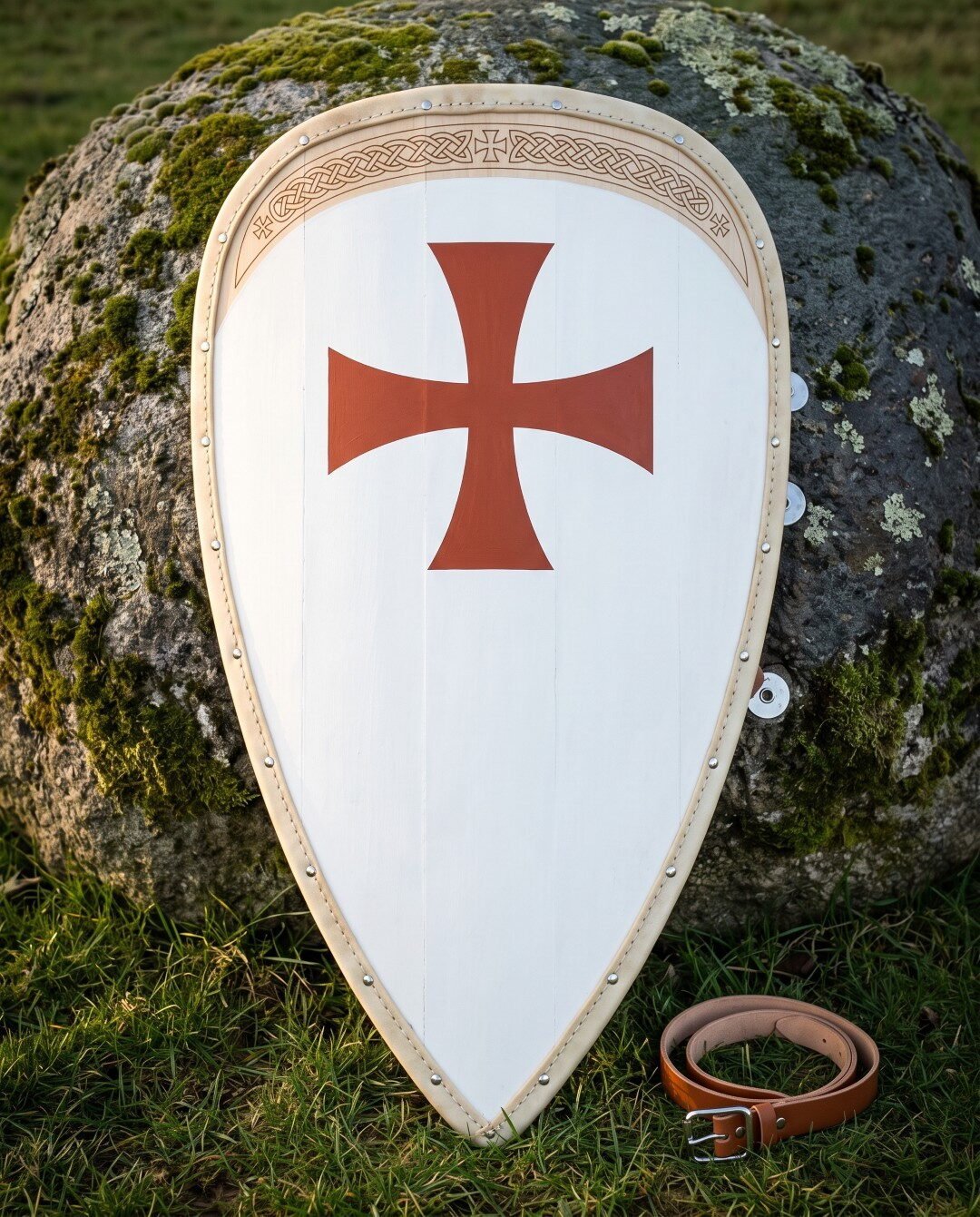
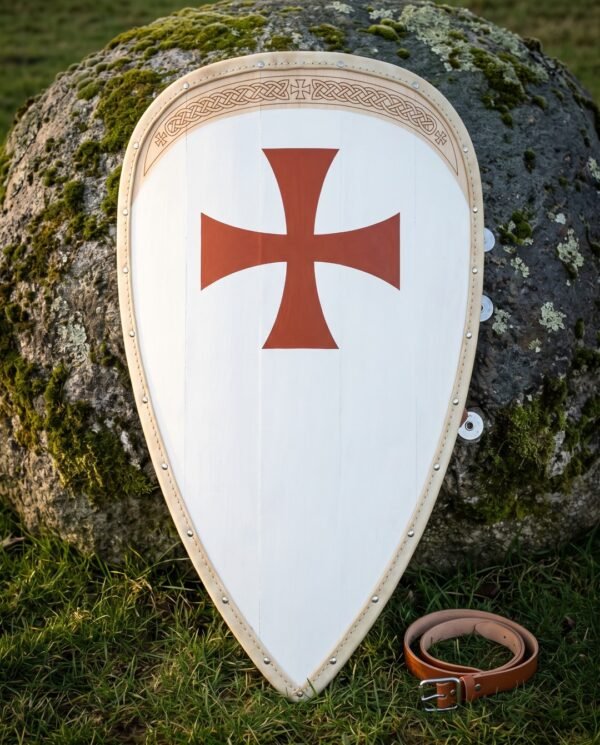
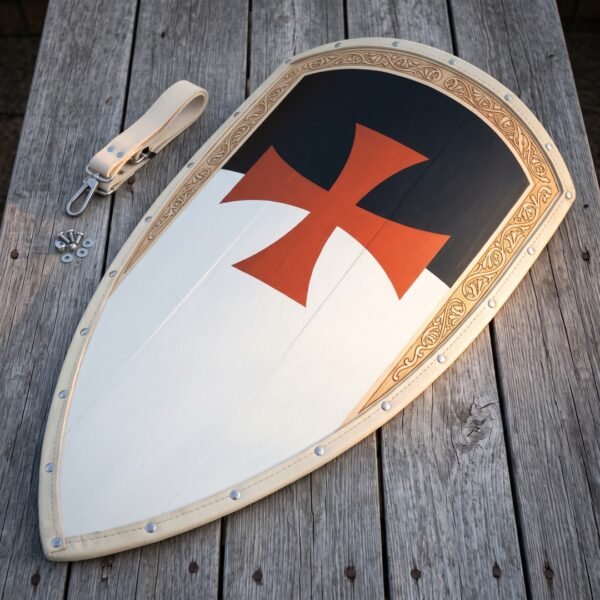
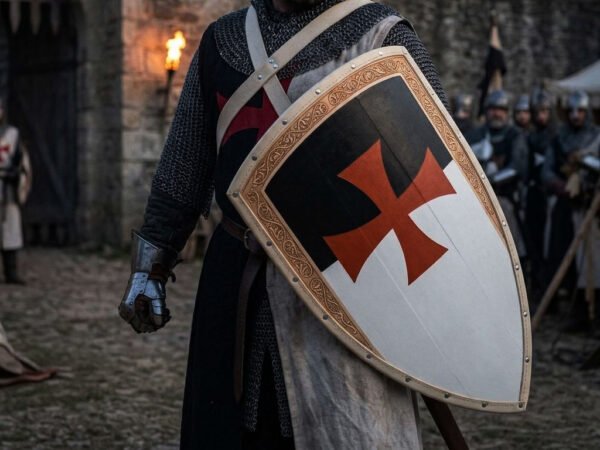
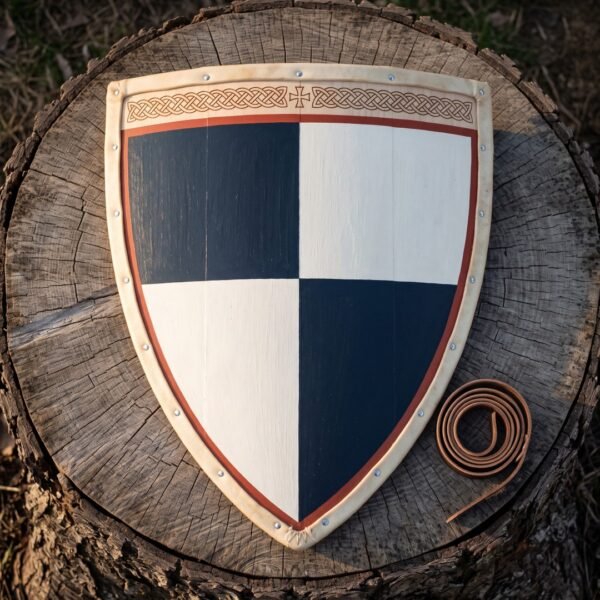
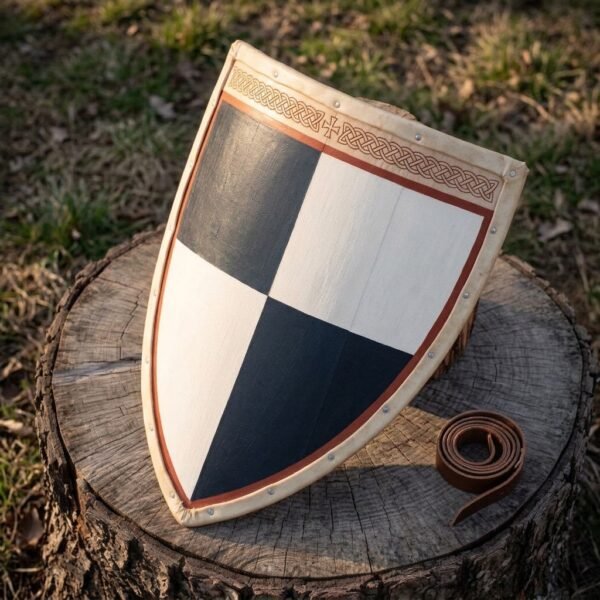
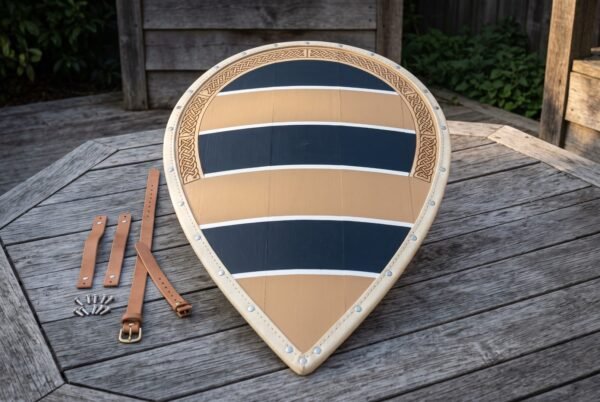
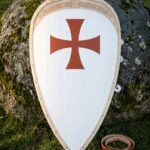
Palecross is a hand made kite shield in the plainest and most recognisable arrangement there is, a red cross pattee standing alone on a white field. The board is planked in wood, faced and painted white, bound around the whole edge in rawhide and riveted, and finished across the rounded top with a hand cut knotwork band carrying a small cross at its centre. The enarmes are fitted to the back and a long leather guige strap is supplied loose so you can set it to your own height.
The cross pattee on white is the device most people picture when they hear the word Templar, and the order really did receive the right to a red cross from Pope Eugenius the Third in 1147, worn on the white mantle that only the knights of the order could wear. What is worth knowing is that the shape of that cross was never fixed. Medieval artists drew it as a pattee, a splayed cross, a plain Greek cross and several other forms, and the crisp geometric versions we treat as canonical today are largely nineteenth century tidying. This one is drawn as a true pattee, arms narrow at the centre and flaring to a straight outer edge. It is planked, painted, bound and engraved in a Czech Republic workshop. Why the shape changed from round to kite is set out in round shield versus kite shield.
Specifications
| Material | Planked wood body, painted face, rawhide bound edge |
|---|
| Size | Approximately 40 inches tall by 20 inches at the widest point |
|---|
| Shape | Rounded top tapering to a point, eleventh to twelfth century kite form |
|---|
| Design | Red cross pattee on a white field, cut knotwork band with a small cross across the top |
|---|
| Rim | Rawhide edging fixed with small steel rivets around the full perimeter |
|---|
| Fittings | Enarmes fitted to the back with steel bolts |
|---|
| Strap | Tan leather guige strap with a steel buckle, supplied loose |
|---|
| Finish | Hand laid paint over a prepared ground, no printing or transfers |
|---|
| Intended use | Display, wall mounting, costume and light reenactment |
|---|
| SKU | RK-1440 |
|---|
Why a shield carries one bold device and nothing else
Heraldry did not begin as decoration. It began as a recognition problem. Once a man is inside a mail hauberk with a helmet and a nasal bar over his face, nobody at fifty yards can tell whether he is a friend or the man who is about to ride you down. The only surface large enough and consistently visible enough to solve that is the shield, and so devices went onto shields and stayed there.
Everything about the way heraldry is drawn follows from being read at distance under bad conditions. Devices are geometric because geometry survives being seen briefly, at an angle, through dust. And the oldest rule in the system, the rule of tincture, exists for the same reason. It says you do not place a colour on a colour or a metal on a metal, because red on blue or gold on silver goes muddy and unreadable in poor light. A cross of gules, which is red, on a field of argent, which is white, is a colour on a metal. It obeys the rule perfectly, and that is a large part of why it reads so hard from so far away.
Practically it means this shield does its job on a wall as well as it ever did in the field. A single high contrast charge on a plain ground carries across a room in a way that a busy quartered design never does.
The board, the ground under the paint and the rawhide
The body is planked, boards butted and glued edge to edge in the medieval manner, which lets the face flex a little under a blow and gives it a predictable line to fail along instead of splitting brittly across the grain. You can see the plank joints through the paint and that is intentional. A shield with no visible planking is a plywood shield pretending to be something else.
A white shield is harder to make well than a coloured one because white shows everything underneath it. The face is prepared with a ground before the white goes on, which fills the grain and the plank joints enough to give a clean surface without burying the construction, then the white and the red are laid by hand. Hand laid paint on a prepared ground ages properly, gaining small marks and a slight mellowing rather than peeling in sheets the way a printed film does.
The rawhide edge binding is the structural piece. Applied wet and allowed to shrink, it clamps the end grain of every plank and turns the vulnerable rim into a hide covered edge that a cut bites into rather than splits. Be honest about the limits though. This is built for display, wall mounting, costume and light reenactment, and it is not made to any full contact combat specification.
Engraving, runes and your own design
Use the rune converter on this page to turn a name, a date or a short phrase into Elder Futhark and we will cut it into the steel or the leather. If you would rather have a Viking pattern than a rune line, choose your own design in the engraving option above the add to cart button and tell us where it goes. Where a piece already carries an engraved design, your chosen engraving replaces it rather than sitting alongside it. On this shield the knotwork band across the top is the engraving field, so a name, a date, a motto or your own device goes there in place of the knotwork shown. See the engraving page for the length that fits comfortably in that band.
Mounting and display
Hang it from two fixings rather than one. Heavy picture hooks or a French cleat catching the rim on both sides of the widest part share the load and stop the shield swinging or twisting on the wall. Never hang it by the guige strap, because leather creeps under constant load and eventually lets go.
A white shield wants thought about lighting and position. Direct sunlight across a season will yellow a white ground and fade a red, so keep it off a wall that gets hard afternoon sun through glass. Side lighting is much kinder than overhead lighting, since a raking light picks up the plank lines, the rawhide stitching and the cut knotwork band that flat top light flattens out completely.
Care
Dust it with a soft dry cloth. If the white face is marked, use a barely damp cloth and nothing else, because household cleaners and solvents will lift hand laid paint immediately. Do not use a magic eraser type sponge on it, which is a fine abrasive and will take the paint off along with the mark.
Keep it out of damp. Painted plank and rawhide both absorb moisture, and a shield stored in a garage over a wet winter will lift paint at the plank joints and soften the binding. The rivets and steel fittings take a wipe of light oil once or twice a year, and the general principles are on the steel care page. If it is going on a wall rather than into a line, choosing a shield for display covers size and mounting.
Made in the Czech Republic
Every piece we sell is made by hand in the Czech Republic. The smiths there work the way the trade has been worked for a long time, heating and hammering the steel, taking the bevels down by eye, and fitting the handle and the leather one at a time. There is no automated line anywhere in it, so small differences from one piece to the next are normal and expected.
Ransack Viking is a United States company based in Chicago, Illinois. We bring the pieces in ourselves, inspect them on arrival and ship them from our own warehouse. If you add engraving, that is carried out here in the United States before your order goes out.
A note on handmade variation
This is hand made rather than machine made or bulk produced, so what arrives will not be a pixel for pixel copy of the photograph. The plank lines fall where the boards fall, the painted edges of the cross are laid by hand so their line weight varies slightly, the rawhide takes its own tone as it dries and the cut knotwork has its own rhythm. The dimensions, the material and the build are the same every time. The character is not.
Frequently asked questions
Are the straps already fitted
The enarmes, the arm loops on the back, are fitted. The long guige strap that goes over your shoulder comes loose in the box so you can cut it and set the buckle to your own height rather than an average one.
Is this the correct Templar cross
It is drawn as a cross pattee in red on white, which is the arrangement the order was granted in 1147 and the one most people recognise. Medieval depictions actually vary a good deal in the exact cross shape, so treat any single version as a strong convention rather than a fixed rule.
Can I fight with it
Use it for costume, film, photography and light reenactment. It is not built to any full contact standard, where groups specify board thickness, rim construction and edge padding and inspect against those specifications.
Will the white stay white
Kept out of direct sunlight, yes, with a slow mellowing over years that most people prefer to the raw new white. Hard sun through a window will yellow the ground and fade the red faster than anything else you can do to it.
How big is it
Roughly 40 inches tall by 20 inches at the widest point. Mark that rectangle on your wall before you order, because a kite shield reads a great deal larger in a room than it does in a photograph on a screen.
How long does it take to arrive
Processing is one to two weeks because each shield is planked, painted and bound to order, then shipping is free within the United States. Returns are accepted within seven days. Custom engraving on the band adds a few days.
What is in the box
- One planked kite shield, painted white with a red cross pattee
- Rawhide bound and riveted edge with a cut knotwork band across the top
- Enarmes fitted to the back
- Leather guige strap and buckle, supplied loose
- Made and finished by hand in the Czech Republic
Explore the range
See more in kite shields and bucklers, medieval helmets and chainmail armor, or read the guides.
Near neighbours in the shop
Sitting beside it in the catalogue is the Silverward buckler. Another in the same line is the Crossmarch buckler. Next along the rack is the Quarterfell buckler.
Fitting out further, the Ringmantle chainmail armor belongs with it. You can have this made your way instead on the design your own page.

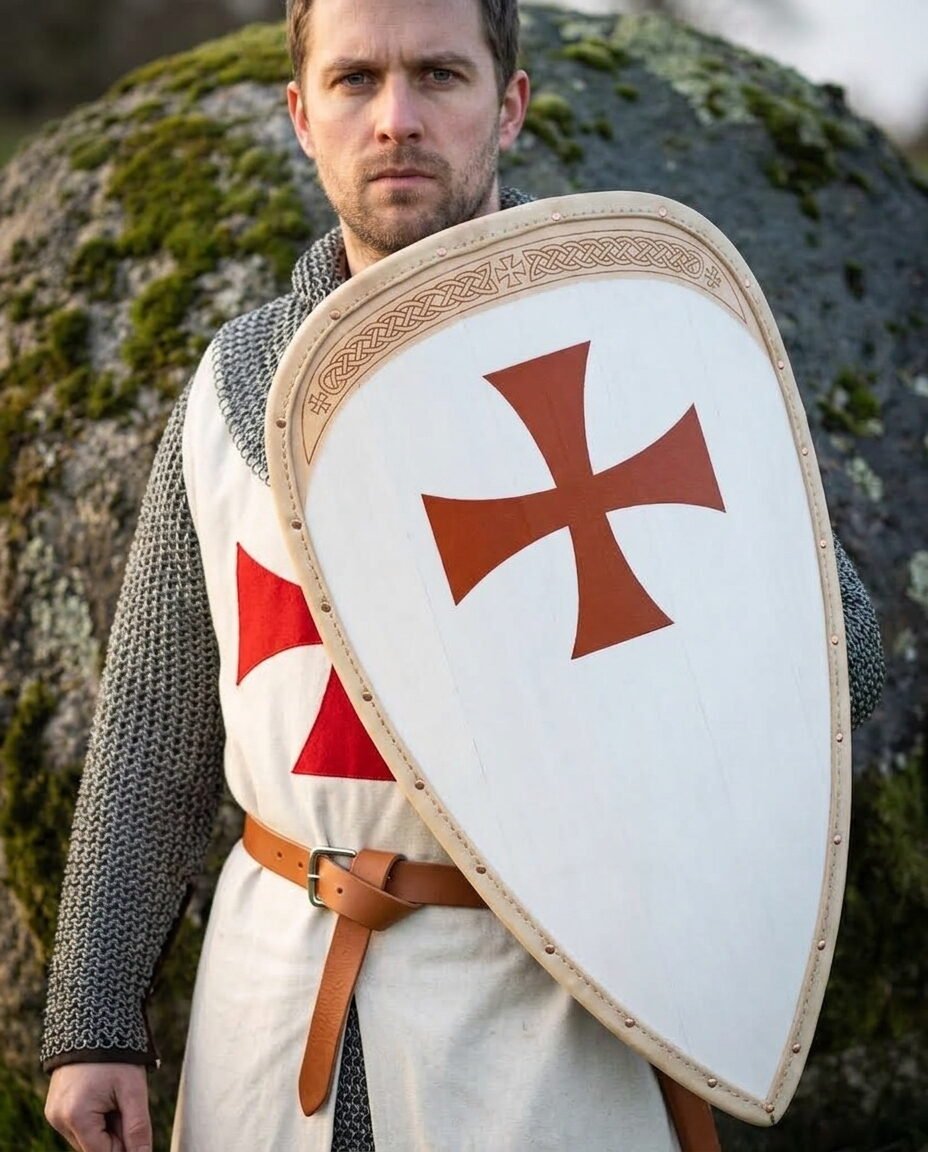


Showed up right on time and looked even better than the photos. Looks incredible with the rest of my reenactment kit. Exactly the look I wanted for my collection. So worth it.