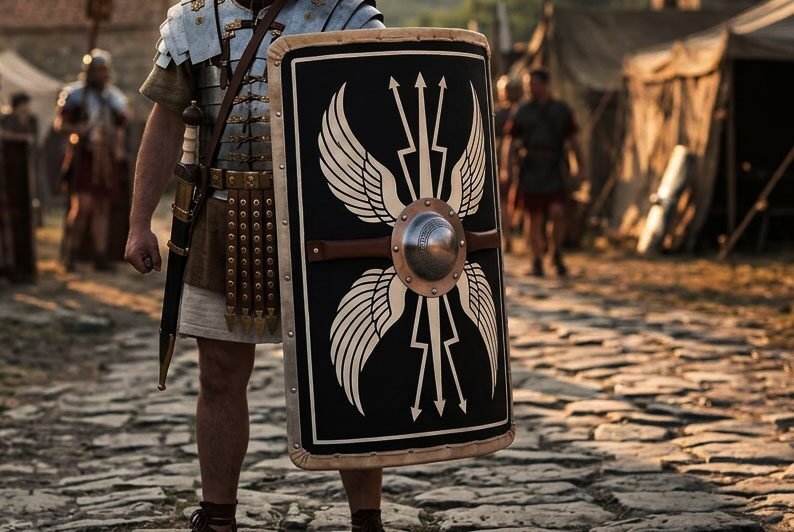
Legionwall is a scutum, the curved rectangular shield carried by the Roman legions of the first and second centuries. The curve is the whole point of it and it is the thing most people miss. A flat board of this size would be an enormous target and would still only cover the front of a man. Bending it around the body means the same area of timber wraps the ribs and the hips, protects the flanks in a formation where you are pressed shoulder to shoulder, and presents a sloped face to anything thrown at it so that missiles glance off rather than strike square.
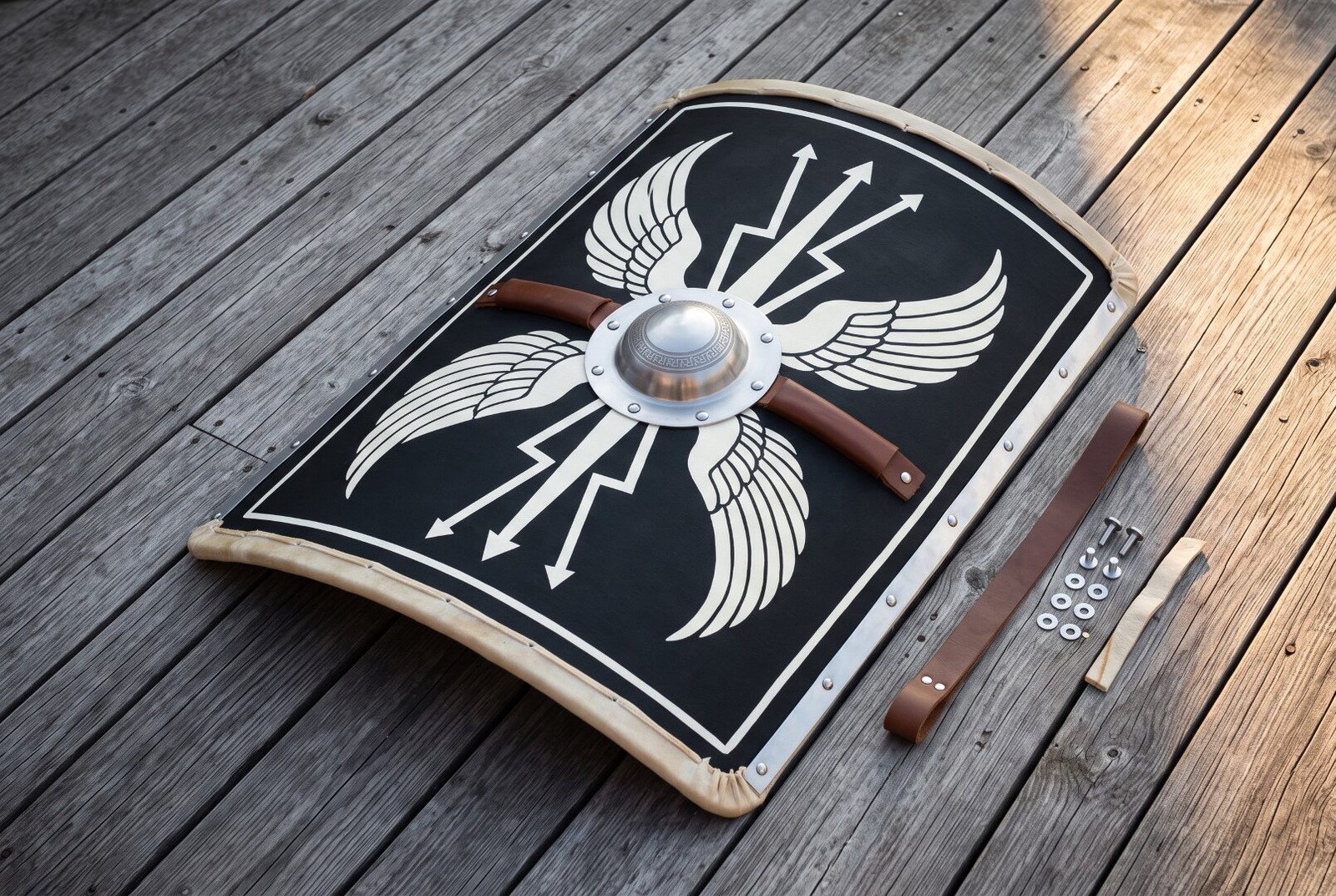
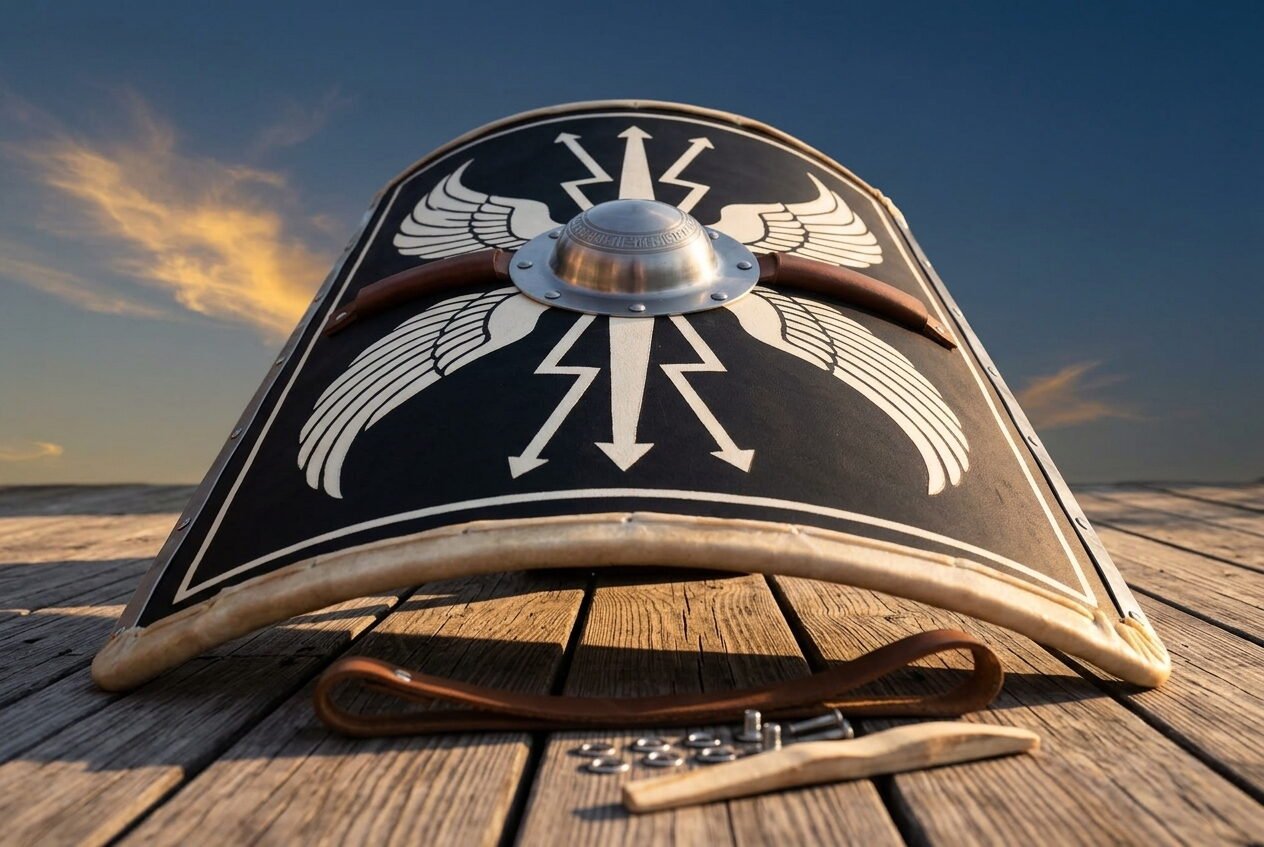
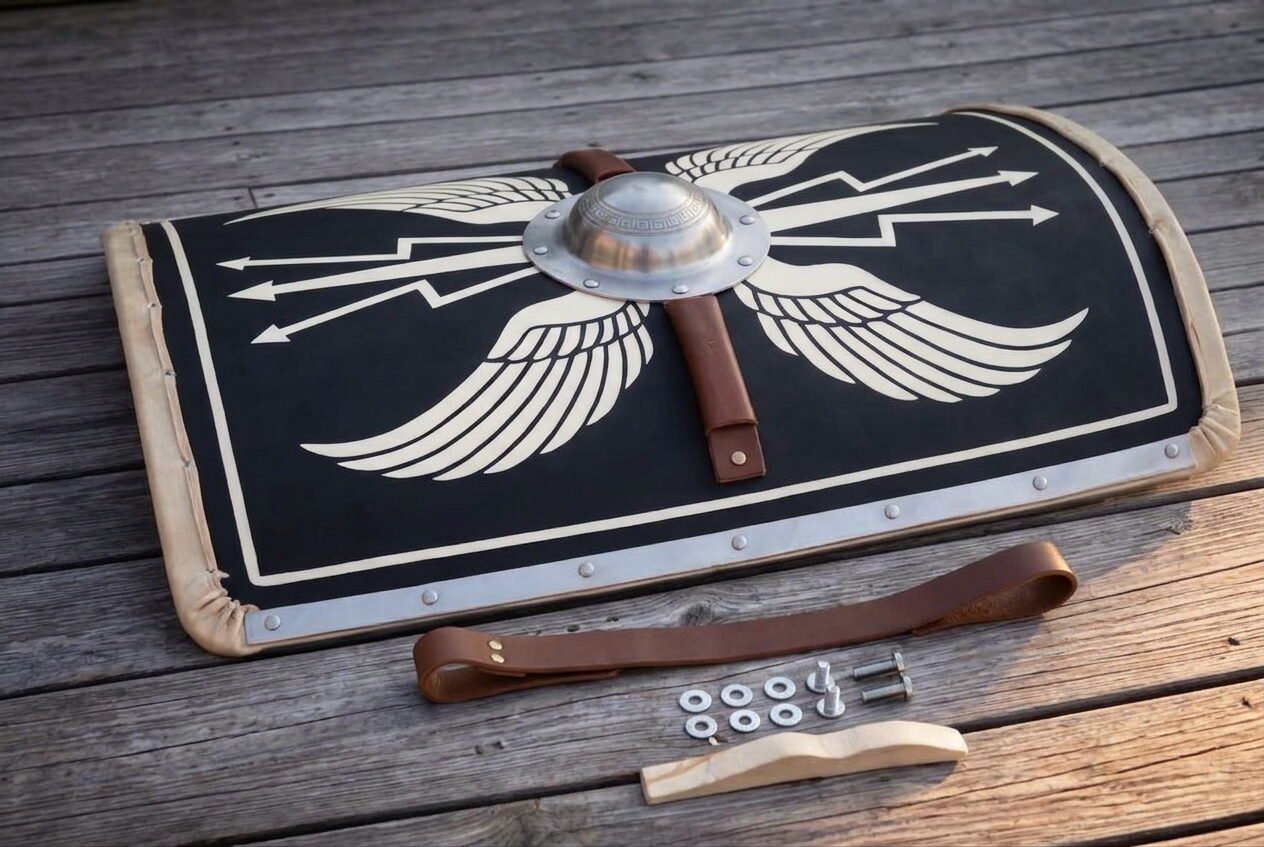
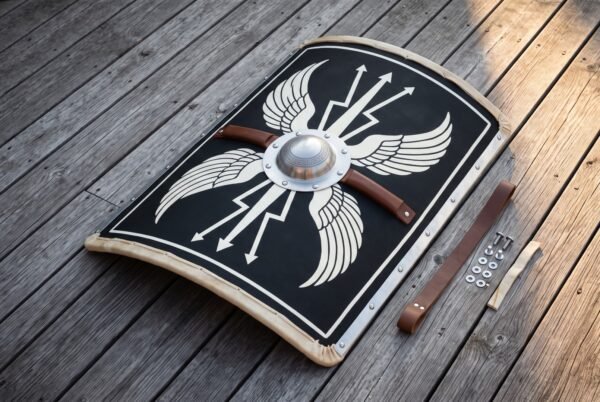
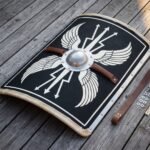
The face here carries a pair of white wings, thunderbolts and arrow motifs on a black field, which is the standard visual language of legionary shield decoration. Jupiter threw the thunderbolt, the wings belong to victory, and the whole device is a claim about who is going to win the day. Every Legionwall is laminated, curved, faced, painted, edged and bossed by hand in the Czech Republic, and it ships with the wooden hand grip, the leather strap and the bolt and washer fitting kit shown in the photograph. Free shipping inside the United States, one to two weeks processing, seven day returns, and a genuine lifetime warranty against defects in the build and the fittings, with no end date and no receipt needed. The round shield of the north worked on the same principles, covered in our guide to Viking shields.
Specifications
| Item type | Curved Roman scutum shield |
|---|
| Shape | Curved rectangular scutum with rounded top and bottom edges |
|---|
| Size | Built to 37 inches tall and shaped in proportion, curved on the vertical axis |
|---|
| Core | Laminated timber core, bent to the curve and sealed before painting |
|---|
| Face | Hand painted wings, thunderbolts and arrows in white on a black field, inside a white border line |
|---|
| Face strap | Brown leather strap across the face, riveted at both ends |
|---|
| Trim | Riveted metal strip set just inside the rim |
|---|
| Edging | Bone coloured rawhide style edge binding around the whole rim |
|---|
| Boss | Domed steel umbo with a riveted flange through the centre of the board |
|---|
| Grip | Shaped wooden hand grip for fitting behind the boss |
|---|
| Fitting kit | Leather strap, steel bolts and washers supplied loose |
|---|
| Intended use | Display, parade, photography and light reenactment |
|---|
| SKU | RK-1456 |
|---|
What a shield boss is actually for
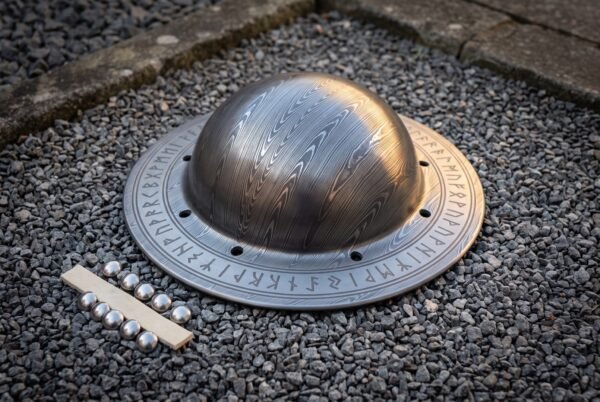
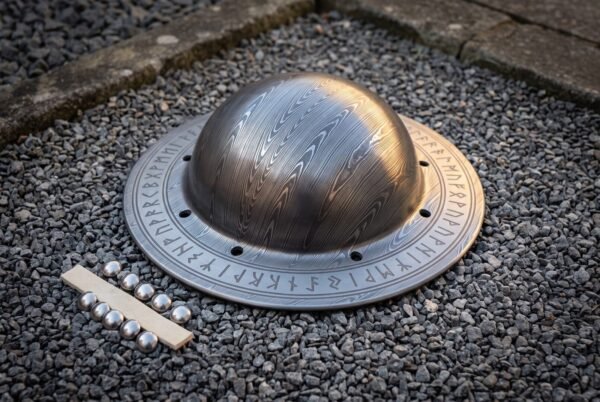
The umbo, the domed steel dish in the middle of the board, exists because of how a scutum is held. There is no arm strap on a Roman shield. There is a single horizontal wooden grip, gripped in the fist, and the boss is the steel cup that covers the hole cut through the board to make room for that fist. Everything else follows from this.
First, the boss is armour for the hand. Your knuckles are sitting inside that dome and a spear point that comes through the timber would otherwise arrive in the middle of your fingers. Second, it is a spreader. A blow that lands on the boss is transmitted through the steel flange into the rim of the hole and out across the board, rather than snapping the thin timber at the weakest point. Third, it strikes. The Roman fighting style was to punch the boss forward into an opponent to break his balance and open him for the short sword, and Roman sources are quite explicit that this was drilled, not improvised.
That is why the boss is riveted through with a proper flange and burrs rather than screwed on. A screwed boss will pull out of a plank core the first time it takes a real impact. Riveted, with a burr set on the back, the load goes through the whole thickness of the board.
The core, the curve, the paint and the fitting kit
The core is laminated timber, bent to the curve while the glue is wet rather than cut from a solid block, which is genuinely how a scutum was made. Roman shields were built from thin layers of wood laid at right angles to each other, essentially early plywood, precisely because that construction can be bent and because the crossed grain resists splitting along any single line. The board is sealed before painting so the face takes pigment evenly, and the wings and thunderbolts are laid in by hand rather than printed.
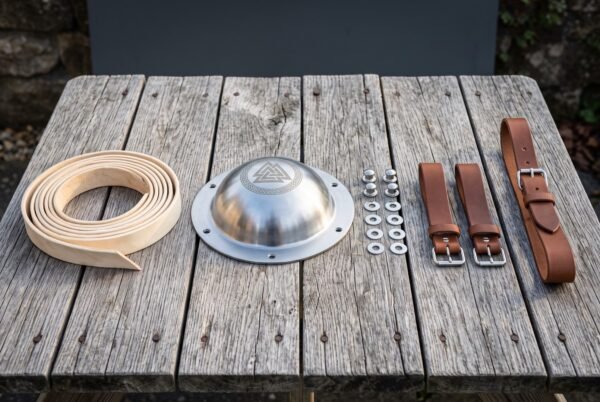
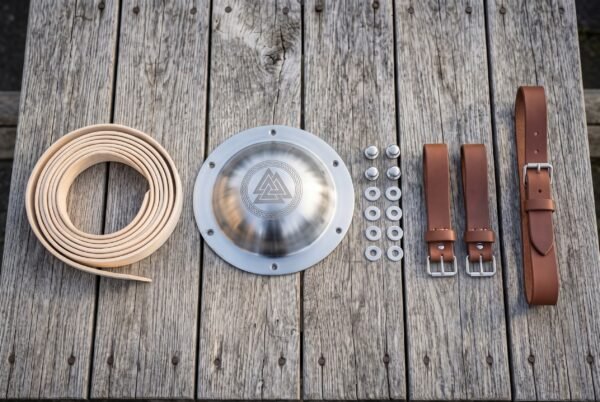
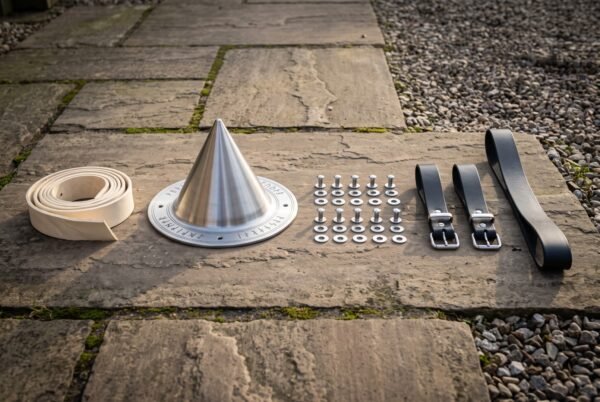
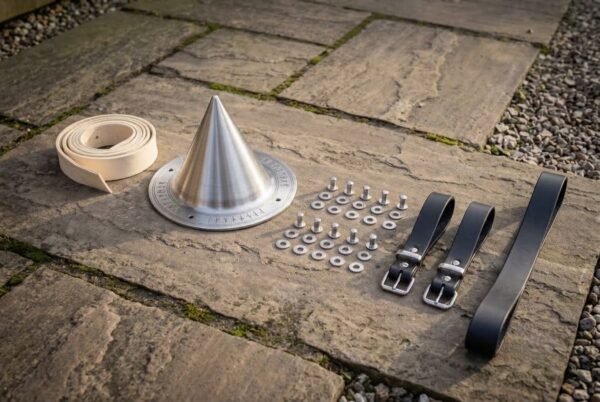
The edging protects the end grain. A shield takes most of its damage on the rim, and unprotected end grain splits, so a period scutum was bound around the whole perimeter with rawhide stitched on wet so it shrank tight as it dried. A shaped wooden hand grip, a leather strap and loose steel bolts and washers are supplied with your shield so that the grip can be fitted or re fitted without hunting for hardware.
Be honest about what this is. Legionwall is a display, parade and light reenactment shield. It is not built to receive full contact steel and it is not rated as combat equipment. If your group runs heavy contact, buy a purpose built combat scutum with a thicker core.
Engraving, runes and your own design
Use the rune converter on this page to turn a name, a date or a short phrase into Elder Futhark and we will cut it into the steel or the leather. If you would rather have a Viking pattern than a rune line, choose your own design in the engraving option above the add to cart button and tell us where it goes. Where a piece already carries an engraved design, your chosen engraving replaces it rather than sitting alongside it. On a scutum the natural homes are the flange of the boss and the leather face strap, and Latin lettering can be painted onto the field in place of a rune line if you prefer. Full detail is on the engraving page.
Mounting and display
A curved shield does not sit flat against a wall, which is part of its charm and all of the difficulty. The tidiest mount is a pair of brackets that catch the top and bottom rims and hold the board a few inches off the plaster so the curve reads properly and a shadow falls behind it. Do not drill through the painted face to hang it, because that breaks the seal and lets damp into the laminations.
If you are standing it on the floor against a wall, put something soft under the bottom rim. The edge binding is the part that wears first and grinding it against a hard floor for a year will do more damage than an event day ever will.
Care
Dust the face with a dry cloth and keep solvents away from the paint. If it gets wet, dry it standing on edge rather than lying flat, because water sitting in the concave face will find its way into the laminations at the rim. Feed the leather grip and any leather binding with a neutral conditioner two or three times a year. Check the boss and grip fixings each season and tighten any that have loosened, which is what the supplied kit is for. Wipe and oil the steel boss occasionally to keep it clean, following the same routine set out on our steel care page. If it is going on a wall rather than into a line, choosing a shield for display covers size and mounting.
Made in the Czech Republic
This piece is made by hand in the Czech Republic, in a workshop that still works the old way. The steel is forged, ground, heat treated and finished by smiths who learned the trade from the people before them, and the wood, horn and leather are cut and fitted by hand rather than pressed out on a line. That is also why no two pieces come out exactly the same.
Ransack Viking is a United States company. We import these pieces ourselves, check every one when it lands and ship from our warehouse in Chicago, Illinois. Engraving is done here in the United States after the piece arrives, so your runes or your own design go on before it leaves for you.
A note on handmade variation
This shield is hand made and not machine made or bulk produced, so what arrives will not be a pixel for pixel copy of the photograph. Brush edges on the wings, the exact depth of the curve, the run of the edge binding, rivet placement and the tone of the timber under the seal all vary because each board is worked by hand from natural materials. The dimensions, the material and the build are the same every time. The character is not.
Frequently asked questions
Is the shield curved or flat?
Genuinely curved on the vertical axis, bent while the laminations were being laid up rather than cut to shape. That is how a real scutum was made and it is why the board wraps the body.
How is it held?
By a single horizontal grip behind the boss, held in the fist. There is no arm strap on a Roman shield, which is why the boss has to cover and protect the hand.
Can I use it for full contact reenactment?
No. This is a display, parade and light reenactment board. It is not built or rated to receive full contact steel. For heavy fighting buy a purpose built combat scutum.
What is the loose hardware for?
It is a fitting kit: a shaped wooden hand grip, a leather strap and steel bolts and washers, so the grip can be fitted or tightened without hunting for parts.
Is the artwork painted or printed?
Painted by hand onto a sealed face. Look closely and you will find brush character in the line work rather than the perfectly uniform edge of a transfer.
How long does it take to ship?
One to two weeks, because each board is laid up, curved, painted and fitted to order. Shipping inside the United States is free.
What is in the box
- One curved Roman scutum shield, hand painted and edged
- Domed steel boss riveted through the centre
- Shaped wooden hand grip for fitting behind the boss
- Fitting kit of a leather strap, steel bolts and washers
- Care, mounting and re riveting notes
- Forged and finished in the Czech Republic
Explore the range
See more in kite shields and bucklers, shield bosses and Roman and Greek helmets, or read the guides for how shields were built and bossed.
Close to this one
Closest to this in the range is the Aquilorn Greek shield. If this one is not quite right, there is the Gorgonward Greek shield. Also in this group is the Crimsonward Greek shield.
If you are putting a set together, the Pathmark shield boss sits alongside it. Nothing here exactly right, build one to your own spec on the design your own page.


This shield is a genuine work of art. Rivets and trim are all solid. Nothing feels flimsy. Couldn’t be happier with this.
Incredible craftsmanship on this one. Padding and straps make it comfortable to wear for hours. Worth every penny.
My whole family was impressed when I unboxed it. Fit is excellent and the steel gauge feels genuinely protective. Looks incredible with the rest of my reenactment kit. Padding and straps make it comfortable to wear for hours. This is my third order from Ransack Viking and they never disappoint. Will definitely order again for another gift.