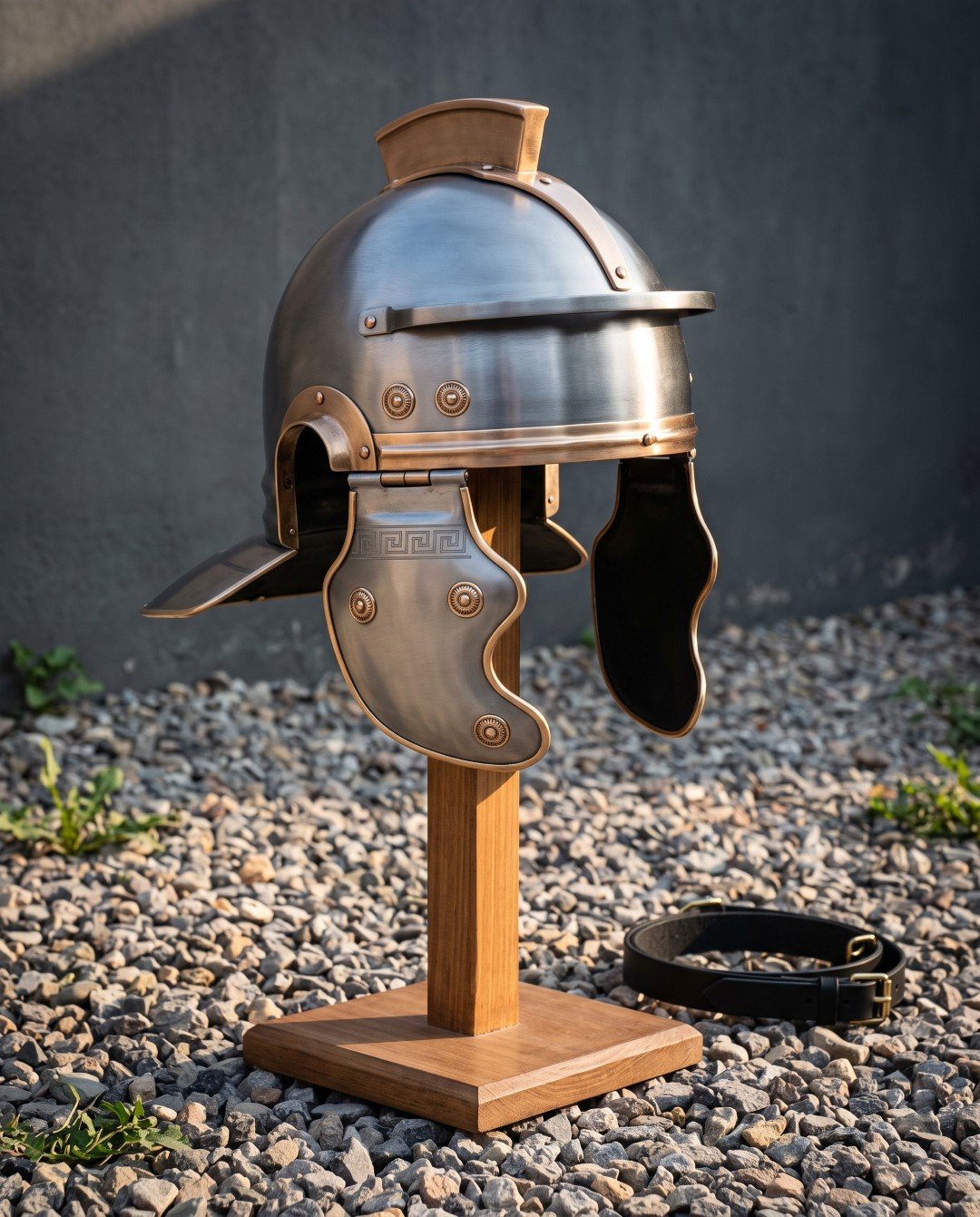
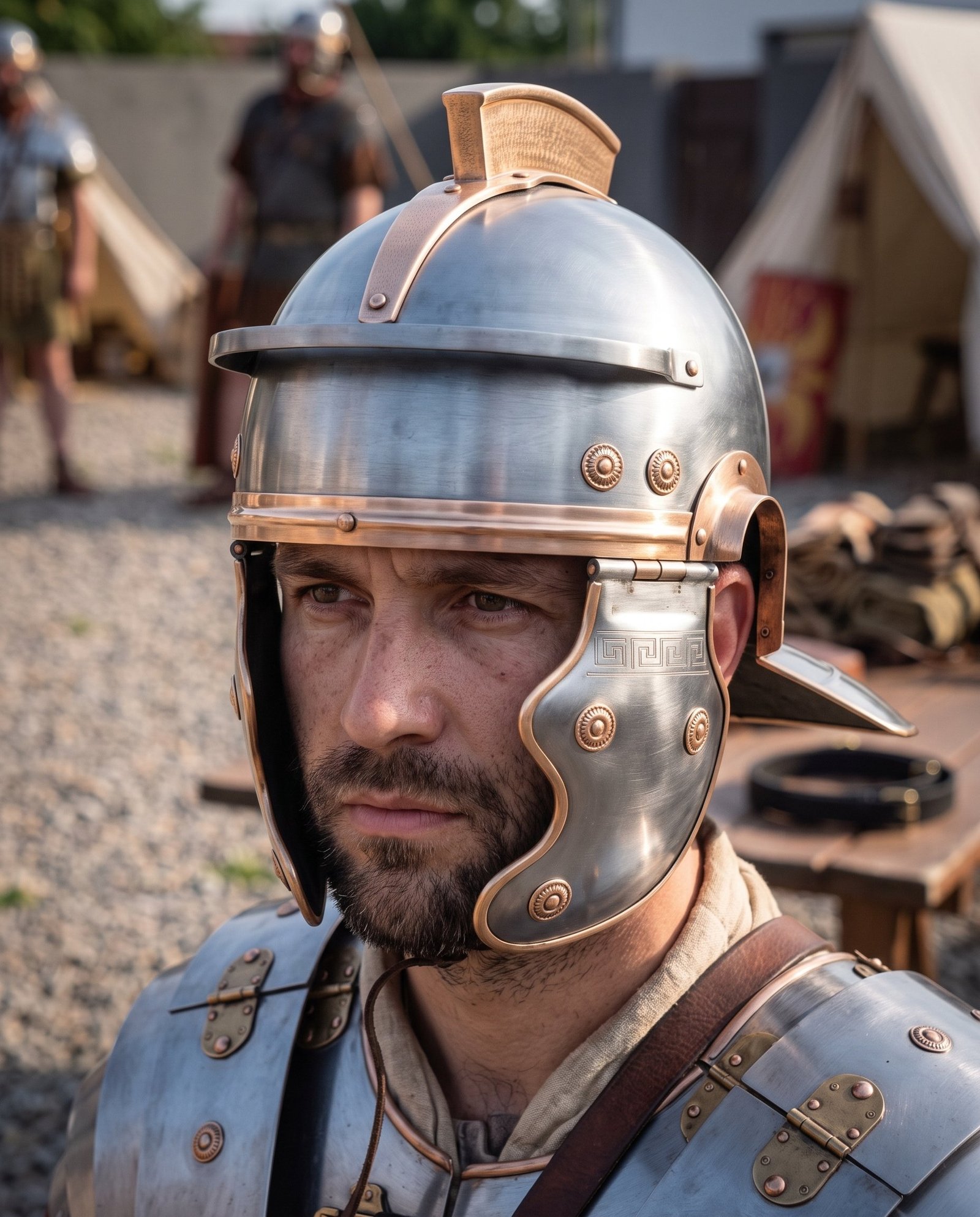
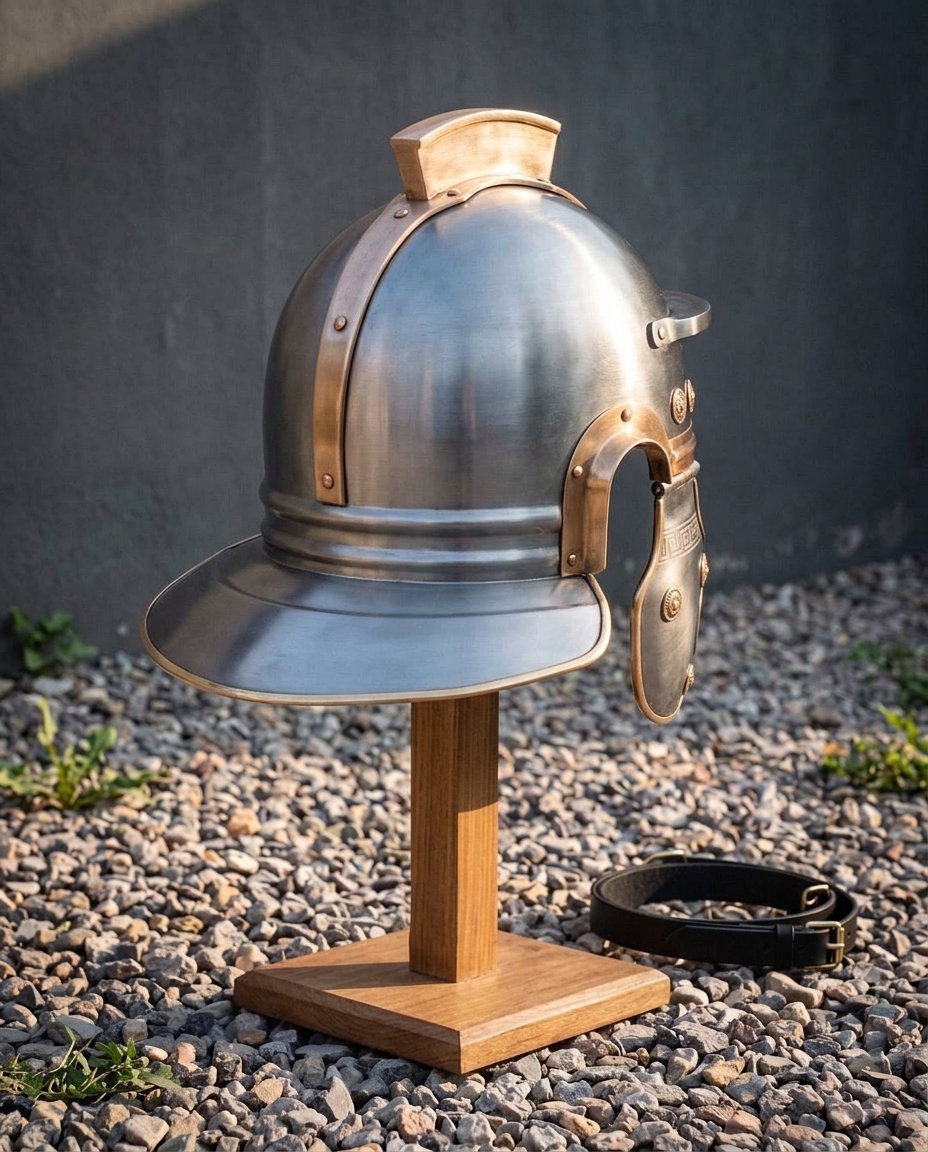
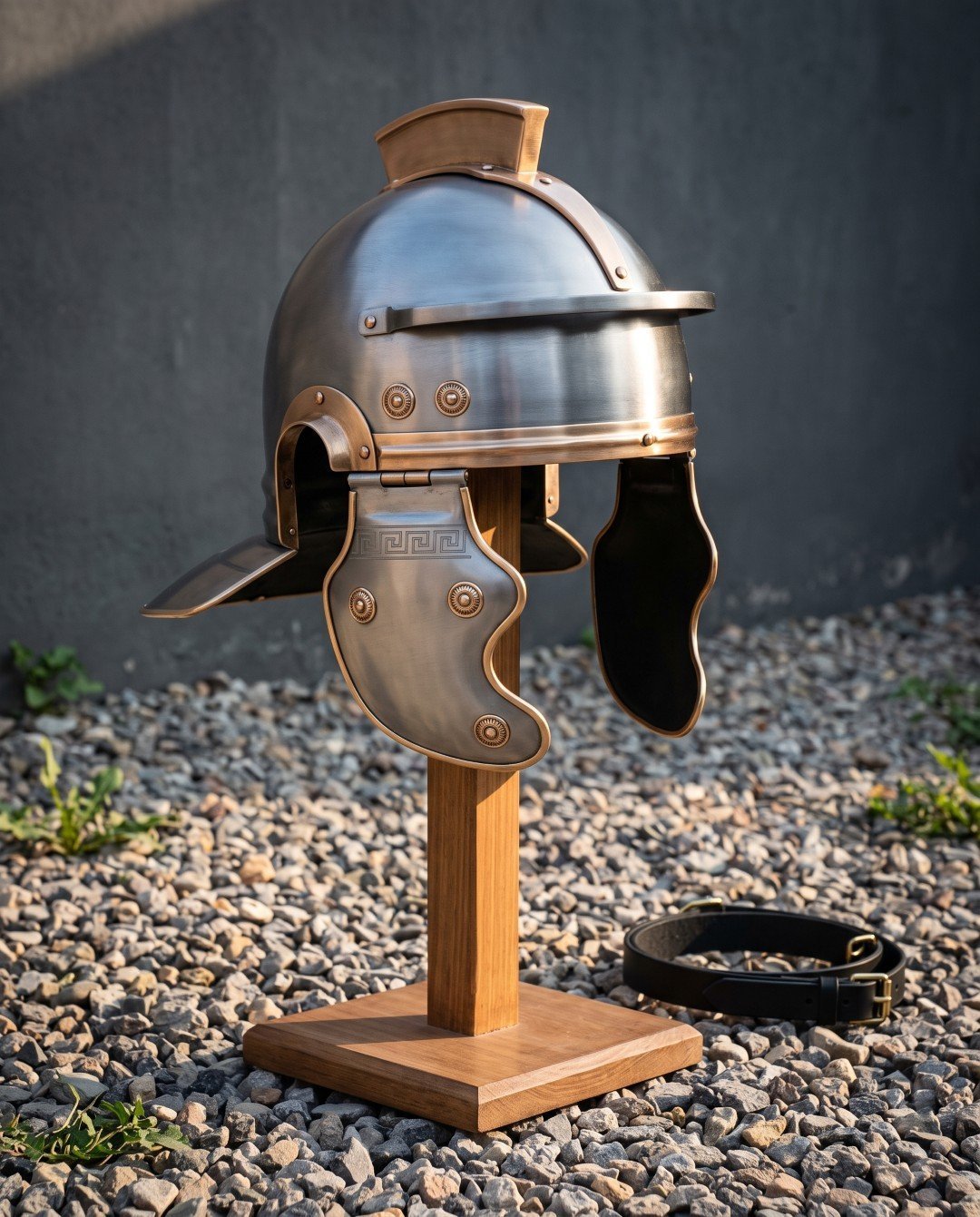
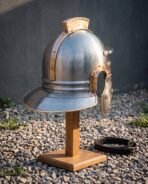
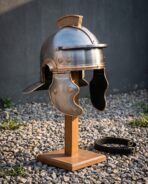
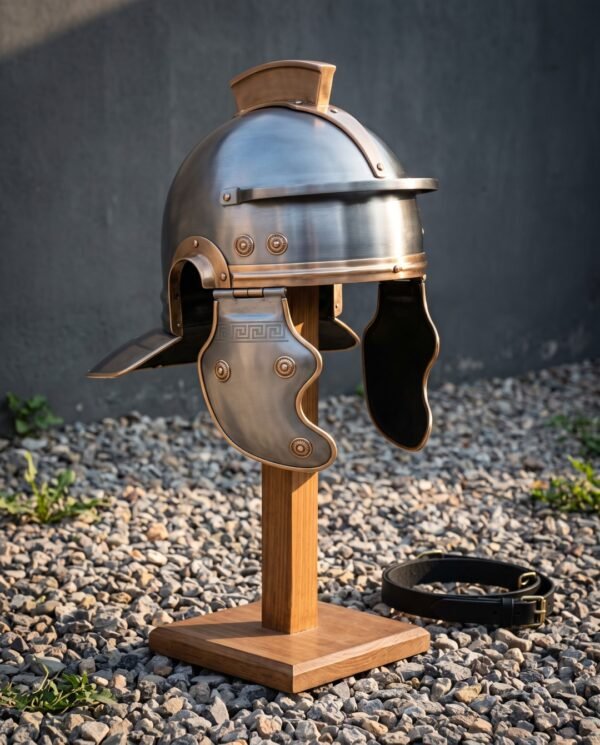
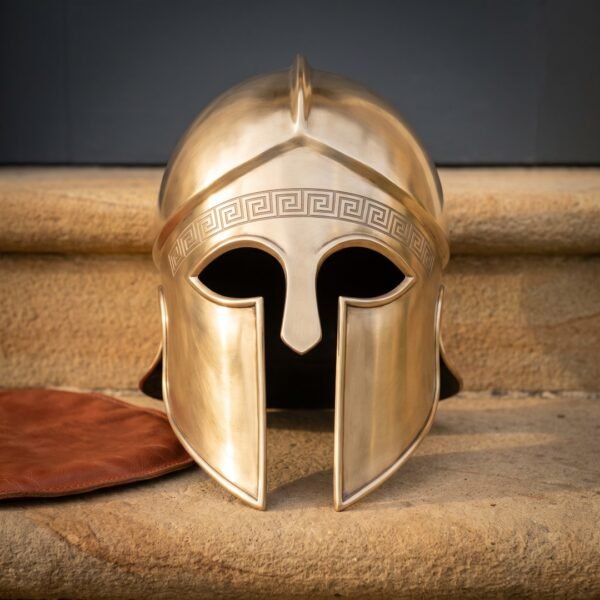
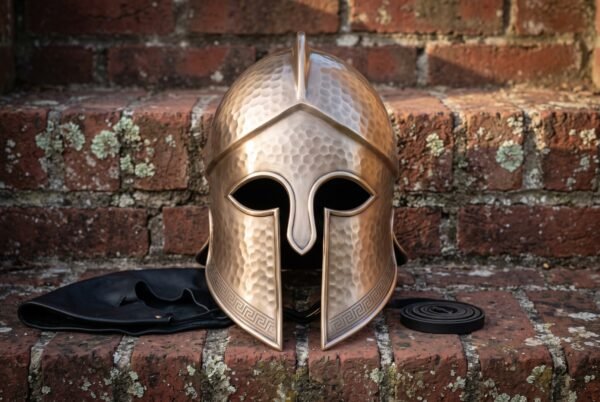
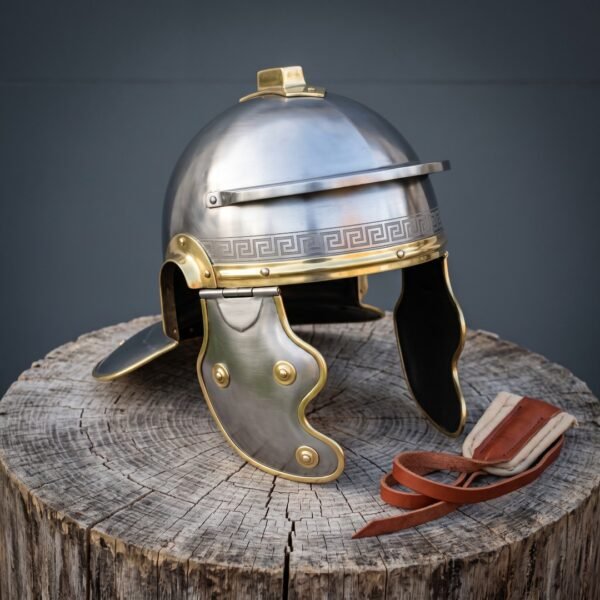
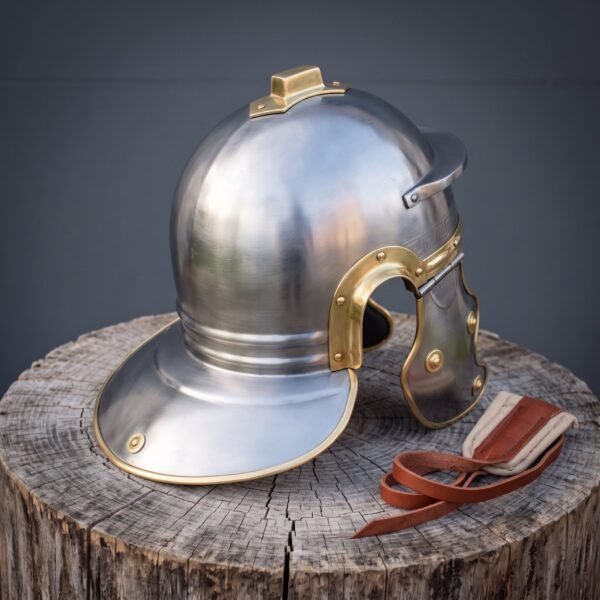
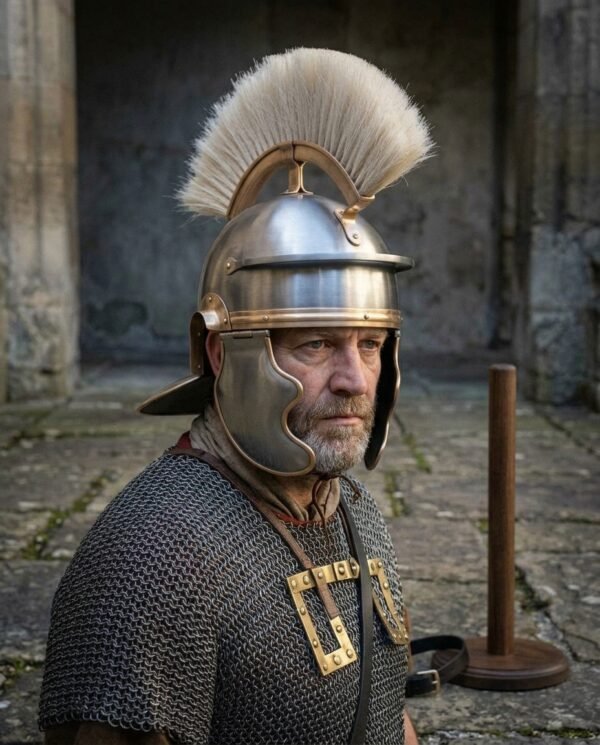
A raised steel bowl with a bronze tone brow reinforce, ringed rosette bosses, a wide swept neck flare and hinged cheek guards engraved with a running meander. On the crown sits a crest holder. That fitting is where one of the best details in Roman military archaeology lives, because crests were not simply decoration. A centurion wore his crest transverse, crista transversa, running from ear to ear rather than front to back, for the plain reason that a man commanding a line has to be findable in it. Twenty ranks back and through dust, a sideways plume is the only thing about a centurion that reads instantly.
The other detail worth knowing is what happens inside the bowl. Surviving Roman helmets frequently carry punched or scratched names on the interior, and several carry more than one, added over the years as the helmet passed from soldier to soldier. A helmet was expensive kit, it was army property in practice, and it outlived the men who wore it. That is the difference between Roman military equipment and heroic personal armour, and it is why the shapes are so consistent across the empire. This one is raised, fitted, engraved and finished in a Czech Republic workshop, and it ships with the cheek guards hinged and a padded liner in place. The oak display stand and the black leather belt in the photograph are studio props and are not included. Roman and Greek kit sat alongside mail and plate in the same centuries, compared in chainmail versus plate versus lamellar.
Specifications
| Material | Mild steel bowl, neck flare and cheek guards with bronze tone trim, reinforce and bosses |
|---|
| Gauge | 18 gauge, approximately 1.2 mm |
|---|
| Finish | Satin steel bowl, warm bronze tone edging and fittings, engraved meander on the cheek guards |
|---|
| Crown | Crossed bronze tone reinforcing bands over the bowl with a crest holder on top |
|---|
| Brow | Riveted steel brow peak across the front, bronze tone edged brow reinforce |
|---|
| Cheek guards | Hinged, engraved with a running meander, ringed rosette bosses, scalloped for the ear |
|---|
| Ear guards | Bronze tone ear guards above the cheek guard hinges |
|---|
| Neck flare | Wide swept plate with raised ridges where it meets the bowl |
|---|
| Size or fit | Made to a stated head circumference, standard build fits roughly 22 to 23 inches |
|---|
| Weight | Approximately 4 lb 2 oz complete with cheek guards |
|---|
| Lining | Padded liner fitted inside the bowl, leather chin ties on the cheek guards |
|---|
| Intended use | Display, living history, film and photography, light reenactment. Not full contact combat rated |
|---|
| SKU | RK-1579 |
|---|
How the cheek guards do their work
The cheek guards are the part of a Roman helmet that people underestimate. They hinge from the brow band, they swing out to let the head in, and they fold back against the jaw and tie under the chin. Once tied they do three things. They cover the side of the face from the temple to the jaw line, which is where a sword coming across rather than down will land. They stop the helmet rotating on the head, because two plates gripping the jaw hold the bowl aligned in a way a chin strap alone never will. And they leave the ear open. Look at the shaped cut in the upper edge of each guard on this helmet. That scallop is deliberate, and it is there so a soldier can hear an order over the noise of a fight, which was worth more than the extra steel would have been.
The neck flare behind does the equivalent job for the back of the neck. It is angled down and away rather than curved down onto the shoulders, so it covers the gap between the helmet and the body armour while leaving the head free to turn. The brow reinforce across the front is riveted rather than welded, and it puts the thickest material at the point where the bowl has been stretched the most in raising and where a descending cut arrives.
Steel, bronze tone trim and the meander
The bowl is 18 gauge mild steel, roughly 1.2 mm, raised over a stake and then planished, which work hardens the metal as it thins and stretches. That gauge is display and light reenactment weight. It is right for parades, static living history, film, photography and drill, and it is not full contact combat plate. Groups running steel on steel bouts generally require 14 gauge or heavier for head protection and this helmet is not built to that standard. We would rather tell you now.
The trim on this helmet is warm bronze tone rather than the yellow brass on our Imperial Gallic build, which gives it a darker, older look under low light and reads well against a red or ochre tunic. The meander, the interlocking key pattern, is engraved into the cheek guards rather than stamped, so the line has real depth and shows from an angle. The ringed rosette bosses on the guards and around the brow are set individually.
Engraving, runes and your own design
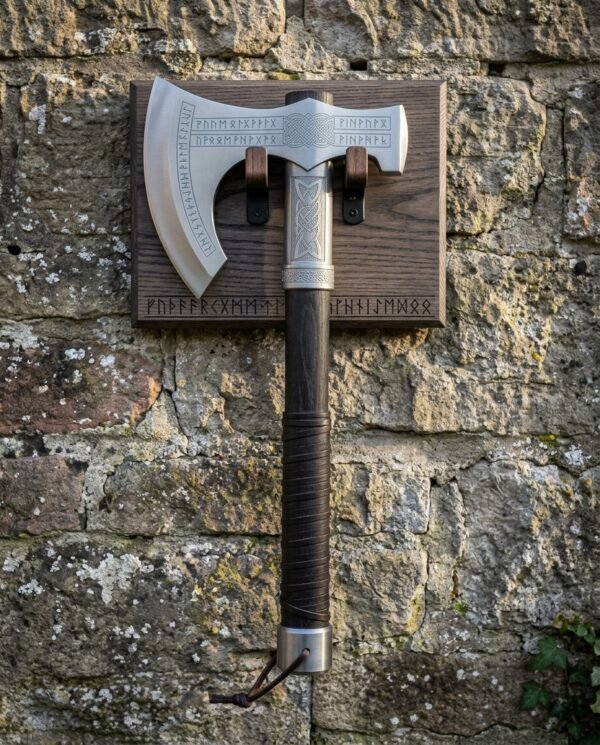
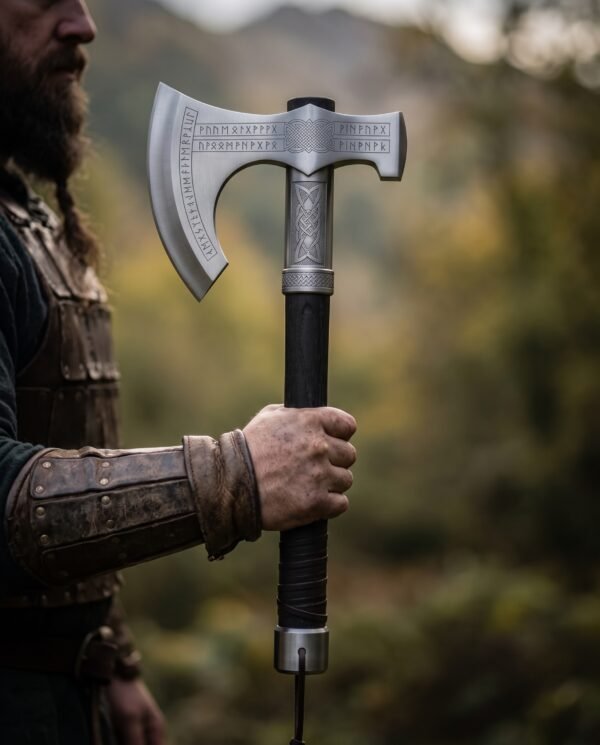
Use the rune converter on this page to turn a name, a date or a short phrase into Elder Futhark and we will cut it into the steel or the leather. If you would rather have a Viking pattern than a rune line, choose your own design in the engraving option above the add to cart button and tell us where it goes. Where a piece already carries an engraved design, your chosen engraving replaces it rather than sitting alongside it. On this helmet the meander panel on the cheek guards is the space, and a name, a unit and a number in the Roman manner is the most fitting request we get. There is also room to punch a name inside the bowl if you want to follow the original practice. See the engraving page.
Fit and sizing
Built to a stated head size, so measure first. Take a soft tape around your head a finger width above the eyebrows and around the widest part at the back and send us that number. The standard build fits roughly 22 to 23 inches with the liner in. A Roman helmet has to sit lower than a medieval helm, because the brow reinforce needs to be at eyebrow height for the cheek guards to close correctly on the jaw, so ordering a size up as insurance will leave it sliding down over your eyes. If your measurement is between sizes, tell us and we will pack the liner rather than jumping a whole size.
Tie the cheek guards snugly enough that the helmet turns with your head but loose enough that you can open your mouth to speak. That is the standard every reenactor learns in their first hour wearing one.
Care
Steel and the bronze tone fittings need different handling. Give the steel a thin film of light oil two or three times a year and a wipe after any damp event, because bare steel will freckle if it is left wet. The bronze tone trim will darken with handling into a deeper brown, which most living history people prefer because a factory bright helmet looks wrong on a field. If you want it brighter, a soft cloth and a metal polish will lift it, but keep the polish off the engraved lines or you will fill them. Store the helmet on a shelf or a stand with air around it rather than sealed in a plastic tub. Full oiling and storage guidance is on the steel care page. Care is the same as for any steel armour, covered in caring for chainmail and steel armour.
Made in the Czech Republic
This piece is made by hand in the Czech Republic, in a workshop that still works the old way. The steel is forged, ground, heat treated and finished by smiths who learned the trade from the people before them, and the wood, horn and leather are cut and fitted by hand rather than pressed out on a line. That is also why no two pieces come out exactly the same.
Ransack Viking is a United States company. We import these pieces ourselves, check every one when it lands and ship from our warehouse in Chicago, Illinois. Engraving is done here in the United States after the piece arrives, so your runes or your own design go on before it leaves for you.
A note on handmade variation
This helmet is hand made, not machine made and not bulk produced, so what arrives will not be a pixel for pixel copy of the photograph. The raising marks across the bowl fall differently every time, the bronze tone finish varies in warmth, the engraved meander is cut by hand and the rosette bosses seat with their own small differences. The dimensions, the material and the build are the same every time. The character is not.
Frequently asked questions
Does the display stand come with it?
No. The oak stand and the black leather belt in the photograph are studio props. This listing is the helmet, the hinged cheek guards, the chin ties and the fitted liner.
What is the difference between this and your brass trimmed Roman helmet?
Both follow the same legionary form. This one uses warm bronze tone trim with the meander engraved on the cheek guards and ringed rosette bosses. The other uses bright yellow brass with the meander running around the brow band. It is a finish and detailing choice rather than a difference in construction.
Can I fit a crest to it?
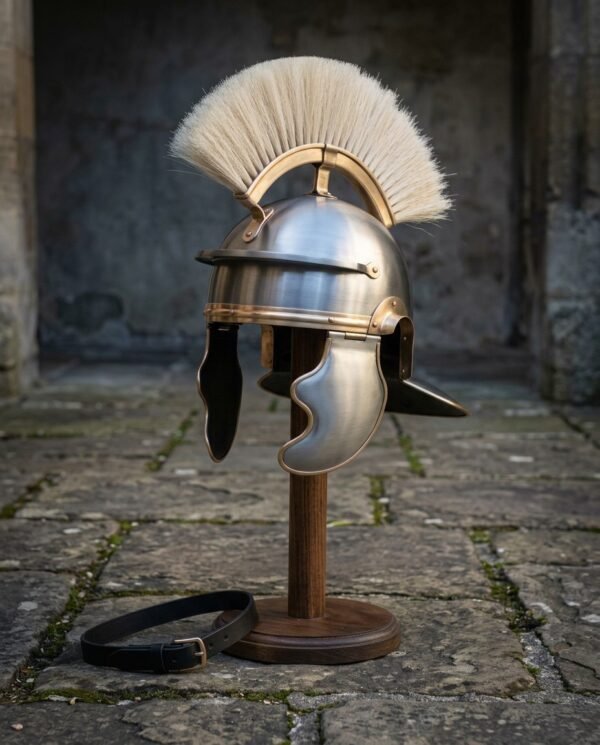
The crest holder on the crown is a working fitting sized for a standard crest box, transverse or fore and aft. A crest is not included in this listing. Contact us before ordering if you want one made to match.
Is it safe for full contact reenactment?
No. At 18 gauge this is display and light reenactment weight. Full contact steel combat generally requires 14 gauge or heavier for the head. Use it for parades, static displays, drill, film and photography.
How should it sit on my head?
Low, with the brow reinforce at about eyebrow level and the cheek guards closing naturally onto the jaw. If it perches high on the crown it is too small, and if it drops over your eyes it is too large. Measure and tell us your number rather than guessing.
How long before it ships?
One to two weeks of processing, because each helmet is raised, engraved and fitted to order. Engraving adds a few days. Shipping inside the United States is free and returns are accepted within seven days.
What is in the box
- One Roman legionary helmet in 18 gauge steel with bronze tone trim
- Two hinged cheek guards, engraved with the meander pattern, with leather chin ties fitted
- Padded liner installed inside the bowl
- Crest holder fitted to the crown, crest not included
- Care card covering oiling, patina and storage
- Forged and finished in the Czech Republic
Explore the range
The rest of the classical head gear is in Roman and Greek helmets, the boards are in Roman and Greek shields, the medieval helms are in medieval helmets, and the plate is in plate armor. Sizing, gauges and finishes are covered in the guides.
Other pieces in this group
Another in the same line is the Eaglemarch Greek helmet. Next along the rack is the Legionplume Greek helmet. For a straight comparison, see the Eaglecrest Greek helmet.
The Hornreave Viking helmet covers the other half of the same kit. Nothing here exactly right, build one to your own spec on the design your own page.

Incredible craftsmanship on this one. Padding and straps make it comfortable to wear for hours. If you’re on the fence just get it. You won’t regret it.
This helmet fell a little short for me. Some of the rivets were a little uneven. Just an average purchase. Wouldn’t rush to buy again.
It’s okay. Not great not bad. Wouldn’t say no to it but wouldn’t rave about it either. It’s Czech made and US shipped. Packaging was just okay though.