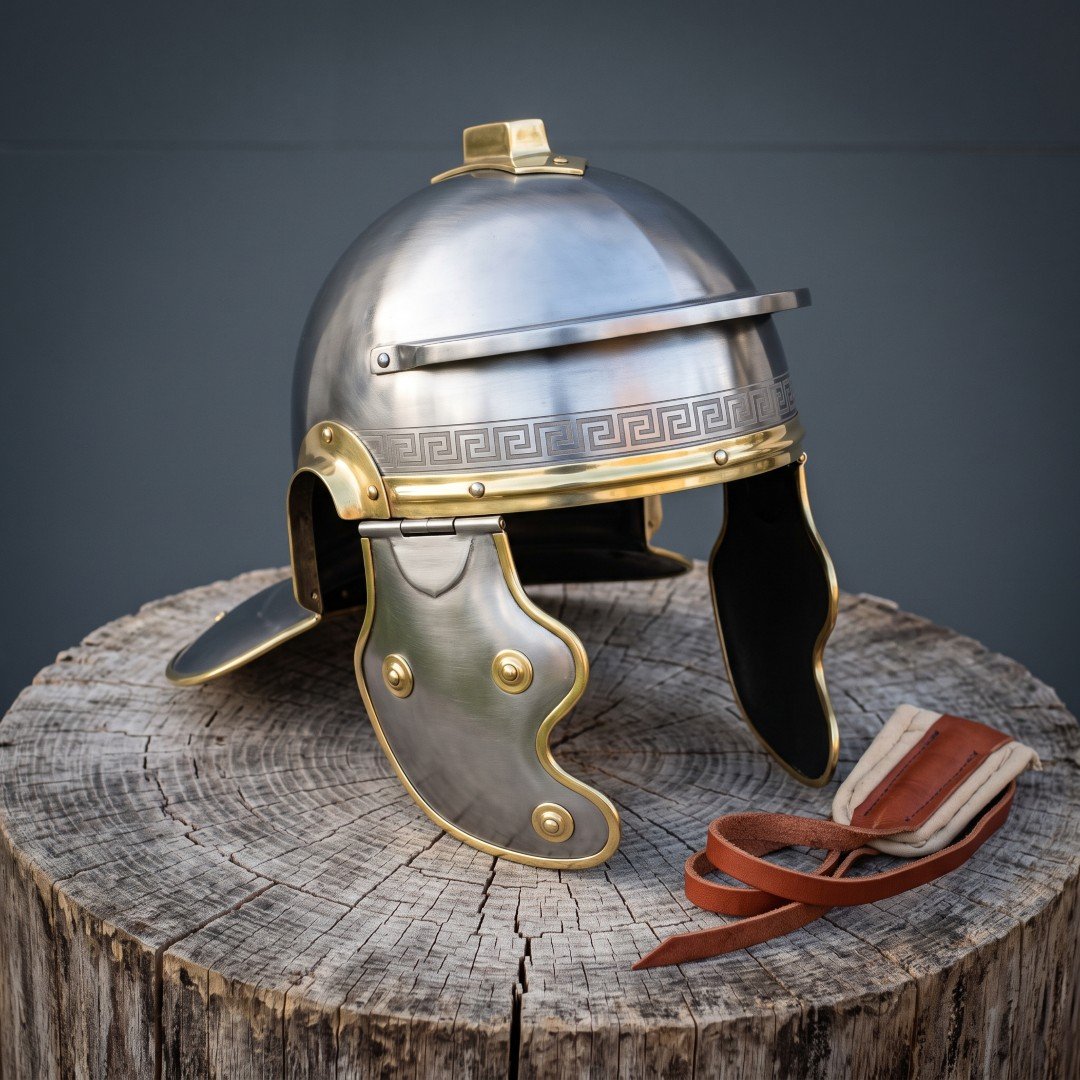
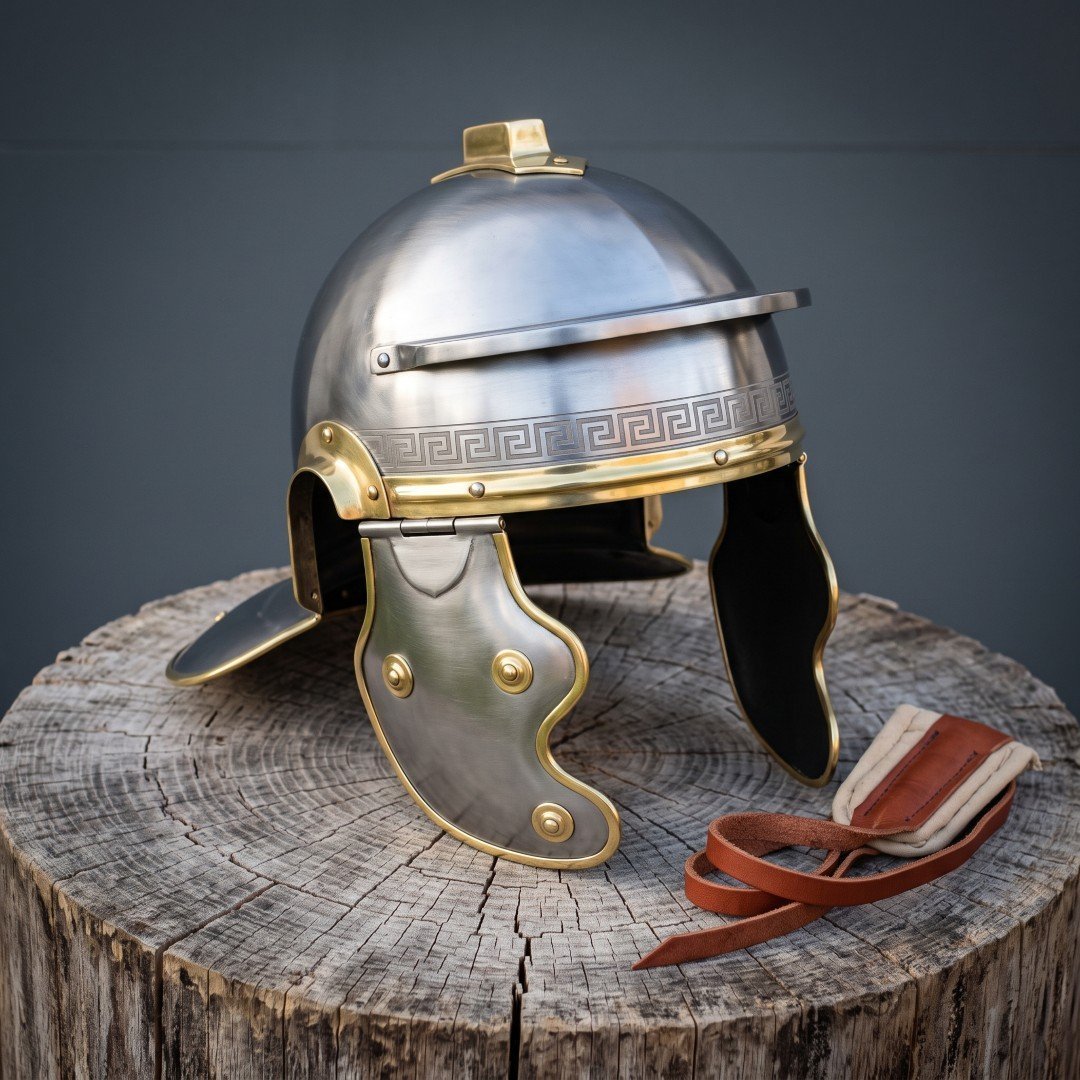
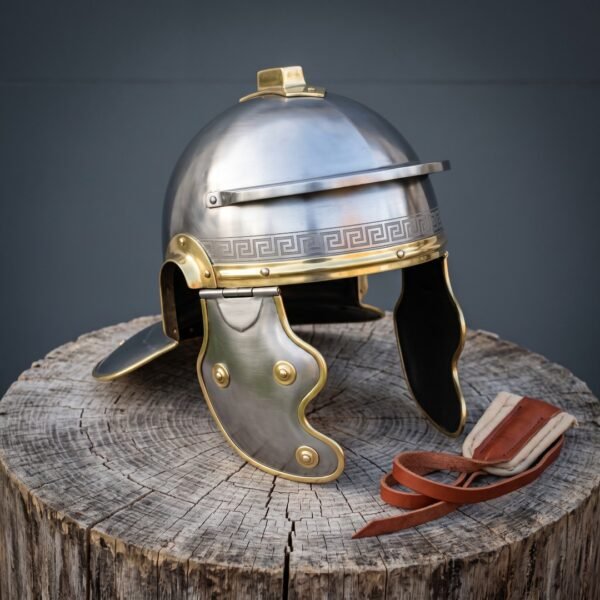
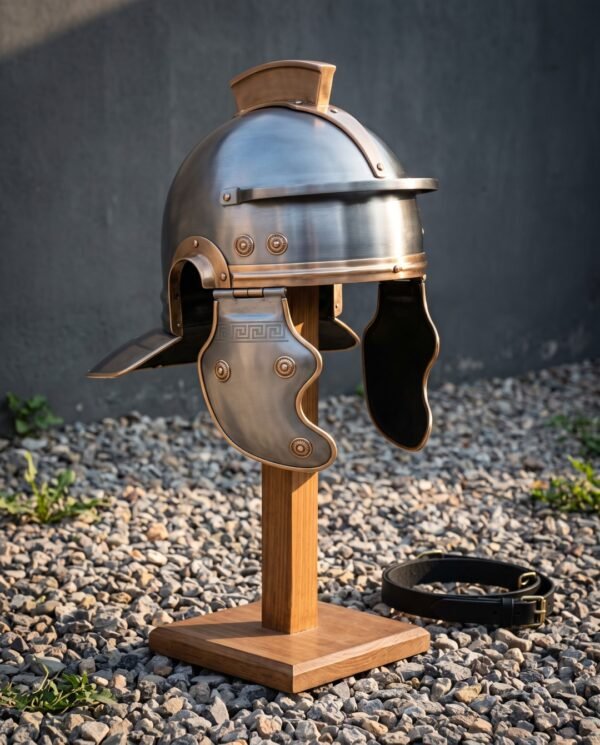
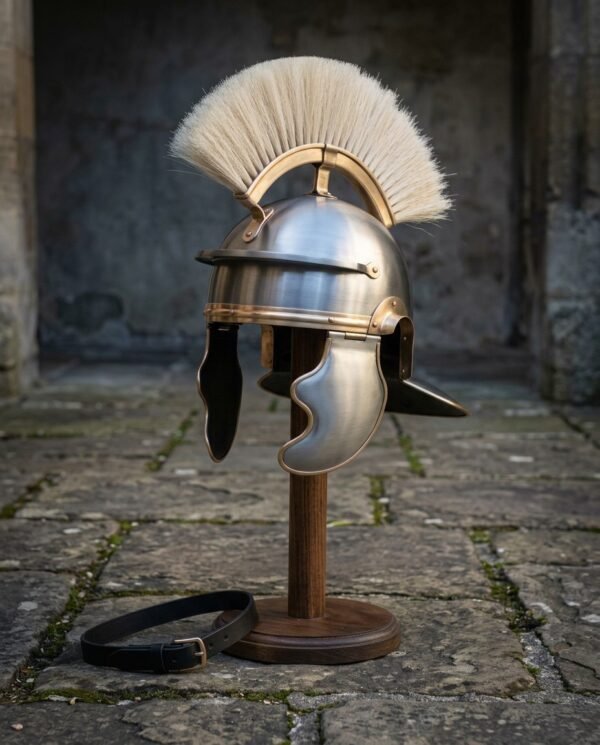
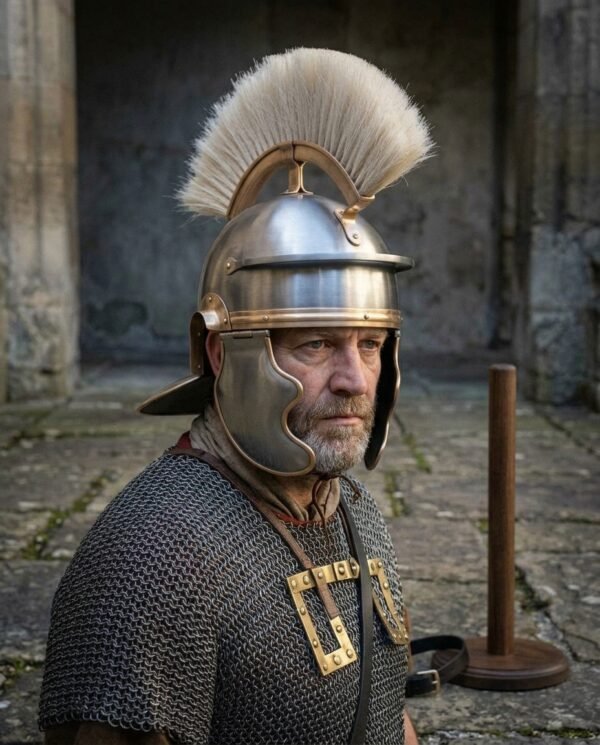
This is a Roman legionary helmet of the Imperial Gallic pattern, raised from steel sheet, trimmed in brass and finished with an engraved meander band around the brow, hinged cheek guards and a crest holder on the crown. The type is named for where it was made rather than who wore it. Roman armourers working in Gaul from the middle of the first century BC produced a distinct family of helmets, and the naming system that separates Imperial Gallic from Imperial Italic comes from H. Russell Robinson, whose 1975 study The Armour of Imperial Rome is still the reference every reenactor and museum reaches for. The tell is the brow. Gallic helmets carry embossed eyebrow shapes above the face opening, a piece of decoration that Celtic smiths brought with them into Roman military production.
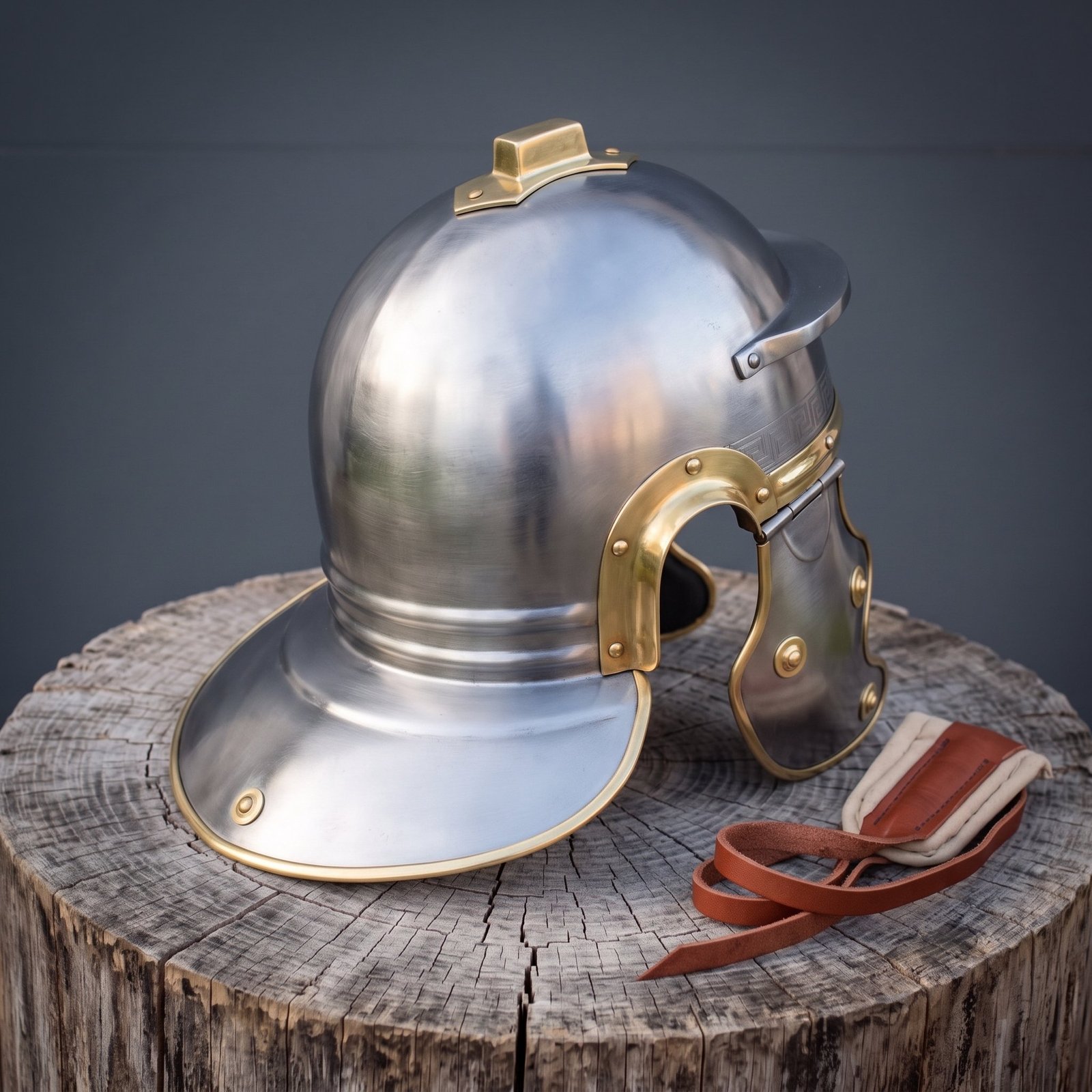
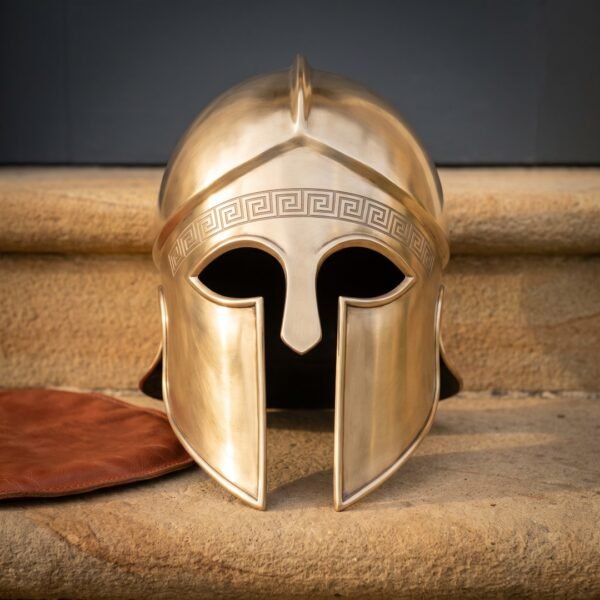
Every functional part of this helmet exists for a reason. The broad neck guard sweeps down and back to cover the gap between helmet and shoulder. The brow reinforce takes a downward cut before it reaches the face. The cheek guards hinge so a soldier can get the helmet on and off quickly and tie them under the chin when it matters. It is cut, raised and assembled by hand in the Czech Republic, and it ships with the cheek guards hinged and a padded liner fitted inside the bowl. The leather straps and the rolled linen cap shown beside the helmet in the photograph are studio props and are not included, and the tree stump is not either. Roman and Greek kit sat alongside mail and plate in the same centuries, compared in chainmail versus plate versus lamellar.
Specifications
| Material | Mild steel bowl, neck guard and cheek guards, brass edging, brass ear guards, brass bosses and brass crest holder |
|---|
| Gauge | 18 gauge, approximately 1.2 mm |
|---|
| Finish | Brushed satin steel, polished brass trim, engraved meander cut into the steel around the brow above the brass rim |
|---|
| Brow | Riveted steel brow reinforce bar across the front |
|---|
| Neck guard | Wide steel neck flare with raised ribs at the nape and a brass edge |
|---|
| Cheek guards | Steel, edged in brass with domed brass bosses, on steel hinges |
|---|
| Crest holder | Brass crest holder on the crown |
|---|
| Size or fit | Made to a stated head circumference, standard build fits roughly 22 to 23 inches |
|---|
| Weight | Approximately 4 lb 4 oz complete with cheek guards |
|---|
| Lining | Padded liner fitted inside the bowl, leather chin ties on the cheek guards |
|---|
| Intended use | Display, living history, film and photography, light reenactment. Not full contact combat rated |
|---|
| SKU | RK-1571 |
|---|
Why a legionary helmet has that huge neck flare
Look at the back of this helmet and the first thing you notice is the neck guard, a wide plate angled down and away from the skull. It looks exaggerated until you understand what it is defending. A Roman soldier in the line fought behind a large shield with his head low, and the vulnerable line was the back of the neck, where a downward cut from a taller opponent or from a man on the flank could reach him. The flare covers that line without touching the shoulders, which matters because a neck guard that rests on the shoulder stops the head turning. The angle is doing two jobs at once: it puts steel over the neck, and it holds that steel away from the body so the wearer keeps the ability to look left and right.
The brow reinforce, the raised band across the front, is the second piece of quiet engineering. A helmet bowl is thinnest where it has been stretched the most, and that is the front. Riveting a heavier strip across the brow puts the strongest section exactly where a descending cut lands, and it stops the face opening from deforming inward if the helmet takes a blow. The cheek guards hinge from that same band. They swing out for the head to go in, then fold back against the jaw and tie together under the chin so the helmet cannot rotate on the head.
Steel, brass and the meander band
The bowl and plates are 18 gauge mild steel, roughly 1.2 mm, brushed to a satin finish rather than mirror polished, which is closer to how a serving helmet would have looked and which does not show every fingerprint. That gauge is display and light reenactment weight. It holds its shape, takes handling and travels well, and it is comfortable to wear for hours. It is not full contact combat plate. Groups running steel on steel bouts generally require 14 gauge or heavier for the head, and this helmet is not built to that standard.
The trim is brass, and the contrast between yellow brass and grey steel is the single most Roman thing about the piece. Original helmets used brass and bronze fittings on iron bowls in exactly this way, and finds from sites along the Rhine show decorative bosses and edging very close to what is on this one. The meander band, the interlocking key pattern engraved around the brow, is a Greek motif the Romans adopted wholesale and used on everything from mosaic borders to military kit. It is engraved into the steel just above the brass rim rather than stamped, so the line has depth and catches the light from an angle.
Engraving, runes and your own design
Use the rune converter on this page to turn a name, a date or a short phrase into Elder Futhark and we will cut it into the steel or the leather. If you would rather have a Viking pattern than a rune line, choose your own design in the engraving option above the add to cart button and tell us where it goes. Where a piece already carries an engraved design, your chosen engraving replaces it rather than sitting alongside it. On this helmet that means the meander band around the brow is the natural spot, and a name, a unit number or a Latin line will replace the key pattern there. See the engraving page for placement options.
Fit and sizing
The helmet is built to a stated head size, so measure before ordering. Take a soft tape around your head a finger width above the eyebrows and around the widest point at the back and give us that figure. The standard build fits roughly 22 to 23 inches with the liner in. A Roman helmet sits lower on the head than most medieval helms because the brow reinforce needs to be at eyebrow level for the cheek guards to close properly around the jaw, so an over generous size will slide down over your eyes rather than perching comfortably. If you fall between sizes, order the larger and we will pack the liner out.
The cheek guards tie under the chin with leather thongs. Getting that tie right is what stops the helmet moving. Snug enough that the helmet turns with your head, loose enough that you can open your mouth to shout, is the standard a reenactor aims for.
Care
Steel and brass want different things. The steel needs a thin film of light oil two or three times a year and a wipe down after any damp event, because bare steel will freckle with rust if it is left wet. The brass will slowly darken to a warm brown patina, which many owners prefer and which is closer to how a used helmet looked. If you want it bright, a soft cloth and a little brass polish will bring it back, but keep the polish off the steel. Store the helmet on a stand or a shelf rather than sealed in a plastic tub, since trapped condensation is what ruins armour in storage. Our full guidance on oils, rust and long term care for hand forged steel is on the steel care page. Care is the same as for any steel armour, covered in caring for chainmail and steel armour.
Made in the Czech Republic
This piece is made by hand in the Czech Republic, in a workshop that still works the old way. The steel is forged, ground, heat treated and finished by smiths who learned the trade from the people before them, and the wood, horn and leather are cut and fitted by hand rather than pressed out on a line. That is also why no two pieces come out exactly the same.
Ransack Viking is a United States company. We import these pieces ourselves, check every one when it lands and ship from our warehouse in Chicago, Illinois. Engraving is done here in the United States after the piece arrives, so your runes or your own design go on before it leaves for you.
A note on handmade variation
This helmet is hand made, not machine made and not bulk produced, so what arrives will not be a pixel for pixel copy of the photograph. The raising marks across the bowl, the exact tone of the satin finish, the depth of the engraved key pattern and the precise seating of the brass bosses vary because each one is worked by hand. The dimensions, the material and the build are the same every time. The character is not, and that is the difference between a hand raised helmet and a pressed one.
Frequently asked questions
Is this an accurate Roman helmet?
It follows the Imperial Gallic pattern closely in shape, in the neck flare, in the brow reinforce and in the hinged cheek guards, and the brass on steel construction matches the originals. It is a working interpretation for display and living history rather than a museum grade replica of one specific excavated find.
Can I wear it for full contact reenactment?
No. At 18 gauge it is display and light reenactment weight. Full contact groups usually require 14 gauge or heavier for head protection. This helmet is right for parades, displays, static living history, film and photography and non contact drill.
Will the brass tarnish?
Yes, and that is normal. Brass darkens to a warm brown over months of handling. Some owners polish it back to yellow, others let it go and prefer the aged look. Neither harms the helmet.
Does the crest holder take a real crest?
The holder on the crown is a functioning fitting sized for a standard transverse or fore and aft crest box. A crest is not included with this listing. If you want one made to match, contact us before ordering.
How do I measure for it?
Wrap a soft tape around your head a finger width above the eyebrows and around the widest part at the back, then send us that number. Tell us as well if you intend to wear any padding beneath it, since a Roman helmet is meant to sit low and does not have much spare room inside.
How long does it take to ship?
Processing takes one to two weeks because each helmet is raised and fitted to order. Engraving adds a few days. Shipping within the United States is free and returns are accepted within seven days.
What is in the box
- One Imperial Gallic pattern Roman helmet in 18 gauge steel with brass trim
- Two hinged cheek guards with brass edging, bosses and leather chin ties, fitted
- Padded liner installed inside the bowl
- Engraved meander band around the brow, or your own engraving in its place
- Care card covering oiling, brass patina and storage
- Forged and finished in the Czech Republic
Explore the range
The rest of the classical head gear is in Roman and Greek helmets, the round and dished boards are in Roman and Greek shields, the medieval helms are in medieval helmets, and the custom cut work is in engraved and personalised. Sizing, gauges and finish notes are collected in the guides.
Other pieces in this group
In the same category sits the Coppercrest Greek helmet. A near match for this one is the Bronzecrest Greek helmet. Closest to this in the range is the Arenaward Greek helmet.
Fitting out further, the Browhold Viking helmet belongs with it. Nothing here exactly right, build one to your own spec on the design your own page.



Feels way more premium than the price suggests. Rivets and trim are all solid. Nothing feels flimsy. Will definitely order again for another gift.
Absolutely blown away by this helmet. This shop clearly takes pride in their work.
Does the job but I wasn’t blown away. Neutral on this one overall.