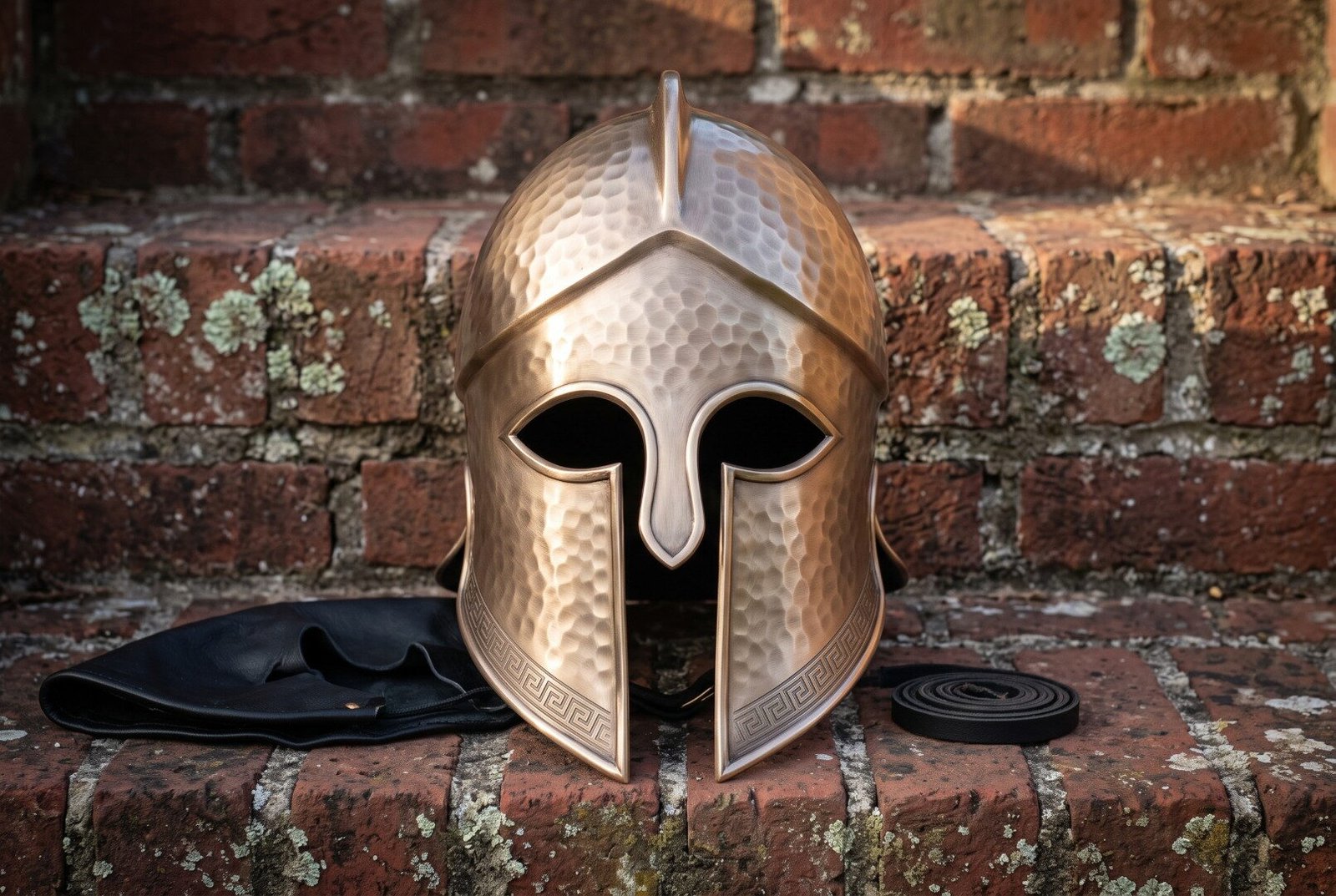
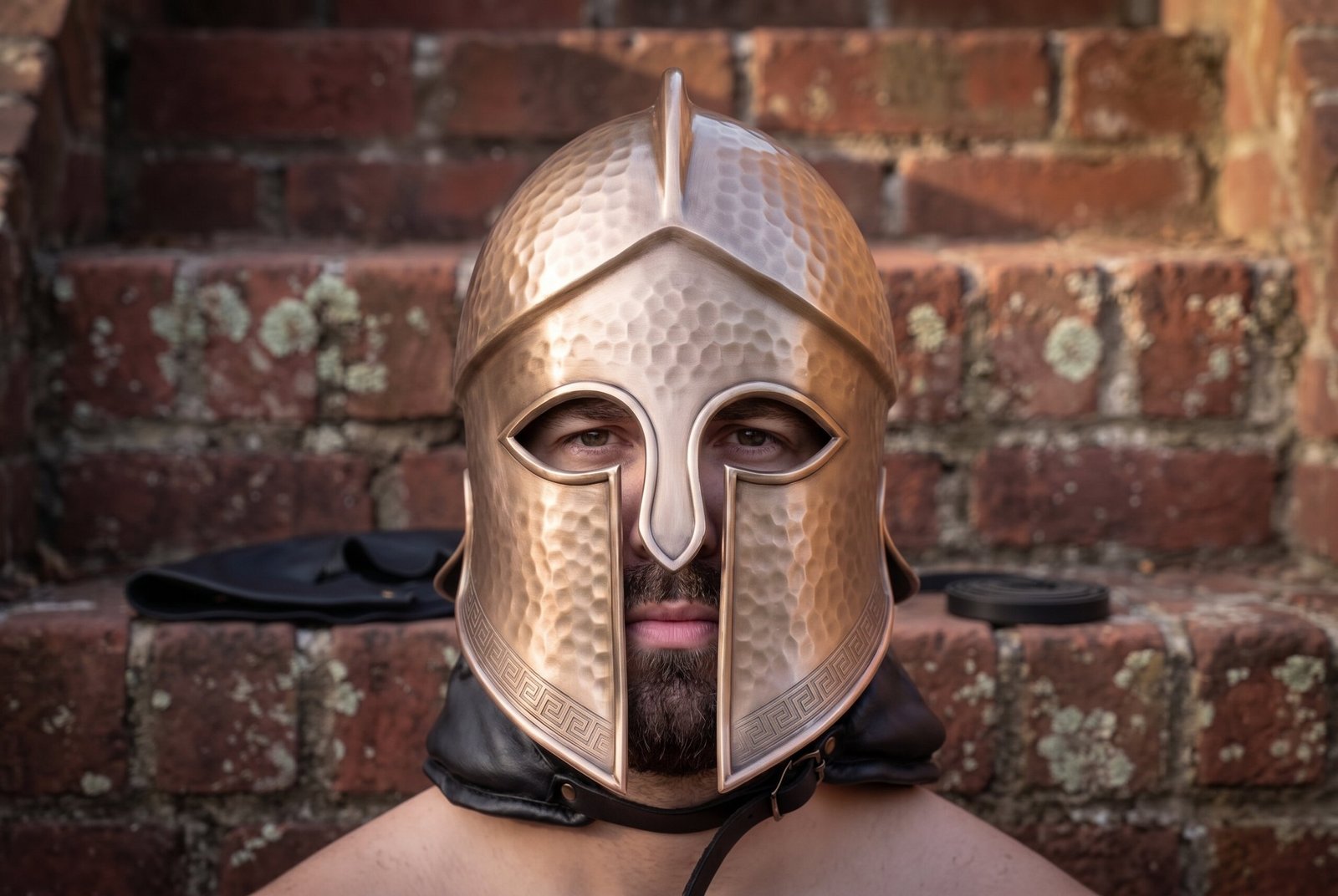
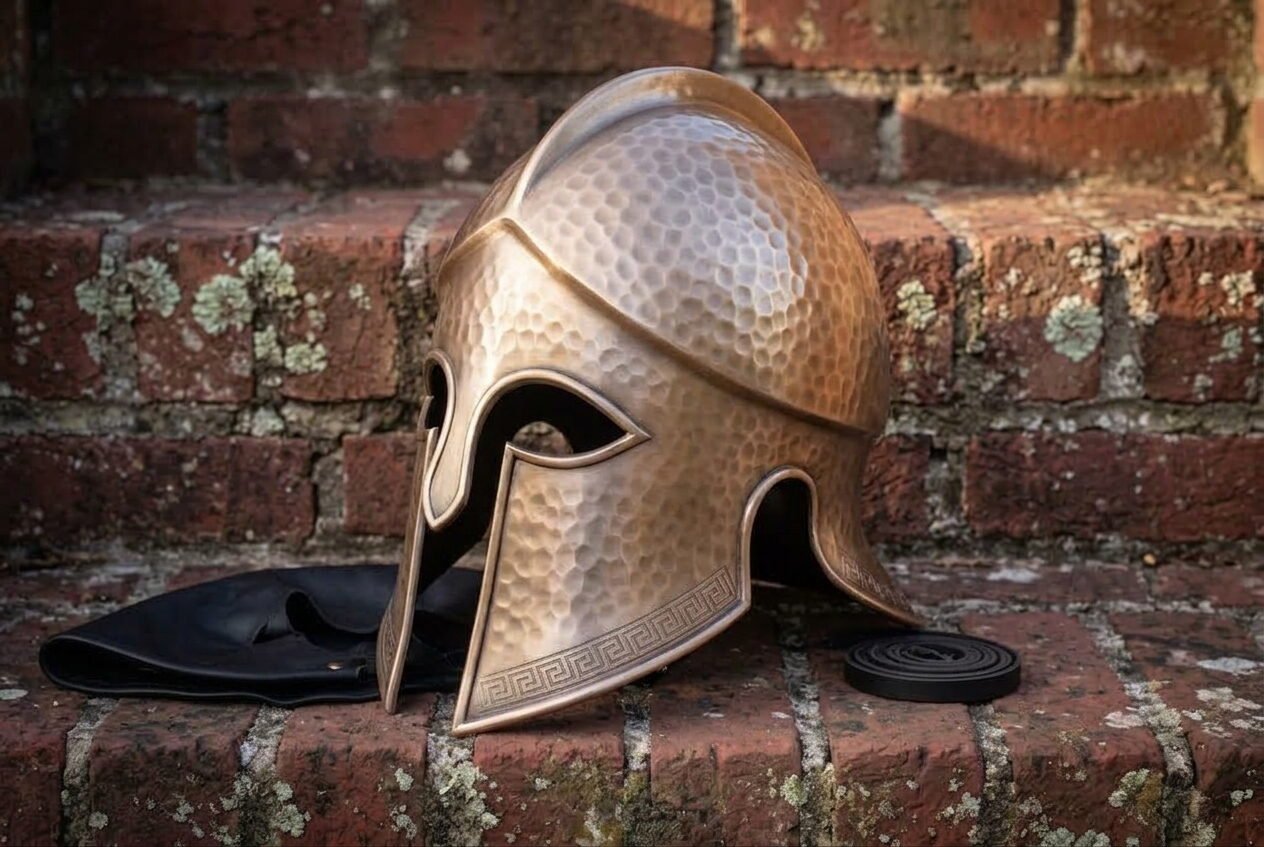
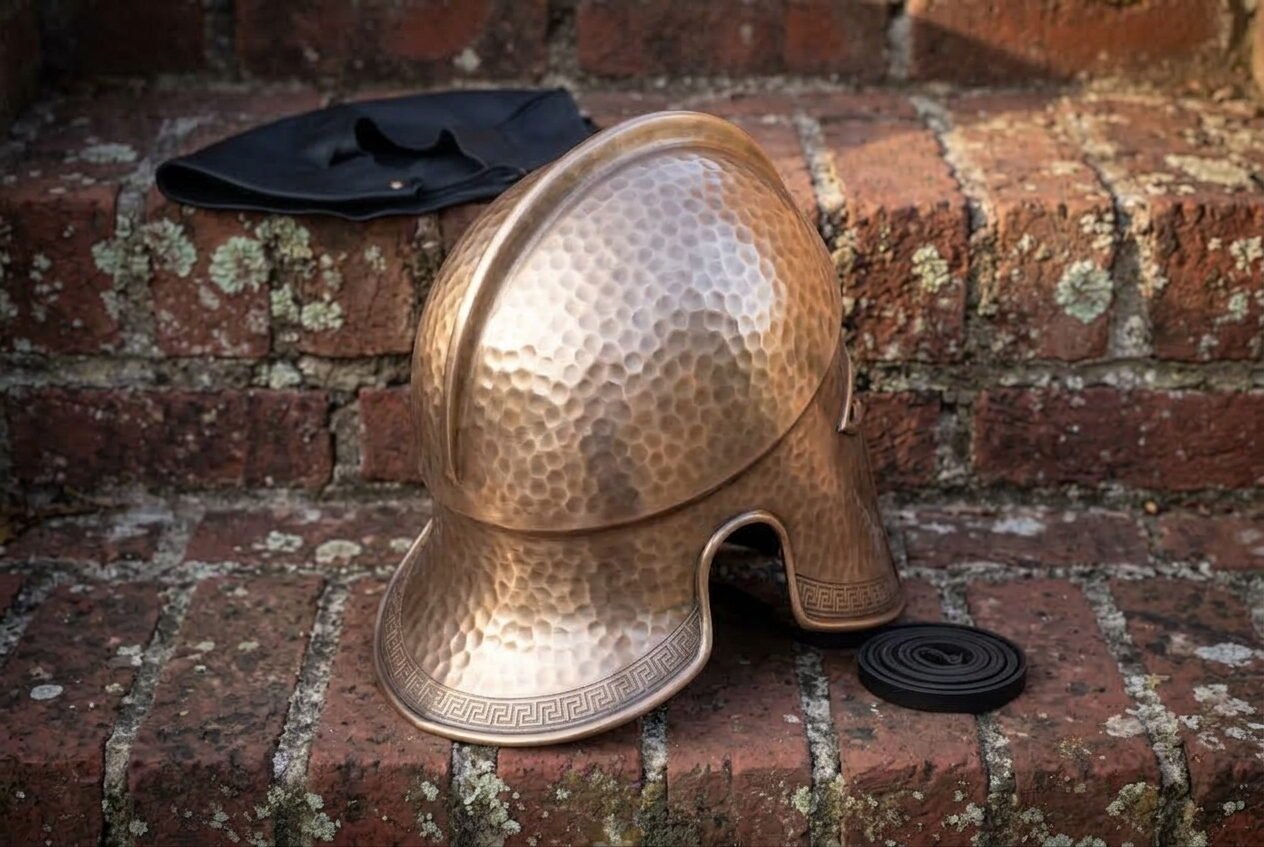
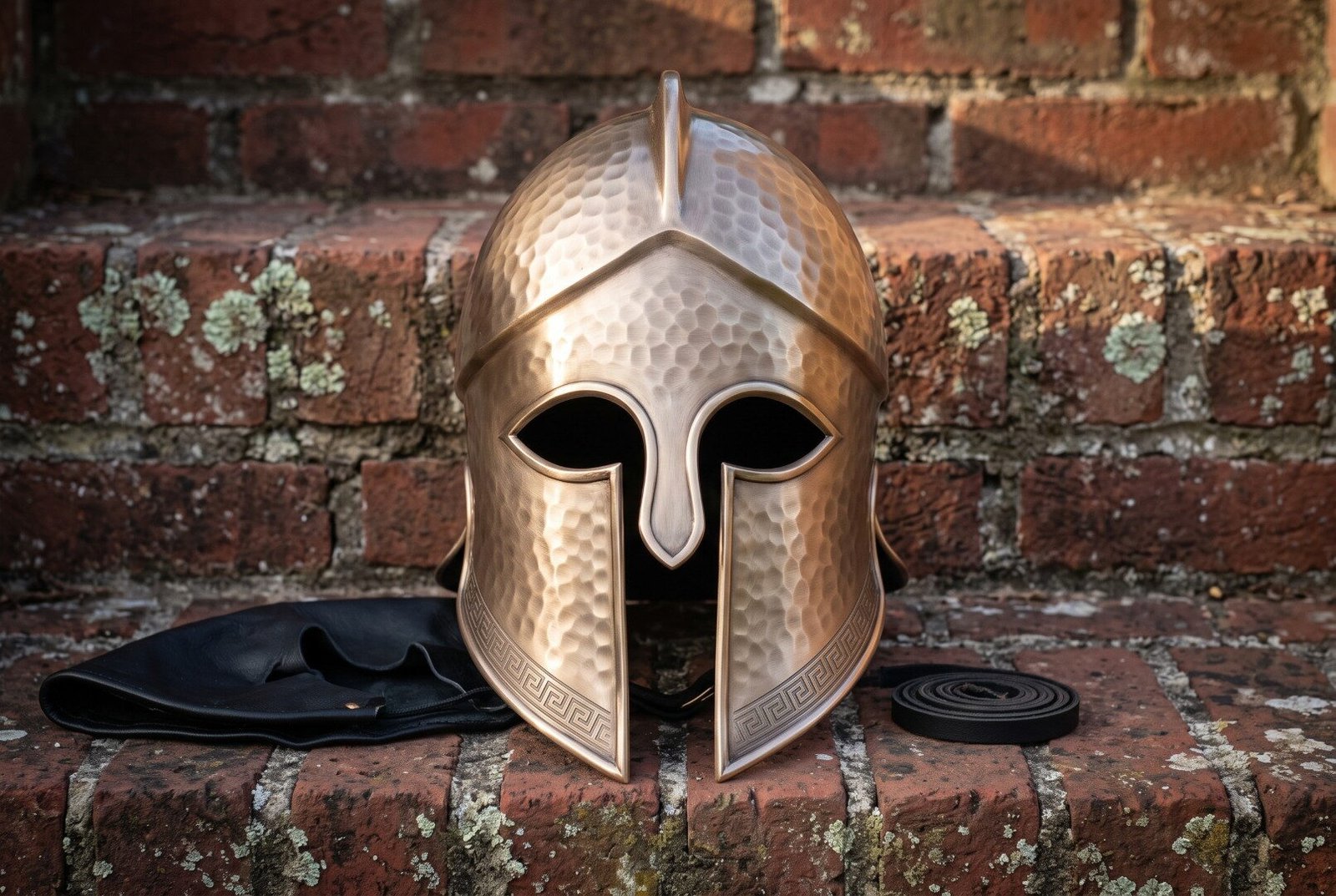
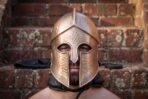
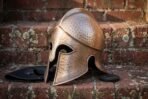
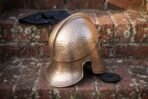
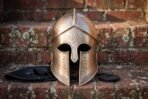
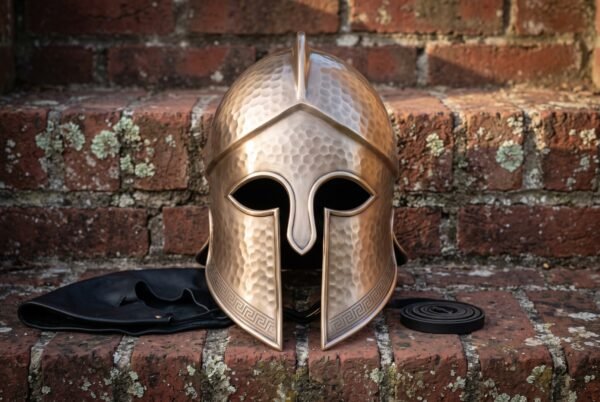
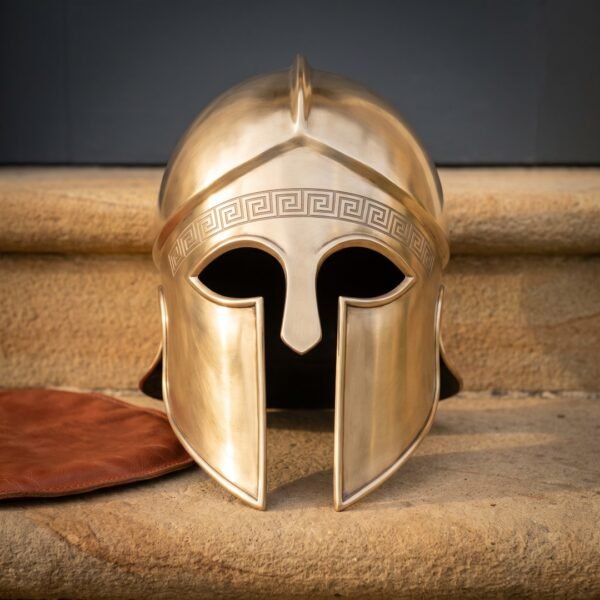
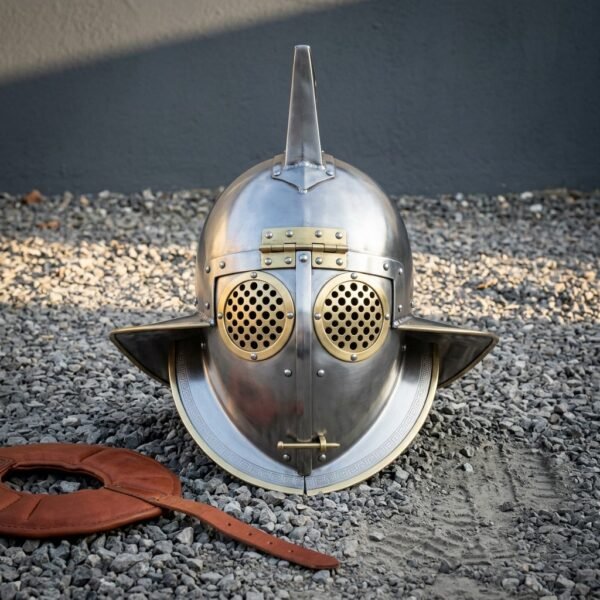
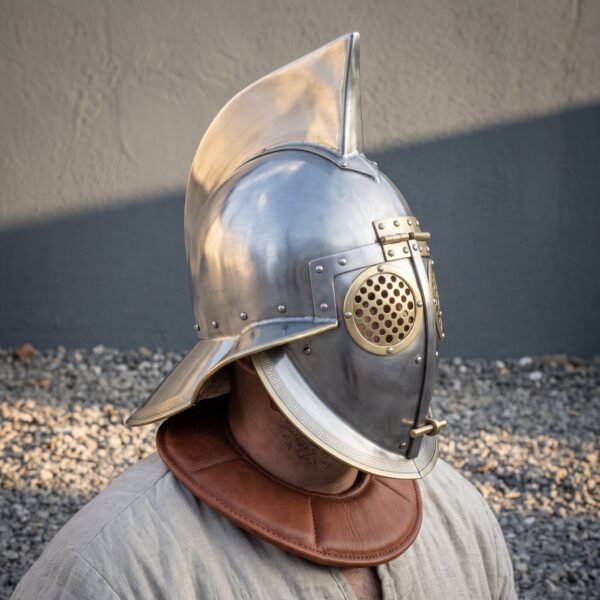
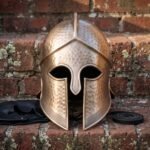
The Corinthian helmet is the shape almost everyone pictures when they think of a Greek hoplite. It is a single bowl drawn down over the whole face, with a narrow nose guard left standing between two long almond eye openings and cheek pieces that flare out under the jaw. This one follows that outline closely. The bowl and cheek pieces carry a hand raised hammer texture, a low crest rail runs front to back along the centre line where a horsehair crest would have been mounted on an original, and a Greek key border is cut around the lower edge on both cheeks.
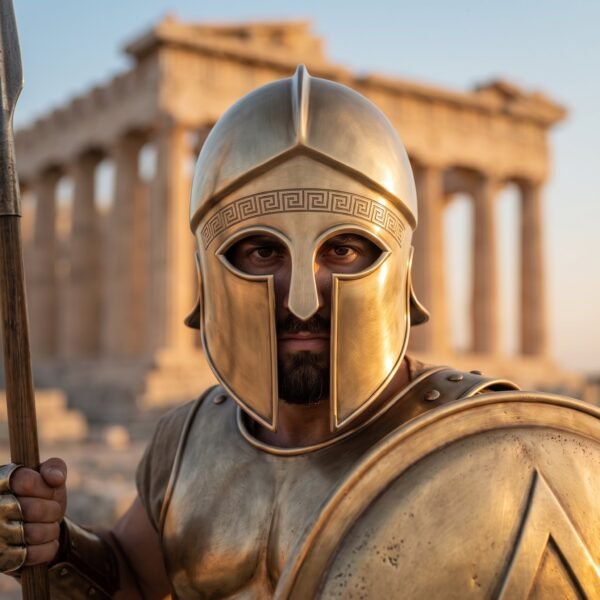
One thing that surprises most buyers is how these helmets were actually worn. Surviving examples from the sixth and fifth centuries BC, and a great many vase paintings and grave sculptures, show hoplites wearing the helmet tipped back on the crown of the head with the face wide open whenever they were not in contact. The flared neck acts as a counterweight and the helmet sits stably in that position, which is how a man could stand in formation for an hour and still hear an order. It is forged and finished here in the Czech Republic, and it ships in a padded box with a soft cloth for the finish and a care card. Roman and Greek kit sat alongside mail and plate in the same centuries, compared in chainmail versus plate versus lamellar.
Specifications
| Material | Mild steel, hand raised and planished |
|---|
| Gauge | 18 gauge, display and light reenactment weight |
|---|
| Profile | Corinthian, single piece bowl with nose guard, almond eye openings and flared cheek pieces |
|---|
| Finish | Warm bronze tone over steel, hand planished hammer texture across the bowl and cheek pieces |
|---|
| Decoration | Engraved Greek key border on both cheeks, raised crest rail along the centre line |
|---|
| Size or fit | Standard adult, roughly 23 to 24 inch head circumference |
|---|
| Weight | Approximately 4 lb 8 oz |
|---|
| Lining | Unlined as standard, intended to be worn over a padded cap |
|---|
| Fittings | No chin strap, the cheek pieces and neck flare hold the helmet |
|---|
| SKU | RK-1550 |
|---|
What the Corinthian profile actually does
The Corinthian is one of the few helmet designs in history that covers the entire face without a hinge or a moving visor. Everything is worked out of one shape. That is the whole point of it. A helmet made from separate plates has seams, and a seam under a spear point is a weak line. By drawing the bowl down over the face in one continuous surface, the Greek armourer removed the seams from the front of the head entirely.
The nose guard is doing more than protecting the nose. It ties the two eye openings together and stops the front of the bowl from flexing inward when it takes a blow, in the same way a spine down the middle of a panel stiffens it. Take the nose guard away and the two eye slots become one wide hole, and the whole face of the helmet becomes soft. The cheek pieces flare outward rather than sitting flat because a flared edge sheds a glancing hit sideways instead of catching it.
The cost of all that coverage is hearing and peripheral vision, and the Greeks knew it. That is exactly why the helmet was worn pushed back until the moment the lines closed. In a phalanx you do not need to see sideways. You need the man on your right to keep his shield where it should be, and you need your own face covered.
Steel, gauge and the bronze finish
Originals were beaten from bronze sheet. This one is raised in mild steel and finished in a warm bronze tone, which gives the colour and the depth of an ancient helmet with steel behind it. The steel is 18 gauge, roughly 1.2 mm. That is the standard display and light reenactment weight across the trade. It holds its shape on a stand, it takes the hammer texture cleanly, and it will stand up to being worn and handled at an event.
Be clear about what 18 gauge is not. It is not full contact armour. A helmet intended to absorb repeated steel on steel blows in a combat league is built in 14 or 16 gauge with a proper suspension liner, and it is heavier and thicker than this. If you are buying for a fighting group that tests kit, ask them what gauge they require before you order. If you are buying for display, for a costume, for a photo shoot, or for light reenactment where nobody is swinging at your head, this is the right weight and it will look far better than a thicker helmet.
The hammer texture across the crown is not stamped. It is planished in, which is why the pattern wanders and the highlights break up unevenly across the dome rather than repeating.
Engraving, runes and your own design
Use the rune converter on this page to turn a name, a date or a short phrase into Elder Futhark and we will cut it into the steel or the leather. If you would rather have a Viking pattern than a rune line, choose your own design in the engraving option above the add to cart button and tell us where it goes. Where a piece already carries an engraved design, your chosen engraving replaces it rather than sitting alongside it. On this helmet the natural place is the band above the Greek key border, or the neck flare at the back. Read more on the engraving page.
Fit and sizing
This is made to one standard adult size, which suits a head of roughly 23 to 24 inches in circumference measured around the brow. Measure with a soft tape just above your eyebrows and around the widest part of the back of your skull before you order. A Corinthian sits differently from a modern hat because it has to pass over the ears and the cheekbones on the way down, so a head that is unusually wide across the cheeks can find it tight even when the circumference is right.
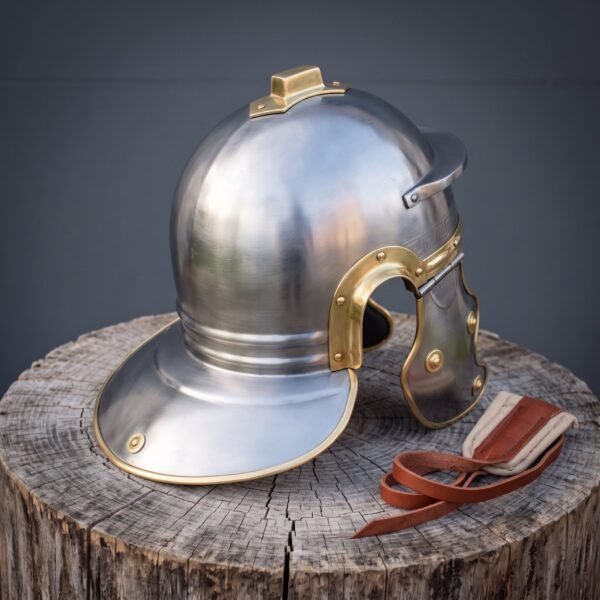
Wear it over a padded cap. The helmet is supplied unlined so that you can choose your own padding thickness, and the padding is what makes the difference between a helmet that rocks around and one that sits still. A quarter inch of padding front and back changes the fit noticeably. The black cloth cap and the coiled black strap shown in the photograph are studio props and are not included.
Care
Wipe the helmet down with a dry cloth after handling, because fingerprints will sit under a bronze tone finish and slowly etch it. Once a month, or after any event where it got damp, put a thin film of light machine oil or a purpose made metal wax on the outside and the inside of the bowl and buff it back. Store it on a stand or upside down on a shelf rather than face down on its cheek edges, which is where the metal is thinnest. Do not put it away wet and do not wrap it in a plastic bag, which traps moisture against the steel. Our general notes on protecting a finish are on the steel care page and apply to a helmet just as well as to a blade. Care is the same as for any steel armour, covered in caring for chainmail and steel armour.
Made in the Czech Republic
This piece is made by hand in the Czech Republic, in a workshop that still works the old way. The steel is forged, ground, heat treated and finished by smiths who learned the trade from the people before them, and the wood, horn and leather are cut and fitted by hand rather than pressed out on a line. That is also why no two pieces come out exactly the same.
Ransack Viking is a United States company. We import these pieces ourselves, check every one when it lands and ship from our warehouse in Chicago, Illinois. Engraving is done here in the United States after the piece arrives, so your runes or your own design go on before it leaves for you.
A note on handmade variation
This is hand made, not machine made or bulk produced. What arrives will not be a pixel for pixel copy of the photograph. The hammer texture across the crown falls differently on every helmet, the bronze tone sits slightly lighter or deeper depending on how the steel took the finish, and the exact curve of the cheek pieces varies by a fraction because they are worked by eye over a stake. The dimensions, the material and the build are the same every time. The character is not, and that is the point of buying something a person actually made.
Frequently asked questions
Can I wear this for full contact reenactment?
No. At 18 gauge this is a display and light reenactment helmet. Combat leagues that permit head contact require heavier gauge steel and an approved suspension liner, and this helmet meets neither standard. Wear it for display, costume, photography and non contact events.
Is it really bronze?
No, and we would rather say so plainly. The helmet is raised in mild steel and given a warm bronze tone finish. It reads as bronze at any normal viewing distance and it is far tougher than a thin bronze reproduction, but the base metal is steel.
Will it fit over my ears?
It is designed to. The bowl passes over the ears as it comes down and the cheek pieces sit outside them. If you have a head circumference above about 24 inches or unusually prominent ears, measure first and contact us before ordering.
Does it come with a liner or a chin strap?
Neither. It is supplied unlined and without a strap so that you can pad it to your own head. A Corinthian is held by the grip of the bowl and the flare at the neck rather than by a strap, which is how the originals worked.
Will it rust?
The finish protects the steel, but steel is steel. If you leave it damp, in a garage, or under a plastic cover it can spot. Wipe it dry, oil or wax it every few weeks and it will stay clean for decades.
How long before it ships?
Processing is one to two weeks because each helmet is raised and finished to order. Shipping inside the United States is free. Returns are accepted within seven days.
What is in the box
- One Corinthian style Greek helmet in 18 gauge mild steel with a bronze tone finish
- Engraved Greek key border and hand planished crown
- Soft polishing cloth
- Care and warranty card
- Forged and finished in the Czech Republic
Explore the range
See the rest of the Roman and Greek helmets, the Roman and Greek shields that go with them, the plate armour, and the guides.
Other pieces in this group
For a straight comparison, see the Aegiscrest Greek helmet. Worth putting side by side with this is the Eaglecrest Greek helmet. In the same category sits the Legionplume Greek helmet.
From the same corner of the shop, there is the Cairnhelm Viking helmet. Nothing here exactly right, build one to your own spec on the design your own page.



It’s okay. Not great not bad. Ransack Viking is hit or miss it seems. This one landed in the middle.
My whole family was impressed when I unboxed it. Exactly the look I wanted for my collection. This will be a family heirloom for sure.
Did not expect this level of quality for the price. Ransack Viking is quickly becoming my go to shop for anything Norse themed. Beyond happy with how this turned out.