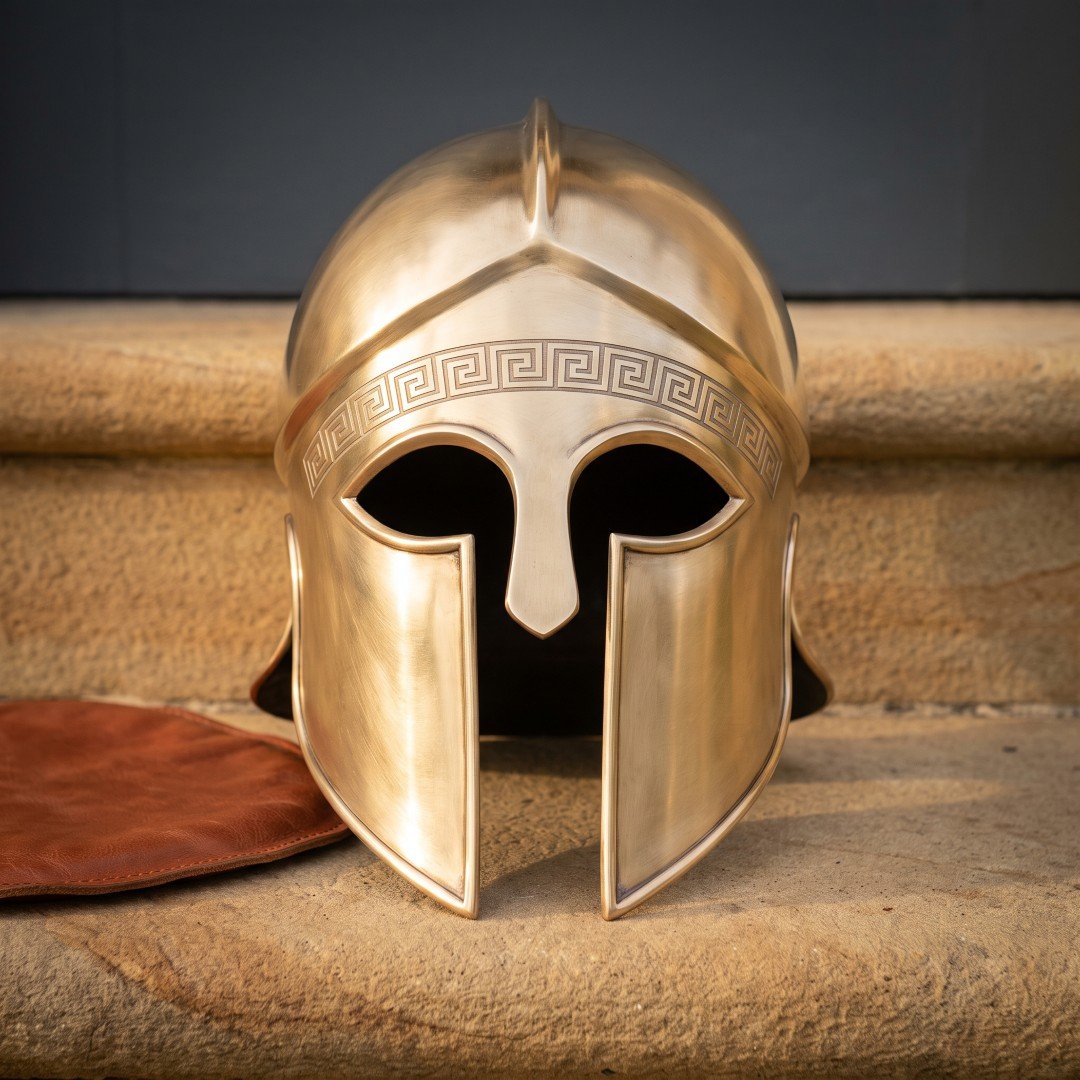
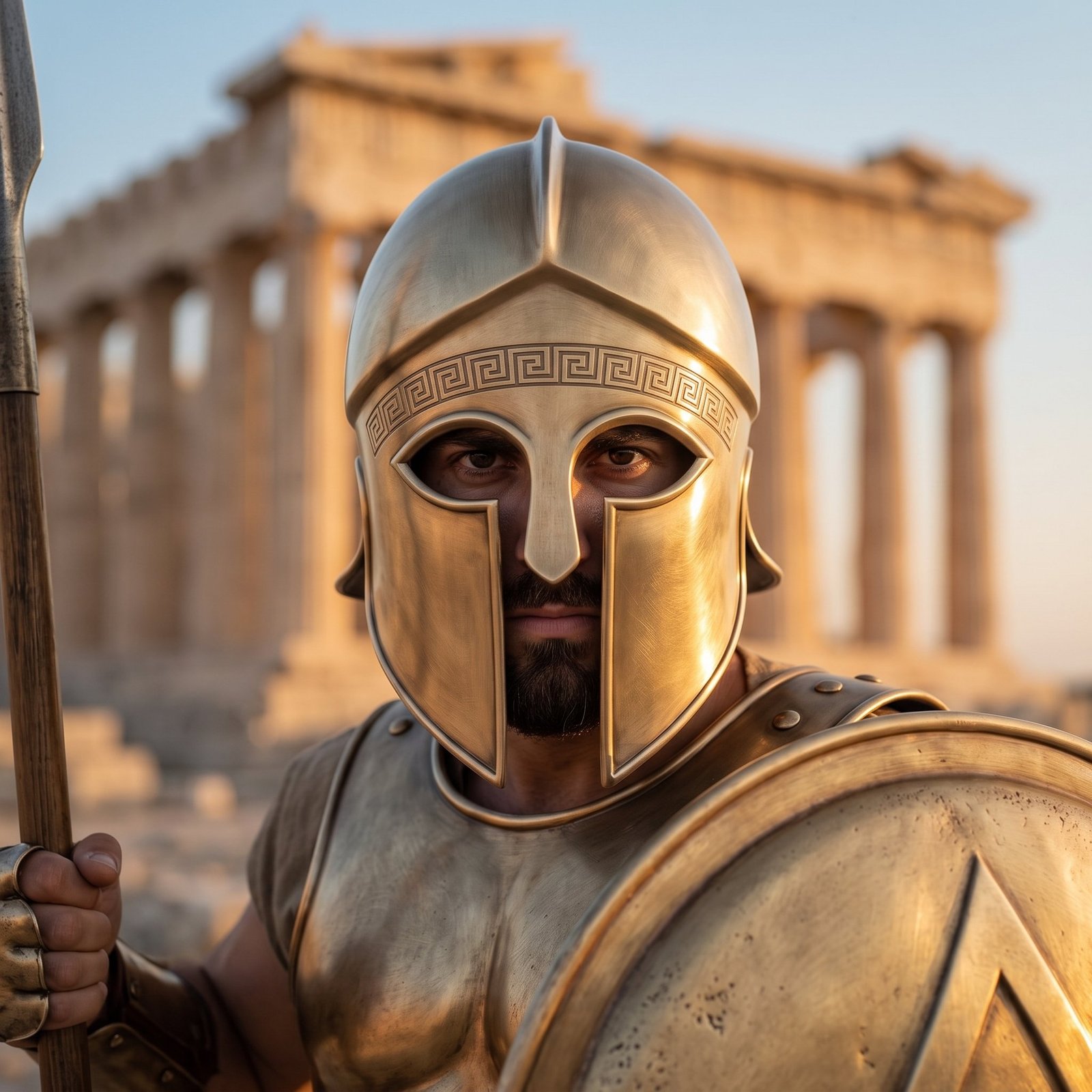
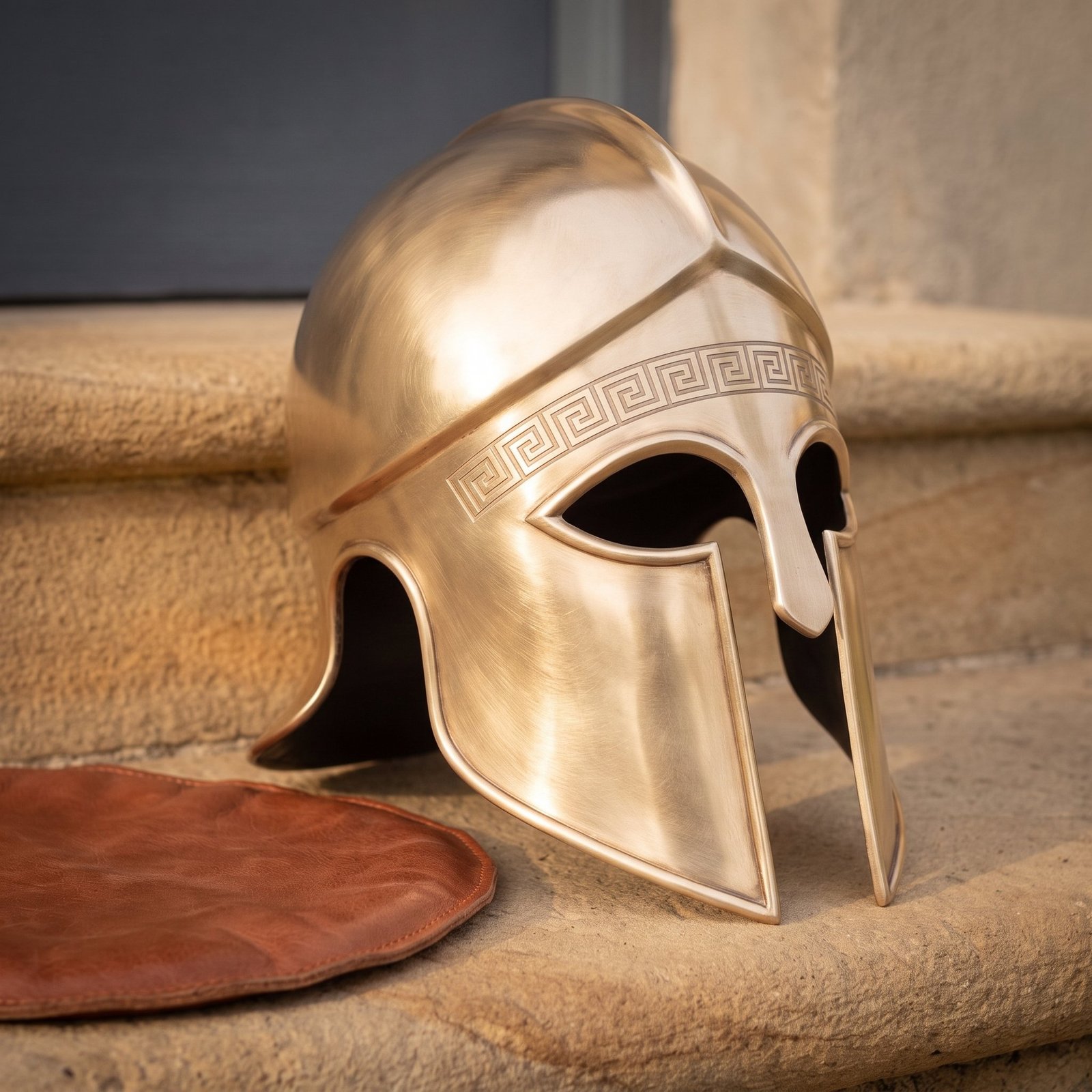
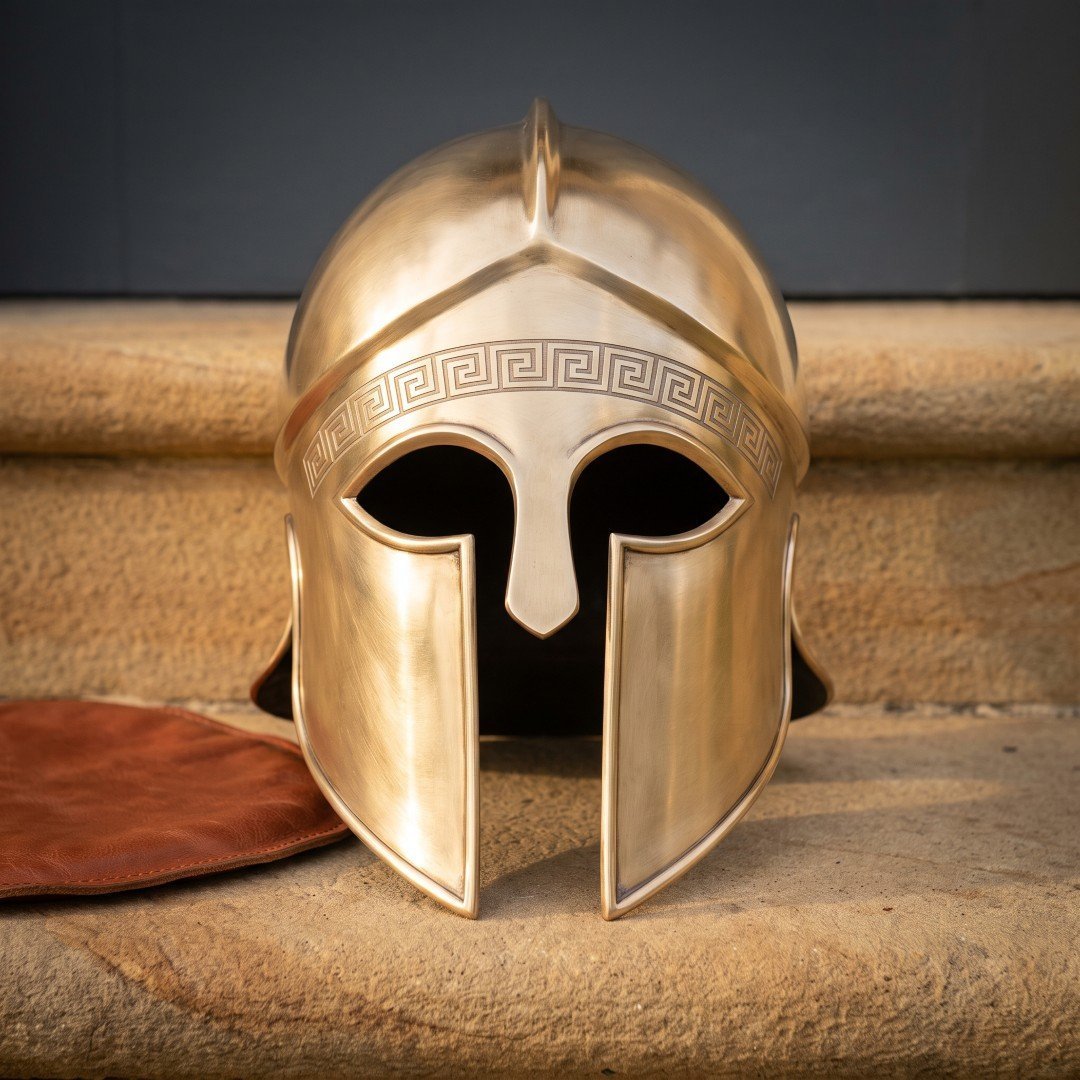
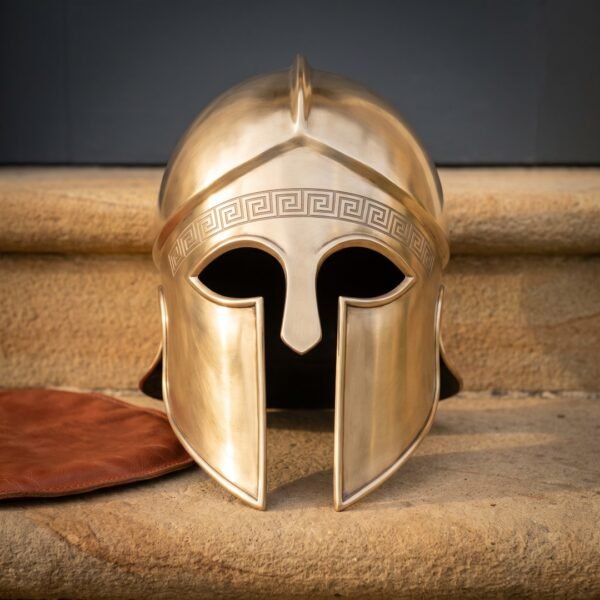
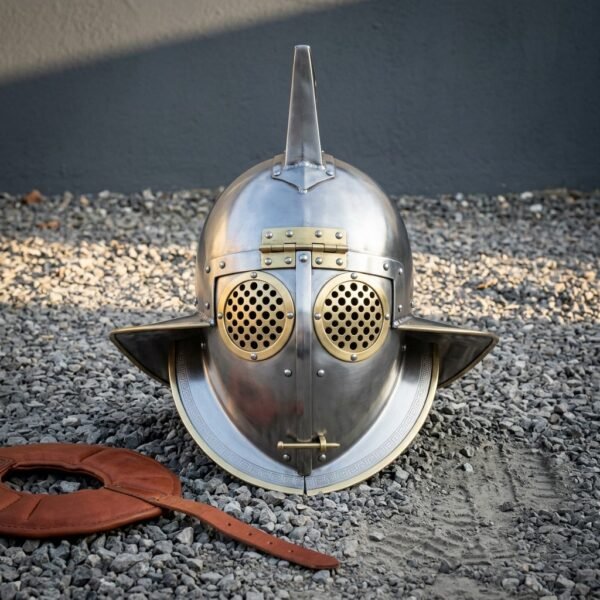
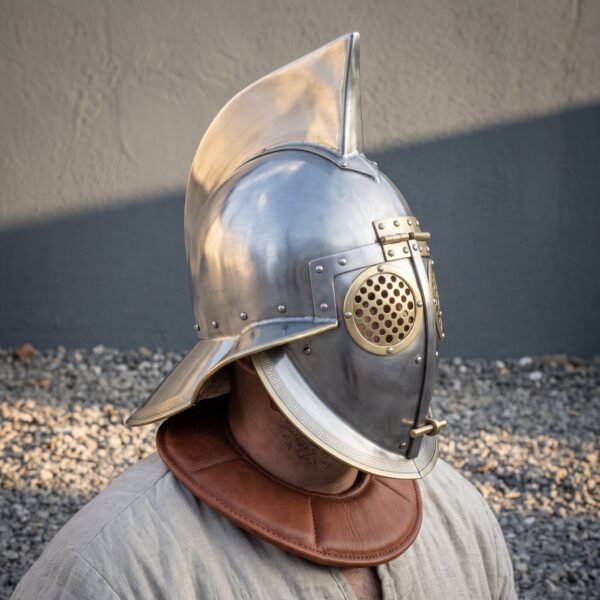
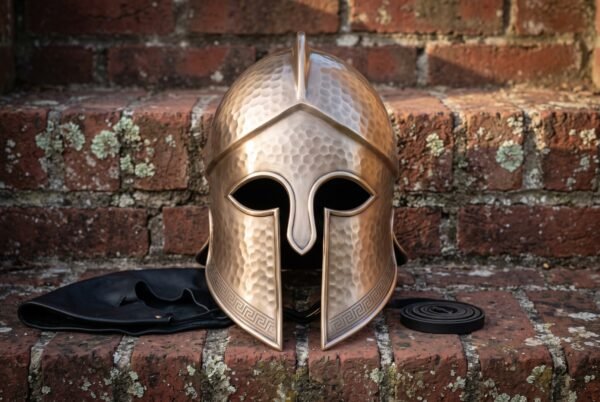
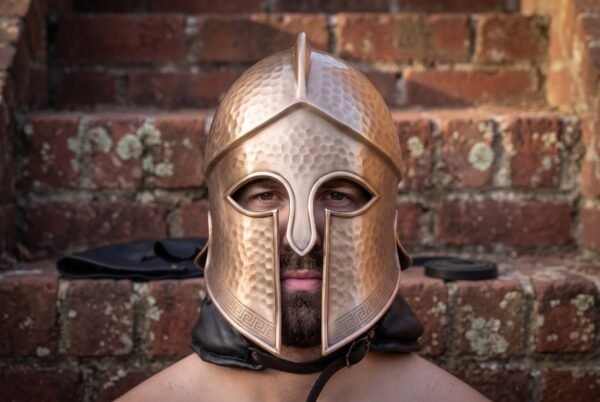
This one is not Norse and we are not going to pretend otherwise. It is a Corinthian helmet, the full face helm of the Greek hoplite, raised by hand from a single sheet of brass so that bowl, nasal, cheek pieces and neck are one continuous piece of metal with no joint anywhere. A raised crest ridge runs over the crown, the almond eye openings are cut and dressed by hand, and a Greek key meander is engraved around the brow. The Corinthian is the helmet on the Athenian coinage and on half the vase paintings that survive, and it was worn for something like three hundred years from the eighth century BC onward. Its most telling feature is what it does to the wearer. It seals almost the entire face, muffles hearing badly and narrows vision to two slots, which was tolerable only because a hoplite fought shoulder to shoulder in a phalanx where you needed to see the man in front of you and nothing else.
Raised, planished, cut and engraved in a Czech Republic workshop. It ships as the helmet. The folded leather piece at the edge of the photograph is a studio prop and is not included. Roman and Greek kit sat alongside mail and plate in the same centuries, compared in chainmail versus plate versus lamellar.
Specifications
| Type | Corinthian pattern Greek hoplite helmet |
|---|
| Material | Brass, hand raised from sheet |
|---|
| Construction | Single piece bowl, nasal and cheek pieces, no seams or rivets |
|---|
| Crest | Raised ridge over the crown, front to back, rising to a small upright fin at the top |
|---|
| Engraving | Greek key meander band around the brow |
|---|
| Openings | Almond eye slots and a long nasal, with a T shaped face opening |
|---|
| Edges | Rolled edges with an incised border line around the eye openings and cheek pieces |
|---|
| Finish | Hand polished brass, satin |
|---|
| Use | Display, costume, stage and film, light living history |
|---|
| SKU | RK-1542 |
|---|
What raising from one sheet actually means
Almost every helmet ever made is built from pieces, because it is far easier to shape two or three panels and rivet them than to persuade one flat disc to become a head shaped vessel. A Corinthian cannot be made that way. There are no rivets and no seams on an original because the whole thing is raised, which means the smith works the sheet from the outside in over a stake, hundreds of overlapping hammer blows at a time, gathering the metal and thickening it as the walls come up. The metal work hardens as you go and has to be annealed, softened again in the fire, over and over. Getting a nasal and two cheek pieces to come out of the same sheet as the bowl is one of the genuinely hard problems in metalworking, and it is the reason Greek armourers were famous.
The raised crest ridge over the crown is the same trick that stiffens a spangenhelm. A rib is far stiffer than a smooth curve of the same thickness, so the top of the head gets structural reinforcement without extra weight, and a blade landing on the ridge is thrown sideways rather than sitting where it hit. It also gives a mounting line for a horsehair crest if you ever want one, though this helmet ships without.
Brass, and why the Greeks used bronze
This helmet is brass, an alloy of copper and zinc. The originals were bronze, copper and tin, because zinc was not available in usable form in the Greek world. Both are copper alloys, both raise beautifully, both take a warm gold colour that steel never manages, and brass is what a modern shop uses because it is available in consistent sheet and it behaves predictably under the hammer.
Copper alloys are different from steel in a way that matters here. They do not rust. Brass tarnishes to a darker gold and eventually to brown, which is oxidation on the surface rather than corrosion eating into the metal, and it polishes back whenever you want it to. Left alone it patinates and many people prefer that. What brass will not do is hold an edge or resist a determined blow the way hardened steel does, and it work hardens as it deforms, which means a badly dented copper alloy helmet can crack if you try to hammer the dent out cold.
Be plain about function. This is display, costume, stage, film and light living history equipment. It is not certified armour, it is not rated for full contact combat of any kind, and it is not suitable for HEMA or reenactment fighting. Its vision and hearing restriction alone make it unsafe in a contact bout, which was true in 500 BC as well.
Engraving, runes and your own design
Use the rune converter on this page to turn a name, a date or a short phrase into Elder Futhark and we will cut it into the brass. If you would rather have a Viking pattern than a rune line, choose your own design in the engraving option above the add to cart button and tell us where it goes. Where a piece already carries an engraved design, your chosen engraving replaces it rather than sitting alongside it, so on this helmet your line would take the place of the meander band around the brow. On a Greek piece most buyers ask for a Greek inscription or a name in Greek letters rather than runes, and we are happy to cut that instead. Full detail is on the engraving page.
Display and mounting
A Corinthian is one of the best looking objects you can put on a shelf, and it deserves a stand rather than a shelf edge. Use a padded helmet stand or a simple wooden post that supports the bowl from inside rather than pinching the cheek pieces, since the cheeks are the thinnest part and will spring if they are loaded. Keep it out of direct sunlight, which accelerates tarnish unevenly and leaves a shadow line. If you want the bright gold look, expect to polish it once or twice a year. If you want it to darken naturally into an aged bronze tone, simply leave it alone and it will get there on its own within a couple of years.
Care
Brass does not rust, so this is easier to look after than a steel helmet. Handle it with clean hands or cotton gloves, because fingerprints etch into the surface over time and leave marks that need polishing out. Dust with a soft cloth. If you want it bright, use a proper non abrasive brass polish sparingly and buff it off completely, particularly out of the engraved meander where residue dries white. Never use steel wool or a wire wheel. If it gets wet, dry it immediately and pay attention to the inside of the bowl. There is more general guidance in our guide to steel care, though brass needs less of it than steel does. Storage and handling are covered in caring for chainmail and steel armour, without the rust worries.
Made in the Czech Republic
Every piece we sell is made by hand in the Czech Republic. The smiths there work the way the trade has been worked for a long time, heating and hammering the steel, taking the bevels down by eye, and fitting the handle and the leather one at a time. There is no automated line anywhere in it, so small differences from one piece to the next are normal and expected.
Ransack Viking is a United States company based in Chicago, Illinois. We bring the pieces in ourselves, inspect them on arrival and ship them from our own warehouse. If you add engraving, that is carried out here in the United States before your order goes out.
A note on handmade variation
This is hand made, not machine made or bulk produced, so what arrives will not be a pixel for pixel copy of the photograph. Raising leaves a record of every hammer blow, so the planished surface catches light differently on every helmet, the exact sweep of the cheek pieces and the depth of the eye slots vary a little, and brass takes its polish with its own character. Grain, tone, hammer texture and exact profile vary because each one is worked by hand from natural materials. The dimensions, the material and the build are the same every time. The character is not.
Frequently asked questions
Is this Viking or Norse?
No. It is Greek, and specifically a Corinthian hoplite helmet. We sell Norse kit and this is not that, so we would rather label it correctly than force a Viking story onto it.
Can I actually wear it?
Yes, for display, costume, photography, stage and film. Vision and hearing are heavily restricted, which is authentic and is also why you should not walk far in it or drive anything while wearing it.
Is it bronze or brass?
Brass. The originals were bronze, since zinc was not available to Greek smiths, but both are copper alloys and brass is the modern shop equivalent that raises predictably.
Does it come with a crest or a liner?
No. It ships as the raised helmet. The crest ridge will take a horsehair crest if you source one, and a liner can be fitted if you ask before ordering.
Will it tarnish?
Yes, and that is normal for brass. It darkens toward an aged bronze tone, which many owners prefer. Polish brings it back to bright gold whenever you want.
How long before it ships?
Processing is one to two weeks because each helmet is raised to order, then free shipping within the United States. Returns are accepted within seven days.
What is in the box
- Hand raised brass Corinthian helmet, single piece bowl with nasal and cheek pieces
- Engraved Greek key meander band, or your chosen engraving in its place
- Care card and lifetime warranty against defects
- Forged and finished in the Czech Republic
Explore the range
See more in Roman and Greek helmets, Roman and Greek shields, medieval helmets and plate armour, or read the guides.
Others in the same line
Next along the rack is the Bronzecrest Greek helmet. For a straight comparison, see the Eaglemarch Greek helmet. Worth putting side by side with this is the Coppercrest Greek helmet.
If you are putting a set together, the Duskwarden plate armor sits alongside it. You can have this made your way instead on the design your own page.



This is exactly what I wanted and then some. Exactly the look I wanted for my collection. This is going straight into my display case. It’s handmade in the Czech Republic but ships from a US warehouse so it arrived quicker than I expected.
Been eyeing this helmet for months and it did not disappoint. Rivets and trim are all solid. Nothing feels flimsy. Padding and straps make it comfortable to wear for hours. Looks incredible with the rest of my reenactment kit. Shipping was fast and everything arrived well packaged.
This helmet beat every expectation I had.