
A double headed axe carries a bit on each side of the eye instead of a bit and a poll. The pattern is not Norse, whatever the Viking axe shelf suggests. It belongs to Minoan Crete, where the labrys was a ceremonial object, and to nineteenth century North American logging camps, where a feller kept one edge keen for clean timber and let the other go blunt for work near soil and grit. What the shape does give you is balance. With the mass sitting evenly around the haft the head has no side it wants to roll towards, so it tracks straight with a light grip.
The pieces here run 19 to 34 inches on the haft. Heads are plain 1095 high carbon hardened to 54 to 58 HRC, or Damascus of 1095 and 15N20 forge welded and etched at 58 to 60 HRC. Hafts are oak, ash, walnut and dark hardwood, some inlaid with steel or wrapped in leather. Every one ships with a fitted leather cover.
These are display and collector pieces. Two live edges means one of them is always pointing somewhere you are not looking.
Free US shipping
On most pieces. Heavier and oversized ones carry a flat charge.
Hand Forged
Heated, hammered and ground by hand.
Engraving available
Names, dates or Norse runes on most pieces.
Ships from Chicago
Inspected and dispatched from our Chicago warehouse. No import duty, no customs delay on US orders.
Double-Headed Axes
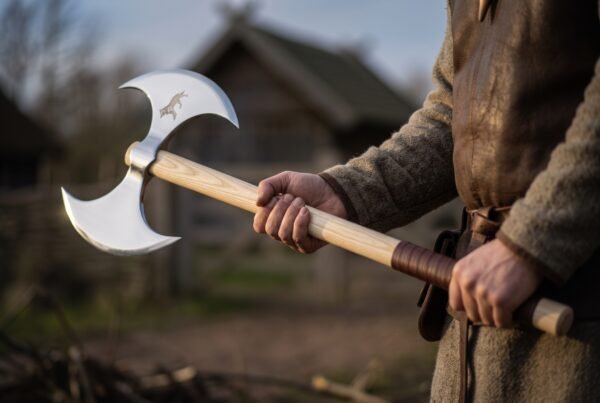
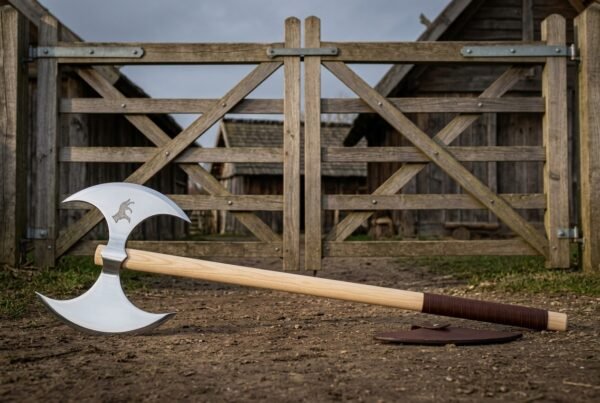
Twincrescent Hand Forged 1095 Steel Double Headed Viking Axe | 34 Inch Haft | Twin Crescent Bits and Etched Beast Motif with Leather Blade Cover | Norse Gift | RK-1903
Original price was: $339.00.$271.20Current price is: $271.20.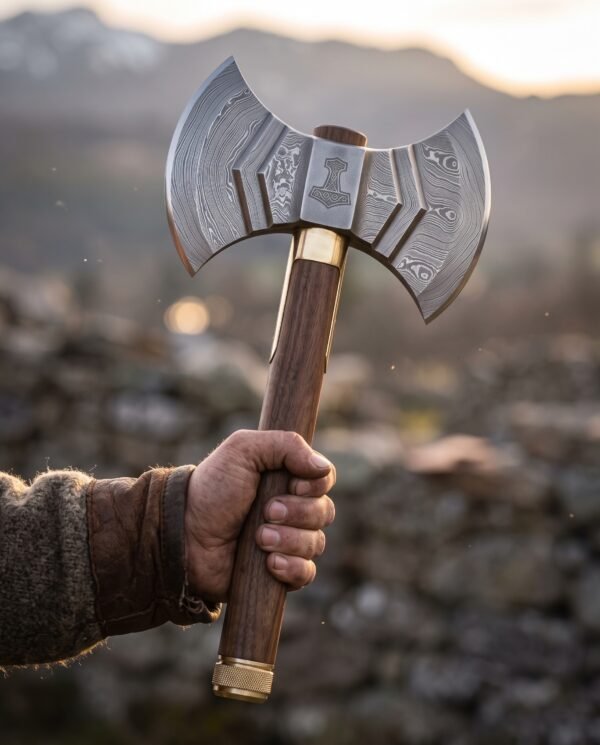
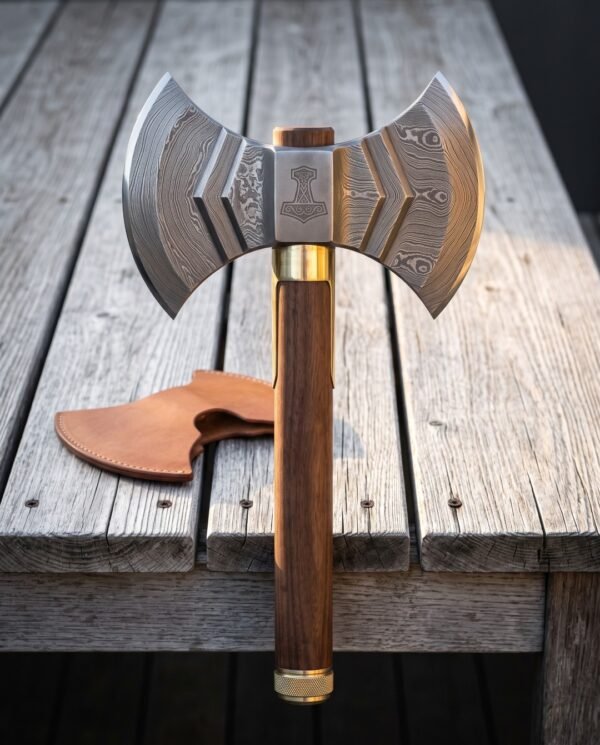
Stormcleave Hand Forged Damascus Double Headed Axe | Twin Damascus Bits with Engraved Mjolnir Cheek | Walnut Haft, Brass Collar and Leather Edge Cover | Norse Gift | RK-1644
Original price was: $379.00.$303.20Current price is: $303.20.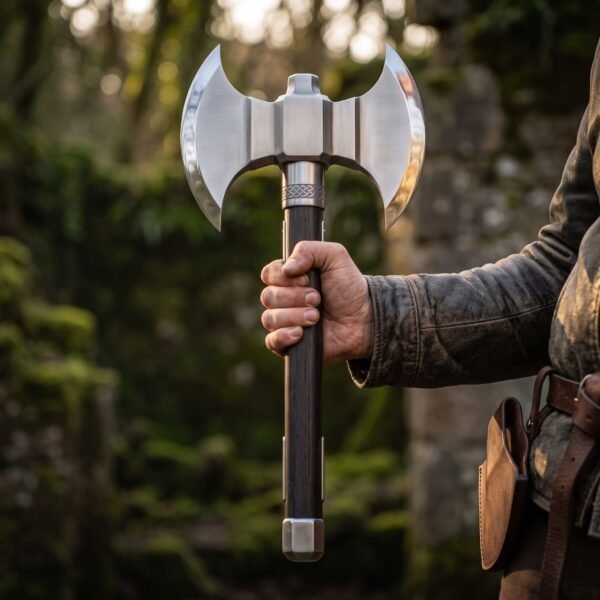
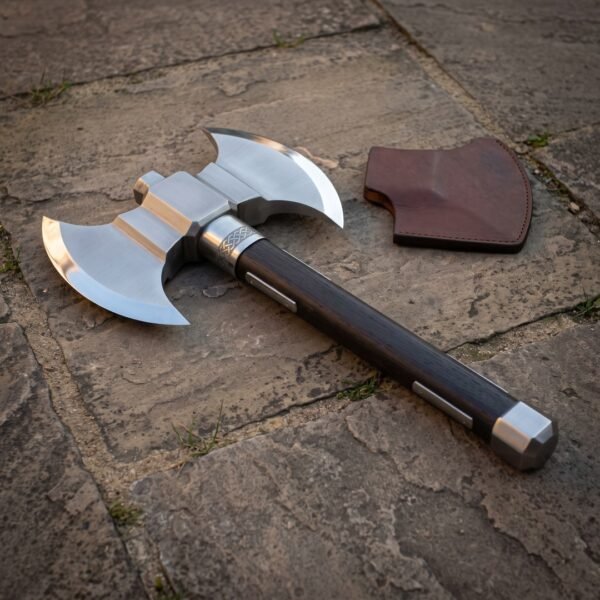
Twinfell Hand Forged 1095 Steel Double Headed Axe | Twin Crescent Bits with Engraved Knotwork Collar | Dark Hardwood Haft, Steel Inlays and Leather Edge Sheath | Norse Gift | RK-1643
Original price was: $299.00.$239.20Current price is: $239.20.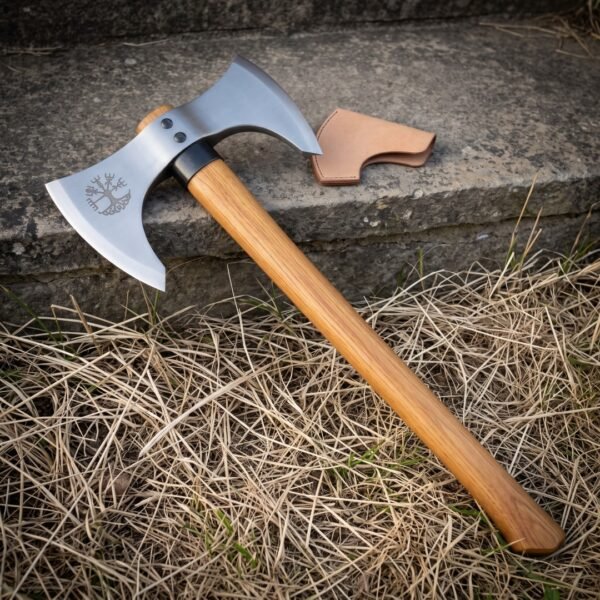
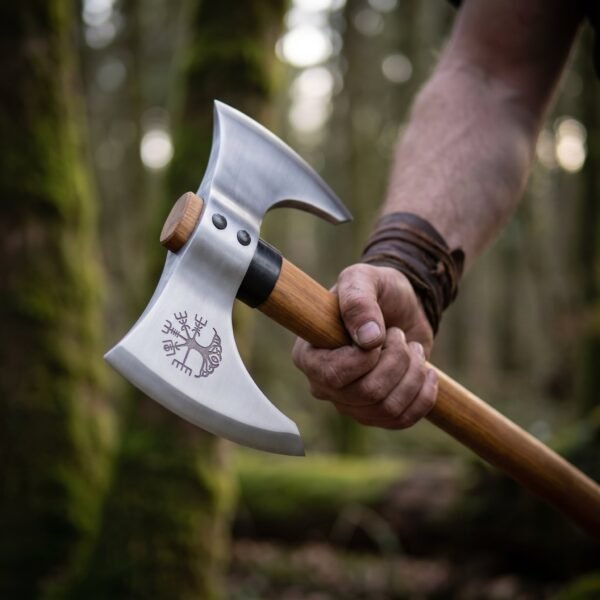
Twinvane Hand Forged High Carbon Steel Double Headed Viking Axe | 19 Inch Oak Haft | Vegvisir and Yggdrasil Etched Head with Fitted Leather Blade Cover | Norse Collector Gift | RK-2145
Original price was: $269.00.$215.20Current price is: $215.20.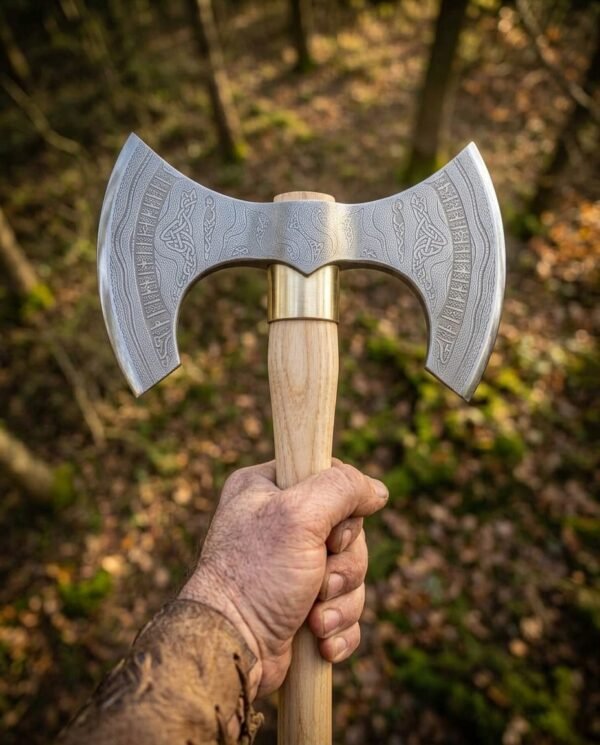
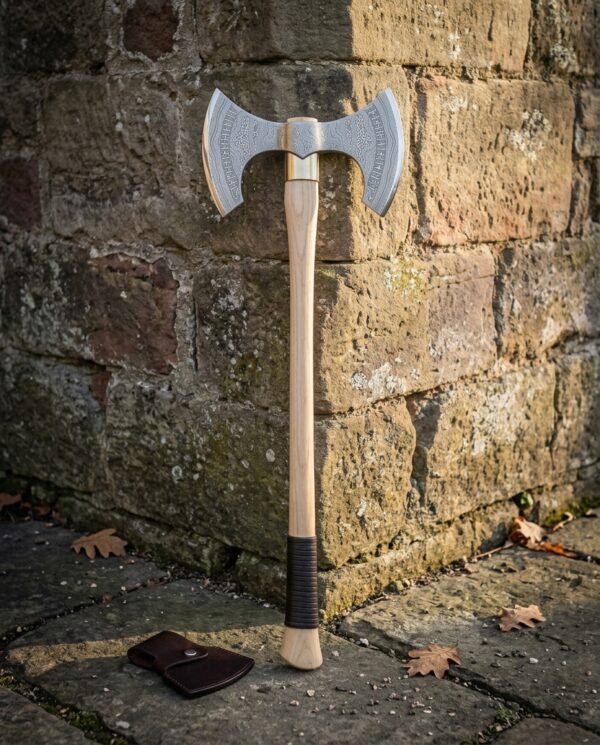
Twinbite Hand Forged High Carbon Steel Double Headed Axe | 28 Inch Overall with 6 Inch Edges | Light Wood Haft and Dark Leather Wrapped Grip | Norse Battle Collector Gift | RK-1215
Original price was: $295.00.$236.00Current price is: $236.00.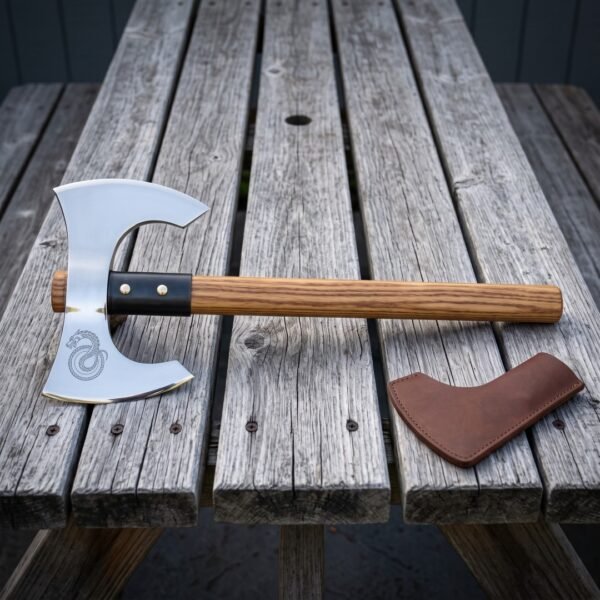
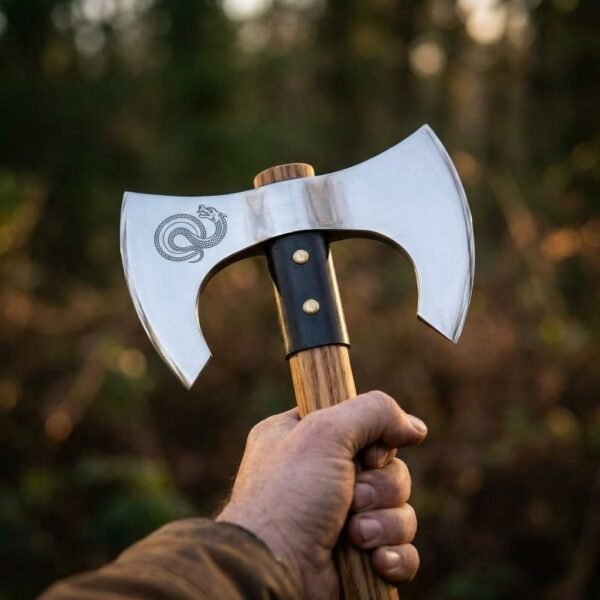
Wyrmhewn Hand Forged High Carbon Steel Viking Double Headed Axe | 19 Inch Oak Haft | Etched Coiled Serpent with Fitted Leather Head Cover | Norse Collector Gift | RK-2146
Original price was: $239.00.$191.20Current price is: $191.20.Two bits, one eye, and why anyone bothered
Put a single bitted axe on a table and it lies over on its side. All the cutting mass sits to one side of the haft, so the head is trying to rotate from the moment you lift it. Learning to use a felling axe is largely learning to hold that twist steady through a swing. Balance a double bit across a finger under the eye and it sits level, because the mass is symmetric about the haft. The head has no preferred side, so it tracks where you were looking rather than a few degrees off, and it does that with a much lighter grip.
That is the honest argument for the pattern, and it is the reason competition choppers used double bits long after the logging camps closed. The second argument is simpler. On a single bit the poll behind the eye is dead steel, useful as a hammer face and nothing else. On a double bit that same weight is a second working edge. A logger ground one bit thin for standing timber and the other thicker and duller for limbing, grubbing near the ground and anything likely to meet dirt. One haft, two jobs, no walk back to camp.
None of this is Viking. Every axe head recovered from a Viking age grave or settlement is single bitted, and once you have held a double bit the reason is obvious. A second bit doubles the weight at the far end of the haft without adding anything you can use in a fight, and it makes the axe impossible to rest on your shoulder or hook behind a shield rim. The double bit reaches us from two other places entirely, the Minoan labrys and the American forestry trade. The pieces on this page take that shape and finish it with Norse etching, which makes them display and collection pieces rather than reenactment accurate ones. We would rather say so than invent a history for the shape.
The double headed axes in this collection
Five pieces, split by steel and by how much haft you want in front of you.
Twin crescent heads in 1095 high carbon
The most common head form here is a pair of crescent bits swept in opposite directions from a squared central eye. Each edge curves out into an upper and a lower horn, so the cutting edge is an arc rather than a straight chord. That puts more edge length on the head for the same steel, and it means contact starts at a point and rolls along the curve instead of landing flat. On the 34 inch piece the head measures 11 inches from horn to horn with roughly 7 inches of arc on each bit. Finishes run from bright polished to satin, with a Norse animal panel or a knotwork band etched into the upper cheek.
The Damascus piece
One head is layered 1095 and 15N20, forge welded, drawn out and acid etched at 58 to 60 HRC. The wavy banding across the bits is what a plain stacked billet gives you once it has been ground back. The stepped chevron panels beside the eye are a separate operation, cut so the grinder crosses the layers at an angle rather than straight through the flat. It carries a Mjolnir cut into a polished block at the centre and sits on a walnut haft with a pinned brass face strip, a brass collar and a knurled brass butt cap.
Short hafts and long hafts
The shortest piece here is 19 inches, an oak hafted head with a bearded forward bit and a hooked rear beak rather than two matching crescents, blackened steel collar riveted through the langets and a Vegvisir etched on the forward cheek. That length is a one handed piece and it hangs on a wall without dominating it. The longest is 34 inches on white ash with a leather wrapped butt, weighing about 4 lb 8 oz complete. Between them sit a 28 inch high carbon head with 4.5 inch edges and a light haft leather wrapped through the lower third, and two pieces built around dark hardwood with steel inlays and brass fittings.
Sizes, steel and fittings across the range
Every figure below comes from the specification panel of a piece on this page. These are forged and ground by hand, so read them as what to expect rather than as a guarantee to the millimetre. Where a listing does not state a figure, the table says so instead of guessing.
| Piece | Head steel | Overall length | Edges | Haft and fittings | Listed weight |
|---|---|---|---|---|---|
| Twinbite | High carbon, etched panels both bits | 28 in | 4.5 in each, twin symmetric bits | Light straight grained wood, dark leather wrap at the grip | Head about 2.5 lb |
| Twinfell | 1095 at 54 to 58 HRC, polished | Not listed | Twin crescent bits with swept horns | Dark hardwood with inlaid steel strips, engraved knotwork collar, faceted steel cap | Not listed |
| Stormcleave | Damascus at 58 to 60 HRC, acid etched | Not listed | Twin crescent bits, stepped chevron panels | Walnut with brass face strip, brass collar and knurled brass cap | Not listed |
| Twincrescent | 1095 at 54 to 58 HRC, satin polished | 34 in | About 7 in of arc per bit, 11 in horn to horn | White ash, oiled, brown leather wrapped butt, steel cross wedge | About 4 lb 8 oz |
| Twinvane | 1095 at 54 to 58 HRC, satin polished | About 19 in | Bearded forward bit and hooked rear beak | Straight oak, oval section, blackened steel collar on two rivets | Not listed |
One number is worth reading twice. Head width matters more on a double bit than on anything else you hang on a wall, because both horns stick out into the room. An 11 inch head at chest height is something people walk into.
Choosing a length
Haft length decides what the piece is for long before the steel does. Anything near 19 inches is a one handed axe. You can hold it out at arm's length for a photograph, it fits a display stand on a shelf, and it takes up about as much wall as a large knife. It is also the one to buy if the axe will be handled by anyone who has not held an axe before.
Twenty eight inches is the middle ground, long enough to need two hands on a swing and short enough to sit above a doorway without looking absurd. Thirty four inches is a floor to shoulder piece. It reads properly as an axe from across a room, and it also weighs enough that a wall mount needs to go into a stud rather than into plasterboard.
If you want a Norse pattern rather than a double bit, the bearded axes and the Dane axes are the historically correct shapes for the same wall.
Steel and hardness
Two steels run through the range. Plain 1095 high carbon is hardened to 54 to 58 HRC, which is the sensible range for a wide thin bit. Harder than that and the horns, which are the most exposed part of the head, chip instead of bending. Softer and the edge rolls under nothing. Damascus of 1095 and 15N20 is forge welded, folded, drawn and acid etched, hardened to 58 to 60 HRC. The 15N20 carries nickel, which resists the etch, and that is why the layers come up as light and dark bands rather than as a uniform grey face.
Neither steel is stainless and neither pretends to be. Stainless resists corrosion by carrying chromium, and chromium costs toughness at cutting hardness, which produces an edge that chips rather than rolls. On a head with two live edges and no soft poll to soak up shock, that trade is a bad one. The cost of carbon steel is a wipe of oil after handling. Our steel and hardness page lays out the numbers properly.
Hardening a double bit is also harder than hardening a single bit, because two edges have to come out at the same hardness while the body around the eye stays tough enough to bend rather than crack. That is why the heat treat is stated as a range for the edges rather than a single figure for the whole head.
Hafts, collars and how the head stays on
A double bit haft is always straight. It has to be, because a curved haft would put one edge out of line with the other, and the entire point of the pattern is that both edges sit on the same plane. Hafts here are oak, white ash, walnut and dark close pored hardwood, cut so the growth rings run down the length rather than out through the side, then shaped by hand to an oval section so your hand can feel the alignment of the edge without looking.
The eye does more work than on a single bit. With a bit on each side there is no mass of poll to brace against, so the eye is drifted through a thickened block and the haft is fitted from below and wedged. On the 34 inch piece that wedge is steel, driven across the wooden one. The collar under the head is a structural band rather than decoration, supporting the throat of the haft exactly where the load concentrates. On the short oak piece it is blackened steel riveted through langets that run down the cheeks.
Butt caps protect the end grain, which is the part of a haft most likely to split when an axe is stood down hard on a stone floor. Steel inlays let into the faces of a haft are seated and pinned rather than glued on the surface, which is what keeps them flush after the wood has been through a few dry heated winters. If a haft ever needs replacing, we sell axe handles and hafts separately.
Care, storage and hanging
Wipe both bits after handling. Fingerprints etch into a bright polish within days, and a double bit gives you twice as much surface to forget about. Keep a thin film of mineral oil or a light machine oil on the steel. Do not leave a leather cover on the edges for months in a humid room, because leather holds moisture directly against metal and a damp cover is the most reliable way to spot an otherwise well kept head. Orange spotting lifts with a nylon pad and oil without dulling the polish or flattening an etched panel. Grey patina is stable and harmless.
Give the wood a light coat of oil once a year so it does not dry and shrink away from a collar or an inlay, and keep the whole piece off radiators and out of hot cars. Our axe care page and the guide on removing rust from an axe cover the rest.
Hanging one takes a little more thought than hanging a sword. Support the head on a pair of hooks under the bits rather than hanging the axe by its haft, so the weight is not sitting on a wedge, and mount it high enough that nobody walks into a horn at eye level. The guide on how to display swords and axes covers mounts and spacing.
Engraving
A double bit gives you two mirrored faces to work with, which is why the usual request here is a rune line on one bit and a knotwork panel on the other. Elder Futhark is a phonetic alphabet rather than a cipher, so a name is transliterated by sound and there is no rune for the letter C. Where a piece already carries an etched design, your engraving replaces it rather than sitting beside it. Text engraving is 19 dollars, a symbol is 39 dollars and a family crest is 49 dollars. Engraving is permanent, an engraved piece cannot be returned, and the spelling you send is the spelling that gets cut. Read it twice.
Where these come from and how they ship
Ransack Viking is a US company based in Chicago, Illinois. The pieces are handmade in the Czech Republic, then imported, inspected and shipped from Chicago. Engraving is done in the US after arrival. Because every head is forged, drifted and ground by eye, the sweep of the horns varies by a fraction between two axes of the same name, hardwood runs from near black to warm brown with visible figure, and leather takes dye differently hide to hide. Dimensions, steel and heat treat are the same each time. The character is not.
How to choose
Buy the 1095 pieces if you want a bright or satin head with clean etching and the lowest maintenance. Buy the Damascus if the layered pattern is the reason you are here, and accept that a busy etched face wants wiping more often than a plain one. Match the haft length to the wall rather than to the photograph, because a 34 inch axe measured against a doorway is a different object from the same axe on a screen.
Browse related categories
- Battle axes, the single bitted fighting patterns
- Bearded axes with the dropped beard and the long cutting arc
- Viking axes, the full range across every pattern
- Dane axes on long hafts
- Splitting and felling axes built to be used
- Axe handles and replacement hafts
Guides worth reading first
- Viking axe history and what the finds actually show
- Battle axe vs bearded axe, how the two patterns differ
- How to choose a Viking axe
- How to sharpen an axe on a puck and a stone
Frequently asked questions
Did Vikings use double headed axes?
No. Every axe head recovered from the Viking age is single bitted. The double bit belongs to Minoan Crete on one hand and to nineteenth century North American forestry on the other. These are made because people want the shape, not because the shape is historical, and the product pages say so.
Are both edges sharp when it arrives?
Both bits arrive with a working convex edge, sharp enough to take skin and not honed to a razor. If you would rather have one bit left blunt for safer handling or display, say so in the order notes and it will be ground that way at no extra cost.
Can I chop wood with one of these?
Please do not. These are finished as display and collection pieces, and polished faces, engraved collars and pinned inlays are not built to take repeated impact. If you want an axe to actually swing, look at the splitting and felling axes instead.
Why is a double bit better balanced?
Because the cutting mass is symmetric about the haft, so nothing is pulling the head to one side. It sits level across a finger under the eye and it does not roll in the hand when your grip relaxes. That predictability is the reason competition choppers kept using the pattern.
What length should I buy?
Nineteen inches for a shelf or a small wall and for anyone who has not handled an axe before. Twenty eight inches for the middle ground. Thirty four inches if the piece needs to read as an axe from across a room, remembering that it weighs about 4 lb 8 oz and wants a mount fixed into a stud.
Which steel should I pick?
Plain 1095 at 54 to 58 HRC if you want a clean polished or satin face with the least upkeep. Damascus at 58 to 60 HRC if the forge welded pattern is what you came for. Neither is stainless and both want a wipe of oil.
How do I hang one safely?
Use two hooks under the bits so the weight rests on the head rather than on the haft and the wedge, and fix them into a stud. Mount it above head height or below waist height, because a horn at eye level in a hallway is an accident waiting for a distracted guest.
Where are these made?
They are handmade in the Czech Republic, then imported, inspected and shipped by Ransack Viking from Chicago, Illinois. Engraving is added in the US after arrival.
Featured pieces
 Twinbite Hand Forged High Carbon Steel Double Headed Axe
Original price was: $295.00.$236.00Current price is: $236.00.
 Twinfell Hand Forged 1095 Steel Double Headed Axe
Original price was: $299.00.$239.20Current price is: $239.20.
 Stormcleave Hand Forged Damascus Double Headed Axe
Original price was: $379.00.$303.20Current price is: $303.20.
 Twincrescent Hand Forged 1095 Steel Double Headed Viking Axe
Original price was: $339.00.$271.20Current price is: $271.20.