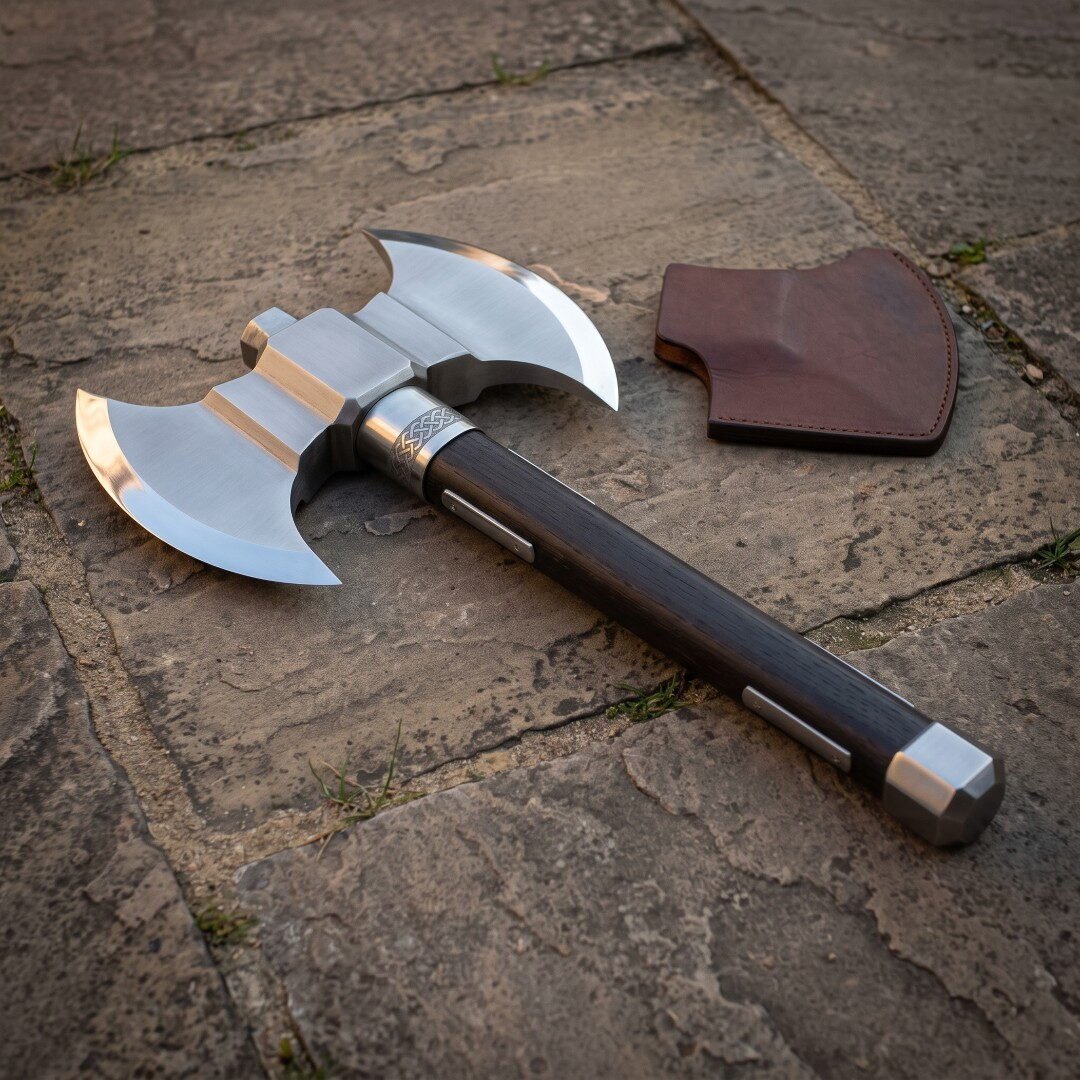
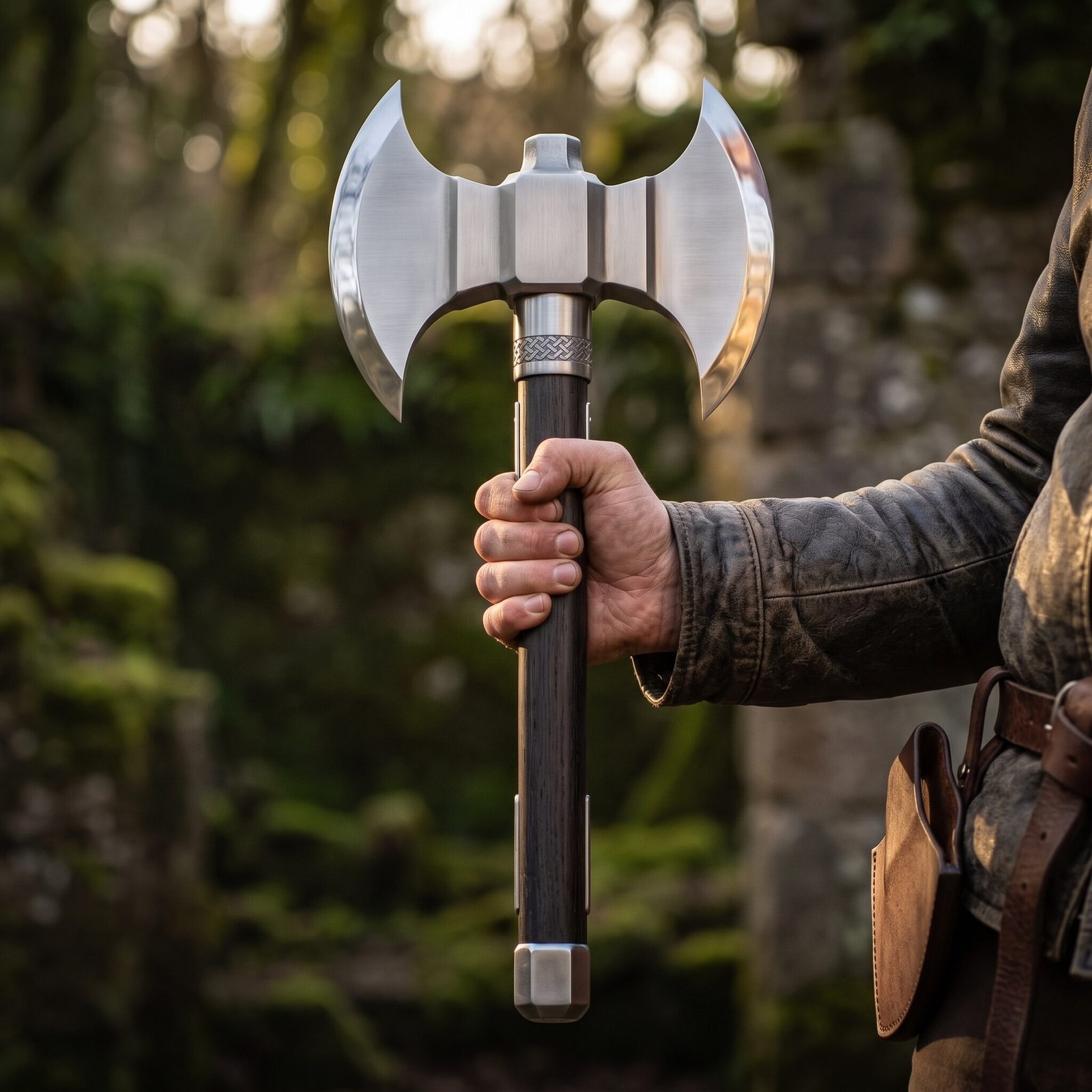
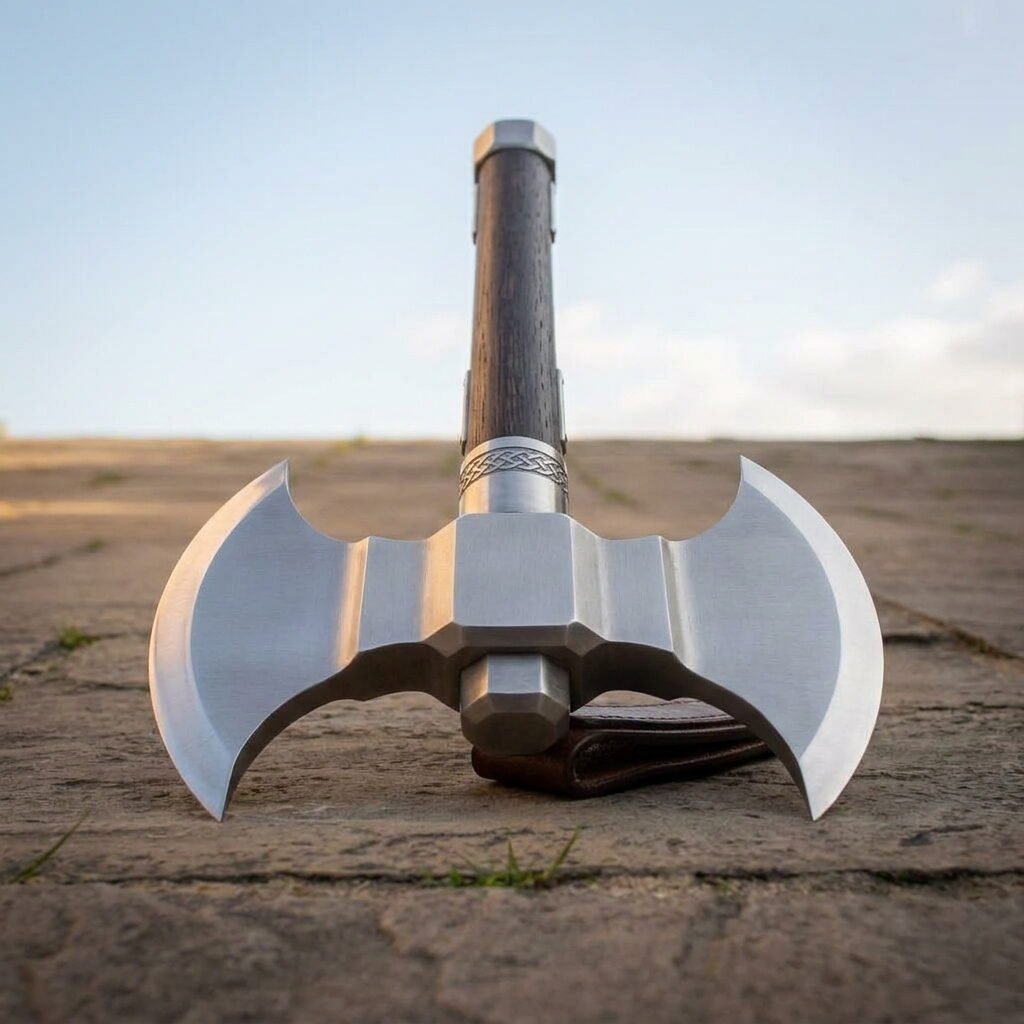
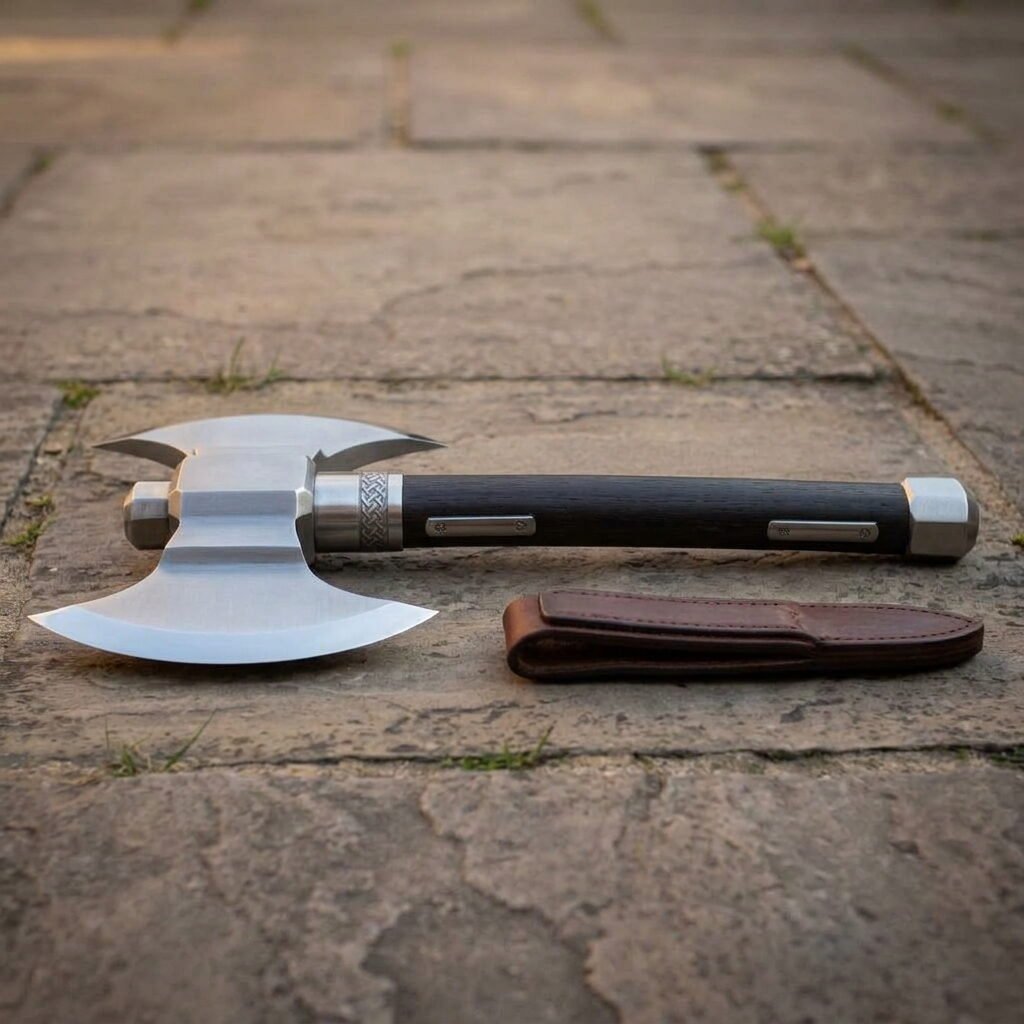
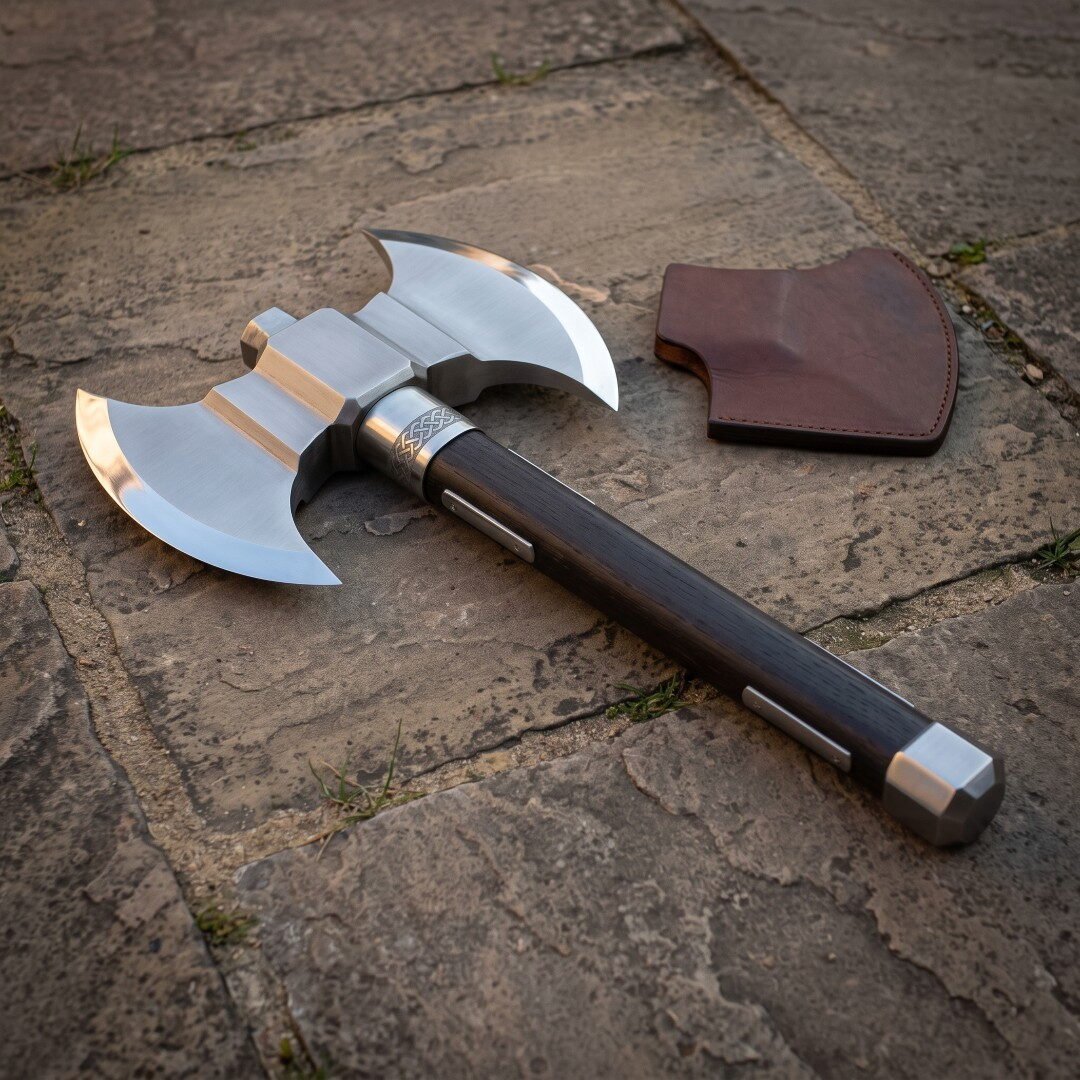
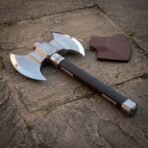
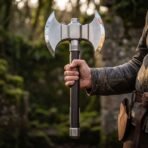
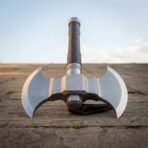
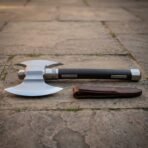
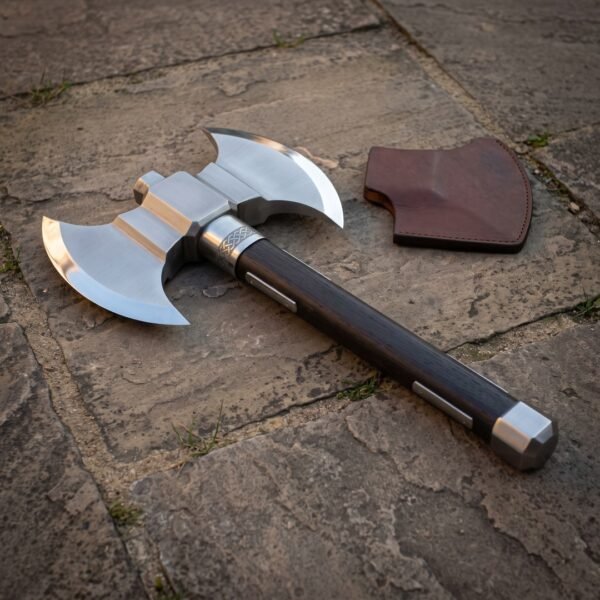
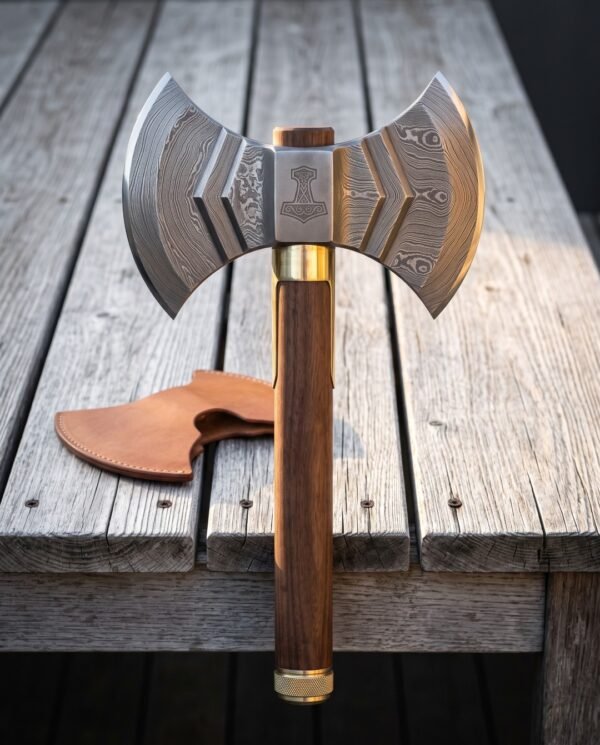
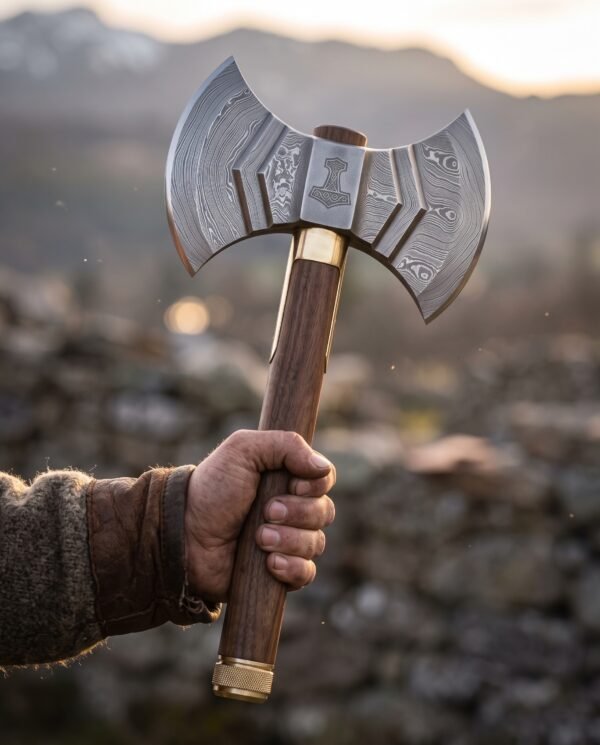
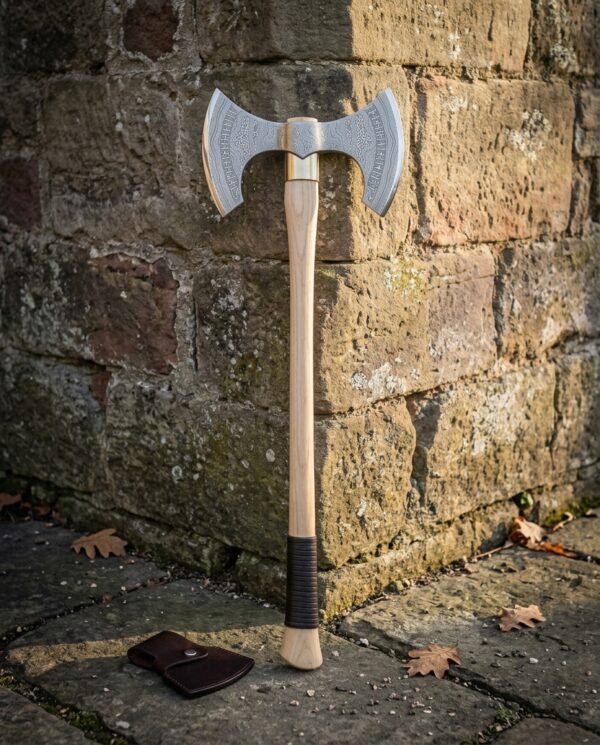
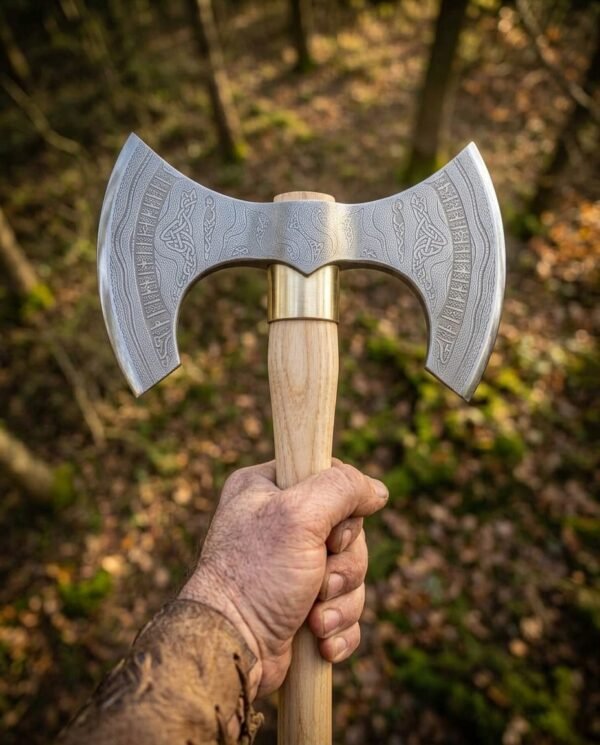
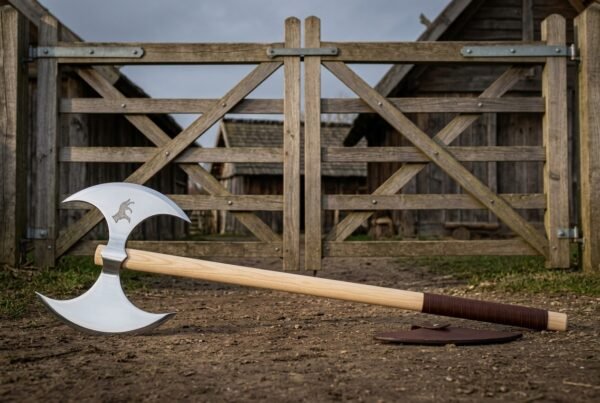
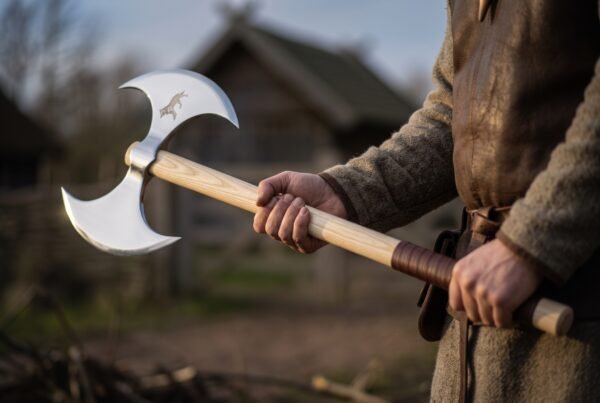
This is a double headed axe with two crescent bits swept in opposite directions from a squared central eye, polished bright and mounted on a dark hardwood haft. A band of engraved knotwork wraps the collar under the head, brushed steel strips are let into both faces of the haft, and the butt is finished with a faceted steel cap. A shaped leather cover is supplied for the edges.
Here is something the Viking merchandise trade will not usually tell you. The Norse did not fight with double headed axes. Every axe head recovered from a Viking age grave or settlement is single bitted, and the reason is straightforward once you have held one. A second bit doubles the weight at the far end of the haft without adding anything you can use, and it makes the axe impossible to rest against your shoulder or hook behind a shield. The double bit belongs to two other places entirely, to Minoan Crete where the labrys was a ceremonial and religious object, and to nineteenth century North American forestry, where a logger kept one edge razor keen for clean timber and let the other go dull for cutting near soil and grit. This one is built as a display and collection piece and we would rather say so than invent a history for it. It sits in the double headed axes. The Viking axes cover the same ground from a different angle.
Specifications
| Head material | 1095 high carbon steel, polished |
|---|
| Hardness | 54 to 58 HRC |
|---|
| Head form | Twin crescent bits with swept horns either side of a stepped, squared central block with a faceted top |
|---|
| Finish | Bright polished bits, satin finished central block |
|---|
| Collar | Steel collar with an engraved knotwork band beneath the head |
|---|
| Haft | Dark hardwood with short brushed steel strips inlaid into the faces |
|---|
| Butt | Faceted octagonal steel cap |
|---|
| Included | Shaped brown leather edge cover |
|---|
| Intended use | Display, collection and costume piece |
|---|
| SKU | RK-1643 |
|---|
Why the horns curve the way they do
Look at either bit and you will see the edge is not a straight line. It sweeps out into two horns, one above and one below, so the cutting edge is a crescent rather than a chord. That shape puts more edge length on the head for the same amount of steel, and because the horns lead the centre of the edge into the cut, the contact starts as a point and rolls along the curve rather than landing flat.
The squared eye between the bits is doing the structural work. On a single bit axe the eye can be a simple slot with the mass of the poll behind it, but with a bit on each side there is nothing to brace against, so the eye is drifted through a thickened block and the haft has to be fitted from below and wedged. That is why the collar is a solid band rather than a decorative ring. It supports the throat of the haft exactly where the load concentrates.
The steel and the hardwood
The head is 1095 high carbon steel, forged, drifted, ground and then hardened and tempered to 54 to 58 HRC. That range gives an edge that holds and a body that will bend rather than shatter, which matters on a wide thin bit like this one where the horns are the most exposed part of the piece.
The haft is a dense dark hardwood, straight grained and close pored, chosen because it takes a deep polish and holds inlay without moving away from it. The steel strips let into both faces are seated and pinned rather than glued on the surface, which is what keeps them flush after the wood has been through a few seasons of dry heating and damp summers. The faceted butt cap protects the end grain, which is the part of any haft most likely to split if the axe is stood down hard.
Engraving, runes and your own design
Use the rune converter on this page to turn a name, a date or a short phrase into Elder Futhark and we will cut it into the steel, the leather or the wood. If you would rather have a Viking pattern than a rune line, choose your own design in the engraving option above the add to cart button and tell us where it goes. Where a piece already carries an engraved design, your chosen engraving replaces it rather than sitting alongside it. On this axe that means your line takes the place of the knotwork on the collar, or goes onto the flat cheek beside the eye where there is more room. See the engraving page.
Handling and balance
A double bit balances differently from anything else you will pick up. Because the mass is symmetrical about the haft, the axe has no natural front, so it does not want to roll in the hand the way a single bit axe does when you relax your grip. It also sits dead level if you balance it across a finger under the eye, which is why double bit axes were traditionally the choice for competition chopping, where a predictable head is worth more than a heavy poll.
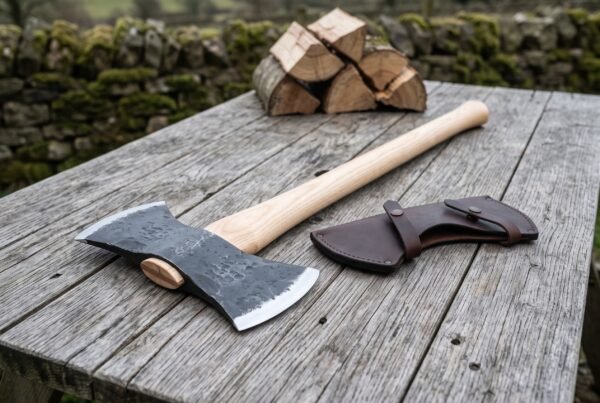
What it does not do is forgive. There is a live edge behind your hand at all times, so never swing this and never walk with it held loosely at your side. Keep the leather cover on both bits when it is not on display, and if you hang it on a wall, hang it low enough that nobody can walk into a horn. We sell this as a display, collection and costume piece. It is not for sparring and it is not a working felling axe.
Care
The head is high carbon steel and it rusts. Wipe both bits after handling, because fingerprints etch into a bright polish within days, and keep a thin film of mineral oil or a light gun oil on the steel. Do not leave the leather cover on the edges for months in a humid room, since leather holds moisture right against the metal. If orange spotting appears, a nylon pad with oil will take it off without dulling the polish. Wipe the hardwood haft with a dry cloth and give it a light coat of hardwood oil once a year so it does not dry and shrink away from the steel inlays. Full detail is on the steel care page.
Made in the Czech Republic
Every piece we sell is made by hand in the Czech Republic. The smiths there work the way the trade has been worked for a long time, heating and hammering the steel, taking the bevels down by eye, and fitting the handle and the leather one at a time. There is no automated line anywhere in it, so small differences from one piece to the next are normal and expected.
Ransack Viking is a United States company based in Chicago, Illinois. We bring the pieces in ourselves, inspect them on arrival and ship them from our own warehouse. If you add engraving, that is carried out here in the United States before your order goes out.
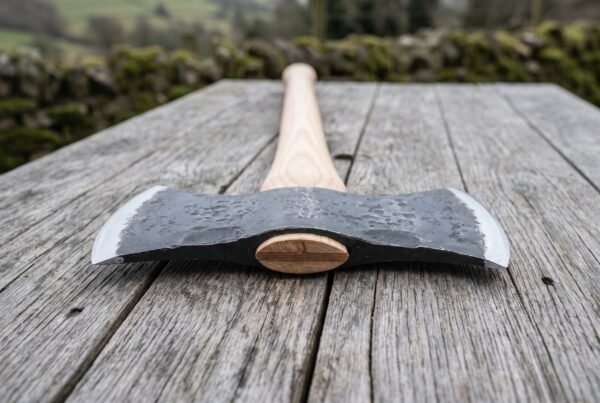
A note on handmade variation
This axe is hand made, not machine made and not bulk produced, so what arrives will not be a pixel for pixel copy of the photograph. The two bits are ground by eye so the sweep of the horns differs by a fraction between them and between axes, the knotwork on the collar is engraved by hand and its line weight varies, the hardwood haft is natural timber that runs from a deep near black to a warm chocolate with visible figure, and the leather cover takes its own tone from the hide. The dimensions, the steel, the heat treat and the fittings are the same every time. The character is not. We go further into it in choosing a Viking axe, and pick it up again in the battle axe set against the bearded axe.
Frequently asked questions
Did Vikings really use double headed axes
No. Every axe head from the Viking age is single bitted. The double bit is Minoan on one hand and modern North American forestry on the other. It is made because people want it, not because it is historical.
Is it sharp when it arrives
It arrives with a working edge on both bits, sharp enough to take skin and not honed to a razor. Keep the cover on it in storage.
Can I chop wood with it
Please do not. It is built and finished as a display and collection piece, and the polish, the inlays and the engraved collar are not made to take the shock of repeated impact.
Is this Damascus steel
No. This one is plain 1095 high carbon steel taken to a bright polish. There is a Damascus double headed axe in the same category if you want the layered pattern.
Can I hang it on a wall
Yes, and most owners do. There is no bracket included, so use a pair of hooks under the bits rather than hanging it by the haft, and mount it out of walking reach.
How long does it take to arrive
One to two weeks of processing in the shop, then free shipping inside the United States. Engraving adds a few days.
What is in the box
- Hand forged 1095 steel double headed axe with twin crescent bits
- Engraved knotwork collar and faceted steel butt cap
- Dark hardwood haft with inlaid brushed steel strips
- Shaped leather edge cover
- Care card for high carbon steel and hardwood
- Lifetime warranty against defects in forging, grind, heat treat and fittings
- Forged and finished in the Czech Republic
Explore the range
See more in the double headed axes, the Viking axes and the battle axes, or read the guides on axe typology and what the finds actually show.
Others in the same line
Sitting beside it in the catalogue is the Twinvane double headed axe, high carbon steel. Another in the same line is the Gleambeard bearded axe, forged from 1095. Next along the rack is the Grainbeard bearded axe, pattern welded Damascus.
Fitting out further, the Stormbeak war axe belongs with it. You can have this made your way instead on the custom Viking axe page.

Reviews
There are no reviews yet