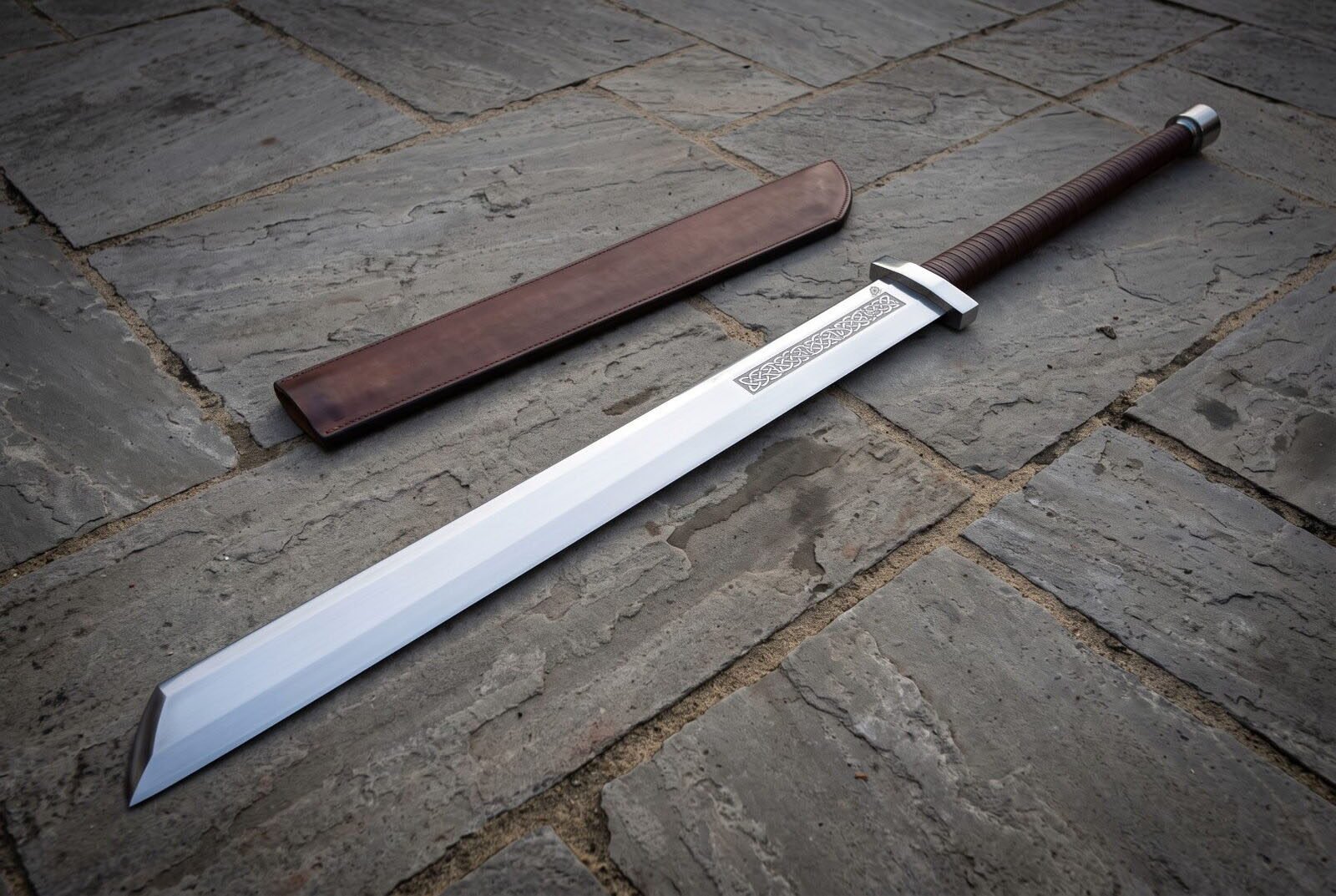
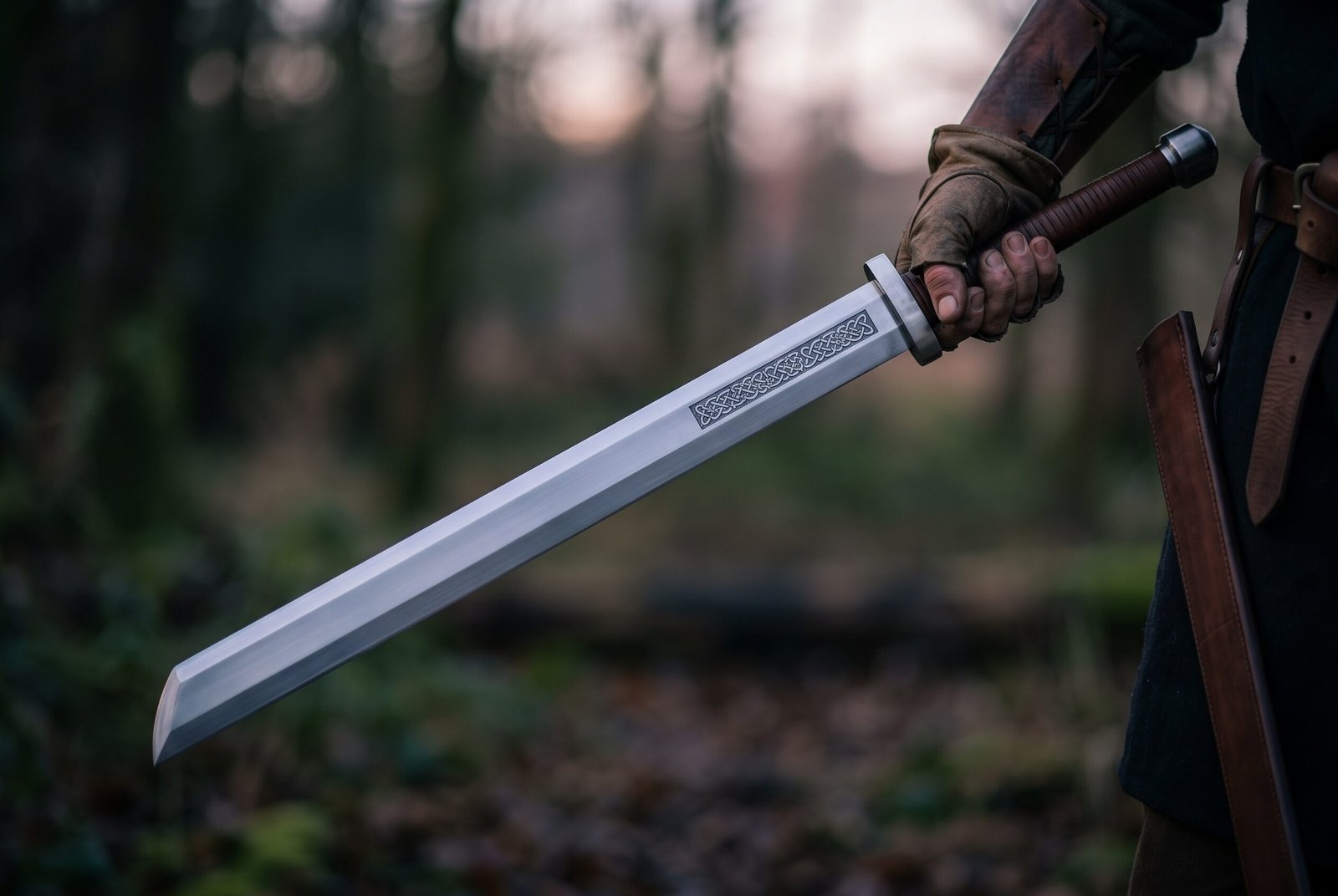
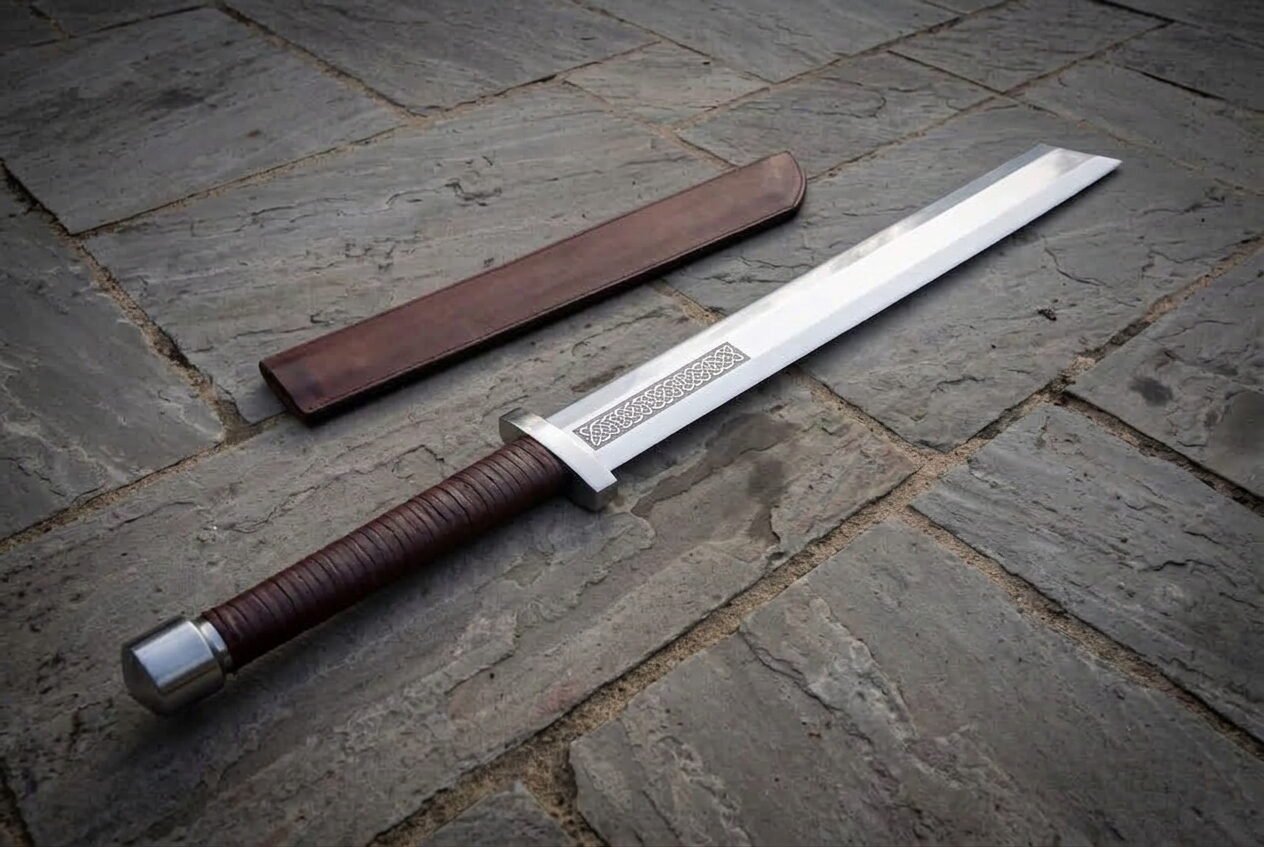
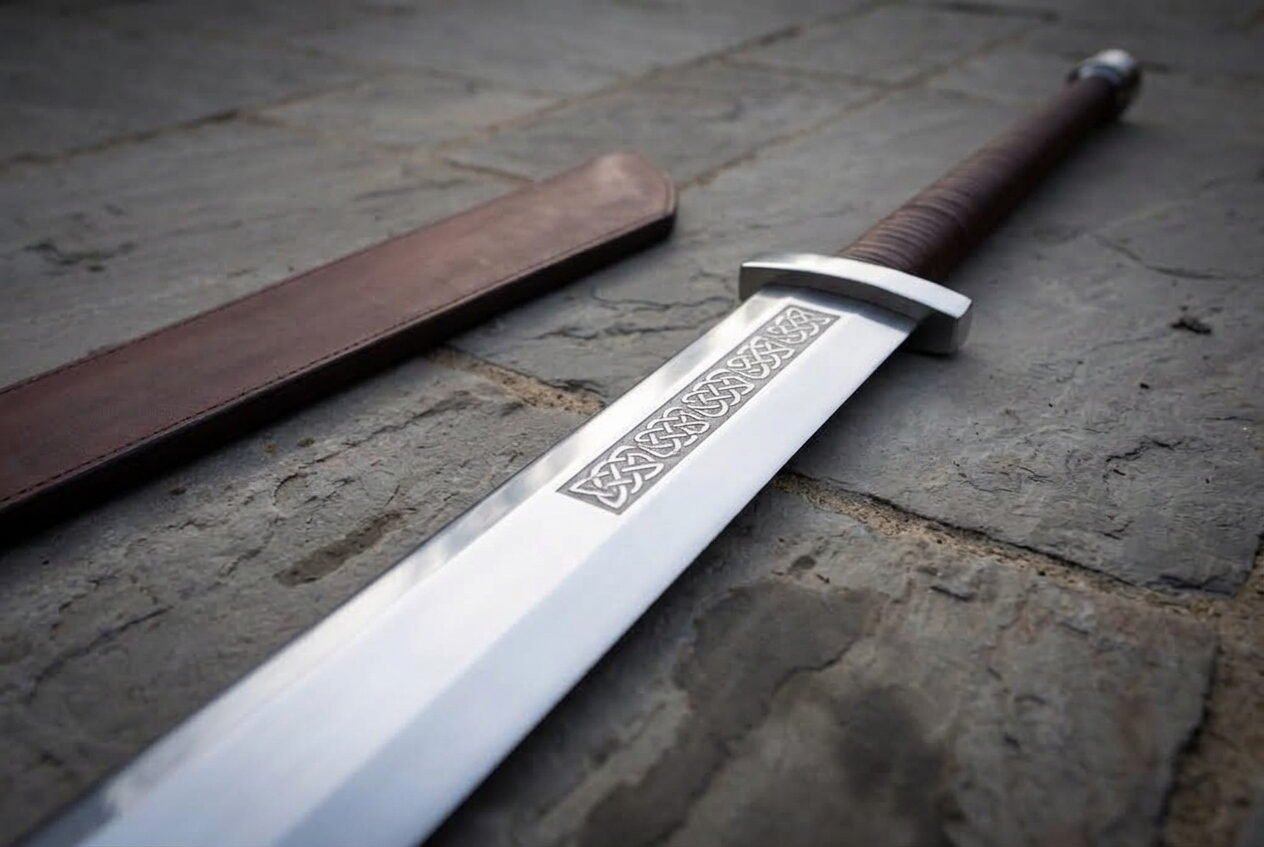
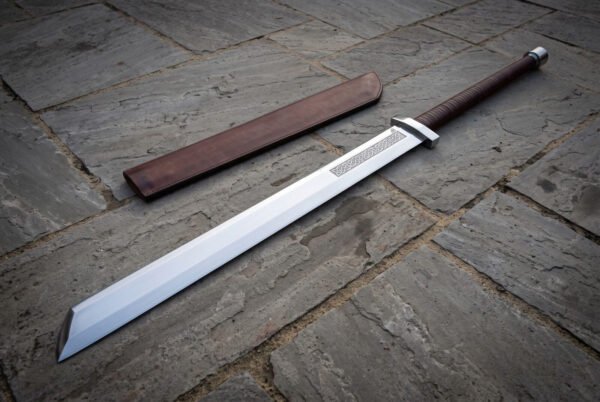
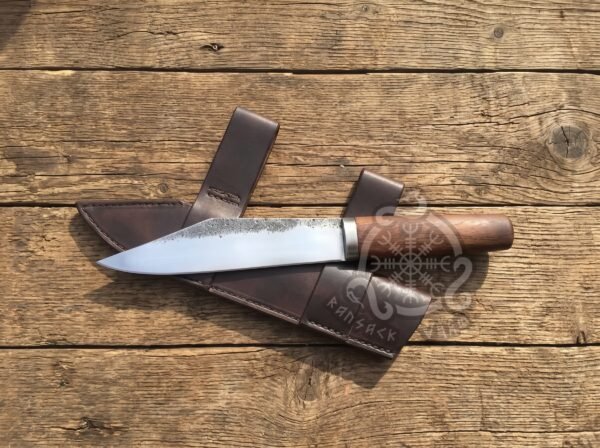
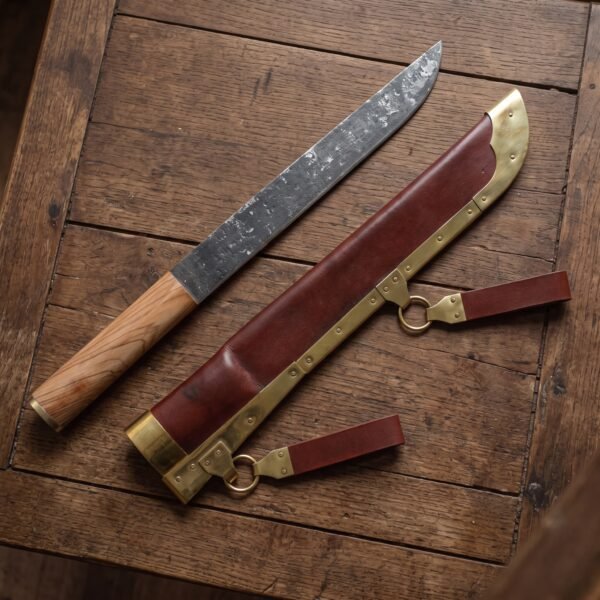
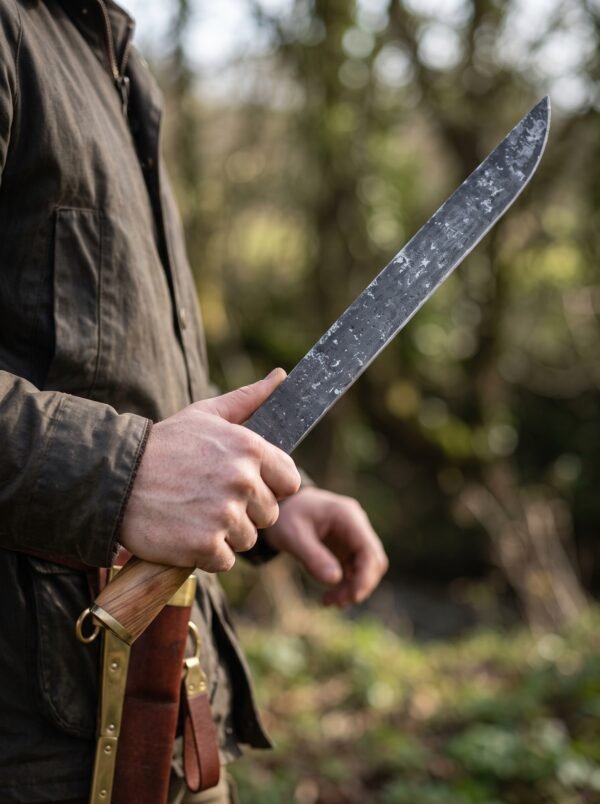
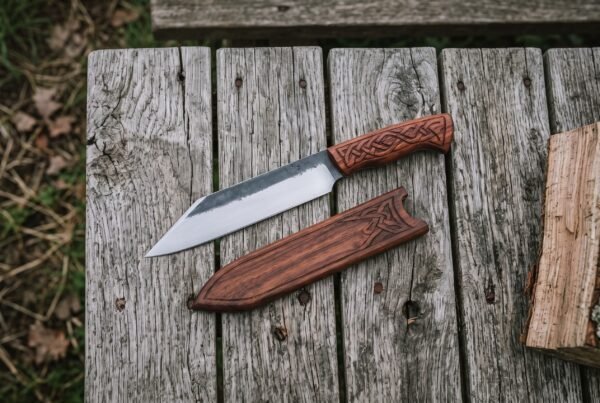
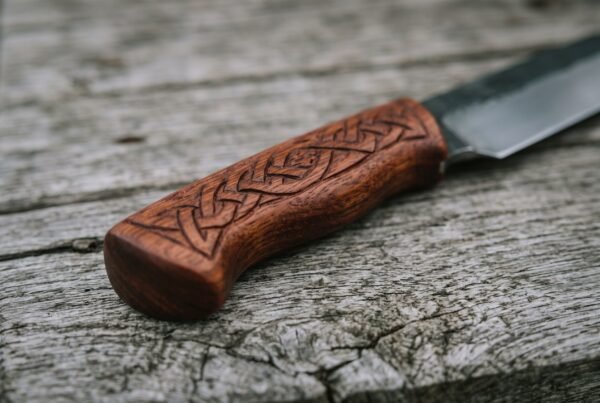
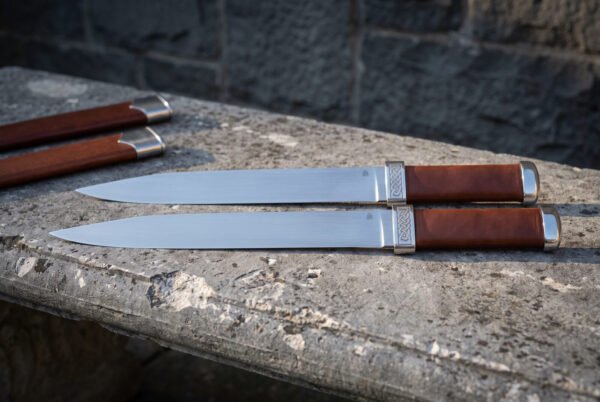
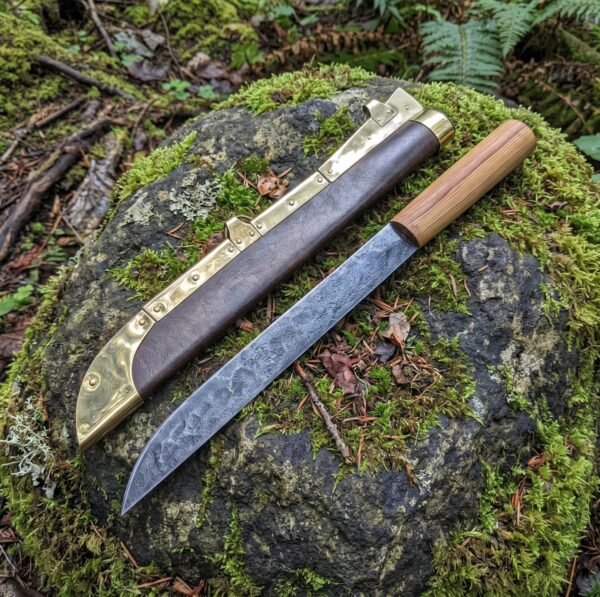
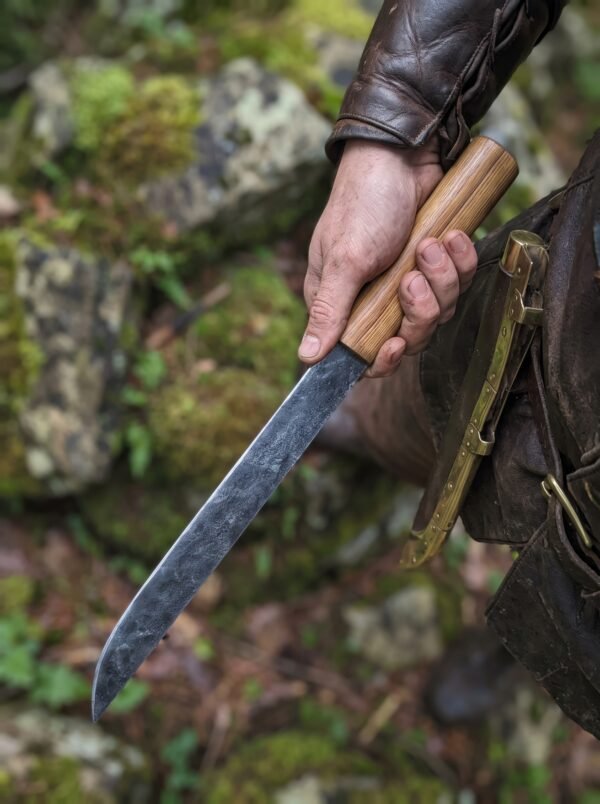
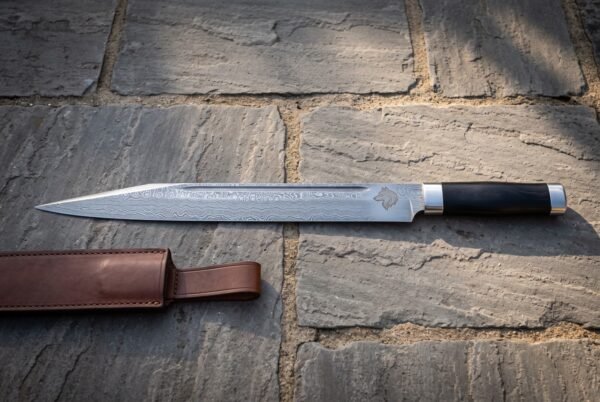
The Broadsax is a langseax, the long form of the Norse and Anglo Saxon single edged fighting knife. The blade is broad and heavy at the spine, running straight for most of its length before the back drops at a sharp angle to meet the edge at the point. That angled break is what gives the type its name. The grip is leather wrapped over a full tang with a steel pommel cap, there is a short guard at the shoulders, and a band of interlace is etched into the blade beside it. A brown leather scabbard comes with it.
The most famous seax in the world is the Seax of Beagnoth, pulled out of the Thames near Battersea in 1857 and now in the British Museum. It matters for two reasons. It carries the only complete Anglo Saxon futhorc ever found on a single object, all twenty eight runes laid out in order along the blade, and beside them the words Beagnoth in runes, which is almost certainly the owner or the maker naming himself. A working knife was worth putting a name on. Every one of these is ground, heat treated and fitted by hand in the Czech Republic, and each ships with the fitted leather scabbard shown and our lifetime warranty against defects in forging, grind, heat treat and fittings.
The seax was the knife a Norseman actually carried, and the seax buying guide covers the types and what to look for. Interlace of this kind was the standard decorative language of the period, and the symbols guide covers the patterns that keep coming back. The bearded axes are the usual companion piece if you are building a Norse kit.
Specifications
| Material | 1095 high carbon steel, hardened to 54 to 58 HRC |
|---|
| Overall length | About 28 inches |
|---|
| Blade length | About 22 inches |
|---|
| Blade type | Single edged broken back seax, long flat bevel, heavy flat spine and an angled break at the point |
|---|
| Handle | Dark brown leather wrapped over a full tang, about 6 inches of grip |
|---|
| Guard | Short squared steel guard at the shoulders |
|---|
| Pommel | Steel pommel cap |
|---|
| Etching | Rectangular interlace panel on the blade beside the guard |
|---|
| Finish | Satin polished blade |
|---|
| Scabbard | Brown leather, wet moulded and fitted to the blade |
|---|
| SKU | RK-1958 |
|---|
Why the back is broken
The angled spine is not a stylistic flourish. Look at what it does to the mass. A straight backed knife with a gentle curve to the point has its steel spread evenly along the blade. Break the spine down at an angle and you take a wedge of steel out of the last third, which pulls weight backward and puts the widest part of the blade in the middle where the cut lands. The result is a long blade that does not feel long, and a point that arrives on the centre line of the blade rather than up at the spine, so a thrust drives straight rather than skidding.
It also leaves a very thick spine along the working length. On these blades the back is left almost as thick as the original bar, which is why a seax can be used with a hand pressed flat on the spine for controlled work without cutting the hand. Anglo Saxon seaxes were carried horizontally in front of the body, edge upward, because the wearer used them for everything from eating to fighting and wanted the handle where a hand naturally fell.
Broken back seaxes belong to the later end of the story, roughly the ninth and tenth centuries in England, and the langseax at the size of this one sits at the boundary where a knife stops being a tool and starts being a fighting blade. On a crowded deck or in a shield line it did what a sword could not, which was work in a space no wider than a man.
Steel and leather
The blade is 1095 high carbon steel taken to 54 to 58 HRC. A single edged blade with a thick spine and a narrow bevel is one of the most forgiving shapes there is, because all the flex happens along a section with plenty of steel behind it. That is why seax geometry stayed in use for so many centuries with nothing but bloomery iron and steel to work with.
The grip is leather wrapped over a full tang. Full tang means the steel runs the whole way through the handle rather than stopping as a thin rod, so the load in a heavy cut goes into the tang and not into a glue joint. Leather over a tang gives you a grip that warms in the hand, does not slip when it is wet the way a polished wood or horn handle can, and can be rewrapped in ten years if it wears. The scabbard is vegetable tanned hide, wet moulded around the blade so it holds the seax by friction on the shoulders rather than by a strap.
Engraving, runes and your own design
Use the rune converter on this page to turn a name, a date or a short phrase into Elder Futhark and we will cut it into the steel, the leather or the wood. If you would rather have a Viking pattern than a rune line, choose your own design in the engraving option above the add to cart button and tell us where it goes. Where a piece already carries an engraved design, your chosen engraving replaces it rather than sitting alongside it. On a seax there is a very good historical case for runes, since the Beagnoth blade did exactly that, and the long clean flat above the edge is the natural place for a name. Ask and we will put it there in place of the interlace band, or stamp it into the scabbard instead. See the engraving page.
Handling and balance
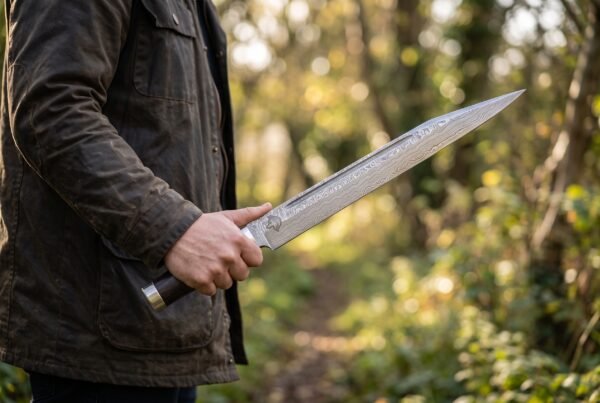
A langseax feels quite unlike a sword. The mass sits low and forward of your hand but close in, so it chops with real authority while still turning quickly. The balance point falls somewhere around three inches ahead of the guard. There is no crossguard to speak of, so this is a blade that rewards keeping your hand where it belongs rather than one that protects you if you do not.
The heavy spine lets you put a thumb or the heel of the off hand on the back of the blade for close controlled cuts, which is a genuinely useful thing on a blade this size. It is a sharp forged blade and it is not for sparring or reenactment, so it must not be used in contact work against a person or another blade.
Care
1095 rusts if you neglect it. Wipe the blade after every handling and keep a light film of mineral or camellia oil across it, paying attention to the flat above the edge where fingers naturally land. Refresh the oil every few weeks and more often in a humid room. Our detailed guidance is in the steel care notes.
Do not store the seax in the scabbard for long periods. A wet moulded scabbard holds the blade tightly, which is exactly what you want for carrying and exactly what you do not want for a blade left sitting for a year. Feed the leather once or twice a year and never dry it by a radiator or a fire, since heat will shrink and crack vegetable tanned hide permanently. Sharpen on a stone, following the existing bevel angle.
When the edge goes dull, sharpening on a whetstone covers the angle and the pressure.
Made in the Czech Republic
This piece is made by hand in the Czech Republic, in a workshop that still works the old way. The steel is forged, ground, heat treated and finished by smiths who learned the trade from the people before them, and the wood, horn and leather are cut and fitted by hand rather than pressed out on a line. That is also why no two pieces come out exactly the same.
Ransack Viking is a United States company. We import these pieces ourselves, check every one when it lands and ship from our warehouse in Chicago, Illinois. Engraving is done here in the United States after the piece arrives, so your runes or your own design go on before it leaves for you.
A note on handmade variation
Every one of these is made by hand and not machine made or bulk produced, so what arrives will not be a pixel for pixel copy of the photograph. The exact angle where the spine breaks is set by eye at the forge and shifts a degree or two from blade to blade. The leather wrap tension, the tone of the hide, the depth of the interlace etch and the satin finish all vary. The length, the steel, the heat treat and the full tang build stay the same. The character does not, and on a seax that has always been the point.
Frequently asked questions
Is a langseax a knife or a sword
Historically it sits between the two and that is exactly why it existed. It is a single edged knife by construction and a sword by size. Most museums file blades at this length as seaxes rather than swords.
Is it sharp on arrival
Yes, with a working edge on the single cutting side. The spine is left blunt and thick on purpose so you can press a hand on it.
How does the scabbard hold it
By friction. The hide is wet moulded around the blade so it grips the shoulders. There is no strap or snap, which is how period scabbards worked.
Can I have runes cut into it like the Beagnoth seax
Yes, and it is the most fitting piece in our range for it. Use the engraving option and tell us the name or phrase. Your line replaces the interlace band unless you ask for the scabbard instead.
Is this legal to own
Fixed blade knife and sword law varies by state and by city in the United States. We ship within the US, and it is on the buyer to know what applies where they live and how it may be carried or transported.
What is the lead time
One to two weeks of processing, then transit. Free shipping inside the United States. Engraved orders add a few days.
What is in the box
- Broadsax Viking langseax in 1095 high carbon steel
- Wet moulded brown leather scabbard fitted to the blade
- Protective oil film on the blade for transit
- Care card and lifetime warranty against defects in forging, grind, heat treat and fittings
- Forged and finished in the Czech Republic
Explore the range
More in Viking seaxes, Viking knives and scabbards and sheaths, or read the guides on seax history and blade care.
Close to this one
Also in this group is the Beltsax Viking seax, high carbon steel. Sitting beside it in the catalogue is the Mosaicsax Viking seax, pattern welded Damascus. Another in the same line is the Wolfnotch Viking seax, pattern welded Damascus.
For a different piece from the same family, look at the Bonewhorl dagger knife. Nothing here exactly right, build one to your own spec on the custom seax page.


Bought this on a whim and it turned out to be one of my favorite purchases this year. Fit and finish is museum quality. You can tell real craftsmen made this by hand. Shipping was fast and everything arrived well packaged.